
Something a bit different from raptor persecution today, Chris Packham and Megan McCubbin are out with the Northants Hunt Sabs this morning, following the Cottesmore Hunt, LIVE on YouTube now:
Category: News
Stobo Hope – did GWCT ‘advice’ help avoid an Environmental Impact Assessment on the destruction of black grouse habitat? (Guest Blog)
The following is a guest blog by someone who wishes to remain anonymous, although I know their identity.
STOBO HOPE – DID GWCT ‘ADVICE’ HELP AVOID AN ENVIRONMENTAL IMPACT ASSESSMENT ON THE DESTRUCTION OF BLACK GROUSE HABITAT?

Regular readers may be familiar with Stobo Hope, a large area of heather moorland with wildlife including golden eagles and the second largest black grouse lek in the Scottish Borders. Wild Justice helped fund a successful judicial review by the Stobo Residents Action Group (see here) to try and save this habitat from a giant Sitka spruce plantation. The Scottish Government conceded the petition for judicial review in September 2024 before going to court, cancelling the taxpayer funded £2 million contract after realising that vast areas (potentially up to 400 hectares) had been blanket sprayed with herbicide (see here), in August 2023.
It strongly seems to me that government body Scottish Forestry, True North Real Asset Partners (managing the Stobo scheme and the Forestry Carbon Sequestration Fund in Guernsey) and forestry agents Pryor and Rickett Silviculture were all desperate to avoid an Environmental Impact Assessment (EIA), which was successfully ‘screened out’ in January 2024 before the contract was awarded in February 2024.
Scottish Forestry will apparently determine again if an EIA is required, claiming they will take into account ‘all other new relevant information’ (see here). At the moment all work at Stobo has been stopped by court order so any work is unlawful. The Forestry Carbon Sequestration Fund (based in a tax haven) has now lodged a petition for judicial review with the Court of Session in Edinburgh (December 2024) to try and cancel the enforcement notice by Scottish Forestry (see here).
It turns out that the Game and Wildlife Conservation Trust (GWCT) were ‘advising’ Pryor and Rickett Silviculture (see here) and True North Real Asset Partners (see here), on how to ‘improve the suitability of the proposed planting area for black grouse’, despite the RSPB, reputable ecologists and NatureScot explaining that black grouse would leave due to the forestry scheme.
Scottish Forestry appear to have relied on recommendations (that were subsequently partially implemented) by the GWCT to help conclude that black grouse would not be significantly affected by the scheme so an EIA could be avoided. If an EIA was required, it would require a much more rigorous assessment of the ecological impacts of the proposal and require further public consultation which probably would have resulted in the scheme being no longer viable for the Forestry Carbon Sequestration Fund.

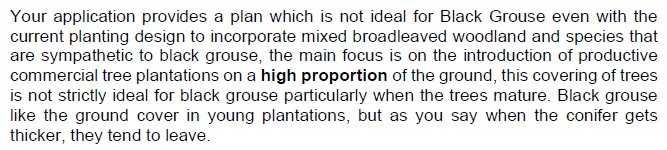
Pryor and Rickett Silviculture were seemingly keen to follow up the GWCT’s advice on predator control, so applied to NatureScot for a fox hunting licence with nineteen dogs, but this was refused. The intended fox hunting was supposedly to reduce black grouse predation (see here), but seemed to be more for sporting than conservation purposes. NatureScot explained that there was no evidence of long-term benefit from the proposed fox hunting. As with the RSPB’s prediction of lek extinction at Stobo, NatureScot stated black grouse ‘tend to leave’ plantations of the kind proposed at Stobo:
How Scottish Forestry makes questionable claims to avoid EIAs
Virtually all woodland creation schemes in Scotland avoid an EIA, with just 4 EIAs for 729 ‘conifer option’ screening applications since 2015, according to a FoI response in March 2023 (see here). This appears to be due to forestry managers implausibly claiming that no significant negative environmental impacts will result from an environmentally destructive forestry scheme.
If a significant impact is said to result for woodland creation proposals above a certain size, an EIA is typically needed. Scottish Forestry simply repeats its contracted ecologist’s claims in its ‘screening opinion’ to determine no EIA is required prior to awarding a forestry contract. As a result, tens of thousands of hectares of priority wildlife habitats outside protected sites across Scotland are being damaged or destroyed by commercial forestry. These priority habitats and species are those that Scottish Ministers consider to be of principal importance for biodiversity conservation in Scotland. Under the Nature Conservation (Scotland) Act 2004 (see here), all public bodies in Scotland have a duty to further the conservation of biodiversity when carrying out their responsibilities. Scottish Forestry appear to be either unaware or negligent in its failure to deliver this duty.
At Stobo, ecologists Mabbett and Associates, now called Arthian Ltd (see here) in its ‘EIA update letter’ (January 2024) claimed the scheme ‘will not have a significant impact’:

Scottish Forestry used this statement to justify their decision to approve the scheme without an EIA and award a £2 million grant for a giant, mostly Sitka spruce plantation of nearly seven square kilometres at Stobo, claiming this scheme was ‘not likely to cause a significant negative environmental effect to black grouse’:

Scottish Forestry repeated this claim for golden eagles (Stobo is a significant area for this species) and for priority habitats such as upland heathland, purple moor grass and rush pasture and numerous other features of nature conservation value in its EIA ‘screening opinion’. These habitats host priority species such as the small pearl-bordered fritillary butterfly, hen harrier, cuckoo, reed bunting and red grouse. Scottish Forestry also claimed that it was unlikely there would be significant negative environmental impacts from the cumulative effects of neighbouring proposed or completed woodland creation schemes, resulting in fourteen square kilometres of contiguous moorland being fragmented by nearly ten square kilometres of predominantly commercial coniferous forestry.
Map of the proposed woodland
For the Stobo plantation, of the planted area, 72% is Sitka spruce, with a further 10% of commercial Scots pine and Douglas fir, so commercial coniferous forestry amounts to 82% of the planted area. The map below does not show three new plantations to the north, west, south or a proposed plantation to the east, creating a giant spruce plantation across what was previously contiguous moorland.

Scottish Forestry claimed there would be 246.4 hectares of open ground within 1.5 km of the lek, but omitted to mention that this remaining open ground would be heavily fragmented by 463.6 hectares of trees. Furthermore, much of this open area within 1.5km is sub-optimal habitat on exposed hilltops and ridges far from the lek and mostly unplantable anyway.

Black grouse need large areas of contiguous moorland – typically bog, dry dwarf shrub heath, marshy and acid grasslands. A 2014 report (No. 741) commissioned by Scottish Natural Heritage (see here) – now NatureScot – found that in the Southern Uplands only 5% of moorland patches less than ten square kilometres (1,000 hectares) were occupied by black grouse:

The approximate location of the Stobo estate is circled red below, showing its relative isolation to other leks, several of which have since become extinct in the last ten years:

The ‘Black Grouse Habitat Management Area’ for Stobo
The forestry scheme applicants proposed a ‘Black Grouse Habitat Management Area’ within 1.5km of the lek to supposedly ‘mitigate’ the effect of planting nearly seven square kilometres of moorland. The stated open area within this habitat management area is only 84 hectares.
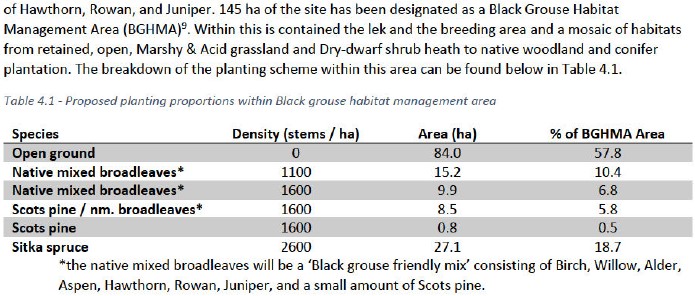
The GWCT stated in its January 2022 report for the forestry applicants that ‘the planting will likely have a significant impact on the visual landscape, land use and ground nesting birds’ and the planning process would ‘recommend measures to mitigate against any impacts of significance’:

The GWCT then stated later in the report that ‘the inclusion of low-density mixed broadleaves and areas of open ground within the site are unlikely to sufficiently limit the impacts of the planting plan on wading birds or black grouse’, then suggesting a ‘comprehensive predator control programme as part of any mitigation measures’:


A later report by the GWCT (March 2023) suggests that efforts had been made to increase the open area within 1.5km of the lek, recommending that 40% open ground should be retained ‘within the vicinity of a lek site’:

The final open area within 1.5 km of the lek could be around 35%, based on the 246.4 hectares in Scottish Forestry’s screening opinion, but much of this area is relatively unsuitable due to fragmentation and being on exposed ridges. The RSPB explains to the forestry agents (red text below) that the GWCT’s recommendation of 40% open ground applies to whole plantations, not just the ‘habitat management area’:


Another report (No. 545) commissioned by Scottish Natural Heritage and published in 2013 (see here), investigating habitat use by black grouse in Scotland, states:

The findings in this report (and other papers) suggest that schemes such as at Stobo will be unviable for black grouse. Areas around leks were on average, two-thirds moorland and the report suggests ‘a lekking group will likely require a continuous moorland area adjacent to forest habitats, that is at least five square kilometres’ (i.e. at least 500 hectares). At Stobo, Scottish Forestry has ignored both the large area of moorland required for an individual lekking group and the cumulative impacts of multiple woodland creation schemes. The 2014 Scottish Natural Heritage Commissioned Report No. 741 refers to ‘little consideration for landscape-scale conservation’:

The same report provides recommendations for conservation measures in Southern Scotland, suggesting that heather moorlands with leks should be ‘adequately protected from any future significant change in land use’:

This report also points out that ‘predator management in isolation may not prevent further declines without the provision and maintenance of suitable habitats’:

Did the GWCT advice influence Scottish Forestry into avoiding an EIA?
It appears that Scottish Forestry relied on specious mitigation measures such as a negligible reduction in planted area, predator control and a ‘Black Grouse Habitat Management Area’, to claim that the Stobo scheme was ‘not likely to cause a significant negative effect to black grouse’, thus avoiding an Environmental Impact Assessment (EIA). The decision by Scottish Forestry to not have an EIA would of course, seem to have huge financial benefits for the Forestry Carbon Sequestration Fund, as the hundreds of hectares of moorland that the Stobo lek needed could now instead be planted with Sitka spruce. Furthermore, Scottish Forestry incorrectly claimed the cumulative impacts of several forestry schemes were taken into account, despite research suggesting habitat connectivity with other large moorland areas was required for long-term viability of black grouse metapopulations.

Did GWCT staff ignore its own research to help forestry managers and Scottish Foresty avoid an EIA?
The two Scottish Natural Heritage Reports (Nos 545 and 741) referenced in this blog showing woodland schemes like that at Stobo would be unviable for black grouse, were both authored by the GWCT. Two of the authors of these reports, Dave Baines and Phil Warren, are widely acknowledged as leading experts on black grouse with over 60 years of combined experience, but it is unclear if they were invited to advise on the Stobo proposals which were authored by the GWCT Advisor, Scotland. After several email exchanges between the GWCT and Pryor and Rickett Silviculture, the GWCT Advisor, Scotland eventually concluded in May 2023 that ‘I believe you now have a considered design that goes as far as practical in terms of accommodating for black grouse’.

This is far from a glowing endorsement of the proposals or indeed any kind of acknowledgement that there would be no significant impacts on black grouse.
Although some of the SNH reports’ content may be biased in favour of shooting interests, they do appear to demonstrate general habitat needs and the extent of these habitats required for black grouse.
Why did Scottish Forestry choose to ignore the RSPB’s prediction that lek extinction would result from the scheme?

The RSPB also stated there was a failure to assess the impact of the loss of habitat and nesting sites through afforestation, explaining that the forestry agents in their ‘woodland operational plan’ incorrectly asserted that the RSPB’s issues with the scheme had been resolved.

Picture courtesy of Ted Leeming photography (Copyright protected)
Harry Humble, CEO of True North Real Asset Partners, was probably very pleased with the GWCT’s advice, claiming in the Scotsman (see here) that ‘more than 140ha of the scheme has been designed specifically to favour black grouse, with an enhanced mix of species and open space provision in line with best practice derived from decades of research’.
Why did the GWCT appear not to tell Pryor and Rickett Silviculture and True North Real Asset Partners that its own research over many years showed the proposed Stobo scheme would likely cause black grouse lek extinction, instead of saying: ‘I believe you now have a considered design that goes as far as practical in terms of accommodating for black grouse’?
Another exercise in ‘Greenwashing’ by Scottish Forestry?
Whoever invested in the Forestry Carbon Sequestration Fund must have been very pleased that Scottish Forestry decided to ignore the RSPB and seemingly disregard readily available, published black grouse research, such as that by the GWCT, commissioned by what is now NatureScot, demonstrating black grouse disappear from areas planted for commercial coniferous forestry. Hundreds of hectares of spruce at Stobo and on neighbouring land was in part permitted by Scottish Forestry under the false premise that the Stobo woodland creation scheme was ‘not likely to cause a significant negative environmental effect to black grouse’. This incorrect claim by Scottish Forestry and similarly incorrect claims relating to impacts on other wildlife and important habitats for many other woodland creation sites must certainly have helped financial gains through land values, carbon credits and funds in offshore tax havens, but sets a terrible precedent for our disappearing moorland landscapes.
Bah Humbug from the hypocritical Scottish Gamekeepers Association
Last Friday I was contacted by a journalist from the Scottish Daily Mail who asked me this:
“I wondered if it would be possible to get a comment from Raptor Persecution UK about the Scottish Gamekeepers Association claiming that ‘insults’ made about them and the work they do on Raptor Persecution UK’s blog is taking its toll on members. In the recent chairman’s column, he claims ‘skilled predator management is now dressed up by campaigners as ‘casual killing’. What is Raptor Persecution UK’s response to this.
It’s for tomorrow’s paper, so a response today would be much appreciated“.
The thing was, I hadn’t read the ‘Chairman’s column’ she referred to. I guessed she was referring to the SGA’s latest quarterly rag for members, ‘Scottish Gamekeeper‘, which hadn’t yet been published (it’s due out this weekend).
It seemed pretty obvious to me then, that someone from the SGA was attempting to plant yet another story in the press, portraying themselves as ‘victims’, presumably in a pathetic attempt to elicit public support and sympathy for their wildlife-killing ways. We’ve been here before (e.g. here in 2021), although to do it at Christmas-time seemed more than a little cynical.

Normally I wouldn’t give the time of day to a journalist from the Mail but as she’d asked so nicely I thought it would be rude not to respond.
I told the journalist that given the SGA’s members’ long-running and well-documented campaign of vitriol and hatred against those of us who campaign against the illegal killing of birds of prey by gamekeepers on shooting estates (e.g. see here and here), this latest attempt to present themselves as victims of ‘insults’ was risible.
Are these the same gamekeepers who, for the duration of this last month, have been sharing an ‘advent calendar of abuse’ on social media, this time targeting named staff members of the RSPB?
This ‘advent calendar of abuse’ is written and published by the grouse shooting industry’s very own hateful astroturfers, C4PMC (see here for an insight in to who they really are), and C4PMC has form for it.
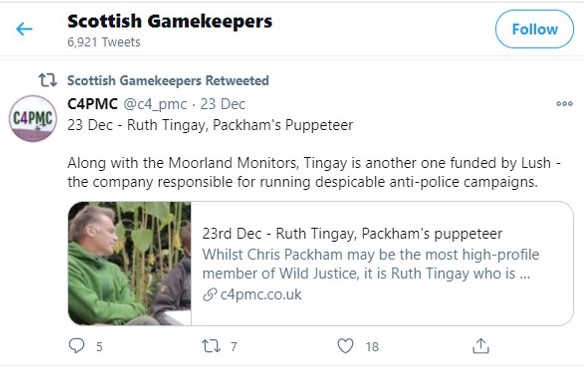
They first started publishing these vindictive narratives in December 2020 (during a Coronavirus lockdown, no less) where each day they targeted a named individual known to campaign against driven grouse shooting. Those targeted included all the usual suspects (me, Chris Packham, various RSPB staff members, raptor fieldworkers, conservationists, even politicians), and guess who was involved in spreading that malicious abuse via their own social media accounts?
Yep, the SGA and friends, including former SGA Director and regular SGA columnist Bert Burnett, and several members of the Scottish Regional Moorlands Group, including the Angus Glens Moorland Group, Speyside Moorland Group, Southern Uplands Moorland Group, Tayside Moorland Group and the Grampian Moorland Group. Here are some examples:
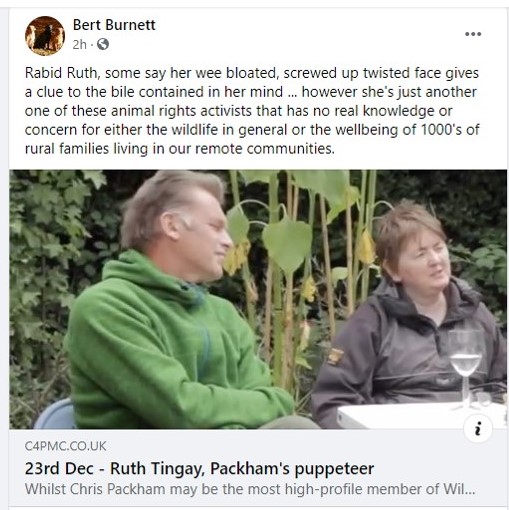
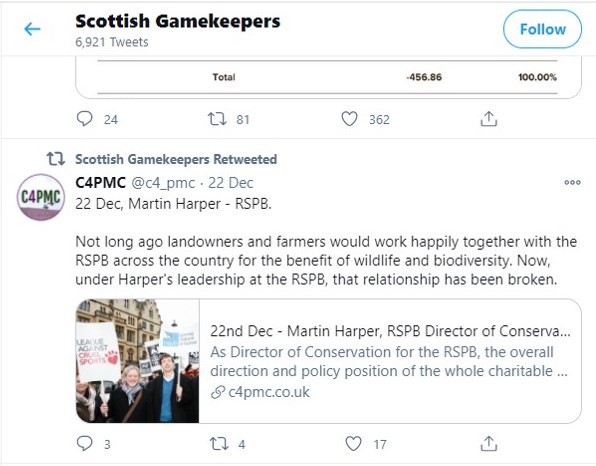

And now they’re actually claiming that ‘insults’ are ‘taking their toll’ on SGA members?!
I also told the journalist, on the issue of ‘casual killing’, recent research has demonstrated that up to a quarter of a million animals are killed on Scotland’s grouse moors each year (in addition to all the gamebirds that are killed), and nearly half of those animals are non-target species (e.g. Hedgehogs, Dippers, Mistle Thrushes). I’d argue that referring to this as ‘casual killing’ is not an ‘insult’, it’s justified criticism.
I also told the journalist that whilst I thought that limited and targeted predator control, in some circumstances, for the conservation of threatened species, is justifiable, the wholesale slaughter of wildlife, just to protect gamebirds that are later shot and killed for so-called ‘sport’, is, in my opinion, inexcusable.
If you’re killing wildlife for a living, in order for others to pay some money to kill even more wildlife just for fun, don’t be surprised when others have legitimate concerns about it.
Funnily enough, the article in the Scottish Daily Mail never materialised. When I asked the journalist what had happened to it, she said the editor had pulled it.
Perhaps there was a realisation that the world according to the SGA was just too embarrassing, even for the Mail!
‘Why are birds of prey still being killed in Scotland despite new legislation?’ – special report in The National
The National newspaper published a special report on Monday 16 December 2024 entitled, ‘Why are birds of prey still being killed in Scotland despite new legislation?’, with a particular focus on the Cairngorms National Park.
It’s reproduced below.

SCOTLAND passed the Wildlife Management and Muirburn (Scotland) Bill earlier this year, introducing a licensing scheme for the grouse shooting industry in a bid to end the illegal killing of birds of prey.
The first licenses were issued this past summer, and while considered a blueprint for tougher legislation across the UK – people are still killing birds of prey on grouse moors, which is not an easy thing to do.
Guilty parties must have access to a vehicle, equipment such as a firearm, opportunity and motive.
“This isn’t people traveling from towns and cities going up onto our hills and randomly killing birds of prey. These are targeted offences,” Ian Thomson, investigations manager for the RSPB, told The National.
But why? And who would do this?
Why are grouse moor shootings still taking place?
A Hen Harrier disappeared in February. A buzzard was shot in Perthshire in mid-May. An osprey was shot in the Glen Doll area in August. A dead golden eagle was found in a plastic bag near Loch Rusky in November.
In the last 15 years, more than 1500 birds of prey have been killed, with 57 convictions. However, the majority of these sentences are suspended, and only one person has been jailed.
Most of the evidence gathered by investigators is from satellite tags, fitted to allow conservationists to monitor the movements around the country.
The technology is estimated to be about 97% reliable, and “very rarely suffers some sort of technical function”, according to Thomson.
“Often we believe that there is strong evidence that supports the fact that these birds are being shot often at night, the tags destroyed, and the carcass is disposed of,” Thomson said.
The RSPB investigations team assists Police Scotland by speaking to local land managers and liaising with the community if a tag stops working. When asked why anyone would target the birds, even with the new legislation in place, Thomson said: “The killings are being undertaken by people who are working on the land.
“That’s the reality, and the vast majority of raptor persecution offenses occurring in Scotland are linked to management for kind of game bird shooting and particularly grouse shooting.
“There are many layers of evidence that support that.
“First of all, the location of the incidents that are found. Whether its birds shot, birds poisoned, or nests destroyed, these are all subject to police investigations.
“A significant proportion of people convicted for raptor persecution offenses have been gamekeepers,” Thomson shared.
RSPB data shows that at least 54% of all confirmed incidents in the last 10 years (2014-2023) have been linked to land managed for pheasant, partridge and grouse shooting.
The association of these crimes with the gamebird industry is also evidenced by criminal court records. Of all individuals convicted of bird of prey persecution related offences from 2009 to 2023, 75% were connected to the gamebird shooting industry and 68% were gamekeepers.
The Angus Glens crime hotspot
Angus Glens in the Cairngorms is a hotspot for the number of raptor persecution in Scotland, with the Highlands having 69 since 2009.
There have been multiple confirmed incidents occurring on several estates in the area. This includes many poisoning incidents using chemicals whose possession was long banned, repeated illegal misusing abuse of crow traps and pole traps, shootings and destruction of nests.
Earlier this year, NatureScot placed restrictions on an estate on the edge of the Cairngorms National Park for three years following evidence of bird poisoning on the property.
Thomson said there had been 10 suspicious disappearances of satellite tags on birds of prey in the Angus Glen in the last 15 years.
There has been a peregrine, and an osprey shot since the start of the shooting season in Angus Glens this year, which Thomson described as “worrying”.
The law as it has stood since 2012 has been serious liability, which means landowners are responsible for the actions of their employees and the land.
So are landowners aware of the circumstances surrounding raptor persecutions on their land?
A wall of silence
The first licenses under the new bill were approved this past July, but Thomson noted there would have been no need for it had the industry “taken possession of this problem decades ago”.
He added: “I think had the industry rooted out criminals, then we wouldn’t have needed this sort of legislation moved on.
“We are in a situation where some Victorian management practices towards birds of prey persist. It really is time that the shooting industry got into the 21st century.”
Thomson said it was rare for estates to report raptor persecutions.
When asked whether estates may be protecting or turning a blind eye to those who target birds of prey, Thomson said he could not confirm but he and his team frequently hear of peer pressure within estates to keep reporting low, adding that crimes are rarely reported by the industry.
“The problem is the game keeping industry is used to operating a bit like a closed shop,” Thomson said.
“It’s very difficult. There is no whistleblowing culture, and it would be fantastic if organizations representing gamekeepers set up a scheme where people could report incidents taking place and those are passed on to the police.
“But that just never seems to happen. Exceedingly rare truths are told.”
Thomson revealed that gamekeepers come to the team sharing their worries and are “terrified” to come forward.
“They say to us this information can’t come from me because I may lose my job and I may lose my friends and I may lose my hobby. People are under considerable pressure to keep their mouths shut,” he said.
“Either people won’t see anything or there is just a culture of denial.”
Thomson described “efforts to deny or downplay” incidents, and said that when satellite tags start to disappear, people blame “imaginary wind farms” or factors, dismissing science and evidence of crimes.
“It’s a mix of cultural misinformation, a wall of silence and complete denial”, Thomson added.
ENDS
For those who are sick to the back teeth of birds of prey being illegally killed on grouse moors, you might want to sign this new petition from Wild Justice calling for a ban on driven grouse shooting – HERE.
Two satellite-tagged hen harriers that disappeared from a winter roost both found dead with shotgun pellets lodged in their bodies
Natural England has today posted a blog updating the status of three brood meddled satellite-tagged hen harriers, which had previously been reported as ‘dead, awaiting post mortem’ (x 1) and ‘Missing, Fate Unknown’ (x 2).
A post mortem on the dead hen harrier has concluded it died from natural causes. The two ‘missing’ hen harriers have been found dead, and both corpses contained shotgun pellets.
I’ll reproduce Natural England’s blog, below, then I’ll comment on the content of Natural England’s blog, then on the extraordinary (or not) response from the Moorland Association.

UPDATE ON THE DEATHS OF THREE TAGGED HEN HARRIERS
Natural England blog, 18 December 2024.
Hen harriers remain rare in England, with a welcome increase in their population over the last few years stalling in 2024. Poor weather and food availability may cause their numbers to fluctuate, but ongoing illegal killing remains a serious threat to the species’ survival in England.
Natural England (NE) has recently received confirmation that police investigations into the deaths of two tagged hen harriers have concluded, and we can now be confident that releasing information relating to these cases will not jeopardise the course of justice. We have also recently received final post-mortem information for a third tagged bird. This blog serves to document their fate.
R2-M1-23, #213927
Juvenile male harrier R2-M1-23 was tagged in July 2023, at a release site in Cumbria as part of the Brood Management Trial, before heading to spend the winter in North Devon (a link to our monitoring spreadsheet for all NE tagged hen harriers can be found here). On 29 February 2024, R2-M1-23’s tag recorded a very low body temperature, indicating death. As is standard procedure, NE’s Enforcement and Appeals Team (NE E&A) informed the police of the discrepancies in the tracking data. On 5 March under direction from police, specialist NE E&A staff were deployed to search for the missing hen harrier. R2-M1-23 was found in a small clearing between agricultural fields, his tag clearly visible, and his body showing some signs of predation.
The carcass of R2-M1-23 was photographed and collected, then sent to the Institute of Zoology at Zoological Society of London (ZSL) for a post-mortem examination. Poor body condition, masses growing in the crop, and other internal signs, indicate that he carried a number of common diseases. The role of these in his death cannot be fully quantified, but R2-M1-23 is considered to have died of natural causes.
R2-F2-20 #55144 + R3-F1-22 #213921a
Two female hen harriers R2-F2-20 and R3-F1-22 were tagged in 2020 and 2022 at release sites in northern England as part of the Brood Management Trial. During the winter of 2022 both settled into the same roost site in the North Pennines, monitored by NE Hen Harrier Team field staff under the brood management trial partnership agreement.
On 7 December 2022, R2-F2-20’s tag stopped transmitting. One week later, on 14 December, R3-F1-22’s tag also went offline. Leading up to this both birds had been behaving naturally. With the full cooperation of local land managers, numerous searches were made by police and NE E&A staff around the last transmission site, nearby roost, and in areas used by each bird, but unfortunately neither was found in the weeks that followed.
Further intermittent transmissions were received from both tags between January and April 2023, but further ground searches were unsuccessful until 10 April, when R3-F1-22 was recovered by NE field staff with the assistance of the local gamekeeper and estate manager. Her remains were collected by a Wildlife Crime (police) Officer and sent to ZSL for a post-mortem examination. On 25 June 2023, R2-F2-20 finally transmitted again; she was located 4 days later by a quickly mustered multi-agency search team, and also sent to ZSL for a post-mortem.
After months laying dead, both bodies were highly degraded, but three suspected lead shotgun pellets were found within the body of R2-F2-20, and two in the body of R3-F1-22. The level of decomposition of the bodies led ZSL to conclude that it was not possible to explicitly link the death of either bird to the pellets. NWCU could take the case no further, but the presence of pellets suggests ongoing illegal persecution of hen harriers in northern England.
Detective Inspector Mark Harrison from the National Wildlife Crime Unit (NWCU) said:
“The work that Natural England, and other organisations do to satellite tag these birds has given the police an opportunity to assess what is going on and where the greatest threats are. We have developed new procedures to assess each incident referred to us so that we can try to establish what has happened and to give the police the best chance of recovering evidence when a crime has occurred. It also means that we can be proactive and target repeat crime locations. It is working and there has been a significant decrease in crimes involving tagged birds this year. Obviously, birds do die naturally, but 2 out of 3 of these rare birds was a victim of crime. That is unacceptable and we will do everything we can to prevent further crimes and prosecute offenders.”
Natural England’s Hen Harrier Team monitor, tag and track these rare and threatened birds to support their recovery as set out in the Hen Harrier Action Plan. We are grateful to partner organisations and land managers who support our work, and will continue to work closely with the National Wildlife Crime Unit in their efforts to investigate bird of prey crime. In the interests of transparency, we publish the status of all tagged hen harriers on our tracking update page, and aim to share details of how birds died when possible. News of deliberate killing of tagged hen harriers is always hard for our team to hear, but it does not discourage us from our continued work on hen harrier recovery.
ENDS
The news of brood meddled hen harrier (R2-M1-23, #213927) found dead in North Devon on 5 March 2024 that NE has now confirmed died of natural causes, first came to light in NE’s August 2024 tracking data update that I blogged about on 10 September 2024 (see here). Quite why it’s taken nine months for its cause of death to be publicised is beyond me.
This harrier was one of five that had been found dead during 2024 and for which we were awaiting post mortem results. I note that NE has still not publicised the post mortem results of the other four dead harriers.
This harrier was not included in my running tally of persecuted/’missing’ hen harriers (currently numbering 130 dead/’missing’ birds since 2018) because the circumstances of its death weren’t known. Now we know it died of natural causes, it definitely won’t be added to the list. I await the post mortem results of the other four birds with interest.
The two brood meddled hen harriers (R2-F2-20 #55144 and R3-F1-22 #213921a) were previously listed as ‘Missing, Fate Unknown’ and were included on my list of dead/’missing’ hen harriers.
They both ‘disappeared’ two years ago, in December 2022, within days of each other, from the same winter roost site in the North Pennines. This is the first time that NE has announced their corpses were later found (one in April 2023 and the other in June 2023). Why on earth has it taken NE 18 months and 20 months respectively to reveal that (a) both birds had been found dead, and (b) both corpses contained shotgun pellets (3 and 2 pellets respectively)?
The post mortem results of these two harriers are smothered in caution: “The level of decomposition of the bodies led ZSL to conclude that it was not possible to explicitly link the death of either bird to the pellets“. The key word here is ‘explicitly’. The fact the two corpses contained shotgun pellets shows that they were both definitely the victims of wildlife crime, as stated clearly by Detective Inspector Mark Harrison from the NWCU’s Hen Harrier Taskforce. The fact that both birds had vanished from the same winter roost on a grouse moor in the North Pennines, within a week of one another, points to a pretty obvious set of circumstances to anyone looking at this objectively.
The Moorland Association (the grouse owners’ lobby group) has responded to Natural England’s blog with yet another blatant and shameful attempt at misrepresentation:

In the Moorland Association’s second paragraph, where it purports to quote from the Natural England blog, the Moorland Association blog author has not only removed the context of the post mortem reports, but has also removed several of Natural England’s words, resulting in an entirely distorted (and thus false) ‘quote’.
Natural England wrote:
“The level of decomposition of the bodies led ZSL to conclude that it was not possible to explicitly link the death of either bird to the [shotgun] pellets”.
The Moorland Association wrote:
“This successful teamwork contrasts with today’s infantile press statement from Natural England which manages to contradict itself by saying “it is not possible to link the death of either bird” with illegal activity while also saying that their deaths “serve of evidence of ongoing killing”“.
The Moorland Association has removed the word “explicitly”, removed any reference to shotgun pellets, and then completely fabricated another ‘quote’ from Natural England (“serve of evidence of ongoing killing”).
The Moorland Association blog author is not identified but this level of distortion and misrepresentation has all the hallmarks of Andrew Gilruth, the Moorland Association’s current CEO, who has somewhat of a track record for this kind of shoddy behaviour.
Interestingly, the Moorland Association published its response prior to the Natural England blog being published, presumably after having sight of what Natural England was about to publish.
The Moorland Association has since revised its statement, once Natural England’s blog went live. Here’s how it currently looks:
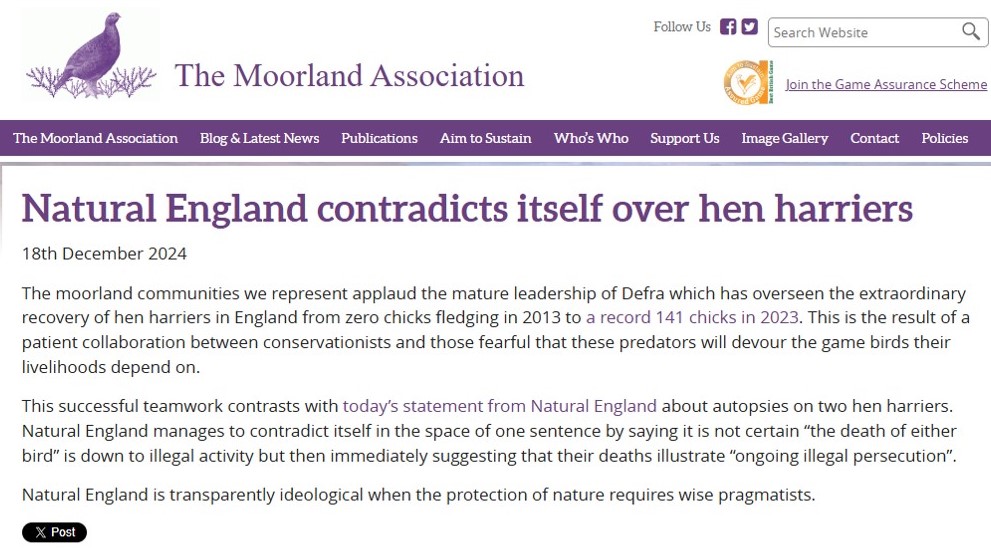
Even if Andrew Gilruth didn’t write this snidey guff, you’d think as CEO he’d be responsbible for overseeing/approving whatever appears on the Moorland Association’s website.
For how much longer will he remain in post, I wonder? The Moorland Association’s reputation is already in tatters after Gilruth was expelled from the Raptor Persecution Priority Delivery Group (RPPDG) earlier this year after the police accused him of “wasting time and distracting from the real work” of the Hen Harrier Taskforce (see here).
Natural England is currently undertaking a formal review of its ludicrous hen harrier brood meddling sham, with its findings due by the end of this month. Those findings will influence DEFRA’s decision on whether the sham is allowed to continue.
The Moorland Association has already stated it wants brood meddling licences to be issued as a routine part of grouse moor management.
With at least 130 killed/’missing’ hen harriers since the brood meddling sham trial began in 2018, and the Moorland Association’s continual denial and misrepresentation of the bleedin’ obvious, we’ll all be very interested in Natural England’s findings.
Meanwhile, for those who can no longer stomach what’s happening to hen harriers on grouse moors across the country, Wild Justice has another petition calling for a ban on driven grouse shooting. Please sign it HERE.
UPDATE 5th March 2025: Natural England quietly releases intriguing grouse moor location where two shot brood meddled hen harriers found dead (here)
NatureScot is stalling on releasing overdue FoI documents relating to its grouse moor licensing shambles
There appears to be something very dodgy going on at NatureScot (NS), the Scottish Government’s statutory advisor on nature conservation.
There’s been some shocking behaviour in recent months, some of which I won’t write about just yet because legal proceedings may be imminent, but one thing I can write about is NS’s failure to provide documents I requested via FoI/EIR over two months ago in relation to the shambolic grouse moor licences.
As many of you will know, the new grouse moor licences, introduced this year as part of the Wildlife Management & Muirburn (Scotland) Act, have already been sabotaged by the grouse shooting industry and as a result have been significantly weakened by a new licence condition introduced by NS, meaning the licences no longer cover an entire shooting estate but just the parts of the estate where red grouse are ‘taken or killed’, which on a driven grouse moor could effectively just mean a small area around a line of grouse butts (see previous blogs here, here, here, here, and here for background details).

I submitted an FoI request to NatureScot on Friday 11 October 2024 and asked for the following information:
- A copy of the legal advice NatureScot received in relation to these changes.
- A copy of all correspondence between NatureScot and Ministers in relation to these changes.
- A copy of all external correspondence in relation to these changes.
- A copy of all internal correspondence in relation to these changes.
NatureScot’s response was due back by 8 November 2024 (20 working days).
Predictably, NS failed to meet this deadline and wrote to me on 5 November with the following:
“We are having to extend the timescale to respond to your request. This means we must respond to your information request by 9 December 2024 [another 20 working days] at the latest, though we will do our best to respond before that“.
On Monday 9 December 2024 [40 working days since I submitted my request], NatureScot wrote again:
“We are working on our response but, unfortunately, we won’t be able to send it to you today…..I will contact you again later this week to update you on progress. We aim to send our response by the end of this week at the latest“.
On Thursday 12 December I wrote to NS to ask for an update and an explanation for the current delay as it was now well past 40 working days since I submitted my request.
On Friday 13 December, NatureScot replied:
“I am writing to let you know that NatureScot will not be able to provide you with the information you have requested today. We are giving careful consideration to releasing the information you have requested, and this is taking longer than expected. We are aiming to provide you with a response as soon as possible and will update you early next week“.
Given it’s now Wednesday (i.e. mid-week), and the ‘early’ part of this week has already passed, today I wrote to NatureScot again and pointed out that they’d already had 46 working days to comply with the FoI regs and as it’s now day 47, where is the information that I requested way back in October?
I’m not usually one for conspiracy theories but given what else I know NS has been up to behind the scenes these last few months, I’m deeply suspicious of these stalling tactics. You can only put so much down to incompetence; after that, it starts to look decidedly dodgy.
UPDATE 24 January 2025: NatureScot capitulated on grouse moor licensing after legal threats by game-shooting industry (here)
Multiple birds of prey found dead in suspicious circumstances – police appeal for information & warn public of potential poisoning danger
Nottinghamshire Police have issued an appeal for information after the discovery of ‘several dead birds of prey that were seen in suspicious and unnatural circumstances‘ near to the village of Bunny, in the Rushcliffe borough of south Nottinghamshire on Tuesday 10th December 2024.
They said: “We are appealing for the public’s help if you have seen any suspicious animal carcasses while out walking please report them to police and do not allow dogs or other animals to touch them as they may be poisoned.
If you have any information which might assist enquiries it can be reported online or via 101 quoting occurrence number 24000745675“.
They haven’t provided any further detail such as the species involved although their social media post was illustrated with an image of a buzzard.
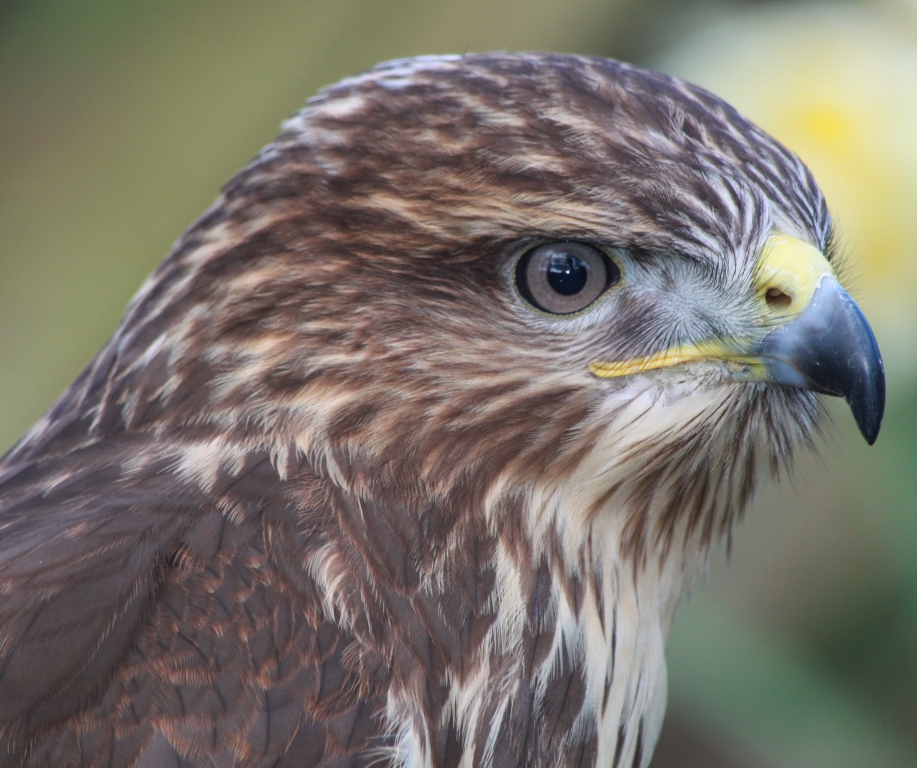
This is an excellent response from Nottinghamshire Police, not only to gather information during the early phase of an investigation but especially to warn the public of the risk of potential poisons being used that could be a danger to people and their pets.
Hopefully Nottinghamshire Police will provide an update once post mortems and toxicology tests have been undertaken.
RPSB launches interactive map showing fates of satellite-tagged hen harriers
Over the last 17 years or so, satellite-tracking technology has revolutionised our understanding of not only hen harrier ecology, but also the persistent, illegal killing of these birds on driven grouse moors across the UK.
Two organisations have been at the forefront of hen harrier satellite tracking – Natural England and the RSPB (with significant help from raptor study groups and others).
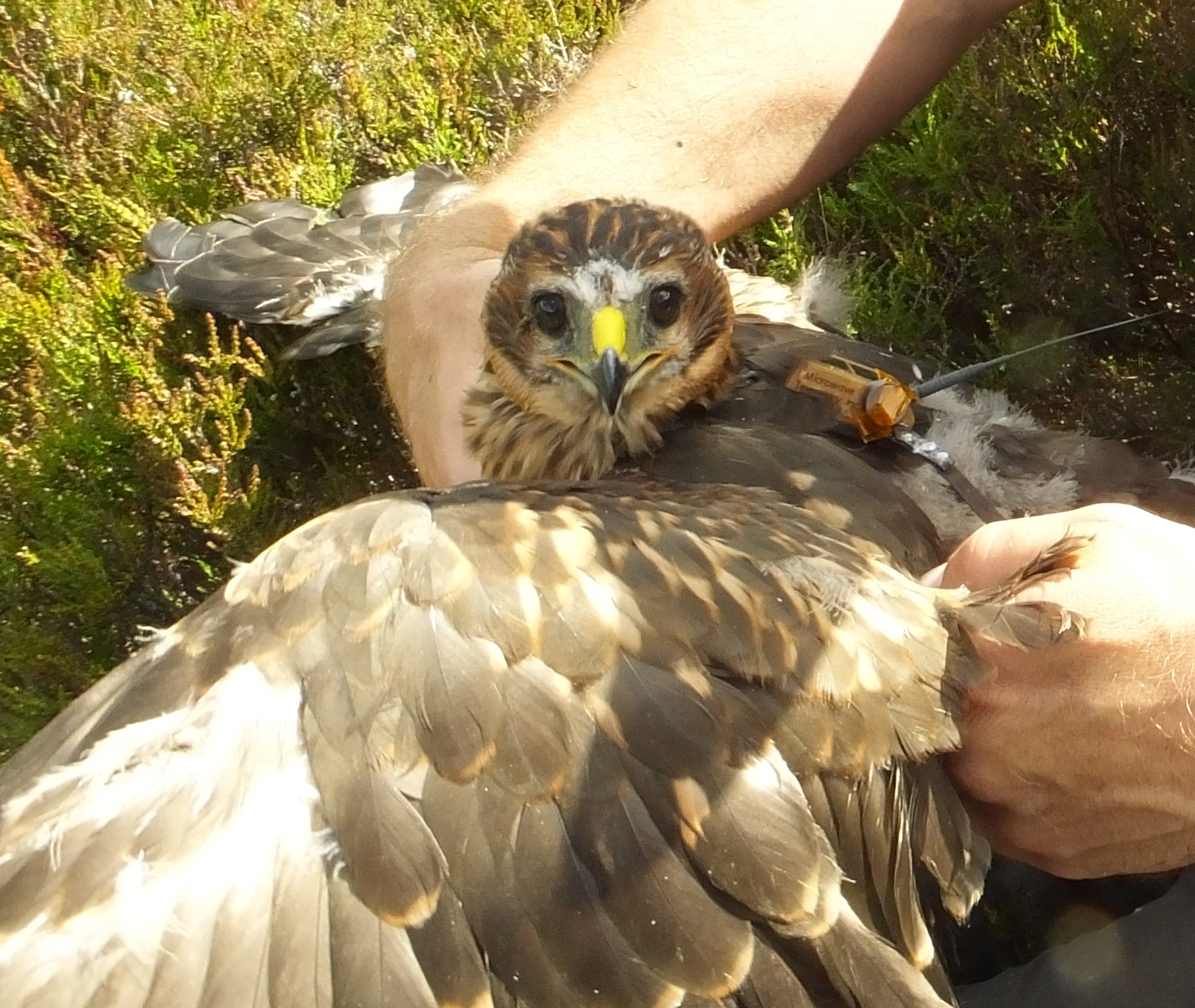
For several years now, Natural England has been intermittently publishing the fates of the hen harriers it’s team has tagged (see here), but only with vague explanations about its definition of the category, ‘Missing, Fate Unknown’ (e.g. see here).
Of course, since then, a significant academic paper published in 2019 demonstrated what we all already knew – that patterns of satellite-tagged hen harrier disappearances suggested widespread illegal killing on British grouse moors (see here).
A further paper, published in 2023 and this time analysing the fates of hen harriers tagged by the RSPB, reached the same conclusion (see here).
Since 2018, I have been publishing details about the confirmed/suspected deaths of satellite-tagged (and a few untagged) hen harriers using data from both Natural England and the RSPB (this list currently stands at 130 illegally killed/’missing’ hen harriers although there are still more to add; those data are currently being withheld from the public – see here).
Now, for the first time, the RSPB has launched an interactive map hub showing the fates of hen harriers its team has satellite-tagged since 2014 (currently up to October 2024).
The RSPB’s interactive database includes the fates of 178 of the 226 hen harriers satellite-tagged so far. Some dead hen harriers are not included as they are subject to ongoing police investigations. The hen harriers that are still alive and are currently being tracked are also not included, for what should be obvious reasons.

The interactive map hub allows users to filter the ‘fates’ of the RSPB’s tagged hen harriers into five different categories:
- Confirmed Illegal persecution
- Stop no malfunction (where the bird has disappeared in suspicious circumstances)
- Natural
- Unknown
- Tag failure/expired
Detailed explanations of each of these categories are provided on the hub.
Users are also able to zoom in to the map to show the general area where a harrier died and you can manipulate the map to show terrain etc.
This facility is a useful and welcome addition to the public record on the fates of individual satellite-tracked hen harriers in the UK. I’m not sure it provides us with any wider, big-picture information that we don’t already know but that’s probably not the intention behind this interactive hub anyway. What it does do is provide the public with a level of detail to help them understand the scale of satellite-tagging efforts on the UK’s hen harriers and thus the veracity of the extent of the ongoing illegal killing of this species on many driven grouse moors.
To visit the interactive map hub, click here.
To read the RSPB’s blog about the map hub, click here.
For those who want to see an end to hen harrier persecution, please consider signing this petition calling for a ban on driven grouse shooting – HERE.
Peregrine found poisoned – Police appeal for information six months later
Press release from PSNI (Police Service for Northern Ireland), 13 December 2024
POLICE CONFIRM BIRD POISONING IN ARMAGH
Police have confirmed that an adult bird of prey was found dead in the Forkhill area of Armagh in June of this year was poisoned.
It was reported on the 12th June that a Peregrine Falcon was found dead in the Forkhill area. The bird was retrieved by our search and rescue team and underwent testing to ascertain the exact circumstances, with enquiries ongoing the last number of months.

Constable Millen said: “We can now confirm the Peregrine Falcon found was poisoned with Carbofuran which is very concerning. This is not only a dangerous substance but it has been banned since 2001.
“We would remind the public if there is a suspicion of a crime, such as poisoning on any bird of prey in their local area, to leave the bird(s) and/or bait in situ and to call the police as soon as possible for officers to action.
“We have been working closely with our partners in Northern Ireland Environment Agency and National Wildlife Crime Unit and Northern Ireland Raptor Study Group regarding the matter and will continue to do so, in the hope to find those responsible.
“Police would appeal to anyone who has information on any suspected bird poisoning to please make contact via our non-emergency number 101, or online at http://www.psni.police.uk/makeareport/ or you can contact Crimestoppers anonymously on 0800 555 111 or online at http://crimestoppers-uk.org/.
ENDS
As far as I’m aware, nobody has ever been prosecuted for the illegal poisoning of any wildlife in Northern Ireland, which might explain why poisoning offences, especially against birds of prey, continue.
The Police waiting for six months before issuing an appeal for information about a poisoning crime won’t help, either.
Following the illegal poisoning of two white-tailed eagles in May 2023, found dead together on Northern Ireland’s only driven grouse moor at Glenwherry in the Antrim Hills (here), the Northern Ireland Raptor Study Group launched a petition calling for a ban on the possession of dangerous pesticides (here).
This petition is still live and has attracted almost 46,000 signatures. If you’d like to support it, please click here (you don’t have to be a resident/citizen of NI to sign – it’s open to anyone).
To learn more about recent raptor persecution incidents in Northern Ireland, this excellent report is well worth a read. It covers incidents reported in 2021 and 2022 (published May 2024).
Stobo Hope – NatureScot refuses licence application by Pryor & Rickett Silviculture to hunt foxes with 19 dogs (Guest Blog)
The following is a guest blog by someone who wishes to remain anonymous, although I know their identity.
STOBO HOPE – NATURESCOT REFUSES LICENCE APPLICATION BY PRYOR & RICKETT SILVICLUTURE TO HUNT FOXES WITH 19 DOGS
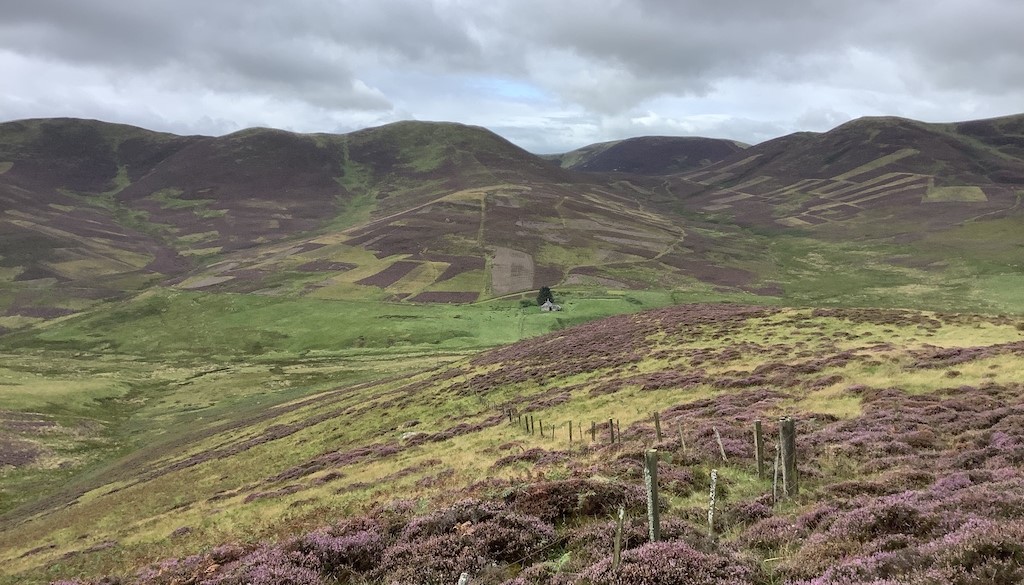
Many of you may have read about Stobo Hope in the Scottish Borders, with government body Scottish Forestry awarding a contract worth £2 million of taxpayers’ money to the Guernsey-registered Forestry Carbon Sequestration Fund, managed by True North Real Asset Partners Ltd with CEO Harry Humble (see here), to plant a giant Sitka spruce plantation.
Stobo Hope appears to be another questionable forestry project approved by Scottish Forestry – the excellent Parkswatch Scotland blog has exposed many, one of the latest being Muckrach (see here and here).
A crowdfunder campaign by the Stobo Residents Action Group, with support from Wild Justice, Raptor Persecution UK and Parkswatch readers, helped raise nearly £30,000 for a judicial review. The decision by Scottish Forestry to approve the plantation without an Environmental Impact Assessment (EIA) was challenged (see here).
Many people are grateful for your support in opposing this scheme, which seems to typify destruction of valuable upland habitats in Scotland. The judicial review was successful, with the Scottish Government eventually conceding before going to court – cancelling the £2 million contract, grant of consent and all associated funding (see here). The forestry work has apparently been halted by a court order since early September 2024 and Scottish Forestry have stated they will decide again if an EIA is needed (see here). [Ed: update, since this guest blog was written, news has emerged that the investment company behind the development work at Stobo Hope has lodged its own legal challenge against Scottish Forestry’s decision to halt all groundwork – see here].
Were dubious claims by Scottish Forestry about black grouse intended to help avoid an EIA?
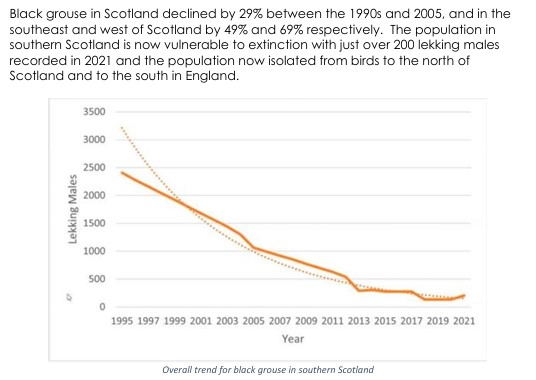
After decades of claiming intensive grouse shooting is beneficial for the local economy and wildlife, some landowners and managers are now claiming to be ‘mitigating climate change’ by planting Sitka spruce. Instead of having a mixture of open moorland with some native woodland, where grouse, waders, raptors and other wildlife can co-exist, moorlands across the Southern Uplands and elsewhere are being destroyed by conifer plantations in the wrong place. This is reaching the point that black grouse are now facing extinction in the Southern Uplands, as explained in a report by the Southern Upland Partnership (see here).
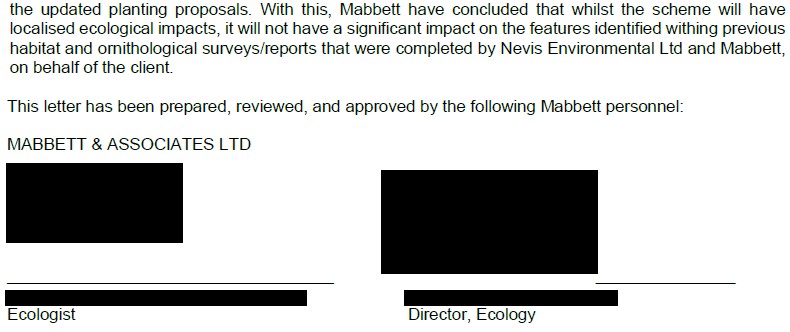
Following advice on 9 January 2024 from Mabbett and Associates Ltd, now called Arthian Ltd (see here), the ecological consultancy engaged and paid for by forestry agents Pryor and Rickett Silviculture to undertake the ecological surveys for Stobo, Scottish Forestry decided on 18 January 2024 that ‘this project is not likely to cause a significant negative effect to black grouse’, helping avoid an EIA.
This begs the question of whether Scottish Forestry employ their own ecologists to review and check such claims in applicants’ reports or do they just take these claims as read? Mabbett claimed ‘that whilst the scheme will have localised ecological impacts, it will not have a significant impact on the features identified withing [sic] previous habitat and ornithological surveys’:
Research has shown black grouse require several hundred of hectares of contiguous moorland habitat at a minimum for breeding. Due to the sedentary nature of black grouse, their breeding areas need to be close to other suitable moorlands for viable populations. Stobo and neighbouring woodland creation schemes, if approved, would together amount to losing nearly ten square kilometres of moorland.
Scottish Forestry claimed that there would be 246.4 ha of open ground within 1.5km of the lek as part of several so-called mitigation measures. Scottish Forestry failed to explain most of these open areas were fragments of relatively unsuitable habitat on exposed hilltops and ridgelines (with deer fences) further away from the lek and there would be 463.6 ha of trees replacing the areas of suitable habitat, so there is no longer any contiguous moorland.

Scottish Forestry stated that ‘the applicant has provided a Predator Control Management Plan to target particular species which could adversely impact upon black grouse’.
Scottish Forestry ignored the RSPB’s earlier prediction in September 2023 that the Stobo lek would become extinct:

In addition to all the damage on site by the forestry managers from groundworks, drains, forest tracks and planting Sitka spruce, herbicide was applied across vast areas of heather moorland in August 2023, five months before a contract was approved by Scottish Forestry (see here), who claimed they didn’t notice this herbicide damage for a whole year.

The Stobo Residents Action Group explained that this herbicide would have ‘wiped out important plant communities including heather, blaeberry and many species of wildflowers, grasses, ferns, lichens and mosses’ thus ‘destroying the food supply for mammals, birds, reptiles and invertebrates including the red-listed black grouse’. It is understood up to 400 hectares could have been sprayed with herbicide.
Pryor and Rickett Silviculture applied to NatureScot for a licence to hunt foxes at Stobo with 19 dogs
Many readers may be aware that the new Hunting with Dogs (Scotland) Act 2023 (see here) prohibits fox hunting with more than two dogs without a licence. This legislation was intended to close loopholes in the now repealed Protection of Wild Mammals (Scotland) Act 2002, which effectively allowed fox hunting to continue for sporting purposes.
NatureScot has authority to grant licences for hunting with more than two dogs under certain ‘exceptions’; (i) the management of wild mammals above ground and (ii) environmental benefit (see here). Campaigners have argued that this new licensing system still has loopholes, allowing fox hunting to continue under these ‘exceptions’ (see here and here).
A FoI from NatureScot has revealed that forestry agents Pryor and Rickett Silviculture Ltd (see here) applied to NatureScot for a licence in March 2024 to use 19 foxhounds to hunt foxes for ‘environmental benefit’ at Stobo. It was claimed this would help protect black grouse from predation from foxes as part of its ‘Predator Control Management Plan’ also targeting corvids and stoats, using Larsen and Perdix spring traps.
The applicant claimed that black grouse were ‘present across the site, with multiple areas identified as Lek’s [sic] and Breeding sites’ (but is unclear what constitutes ‘breeding sites’), also claiming ‘the site is also understood to be a significant movement corridor for Black Grouse between neighbouring glens’:

It was claimed management proposals ‘have been designed to increase the quality of the habitat available for black grouse within the site’. However, it claims that of the 1080 ha Stobo site ‘800 ha +/- is in the plans to be planted as a woodland creation project’ with a ‘Black Grouse Habitat Management Area’ of 145 hectares, of which just 84 hectares is open ground:

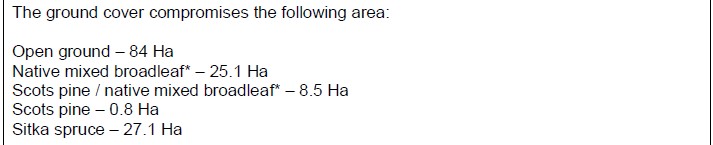
The applicants claimed to be ‘partnering with the University of Edinburgh to establish a long-term study of the black grouse management area’:

This claim was also made in the Stobo Woodland Creation Operational Plan submitted to Scottish Forestry by Pryor and Rickett Silviculture on behalf of True North Real Asset Partners Ltd:

A FoI response from the University of Edinburgh contradicted this claim, stating they had ‘not been engaged to put in place long-term research on black grouse’. True North Real Asset Partners Ltd had approached the University for discussions but no research collaboration resulted.


Did the applicants approach Edinburgh Napier University as an alternative organisation for a research study as the applicants also made several references to Edinburgh Napier University?

A FoI response from Edinburgh Napier University explained there were no plans for Edinburgh Napier University researchers using Stobo as a long-term research site:


Applicants attempt to justify reasons for licence application
NatureScot require applicants to justify the proposed number of guns and dogs. Five guns and nineteen dogs were proposed, with the applicant claiming if only two dogs were allowed the ‘guns’ (people with the guns) would become ‘very cold and bored and unwilling to partake in future fox control work’:

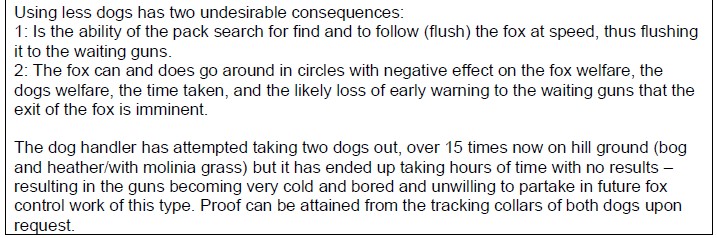
NatureScot also asks applicants to demonstrate all alternative options to achieving the licensable purpose, explaining that applicants cannot use the presence of ‘dense cover’ to justify the use of dogs. The applicant appears to rule out alternatives such as cage traps, diversionary feeding and fencing, claiming it was unsafe to increase the number of guns ‘without the use of a pack of dogs’:

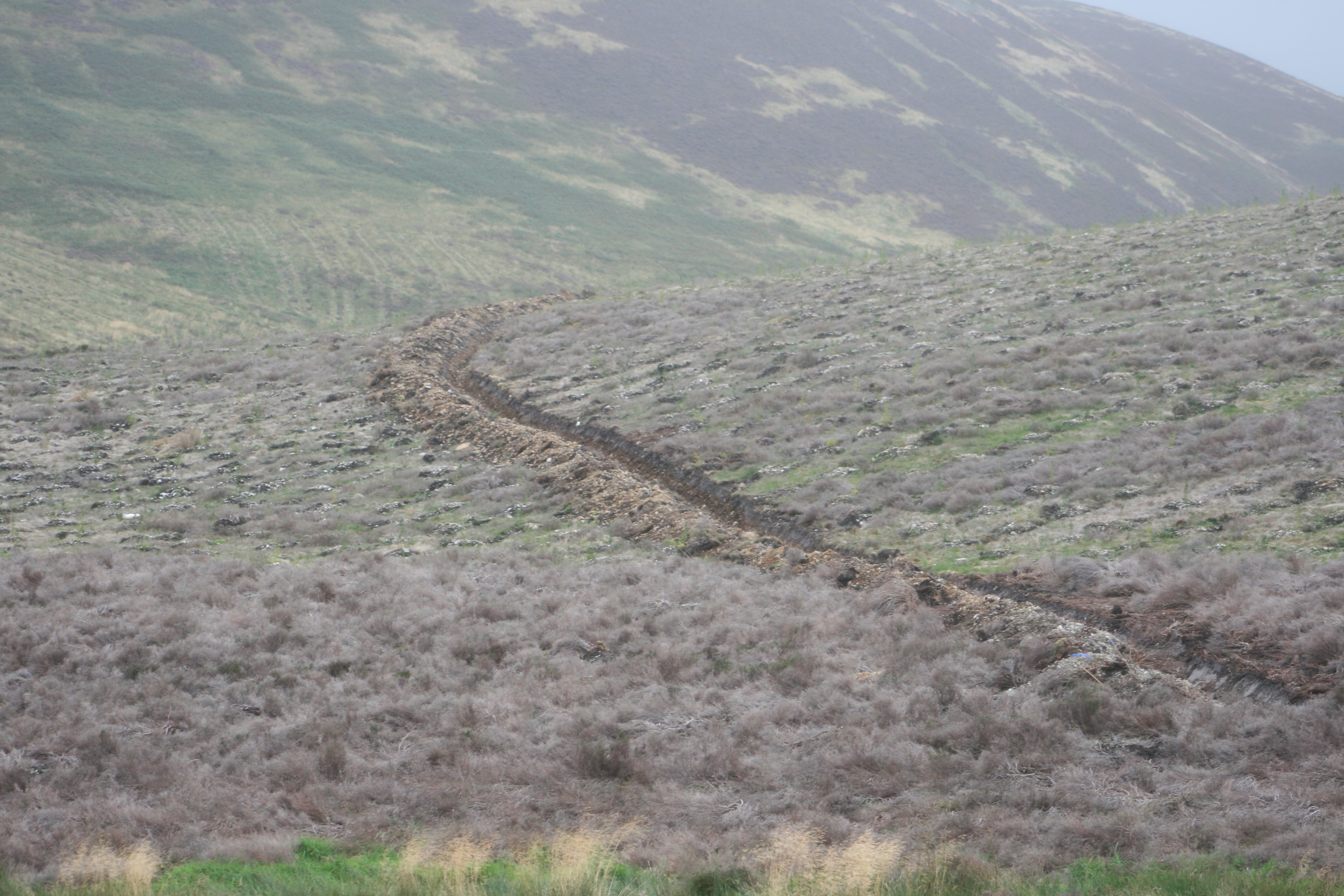
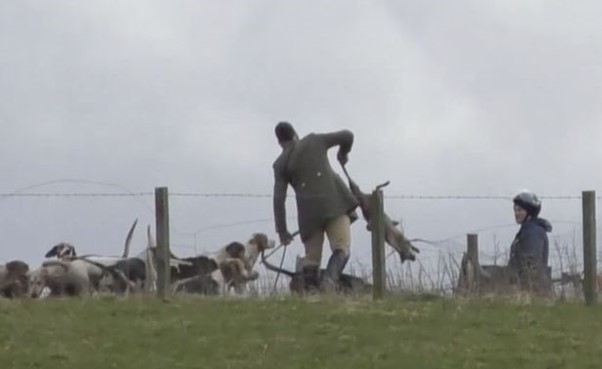
The ‘high level of ground cover’ mentioned sounds rather like ‘dense cover’. The picture of a spruce plantation below gives an idea of the ‘high level of ground cover’ or ‘dense cover’ that would occur in the long-term, which also hardly looks like suitable black grouse habitat.

Reasons for refusal of the licence application by NatureScot
A licence can only be granted if NatureScot considers three tests have been met; (i) Licensable purpose, (ii) No alternative solutions to achieve purpose, and (iii) Contribution to long-term environmental benefit.
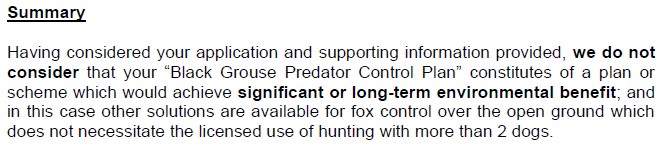
The first test was passed as NatureScot were satisfied there was a purpose in controlling foxes, potentially reducing black grouse predation. The second test was not passed as the applicants had not fully demonstrated that there were no alternative solutions to controlling the fox population without increasing dog numbers. The third test was also not passed as NatureScot were not satisfied a long-term environmental benefit would be achieved:
Criticisms by NatureScot
NatureScot said that the loss, fragmentation and deterioration of suitable habitats in the uplands from commercial forests was leading to a decline in black grouse. NatureScot stated the proposed mitigation measure in the plan ‘to plant commercial plantations with edges of mixed broadleaves will still unlikely sufficiently limit the impacts of the planting of the large conifer plantations on the open moorland that black grouse prefer’.
NatureScot quoted the applicants (who had given reasons for declines in black grouse to justify predator control), stating ‘Black grouse like the ground cover in young plantations, but as these develop into solid conifer thickets they tend to leave’. The loss of suitable habitat for black grouse and absence of ‘a wider-scale and longer-term environmental plan for addressing black grouse conservation’ under the proposed scheme was mentioned. NatureScot explained that the applicant ‘had not provided sufficient detail or explanation to demonstrate how the activity will be monitored and therefore how it will achieve long-term or significant environmental benefit’.
NatureScot also questioned why it was not possible to use two dogs to flush foxes to waiting guns.
The scale of the commercial plantations at Stobo
For the Stobo plantation, of the planted area, 72% is Sitka spruce, with a further 10% of commercial Scots pine and Douglas fir, so commercial coniferous forestry amounts to 82% of the planted area. The map below does not show three new plantations to the north, west, south or a proposed plantation to the east, creating a giant spruce plantation across what was previously contiguous moorland. Nearly ten square kilometres could be cumulatively planted, affecting fourteen square kilometres:

Why did the application fail to declare if the dog handler didn’t have wildlife crime convictions?
Although the completed licence application stated ‘no’ in response to a question asking if the applicant or anyone working under the licence being applied for had been ‘convicted of a wildlife crime or disqualified from keeping dogs’, when the same question was put for the dog handler (whose details were redacted), this was unanswered. Perhaps this was missed out by accident or the applicant was uncertain about the background of the dog handler?

‘Greenwashing’ to try and create a loophole in foxhunting legislation?
After reading this licence application, one cannot help thinking that the applicants were trying to take advantage of current black grouse presence to have fox hunting with nineteen foxhounds for sporting purposes. At the time of writing, no licences for hunting with more than two dogs for ‘environmental benefit’ have been granted anywhere – only for preventing serious damage to livestock, woodland or crops (see here).
A FoI response from July 2024 showed that of eight licence applications for the ‘environmental benefit’ option, seven were refused and one was frozen, pending further information, suggesting that NatureScot are restricting applicants from exploiting possible loopholes in the new legislation.
Are Scottish Forestry ignoring ecological impacts of new woodlands becoming sporting estates?
It is understood many organisations involved with conservation of golden eagles, black grouse and other projects in the Southern Uplands may be reluctant to publicly object to, or criticise forestry proposals because this could jeopardise future funding from the Scottish Government and Scottish Forestry.
It appears Scottish Forestry are exploiting those lack of objections, to help avoid EIAs. Scottish Forestry have also been publicly funding new woodland creation schemes that subsequently become overrun with released pheasants, red-legged partridges and even mallard ducks for recreational shooting, with significant negative ecological impacts (see here), even in Scotland’s so-called National Parks as explained on Parkswatch (see here).
These game bird releases have multiple detrimental impacts, such as on native woodland vegetation and remaining open areas of grassland. This occurs through factors such as eutrophication of soil, losing herb rich vegetation and birds eating invertebrates and even reptiles.
Scottish Forestry do not appear to account for the significant negative future environmental impacts of intensive recreational game shooting in their assessment of woodland grant scheme applications. It would be interesting if the Stobo scheme was being considered for future game shooting by the landowners and managers, in addition to its now foiled plans for foxhunting.
Scottish Forestry have said that they will ‘now screen the project again’, to see if an EIA is required, taking into account ‘all other new relevant information’ (see here).
Will Scottish Forestry again be selective in choosing information and sources, continuing to incorrectly maintain ‘this project is not likely to cause a significant negative effect to black grouse’?
Will Scottish Forestry continue to align its claims with those of True North Real Asset Partners Ltd, whose CEO Harry Humble asserted in the Scotsman (see here) that ‘the scheme has been designed specifically to favour black grouse, with an enhanced mix of species and open space provision in line with best practice derived from decades of research’.
Will Scottish Forestry continue to disregard warnings by reputable ecologists and the RSPB that the black grouse lek at Stobo will disappear, with NatureScot confirming black grouse ‘tend to leave’ (plantations of the kind at Stobo), as corroborated by peer-reviewed research?
ENDS

