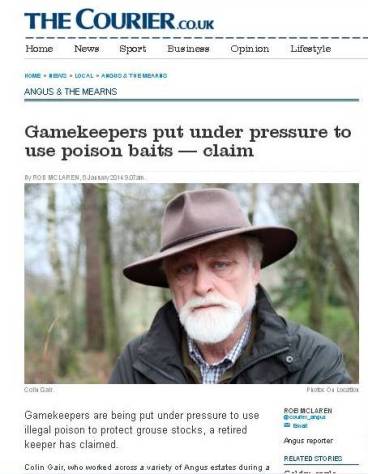
 On Wednesday we blogged about an article that had appeared in the Courier that morning. The article was all about a retired Angus gamekeeper, Colin Gair, who claimed that gamekeepers were being put under pressure to use poison baits to protect grouse stocks. Here is what we wrote in that blog.
The Courier article seemed to cause quite a stir and was soon being cited all over social media sites like Facebook and Twitter. That’s not surprising – it’s not very often that you get a gamekeeper willing to admit that illegal practices such as poisoning are still taking place so of course, people would be interested in reading about that.
We didn’t think anything more of it until Thursday morning. After reading one of the comments left on our blog it became apparent that the original article in the Courier appeared to have been edited with some material removed and some new material added.
That’s not so unusual – many on-line news articles are edited, often adding new quotes from different sources when they become available; we even do that on our own lowly blog. However, not many news articles are edited in such a radical way as to change the original information into something completely different. Bizarrely, that is exactly what looks like has happened with the Courier article.
After some digging, we have been able to find a cached version of the original Courier article, which was published on-line at 9.07 am on Weds 8th Jan 2014. Here is the text:
Gamekeepers are being put under pressure to use illegal poison to protect grouse stocks, a retired keeper has claimed.
Colin Gair, who worked across a variety of Angus estates during a 50-year career, has hit out at the use of poisoned baits, which claimed the life of a golden eagle in Angus in November.
Fearnan’s death is the latest in a series of incidents — several other eagles and other raptors having been shot, poisoned or trapped on sporting estates.
Mr Gair, 66, claimed the situation in Angus had deteriorated in the past two years and is urging gamekeepers to speak out if they are being asked to use poison.
He said: “Grouse have to be reared naturally on the heather moors, therefore vermin must be controlled, but legally all the keeper can do is trap and shoot.
“If you are a gamekeeper who is a married man with wife and family and the very nature of the job entails living in a tied house, pressure can be applied to you.
“If you are asked by a landowner or the tenant to use poison it is not easy for a keeper to say ‘I refuse to do this’ when his house, job and future might be at risk.”
The Tayside division of Police Scotland said their inquiries into the death of Fearnan are continuing.
 Now, compare the original version of the Courier article with the edited version that appeared on-line five hours later at 2.07 pm on Weds 8th Jan 2014. Here is the text:
Gamekeepers are being urged to contact police if they are asked by landowners or tenants to use illegal poisons to protect grouse stocks.
Retired keeper Colin Gair made the plea in the wake of the death of the golden eagle Fearnan, which died after being poisoned in Angus in November.
The type of poison used has not been revealed by police, but website Raptor Persecution Scotland, which has been tracking the series of killings in Angus, claim the poison was the illegal pesticide carbofuran.
In the past five and a half years, four eagles, a red kite and seven buzzards have been shot, poisoned or trapped on sporting estates in the Angus glens.
Mr Gair said he didn’t have pressure applied to him to use poison during his career, but was aware of the practice taking place.
He claimed young keepers who are fearful of losing their job could easily be coerced into using poison by unscrupulous tenants.
“I am certain many moors do not use poison, but some do and there are areas of Angus which are regarded as raptor black holes,” he claimed.
“If you are a young keeper with a wife and kids you dare not stick your head above the parapet, but I hope that someone will come forward and report that they have been asked to use poison to police.”
Mr Gair, 66, said the agricultural poisons used would be very difficult to obtain by gamekeepers and speculated that they were more likely to be supplied by corrupt traders to one or two shoot managers before being passed down to keepers.
He added: “Who is the real criminal in the poisoning cases? Is it the keeper who knowingly uses the chemical or is it another person who deliberately buys the chemical and passes it on to keepers with instructions to use it for vermin control?
“With most of these concentrated agricultural chemicals you would just need a few drops on an animal’s carcase and it would be deadly for anything that eats it.”
Tayside Raptor Study Group expert and wildlife artist Keith Brockie has called on the Scottish Government to licence shooting estates, a move Mr Gair said he would not oppose.
However, if licensing did come in, he said there would have to be some “give and take” and that the killing of certain raptors be allowed.
He added: “If gamekeeping and shooting interests are to face a licencing system, then we should be given something in return.”
Anyone with information that could assist police inquiries regarding the death of Fearnan is asked to contact 101, or speak to any officer.
That’s quite a different story being told in the edited version. What struck us the most was the change in the opening paragraph. In the original version, Mr Gair’s claim is crystal clear:
“Gamekeepers ARE BEING put under pressure to use illegal poison to protect grouse stocks“.
In the edited version, this claim has been considerably diluted to this:
“Gamekeepers are being urged to contact police IF they are asked by landowners or tenants to use illegal poisons to protect grouse stocks“.
Suddenly the article has gone from ‘they are being put under pressure’ to ‘if they are being asked’.
Another significant change is the removal of Mr Gair’s claim that ‘the situation in Angus has deteriorated in the past two years‘. That statement does not appear in the edited version.
New material in the edited version includes: a reference to this blog, Mr Gair’s claims that he was never asked to poison anything throughout his career, his claim that ‘young keepers could easily be coerced’ [into poisoning], his view that ‘many moors do not use poison’, his view on the ‘difficulty’ of obtaining poisons, the reference to Keith Brockie and Keith Brockie’s view that estate licensing should be on the cards, and Mr Gair’s view of estate licensing.
We are intrigued by the scale of the editing that took place on the original article, and we’re particularly interested in who or what might have prompted such fundamental changes to the original article. Who might not have been happy with the claims made in the original article, that gamekeepers were being pressurised by landowners to use poison to protect grouse stocks? And who might have the power and influence to instruct those editorial changes? Hmmm….
 Meanwhile, the landowners’ organisation Scottish Land & Estates has written a letter to the Courier to complain about the [edited] version of the article. Here’s what they had to say:
Sir,
The article by Rob McLaren “Gamekeepers urged to report unscrupulous owners” (January 8) repeats some very dangerous assumptions. The death of the golden eagle “Fearnan” has been subject to police investigation for over a month and there has been no indication that it resulted from the actions of a gamekeeper or that it was related to grouse moor management. Anything more than was included in the police press release of 19th December is speculation.
The gamekeeper Colin Mair [sic], whose purely personal comments are repeated in the article, admits that he “didn’t have pressure applied to him to use poison during his career” and merely speculates that others might have done. To be quite clear, landowners do not put pressure on gamekeepers to use poison or break the law, indeed any gamekeeper would have full protection of employment legislation if that should happen. In the few cases where gamekeepers have been convicted for using poison to control predators, there has been no indication that they were told by their employers to do so and particularly no evidence that poisons were supplied by shoot managers, as the article alleges. Since 2011, the already strong laws on employer liability have been tightened further by a “vicarious liability” offence whereby a land owner, manager or employer can be held liable for wild bird offences carried out by another person even if he was not aware of them. Any estate employing gamekeepers now has to make it doubly clear that no illegal activity can be condoned.
If anyone, including a gamekeeper, has specific evidence as to who was responsible for the death of the golden eagle, it should be reported to the police immediately. This case needs to be resolved as soon as possible, not least to put an end to speculative comment of the kind repeated in this article.
Tim Baynes
Director, Scottish Land & Estates Moorland Group
 Christine Grahame’s question is bang on the money. It’ll be interesting to see how Wheelhouse responds. Perhaps he’ll mention the long-promised public consultation on increasing the powers of the SSPCA to allow them to investigate more wildlife crime than they are currently allowed.
 MAY 2006: A dead adult golden eagle was found on the Dinnet & Kinord Estate, near Ballater, Aberdeenshire. Tests revealed it had been poisoned by the illegal pesticide Carbofuran. Grampian Police launched an investigation. Seven years and 7 months later, nobody has been prosecuted.
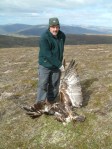 JUNE 2006: A dead golden eagle was found on Glen Feshie Estate in the Cairngorms. Tests revealed it had been poisoned by the illegal pesticide Carbofuran. Northern Constabulary launched an investigation. Seven years and 6 months later, nobody has been prosecuted.
 AUGUST 2007: A dead adult female golden eagle was found on an estate near Peebles in the Borders. She was half of the last known breeding pair of golden eagles in the region. Tests revealed she had been poisoned by the illegal pesticide Carbofuran. Lothian & Borders Police launched an investigation. Six years and 4 months later, nobody has been prosecuted.
 NOVEMBER 2007: Tayside Police received a detailed tip-off that a young male white-tailed eagle (known as ‘Bird N’) had allegedly been shot on a grouse moor estate in the Angus Glens. The timing and location included in the tip-off coincided with the timing and location of the last-known radio signal of this bird. Six years and 1 month later, the bird has not been seen again. With no body, an investigation isn’t possible.
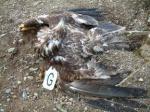 MAY 2008: A one year old male white-tailed eagle hatched on Mull in 2007 and known as ‘White G’ was found dead on the Glenquoich Estate in the Angus Glens. Tests revealed he had been poisoned by an unusual concoction of pesticides that included Carbofuran, Bendiocarb and Isofenphos. A police search in the area also revealed a poisoned buzzard, a baited mountain hare and 32 pieces of poisoned venison baits placed on top of fenceposts on the neighbouring Glenogil Estate. Laboratory tests revealed the baited mountain hare and the 32 poisoned venison baits contained the same unusual concoction of highly toxic chemicals that had killed the white-tailed eagle, ‘White G’. Five years and 7 months later, nobody has been prosecuted.
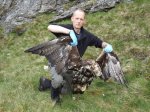 JUNE 2009: An adult golden eagle was found dead at Glen Orchy, Argyll, close to the West Highland Way. Tests revealed it had been poisoned by the illegal pesticide Carbofuran. Strathclyde Police launched a multi-agency investigation. Three years and 3 months later, estate employee Tom McKellar pled guilty to possession of Carbofuran stored in premises at Auch Estate, Bridge of Orchy and he was fined £1,200. Four years and 6 months on, nobody has been prosecuted for poisoning the golden eagle.
 JULY 2009: A two year old female golden eagle known as ‘Alma’ was found dead on the Millden Estate in the Angus Glens. Tests revealed she had been poisoned by the illegal pesticide Carbofuran. Alma was a well-known eagle – born on the Glen Feshie Estate in 2007, she was being satellite-tracked and her movements followed by the general public on the internet. Tayside Police launched an investigation. Four years and 5 months later, nobody has been prosecuted.
 AUGUST 2009: A young white-tailed eagle was found dead on Glenogil Estate in the Angus Glens. Tests revealed it had been poisoned by the illegal pesticide Carbofuran. Tayside Police was criticized in the national press for not releasing a press statement about this incident until January 2010. Four years and 4 months later, nobody has been prosecuted.
 MAY 2010: #1 of three dead golden eagles found on or close to Skibo Estate, Sutherland. Tests revealed they had been poisoned; two with Carbofuran and one with Aldicarb. Northern Constabulary launched a multi-agency investigation. One year later (May 2011), Sporting Manager Dean Barr pled guilty to possession of 10.5 kg of Carbofuran stored in premises at Skibo Estate. Three years and 7 months later, nobody has been prosecuted for poisoning this eagle.
 MAY 2010: #2 of three dead golden eagles found on or close to Skibo Estate, Sutherland. Tests revealed they had been poisoned; two with Carbofuran and one with Aldicarb. Northern Constabulary launched a multi-agency investigation. One year later (May 2011), Sporting Manager Dean Barr pled guilty to possession of 10.5 kg of Carbofuran stored in premises at Skibo Estate. Three years and 7 months later, nobody has been prosecuted for poisoning this eagle.
 MAY 2010: #3 of three dead golden eagles found on or close to Skibo Estate, Sutherland. Tests revealed they had been poisoned; two with Carbofuran and one with Aldicarb. Northern Constabulary launched a multi-agency investigation. One year later (May 2011), Sporting Manager Dean Barr pled guilty to possession of 10.5 kg of Carbofuran stored in premises at Skibo Estate. Three years and 7 months later, nobody has been prosecuted for poisoning this eagle.
 JUNE 2010: A white-tailed eagle was found dead on Farr & Kyllachy Estate, Inverness-shire. Tests revealed it had been poisoned by the illegal pesticide Carbofuran. Northern Constabulary apparently did not search the property until July 2011. Three years and 6 months later, nobody has been prosecuted.
 DECEMBER 2010: A decomposing carcass of a white-tailed eagle was found and photographed on Logie (Lochindorb) Estate, Morayshire. It was reported to Northern Constabulary. By the time the police arrived to collect it, the carcass had disappeared. The police said they couldn’t investigate further without the body.
 MARCH 2011: The body of a young golden eagle was discovered on North Glenbuchat Estate, Aberdeenshire. Tests revealed it had been poisoned by the illegal pesticide Carbofuran. Grampian Police launched an investigation and raided the property in May 2011. Two years and 7 months later, nobody has been prosecuted.
 APRIL 2011: The body of a white-tailed eagle was found at the base of cliffs on Skye. The person who discovered it (a professional medic) considered it to have been freshly shot with a rifle, decapitated with a sharp implement and thrown from the cliff top. He took photographs and alerted Northern Constabulary and RSPB. There was a delay of two weeks before the now probably decomposed carcass was collected. A post-mortem was inconclusive. This incident was not made public until one year later after a tip off to this blog. Two years and 8 months later, nobody has been prosecuted.
 MARCH 2012: The body of a young golden eagle being tracked by satellite was discovered in Lochaber. Tests revealed it had been poisoned with the banned pesticides Aldicarb and Bendiocarb. Information about this incident was not made public until three months later. One year and 9 months later, nobody has been prosecuted.
 MAY 2012: The dead body of a young satellite-tracked golden eagle (hatched in 2011) was discovered near a lay-by in Aboyne, Aberdeenshire. The data from its satellite tag & the injuries the bird had when found (2 broken legs) suggested it had been caught in an illegal trap on a grouse moor in the Angus Glens and then removed, under cover of darkness, to be dumped in another area where it was left to die, probably a slow and agonising death. Information on this incident was not released until almost five months later, by the RSPB. It appears the police failed to properly investigate this incident as we understand that no search warrants were issued and no vehicles were searched. One year and 7 months later, nobody has been prosecuted.
 OCTOBER 2012: An adult golden eagle was found shot and critically injured on grouse moor at Buccleuch Estate, near Wanlockhead, South Lanarkshire. The bird was rescued by the SSPCA and underwent surgery but it eventually succumbed to its injuries in April 2013. One year and 2 months later, nobody has been prosecuted.
 DECEMBER 2013: A two year old satellite tracked golden eagle (‘Fearnan’) was found dead on a grouse moor in the Angus Glens. Tests revealed he had been poisoned with the banned pesticide Carbofuran.