Two marsh harriers and a red kite poisoned: late appeal for info

The RSPB and two county police forces have put out an appeal for information following the discovery of a poisoned pair of Marsh Harriers and a Red Kite.

According to the press release (see here), the two breeding Marsh Harriers were discovered in April on land adjacent to the RSPB’s Nene Washes Nature Reserve in Cambridgeshire. The Red Kite was discovered in Old Leake, Boston, Lincolnshire in May. Toxicology analyses showed that all three birds had been poisoned with the banned pesticide Aldicarb.

So here we are again, a ridiculously late appeal for information, seven and six months respectively after the birds had been found. Further more, according to the press release, the Chemicals Regulation Directorate (CRD) who funds the toxicology testing programme has already declared the two cases closed!

It seems there is more to these cases than meets the eye. Rumour has it that these cases have not been thoroughly investigated due to a lack of police resources. If that’s true, then why weren’t other agencies drafted in to help? Where’s all the much-heralded ‘partnership working’?

And why the bloody hell are appeals for information still coming so late? Every single bloody time it’s the same old story. What’s the point? Why is it so difficult to get these investigations right? That will be a question we’ll be posing in due course (and you can, too) to the newly-appointed ACPO (Association of Chief Police Officers) lead on Wildlife and Rural Crime, Chief Constable Simon Prince (from Wales). Watch this space.

In the meantime, we had a look at the quarterly poisoning results published by the CRD’s Wildlife Incident Investigation Scheme (see here). Have a look and see how many confirmed poisoning cases you can spot in England and Wales between Jan – June 2013 that have not been publicised in the media.

It seems the influence of The Untouchables spreads far and wide throughout these isles.

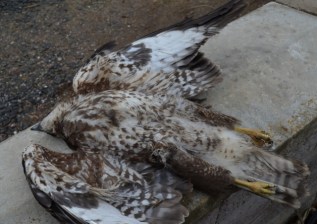
Here are the two poisoned Marsh Harriers

Marsh Harriers poisoned Nene 2013

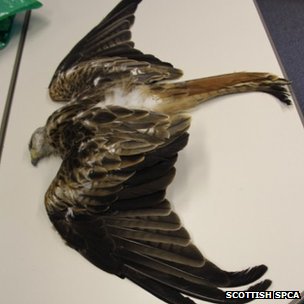
And here is the poisoned Red Kite

RK poisoned Lincoln 2013

The gruesome fate of mountain hares on Scottish grouse moors

Following yesterday’s article on the reported ‘massive declines’ of mountain hares on Deeside grouse moors, and the game-shooting industry’s response that mountain hares are ‘thriving’ on Scottish grouse moors (see here), one of our contributors has sent in the following photos, taken on a well-known Angus grouse moor between 2011-2012.

The awful, bloody truth.

If you are disgusted by these images and are concerned about SNH’s long-term failure to implement an effective monitoring scheme to protect this species, you might want to email SNH’s mammal expert, Rob Raynor and ask him what measures he intends to introduce, and when. Email: Robert.Raynor@snh.gov.uk

MH1

MH2

MH3

MH4

Poison awareness posters appear in Leadhills village

Leadhills village in South Lanarkshire has been saturated with a series of ‘poison awareness’ leaflets and posters, alerting the local community to the discovery of highly toxic (and illegal) poison on the surrounding hills earlier this year (see here). The poster warns the public of the dangers of coming in to contact with this poison (Carbofuran) and also provides contact telephone numbers (police, SSPCA and RSPB) if anyone finds any more or has information about who might be putting out the poison.

Is this community initiative the work of a local estate? Or the local police? Or the local council? Or PAW Scotland? Nope, none of the above. It’s the handiwork of Project Raptor.

It’ll be interesting to see how long the posters and leaflets remain on display. Last year we blogged about the mysterious disappearance of another sign at Leadhills (see here).

PR Leadhills flyer


“Massive declines” of mountain hares on Scottish grouse moors

Here we go again.

A leading ecologist has accused Scottish landowners of causing “massive declines” of mountain hares on grouse moors around Deeside, Aberdeenshire.

In an excellent article published in The Herald today (and on journalist Rob Edwards’ website, see here), Dr Adam Watson claims that what is going on is a ‘national scandal’ and accuses SNH of failing in their duty to protect this important keystone species.

To counter this argument, Tim Baynes of Scottish Land and Estates claims that even though thousands of hares are destroyed each year, this was ‘less than 10% of the population’.

That’s an interesting argument, especially given the uncertainty of the actual population size of this species. The most up-to-date UK population estimate appears to have been made in a 1995 publication (Harris et al 1995). The estimate given then was in the region of 350,000 individuals, with 99% of these living in Scotland. However, the authors recognised that this figure may be either overestimated or underestimated by a whopping 50%!

It would appear that Baynes is basing his (flawed) ‘no-impact’ argument on an SNH-commissioned study that showed at least 25,000 mountain hares were culled on Scottish estates during 2006/2007. That study demonstrated no impact on the hare’s distribution (at that time) but was not able to determine whether there was an impact on the hare’s abundance (which is the key point when estimating population size!) because no reliable measures of estimating abundance for this species were available.

What Baynes also failed to mention was that the 25,000 culled only related to information provided by 90 estates; a further 102 estates (68 driven grouse estates and 34 walked-up grouse estates) did not provide any information to the survey, so the actual figure culled was likely to be considerably higher.

It’s also ludicrous for Baynes to be referring to a (fairly dodgy) population estimate from 1995 – that was 18 years ago! The latest information, just published by the BTO, suggests a 43% decline in mountain hares between 1995-2012 (see here).

Talking of ludicrous, Alex Hogg of the Scottish Gamekeepers’ Association is also quoted in The Herald article, claiming that gamekeepers have ‘no alternative but to suppress the numbers of mountain hares on grouse moors because of the dangers of Louping Ill Virus, which can infect humans’. However, here is an article that suggests humans are “rarely” affected by the Louping Ill Virus! And here is an article about a scientific publication that suggests there is “no compelling evidence base” that culling mountain hares can stop the spread of Louping Ill Virus!

A tick-borne disease that seems to be of more concern to humans is Lyme Disease. And what spreads Lyme Disease? Pheasants, amongst other species (see here). Given Mr Hogg’s concern for human health, can we expect to see him advocating a moratorium on the release of 43 million pheasants, per year, into our countryside?

The crux of The Herald article is that SNH is failing in its statutory duty to protect the mountain hare. This is a European-protected species and thus SNH has a duty to ensure the species’ conservation status is maintained and that their populations are managed sustainably. Given previous concerns about the species’ conservation status, the Scottish Government recently introduced a closed season for mountain hares as part of the WANE Act (see here), although it’s hard to judge just how effective that will be given the lack of monitoring and enforcement.

To be fair to SNH, they have previously tried to establish an effective monitoring programme for the mountain hare. They commissioned several reports on the subject between 2005-2010 but these reports all recommended a clear need to develop ‘reliable, robust and easily implemented survey methods’. As far as we can tell, nearly four years later they still haven’t done so and according to Dr Watson’s findings of “massive declines” of mountain hares in Deeside, in addition to the BTO’s findings of a 43% decline between 1995-2012, it would appear that SNH need to prioritise their monitoring scheme with some urgency. Asking moorland managers to ‘talk to us if they are thinking of culling hares in large numbers’ (see SNH quote in The Herald) is not going to stand up as evidence when SNH are finally taken to court for breaching European conservation laws.

New wildlife crime reporting app launched

PAW crime app screen 2A new smartphone app has been launched by PAW Scotland to help the general public to record and report suspected wildlife crime in Scotland.

Using the free app, the public can complete an on-screen reporting form and can upload scenes of crime photos that are automatically tagged with a GPS reference. This information is then sent directly to Police Scotland via email.

The app was the brainchild of former Police Wildlife Crime Education Officer, Andy Turner, who is now employed as Wildlife Crime Officer for SNH. Here is a short video of Andy explaining how to report wildlife crime and his introduction to the new app.

The government has issued a press release about the new app here.

It is good to see anything that raises awareness of wildlife crime in Scotland, although just how effective this new app will be remains to be seen; rural mobile phone coverage is not brilliant in large parts of Scotland – will this app work if you’re standing on a remote grouse moor looking at a poisoned eagle?

There are other concerns, too. Comments made in the government’s press release suggest that the reporting of wildlife crime is a problem in Scotland. That is simply not the case. Many people are reporting suspected incidents – it’s the police follow-up that is lacking in many areas. Not everywhere – there are some excellent Police Wildlife Crime Officers who can be relied upon to follow up every single reported incident – but it’s a bit of a lottery – if you happen to be in an area where (a) there isn’t a Police WCO or (b) there is a Police WCO but they are unreliable, then reporting an incident via this app won’t make a blind bit of difference.

A more serious concern as far as we’re concerned is the exclusion of other investigatory agencies. In his video, Andy makes a point of saying that Police Scotland is the investigatory agency for wildlife crime – and blatantly ignores the statutory reporting status of the SSPCA. This app will not forward reported incident details to other investigatory agencies such as the SSPCA or the RSPB – the information just goes directly to Police Scotland. That is certainly not ideal. By excluding the other agencies, there won’t be anybody to follow up / chase up Police Scotland to ensure that the incident is actually being investigated. As we’ve seen time and time again, when Police Scotland are left to their own devices then many reported incidents just get buried /hidden / unpublicised / forgotten.

We would encourage anybody who is reporting a suspected wildlife crime to the police, either using the app or not, to also notify at least one of these two agencies at the same time (if not before!) –

RSPB Scotland Investigations: 0131-317-4100

SSPCA 24hr hotline: 03000-999-999

If you haven’t already added these numbers to your phone, now is the time to do it.

Whilst Andy Turner deserves credit for helping to raise awareness at least, we doubt very much whether the use of this new app will improve prosecution or conviction rates. Do you think we would have seen a prosecution or conviction for the Leadhills poison baits had the incident been reported via this app? Of course not! Although had the poisoned baits been reported via this app we the general public would still be very much in the dark about that crime because Police Scotland have refused to issue a press statement about it, eight months after the discovery. If they are being provided exclusive information via this app then we can expect to see much more of the same. That, for us, is unacceptable.

No prosecution for poisoned baits found on Leadhills Estate?

leadhills estateEight months ago (March), a significant haul of pre-prepared poisoned baits was discovered on Leadhills Estate in South Lanarkshire. The baits comprised chopped up pieces of rabbit, liberally sprinkled with the banned poison Carbofuran, that had been placed inside two gamebags that had been hidden inside a wood next to a grouse moor.

The discovery was made by fieldworkers from Project Raptor and they duly reported their finding to the police. We waited for a press release and an appeal for information from the police but nothing came, so three months later (June) we blogged about it (here) because, unlike the police, we considered it a newsworthy item in the public interest, as apparently did BBC Scotland (here).

Recently, an update on the police investigation appeared on Project Raptor’s website:

24th October 2013. Project Raptor have contacted South Lanarkshire police and they have now informed us that evidence gathered from the two game bags has come back negative. This means that unless further evidence comes their way then this case is just another in a long line of wildlife crimes that have taken place within the Leadhills area over the years that will never be solved”.  See here for full update.

When Project Raptor says that ‘evidence gathered from the two gamebags has come back negative‘ they do not mean that the analysis of the poison came back negative – SASA has already confirmed the poison found on those baits was Carbofuran and they included the incident in their quarterly report on poisoning incidents. Rather, what we think Project Raptor is referring to is that any fingerprint or DNA testing that might have been done on the two gamebags has come back negative.

This means that there is no evidential link between the two gamebags and any individual person and therefore it is not possible to charge anyone for committing an offence in relation to these items.

This case is an excellent example of just how difficult it is to bring illegal poisoners to justice. It’s not the fault of the police that there isn’t enough evidence, although to be frank they are not blameless in this particular situation – had they had the foresight and interest to install a covert camera overlooking the site where the poisoned baits had been found they may well have caught the criminal(s) in the act of retrieving the bait or even adding more bait to the secret stash. They could (should) also have conducted a thorough search of the surrounding area, particularly the adjacent grouse moor, to see whether any of the baits had already been placed out on the hill. Given that one of the bags was full (of bait) and the other bag was only half-full, this would have been a reasonable assumption, especially given the reported history of poisoned baits being found on this estate (see here). Instead, the police decided to arrive on site in two marked police vehicles (thus alerting everybody to their presence and allowing any nearby criminal to hide any other incriminating evidence) and they quickly removed the gamebags and left the site without conducting a wider search. On top of all that, they still have not issued a press release about this case, giving us the impression that they’re just not all that bothered. At the very least they should be alerting the general public to the potential threat of people and their pets stumbling across what is a fatally toxic poison in a publicly-accessible area.

So is that it, then? Will the discovery of these baits (which we believe to be the biggest stash of pre-pared baits found since 32 poisoned baits were found on Glenogil Estate in 2008) just be conveniently ignored and everyone carries on as usual? For certain, these baits will not feature in any ‘official’ raptor persecution statistics because, as we were recently told by the Environment Minister’s office, where poisoned baits have been discovered but ‘no raptors were involved’ they cannot be listed as a raptor persecution incident. We don’t actually know whether ‘no raptors were involved’ at Leadhills because the police didn’t conduct a search to look for poisoned carcasses!

It looks certain that no action will be / can be brought in the criminal courts. But what about other types of action?

There’s the possibility of civil action – we will wait to see whether any single farm payments are withdrawn from Leadhills Estate by the Scottish Executive (as they were from Glenogil Estate in 2008 – see here) although we suspect any such action would be strongly challenged by the estate precisely because there is no evidential link between the baits and any employee of Leadhills Estate.

Great, isn’t it?

Is there any other type of action? Well, yes, there is. What we would really like to see is action taken by Scottish Land and Estates, the representative body of Scottish landowners. The only response we saw from SLE about the discovery of the poisoned baits on Leadhills Estate was a false accusation levelled at this blog for reporting the incident! (see here).

Interestingly, in a comment made on Mark Avery’s blog today, SLE Chief Executive Doug McAdam claims, “…..a range of partners, Scottish Land and Estates included, invest a significant amount of time and resource into working with and through PAW Scotland to help achieve this [eradication of golden eagle persecution], not just for golden eagles though, but all wildlife crime” (see here for his full comment).

So what, exactly, has SLE done about the continuing issue of alleged and confirmed illegal raptor persecution on Leadhills Estate? We’ve asked this time and time again but the question is just met with silence every time.

We’re not sure that Leadhills Estate is a member of SLE, although given that the owner of Leadhills Estate (Lord Hopetoun) also just happens to be a Board member of SLE, it would be quite strange if Leadhills Estate wasn’t an SLE member. Why doesn’t SLE publicly condemn the crimes that are alleged and confirmed at Leadhills Estate? If Leadhills Estate is an SLE member, why hasn’t SLE kicked them out, just as they did with Glasserton Estate earlier this year following the conviction of their gamekeeper (see here). McAdam may argue that nothing has been proven at Leadhills in relation to the latest discovery (in terms of a legal evidential link) and that would be accurate, but there is a long, long, long, long list of alleged and confirmed incidents from this estate, dating back decades (see here), several of which have resulted in criminal convictions.

It seems to us that SLE is repeatedly turning a blind eye to reported activities on this estate that the rest of us can see very clearly. Why would they do that if they’re so keen to eradicate raptor persecution?

So long, Sheriff Drummond

One of the most influential figures in the world of Scottish wildlife crime enforcement, and particularly in relation to raptor persecution, has finally retired. There are some who will be delighted with this news, others not so much.

Sheriff Kevin Drummond QC left office this week after 13 years in the Sheriff courts of the Scottish Borders. In addition, he’d played a significant role on various PAW Scotland committees, including Chair of the Legislation, Regulation and Guidance Sub Group (see here), and was a member of the high-level PAW Scotland Executive Group (see here). He was also heavily involved in the provision of ‘mock trials’ as part of a training programme for police wildlife crime officers and procurators fiscal to help prepare them for dealing with wildlife crime trials. Prior to being appointed Sheriff, he had worked as a leading defence QC whose clients included gamekeepers accused of wildlife crimes. His own reported hobbies include shooting and fishing (see here).

An article in the Selkirk Advertiser reporting his retirement (see here) describes the Sheriff as ‘well-respected’, ‘fair and consistent’ and ‘kind and approachable’. We’d agree with ‘consistent’ at least. In a number of cases over which Sheriff Drummond presided around 2006-2007 there was opportunity to sentence the convicted gamekeepers in his court to jail time – a provision that had at the time been recently introduced in an attempt to crack down on raptor persecution. Disappointingly, Sheriff Drummond decided that community service orders were adequate punishments for these convicted poisoners, including one case that had been described by one RSPB investigator as ‘the worst he had seen in 20 years’. This reluctance to send convicted poisoners to jail is still very much in evidence in Sheriff courts right across Scotland – there still hasn’t been a single one.

Sheriff Drummond held strong views against the introduction of vicarious liability – his visibly agitated performance in front of the WANE bill committee in 2010 was quite a display – and he also strongly opposed the concept of increasing the investigatory powers of SSPCA inspectors to allow them to take on raptor persecution cases (e.g. see here).

There were calls for the Sheriff’s dismissal from the PAW Scotland group following another of his outbursts at the Police Wildlife Crime Conference in 2010 when a wildlife investigator asked whether there should be tougher sentences for wildlife criminals. Sheriff Drummond’s reported response, “Get a life“, was met with ‘shock and bewilderment’ by conference delegates but was later defended by then Environment Minister Roseanna Cunningham (see here).

Many years earlier RSPB Investigator Dave Dick also found himself on the receiving end of one of the Sheriff’s seemingly characteristic tantrums. Here’s an excerpt from Dave’s 2012 book, Wildlife Crime: The Making of an Investigations Officer:

Thursday 20 June 1991. Jedburgh Sheriff Court and Jimmy [a gamekeeper] has got himself a QC – or more correctly, Jimmy’s boss, a wealthy Austrian banker, has got Jimmy a QC. Kevin Drummond, QC, who walks into the Fiscal’s office just before the trial is due to start, where I am having a last-minute conference as was the normal, efficient practice by 1991. Kevin announces that he is going to win this case because Section 19 of the 1981 Act does not permit a constable to enter land and search for evidence. The Fiscal may have been used to this robust, even arrogant approach but I wasn’t and in my naivety, combined with experience of Section 19 in court, I blurted out, “Do you really think that’s what Parliament thought, when they drew this up?” The resulting angry out-burst (‘You may be very good at what you do out there, Mr Dick, but in here, I’m in charge!’) was my first sight of an apparent lack of control which I have since witnessed many times“.

It is without question that Sheriff Drummond has had considerable influence on the approach taken to tackling wildlife crime in Scotland, at both a strategic governmental level as well as on the front-line level in court. That influence has been welcomed by some, while exasperating others.

Today is his 70th birthday and we wish him a long and enjoyable retirement – here’s hoping he doesn’t ‘do a Dysart‘ – we’re all hoping for the start of a new era.

Golden eagle voted nation’s ‘favourite’ wild animal

The golden eagle has taken pole position in a vote to identify the nation’s favourite wild animal. The poll was organised by SNH and VisitScotland to highlight the Year of Natural Scotland and included the so-called ‘Big 5’ species: golden eagle, red squirrel, red deer, harbour seal and otter. The golden eagle won by a landslide majority (see here).

But so what? Will winning this poll make any difference to the number of illegally poisoned, illegally shot or illegally trapped golden eagles that keep turning up on Scottish grouse moors? Or any difference to those young satellite-tagged golden eagles that keep mysteriously ‘disappearing’ over Scottish grouse moors? Or any difference to the number of grouse moor gamekeepers and grouse moor estate owners that are never prosecuted for killing our favourite species?

Here’s a link to all the blog entries we’ve written about golden eagle persecution in Scotland – a fairly comprehensive overview of how appallingly our favourite species is treated by those who won’t tolerate it on their moors and by those who are supposed to be protecting it.

Here’s a photo of the golden eagle that was found shot and critically injured on a grouse moor in southern Scotland last year. Despite top veterinary care, he didn’t make it. This is what we’re allowing to happen to our ‘favourite’ species…

optable

Persecution case dropped as alleged raptor killer dies

Last month we blogged about Robert Simpson, a 66-year-old from Cleghorn in South Lanarkshire who was facing three charges of alleged wildlife crime, including the illegal trapping and killing of a barn owl. His case was continued without plea for four weeks as he was considered too unwell to attend court (see here).

His case was due to re-start at Lanark Sheriff Court yesterday (31st Oct). However, a local reporter has informed us the Fiscal did not call the case yesterday as Mr Simpson has died.

SGA urges government to kill predators

Hey, guess what? The Scottish Gamekeepers Association is urging the Scottish Government to kill predators! Gosh, it must be all of two weeks since they last called for this sort of action. Thank goodness they’re so full of fresh new ideas.

In an amusingly familiar article in the Scotsman (see here), we learn that the SGA has declared 2014 as the Year of the Wader and will use this banner as a way of repeatedly asking the government to kill some predators, although they haven’t actually specified which predators they want killed. Any will do, right?

In honour of this initiative, we’ve declared 2014 as the Year of the Wanker, and we’ll use this banner as a way of repeatedly asking the government to get rid of some wankers. We might specify which wankers should be removed or we might just generalise in the hope of netting one or two in a broad trawl.