Scottish Government ‘actively considering’ additional enforcement action on wildlife crime

On Tuesday (17 December 2019) the Scottish Rural Affairs & Environment Minister, Mairi Gougeon, gave evidence to the cross-party Environment, Climate Change & Land Reform (ECCLR) committee which is currently considering Stage 1 of the Animals and Wildlife (Penalties, Protections and Powers) (Scotland) Bill.

The transcript can be read here (wildlife crime discussed from page 20 onwards): ECCLR report_17December2019

The archived video can be watched here

We’ve already blogged about one aspect of that evidence, where rather than committing to a mandatory custodial sentence for possession of banned deadly poisons, just as there is for those caught in possession of illegal firearms, yet another poisons amnesty was being considered instead (see here).

The rest of the session covered a lot of ground with some well-informed questions posed by some members of the ECCLR committee, especially Mark Ruskell MSP and Claudia Beamish MSP. In addition to an increase in penalties for wildlife crimes, which is part of the core text of the proposed Bill, other topics discussed included the Werritty review (due before the end of the year), the Government’s annual wildlife crime report (apparently due to be published ‘by the end of the year’ and we expect it will show an increase in confirmed raptor persecution crimes), vicarious liability, increasing SSPCA powers to tackle wildlife crime, the ineffectiveness of General Licence restrictions because estates can simply apply for Individual licences instead, covert video surveillance, the failure of the Police Special Constables pilot scheme in the Cairngorms National Park and a question about why the General Licence restriction at Leadhills Estate, imposed after Police Scotland provided ‘clear evidence of wildlife crime’, has been reinstated during the appeals process. Government officials committed to submitting a written response to Claudia Beamish’s question on this legally complicated issue.

The discussion on increasing powers for the SSPCA during Stage 2 of the Bill was quite telling. The Minister said the SSPCA had approached the Government in recent weeks to request additional powers to help tackle wildlife crime but she seemed to go to great lengths to argue that although she is committed to considering options she didn’t forsee anything happening in this particular Bill because the Government ‘needs the chance to fully discuss the issue’ and to ‘assess the ramifications of increasing those powers’.

Yeah, she’s right, so far the Government has only taken six years and five different Environment Ministers to fully discuss the issue and consider the ramifications – see here for a jaw-dropping timeline. And after all that it then concluded that accepting the offer of free resources from an expert and experienced reporting agency like the SSPCA wasn’t the right option for tackling serious organised crime and, inexplicably, chose instead to launch a £28k pilot scheme for five part-time voluntary Police Special Constables to potter around in the Cairngorms National Park and ‘meet stakeholders’; a scheme which, unsurprisingly, has been a complete flop. Even though Mairi Gougeon wasn’t in post as one of those five Environment Ministers during that six-year stalling exercise, her advisors should know all about those shenanigans. Honestly, the extent of the feet dragging is astonishing.

Mark Ruskell MSP again raised the issue of the ineffectiveness of General Licence restrictions and other sanctions, and asked the Minister if other sanctions were available? She responded by saying that she thought it was ‘important that other deterrents are available‘ and “We are actively considering the need for an additional level of enforcement, which would not require referral to the procurator fiscal or involvement of the Scottish courts but would still provide a penalty that would act as a deterrent. We will be happy to consider the evidence and consider whether measures are as effective as they can be“.

When Mark asked her whether she would be interested in discussing with the Westminster Government the withdrawal of a firearms certificate as a potential sanction, she responded,

Absolutely. I know that there were two recommendations around that in the Poustie review, so we will happily engage in discussions with the UK Government. I believe that the matter falls under the justice portfolio, so I would also be happy to raise it with justice colleagues and see how we can get some movement on the recommendations with the UK Government“.

Good, but if this was in the Poustie review on wildlife crime penalties published in 2015, why haven’t those discussions already taken place? That’s not Mairi Gougeon’s fault – she wasn’t in post then – but come on Scottish Government, five years on and discussions haven’t even started? This is like pulling teeth.

It’s not clear what other potential sanctions the Scottish Government is ‘actively considering’ to tackle wildlife crime but the long-awaited Werritty review should have some suggestions.

Gamekeepers caught with banned poisons should receive mandatory jail sentence

Yesterday the Scottish Rural Affairs & Environment Minister, Mairi Gougeon, gave evidence to the cross-party Environment, Climate Change & Land Reform (ECCLR) committee which is currently considering Stage 1 of the Animals and Wildlife (Penalties, Protections and Powers) (Scotland) Bill.

We’ll come back to the wider evidence session in another blog because there were some interesting and important discussions but one point raised deserves an immediate reaction:

Possession of banned poisons.

Here’s the mini transcript:

ECCLR Committee Member Rachael Hamilton MSP: I will go back to the categorisation of wildlife offences and the different tiers of the penalty system. We heard evidence that perhaps possession of illegal pesticides should be categorised as a tier 1 offence, because they are currently illegal anyway. Do you have any comments on that point and do you have any plans to have an amnesty on illegal pesticides prior to the bill being passed? People should not possess illegal pesticides anyway, so using them in connection with animal crimes should attract the highest and severest category of penalty.

Environment Minister Mairi Gougeon: That has been the feeling behind that issue. As you said, possession of such pesticides is already illegal and there are offences in place to deal with that individual issue separately. Using such pesticides as part of another offence would attract the higher penalty. As they are already illegal and there are offences attached to them, using them in relation to any other offences could well attract severe penalties.

In relation to your amnesty point, I would be happy to consider looking at the matter.

Scottish Government Wildlife Management Team leader Leia Fitzgerald: Just to clarify, there was a previous amnesty, which was quite successful and resulted in a lot of pesticides being handed in. We could speak to stakeholders about whether that is something that could be done again. We would hope that we got all of what we needed after the last amnesty, but we can look at the matter.

Environment Minister Mairi Gougeon: I will happily get back to the committee and let you know how we get on with that.

ENDS

Is the Scottish Government seriously considering yet another amnesty for banned poisons, which would be the third amnesty in the 15 years since it became an offence to even possess these deadly toxins, let alone use them? (The Possession of Pesticides (Scotland) Order 2005).

The first amnesty took place in 2011 (see here), six years after the ban was first introduced. The second amnesty came four years later in 2015 (see here).

Since then poisoning crimes have certainly dropped in Scotland, probably thanks to the increase in satellite-tagged raptors, whose tags lead researchers to the poisoned corpses that would otherwise remain undetected, and also due to the introduction of vicarious liability legislation in 2012 which made it possible for landowners to be prosecuted for raptor persecution crimes committed by their gamekeeper employees. However, these poisoning crimes haven’t been totally eradicated and we’re still reading reports about illegally-poisoned birds (and some dogs) that have died after ingesting banned poisons in Scotland including some that were killed this year, and some even inside the Cairngorms National Park (e.g. see here, here, here, here, here, here, here, here, here, here, here, here).

[An illegally-poisoned buzzard found on the boundary of a sporting estate in Perthshire. Contributed photo]

How many more chances is the Scottish Government planning on giving to these criminals? How many more get-out-of-jail-free cards will be dished out?

Why can’t the Scottish Government, 15 years on, implement a zero tolerance policy on this vile and primitive crime that not only risks the lives of wildlife and domestic animals but puts humans at risk as well? In the most recent criminal case, a Scottish gamekeeper was found with two cartons containing the banned poison Carbofuran. He was carrying one of these containers in his bum bag – presumably he wasn’t just taking the container out for company every day – and yet 180 schoolchildren were put at risk when they attended the grouse shooting estate on an officially-sanctioned school trip. Can you believe that? The gamekeeper was convicted for possession (along with a litany of other wildlife offences) and received a community payback order. No fine, no jail sentence, no deterrent whatsoever. Compare and contrast to how illegal poisoners are dealt with in Spain (see here, here and here).

The criminals who persist with such reckless activity in Scotland deserve a mandatory custodial sentence – there can be no more excuses, no more discussion and certainly no more amnesties.

Enough.

Changes to Scottish General Licences delayed until 1 April 2020

The anticipated changes to Scotland’s General Licences have been delayed until 1 April 2020, according to an announcement from Scottish Natural Heritage (SNH) yesterday.

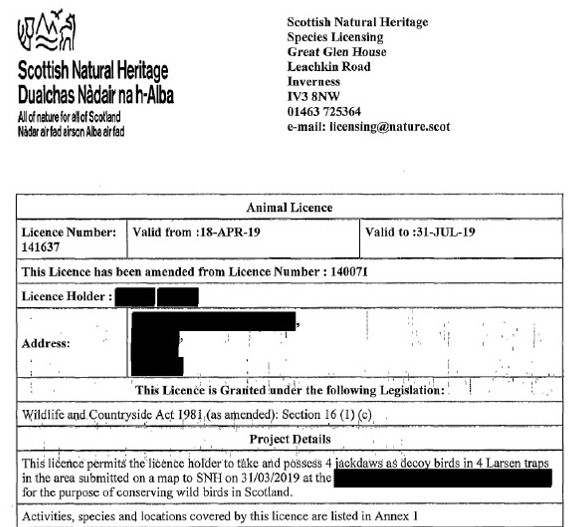
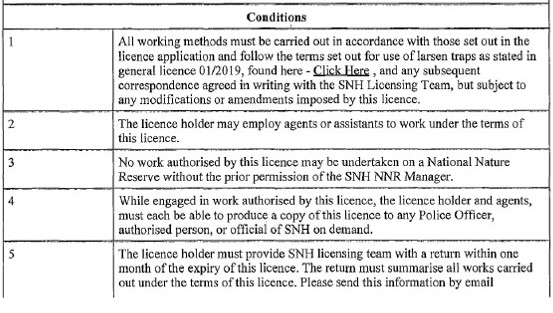
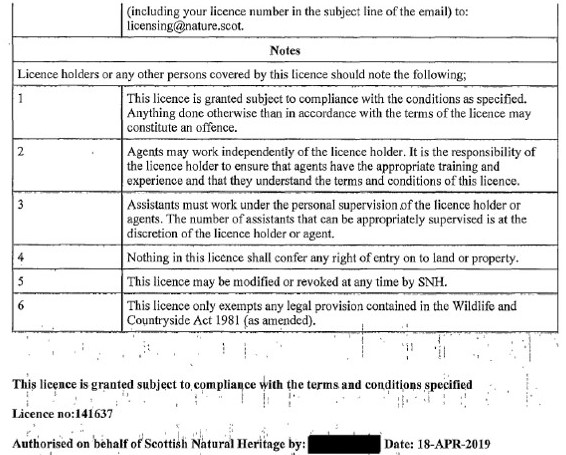
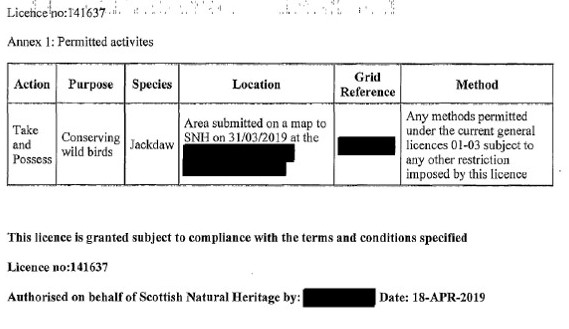
General Licences are issued annually by the statutory conservation agencies and permit the ‘casual killing’ of an unlimited number of birds (crows, jackdaws, rooks and others), which may be killed under certain circumstances but without any monitoring or reporting requirements. It can be carnage (e.g. see here for a new report on the scale of the killing).

Last spring Wild Justice successfully challenged Natural England over the legality of the English General Licences which has led to subsequent reviews and revisions by statutory agencies in England, Wales and Scotland. These reviews are expected to result in significant changes to the General Licences in each country, such as a reduction in the number of species which may be killed and a tightening up of the circumstances in which they may be killed.

SNH undertook a public consultation and the revised Scottish General Licences were expected to be published on 1 January 2020. However, yesterday consultation respondents received the following email from SNH:

I am writing to you to provide a quick update on the General Licensing regime in Scotland for 2020. Our consultation closed on the 9th October and we received over 700 responses, so thank you for sharing your views on the importance of GLs and your experience of how they are currently working. As you are aware, the key areas we were seeking views on were primarily aiming to:

i. Help inform the evidence base and rationale for inclusion of certain species currently listed on GLs in Scotland.

ii. Help inform whether there are other satisfactory solutions available without recourse to management under licence.

We have been working hard to analyse the consultation responses, supplemented by additional intelligence gathered from a series of bilateral meetings we held with some of you during the consultation period. It is clear that GLs remain an important and useful mechanism to help regulate wildlife to manage conflicts with key areas of public interest.

In order for us to provide a licensing service which is enabling, proportionate and legally compliant, the challenge remains to balance species conservation with the wide range of other legitimate activities, interests and concerns from land management to public health and safety. As a result, and following feedback from our most recent analysis, we are proposing to make some changes to the species listings for most of 2020 and a number of additional modifications.

Due to the nature of these changes and the time required to help people understand and prepare they won’t come into effect until the 1st April 2020. This means we will be extending the existing GL’s in their current format until the 31st March. It is our intention to discuss these changes further with you early in the New Year and we will plan to have draft licences available to view and discuss prior to the changeover date.

In the meantime, if you have any queries please do get in touch with the Licensing Team.  General Licences for 1 January to 31 March 2020 will be published on our website by this Friday 20 December.

Kind Regards,

Robbie

Robbie Kernahan | Head of Wildlife Management

ENDS

It seems entirely sensible that SNH is planning to discuss the proposed changes early in the New Year, rather than publish them without warning at one minute after midnight on 1st April 2020 and then expect everyone to immediately understand and comply with the new rules. However, it’s also worth noting that this delay coincides with two months (Feb & March) where routine bird killing is especially prevalent. Hmmm. If SNH has reduced the number of species that may be killed under the General Licences we can probably expect a massive onslaught against those particular species in February and March, just as was seen in England when Natural England announced the imminent withdrawal of General Licences in April 2019.

It’ll be interesting to see just how significant the new licence changes are from SNH and of course, whether the new licences are lawful….

Scottish Parliament evidence session on proposed wildlife crime penalties increase

Raptor Persecution UK was one of a number of organisations giving evidence to the Scottish Parliament’s Environment, Climate Change & Land Reform (ECCLR) Committee last week on the proposed increase in penalties for wildlife crime.

The Animals and Wildlife (Penalties, Protections & Powers) (Scotland) Bill was introduced by Environment Cabinet Secretary Roseanna Cunningham on 30th September 2019 (see here for associated docs) and will, amongst other things, increase the maximum available penalties for the most serious animal welfare and wildlife offences.

See here for an earlier blog on this subject.

The Bill is currently at Stage 1 and the ECCLR Committee has been taking evidence from a wide range of authorities and organisations. Last Tuesday saw representatives from the grouse shooting industry, conservation organisations, Police Scotland, SNH and the Crown Office sharing their opinions in an informal round-table discussion:

The transcript can be read here: ECCLR report_10Dec2019

The archived video can be watched here

We’ll come back to some of the detail of this discussion in further blogs, particularly about some of the claims made by BASC in relation to the supposed effectiveness of general licence restrictions, where the evidence simply doesn’t support some of the assertions made.

We’ll also be considering the claim from the Scottish Gamekeepers Association that “A five-year jail term will mean that more people will go to jail than has been previously the case“. Really? Why’s that, then? Are more gamekeepers at it than are currently being caught? Surely not. And how will an increased penalty mean more offenders are jailed? You’ve got to catch them first and then have sufficient evidence to get them in to court.

This Bill is very welcome as it stands, but perhaps more importantly it also has the potential to include some pretty useful amendments as it progresses through Parliament. Of particular interest to us is that increased powers for the SSPCA is back on the table. Given the complete failure of the Scottish Government’s alternative course of action (Police Special Constables in the Cairngorms National Park – a scheme that failed to report a single wildlife crime), it seems the timing is just right.

Environment Minister Mairi Gougeon will be giving evidence to the ECCLR Committee tomorrow and will no doubt face questions about some of the proposals already heard.

SNH reinstates General Licence use on Leadhills Estate during appeal process

In late November 2019 Scottish Natural Heritage (SNH) imposed a three-year General Licence restriction on Leadhills Estate, South Lanarkshire, after receiving what it described as “clear evidence” of wildlife crimes from Police Scotland (see here, here and here).

Those alleged offences included the ‘illegal killing of a short-eared owl, two buzzards and three hen harriers’ that were ‘shot or caught in traps’ on Leadhills Estate since 1 January 2014 (when SNH was given the power to impose a General Licence restriction on estates or individuals in Scotland). SNH has also claimed that ‘wild birds’ nests have also been disturbed’, although there is no further detail on this. The estate has consistently denied responsibility.

[The body of a shot short-eared owl that was found shoved under some heather on Leadhills Estate in May 2017. Photo by RSPB Scotland]

The General Licence restriction was imposed on Leadhills Estate on 26 November 2019.

It lasted for just 14 days.

On 10 December 2019, a notice appeared on SNH’s website announcing that the restriction had been lifted due to an on-going appeal:

This means that Leadhills Estate can, until further notice, go back to using General Licences 1, 2 & 3 to lawfully kill hundreds if not thousands of certain bird species (e.g. crows) on the estate without having to report its activities to anybody.

Leadhills Estate is perfectly entitled to appeal SNH’s decision to impose the General Licence restriction. SNH has a clearly-explained policy on its appeals procedure, which states an appeal must be made within 14 days of SNH’s decision to impose the restriction and that appeal must be in writing. From the information available in the public domain it looks like Leadhills Estate has met this deadline.

An appeal has the immediate effect of suspending the General Licence restriction from the date SNH receives the appeal letter. SNH now has to consider the appeal and must notify the estate of the appeal outcome in writing, setting out the reasons behind the decision. SNH says it will seek do this within four weeks of receiving the appeal letter.

We’ll be monitoring this case very carefully.

There’s quite a lot of deja vu going on here. You might remember that Raeshaw Estate (Scottish Borders) was one of the first to be slapped with a General Licence restriction back in November 2015 (see here). That restriction only lasted for six days before the estate appealed (see here). The appeal failed and two and half months later the General Licence restriction was re-imposed on the estate (see here).

However, a couple of months later the General Licence restriction was suspended again when Raeshaw Estate took SNH to judicial review (see here). Raeshaw lost the judicial review when the court decided SNH had acted fairly so the General Licence restriction was re-instated on the estate, again, approximately one year later (see here). Interestingly, SNH did not backdate the restriction order so effectively Raeshaw Estate didn’t serve a full three-year restriction at all, thanks to all the legal disruption.

During this time Raeshaw employees also applied for individual licences to permit the continued killing of birds on the estate (e.g. 1,000 birds reported killed under one of these licences, see here), but then even the individual licence was revoked after SNH found ‘multiple instances of breaches of conditions of an individual licence that had been granted to cover essential management activities‘ (see here). SNH also said ‘These breaches may also constitute offences under the Wildlife and Countryside Act, so SNH has reported the details to Police Scotland‘. We’re not aware of any pending prosecution in relation to these alleged offences. And SNH chose not to extend the General Licence restriction further, in light of these breaches, even though it had the powers to do so (see here).

The link between Raeshaw Estate and Leadhills Estate, apart from them both being grouse shooting estates and the subject of a General Licence restriction for ‘clear evidence of wildlife crime’? Leading sporting agent and grouse moor ‘guru’ Mark Osborne, whose company J M Osborne & Co is believed to be involved at both estates (involved as in ‘present’, not involved as in ‘guilty of wildlife crime’ – SNH has made clear that a General Licence restriction does not infer responsibility for the commission of crimes on any individuals).

Also of interest, to us at least, is the ownership of Leadhills Estate, which has belonged to the same family (the Hopetouns) for more than 300 years, according to the estate’s website:

It’s also of great interest that not only is Leadhills Estate a member of Scottish Land & Estates (who, incidentally, have said absolutely nothing about this General Licence restriction so far), but that Lord Hopetoun is chair of Scottish Land & Estate’s Scottish Moorland Group:

If Leadhills Estate’s appeal fails and SNH re-instates the General Licence restriction, we’ll be expecting a full response from both Scottish Land & Estates and the Scottish Moorland Group.

UPDATE 9 January 2020: Decision due on General Licence restriction for Leadhills Estate (here)

Chris Packham to address Scottish Parliament on grouse moor reform

Press release from Revive, the coalition for grouse moor reform (10 December 2019).

Grouse moor reform campaigners celebrate a year of success on last day of grouse shooting season

TV presenter and naturalist Chris Packham to address Scottish Parliament event on behalf of Revive, the coalition for grouse moor reform.

Revive, the coalition for grouse moor reform is using the last day of the grouse shooting season to highlight a year of successes since its launch at the end of 2018. The campaign, which is supported by TV presenter and naturalist Chris Packham, brings together several charities across social, environmental and animal welfare sectors, working together to reform Scotland’s grouse moors.

[Members of Revive with Andy Wightman MSP and Chris Packham at the coalition’s launch in Edinburgh, November 2018].

Chris Packham said:

Revive is a proper partnership between intelligent groups that has immediately delivered a vision for a better Scottish landscape, a better future for Scotland. Everyone is sick of the illegal killing, the mass legal killing, the slaughter of mountain hares, the burning, the draining, the poisoning… and Revive has coolly and calmly exposed and explained these horrors at the same time as developing a viable alternative to the misery of driven grouse shooting. A healthy, sustainable and productive landscape that will offer people and wildlife a harmonious future. All in one year! Top work I’d say!

The coalition was created to challenge the intensive management of land across vast swathes of Scotland’s uplands. Up to almost a fifth of Scotland’s entire land mass is managed for grouse shooting, and despite popular perception these moors are not natural. Much of this land is intensively managed to create a habitat suitable for one wild species, the red grouse, which is effectively farmed to be shot for entertainment.

Campaign Manager Max Wiszniewski said:

The Revive coalition was launched with one clear aim – significant reform of Scotland’s grouse moors to benefit our environment, our communities and our wildlife.

“Over the last twelve months we have been overwhelmed with the support for Revive with thousands of people joining our movement to campaign to take back ownership of Scotland’s uplands and end the circle of destruction that surrounds grouse moors.”

The coalition is calling for:

● The protection of peatland on Scotland’s moors, ending muirburn for grouse moor management

● A ban on the use of medicated grit

● A change to non-lead ammunition

● Regulation of off-road hill tracks

● Transformational land reform

● An end to the cruel killing of animals on grouse moors

● An end to driven grouse shooting

Over the last twelve months the campaign has notched up a number of successes including the creation of a catalogue of independent, evidence-based reports to support the campaign asks. These include The Case for Reforming Scotland’s Driven Grouse Moors, authored by Dr Ruth Tingay and Andy Wightman; Back to Life: Visions of Alternative Futures for Scotland’s Grouse Moors, by Common Weal, Untold Suffering by the League Against Cruel Sports and OneKind; and the most recent A Better Way, written by Dr Helen Armstrong. A Better Way explores the impact of grouse moors on carbon, wildlife and communities, illustrating how intensive management contributes to devastated, man-made landscapes void of trees and wildlife.

Dr Richard Dixon, Director of Friends of the Earth Scotland said:

This important report describes how a transition to a more wooded landscape would start to bring the land back into good health, providing benefits for both people and wildlife. From flood risk and landslip reduction to an increased diversity of wildlife, more productive soils and the protection of the vital store of carbon that is locked up in our peatlands, transforming heavily managed grouse moors into a rich diversity of wooded and open habitats has many benefits. For the sake of our wildlife, our rural communities and the global climate, change needs to come soon.”

As well as publishing a series of reports the coalition has hosted successful events including the first Revive conference in August which sold out in days, and has exceeded capacity at party political Fringe events. A campaign pledge supporting the coalition has attracted in excess of 14,000 signatures.

To mark the end of the grouse shooting season the coalition is holding a Garden Lobby reception in the Scottish Parliament which will be addressed by Chris Packham.

[Chris Packham has recently accused the Scottish Government of dragging its heels when it comes to tackling illegal raptor persecution on driven grouse moors. Photo by Ruth Tingay]
This evening’s event is hosted by Ruth Maguire MSP, who said:

I’m delighted to host this Revive event in our Scottish Parliament and in particular look forward to the address from respected naturalist Chris Packham. The Revive campaign has made a real impact and people right across Scotland from across the political spectrum are now seeing the potential environmental, public health, and economic benefits reform could bring.”

A report following a Scottish Government commission led by Professor Werritty on sustainable grouse moor management is expected to be published before the end of the year.

ENDS

Hen harrier found shot & two others ‘disappear’, all on Scottish grouse moors

Press release from RSPB Scotland (9 December 2019)

Hen harrier found dead while two others disappear in suspicious circumstances

RSPB Scotland is appealing for information following the discovery of the body of a hen harrier found to have been shot and the sudden disappearances of two young satellite tagged hen harriers.

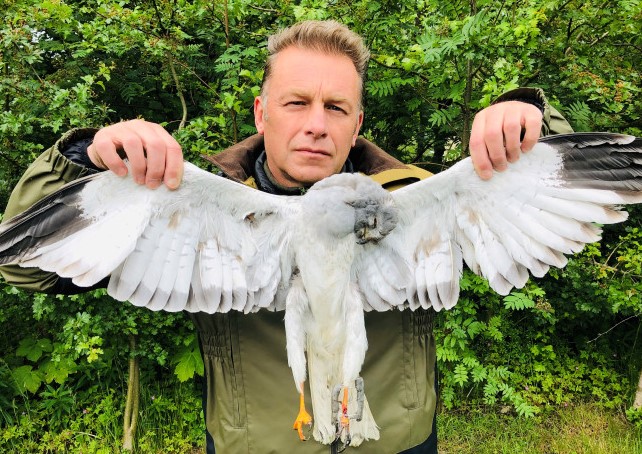
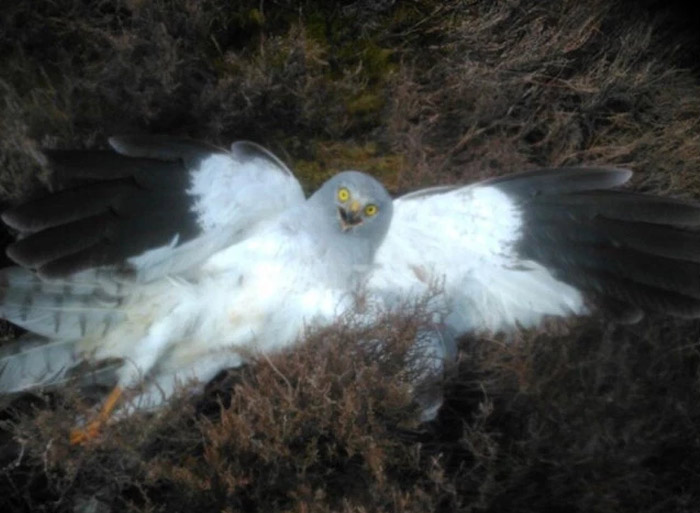
A member of the public found the dead female bird on a grouse moor on the Dumfries-shire/South Lanarkshire boundary near the village of Wanlockhead on 7 June 2019. A post mortem examination of the body by SRUC vets confirmed that the bird had died as a result of “penetrating trauma” injuries of unknown cause, with shooting a possibility. The examination also showed that the bird had previously been shot, with a shotgun pellet recovered from the left breast muscle. An investigation by Police Scotland has not identified a suspect for the bird’s shooting.

The birds who have disappeared in suspicious circumstances were fitted with satellite tags under licence by the RSPB’s Hen Harrier LIFE project team this summer while they were still in the nest. Romario, a young male, fledged from a nest on National Trust for Scotland’s Mar Lodge Estate, while Thistle, a young female, was tagged on an estate in Easter Ross.

Romario was last recorded on 11 September on a grouse moor between Tomintoul and Grantown-on-Spey, while the last transmission from Thistle’s tag was received on 12 October, from another grouse moor, in east Sutherland. Satellite tags are highly reliable, so sudden stops in transmission give immediate cause for concern.

Since the birds fledged the tags had been tracking their movements as they set out on their own. Romario had made his way slowly north, spending time in western Aberdeenshire, before moving into Moray. Thistle, who had been named by the children of Sunnyside Primary School in Glasgow, headed west to into Strathoykel for almost a month before journeys to the east and north of here. She then returned to Strathoykel, before again heading east prior to her disappearance.

This appeal for information follows the suspicious disappearance of another Scottish harrier tagged by the project being investigated by Northumbria Police – Ada hatched and was tagged in the Scottish Borders this summer and was last recorded in the North Pennines in England, an area known for bird of prey persecution. When she first fledged she had spent some time in lowland East Lothian before heading south; her tag’s last transmission was on 10 October in a grouse moor area near Allendale in Northumberland. RSPB England issued an appeal for information about her last month.

Despite laws to protect them, hen harriers remain one of the UK’s rarest and most persecuted birds of prey. From satellite tagging data they are known to be ten times more likely to be illegally killed over grouse moors where the land is managed specifically to raise artificially high numbers of red grouse, which are then shot, than any other land use.

Studies suggest there are only around 575 pairs of hen harrier remaining in the whole of the UK and Isle of Man. The vast majority of these pairs – 460 – are in Scotland, making the population here crucial to the future of this species in the UK.

Dr Cathleen Thomas, RSPB’s Hen Harrier LIFE Project Manager said: “We’re devastated to have lost more young birds in suspicious circumstances. The UK’s hen harrier population is in such a precarious position it means that every bird really does count and to have these ones disappear at such a young age is really concerning. Sadly, incidents such as this have become common place for our project with tagged hen harriers disappearing at alarming regularity every year, and it’s really worrying that a young female bird has been shot.”

Duncan Orr-Ewing, Head of Species and Land Management at RSPB Scotland said: “The project satellite tags don’t stop transmitting if a bird dies of natural causes. To have them go offline suddenly and without warning strongly suggests the hen harriers have been the victims of crime, as in the case of the shot bird. Scotland is leading the way in the UK in terms of legislation to tackle bird of prey persecution, but continuing incidents such as this show that existing measures are not enough. There needs to be robust regulation of driven grouse shooting if crimes against some of this country’s incredible wildlife are to be brought to an end.”

If anyone can provide information about these incidents or any illegal persecution of birds of prey, please contact Police Scotland on 101, or call the RSPB’s confidential raptor crime hotline on 0300 999 0101.

ENDS

New Revive coalition report offers alternatives to environmental devastation of Scottish grouse moors

Yesterday the Revive coalition published a new report detailing the scale of animal suffering on Scottish grouse moors (see here).

Today the coalition has published a second commissioned report, outlining alternatives to Scottish grouse moors that could help tackle climate change, increase biodiversity and benefit Scotland’s people.

Authored by Dr Helen Armstrong, an ecological consultant specialising in sustainable land management, the report can be downloaded here: A Better Way_Revive Report

This report, along with the Untold Suffering report, will be discussed at Revive’s Parliamentary reception at Holyrood tomorrow and hard copies will be distributed to every MSP.

Sev Carrell has an exclusive on the latest report in today’s Guardian here which includes a quote from Dr Richard Dixon, Director of Friends of the Earth Scotland. Discussing the  potential findings of the forthcoming Werritty report, Richard says:

Licensing [of grouse moors] would be welcome but we would like to go further than that, by promoting a much more comprehensive move to more sustainable land use”.

The article also includes a quote from Sarah-Jane Laing, the chief executive of Scottish Land and Estates, the grouse moor owners lobby group.

Sarah-Jane said, “Such land management [grouse moors] is funded privately and without management for grouse it is likely that the motivation for many of these benefits would disappear”.

Really?

She’s obviously ‘forgotten’ about the Cairngorms Connect project, a partnership of neighbouring land managers committed to a bold and ambitious 200-year vision to enhance habitats, species and ecological processes across a vast area within the Cairngorms National Park.

She’s also obviously ‘forgotten’ about what’s going on at Langholm, where the local community, with the help of crowdfunding support, is planning a buy-out of the knackered old grouse moor to turn it in to a species-rich nature reserve to benefit local people, nature conservation and tourism (see here, here and here).

If you support significant reform of Scotland’s grouse moors please sign Revive’s call for change here

Scale of animal suffering on Scotland’s grouse moors revealed in new report from Revive coalition

Press release from Revive (8 December 2019)

Animal welfare charities publish new report highlighting the scale of suffering on Scotland’s grouse moors

Leading animal welfare charities have published a new report illustrating industrial scale suffering on Scotland’s grouse moors to sustain the grouse shooting industry.

Untold Suffering, published by the League Against Cruel Sports Scotland and OneKind, documents the extent to which animals are being killed and subjected to negative welfare impacts to ensure grouse stocks are kept artificially high to be shot for entertainment.

The report which includes a foreword from TV presenter and naturalist Chris Packham, describes the circle of destruction that surrounds grouse moors to effectively wipe out any species which pose a threat to game birds stocks. It highlights a number of case studies illustrating the types of suffering endured by a range of different species, including protected and domestic animals.

The charities are calling for:

● An independent review of the welfare implications of all traps, conducted by animal welfare scientists.

● A ban on snares, stink pits, Larsen traps, the use of decoy birds and mountain hare culls.

● An end to driven grouse shooting.

● A system of mandatory proficiency tests and licenses for all shooters.

● All wildlife management carried out in Scotland to conform to the seven principles of Ethical Wildlife Control.

Director of the League Against Cruel Sports Scotland, Robbie Marsland said: “Thousands and thousands of animals are condemned to die a cruel death that fuels the circle of destruction that surrounds grouse moors – all to make sure there are more grouse to be shot for entertainment. It’s time for this madness to end.”

Director of OneKInd Bob Elliot added: “The report helps to raise awareness of the physical and mental suffering inflicted on the animals caught in these cruel traps and snares. The level of suffering inflicted on these wild animals, that will often die slow, agonising deaths, is completely unacceptable and would be illegal if inflicted on our pets.

‘’OneKind calls for a complete ban on these cruel and antiquated traps and snares and we’ve recently petitioned the Scottish Parliament to end these wildlife killings in Scotland.’’

As well as making a series of recommendations the report includes commentary from Romain Pizzi from the Royal College of Veterinary Surgeons, describing the welfare impacts of the trapping and killing methods outlined in the report. In one case study, where a pine marten which has become trapped in a spring trap, Romain comments:

There is no doubt in my mind that this pine marten suffered severe pain and distress. Considering that it is an intelligent carnivore, probably the best way one can empathise with the animal’s suffering is to imagine a pet dog undergoing the same experience.”

The report was commissioned by Revive, the coalition for grouse moor reform. The coalition partners are OneKind, League Against Cruel Sports Scotland, Common Weal, Friends of the Earth Scotland and Raptor Persecution UK.

ENDS

The report can be downloaded here: Untold Suffering_Revive Report

A hard copy of this report will be sent to every MSP in the new year. It will also feature at the Revive coalition’s parliamentary reception later this week to mark the end of this year’s grouse shooting season.

If you support significant reform of Scotland’s grouse moors please sign Revive’s call for change here

Special Constables pilot scheme in Cairngorms National Park a waste of time & money

Two and a half years ago, Environment Cabinet Secretary Roseanna Cunningham announced a pilot scheme whereby Police Special Constables would be deployed in the Cairngorms National Park to tackle wildlife crime.

This initiative was one of a number of measures announced in May 2017 in response to the findings of the golden eagle satellite tag review which showed clear evidence of deliberate and sustained illegal raptor persecution, particularly on some driven grouse moors in and around the Cairngorms National Park (CNP).

This RPUK map shows the last known location of satellite-tagged golden eagles that were either found illegally killed or had disappeared in suspicious circumstances in and around the CNP (data from the golden eagle satellite tag review):

Golden eagles are not the only victims of wildlife crime in and around the CNP. This RPUK map below, based mostly on RSPB data, shows raptor persecution incidents between 2005-2016. Only one of these (just outside the CNP boundary on Kildrummy Estate) has resulted in a successful prosecution. With such clear evidence of wildlife crime it’s easy to see why the CNP was chosen as the first location for this pilot scheme.

This pilot scheme was the Government’s alternative to extending the powers of the SSPCA to allow it to investigate a wider suite of wildlife crime (including raptor persecution) – a decision made after six years of Governmental deliberation under five different Environment Ministers.

It also emerged in 2018 that this pilot scheme was an alternative to the Government’s 2016 manifesto pledge to establish a Wildlife Crime Investigation Unit as part of Police Scotland – a pledge on which it has now reneged (see here).

The idea was that the police special constable scheme could be rolled out across Scotland “if judged to be successful” in the CNP, but we weren’t told the criteria that would be used to judge this ‘success’.

The scheme was formally launched in March 2018 (see here) and nothing more was heard of it.

Just over a year later in April 2019 we asked the Cairngorms National Park Authority the following questions about the scheme:

Here’s the response:

So basically after a year of operation, one of the main project partners couldn’t tell us anything about the scheme.

Fast forward six months to November 2019 and Scottish Greens MSP Mark Ruskell thought it was time more questions were asked. Here are his two Parliamentary questions and Roseanna Cunningham’s answers:

S5W-26349 Mark Ruskell (Mid Scotland and Fife) (Scottish Green Party): To ask the Scottish Government how much funding (a) it and (b) the Cairngorms National Park Authority allocated each year to the Wildlife Special Constables pilot project.

Roseanna Cunningham: The Scottish Government agreed to contribute £18,000 and the Cairngorms National Park Authority agreed to provide £10,000 for the Wildlife Special Constables pilot project.

S5W-26346 Mark Ruskell (Mid Scotland and Fife) (Scottish Green Party): To ask the Scottish Government what the outcome was of the Wildlife Special Constables pilot project; how many constables participated each month in this, and how many suspected crimes they reported, also broken down by how many led to subsequent (a) arrests, (b) charges, (c) prosecutions and (d) convictions.

Roseanna Cunningham: a)The Scottish Government is currently undertaking an evaluation of the Special Constable Pilot Project in conjunction with Police Scotland and the Cairngorms National Park Authority. We will announce a decision on the future direction of the project in due course.

b) There were five special constables in the project, employed on a part-time basis.

c) and d) From the information gathered in the review conducted by Police Scotland, there were no recorded crimes reported by the Special Constables during their patrols in the 12 month trial period. However, Special Constables were involved in meeting stakeholders and partners operating within the Cairngorms National Park to build relationships and understand the needs and demands of National Park users which will aid future intelligence gathering.

Gosh, it’s easy to see why the Scottish Government’s evaluation of the pilot scheme is taking so long, what with having to count ZERO reported wildlife crimes.

Meanwhile satellite tagged raptors continue to disappear in suspicious circumstances in the Cairngorms National Park (white-tailed eagle here; hen harrier here; hen harrier here and hen harrier here); birds are still being illegally poisoned in the Cairngorms National Park (here) and birds of prey are still being caught by illegally-set traps in the Cairngorms National Park (golden eagle here).

But it’s ok, nothing to worry about because £28K has just been spent on ‘building relationships and understanding the needs and demands of National Park users’.

FFS.