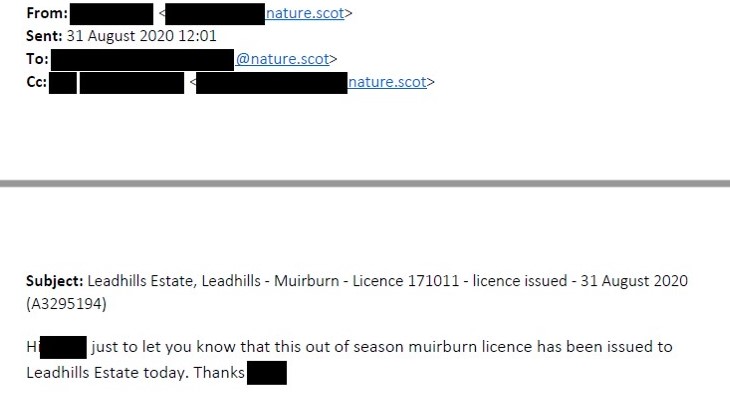
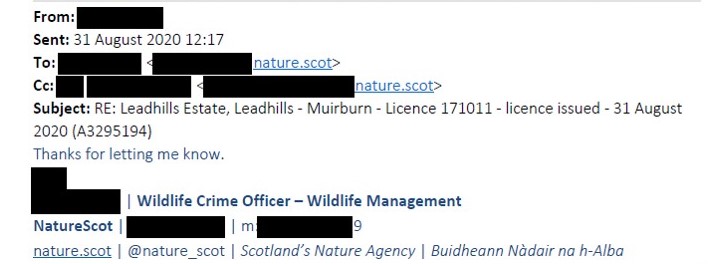
Over the last few weeks a series of Freedom of Information requests has revealed that Scottish Natural Heritage (now rebranded as NatureScot) issued an out-of-season muirburn licence to Leadhills Estate, allowing gamekeepers to set fire to parts of the grouse moor in September 2020.
Four blogs have been written about it: here, here, here and here.
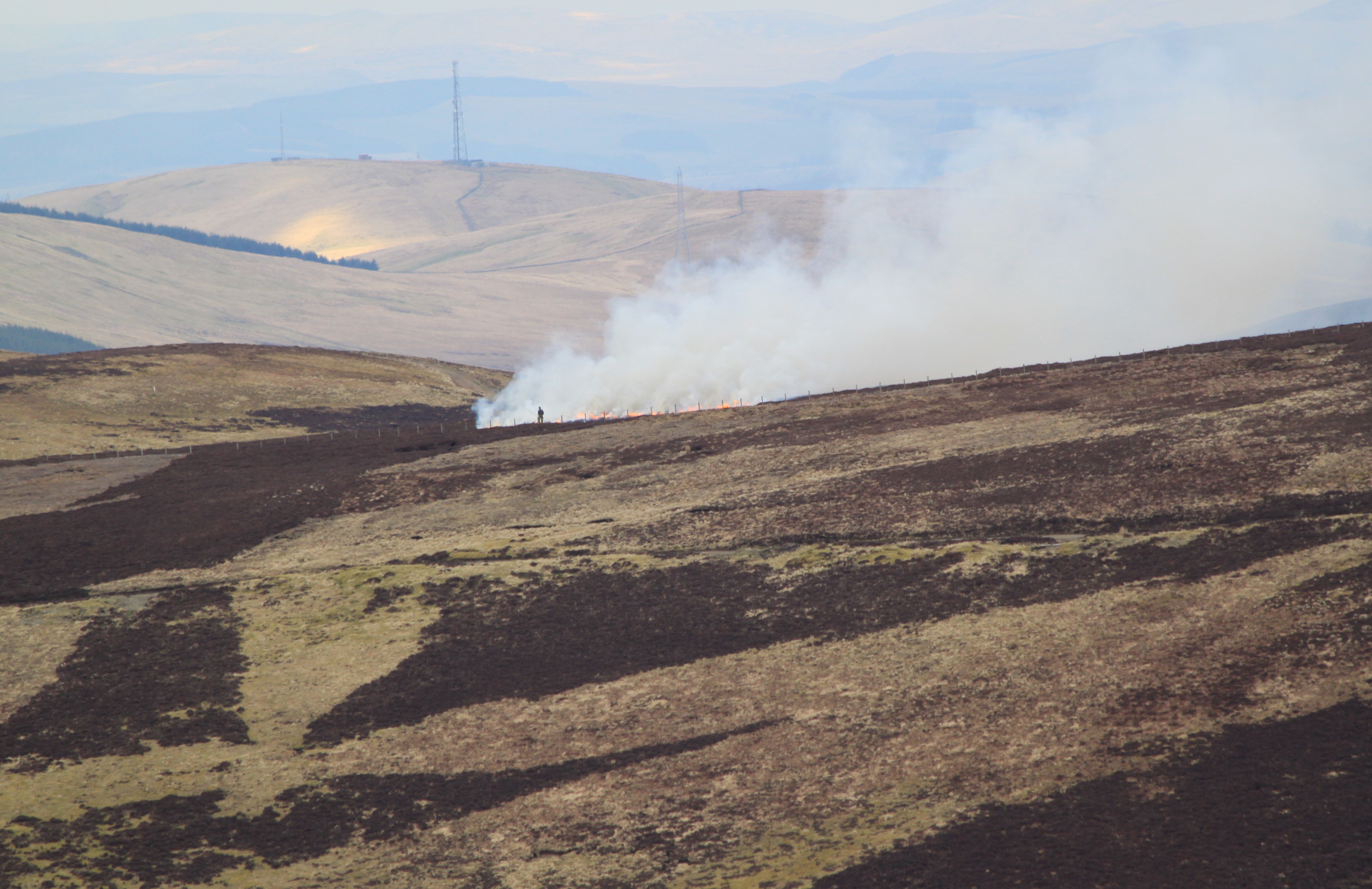
[Grouse moors at Leadhills Estate, photo by Ruth Tingay]
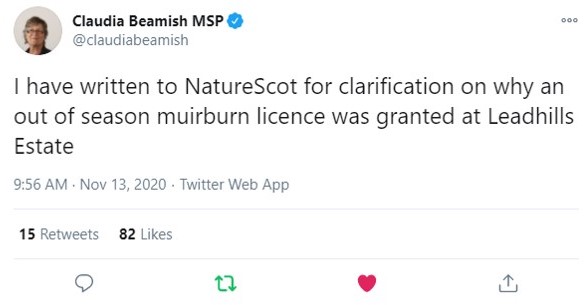
Well this is a question being asked by Claudia Beamish MSP, according to her Twitter feed today:
Claudia is very familiar with the recent history of Leadhills Estate as it’s in her south Scotland constituency. Claudia is also the spokesperson on Environment, Climate Change and Land Reform for Scottish Labour so she’s well-versed in these issues and has regularly supported and hosted events for the Revive coalition for grouse moor reform.
Thanks, Claudia, it’ll be interesting to hear what SNH (NatureScot) has to say about this particular licence.
There’ll be another blog, shortly, on another out-of-season muirburn licence that SNH issued to Leadhills Estate…..
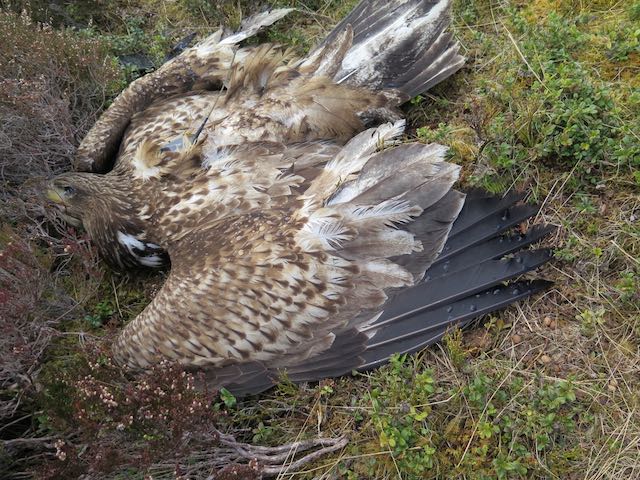
It’s been another year of shocking wildlife crimes being uncovered on grouse moors in the UK, including the illegal poisoning of this iconic white-tailed eagle, found dead on a grouse moor inside the Cairngorms National Park in the spring (see here).
[The poisoned white-tailed eagle, photo by Police Scotland]
Last week, Scottish Greens MSP Alison Johnstone lodged a Parliamentary question asking what assessment the Scottish Government has made of the impact on the rural economy of wildlife crime linked to grouse moor management (see here).
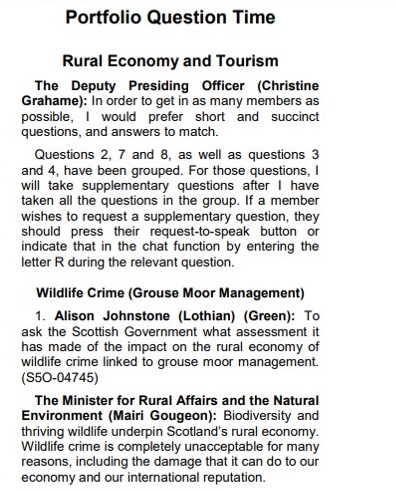
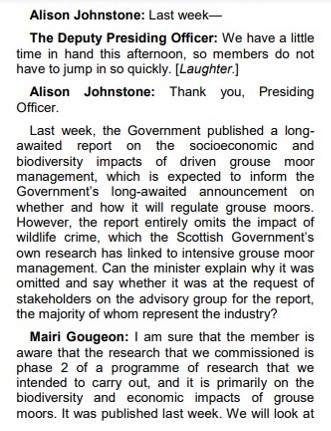
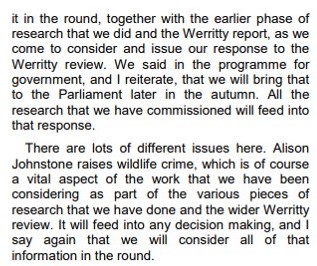
Her question, and a supplementary one, were ‘answered’ by Environment Minister Mairi Gougeon during Portfolio Question Time yesterday in the Scottish Parliament.
When I say ‘answered’, I use the term loosely. A more fitting word might be ‘sidestepped’.
Here’s how it went:
It’s good that Mairi Gougeon acknowledges the potential economic damage of wildlife crime linked to grouse moor management – it’d be insane to claim that the photograph of that poisoned eagle, laying dead on a grouse moor inside the Cairngorms National Park of all bloody places, would not have an economic impact and, as the Minister pointed out, on Scotland’s international reputation.
But the question Alison asked was ‘What assessment of that economic damage has the Scottish Government undertaken?’
None, it seems.
Still, as the Government’s response to the Werritty Review is imminent, we can all look forward to “decisive action” on wildlife crime linked to grouse moor management, as Environment Cabinet Secretary Roseanna Cunningham assured us all in August after a huge outpouring of public anger about this poisoned sea eagle (see here).
The scandal that is driven grouse shooting continues to feature prominently in the Scottish media as pressure continues to mount on the Scottish Government to respond to the Werritty Review on grouse moor licensing, a report that was submitted to the Government almost a year to the day (18 November 2019).
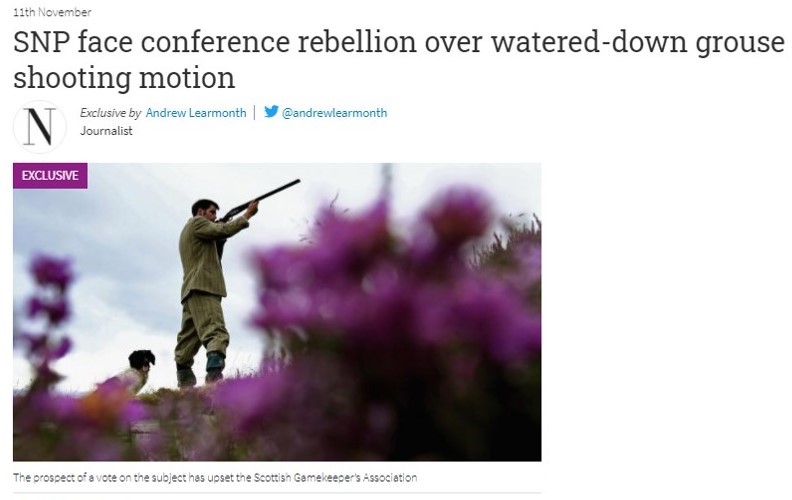
Last week The National ran an article on the 25 regional SNP branches who had submitted a motion for debate at the national conference calling for an end to driven grouse shooting in Scotland (see here).
The motion was proposed by councillor Julie Bell of Kirriemuir and Dean (Angus) and seconded by Ruth Maguire MSP. The resulting personal abuse hurled at them on social media from those with a vested interest in maintaining grouse shooting won’t have gone unnoticed by Julie, Ruth or their party colleagues and probably beyond.
Meanwhile, the motion appears to have been watered down considerably, despite being ‘the most backed resolution this year’, and as a result, Ruth Maguire MSP has lodged an amendment. The National ran an article on this yesterday, as follows:
THE SNP leadership faces a grassroots rebellion at this year’s conference over plans to end grouse shooting in Scotland.
The prospect of a vote on the subject has upset the Scottish Gamekeeper’s Association, who warn that the party risk alienating the countryside.
An initial motion to conference calling for an end to “unsustainable practices on grouse moors including the snaring, trapping and killing of hundreds of thousands of animals, muirburn and mass outdoor medication” was popular with members, being the most backed resolution put forward.
However, it was missing from the conference agenda. Instead there was another resolution which called for Scottish Government to continue its work “on regulating sporting estates in order to protect our biodiversity, native species and peatlands.”
MSP Ruth Maguire said this didn’t go far enough. Backed by her Holyrood colleague Christine Graham and a number of branches, she’s now submitted an amendment which urges the party to back the licensing of all shooting estates, and “move away from driven grouse shooting towards more sustainable and diverse land uses”.
Maguire said: “The original motion submitted to conference appears to be the most backed resolution this year showing the strength of support within the party for tackling Scotland’s grouse moors.
“For the huge swathes of Scotland they use up, driven grouse moors are one of the most destructive land uses in Scotland for our wildlife and environment, offering little economic benefit compared to other land uses.
“As recent polling shows almost three quarters of Scots are against grouse shooting and the SNP membership want the chance to put the party on the forefront of public opinion. This amendment, like the original motion, seeks to end the unsustainable practices of grouse shooting and in line with land reform, make our land work better for our people, our wildlife and the environment.”
Scottish Gamekeepers Association Chairman Alex Hogg said: “The SNP, down the years, has enjoyed strong levels of support within working gamekeepers, their families and extended groups in rural constituencies.
“These are ordinary, hard-working individuals and families who vote for people and parties they feel will represent the interests of their communities.
“Recent policy decisions have left them alienated. Land working people, just now, are angry.
“They feel the Scottish Government is no longer listening or supporting them, despite the many benefits their work brings to the Scottish countryside and economy.”
ENDS
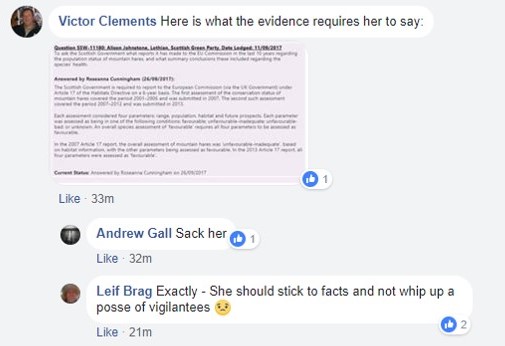
Funny, the so-called ‘strong levels of support’ for the SNP that I’ve seen from the SGA’s members and supporters over the last few years has consisted almost entirely of vile personal misogynistic abuse.
Here’s a short example targeting Environment Cabinet Secretary Roseanna Cunningham in March 2018 after she spoke to campaigners outside Holyrood about the mass slaughter of mountain hares on grouse moors (thanks to the blog reader who’s been compiling this material):
Roseanna hasn’t been the only target – First Minister Nicola Sturgeon has received ‘special attention’ as has Environment Minister Mairi Gougeon. And it’s not just female politicians in the SNP who have been at the receiving end of this disgraceful behaviour – politicians in the Scottish Greens and Labour have also been targeted, as have campaigners, bloggers, researchers, journalists, scientists, police officers, lawyers, raptor workers, tv presenters, bird ringers, satellite taggers, funders, charity workers, in fact anyone who dares even hint that driven grouse shooting is a Victorian throwback with huge environmental costs has been a victim of this abusive and targeted harassment.
Press release from the Revive coalition for grouse moor reform (12th November 2020)
Think tank claims Government report on driven grouse shooting shows the bloodsport is ‘economically unviable‘
A Scottish think tank, and coalition partner of Revive, says grouse moor management is a ‘loss-making activity’, claiming driven grouse shooting is ‘economically unviable’.
Common Weal’s comments come in response to recently published research into the socioeconomic and biodiversity impacts of driven grouse moors and the employment rights of gamekeepers, funded by the Scottish Government.
Head of Policy and Research for the Common Weal think tank, Craig Dalzell said:
“Following our analysis of the latest Scottish Government funded research, our strong view is that the conclusion that driven grouse moors have a positive economic impact without public subsidy is greatly overblown.
“Driven grouse shooting has been shown to be a loss-making activity reliant on other activities such as sheep farming to remain viable and thus often benefiting indirectly from significant public subsidy.
“With the climate emergency worsening and the time to avert it growing shorter, the Scottish Government should use this research as the basis for radical land reform and a major economic and ecological strategy based around conservation and regeneration of our uplands.
“Activities that this report states can create at least as much economic benefit as driven grouse shooting and often significantly more whilst also protecting the environment and helping to meet the Scottish Government’s commitments on climate change.”
The analysis from Common Weal also concludes that land managed for driven grouse shooting is at odds with the Scottish Government’s goal of a ‘Green New Deal Scotland’ and that land conservation, which is also subsidised, is ‘almost on par with driven grouse shooting in terms of overall revenue per hectare and results in substantially better returns in terms of environmental protection.’
Campaign Manager for Revive Max Wiszniewski added:
“It’s clear that any positive economic impact from grouse shooting is consistently exaggerated by those with a vested interest in maintaining it – relying on subsidies from other land uses to support it. Meanwhile hundreds of thousands of animals are snared, trapped and killed so more grouse can be shot for ‘sport’ while the environment is destroyed.
“For all the land it uses up, somewhere around half the size of Wales, it is estimated that grouse shooting contributes between 0.02% and 0.04% of Scotland’s overall economy. We welcome the fact that this report explores alternative land uses, all of which would be better for Scotland’s people, our wildlife and the environment.”
ENDS
For more info about Common Weal please visit the website here
For more information about the Revive coalition for grouse moor reform please visit the website here
Leadhills Estate, which has been at the centre of over 50 police wildlife crime investigations in the last two decades, has had two gamekeepers convicted for committing wildlife crime offences during that time, and is currently the subject of a three-year General Licence restriction, imposed after Police Scotland found ‘clear evidence’ of wildlife crimes having being committed by persons unknown in recent years, and is under further police investigation since more allegations have been made this year, was granted a licence by SNH to undertake out-of-season muirburn on estate grouse moors in September.
There have been some jaw-dropping revelations on this blog over the years but this one is right up there.
[Muirburn on Leadhills Estate, South Lanarkshire. Photo by Ruth Tingay]
A quick recap of the situation (for those who want more detail please see the links to previous blog posts below).
In April 2020 the Scottish Government temporarily banned all muirburn in Scotland under emergency Coronavirus legislation (see here).
Despite being in the middle of a pandemic, in July 2020 Mark Osborne, acting on behalf of Leadhills Estate, applied to Scottish Natural Heritage for an out-of-season licence to conduct muirburn on the estate in September after spraying some areas with glyphosate (see here).
Scottish Natural Heritage (now rebranded as NatureScot but that’s irrelevant) refused the licence application in August (here) and Osborne immediately appealed the decision (see here).
That’s where we left the saga last time. Here’s what happened next…..
SNH was obliged to consider Osborne’s appeal, although it wasn’t obliged to overturn it’s previous decision to refuse permission.
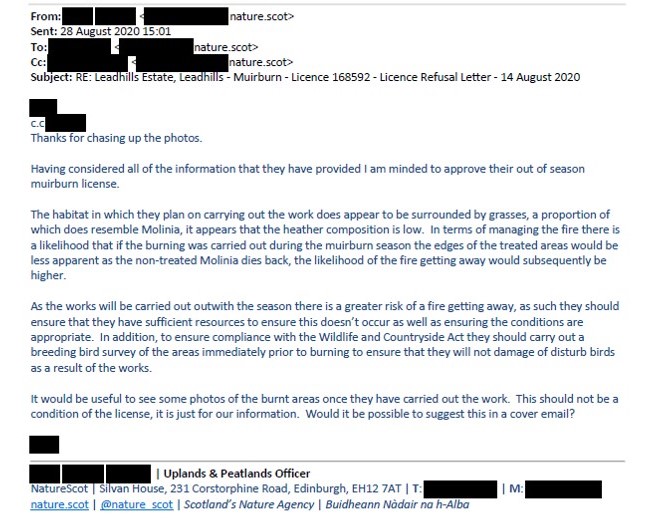
Here’s how SNH’s reconsideration went:
According to the Freedom of Information documents that have been released, that’s it. That’s the extent of the discussion at SNH about whether Leadhills Estate should be given permission to set fire to its grouse moors out of season and in the middle of a global pandemic.
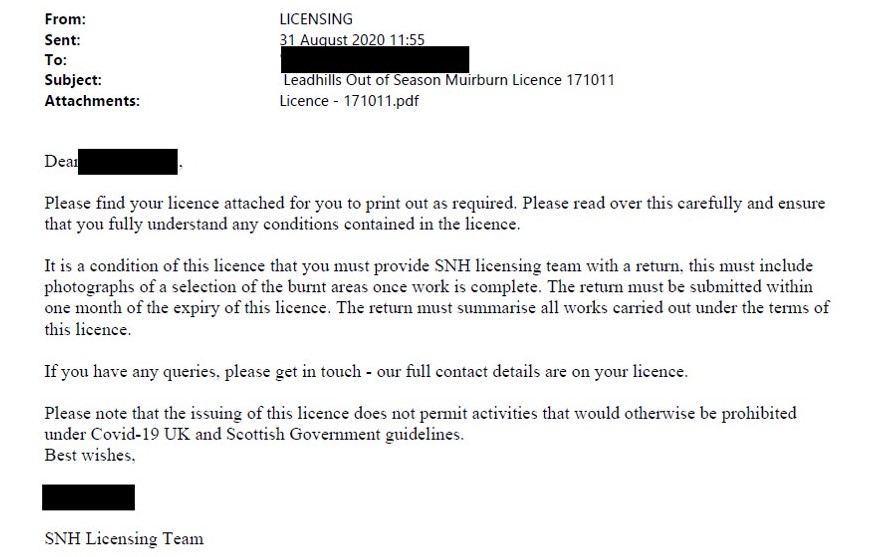
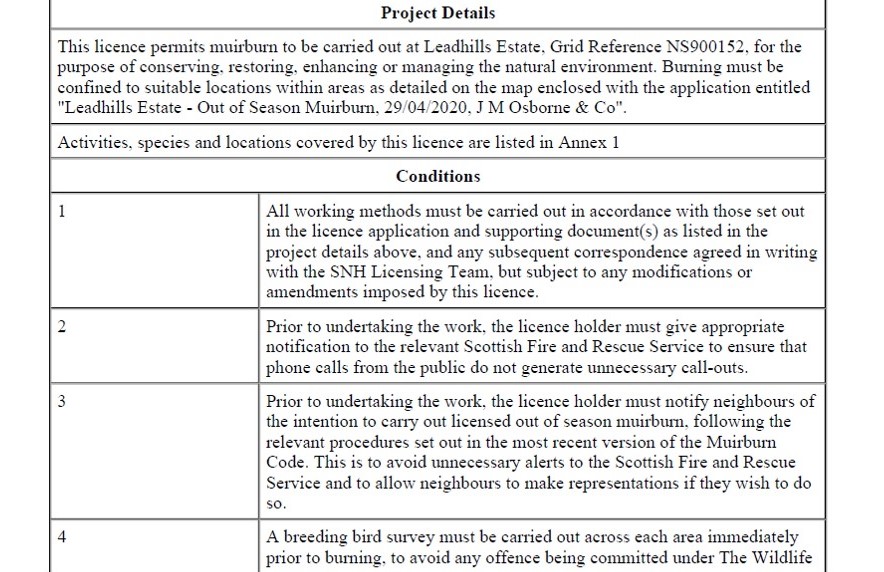
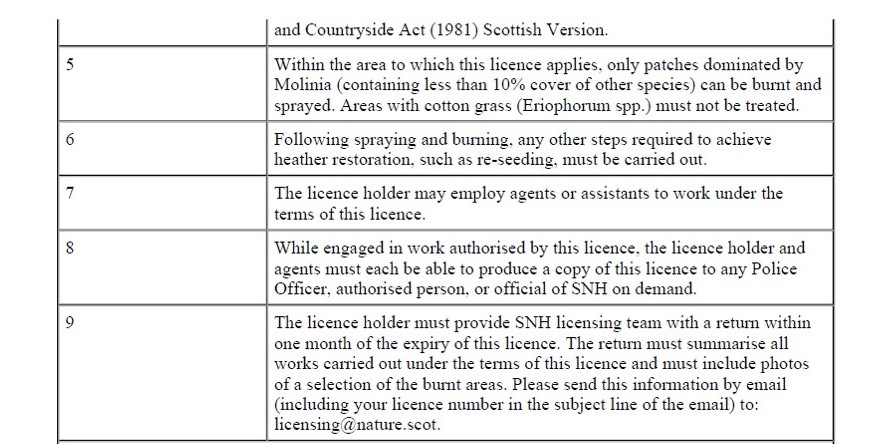
A couple of days later SNH wrote to advise Osborne of its U-turn decision and sent him the licence, as follows:
There has been some discussion amongst RPUK colleagues and associates about whether SNH’s decision to issue this licence was a breach of the Government’s emergency Coronavirus legislation which had temporarily banned muirburn until the official season opened on 1 October 2020. I might return to that topic.
However, of greater interest, to me, is how SNH’s decision-making on whether to issue an out-of-season muirburn licence apparently failed to consider the wider picture of what’s been going on at Leadhills, and especially the current three-year General Licence restriction placed on the estate, by, er, SNH. Didn’t anybody think about that?
Ah, well somebody did, but unfortunately it seems this person’s expert input wasn’t invited as part of the decision-making process:
There’s quite a lot to take in about this case, and the details and circumstances of this particular licence. An FoI has been submitted to SNH to see the licence return which, as detailed in condition #9, should have now been submitted to SNH by Osborne.
And it turns out that this isn’t the first year that SNH has granted an out-of-season muirburn licence to Leadhills Estate. More on that shortly.
For some reason, the phrases ‘taking the piss’ and ‘impotent licensing authority’ are uppermost in my mind.
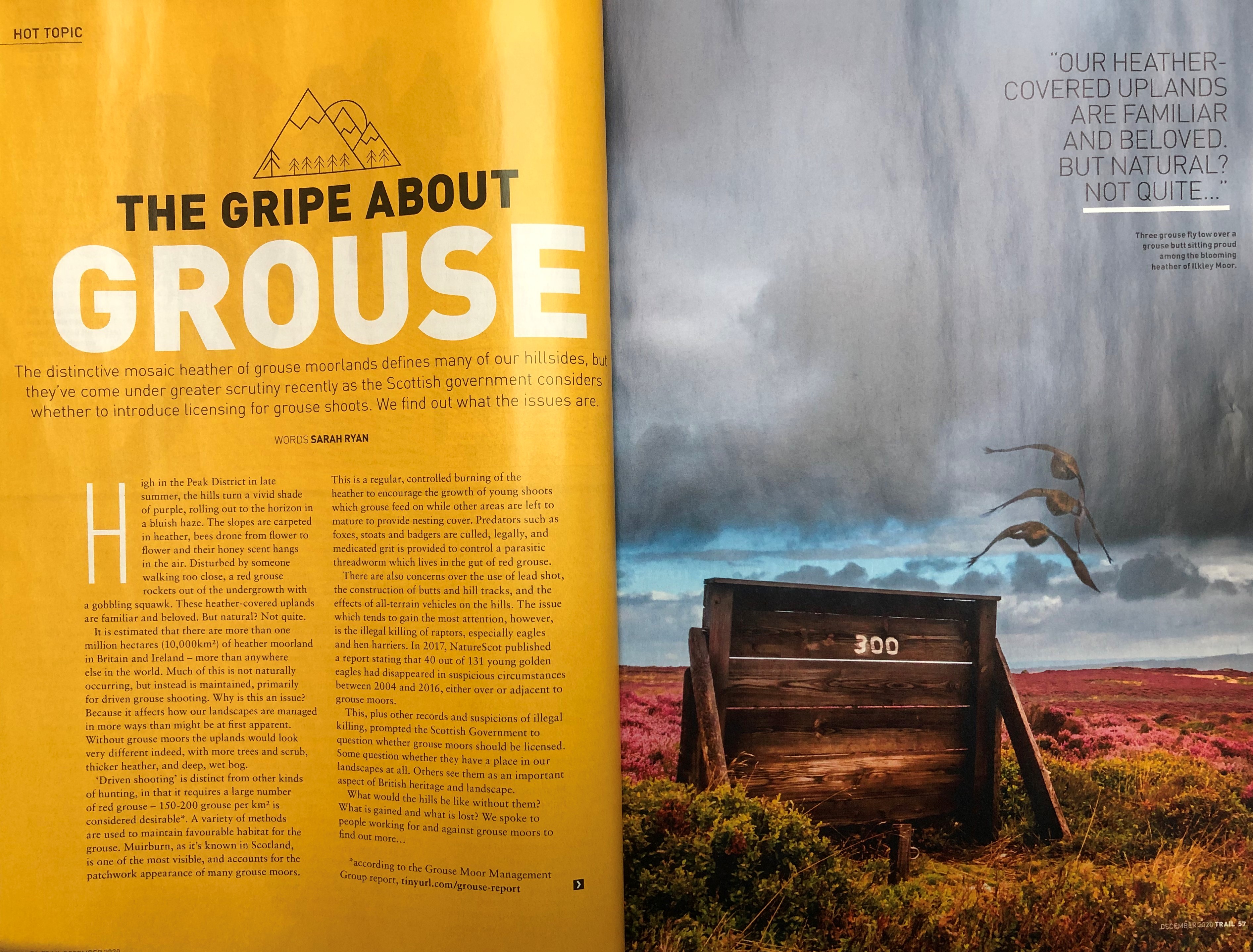
There’s a very good feature article on grouse shooting in the December 2020 edition of Trail magazine, apparently ‘The UK’s best-selling hillwalking magazine’.
Written by Sarah Ryan, it’s an excellent introduction to this controversial activity and is ideal for readers who may not already be familiar with the subject (with only a few minor inaccuracies – e.g. badger killing is an offence and shouldn’t be listed as legal predator control).
Sarah sets the scene with an overview, including an explanation of the difference between driven and walked-up shooting and the environmental costs and damage of associated practices such as muirburn, legal predator control, medicated grit, the use of lead ammunition, the construction of shooting butts and hill tracks, the use of all-terrain vehicles on sensitive habitats and of course the illegal killing of birds of prey, with a special focus on golden eagles and hen harriers.
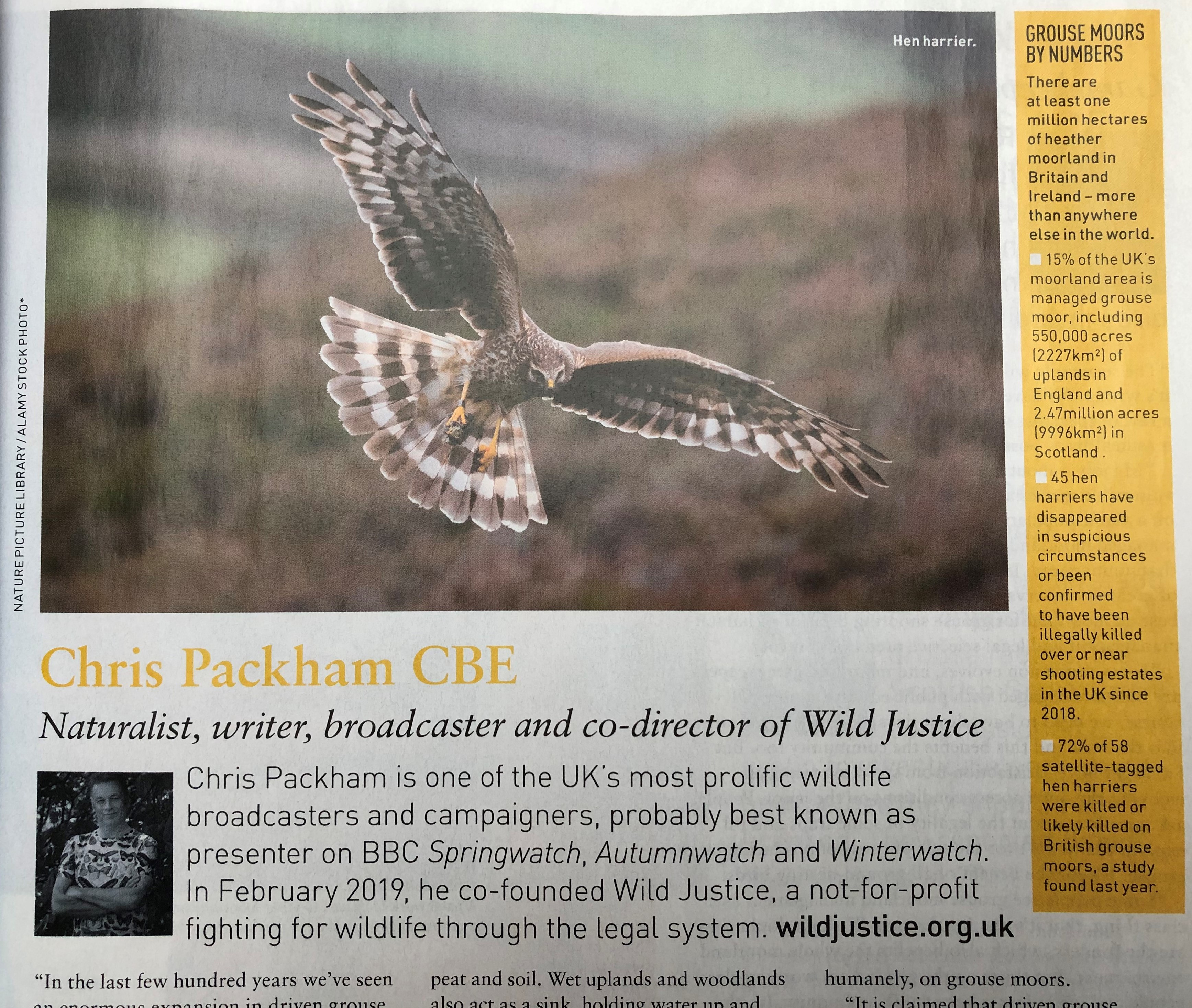
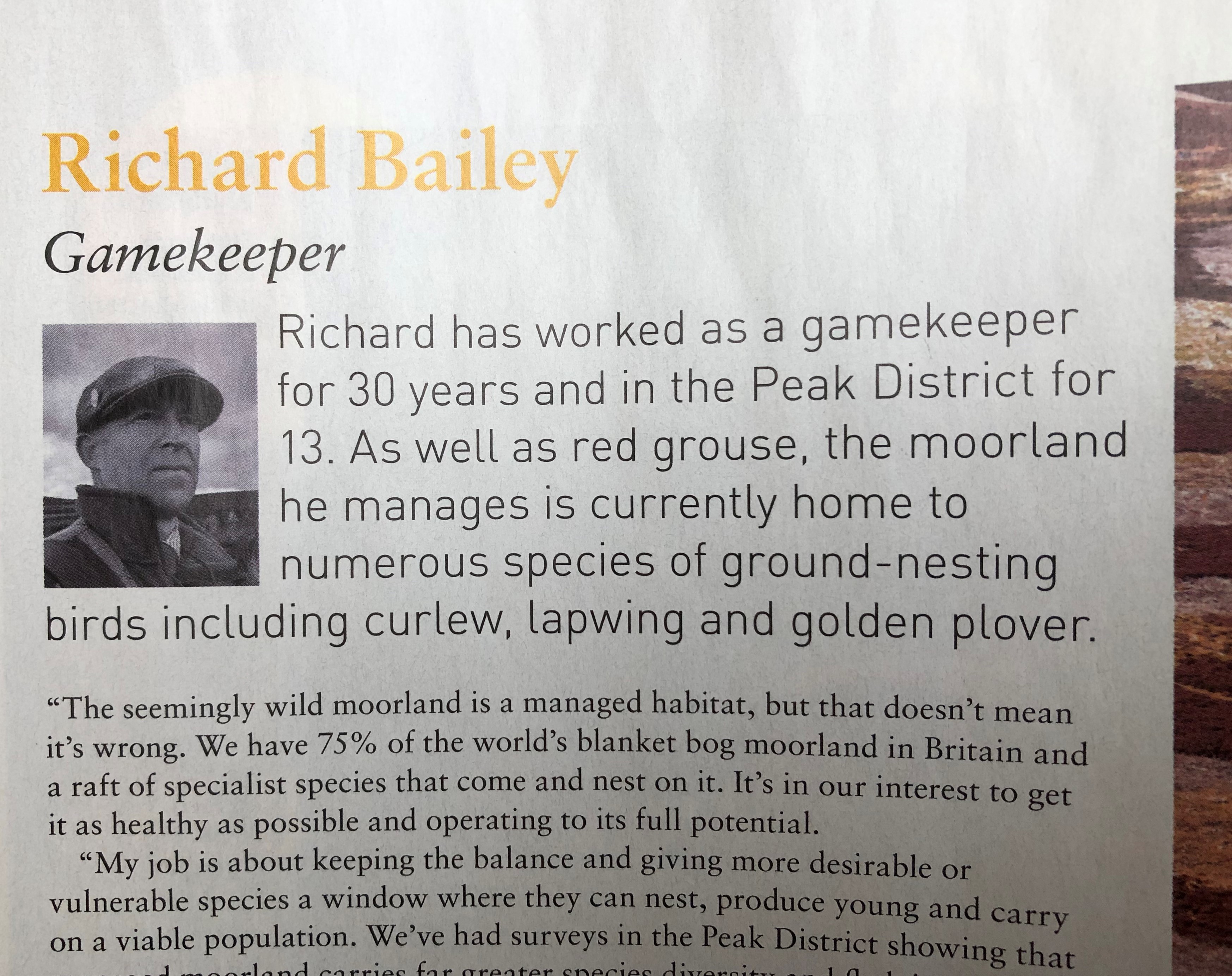
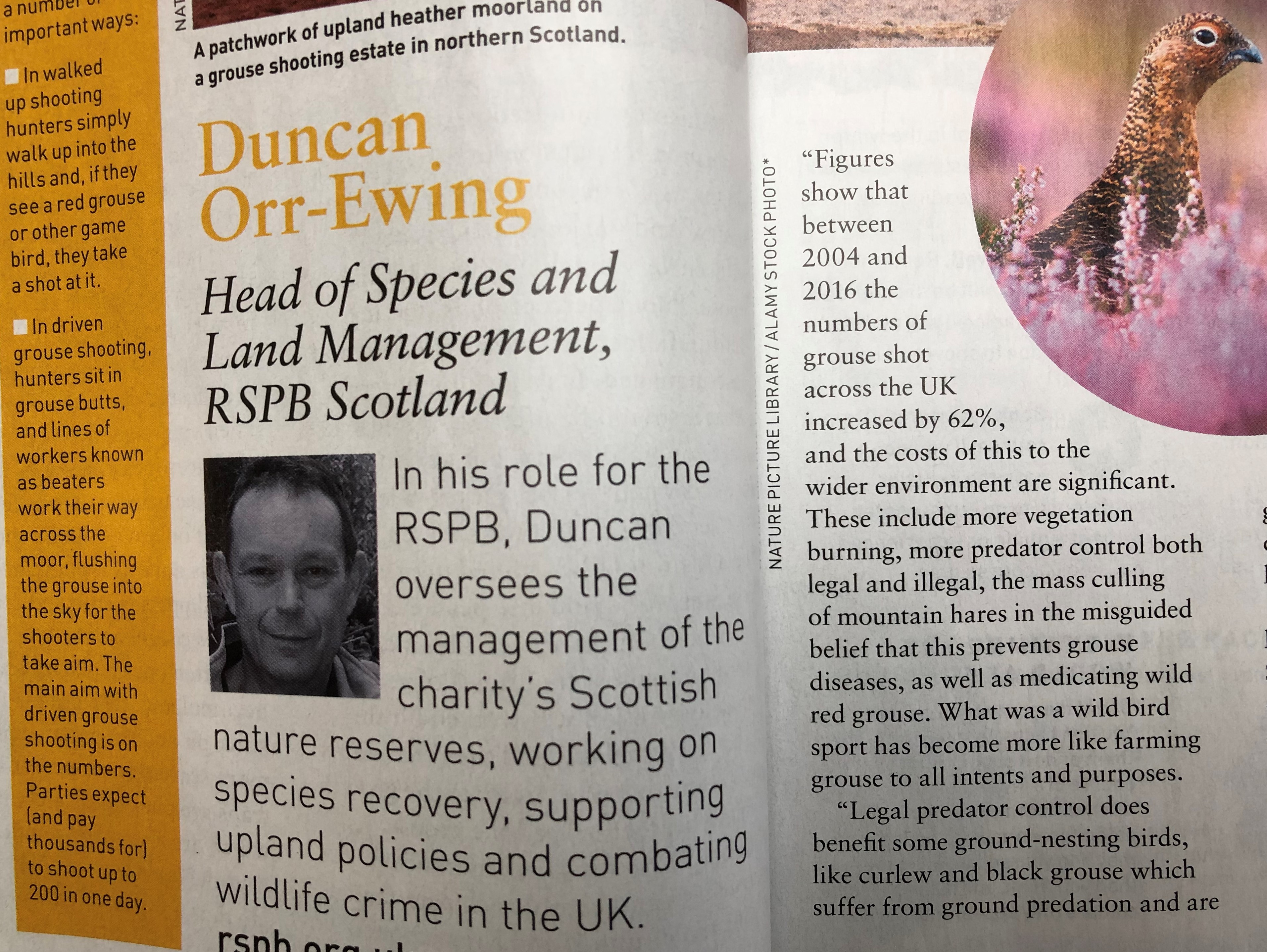
There then follows a series of contributions from conservationists (Chris Packham), Peak District gamekeeper Richard Bailey (who has previously been identified by the shady grouse shooting astroturf group C4PMC as being [one of] ‘Our People‘ – see here), Duncan Orr-Ewing (Head of Species & Land Management at RSPB Scotland) and Professor Alan Werritty, author of the now infamous government-commissioned Werritty Review (for which we’re still waiting for a response from the Scottish Government as we approach the year anniversary of the report’s submission on 18th November 2019).
The whole article can’t be reproduced here – if you want to read it you’ll have to buy the magazine – but to be honest, most of this blog’s audience will already be well versed with the arguments put forward and won’t be surprised by any of the views.
The value of this article is the potential it has to reach a new audience of people who are clearly interested in the outdoors but who may not previously have appreciated the environmental devastation taking place up on those moors.
Press release from Prospect, Natural England’s staff trade union (10th November 2020):
Prospect launches second State of Natural England Report
A decade of austerity with pay cuts, budget cuts, cuts to grants and a decline in staff numbers is putting England’s natural heritage at risk.
That is the finding of the second report by Prospect into the State of Natural England which shows that the agency does not have the resources it needs to continue to adequately fulfil its responsibilities. The first report was published in 2019.
Over the past two years Prospect, the main union for workers in Natural England, has spoken to its members about their experiences at work, analysed budgets and grants, and assessed programmes. What we have found is an agency getting beyond crisis point.
Natural England is the body responsible for maintaining and protecting England’s natural environment. It is responsible for: protected sites such as national parks and Sites of Special Scientific Interest; countryside stewardship, helping farmers and landowners enhance the biodiversity of their lands; planning and development policy; the marine environment; ramblers’ favourites like the England Coast Path, and many more things which make our natural heritage what it is.
Natural England is at risk because its funding has been slashed and its workforce reduced. Natural England’s government-funded Grant in Aid budget has declined by 49% in six years and almost two-thirds over a decade. Over that time the agency has gone from more than 2,500 staff in 2010 to, we estimate, around 1,900 staff now.
Workers in Natural England were subject to a 1% pay cap for eight years. This has improved this year but the increase comes nowhere close making up for the real-terms losses of the past decade. There is also an 8.4% gender pay gap which shows little sign of being reduced.
This is the reality of government austerity and its effect on agency staff – highly qualified workers facing financial hardship, increased workloads, loss of pension accrual, terrible morale and looking to move elsewhere for a better deal. Successive ministers have made things worse by undermining and attacking the independence of the work of agency experts.
Prospect is calling for:
Natural England’s wide and important remit for people, nature and the green recovery, to be properly recognised and funded.
It’s autonomy as a non-departmental public body to be meaningfully restored.
The damage caused by the pay cap to be reversed and pay progression and pay equality, to be restored.
To achieve pay parity with the rest of Defra, particularly for pay scale minima and maxima.
To no longer be covered by the civil service pay guidance and be subject to an independent pay review body.
“There is a yawning gap between the government’s rhetoric on climate change, the environment and biodiversity and the reality of years of underfunding our environmental agencies.
“Protecting nature means investing in the people who do that work. Natural England is at the heart of this agenda but it can only be effective if it is properly funded and the importance of its staff properly recognised.
“The disproportionate cuts, out-dated and unfit pay framework, and significant pay inequality all need to be addressed. The UK has a world-class natural environment which is treasured by the public, but this natural heritage will suffer if the expert custodians of our natural heritage continue to be treated as second class public servants.”
ENDS
There’s also an article on this in today’s Guardian (here).
It might help a little bit if Natural England bosses stopped defending the pouring of money in to the insane Hen Harrier brood meddling trial, a conservation sham sanctioned by DEFRA and carried out by Natural England, in cahoots with the very industry responsible for the species’ catastrophic decline in England.
Although the actual ‘meddling’ bit is apparently being funded in a secret financial arrangement between the Moorland Association (grouse moor owners’ lobby group) and the National Birds of Prey Centre in Newent – the cost of this has not been made public, which you’d think would be quite crucial when it comes to assessing the viability of this ‘trial’ – there is still considerable cost in terms of NE project staff time.
And then there’s the equally ridiculous NE project to ‘reintroduce’ hen harriers to southern England, another conservation sham aimed at drawing attention away from the criminal onslaught in the uplands, and for which NE is forking out thousands of pounds to send staff over to Europe, along with satellite tags bought by British tax payers, to fit to harriers in Europe in what looks like a way of ‘persuading’ the European authorities to send young harriers to the UK for the ‘reintroduction’. More details on this shortly.
The question of Natural England’s ability to conduct effective monitoring and enforcement of the new General Licences was raised in a Zoom call between Wild Justice and DEFRA officials yesterday. Judging by today’s report from Prospect, there’s very little indication that NE will be up to the task.
BBC Radio 4’s Farming Today did a short piece on DEFRA’s new General Licences this morning (available here for 29 days, starts at 8.55 min) and this included an amusing interview with Glynn Evans, Head of Gundogs and Game at BASC, the British Association for Shooting (and, ahem, conservation).
Glynn seemed a bit confused. BASC are said to have ‘welcomed’ the new licences but Glynn then said, “I don’t think it was right for them [Wild Justice] to bring their case [legal challenge]. I think where there’s an issue dialogue is the way forward“.
It’s worth reading Mark Avery’s take on this hypocrisy from BASC (here), where he points out that dialogue was the last thing on BASC’s mind last year when he and Chris Packham were banned from attending an interview at The Game Fair!
It’s also worth looking back at this RPUK blog from last year (here) where it was pointed out that BASC had itself attempted to launch a judicial review (that subsequently failed) following Natural Resources Wales’s ban on pheasant shooting on public land. Was ‘dialogue the way forward’ then, Glynn?
And, er, how about BASC’s big song & dance announcement this summer that it had launched a ‘seven-figure legal fighting fund’ to ‘push forward with proactive legal initiatives’?
There’s no issue with BASC, or anybody else for that matter, applying for a judicial review if they believe an issue is worth fighting for and they have a case that stands a reasonable chance of success – that’s what access to justice is all about and, indeed, is one of the main guiding principles behind the formation of Wild Justice.
But it is about time BASC reined in the hypocrisy and stopped trying to demonise Wild Justice for doing something that BASC is now bragging about trying to emulate!
In February 2019 a new conservation campaign group, Wild Justice, launched its first legal challenge against the casual killing of millions of birds, as authorised by statutory agency Natural England under the guise of General Licences.
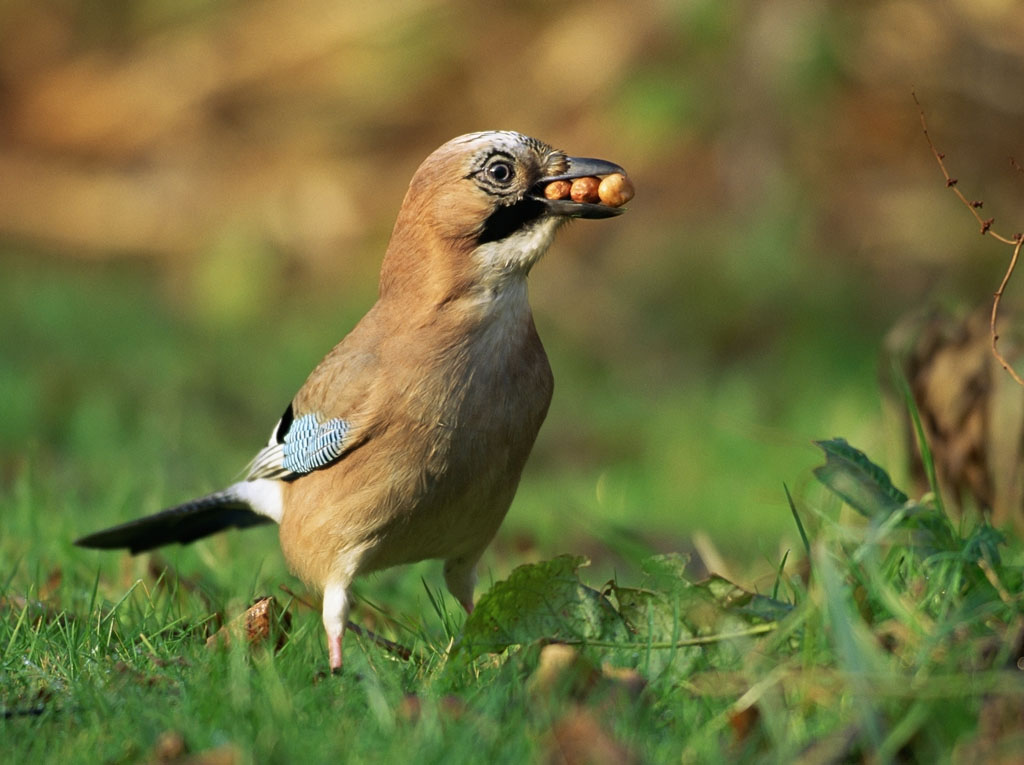
These General Licences have been published at the start of each year and have permitted users to kill unlimited numbers of birds such as Carrion Crows, Rooks, Magpies, Woodpigeons, Jackdaws, Jays and Ring-necked Parakeets.
[Common Jay photo by Andy Rouse]
General Licence users don’t have to apply to use the licences, don’t have to justify why killing the birds is necessary, don’t have to explain why alternative non-lethal measures such as scaring or proofing are ineffective or impracticable, and don’t have to report on how many birds are killed. All a person needs to do to ‘qualify’ to kill unlimited numbers of these birds is to claim to have read and understood the relevant General Licence.
Wild Justice believed the system was unlawful and argued that, amongst other things, it was Natural England’s responsibility to satisfy itself that killing was an appropriate last resort. Natural England disagreed so Wild Justice applied for permission to seek a Judicial Review.
Shortly afterwards, Natural England finally acknowledged the General Licences were indeed unlawful and pulled them at ridiculously short notice. DEFRA then removed the licensing authority role from Natural England and took it on itself, issuing temporary General Licences last year and this year, whilst having to conduct a scientific review, survey and consultation of the entire system.
The new General Licences that have been published today will become enacted on 1 January 2021. On a first glance through, they are certainly different – some species have been removed from the kill list of some of the General Licences (e.g. as of 1 January 2021 it’ll be unlawful to kill rooks or jackdaws under the guise of conserving bird species) and other species have more restricted terms of how and when that species can be killed (e.g. as of 1 January 2021 General Licence users will be able to kill Jays to protect Honey Buzzards – yep, that’s what the new licence says).
Further licence conditions relating to trapping regulations and killing birds on protected sites are due to be published before 1 January 2021.
Of course, these new General Licences will be the subject of close scrutiny, certainly by Wild Justice and no doubt by the shooting organisations, and are still open to further legal challenge if necessary.
The new General Licences for England can be viewed here:
Wild Justice is also currently challenging the General Licences issued in Wales by Natural Resources Wales and the court hearing is due in mid December 2020 (see here for background to that case).
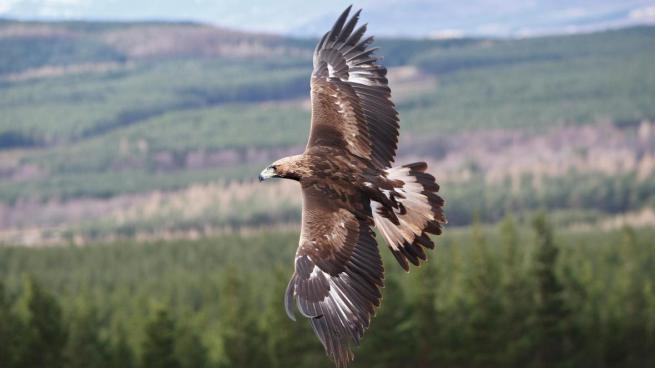
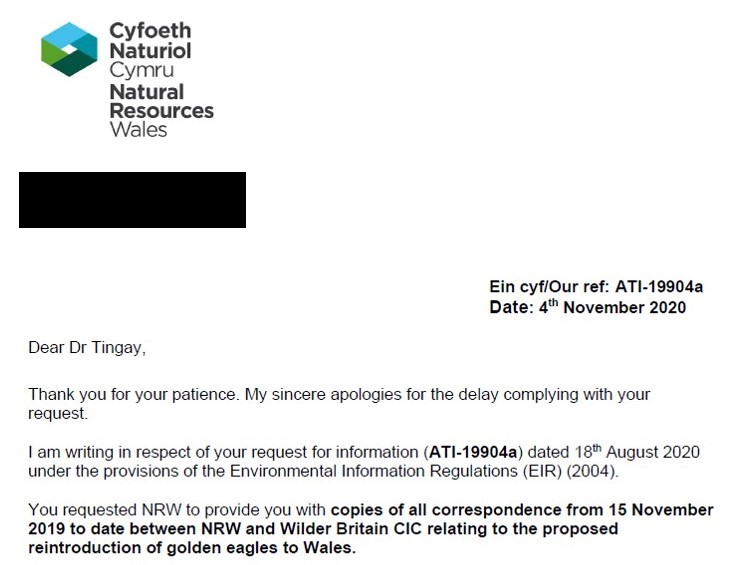
Way back in February 2019, in a publicity fanfare, a claim was made that a licence application to reintroduce golden eagles to Snowdonia would be submitted to Natural Resources Wales (NRW) ‘by summer’ by an organisation called Wilder Britain (see here and here).
In November 2019 an FoI request to NRW revealed that no such application had been received (see here).
[A young golden eagle, photo Getty Images]
Dr Paul O’Donoghue of Wilder Britain was back in the press again in August this year, fundraising for his proposed reintroduction project, which raised questions about whether there was genuine intent to try and reintroduce golden eagles or whether it was just an ongoing publicity/fundraising stunt from the previous year (see here).
O’Donoghue hosted several poorly-attended public meetings this summer, some of them announced at very short notice, and these elicited some interesting commentary from those who managed to attend and also from members of the Welsh Parliament (see here and here).
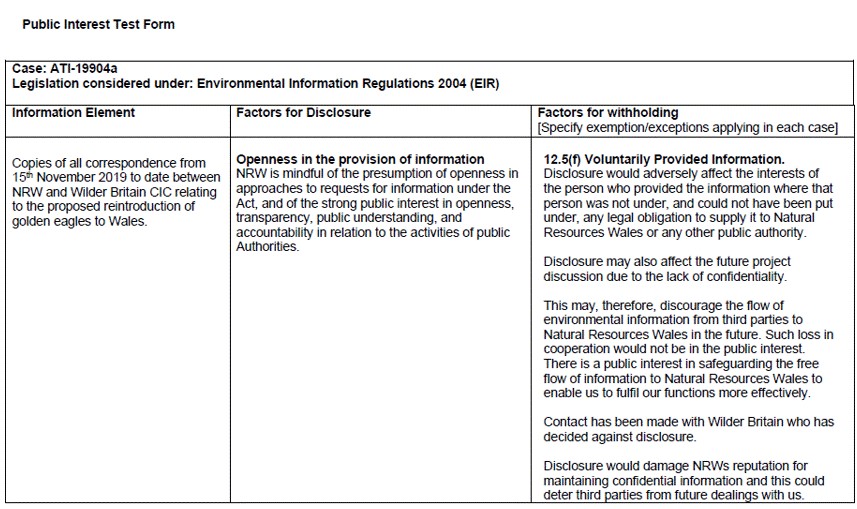
In August a Freedom of Information request was submitted to NRW to find out more details about O’Donoghue’s proposals. NRW has finally responded and has refused to release any information because it needed O’Donoghue’s consent and he has refused permission:
Interesting. An appeal has been lodged with NRW because I believe it’s in the public interest to see what advice NRW has been giving to O’Donoghue about a proposed reintroduction scheme.
Meanwhile, a more open and transparent organisation interested in a Welsh reintroduction of both golden and white-tailed eagles, under the project Eagle Reintroduction Wales, is continuing its involvement in online interviews and question & answer sessions which allow any interested member of the public an opportunity to find out more details, ask questions and listen to the responses.
The next one is this evening at 17.30hrs with ERW project manager Dr Sophie-lee Williams and can be watched here.