Hysteria from Scottish gamekeepers as SNP and Greens formalise talks to cooperate

Earlier this week it was announced that First Minister Nicola Sturgeon was in formal talks with the Scottish Greens over a ‘co-operation agreement’ designed to seal a pro-independence majority at Holyrood. Falling short of a formal coalition, the agreement could in future lead to Green MSPs becoming Ministers as part of the current Scottish Government (see Scottish Greens statement here, BBC news article here and an analysis from the Guardian’s Scotland Editor Sev Carrell here).

This proposed agreement is of huge interest to many environmentalists and although the specific policy areas of potential cooperation have not yet been agreed (see here), tackling the climate emergency (and by default, surely, the nature emergency) should be a prominent feature.

The news of these talks has triggered the Scottish Gamekeepers Association (SGA) to publish a typically over-the-top scaremongering response about perceived job losses, presumably as a ploy to keep its less well-informed members ready to join a protest at short notice: [Update 16.30hrs – see foot of blog!]

Job losses are of concern to everyone, of course, but as I’ve written previously, the SGA is once again accusing the Scottish Greens of doing something they haven’t done.

The Scottish Greens have made it an aspiration to abolish our members’ jobs‘, says the SGA.

Actually, the Greens have done no such thing. In fact in their election manifesto the Scottish Greens have committed to creating jobs in the countryside, promising ‘at least £895M over the next five years in restoring nature whilst investing in rural communities, creating over 6,000 green jobs’.

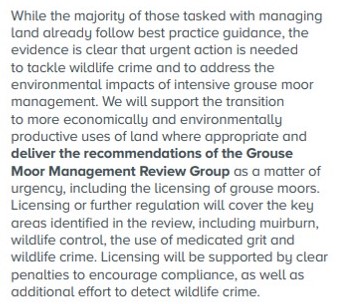
The Greens are also committed to ensuring that the licencing of grouse moors ‘is properly resourced and well enforced’ – how does that equate to rural job losses if grouse moor managers are abiding by the law?

A spokesperson from the Scottish Greens is cited today in another article about the proposed cooperative agreement amid concerns from fish farmers and National Farmers Union Scotland (NFUS):

A spokesman for Scottish Green MSPs responded that it was too early to say which issues would arise in talks with the SNP.

He said that environmental harm and fish welfare was a higher priority than phasing out caged fish farms altogether.

He explained that the party’s intention was to support industries in finding alternatives to harmful and polluting activities, and not to force sudden change‘.

Perhaps if the SGA had spent less time and money sponsoring adverts against the Scottish Greens (that went well – great use of members’ funds, not), less time complaining to the electoral commission (how did that go?) and more time reading and engaging with the Greens instead of excluding them from hustings, they’d have a better grasp of what was going on and be in a stronger position to contribute to discussions instead of constantly throwing their toys out of the pram and howling, ‘It’s so unfair’.

Actually, if they’d got any sense at all they’d realise that these talks are not their greatest immediate threat – it’s the continued illegal killing of birds of prey on land managed for gamebird shooting that’s pushing them further and further in to the corner and away from public support.

That poisoned golden eagle, found dead next to a poisoned bait on Invercauld Estate, sent shockwaves through the public, many of whom had no idea this sort of barbarity still goes on.

The SGA’s response? Well I can’t see any statement of condemnation on their website, can you?

[The poisoned golden eagle found lying on a grouse moor next to a poisoned bait on Invercauld Estate. Photo by RSPB Scotland]

UPDATE 16.30hrs:

Right on cue, the Scottish Gamekeepers Association has just published this:

Wild Justice highlights alleged breach of new General Licences & asks DEFRA to investigate

To read the full story please visit the Wild Justice blog here

Sensationalist media reporting over red kite ‘attack’ will not help stop persecution

When I talk with international colleagues about the problem we have in the UK with bird of prey persecution, many of them are baffled how it can still be ‘a thing’ over here, so many decades after societies elsewhere developed a much more progressive attitude.

To be honest it’s a question I struggle to answer, but it is indeed still ‘a thing’ in many parts of the UK, as entries on this blog will attest. One of the causes of this ongoing perception that birds of prey are ‘bad’, ‘evil’, ‘vermin’ etc is undoubtedly the sensationalist, distorted version of reality published by mainstream media, designed to grab headlines rather than sensibly inform.

Here’s a classic example from yesterday, after a red kite lifted a custard cream from the hand of a two-year-old boy in Henley, Oxfordshire and accidentally scratched the back of his hand. Here’s how the press responded (The Times, Sky News, The Guardian, Daily Mail):

The toddler wasn’t ‘attacked’, nor was the town, and nor are residents being ‘terrorised’ by red kites, which the Daily Mail says ‘resemble eagles’!

Red kites are skilled opportunists and if there’s an easy meal to be had, they’ll take it. The situation in Henley with red kites coming in close to humans has been exacerbated by some residents feeding scraps to the kites in their gardens, and although this has been widely discouraged some people continue because they still enjoy having the kites around, 30 years on from the reintroduction project just a few miles outside Henley.

I know the Chilterns very well and the draw has always been the kites. The vast majority of people I know there and others I meet when out walking there are not ‘in fear of being attacked’ and nor do they believe they are living in a ‘Hitchcock horror’. Those of us lucky enough to have kites around relish the fact we can live alongside these birds and get enormous pleasure from seeing them every day.

This unsubstantiated hysteria generated by the press does nothing to educate the public about the benefits of having birds of prey in our environment and will not help to stop those still intent on killing any bird of prey whether by trap, poison or the gun.

Just in the last few months alone there have been reports of a poisoned red kite in Scotland (here), a poisoned red kite in Lincolnshire (here), a poisoned red kite in Dorset (here), a shot red kite in the Cotswolds (here), a shot red kite in Norfolk (here), a suspected shot red kite in Warwickshire (here), a red kite killed in an illegally-set trap in Berkshire (here), a poisoned red kite in North Yorkshire (here), dead red kites found in suspicious circumstances in Wiltshire (here), a shot red kite in Wales (here)……and on and on and on.

The UK media needs to get a grip and stop demonising these birds.

Golden eagles breeding again in Orkney after almost 40 years

RSPB press release (26 May 2021)

Golden eagles breeding again in Orkney after almost 40 years

Golden eagles have returned to Orkney and are breeding here once again after an absence of almost 40 years. Earlier this year local RSPB Scotland staff were delighted to spot a pair nesting at the organisation’s nature reserve in Hoy, and can confirm that they now have chicks. The pair have been seen flying about as they forage.

[One of the breeding pair. Photo by Christine Hall]

These majestic birds used to be a common sight and breed across Orkney but persecution by humans meant just a single pair was left by 1848 in Hoy. Orkney had to wait 116 years until 1966 to see the return of breeding golden eagles. This pair had a long and successful partnership in Hoy raising many chicks together until one of the adults died in the winter of 1982. As these birds pair for life the surviving eagle continued to return to Hoy for three years but there were no further nesting attempts.

The RSPB Scotland staff have been keeping a watchful eye on the new pair to see how they are faring. As golden eagles are very sensitive to disturbance the location of the nest is not being disclosed, and the number of chicks isn’t known as those watching it having been keeping a safe distance away. The species typically has one or two chicks at a time, so the local team are looking forward to when the young fledge to see how many emerge.

Lee Shields, RSPB Scotland’s Hoy warden, said “It is wonderful to see these magnificent eagles return to Orkney and we’re delighted that they are nesting in Hoy. Golden eagles are one of the most iconic birds in Scotland and they have been missing here for too long.

We want to give these birds the best chance of success which is why it’s so important to not reveal where the nest is. It is an inspiring sight to see the male and female soaring over the Hoy hills, and we’re eagerly awaiting finding out how many chicks they have.”

Hoy appears to be the go to place for returning eagles to breed in Orkney, likely due to the terrain in uninhabited areas of the island being well suited for them. Back in 2018 Orkney’s first white-tailed eagle chicks for over 140 years hatched in Hoy. Then RSPB Scotland ran “Eaglewatch” events to allow people to catch a glimpse of the birds but given the heightened sensitivity of golden eagles and as the white-tailed eagles have not bred this year is not doing so here.

Golden eagles are one of the largest birds in Scotland. They are more than twice the size of a buzzard, with a wingspan of 1.8 – 2.3m. Their lifespan is typically over 20 years. All of the UK’s breeding golden eagles are found in Scotland, with the most recent national survey in 2015 putting their numbers at 508 pairs.  

Lee added: “This golden eagle pair are at an early stage of their breeding life and as they are long-lived birds we hope not only that they will be as successful as their predecessors, but that they are the beginning of this species re-establishing itself in Orkney. These birds are an integral part of Orkney’s history and with this pair and their young we’re keeping our fingers crossed we can look forward to them being part of its future once again.” 

ENDS

Natural England considers a request for a copy of a hen harrier diversionary feeding licence to be ‘complex’!

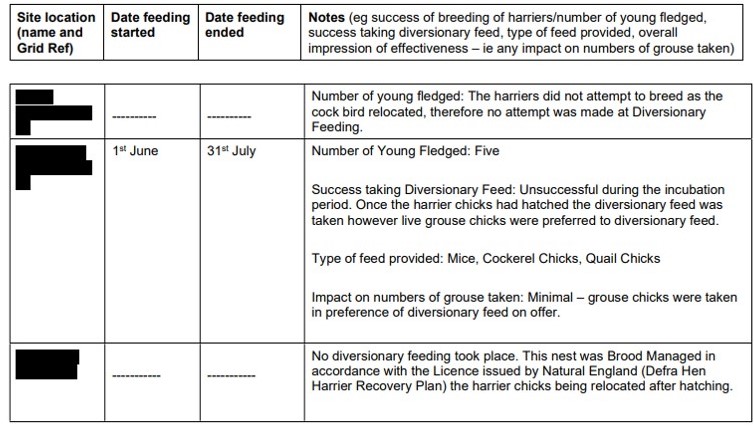
A month ago I blogged about a breach of Natural England’s hen harrier diversionary feeding licence on a North Yorkshire grouse moor – a breach that had been captured on film by raptor fieldworkers monitoring an active hen harrier nest (see here).

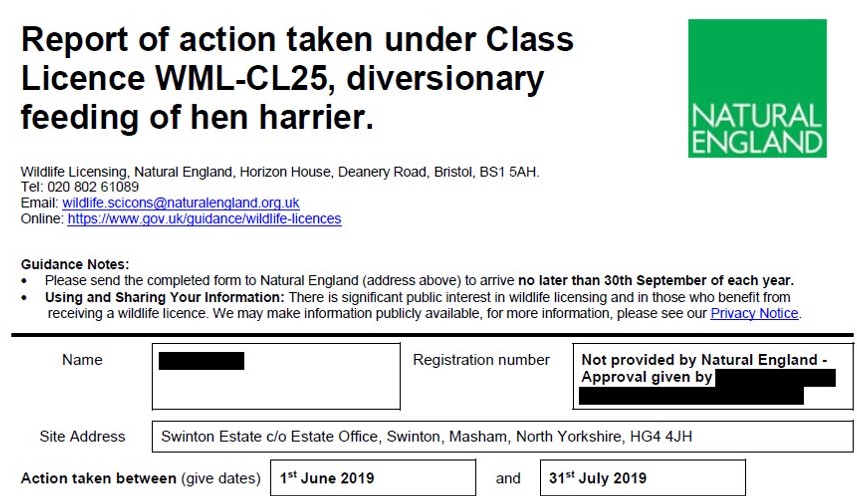
Given that the female harrier was only in the early stages of incubation, the timing of this diversionary feeding was in clear breach of the CL25 licence, a licence issued by Natural England to grouse moor managers to permit diversionary feeding ONLY after the eggs have hatched.

[A gamekeeper and a Natural England employee caught on camera visiting an active hen harrier nest on a North Yorkshire grouse moor, April 2021]

You might recall I wrote to Natural England to ask a series a questions about whether they would take any enforcement action – apparently they’re still investigating and can’t/won’t tell me how long they expect an investigation of a single incident involving known individuals, including a Natural England employee, to take (see here and here for previous blogs).

I also asked Natural England for a copy of the previous year’s CL25 licence from this estate, and importantly, the licence return. The licence holder is required to provide detail in this return of each date that diversionary feeding was provided for the breeding hen harriers. I wanted to see whether this estate had breached the terms of previous licences in addition to this year’s licence and if so, find out what enforcement action Natural England had taken, if any.

Natural England was due to provide this information by today at the latest (20 working days from my request).

Yesterday afternoon, at 17.04hrs, I received the following:

I am writing to advise you that the time limit for responding to question 4 in your request for information under the Environmental Information Regulations 2004, which we received on 22 April 2021, needs to be extended.

The Regulations allow us 20 working days to respond to your request from the date of its receipt. However, it is occasionally necessary to extend the 20 working day time limit for issuing a response. In this case, we regret that we must extend the time limit for responding by a further 20 working days to 21 June 2021, because of the complex nature of the request, but we hope to be able to reply sooner‘.

They crack me up! ‘The complex nature of the request’?? What’s complex about asking for a copy of last year’s licence return? Absolutely nothing! All they’ve got to do is go to the estate’s file, pull out the licence return, redact any personal information, have someone double check it, convert it to a PDF, email it to me. Pretty simple, I’d say.

Unless, of course, (a) the estate failed to submit a licence return and now there’s panic trying to get the estate to submit it albeit very late (which would be another licence breach) or (b) last year’s licence return reveals previous breaches of the licence conditions and thus (c) perhaps reveals Natural England’s failure to impose any enforcement action in the past.

Or perhaps (d), the estate about which I’m enquiring, which is also supposedly under investigation by Natural England for this year’s breach of the licence, is part of this year’s hen harrier brood meddling sham and any exposure of past licence breaches might just be a bit embarrassing for Natural England right about now.

It could of course simply be (e), Natural England is a bit crap.

Who knows, it’s all very ‘complex’. I guess we’ll find out by 21st June.

New Environment Minister is Mairi McAllan

Following yesterday’s big news that Mairi Gougeon has been appointed the new Cabinet Secretary for Rural Affairs & Islands (here), to replace the Scottish Gamekeepers’ ‘friend in Government‘, Fergus Ewing, now there’s even more promising news.

Nicola Sturgeon has reshuffled her junior ministerial team as well and has appointed Mairi McAllan as the new Minister for Environment, Biodiversity and Land Reform.

Ben Macpherson, who was the previous Environment Minister for just a few months has been moved across to social security and local government.

Mairi’s appointment came as some surprise but when you look a bit more closely it perhaps shouldn’t have been.

Mairi McAllan was a first-time SNP MSP candidate in Clydesdale before almost immediately landing the Ministerial role. The speed of that appointment makes more sense when you realise what Mairi did before she stood for election – she was a special advisor to Nicola Sturgeon on climate change, environment, land reform and renewable energy policy.

And she knows her stuff. Some of you might have heard her at Revive’s political hustings in April (see here – video still available to watch and I recommend you do). She’s another intelligent and articulate politician and she appears to be up to speed on raptor persecution – a quote from her opening speech at the Revive hustings on the Government’s response to the Werritty Review:

We will not wait five years to implement [Werritty’s recommendation to introduce a licensing scheme for grouse shooting] because quite frankly we can’t afford to wait five years, that could make it eight years and we think there is evidence now that self-regulation is not working“.

Mairi’s background as a solicitor will stand her in good stead for being a law-maker and her experience as a human rights activist with a legal organisation she co-founded, ‘aiming to use the law as a tool in the fight for social justice’ is a principle that will be recognised and supported by those who also support Wild Justice.

Dare I say it…there is an almost tangible sense of optimism in the air about this new Rural Affairs/Environment team, and, let’s be honest, although a lot of that is also about the unexpected but nevertheless very welcome departure from influence of Fergus Ewing, the calibre of the latest Cab Sec and Minister is pretty bloody encouraging.

I think this is only going in one direction now.

Peregrine found critically injured with shotgun injuries in North Yorkshire

Press statement from North Yorkshire Police (20th May 2021)

Police appeal for information after peregrine falcon found shot near Selby Abbey

On 7 May 2021, an 8 year old female peregrine falcon was discovered in the grounds of Selby Abbey with injuries which meant she was unable to fly.

[Photograph from North Yorkshire Police]

The peregrine was rescued and x-rayed by a local falconry specialist vet, Mark Naguib, who found a number of shotgun pellets throughout the bird’s body. The peregrine is ringed by the British Ornithology Trust so was able to be traced back to being released as a chick near Newark eight years ago.

The peregrine falcon is now in the expert care of local wildlife rehabilitator, Jean Thorpe, who will give her the best possible chance of making a recovery.

[X-ray from North Yorkshire Police]

North Yorkshire Police Constable Sarah Ward said:

“Peregrine falcons are a protected schedule one species and it is shocking that anyone would target one in this cruel and callous way.

“Our county should be a haven for birds of prey and this type of cruelty will not be tolerated.

“If anyone has information about this worrying incident please get in touch and report to us. You can either call 101 or if you wish to remain anonymous please call Crimestoppers on 0800 555 111.”

RSPB Investigations Officer, Jack Ashton-Booth said:

“We are appalled at this deliberate and illegal attack on a protected peregrine falcon. The bird was riddled with shot, including one piece lodged in its head. Incredibly, it is still alive but it’s touch and go.

“We urge anyone with information to contact North Yorkshire Police immediately. Alternatively, if you wish to speak out in confidence, please don’t hesitate to call our Raptor Crime Hotline on 0300 999 0101.

“Peregrines are incredibly good at adapting and are increasingly living alongside us in our towns and cities, and are a joy to see nesting on tall buildings like cathedrals. Nature is in trouble, and we must embrace it or risk losing it.”

If you have any information about this incident please call North Yorkshire Police on 101 quoting ref: 12210119786.

ENDS

UPDATE 29th June 2021: Shot peregrine successfully rehabbed and released back to wild (here)

Fergus Ewing out, Mairi Gougeon in – Scottish Cabinet reshuffle revealed

Well this is very very very good news indeed.

Nicola Sturgeon has announced her reshuffled Cabinet team; former Rural Affairs Cabinet Secretary Fergus Ewing is no longer in the Cabinet at all and former junior Rural Affairs Minister Mairi Gougeon has been promoted to the position of Cabinet Secretary for Rural Affairs and Islands.

There is likely to be some cross-over with Mairi’s role and that of Michael Matheson who is the new Cab Sec for Net Zero, Energy & Transport, which will include working on the climate emergency (think muirburn).

I’m absolutely delighted and judging by the number of texts I’ve received this morning, I’m not alone.

I don’t intend to comment on the departure of Fergus ‘friend of the Scottish Gamekeepers Association‘ Ewing other than to say, goodbye.

Mairi Gougeon is a brilliant choice for Cab Sec. She is an intelligent, dynamic and often thoughtful politician who has not been afraid to speak out against the persecution of the hen harrier in her role as a junior Minister and Hen Harrier Species Champion. She has taken an active role, even prior to her appointment as a junior Minister, asking questions about the Government’s commitment to tackling raptor persecution (here), attending and speaking at Hen Harrier Day events (e.g. here), taking the time to accompany raptor fieldworkers in to the field to understand more about this species’ ecology and its perilous conservation status (e.g. here and here), has initiated Parliamentary debates on hen harrier conservation (e.g. here) and has supported the Scottish Raptor Study Group at Holyrood gatherings (e.g. here).

[Mairi Gougeon beaming after a visit to watch hen harriers with members of the Scottish Raptor Study Group a couple of years ago in her role as Hen Harrier Species Champion]

I haven’t always agreed with her earlier thinking on how raptor persecution should be tackled (e.g. see here, and here) and I have criticised her for her silence in response to some brutal, sadistic crimes against birds of prey on Scottish grouse moors (here) but her delivery of the Government’s response to the Werritty Review back in November 2020 revealed an increased understanding of the issues and a sign of a genuine commitment to changing the status quo (here).

Last week, author Jim Crumley wrote an excellent piece about the need for a new Environment Secretary ‘who will act’ (here). I have high hopes that Mairi Gougeon will be that Cab Sec (albeit under a new title).

Congratulations, Mairi, there are many of us looking forward to supporting your efforts.

The new junior Ministerial team, working in support of the Cabinet Secretaries, is expected to be unveiled shortly.

56 hen harriers confirmed illegally killed or ‘missing’ since 2018

For anyone who still wants to pretend that the grouse shooting industry isn’t responsible for the systematic extermination of hen harriers on grouse moors across the UK, here’s the latest catalogue of crime that suggests otherwise.

[This male hen harrier died in 2019 after his leg was almost severed in an illegally set trap that had been placed next to his nest on a Scottish grouse moor (see here). Photo by Ruth Tingay]

Just 19 days ago, this list totalled 53 hen harriers, all either confirmed to have been illegally killed or to have ‘disappeared’, most of them on or next to driven grouse moors.

They disappear in the same way political dissidents in authoritarian dictatorships have disappeared” (Stephen Barlow, 22 January 2021).

Today the list has been updated to include the most recently reported three victims: one male hen harrier that vanished from its breeding attempt on the RSPB’s Geltsdale Reserve in 2020 and two more from the same site that yesterday the police reported as ‘missing in suspicious circumstances’ (see here).

The RSPB’s Geltsdale Reserve is located in close proximity to a large area managed for driven grouse shooting and breeding males have disappeared from here prior to 2020 and 2021. In fact, raptor persecution incidents in this area, both on and off the reserve, have been reported by the RSPB since at least the mid 1990s and have included the confirmed shooting of a number of hen harriers (i.e. their corpses were found), witnessed reports of attempted hen harrier shootings, including a gamekeeper from a neighbouring estate filmed with a gun stalking a hen harrier on the reserve, at least one confirmed poisoning of a hen harrier and a wide array of other victims including buzzards, peregrines and ravens either shot or poisoned.

The disgraceful national catalogue of illegally killed and ‘missing’ hen harriers will continue to grow – I know of at least one more on-going police investigation which has yet to be publicised.

I’ve been compiling this list only since 2018 because that is the year that the grouse shooting industry ‘leaders’ would have us believe that the criminal persecution of hen harriers had stopped and that these birds were being welcomed back on to the UK’s grouse moors (see here).

This assertion was made shortly before the publication of a devastating new scientific paper that demonstrated that 72% of satellite-tagged hen harriers were confirmed or considered likely to have been illegally killed, and this was ten times more likely to occur over areas of land managed for grouse shooting relative to other land uses (see here).

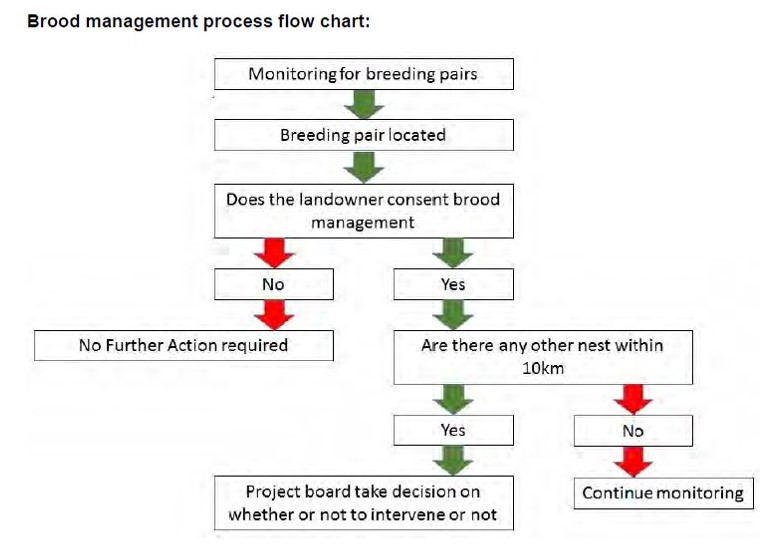
2018 was also the year that Natural England issued itself with a licence to begin a hen harrier brood meddling trial on grouse moors in northern England. For new blog readers, hen harrier brood meddling is a conservation sham sanctioned by DEFRA as part of its ludicrous ‘Hen Harrier Action Plan‘ and carried out by Natural England (NE), in cahoots with the very industry responsible for the species’ catastrophic decline in England. For more background see here.

Brood meddling has been described as a sort of ‘gentleman’s agreement’ by commentator Stephen Welch:

I don’t get it, I thought the idea of that scheme was some kind of trade off – a gentleman’s agreement that the birds would be left in peace if they were moved from grouse moors at a certain density. It seems that one party is not keeping their side of the bargain“.

With at least 56 hen harriers gone since 2018, I think it’s fair to say that the grouse shooting industry is simply taking the piss. Meanwhile, Natural England pretends that ‘partnership working’ is the way to go.

‘Partnership working’ appears to include authorising the removal of hen harrier chicks from a grouse moor already under investigation by the police for suspected raptor persecution (here) and accepting a £10K bung from representatives of the grouse shooting industry that prevents Natural England from criticising them (see here).

[Cartoon by Gill Lewis]

So here’s the latest gruesome list:

February 2018: Hen harrier Saorsa ‘disappeared’ in the Angus Glens in Scotland (here). The Scottish Gamekeepers Association later published wholly inaccurate information claiming the bird had been re-sighted. The RSPB dismissed this as “completely false” (here).

5 February 2018: Hen harrier Marc ‘disappeared’ on a grouse moor in Durham (here)

9 February 2018: Hen harrier Aalin ‘disappeared’ on a grouse moor in Wales (here)

March 2018: Hen harrier Blue ‘disappeared’ in the Lake District National Park (here)

March 2018: Hen harrier Finn ‘disappeared’ near Moffat in Scotland (here)

18 April 2018: Hen harrier Lia ‘disappeared’ in Wales and her corpse was retrieved in a field in May 2018. Cause of death was unconfirmed but police treating death as suspicious (here)

8 August 2018: Hen harrier Hilma ‘disappeared’ on a grouse moor in Northumberland (here).

16 August 2018: Hen harrier Athena ‘disappeared’ on a grouse moor in Scotland (here)

26 August 2018: Hen Harrier Octavia ‘disappeared’ on a grouse moor in the Peak District National Park (here)

29 August 2018: Hen harrier Margot ‘disappeared’ on a grouse moor in Scotland (here)

29 August 2018: Hen Harrier Heulwen ‘disappeared’ on a grouse moor in Wales (here)

3 September 2018: Hen harrier Stelmaria ‘disappeared’ on a grouse moor in Scotland (here)

24 September 2018: Hen harrier Heather ‘disappeared’ on a grouse moor in Scotland (here)

2 October 2018: Hen harrier Mabel ‘disappeared’ on a grouse moor on the edge of the Yorkshire Dales National Park (here)

3 October 2018: Hen Harrier Thor ‘disappeared’ next to a grouse moor in Bowland, Lanacashire (here)

23 October 2018: Hen harrier Tom ‘disappeared’ in South Wales (here)

26 October 2018: Hen harrier Arthur ‘disappeared’ on a grouse moor in the North York Moors National Park (here)

1 November 2018: Hen harrier Barney ‘disappeared’ on Bodmin Moor (here)

10 November 2018: Hen harrier Rannoch ‘disappeared’ on a grouse moor in Scotland (here). Her corpse was found nearby in May 2019 – she’d been killed in an illegally-set spring trap (here).

14 November 2018: Hen harrier River ‘disappeared’ on a grouse moor in the Nidderdale AONB (here). Her corpse was found nearby in April 2019 – she’d been illegally shot (here).

16 January 2019: Hen harrier Vulcan ‘disappeared’ in Wiltshire close to Natural England’s proposed reintroduction site (here)

7 February 2019: Hen harrier Skylar ‘disappeared’ next to a grouse moor in South Lanarkshire (here)

22 April 2019: Hen harrier Marci ‘disappeared’ on a grouse moor in the Cairngorms National Park (here)

26 April 2019: Hen harrier Rain ‘disappeared’ on a grouse moor in Nairnshire (here)

11 May 2019: An untagged male hen harrier was caught in an illegally-set trap next to his nest on a grouse moor in South Lanarkshire. He didn’t survive (here)

7 June 2019: An untagged hen harrier was found dead on a grouse moor in Scotland. A post mortem stated the bird had died as a result of ‘penetrating trauma’ injuries and that this bird had previously been shot (here)

5 September 2019: Wildland Hen Harrier 1 ‘disappeared’ on a grouse moor nr Dalnaspidal on the edge of the Cairngorms National Park (here)

11 September 2019: Hen harrier Romario ‘disappeared’ on a grouse moor in the Cairngorms National Park (here)

14 September 2019: Hen harrier (Brood meddled in 2019, #183704) ‘disappeared’ in North Pennines (here)

23 September 2019: Hen harrier (Brood meddled in 2019, #55149) ‘disappeared’ in North Pennines (here)

24 September 2019: Wildland Hen Harrier 2 ‘disappeared’ on a grouse moor at Invercauld in the Cairngorms National Park (here)

24 September 2019: Hen harrier Bronwyn ‘disappeared’ near a grouse moor in North Wales (here)

10 October 2019: Hen harrier Ada ‘disappeared’ on a grouse moor in the North Pennines AONB (here)

12 October 2019: Hen harrier Thistle ‘disappeared’ on a grouse moor in Sutherland (here)

18 October 2019: Member of the public reports the witnessed shooting of an untagged male hen harrier on White Syke Hill in North Yorkshire (here)

November 2019: Hen harrier Mary found illegally poisoned on a pheasant shoot in Ireland (here)

January 2020: Members of the public report the witnessed shooting of a male hen harrier on Threshfield Moor in the Yorkshire Dales National Park (here)

23 March 2020: Hen harrier Rosie ‘disappeared’ at an undisclosed roost site in Northumberland (here)

1 April 2020: Hen harrier (Brood meddled in 2019, #183703) ‘disappeared’ in unnamed location, tag intermittent (here)

5 April 2020: Hen harrier Hoolie ‘disappeared’ on a grouse moor in the Cairngorms National Park (here)

8 April 2020: Hen harrier Marlin ‘disappeared’ on a grouse moor in the Cairngorms National Park (here)

19 May 2020: Hen harrier Fingal ‘disappeared’ on a grouse moor in the Lowther Hills, Scotland (here)

21 May 2020: Hen harrier (Brood meddled in 2019, #183701) ‘disappeared’ on a grouse moor in Cumbria shortly after returning from wintering in France (here)

27 May 2020: Hen harrier Silver ‘disappeared’ on a grouse moor on Leadhills Estate, Scotland (here)

day/month unknown: Unnamed male hen harrier breeding on RSPB Geltsdale Reserve, Cumbria ‘disappears’ while away hunting (here)

9 July 2020: Unnamed female hen harrier (#201118) ‘disappeared’ from an undisclosed site in Northumberland (here).

25 July 2020: Hen harrier Harriet ‘disappeared’ on a grouse moor in the Yorkshire Dales National Park (here)

14 August 2020: Hen harrier Solo ‘disappeared’ in confidential nest area in Lancashire (here)

7 September 2020: Hen harrier Dryad ‘disappeared’ on a grouse moor in the Yorkshire Dales National Park (here)

16 September 2020: Hen harrier Fortune ‘disappeared’ from an undisclosed roost site in Northumberland (here)

19 September 2020: Hen harrier Harold ‘disappeared’ on a grouse moor in the Yorkshire Dales National Park (here)

20 September 2020: Hen harrier (Brood meddled in 2020, #55152) ‘disappeared’ next to a grouse moor in North Yorkshire (here)

24 February 2021: Hen harrier Tarras ‘disappeared’ next to a grouse moor in Northumberland (here)

12th April 2021: Hen harrier Yarrow ‘disappeared’ near Stockton, County Durham (here)

18 May 2021: Adult male hen harrier ‘disappears’ from its breeding attempt on RSPB Geltsdale Reserve, Cumbria whilst away hunting (here)

18 May 2021: Another adult male hen harrier ‘disappears’ from its breeding attempt on RSPB Geltsdale Reserve, Cumbria whilst away hunting (here)

To be continued……..

Police appeal for information following disappearance of two male hen harriers

Press statement from Cumbria Police (18 May 2021)

Police appeal for information following disappearance of two male hen harriers

Cumbria Police are appealing for information following the disappearance of two male Hen Harriers, in suspicious circumstances from the RSPB reserve at Geltsdale. 

PC Samantha O’Key the forces Wildlife, Rural and Environmental Crime Co-ordinator said,

The two male birds were servicing nests, and as a result both nests have now failed

In 2020 another male bird went missing in suspicious circumstances. The male was servicing two nests and as a result both nests failed. These birds were in good health, in a perfect environment for them to thrive, with plenty of food.  It is highly unlikely that the Harriers have died of natural causes.

Hen Harriers are a Schedule 1 protected species under the Wildlife and Countryside Act 1981, and are one of the UK’s most persecuted bird of prey. Cumbria Police will continue to work in partnership with the RSPB and other agencies to protect our wild birds.

We would ask that anyone with any information contact Cumbria Police on 101 or Crimestoppers on 0800 555 111 or www.crimestoppers-uk.org.” 

Warden at RSPB Geltsdale, Steve Garnett:

This is devastating news, for hen harriers, for our hard-working team here at RSPB Geltsdale and for everyone who is rooting for a better outcome for these birds.

Each season, the joy of seeing these birds return to breed is always tinged with worry over what might happen to them while they’re hunting beyond the safety of our reserve.  

We can make sure they are safe when they are on our land, but of course, they are free to range more widely and we know that not everyone has the best interests of these birds in mind.  Hen harriers are illegally killed every year, so we are bound to view these disappearances as suspicious.  

Anyone with information can contact the RSPB in confidence on our raptor persecution hotline (0300 999 0101) and we will support the police in any way we can.”

ENDS

UPDATE 19th May 2021: 56 hen harriers confirmed illegally killed or ‘missing’ since 2018 (here)