A couple of weeks ago I blogged about the conviction of a 53-year-old gamekeeper in the Scottish Borders, Peter Givens, who was responsible for an illegally-operated trap in which a barn owl and a goshawk had starved to death (see here). I’ll be blogging more about that case shortly as some interesting things have come to light.
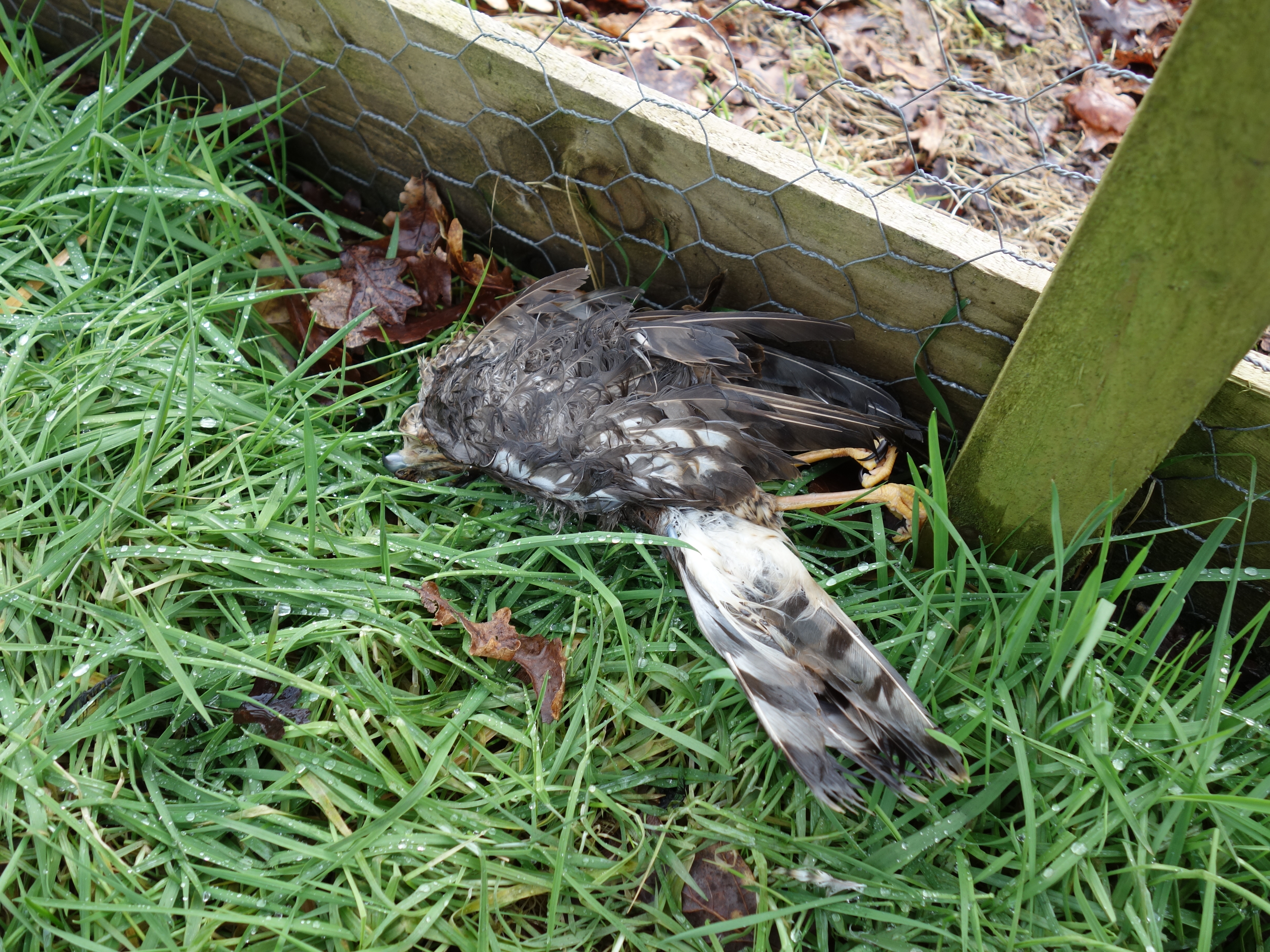
Fast forward two weeks and today another gamekeeper, 58-year-old Hilton Prest, has been convicted for an almost identical offence, this time causing a sparrowhawk to starve to death inside an illegally-operated trap in Bosley, Cheshire, in February this year.
[The dead sparrowhawk inside the crow cage trap. Photo by RSPB]
The RSPB has published a press release about this latest conviction, which I’ll reproduce below, and then I’ll add some commentary at the end.
RSPB press release, 16th December 2021:
Man fined after sparrowhawk starves to death in trap
An amateur gamekeeper has received an £800 fine after a sparrowhawk starved to death in a trap in Cheshire.
At Manchester Magistrates’ court today (16 December 2021), Hilton Prest pleaded guilty to unlawfully using a trap on or before 10/2/21 contrary to Sec 5(1)(b) of the Wildlife and Countryside Act. He was fined £800 (plus £85 costs and £80 victim surcharge). A charge against a second man was discontinued.
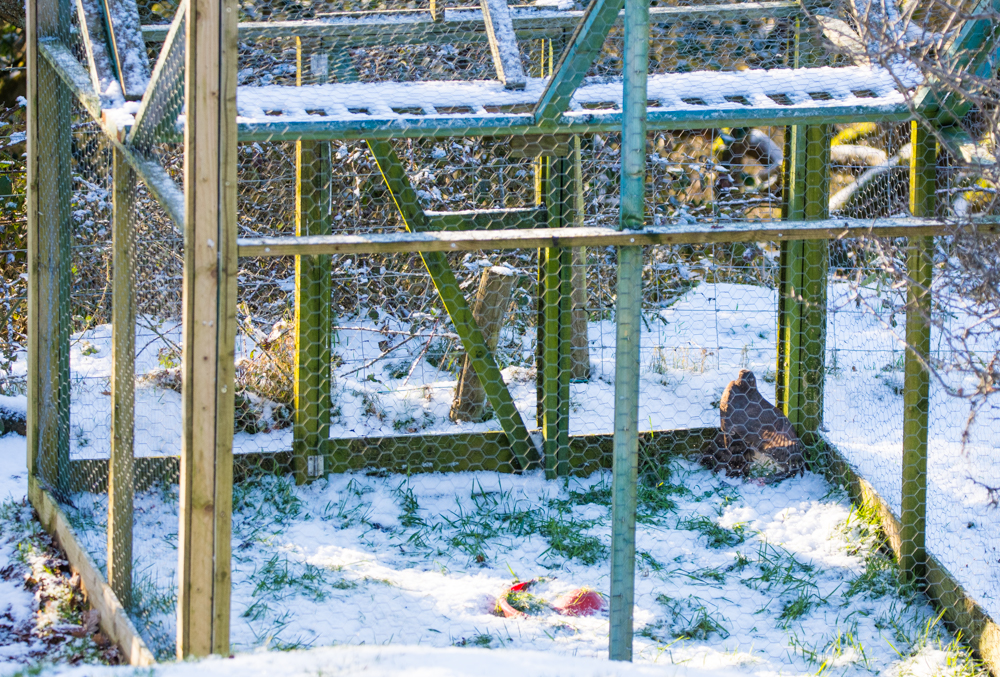
On 10 February 2021, a member of the public found a sparrowhawk alive in a cage trap on land managed for gamebird shooting near Bosley. Cage traps are large mesh traps designed so a bird can get in but not out. They can be used legally, under license, to control crows, and must be checked every 25 hours. Any non-target birds caught accidentally must be released unharmed during daily inspections. When not in use the doors on such traps must be removed or secured open so birds cannot be caught.
There was snow on the ground and no shelter or water for the bird. The door to the trap was closed, so the member of the public opened it slightly, hoping the sparrowhawk would escape. Concerned for the bird’s welfare, they later provided the trap’s location to the RSPB.
[The juvenile sparrowhawk caught inside the trap during freezing weather in Feb 2021. Photo by RSPB]
RSPB Investigators attended the following day, 17 February, however they found the sparrowhawk (later confirmed as the same bird) dead inside the trap. There were also the remains of a blackbird, which had presumably attracted the sparrowhawk inside, and some grain, which had presumably attracted the blackbird. Despite the door being ajar, it appeared the sparrowhawk had been unable to escape and starved to death.
Cheshire Police were notified and the body of the bird sent for post-mortem examination. A veterinary pathologist confirmed the bird had died of starvation and would have experienced considerable unnecessary suffering inside the trap. (The veterinary work was funded by money from Wild Justice’s Raptor Forensic Fund, provided to support such cases, and administered by the PAW Forensic Working Group.) Two men were later interviewed by the police and reported for offences in relation to the unlawful use of the trap.
District Judge Mr Jack McGarver said that he accepted that the act was careless rather than reckless or intentional, but that the degree of carelessness was high, and that it was well below the standard that was expected.
He added: “The sparrowhawk is a beautiful native creature which is entitled to be protected.”
Tom Grose, RSPB Investigations Officer, said: “An unattended set trap in sub-zero temperatures was a death sentence for both birds.
“If a trap is no longer in operation, it must be disabled in such a way that no bird can become caught. The operator has a duty of care to ensure that this happens, and that no birds can become caught inside. This duty of care was not met.
“This is yet another example of why Natural England must improve the general license conditions for disabling these traps, in line with conditions in Scotland. We are aware of a number of other birds, including buzzards and a goshawk, that have starved to death inside cage traps which appear not to have been properly disabled. In this case, a simple padlock securing the door wide open would have saved the life of this blackbird and this sparrowhawk. This needs to be addressed to ensure no more birds perish in this sad and wasteful way.”
If you find a wild bird of prey which you suspect has been illegally killed, or a trap with a bird of prey caught inside, phone the police on 101, email RSPB Investigations at crime@rspb.org.uk or fill in the online form: https://www.rspb.org.uk/our-work/our-positions-and-campaigns/positions/wildbirdslaw/reportform.aspx
ENDS
First of all, well done to the RSPB’s investigations team, working with Cheshire Police, to bring this case to court and secure a conviction.
The penalty given to gamekeeper Prest (£800 fine plus £85 costs and £80 victim surcharge) is higher than that given to gamekeeper Givens (£300 fine plus £20 victim surcharge) even though two Schedule 1 species had died as a result of Givens’ offence so once again sentencing consistency is lacking.
What’s really interesting though is the difference in the trapping rules between Scotland and England. In the Scottish case, it could be shown quite easily that Givens was operating an unlawful trap because (a) in Scotland the General Licence requires that the trap user be identified by a code attached to each trap (this is not a requirement in England because statutory agency Natural England hasn’t bothered to introduce it), and (b) in Scotland, when the trap is not in use the trap operator MUST do the following, as a condition of the General Licence:
‘Any trap not in use must be immobilised and rendered incapable of use. For multi-catch cage traps, the access doors must be removed from the site or securely padlocked open so that no bird can be confined‘.
This is a clear instruction – you either padlock the door open or you remove it completely if the trap is not in use. It’s unambiguous.
However, the equivalent General Licence condition in England is nowhere near as clear cut and can lead to all sorts of ‘accidents’ and excuses.
In England, the General Licence condition says this:
‘When you are not using a trap, it must not be capable of holding or catching animals.
You must secure trap doors in a fully open position, or remove the doors completely from the site‘.
Then there’s an add-on bit of ‘advice’ underneath, that says:
‘Padlocks are the most secure way to secure trap doors open, but cable ties or wire may also be suitable‘.
Crucially, this ‘advice’ is not legally binding, so a trap operator in England could legally use a rock or a piece of baler twine to ‘secure trap doors in a fully open position’ but both these techniques, and others, are not bomb proof and a door could ‘accidentally’ close, preventing a trapped bird from a means of escape. Padlocking the door or removing the door completely provides a trapped bird with a route to escape.
Quite why Natural England hasn’t incorporated this very simple but effective condition into its General Licence is a matter of bemusement for many of us. It’s really not that difficult, is it?
And if game-shooting organisations were as interested in protecting birds of prey as they claim to be, they’d be pushing for this very simple measure, too.