It’s been almost two years since a judge threw out a defamation claim against Andy Wightman and a ludicrous claim for £750,000 damages against him, made by Dr Paul O’Donoghue of Wildcat Haven Enterprises [and Wilder Britain and Lynx UK Trust and various other assorted outfits], who had argued that Andy had published, with malice, defamatory material on his blog, on Twitter and on Facebook in 2015 and 2016 (see here).
Andy’s defence drew widespread support and he successfully crowdfunded approx £170K to help fund legal representation.
Since he won the case, Andy has been waiting to find out whether his legal costs would be paid for by O’Donoghue.
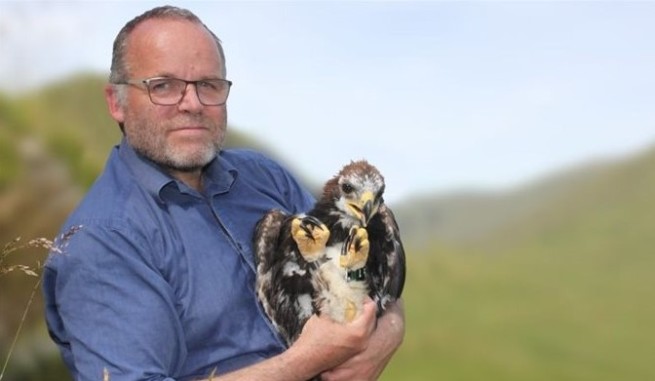
[Andy Wightman with a young golden eagle. Photo by Ruth Tingay]
Many of this blog’s readers donated to Andy’s crowdfunder and those who did would have received the following email from Andy yesterday:
Wildcat Haven Enterprises CIC vs Wightman Expenses
Dear Donor,
Following my previous email, I am pleased to report that I have been awarded expenses of £170, 973.31. My final legal bill will be short of £200,000. The pursuer [O’Donaghue] has 14 days in which to object to the award.
There is a £110,000 bond of caution lodged in the Court of Session [from the pursuer] which will be released once the settlement is finalised.
With another £25,000-£30,000 of expenses I anticipate refunding £80,000 of the approx. £170,000 raised in crowdfunded donations and so you can anticipate being offered over 45% of your donation. Options to donate to two good causes, to support my ongoing campaigning work, or to claim a refund will be offered. I hope to be in touch again shortly.
Following on from yesterday’s blog where I wrote about DEFRA Minister Lord Richard Benyon’s wilful blindness when it comes to tackling the illegal killing of birds of prey on gamebird shooting estates (here), there was a further exchange in the House of Lords about gamebird shooting, including several Lords’ unfounded claims that lead-shot gamebirds are ‘healthy‘ and ‘about the most nutritious food that you can possibly eat‘ (!!) and Baroness Bennett of Manor Castle (Natalie Bennett’s) well-informed question to Lord Benyon about the environmental impact of releasing 60+ million non-native gamebirds in to the countryside every year.
There was an additional exchange between Lord Newby (Dick Newby, Leader of the Lib Dems in the House of Lords) and Benyon:
I find it totally implausible that a DEFRA Minister, with a long-term personal interest in gamebird shooting (he owns a pheasant-shooting estate in Berkshire and a grouse moor in Scotland and was a former Trustee of the GWCT) would ‘not have any evidence’ of pheasant-dumping, especially given several high profile incidents in recent years, the most recent featuring on ITV news just last week!
Benyon told Dick Newby that if evidence could be produced he’d be ‘happy to discuss it with officials and with Natural England’.
So I tweeted Dick Newby this morning and gave him a link to this blog post which documents widespread pheasant dumping incidents in Cheshire, Scottish borders (here), Norfolk (here), Perthshire (here), Berkshire (here), North York Moors National Park (here) and some more in North York Moors National Park (here) and even more in North Yorkshire (here), Co. Derry (here), West Yorkshire (here), and again in West Yorkshire (here), N Wales (here), mid-Wales (here), Leicestershire (here), Lincolnshire (here), Somerset (here), Derbyshire’s Peak District National Park (here), Suffolk (here), Leicestershire again (here), Liverpool (here), even more in North Wales (here) even more in Wales, again (here), and in Wiltshire (here).
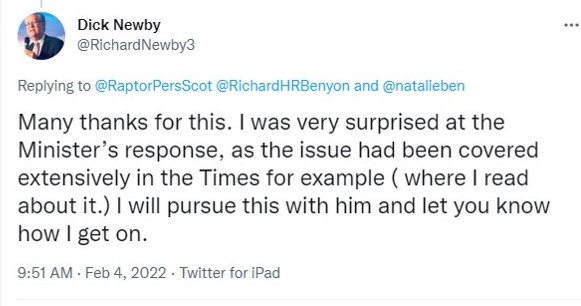
Within just four minutes of receiving my tweet, Dick Newey responded with this:
Impressive. Let’s see how he gets on.
For those interested in the full exchange in the House of Lords yesterday, the Hansard transcript can be read here.
This really won’t come as any surprise to anyone who’s followed this blog for any length of time but god, it’s depressing.
Today in the House of Lords the following exchange took place between Baroness Hayman of Ullock (Sue Hayman, a life peer serving as Shadow Spokesperson for Environment Food & Rural Affairs) and the Rt Hon Lord Richard Benyon (Parliamentary Under Secretary of State at DEFRA and a pheasant shoot and grouse moor owner):
Sue Hayman was of course referring to the recent criminal conviction of gamekeeper John Orrey, who was filmed by the RSPB battering to death two buzzards that he’d caught inside a trap on a pheasant shoot in Nottinghamshire (see here). The United Nations report on UK wildlife crime to which she referred was quietly published by DEFRA just before Christmas without any fanfare whatsoever. You can read it here:
Benyon’s response to Sue Hayman’s question about how the Westminster Government intends to take forward the recommendations of this report, which includes the licensing of gamebird shoots, was risible but not unexpected – he’s got form.
Note in his response the use of the word ‘can’. “Unlimited fines and up to six-month custodial sentencescan be awarded where people commit these hideous acts” [of raptor persecution]. Yes, they ‘can’, but when are they ever? When has there EVER been a custodial sentence?
That’s an easy one to answer. Once, in Scotland, in 2014, when a gamekeeper was filmed by the RSPB trapping and then battering to death a goshawk (see here).
Before that, nothing. After that, nothing.
Given his long term connection with the gamebird shooting industry, including a period as a Trustee of the GWCT, Benyon should be well aware that raptor killers are rarely brought before the courts and when they are, they’re given sentences that offer virtually no deterrent to anyone else who might be thinking of committing the same offence.
It’s not even as though his previous work portfolio hasn’t included this subject (see here).
He should also be well aware through his current work portfolio that raptor persecution crime is not diminishing, as evidenced by the RSPB’s most recent Birdcrime report which demonstrated that 2020 was the ‘worst year on record’ for crimes against birds of prey (here).
Today’s exchange wasn’t the only example of Benyon displaying wilful blindness, as discussed in my earlier blog today about the dumping of shot pheasants, a widespread practice Benyon claimed to know nothing about (here). More on that shortly.
Vested interests + wilful blindness + holding positions of power = 68 years of raptor persecution associated with gamebird shooting in the UK, and counting.
UPDATE 4th February 2022: Lord Newby to pursue DEFRA Minister Lord Benyon on pheasant dumping (here)
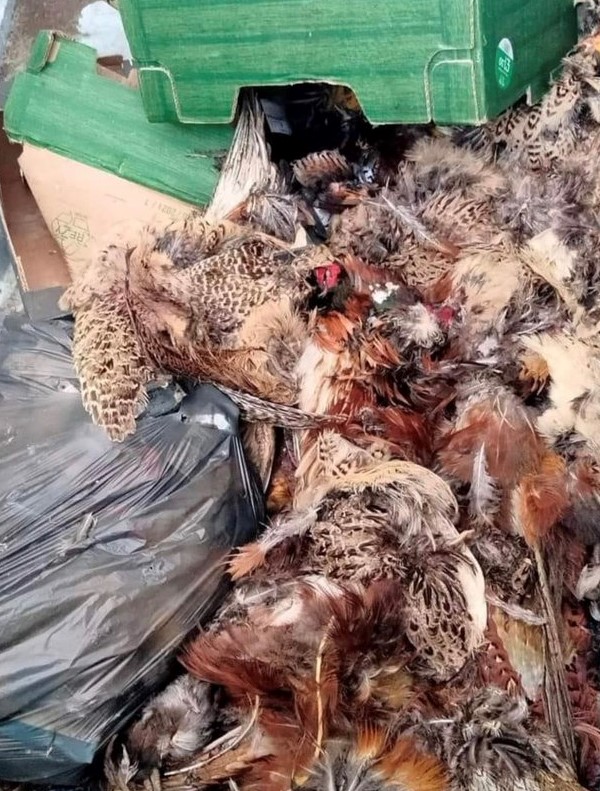
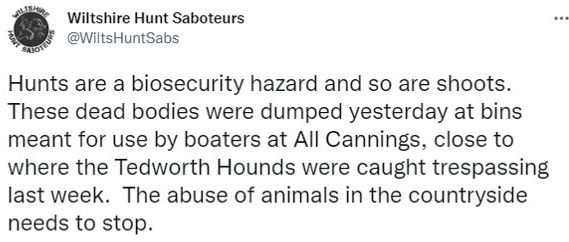
Wiltshire Hunt Saboteurs have posted the following on Twitter this morning:
There was also shocking footage shown on ITV News yesterday of how at least five hunts are breaching the regulations about the disposal of animal carcasses under a ‘Fallen Stock Service’ for farmers. Amongst the horror revealed in covert camera footage was the dumping of shot partridges. The locations were not given. The report is well worth reading and there’s an embedded video but be warned, it includes distressing images – HERE.
Earlier today, Parliamentary Under Secretary of State at DEFRA and pheasant shoot owner, the Rt Hon Lord Benyon, was speaking in the House of Lords about gamebird shooting and was asked about pheasant dumping. Benyon claimed to have no knowledge of it taking place! I’ll blog more about his jaw-dropping statements once the transcript is available but in the interim I have tweeted links to the following incidents of pheasant dumping that I’ve have been cataloguing on this site for a few years, including:
Dumped gamebirds in Cheshire, Scottish borders (here), Norfolk (here), Perthshire (here), Berkshire (here), North York Moors National Park (here) and some more in North York Moors National Park (here) and even more in North Yorkshire (here), Co. Derry (here), West Yorkshire (here), and again in West Yorkshire (here), N Wales (here), mid-Wales (here), Leicestershire (here), Lincolnshire (here), Somerset (here), Derbyshire’s Peak District National Park (here), Suffolk (here), Leicestershire again (here), Liverpool (here), even more in North Wales (here) and most recently in Wales, again (here).
The evidence is clear, Lord Benyon, for those who choose to see.
An advert in this week’s edition of Shooting Times:
One of these ‘prestigious game shoots’, advertised here as ‘hugely successful’ appears to be Dyfi Falls, currently under a multi-agency investigation after covert video footage by the League Against Cruel Sports revealed a gamekeeper from Cambrian Birds flinging shot pheasant carcasses down a disused mine shaft on the edge of a Site of Special Scientific Interest (see here, here and here).
The video footage published last week showing a gamekeeper tossing shot pheasants (and what appears to be other unidentified wildlife) down a disused mineshaft after a shooting day was a shocker, on so many levels.
If you missed it, here it is again:
We know where this took place (Dyfi Falls, mid-Wales) and when it took place (2nd November 2021) because the League Against Cruel Sports, whose investigators had installed the covert camera, told us all in a press release published on 27th January 2022 (here).
We even know who was responsible – a gamekeeper employed by sporting agency Cambrian Birds Ltd who ‘manage’ this particular shoot. How do we know? Because a spokesperson for the estate told ITV news (here).
With the unequivocal video evidence and the public admission of responsibility, this appalling incident wasn’t one that the game-shooting industry could subsequently deny, which seems to be its usual default setting. No, its pants were well and truly down on this one.
Instead, what we’re seeing is the industry moving to default setting #2, which is to ignore all the evidence and hope it goes away soon. Not one of the main game-shooting organisations has drawn attention to this incident, let alone condemned it in the news sections of their websites, which I find extraordinary for an industry under so much scrutiny and pressure to clean itself up.
I think a lot of the decision to remain silent rests with the fact it was the League Against Cruel Sports who secured the footage and publicised it. The game-shooting industry detests the League, almost as much as it does the RSPB, which is probably why STILL none of the game-shooting organisations have condemned the actions of gamekeeper John Orrey, who was sentenced last week for multiple wildlife crime & firearms offences, including battering to death two buzzards, because it was RSPB footage that nailed him.
It makes no difference to me whether the game-shooting organisations screw up their PR on these crimes – it’s their sordid little industry that’s on the line and it’s not my job to save it.
However, I am very interested in how the statutory authorities deal with these issues. It’s harder for them to deny what’s going on (although some of them try!) and it’s harder for them to ignore it when organisations like the League and the RSPB are putting the evidence right under their noses.
But it seems to me that the Welsh Government’s agency Natural Resources Wales (NRW) and Dyfed & Powys Police have been doing their best to ignore this pheasant-dumping case. The footage was filmed on 2nd November 2021 and I understand that NRW and the police were notified on 17th November 2021.
It’s now 1st February 2022. What have they been doing since mid-November? How long does an investigation take when you’ve got footage of the incident and an admission from the landowner about who was involved? Have they even started an investigation?
Gamekeeper John Orrey’s conviction was secured in December 2021 when he pleaded guilty to five wildlife crime offences and four firearms offences. Sentencing was deferred until yesterday when he was handed a suspended custodial sentence and a small fine (see here) – nowhere near as severe as he deserved for deliberately baiting a trap to attract buzzards and then casually but brutally beating those buzzards to death with a stick as if it was part of his daily routine.
[Screengrab from the RSPB’s covert footage of criminal gamekeeper John Orrey killing buzzards at Hall Farm, Kneeton, Nottinghamshire]
At the time of his guilty plea I checked around the websites of the five game-shooting organisations that claim to have a ‘zero tolerance’ for raptor persecution to read their statements of condemnation and see what efforts they’d made to distance themselves from this criminal gamekeeper, e.g. expelled him from membership (if he is a member) or blacklisted him to prevent future membership, blacklisted the pheasant shoot at Hall Farm in Kneeton, Nottinghamshire where Orrey is employed etc.
I found absolutely nothing about his conviction on any of the shooting org websites.
Perhaps they were waiting for sentencing before they took action?
Well let’s see. At the time of writing this blog, 24 hours after Orrey was sentenced, and with the story being covered widely online and in local, regional and national press, of the five shooting organisations claiming zero tolerance of raptor persecution, the National Gamekeepers Organisation has remained silent, the Countryside Alliance has remained silent, the Moorland Association has remained silent, and the CLA has remained silent. So has the GWCT. How telling is that?
The only shooting organisation to have published a statement is BASC, although it’s so weak and heavily disguised it really needn’t have bothered.
Here it is:
Note there is no mention of gamekeeper John Orrey or that he’s just been convicted of committing 5 wildlife crimes and 4 firearms offences on a pheasant shoot in Nottinghamshire. There are just generic statements suggesting, as BASC always does, that it’s a ‘tiny minority’ responsible for the wide ranging criminality found within the game-shooting industry, even though the most recent report shows the number of raptor persecution crimes is at a 30-year high.
Any casual visitor to the BASC website will struggle to know what the article is even about, and I’d argue that that is exactly what the BASC press team intended when it decided on what the headline and text would be. ‘Yeah, let’s make it look as though we’re condemning this gamekeeper’s actions without actually referring to him or his case or providing any details, because that would be too embarrassing/damaging for our industry‘.
BASC has added a link at the foot of its statement but this is a link to an article in the Newark Advertiser! No disrespect to the Newark Advertiser, but why on earth didn’t BASC include a link to the RSPB blog and the RSPB video? BASC even mentions in its statement its so-called partnership work with the Raptor Persecution Priority Delivery Group (RPPDG), a group on which the RSPB is also present, so why not share the work of an RPPDG partner that’s been at the centre of this criminal investigation, if BASC is genuinely interested in dealing with raptor persecution?
I’ll tell you why. Because the publicity about gamekeeper John Orrey’s criminality is highly damaging to the game-shooting industry’s reputation. BASC even admits this in its own press statement. BASC needs to be seen to be condemning the criminality because otherwise it looks to be supportive of the crime at best, complicit at worst, but it will go out of its way to avoid providing the abhorrent details that a casual visitor to its website will rightly associate with the game-shooting industry.
Orrey is the 4th gamekeeper to be convicted of wildlife crimes/raptor persecution since November 2021. The three others were gamekeeper Shane Leech (33) in Suffolk (here), gamekeeper Peter Givens (53) in the Scottish Borders (here) and gamekeeper Hilton Prest (58) in Cheshire (here). I didn’t see any publicity/condemnation from any of the shooting organisations in relation to these other convictions.
So why has BASC responded to Orrey’s conviction and not the others? Simply pressure to be seen to be doing the right thing, because Orrey’s case has been high profile and drawn plenty of media attention due to the brutality of his crimes that were laid bare in the RSPB video. That footage is shocking and has caused revulsion amongst the general public. How else do you explain BASC’s silence (and all the other shooting organisations’ silence) about these three other convictions?
I’ve asked whether Orrey was/is a member of these organisations and if so, whether he’s been expelled. I haven’t received any responses.
And what now of John Orrey?
We know that his firearms were removed from him by Nottinghamshire Police back in January 2021 when his house was raided but there is no indication that he lost his job at that time. Indeed, in court his defence solicitor highlighted the fact that Orrey had managed to go a whole year without killing any more buzzards (see here).
Orrey was (is still?) employed by Hill Farm in Kneeton, Ruchcliffe, Nottinghamshire. This is a working farm with an ancillary pheasant shoot. It’s been reported that Orrey’s role is a mixture of farm labourer and gamekeeper. His firearms certificates have now been revoked for an indeterminate period (it’ll be up to the Chief Constable to decide whether Orrey is fit to have them returned) and as a result of his fine and suspended sentence, it seems he will not be allowed to use the General Licences for two years until his conviction is considered ‘spent’ and he is considered to have been ‘rehabilitated’ (in the eyes of the law, at least).
This should restrict Orrey’s gamekeeping activities considerably assuming he’ll abide by the law (and if he doesn’t he’ll find himself in jail because the suspension on his custodial sentence will no longer apply). If anyone happens to be walking in the Kneeton area and particularly in the vicinity of Hall Farm (there are public footpaths) it will be worth keeping a look out to see whether any traps are being deployed to catch and kill so-called ‘pest’ birds such as crows, magpies, rooks, jays, woodpigeons etc. If you find anything that looks suspicious please report it to Nottinghamshire Police immediately.
Further to today’s news that gamekeeper John Orrey, 63, of Hall Farm, Kneeton, Nottinghamshire was sentenced today at Nottingham Magistrates Court for battering to death two buzzards he’d caught inside a trap (see here), here’s a piece from BBC journalist Simon Hare on East Midlands Today. Hare door-stepped Orrey as he left the court today but Orrey refused to comment.
Tom Grose from the RSPB Investigations team deserves credit for his poise and professionalism in what must have been a harrowing case.
Unfortunately this short video will expire at 7pm tomorrow (Saturday 29th Jan 2022) so watch it while you have the chance. Starts at 04.40 min:
A gamekeeper has been sentenced to a total of 20 weeks’ imprisonment suspended for 12 months and fined £1000 after pleading guilty to killing two buzzards on land managed for pheasant shooting after an investigation by Nottinghamshire Police and the RSPB.
Shocking footage was played in court, showing John Orrey, 63, of Hall Farm, Kneeton, brutally killing two healthy buzzards inside a cage trap, into which they had been lured.
The court heard how, early in January 2021, members of the public reported a live buzzard caught in a cage trap in Kneeton, Nottinghamshire. Following up the report, an RSPB Investigations Officer located the trap on a pheasant shoot. There was a live buzzard inside – later confirmed to be a different bird than the one first reported – along with the carcasses of a pheasant and two stock doves, used as bait to attract the buzzard.
Cage traps can be used legally under license for certain reasons to catch corvids such as crows and magpies. However the law states that traps must be checked at least every 25 hours, and anything caught accidentally must be released unharmed.
The buzzard was released due to concerns for its welfare and the RSPB Officer installed a remote camera.
A review of the footage revealed that the trap had been visited on several occasions by a man – later identified as John Orrey – driving a green 4×4. Two buzzards entered the trap on separate, consecutive days, no doubt attracted to the carrion in the harsh weather. On both occasions Orrey entered the trap and bludgeoned the buzzards to death with the long handle of a slash hook.
[Ed: A five-minute video of these offences has been produced by the RSPB’s Investigations Team. WARNING – it contains distressing footage]
Nottinghamshire Police were notified and swiftly identified the suspect as John Orrey, a gamekeeper on a pheasant shoot on the land in question. A warrant was obtained to search his premises. In a barn near his home was the same green 4×4 with a long-handled slash hook in the boot. The bodies of the buzzards had likely been disposed of. A forensic examination of the two stock doves confirmed they had been illegally shot.
Buzzards and stock doves are legally protected by the Wildlife and Countryside Act 1981. To intentionally kill or injure one is a criminal offence and could result in an unlimited fine or up to six months in jail.
Orrey pleaded guilty to all charges in December 2021 and was sentenced today (28 January) at Nottinghamshire Magistrates’ Court. In relation to the killing of the buzzards, for each bird he received an 18-week suspended sentence to run concurrently and a £500 fine for each bird. He was also ordered to pay £650 costs and £50 victim surcharge, and £180 compensation to the Wild Justice Raptor Forensics Fund.
District Judge Grace Leong remarked: “This was a shocking and unnecessary act of cruelty and violence.”
Tom Grose, RSPB Investigations Officer, said: “When I first saw the footage I was shocked and sickened. The birds were subject to a repeated torrent of blows before being thrown into the boot of a vehicle. This was clearly a premeditated operation and yet again illustrates that the shooting industry has a serious problem that needs to be sorted. Killing birds of prey has been illegal for decades, and yet it is still commonplace. Why? Clearly the punishments are no deterrent and the courts must look at using the full range of sentences available – including jail – to signal clearly that this sort of behaviour is simply not acceptable.
“Better regulation is needed too. The RSPB has repeatedly asked for the conditions on cage traps to be tightened. The UK Government must follow the recommendations of the recent
UN assessment, which calls for stronger regulation of the shooting industry and to allow for the removal of licences to use these traps.”
Chief Inspector Heather Sutton, Nottinghamshire Police’s lead for rural crime, said: “This sentencing is extremely significant and I hope it demonstrates just how seriously Nottinghamshire Police takes reports of rural crime and how we will work together with our partners to bring anyone committing these horrific offences to justice. It is unacceptable that any wildlife should experience the kind of ordeal John Orrey subjected them to.”
Orrey pleaded guilty to 5 x WCA and 4 x firearms charges:
• Possession of two dead stock doves.
• Intentionally killing a common buzzard on 8/1/21
• Intentionally killing a common buzzard on 9/1/21
• Using a cage trap to kill or take a wild bird
• Possession of an article (slash hook) capable of being used to commit an offence
• Failure to comply with condition of shotgun certificate (weapon not securely stored)
• Failure to comply with condition of firearms certificate (ammunition not securely stored)
• Failure to comply with condition of firearms certificate (weapons and ammunition not securely stored)
• Possessing ammunition for a firearm without a certificate
I understand a blog from the RSPB is imminent, providing more detail and commentary than this press release.
I’ll post both as soon as they become available.
UPDATE 15.20hrs: An article in the Newark Advertiser provides more detail about the case and states that Orrey’s shotgun licence has been revoked (see here).
UPDATE 15.50hrs: The blog by the RSPB’s Investigations Team can be read here
UPDATE 18.50hrs: Photo of buzzard-killer John Orrey from BBC News:
UPDATE 19.10hrs: Wild Justice Raptor Forensic Fund helps secure conviction of buzzard-killing gamekeeper John Orrey (here)
UPDATE 21.00hrs: “A shocking and unnecessary act of cruelty and violence” says Judge sentencing gamekeeper John Orrey (here)
Following on from the disturbing footage released yesterday by the League Against Cruel Sports, showing an individual tossing dead gamebirds into an unused mineshaft in Powys, Wales (see here), an extraordinary admission has been made by the local shooting estate.
[Photo from a video clip from the League Against Cruel Sports, published yesterday, here]
Published in an article by ITV News (here), a spokesperson for Dyfi Falls shooting estate is quoted as follows:
“All game shot on the shooting estates run by Cambrian Birds Limited is processed through a certified game dealer which then goes on for human consumption.
Cambrian Birds allow their keepers to retain a certain number of birds for their personal consumption.
We understand that in this instance the individual in question stripped the meat off the birds and thereafter disposed of the carcasses by throwing them into a disused mineshaft.
Such a practice is contrary to the company rules and procedures. The individual in question was severely reprimanded and no longer works for the company“.
Severely reprimanded?? Why the hell wasn’t he sacked and reported to the authorities?
Cambrian Birds Limited, the outfit reported to be ‘managing’ the shoot at Dyfi Falls, is worth a closer look. Particularly this blog written by someone who seems to know the local area well.
I’ve been looking for statements of unequivocal condemnation about this latest pheasant-dumping debacle from the major shooting organisations but at the time of writing I haven’t seen anything on the websites of BASC, National Gamekeepers Association, Countryside Alliance or the GWCT.
BASC is cited in the ITV news article but simply says it would be inappropriate to comment on an ongoing investigation and gave some general advice about the disposal of shot gamebirds. Why BASC can’t make a statement of unequivocal condemnation about those pheasants being flung down the mineshaft, I don’t know. The estate has already admitted that a gamekeeper from Cambrian Birds Limited was responsible so there is no danger of libelling the shoot or prejudicing a potential prosecution.
Countryside Alliance Wales was also cited in the ITV news article but again failed to offer anything more robust than a sentence of advice about how gamebirds should be disposed.
What a pathetic response from the shooting industry. It was suggested to me on Twitter by a former policy director at the CLA (Country Land & Business Association) that even if the shooting organisations did condemn it, the shooters/gamekeepers won’t necessarily listen. That’s an damning admission that these organisations can’t influence enough of their members to stop this appalling behaviour, in which case, as self-regulation is impossible then statutory regulation of the game-shooting industry should be imposed without delay.
In an article on today’s BBC website (here), a spokesperson from Natural Resources Wales said its investigation was ongoing.
UPDATE 1st February 2022: Game-shooting industry scrupulously ignoring the mass dumping of shot pheasants (here)