Firebomb at Chris Packham’s house – new evidence to be revealed on Crimewatch

In October last year, a stolen Land Rover was packed with fuel cannisters, driven to the front gates of Chris Packham’s house just after midnight and set alight. The vehicle exploded and the subsequent inferno caused considerable damage to Chris’s property (see here). Two masked individuals were caught on security cameras and were seen to escape in a second vehicle.

Hampshire Constabulary has been investigating this arson attack and in December 2021 an appeal was issued asking the public to help identify an individual caught on CCTV at a petrol station:

The police investigation is ongoing and on Wednesday 16th March, Chris will join Detective Inspector Howard Broadribb on the BBC’s Crimewatch programme at 10am as new evidence is revealed.

I’ll add a link here for those who want to watch it later on BBC iPlayer. [Ed: click here]

If anyone has any information about this criminal attack please call Hampshire Constabulary on 101 and quote incident reference number 44210403698.

UPDATE 16th March 2022: Police describe arson attack at Chris Packham’s home as ‘absolutely terrifying’ & appeal for information (here)

Multi-agency searches in raptor poisoning hotspot in Derbyshire

Multi-agency searches were conducted last week at a raptor-poisoning hotspot in Derbyshire.

Since 2015, at least eight illegally poisoned birds of prey including buzzards and kestrels, as well as poisoned pheasant baits, have been uncovered on farmland in the Glapwell / Ault Hucknall / Rowthorne / Pleasley area of north east Derbyshire. Toxicology analysis has confirmed they were killed by the poisons Aldicarb and Alphachloralose (see here).

[A dead buzzard found in the area. Photo by Derbyshire Constabulary]

Last week police officers from Derbyshire Police’s Rural Crime Team were joined by staff from the RSPB Investigations Team, Natural England and the National Wildlife Crime Unit to undertake a series of land searches. A number of follow-up investigations are now continuing as a result of those searches.

Derbyshire’s Rural Crime Team posted the following statement on Facebook yesterday:

Consider this post both an appeal for information and a public safety warning.

Over recent years there has been a concerning number of dead buzzards found to have died as a result of poisoning on land around the Glapwell / Ault Hucknall / Rowthorne / Pleasley area.

In response to this issue, last week Derbyshire Rural Crime Team, RSPB Birders , the NWCU and Natural England were involved in a day of action in the area. Land searches were conducted and other lines of enquiry pursued in what proved to be a very positive day.

Clearly these beautiful birds are being targeted. Killing birds of prey in any way is ILLEGAL but laying poison on land that can be easily accessed by the public poses a significant risk to public safety.

When out and about, should you find anything suspicious it is important that you contact the Police immediately. DO NOT touch or handle anything and do not let children or animals go near.

If you have any information that may aid this enquiry please contact Derbyshire Rural Crime Team’.

This is the latest in a surge of multi-agency investigations in response to raptor persecution crimes over the last 14 months, including a raid in Suffolk on 18th January 2021 (here), another raid in Nottinghamshire in January 2021 (here, resulting in a conviction of a gamekeeper in 2022 here), a raid in Lincolnshire on 15th March 2021 (see here), a raid in Dorset on 18th March 2021 (here), a raid in Devon on 26th March 2021 (see here), a raid in Teesdale on 21st April 2021 (here), a raid in Shropshire on 2nd August 2021 (here), a raid in Herefordshire on 12th August 2021 (here), a raid in Norfolk on 14th September 2021 (here), a raid in Wales in October 2021 (here), a raid in Humberside on 10th December 2021 (here) and a raid in North Wales on 8th February 2022 (here).

Police investigate after sudden death of white-tailed eagle on Isle of Wight

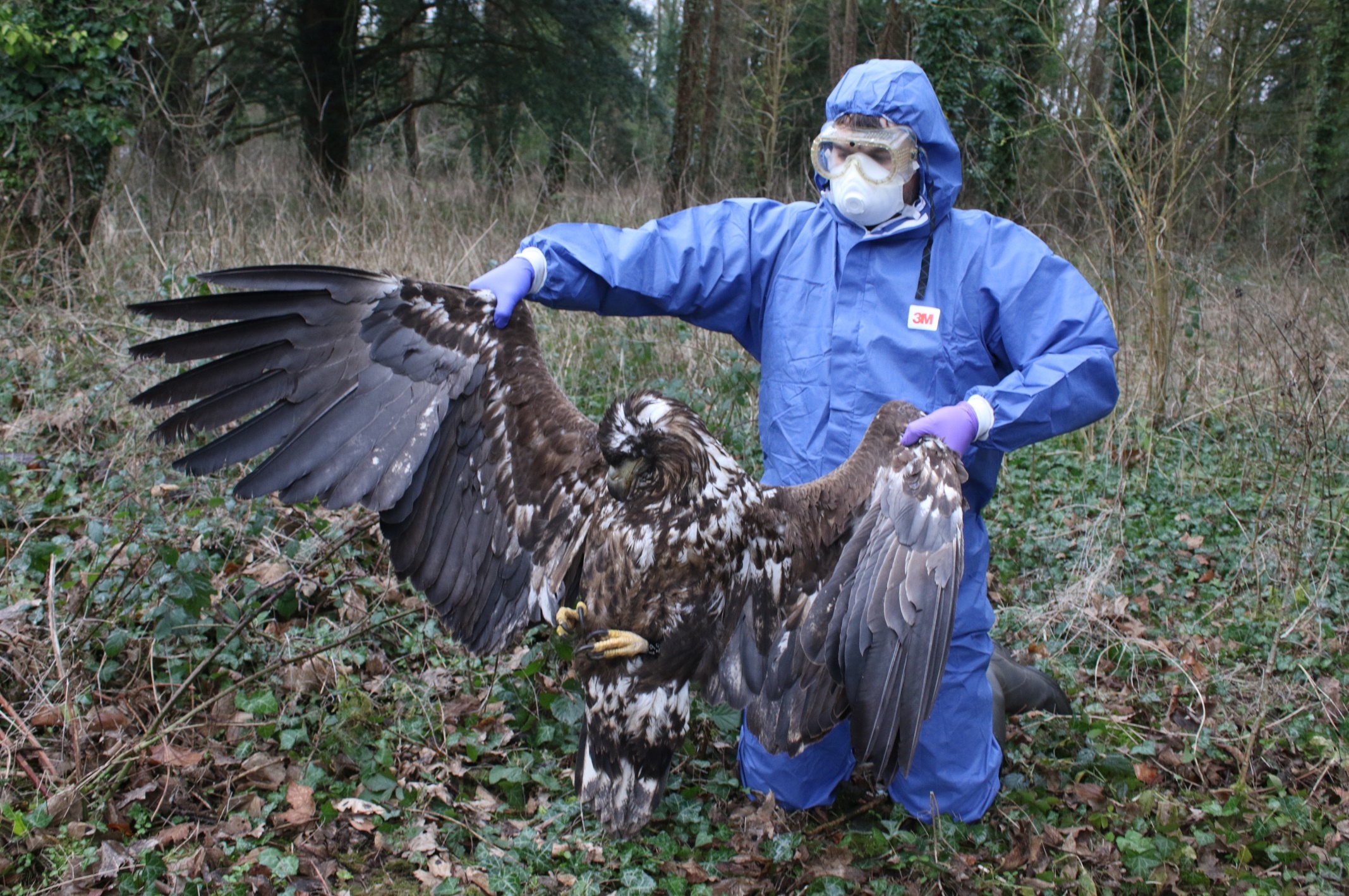
Another white-tailed eagle has died in southern England and another police investigation has been launched. This is the third one since October 2021 and all three investigations are focused on eagles from the Isle of Wight Reintroduction Project.

Hampshire Police have become involved after this latest eagle’s ‘sudden death’ on 24th February 2022. A post-mortem has revealed the eagle was carrying avian flu but this has not been confirmed as the cause of death and other evidence, not yet in the public domain, suggests there may be more to this than meets the eye.

Forestry England and the Roy Dennis Wildlife Foundation, partners on the eagle reintroduction project, have issued a very carefully-worded statement:

A satellite-tracked White-tailed Eagle from the Isle of Wight reintroduction scheme was found dead on the Isle of Wight on 24 February 2022. Circumstances surrounding the sudden death of the bird are being investigated by Hampshire Police and partners.

During a post mortem examination it has been identified that the bird was carrying avian influenza, although it is unknown at this stage if this is related to the bird’s death and enquiries are continuing‘.

A spokesperson for Hampshire Constabulary said:

We were called shortly after 5pm on Thursday 24 February to a report of a dead sea eagle on Bowcombe Road on the Isle of Wight.

The investigation into the circumstances surrounding the animals death is ongoing.

We are not linking this to any other investigations at this time‘.

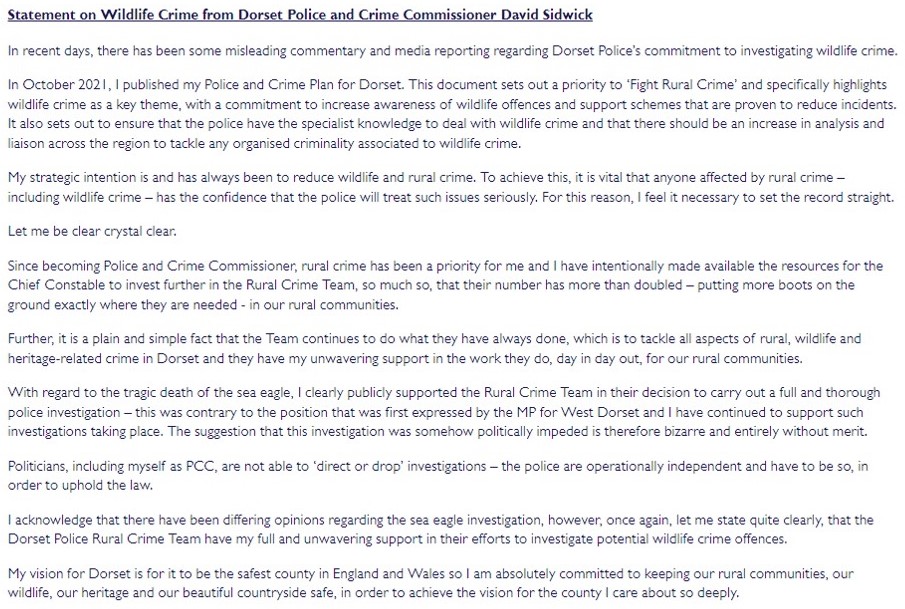
We are still waiting for the post-mortem and toxicology results to be published from the two other young sea eagles that have died in suspicious circumstances (see here). Both eagles were found dead on game-shooting estates, one in Sussex in October 2021 and one in Dorset in January 2022. Neither of them tested positive for avian flu.

There is ongoing police activity on both these cases, which may account for Dorset and Sussex police’s reluctance to release the post mortem results, but the longer this secrecy goes on, the more damaging to those force’s reputations when the results do finally emerge. And emerge they will, you can be sure of that.

UPDATE 9th February 2023: Death of white-tailed eagle on Isle of Wight recorded as ‘uncertain’ as presence of avian flu restricted toxicology tests (here)

DEFRA forced to U-turn on Schrodinger’s pheasant after legal threat from Wild Justice

Last month conservation campaign group Wild Justice started legal proceedings against DEFRA over changes that DEFRA had apparently slipped in to General Licence #42 in January, extending the definition of ‘livestock’ which meant permitting the killing of so-called ‘pest’ species to protect pheasants when they were classified as ‘livestock’ (see here and here).

Wild Justice nicknamed this Schrodinger’s pheasant, with a nod to Schrodinger’s cat, because the pheasant’s status seemed to be ‘livestock’ and ‘wildlife’ simultaneously, according to whatever seemed to suit the shooting industry at any given time:

Earlier this week, DEFRA wrote back to Wild Justice to acknowledge that the extension of the definition of ‘livestock’ in this case would not be not lawful and that the terms of General Licence #42 have now been amended to clarify the status of pheasants.

Tom Short, one of Wild Justice’s lawyers at Leigh Day, simplifies the arguments very well with this explanation:

When GL42 was published in January, it appeared that Defra had deliberately sought to extend the definition of “livestock” as set out in 27(1) Wildlife and Countryside Act 1981 by way of footnote 7. This meant that certain Pheasants released from their pens by shooting estates would now be counted as “livestock” rather than wild birds. That matters because as “livestock”, GL42 authorisers user to kill or take Carrion Crows, Jackdaws, Magpies or Rooks to protect the Pheasants.

In particular, Wild Justice was concerned that GL42 went beyond the definition of “livestock” in the WCA 1981, to now include gamebirds “kept in an enclosure or which are free roaming but remain significantly dependent on the provision of food, water or shelter by a keeper for their survival”. The WCA 1981 definition by contrast only includes gamebirds which remain “kept” “for the provision or improvement of shooting”. On that definition, once a Pheasant is let out of the release pens ready for the shooting season, it is no longer kept for the provision of shooting and so its protection cannot be a lawful reason to kill or take Carrion Crows, Jackdaws, Magpies or Rooks under GL42.

Wild Justice asked Defra to justify the extension of the definition. In their response, Defra has agreed to revise the definition, has conceded that it is the WCA 1981 definition that applies and that they cannot extend that definition by including additional wording in the general licences. DEFRA also says that “The Secretary of State does not consider pheasants to be livestock within the meaning of the WCA 81 once they cease to be kept”.

Defra’s agreement to amend footnote 7 also clarifies that gamekeepers cannot claim that Pheasants they have released are “kept” simply by virtue of providing supplementary food “out into the environment”. Supplementary food does not make a wild Pheasant a kept Pheasant.  Defra says that “In principle, there is a significant and clear difference between the feeding of dependent kept birds and the provision of supplementary food in the environment”. We might doubt quite how clear that difference is, but certainly it is a reasonable argument (to be judged on the facts of each case) that a “dependent kept bird” would be one that is largely dependent on food in or by the pen.

Related to this, Defra has also confirmed that only shelter that is provided by a gamekeeper “by or within the release pen” is a factor in assessing whether a Pheasant is kept or wild. Any shelter that is provided further away does not bring a Pheasant back into a gamekeeper’s keeping.

Defra has also confirmed that lethal control is a method of last resort and alternatives must always be tried first.

Wild Justice challenged the expansion of the definition of “livestock” footnote 7 and the Secretary of State has conceded that the definition cannot be extended past what is set out in primary legislation. Any gamekeepers hoping to kill Carrion Crows, Jackdaws, Magpies or Rooks to protect Pheasants are only permitted to do so where those Pheasants are still “kept” and not yet wild birds, and only where they have explored non-lethal alternatives. No amount of spreading “supplementary food” or extra bits of shelter away from the release pen can make a wild Pheasant a kept Pheasant.

There’s a piece in today’s Guardian about this latest win for Wild Justice (here) and a Wild Justice blog (here).

Wild Justice has three co-directors (Mark Avery, Chris Packham, Ruth Tingay) who work unpaid as volunteers. Their work to get a better deal for wildlife relies entirely on donations so if you’d like to support their work please consider a donation here. If you’d like to hear more about their legal challenges and campaign work, please sign up for their free newsletter here.

Thank you.

More pheasants shot & dumped, in Somerset this time

Even though the pheasant-shooting season ended over a month ago, shot and dumped pheasants are still being discovered by shocked members of the public.

Many thanks to the blog reader who sent in this photo of shot & dumped pheasants, found last Monday chucked behind a hedge at the T-junction of Green Lane and Barnburgh Lane, just outside Goldthorpe, Barnsley, South Yorkshire.

So yet another dumping incident to add to the long list of those found in Cheshire, Scottish borders (here), Norfolk (here), Perthshire (here), Berkshire (here), North York Moors National Park (here) and some more in North York Moors National Park (here) and even more in North Yorkshire (here), Co. Derry (here), West Yorkshire (here), and again in West Yorkshire (here), N Wales (here), mid-Wales (here), Leicestershire (here), Lincolnshire (here), Somerset (here), Derbyshire’s Peak District National Park (here), Suffolk (here), Leicestershire again (here), Somerset again (here), Liverpool (here), even more in North Wales (here) even more in Wales, again (here), in Wiltshire (here) and in Angus (here).

I really hope Liam Stokes is paying attention to this. Liam is the Chief Executive of British Game Assurance (formerly British Game Alliance), the game-shooting industry’s version of a marketing board but not without its problems (e.g. see here).

Last month (Feb) Liam spoke at the BGA’s symposium, recorded here. After referring to the recent discussion in the House of Lords between Lord Newby and Lord Benyon (when Newby asked Benyon about shot gamebirds being dumped and Benyon claimed to have no knowledge of this happening – see here), here is what Liam Stokes had to say about shot & dumped gamebirds (starts at 4.24 min in the video link above):

He [Lord Newby] then goes on to ask this question – ‘In many cases game birds are shot and not used for food’. Now, as Lord Benyon is going to respond here, the evidence for this is vanishingly thin, this is, I mean, this, this is something that goes round in rural circles all the time, you know, that this, this is happening. We don’t see the evidence for it. So please don’t think that I’m sharing this because I also think this is happening, this is, this is something that goes around rural rumour mills and the evidence does not appear“.

Such forthright denial might seem convincing if you’re new to this. But if you’ve been around a while you might remember Liam Stokes in his former job at the Countryside Alliance when he had to respond to press enquiries when evidence appeared of shot & dumped pheasants (e.g. see here and here).

It’s also worth pointing out that Liam’s denial at the recent symposium came just a few days after national press coverage (including by ITV news) of a gamekeeper filmed by undercover investigators from the League Against Cruel Sports flinging shot gamebirds into a mineshaft in North Wales (see here) leading to an ongoing investigation by the police, Natural Resources Wales and a local council authority.

Surely, as CEO of the game shooting industry’s own self-styled marketing board, Liam Stokes would have been well aware of this very clear evidence of gamebird dumping, and yet he was prepared to go on camera and deny there’s any evidence of this happening?!

Crikey, you’d think that the CEO of a marketing board, reliant on consumers’ trust, would do a bit better than this, wouldn’t you?

High Court rules allegations about Chris Packham are defamatory, trial to commence

A High Court judge has this morning ruled that 19 separate articles, tweets and videos containing allegations about Chris Packham are defamatory at common law and that Chris’s lawsuit for libel damages against three defendants can proceed to trial.

[Chris, his partner Charlotte, and some of his legal team at the High Court in February 2022. Photo by Ruth Tingay]

The ruling relates to a preliminary ‘meanings’ hearing held at the Royal Courts of Justice on 15th February 2022. During that hearing, amongst other things, Mr Justice Johnson considered the ‘natural and ordinary’ meanings of the allegations made by the defendants in the 19 articles, tweets and videos and whether their allegations were written as ‘opinion’ or ‘fact’. If found to be ‘opinion’ that could provide a defence for the three defendants.

Today’s ruling comprehensively states that each of the ‘meanings’ are defamatory of the claimant [Chris Packham] at common law and that they all amount to statements of fact rather than expressions of opinion.

At the forthcoming trial the burden of proof will be on the defendants to provide a lawful defence for their defamatory statements.

Today’s judgement can be read here:

UPDATE 15.30hrs:

Press release from Chris’s solicitors at Leigh Day –

A series of nine articles in Country Squire magazine, two videos on YouTube and eight tweets about Chris Packham were defamatory, according to a judgment handed down today.

An initial trial of preliminary issues about the meaning of the articles, videos and tweets rejected the contention that all were expressing an opinion.

The defendants claimed that when they contended that Mr Packham misused his role as a BBC presenter to defraud the public into making charitable donations on the false pretext that tigers had been mistreated by a circus and rescued by a zoo, they were expressing an opinion. 

They relied on question marks, reference to the need for clarifications, an invitation to the reader to “make up your own mind” as part of their case.

However Mr Justice Johnson held that the meaning of each article is defamatory of Mr Packham at common law and amounts to a statement of fact. 

He rejected arguments that serious allegations of fraud were mitigated. References to the police and other investigating bodies “were not presented in a way to suggest that the reader should keep an open mind. They again reinforce the central theme of the publications that the claimant has perpetrated a fraud on the public”.

He said the parts of the publications that express opinions were ancillary to the defamatory meanings that the articles convey.

Following the determination of the meanings of the publications, it is expected that a substantive trial will be held towards the end of the year.

Mr Packham began proceedings following repeated allegations in Country Squire magazine that he defrauded the public into donating funds for the Wildheart Trust, where he is a trustee, by falsely claiming that it had rescued emotionally and physically broken tigers from European circuses.

The claims were independently investigated by the Fundraising Regulator and found to be unsupported [Ed: RPUK blog on that here], but the defendants refused to remove the articles, tweets and videos from the public domain and since the proceedings were issued, repeated the allegations. 

Following the judgment, Chris Packham said:

Truth and love, and a love of truth are things we cherish. They give us the ability to proceed, to become better people. They give us a chance of making a better world. So we must protect them, sometimes at great  personal cost. And that is why I have no choice but pursue this course of litigation. In this case the three defendants have proactively sought to damage my reputation. There is a line in the sand and it’s been crossed and I aim to ensure that they and any others who seek to employ such methods cross back again. And stay there.”

Chris Packham is represented by Leigh Day partner Tessa Gregory and solicitor Carol Day, who said: 

Our client is pleased the judge has recognised these very serious allegations are defamatory at common law. The burden of proof is now on the defendants to show a lawful defence to these claims in a substantive trial.”

ENDS

UPDATE: The trial is due to take place in May 2023.

RSPB records peatland fires on grouse moors in supposedly protected areas

Last autumn the RSPB launched an online reporting system for members of the public to document moorland fires (muirburn) to help build a picture of where heather moorland is being set alight as part of so-called grouse moor ‘management’ (see here).

In February 2022 the RSPB renewed its call for muirburn reports from the public with the aid of a free APP to make it a simple process (see here).

[Gamekeepers setting fire to a grouse moor in Aberdeenshire in February 2022]

The RSPB also provided this infographic analysing the reports it had received between October 2021 – January 2022, providing evidence that muirburn was taking place on peat, which is obviously of huge concern in this period of climate crisis. There was also evidence that burning was taking place in protected areas which is now illegal unless an individual licence has been granted:

The grouse shooting lobby was furious that the RSPB was asking people to report these fires (see here).

They’re going to be even more furious today because the RSPB has just published even more analysis of even more fires, showing that 82% of all reported fires on what is believed to be peatland (32 of 39 reports) were also in supposedly protected landscapes designated for conservation: Sites of Special Scientific Interest (SSSIs), Special Areas of Conservation (SACs), and Special Protection Areas (SPAs). Oops.

Today the RSPB in England has released another press release (see below) urging members of the public to continue to report moorland fires until the end of the burning season (April 15th). A similar request is expected from the RSPB Scotland team next week.

Press release from RSPB England (9th March 2022):

Public have reported 137 burns to the RSPB this season in England

  • The RSPB’s new upland burning reporting app has documented over 137 reports of burning in our uplands from 1 October 2021 to 28 February 2022.
  • More than 1 in 4 reported burns in England were on likely peat.
  • Of the burns reported on likely peat, 4 out of 5 (or more than 80%) were in a protected area (Sites of Special Scientific Interest, Special Areas of Conservation or Special Protected Areas).
  • The RSPB is calling on members of the public to continue to report incidents of burning in our uplands using their Survey 123 app before the end of the burning season on 15th April.
  • The data collected will help make the case for better protection of our globally important blanket bog and support the RSPB’s call for Governments across the UK to ban burning on peatland and to licence all moorland and grass burning to protect people, nature and our climate. 

This burning season, the RSPB launched their Burning Reporting App, allowing members of the public to simply and anonymously submit evidence of burning in our upland areas.

The burning season, which runs from October until April is undertaken across our moors, hillsides and valleys. The practice is used by gamekeepers and farmers to remove old heather and grass, with new growth preferred by grouse and sheep to eat.

In response to environmental concerns, DEFRA has taken steps to end rotational burning on peatland (>40cm deep), limiting where and when it can take place within Special Areas of Conservation and Protected Areas

However, burn reporting evidence collected by RSPB and our partners demonstrates that this legislation does not go far enough with burning still being recorded on peaty soils.

Dr Pat Thompson, Senior Policy Officer for RSPB UK said, ‘We have had a great response from the public to our app, with over 130 reports of burning it’s clear that people from across our upland communities are eager to help to do their part to protect these internationally significant landscapes.’  

‘It is clear from the reports we have received so far that burns are being conducted on our peatlands and in our protected areas.’

‘Our peatlands vital carbon stores and home to some of our most precious wildlife with their protection vital to tackling the climate crisis and in light of the latest IPCC report it is clear that we must take action to protect them.’

‘The evidence collected by our app demonstrates that the actions taken so far by government in Westminster to regulate burning does not go far enough. If we are to protect these internationally important landscapes and we must put a stop to burning on our peatlands and ensure that licencing is brought in for all heather and grass burning.’

Oriole Wagstaff, Casework Officer for RSPB UK said, ‘We cannot protect our uplands if we do not have a full picture of the land management undertaken throughout them. With many burns taking place in remote areas, we need the public to support us and report these burns.’  

‘Our new burning app is providing vital information on the extent and location of burning in the English uplands.  Information gathered to date shows that burning on peatlands is still happening, despite regulation intended to stop it on areas of deep peat.’

Burning can take place until the 15th April in England. To anonymously report a burn and download the app (available on iOS and Android), members of the public can visit the RSPB Burning website. There they can find instructions on how to download the app, as well as information on how to spot a burn and to stay to safe when reporting when reporting a burn.

By downloading the app and reporting evidence of burning you can play a vital role in helping to show the UK Government that despite current legislation, burning on carbon-rich blanket bogs is still taking place across our uplands. Ending burning will be a key step in ensuring we can turn round the fate of this globally important habitat in the UK.

ENDS

UPDATE 24th March 2022: RSPB Scotland encouraging the public to continue to report upland fires this season (here)

67 hen harriers confirmed ‘missing’ or illegally killed since 2018, most of them on or close to UK grouse moors

For anyone who still wants to pretend that the grouse shooting industry isn’t responsible for the systematic extermination of hen harriers on grouse moors across the UK, here’s the latest catalogue of crime that suggests otherwise.

[This male hen harrier died in 2019 after his leg was almost severed in an illegally set trap that had been placed next to his nest on a Scottish grouse moor (see here). Photo by Ruth Tingay]

This is the blog I now publish after every reported killing or suspicious disappearance.

They disappear in the same way political dissidents in authoritarian dictatorships have disappeared” (Stephen Barlow, 22 January 2021).

Today the list has been updated to include the most recently reported victims, six young hen harriers whose satellite tags inexplicably stopped transmitting and whose corpses vanished into thin air between November 2021 and January 2022 (see here).

I’ve been compiling this list only since 2018 because that is the year that the grouse shooting industry ‘leaders’ would have us believe that the criminal persecution of hen harriers had stopped and that these birds were being welcomed back on to the UK’s grouse moors (see here).

This assertion was made shortly before the publication of a devastating new scientific paper that demonstrated that 72% of satellite-tagged hen harriers were confirmed or considered likely to have been illegally killed, and this was ten times more likely to occur over areas of land managed for grouse shooting relative to other land uses (see here).

2018 was also the year that Natural England issued a licence to begin a hen harrier brood meddling trial on grouse moors in northern England. For new blog readers, hen harrier brood meddling is a conservation sham sanctioned by DEFRA as part of its ludicrous ‘Hen Harrier Action Plan‘ and carried out by Natural England (NE), in cahoots with the very industry responsible for the species’ catastrophic decline in England. For more background see here.

Brood meddling has been described as a sort of ‘gentleman’s agreement’ by commentator Stephen Welch:

I don’t get it, I thought the idea of that scheme was some kind of trade off – a gentleman’s agreement that the birds would be left in peace if they were moved from grouse moors at a certain density. It seems that one party is not keeping their side of the bargain“.

With at least 67 hen harriers gone since 2018, I think it’s fair to say that the grouse shooting industry is simply taking the piss. Meanwhile, Natural England pretends that ‘partnership working’ is the way to go and DEFRA Ministers remain silent.

‘Partnership working’ according to Natural England appears to include authorising the removal of hen harrier chicks from a grouse moor already under investigation by the police for suspected raptor persecution (here) and accepting a £10K bung from representatives of the grouse shooting industry that prevents Natural England from criticising them or the sham brood meddling trial (see here).

[Cartoon by Gill Lewis]

So here’s the latest gruesome list. Note that the majority of these birds (but not all) were fitted with satellite tags. How many more [untagged] harriers have been killed?

February 2018: Hen harrier Saorsa ‘disappeared’ in the Angus Glens in Scotland (here). The Scottish Gamekeepers Association later published wholly inaccurate information claiming the bird had been re-sighted. The RSPB dismissed this as “completely false” (here).

5 February 2018: Hen harrier Marc ‘disappeared’ on a grouse moor in Durham (here)

9 February 2018: Hen harrier Aalin ‘disappeared’ on a grouse moor in Wales (here)

March 2018: Hen harrier Blue ‘disappeared’ in the Lake District National Park (here)

March 2018: Hen harrier Finn ‘disappeared’ near Moffat in Scotland (here)

18 April 2018: Hen harrier Lia ‘disappeared’ in Wales and her corpse was retrieved in a field in May 2018. Cause of death was unconfirmed but police treating death as suspicious (here)

8 August 2018: Hen harrier Hilma ‘disappeared’ on a grouse moor in Northumberland (here).

16 August 2018: Hen harrier Athena ‘disappeared’ on a grouse moor in Scotland (here)

26 August 2018: Hen Harrier Octavia ‘disappeared’ on a grouse moor in the Peak District National Park (here)

29 August 2018: Hen harrier Margot ‘disappeared’ on a grouse moor in Scotland (here)

29 August 2018: Hen Harrier Heulwen ‘disappeared’ on a grouse moor in Wales (here)

3 September 2018: Hen harrier Stelmaria ‘disappeared’ on a grouse moor in Scotland (here)

24 September 2018: Hen harrier Heather ‘disappeared’ on a grouse moor in Scotland (here)

2 October 2018: Hen harrier Mabel ‘disappeared’ on a grouse moor on the edge of the Yorkshire Dales National Park (here)

3 October 2018: Hen Harrier Thor ‘disappeared’ next to a grouse moor in Bowland, Lanacashire (here)

23 October 2018: Hen harrier Tom ‘disappeared’ in South Wales (here)

26 October 2018: Hen harrier Arthur ‘disappeared’ on a grouse moor in the North York Moors National Park (here)

1 November 2018: Hen harrier Barney ‘disappeared’ on Bodmin Moor (here)

10 November 2018: Hen harrier Rannoch ‘disappeared’ on a grouse moor in Scotland (here). Her corpse was found nearby in May 2019 – she’d been killed in an illegally-set spring trap (here).

14 November 2018: Hen harrier River ‘disappeared’ on a grouse moor in the Nidderdale AONB (here). Her corpse was found nearby in April 2019 – she’d been illegally shot (here).

16 January 2019: Hen harrier Vulcan ‘disappeared’ in Wiltshire close to Natural England’s proposed reintroduction site (here)

7 February 2019: Hen harrier Skylar ‘disappeared’ next to a grouse moor in South Lanarkshire (here)

22 April 2019: Hen harrier Marci ‘disappeared’ on a grouse moor in the Cairngorms National Park (here)

26 April 2019: Hen harrier Rain ‘disappeared’ on a grouse moor in Nairnshire (here)

11 May 2019: An untagged male hen harrier was caught in an illegally-set trap next to his nest on a grouse moor in South Lanarkshire. He didn’t survive (here)

7 June 2019: An untagged hen harrier was found dead on a grouse moor in Scotland. A post mortem stated the bird had died as a result of ‘penetrating trauma’ injuries and that this bird had previously been shot (here)

5 September 2019: Wildland Hen Harrier 1 ‘disappeared’ on a grouse moor nr Dalnaspidal on the edge of the Cairngorms National Park (here)

11 September 2019: Hen harrier Romario ‘disappeared’ on a grouse moor in the Cairngorms National Park (here)

14 September 2019: Hen harrier (Brood meddled in 2019, #183704) ‘disappeared’ in the North Pennines (here)

23 September 2019: Hen harrier (Brood meddled in 2019, #55149) ‘disappeared’ in North Pennines (here)

24 September 2019: Wildland Hen Harrier 2 ‘disappeared’ on a grouse moor at Invercauld in the Cairngorms National Park (here)

24 September 2019: Hen harrier Bronwyn ‘disappeared’ near a grouse moor in North Wales (here)

10 October 2019: Hen harrier Ada ‘disappeared’ on a grouse moor in the North Pennines AONB (here)

12 October 2019: Hen harrier Thistle ‘disappeared’ on a grouse moor in Sutherland (here)

18 October 2019: Member of the public reports the witnessed shooting of an untagged male hen harrier on White Syke Hill in North Yorkshire (here)

November 2019: Hen harrier Mary found illegally poisoned on a pheasant shoot in Ireland (here)

January 2020: Members of the public report the witnessed shooting of a male hen harrier on Threshfield Moor in the Yorkshire Dales National Park (here)

23 March 2020: Hen harrier Rosie ‘disappeared’ at an undisclosed roost site in Northumberland (here)

1 April 2020: Hen harrier (Brood meddled in 2019, #183703) ‘disappeared’ in unnamed location, tag intermittent (here)

5 April 2020: Hen harrier Hoolie ‘disappeared’ on a grouse moor in the Cairngorms National Park (here)

8 April 2020: Hen harrier Marlin ‘disappeared’ on a grouse moor in the Cairngorms National Park (here)

19 May 2020: Hen harrier Fingal ‘disappeared’ on a grouse moor in the Lowther Hills, Scotland (here)

21 May 2020: Hen harrier (Brood meddled in 2019, #183701) ‘disappeared’ on a grouse moor in Cumbria shortly after returning from wintering in France (here)

27 May 2020: Hen harrier Silver ‘disappeared’ on a grouse moor on Leadhills Estate, Scotland (here)

day/month unknown: Unnamed male hen harrier breeding on RSPB Geltsdale Reserve, Cumbria ‘disappeared’ while away hunting (here)

9 July 2020: Unnamed female hen harrier (#201118) ‘disappeared’ from an undisclosed site in Northumberland (here).

25 July 2020: Hen harrier Harriet ‘disappeared’ on a grouse moor in the Yorkshire Dales National Park (here)

14 August 2020: Hen harrier Solo ‘disappeared’ in confidential nest area in Lancashire (here)

7 September 2020: Hen harrier Dryad ‘disappeared’ on a grouse moor in the Yorkshire Dales National Park (here)

16 September 2020: Hen harrier Fortune ‘disappeared’ from an undisclosed roost site in Northumberland (here)

19 September 2020: Hen harrier Harold ‘disappeared’ on a grouse moor in the Yorkshire Dales National Park (here)

20 September 2020: Hen harrier (Brood meddled in 2020, #55152) ‘disappeared’ next to a grouse moor in North Yorkshire (here)

24 February 2021: Hen harrier Tarras ‘disappeared’ next to a grouse moor in Northumberland (here)

12th April 2021: Hen harrier Yarrow ‘disappeared’ near Stockton, County Durham (here)

18 May 2021: Adult male hen harrier ‘disappeared’ from its breeding attempt on RSPB Geltsdale Reserve, Cumbria whilst away hunting (here)

18 May 2021: Another adult male hen harrier ‘disappeared’ from its breeding attempt on RSPB Geltsdale Reserve, Cumbria whilst away hunting (here)

24 July 2021: Hen harrier Asta ‘disappeared’ at a ‘confidential site’ in the North Pennines (here)

14th August 2021: Hen harrier Josephine ‘disappeared’ at a ‘confidential site’ in Northumberland (here)

17 September 2021: Hen harrier Reiver ‘disappeared’ in a grouse moor dominated region of Northumberland (here)

24 September 2021: Hen harrier (Brood meddled in 2021, R2-F-1-21) ‘disappeared’ in Northumberland (here)

15 November 2021: Hen harrier (brood meddled in 2020, #R2-F1-20) ‘disappeared’ at the edge of a grouse moor on Arkengarthdale Estate in the Yorkshire Dales National Park (here)

19 November 2021: Hen harrier Val ‘disappeared’ in the Lake District National Park in Cumbria (here)

19 November 2021: Hen harrier Percy ‘disappeared’ in Lothian, Scotland (here)

12 December 2021: Hen harrier Jasmine ‘disappeared’ on a grouse moor (High Rigg Moor on the Middlesmoor Estate) in the Nidderdale AONB in North Yorkshire (here)

9 January 2022: Hen harrier Ethel ‘disappeared’ in Northumberland (here)

26 January 2022: Hen harrier Amelia ‘disappeared’ in Bowland (here)

10 February 2022: An unnamed satellite-tagged hen harrier ‘disappeared’ in a grouse moor dominated area of the Peak District National Park (here)

To be continued……..

Not one of these 67 incidents has resulted in an arrest, let alone a prosecution. I had thought that when we reached 30 dead/missing hen harriers then the authorities might pretend to be interested and at least say a few words about this national scandal. We’ve now reached SIXTY SEVEN hen harriers, and still Govt ministers remain silent. They appear not to give a monkey’s. And yes, there are other things going on in the world, as always. That is not reason enough to ignore this blatant, brazen and systematic destruction of a supposedly protected species being undertaken to satisfy the greed and bloodlust of a minority of society.

Please consider sending a copy of this list of dead/missing hen harriers to your elected representative. Ask them for their opinion, tell them your opinion, and demand action (politely please). We know where these crimes are happening and we know why they’re happening. The Government’s own data, published three years ago, have provided very clear evidence (see here). MPs need to know how many of us care about this issue and how we will not be fobbed off by disingenuous platitudes from DEFRA Ministers (e.g. see here, here and here for repeated recent examples of this).

Not sure who is your MP? Click here to find out.

Don’t be put off by thinking, ‘Well my MP is a grouse shooter, he/she won’t bother responding so why should I bother?’. Do not give these politicians an easy option out. As your elected representative they have a duty to listen to, and respond to, constituents’ concerns, whether they agree with them or not.

If you use social media, please share this post.

If you fancy scribbling a few sentences to your local newspaper or even a national one, please do.

Please talk to friends, family and colleagues about these 67 birds. They will be horrified about what’s being allowed to go on.

We MUST increase public awareness. It’s up to all of us.

Thank you

Six more satellite-tagged hen harriers ‘disappear’ in suspicious circumstances

Six more satellite-tagged hen harriers have gone missing in suspicious circumstances, according to the most recent data published by Natural England last Friday, 4th March.

Natural England’s previous hen harrier update, published in December 2021 (here), identified three other tagged harriers that had vanished in the summer/autumn of 2021.

Now there are six more. Three disappeared in November 2021, one in December 2021 and two in January 2022. Neither the police or Natural England have issued any media press releases or made any public appeals for information about any of them.

Here are the details of the latest six to vanish, in chronological order:

Brood meddled hen harrier R2-F1-20, female, hatched in 2020 at nest site BM R2 Cumbria, last known satellite tag fix on the edge of a grouse moor (believed to be on Arkengarthdale Estate) in the Yorkshire Dales National Park on 15th November 2021, grid ref: NY959039.

Hen harrier Val (Tag ID 213849), female, hatched in North Pennines in 2021, last known satellite tag fix in Cumbria, west of Coniston Water on 19th November 2021, grid ref: SD256921.

Hen harrier Percy (Tag ID 213847), male, hatched in Northumberland (nest site Northumberland 1) in 2021, last known satellite tag fix in the Scottish Borders nr Fala Moor on 19th November 2021, grid ref: NT410615.

Hen harrier Jasmine (Tag ID 213848), female, hatched in Cumbria in 2021, last known satellite tag fix on a grouse moor (High Rigg Moor, Middlesmoor Estate) in the Nidderdale AONB, North Yorkshire on 12th December 2021, grid ref: SE034733.

Hen harrier Ethel (Tag ID 213852), female, hatched in Northumberland (nest site Northumberland 2) in 2021, last known satellite tag fix in Hexham on 9th January 2022, grid ref: NY936632.

Hen harrier Amelia (Tag ID 213846), female, hatched Bowland in 2021, last known satellite tag fix in Bowland on 26th January 2022, no grid reference provided.

These suspicious disappearances are no longer shocking, not even when six of them are reported at the same time.

The complete lack of media appeals about any of them from Natural England and the various police forces is no longer shocking.

The lack of prominence in the recent update blog that Natural England has given these latest disappearances is no longer shocking.

The zero prospect of any so-called investigation progressing to a prosecution is no longer shocking.

The complete silence from the grouse-shooting industry about this continued organised crime is no longer shocking.

It’s all just so routine, isn’t it?

It doesn’t have to be. It’s up to you, as blog readers, to bring this scandal to the attention of your elected representative(s) and demand that they put pressure on the Government to take action.

I’ll update the ever-increasing list of hen harriers known to have been illegally killed in the UK or that have vanished in suspicious disappearances since 2018, most of them on or close to grouse moors, and will post it here shortly. It would be good if you could then send that list to your local MP so they can’t claim to be ignorant of what’s going on.

UPDATE 9th March 2022: 67 hen harriers confirmed ‘missing’ or illegally killed since 2018, most of them on or close to UK grouse moors (here)

Brood meddled hen harrier siblings in incestuous relationship

It seems Natural England has some (more) explaining to do.

In the latest NE update on satellite-tagged hen harriers published last Friday, buried amongst the spreadsheet notes and carefully not mentioned in NE’s accompanying blog, I found the following information:

Two sibling hen harriers, both hatched in the same nest in 2020 (nest site: BM R2 Cumbria) and both brood meddled as part of NE and DEFRA’s sham conservation project, apparently ‘bred successfully‘ in Co Durham in 2021 (see lines 43 & 46 in the March 2022 spreadsheet).

The two incestuous individuals are Male R2-M1-20 and Female R2-F3-20.

Isn’t that interesting? Two young hen harriers, removed from their nest (along with two other siblings), raised under artificial conditions in captivity, released back to the wild just after reaching fledging age, pair up the next breeding season and produce offspring.

I don’t know what Natural England means by ‘bred successfully‘. I wouldn’t call an incestuous breeding attempt ‘successful’ by any stretch of the imagination. I’d call it deeply concerning, at the very least.

I haven’t heard of incestuous hen harriers before. Quite a bit has been written by several authors on the intimate details of the hen harrier’s love life (which is why we know that polygyny can be common) but I haven’t been able to find any reference to incest.

I spoke about it this morning to my colleague Mark Avery, who said that incestuous relationships are probably very common in the uplands of England but I don’t think he was referring to hen harriers.

I wonder how Natural England will explain this behaviour? It’s clear they’re not that keen to explain anything, because otherwise they would have already drawn attention to this incestuous pair.

One for the brood meddling scientific committee to answer, perhaps.

Meanwhile, standby for more news of vanishing hen harriers; yet another indication that this brood meddling trial is utterly futile.