Multi-agency raid in relation to captive raptors in Merseyside

The following statement was published on social media on Friday (15th July) by Cheshire Police Rural Crime Team:

WILDLIFE & COUNTRYSIDE ACT WARRANT

Today, PCSO Graham and I assisted with a search warrant led by Merseyside Police in relation to possible offences under the Wildlife & Countryside Act. The activity focused on crime associated with the keeping of birds of prey and owls, with possible links to Cheshire.

We were joined by our colleagues from North Wales Police Rural Crime Team and the National Wildlife Crime Unit. We also had assistance from the RSPCA and RSPB, who provided expertise around welfare and conditions of birds of prey at the location concerned.

A number of items were seized during the warrant including a bird of prey which has been taken in to care by the RSPCA.

The investigation is currently ongoing between Merseyside Police and the National Wildlife Crime Unit.

PC Tether, St Helens Police.

ENDS

Scottish Gamekeepers Association plan awards ceremony at disgraced Moy Estate

Remember all those recent headlines from the game shooting industry, declaring a ‘zero tolerance’ stance against raptor persecution?

Well quelle surprise, it seems their interpretation of ‘zero tolerance’ isn’t quite the same as everyone else’s.

Last month Moy Estate, a shooting estate in the Monadhliaths was given a three-year General Licence restriction, imposed by NatureScot on the basis of evidence provided by Police Scotland of wildlife crime against birds, specifically the discovery of a poisoned red kite in 2020 (here).

It was just the latest in a long line of raptor persecution incidents reported on or next to Moy Estate for over a decade, and another court case is due to be heard this autumn.

For an example of the history, here is a map we created way back in 2016 to highlight the extent of raptor persecution crimes in former Cabinet Secretary Fergus Ewing’s constituency (given his strong support of the Scottish Gamekeepers Association) and this shows the concentration of incidents on and close to Moy Estate:

The General Licence restriction is a bit like putting a school into ‘special measures’ – a status applied by regulators to indicate the school has fallen short of acceptable standards, although the main serious difference here of course is that a General Licence restriction is imposed on the basis of wildlife crimes being committed on the estate, rather than merely a shortfall in standards.

The main idea behind the introduction of General Licence restrictions back in 2014 was that they would act as a “reputational driver” for those sanctioned estates, according to the then Environment Minister Paul Wheelhouse (see here).

However, there has been no evidence that the game-shooting industry takes any notice whatsoever of such sanctions. For example, the Game & Wildlife Conservation Trust hosted a guided tour and BBQ on ‘the renowned Corsehope Shoot‘ in June 2017, at the same time that this estate was serving a three year General Licence restriction for wildlife crime; Edradynate Estate bragged about “a belter season“ at the same time it was serving a three-year General Licence restriction for wildlife crime; and this estate was also endorsed by the British Game Alliance, the game shooting industry’s own ‘assurance’ scheme, membership of which is supposed to indicate ‘rigorous and ethical standards’, whilst the estate was under a General Licence restriction for wildlife crime (see here).

So it comes as no surprise to see that the Scottish Gamekeepers Association (SGA) is not only intending to have a stand at the forthcoming Highland Field Sport Fair hosted by Moy Estate (now rebranded as the Moy Country Fair, presumably in an attempt to make it more palatable), but the SGA is also planning an awards ceremony at the event to announce the winner of the SGA Young Gamekeeper of the Year Award as well as presenting various Long Service Medals!

You couldn’t make this up!

The Moy game fair has previously attracted the likes of former Cabinet Minister Fergus Ewing who used his attendance to give a rallying speech to the game-shooting sector (here) and Scottish Land & Estates (SLE) also usually has a stand. I can’t remember if Moy Estate is a member of SLE, but it’ll be interesting to see if SLE puts in an appearance this year.

Farmer receives pathetic fine for poisoning two buzzards & a raven

This article appeared in The Journal today:

Farmer fined €500 for poisoning protected bird species in Co Wicklow

By Lauren Boland

A FARMER HAS been fined for poisoning protected birds in Co Wicklow after pleading guilty to what a judge described as a “serious crime”.

Christopher Thomas Noel Doyle, also known as Noel Doyle Senior, with an address at Crehelp in Co Wicklow, came before the Carlow District Court over a breach of restrictions on the use of poisoned bait.

The judge imposed a €500 fine and €1,500 in expenses that he must pay within four months.

A conservation ranger told the court he had discovered two dead buzzards, a dead raven, and a sheep carcass on lands at Athgreaney, Co Wicklow.

[Buzzard, photographer unknown]

The court heard that the ranger first found a dead buzzard and after further investigation identified a second dead buzzard, a dead raven, and a sheep carcass placed near a fox den.

Post-mortems by the Department of Agriculture and testing by Dublin Regional Veterinary Laboratory and the State Laboratory found that the birds died due to high levels of poison (carbofuran) in their systems.

The sheep had been cut open and the wound was laced with large amounts of carbofuran.

The ranger said that the levels of poison were extremely hazardous to all forms of life and that it was very fortunate that no humans had been accidentally poisoned.

He said it was likely that other wild animals had scavenged the carcasses and died from poisoning but were never found. 

Judge Marie Keane said there was an “astonishing amount of poison” used in what she described as a “serious crime” and “a deliberate enterprise” to try to persecute the local wildlife.

In a statement, Minister of State for Heritage Malcolm Noonan called it a “particularly heinous and disturbing wildlife crime”.

Buzzards are a protected species and deliberate poisoning of them is an offence under the Birds and Natural Habitats (Restrictions on the Use of Poisoned Bait) Regulations 2010.

Carbofuran was previously used as a pesticide in agriculture but is now banned because of its toxicity to wildlife, especially to birds.

Approval for the use of carbofuran products was withdrawn throughout the EU in 2007, including in Ireland in December of that year.

After an 18-month period to use up remaining stock, it was banned fully from 2009.

ENDS

Convicted Scottish gamekeeper Rhys Davies: delayed sentencing explained

In May this year, Scottish gamekeeper Rhys Owen Davies, 28, pleaded guilty to a number of depraved animal cruelty offences relating to the keeping and training of dogs for animal fighting (badger baiting) and of failing to seek veterinary attention for dogs that had sustained serious injuries from those fights (see here).

He also pleaded guilty to a number of firearms offences after the Scottish SPCA raided his home in 2019 on Millden Estate in the Angus Glens and found three unsecure guns and ammunition left lying around inside the house.

His fellow gamekeepers, the sporting agent and the landowner at Millden Estate (a well known raptor persecution hotspot) all apparently failed to notice any of his crimes, or the injuries sustained by some of his eleven dogs housed in kennels on the estate. They also apparently failed to notice the bags of dead raptors scattered around the estate – more on those soon.

Davies was only caught because, being a top-notch criminal mastermind, he sent ‘trophy’ photos of himself and some of his mates posing with mutilated animals to a printing shop and used his address on Millden Estate as the return address. The shop assistant alerted the Scottish SPCA who immediately opened an investigation.

On conviction at Forfar Sheriff Court on 5th May 2022, Sheriff Derek Reekie ignored the mitigation plea from the defendant’s QC (who paid for this QC??) and instead concurred with Crown Office Fiscal, Karon Rollo, who made clear that Davies was a fully-trained gamekeeper (three-years college training) and had been employed as a gamekeeper for four years so knew exactly what he was doing. Sheriff Derek Reekie agreed and asked for social reports on Davies before sentencing was due on 28th June 2022.

[Photographic evidence of badger baiting from Millden Estate gamekeeper’s phone. Photo provided by SSPCA]

Sentencing day arrived but frustratingly, sentencing was deferred for a further five weeks (here) without any explanation appearing in the media. This led to all sorts of unhelpful conspiracy theories on social media, mostly referring to the Masons and a corrupt judiciary.

I’ve since been provided with some information by someone who was present in court at that deferred sentencing hearing and hopefully this explanation will put to bed the conspiracy theories.

In May, Sheriff Reekie had asked for a report on Davies’ domestic circumstances in Wales, where Davies had since moved to after leaving Millden Estate in the Angus Glens. The Sheriff had allowed seven weeks for that report to be compiled and expected it to be available at the sentencing hearing on 28th June.

However, it turns out the social services department in Wales had only managed to make one phone call to Davies’ parents during that seven-week period and had not made a home visit. That’s probably an indication of how stretched these services are but nevertheless, the background report on Davies wasn’t ready.

Rather than ignore the non-existent social report and just pass sentence anyway, Sheriff Reekie allowed a further five weeks for that report to be completed. Apparently he made clear that this was to avoid providing any grounds for an appeal (by Davies’ QC) later on.

Sentencing is now due on 1st August 2022.

On the separate issue of dead raptors being found on Millden Estate during the search, I’ll be blogging about that very soon.

Raptor persecution “hasn’t been a problem for years”, claims Scottish Gamekeepers committee member

There was a jaw-droppingly half-baked article published in The Courier last week, featuring commentary from a Scottish gamekeeper.

Bob Connelly, who is reportedly a Committee member of the Scottish Gamekeepers Association (SGA), had been speaking at the Scottish Game Fair and the Couriers environment journalist Scott Milne took the comments at face value and wrote the following article, which has to be read to be believed.

People will not realise the importance of land management and the shooting industry until campaigners force the end of the sector.

That is the view of gamekeeper Bob Connelly, who works in an estate in north east Perthshire.

Bob was speaking at the Scottish Game Fair, which took place in Scone over the weekend.

The Scottish Government is preparing legislation that could see gamekeeper grouse shooting licenced.

This has come after a campaign by animal rights advocates [Ed: he’s referring to this blog!] releasing evidence which appears to show wildlife crimes such as raptor persecution and misuse of traps.

The theory goes that predators such as buzzards and hen harries are killed in order to protect grouse, which brings in a lot of money during shooting season.

ARE GAMEKEEPERS VICTIM OF A HATE CAMPAIGN?

Bob feels much of this evidence has been manufactured as part of a “malicious” campaign to turn public opinion against gamekeepers and the shooting industry.

He said: “They want to get rid of us.

“But people don’t understand what we do and why we do it.”

A case in point is the controversial practice of heather burning.

It has been criticised as unnecessary and potentially damaging to peatland, which can release large swathes of carbon.

But Bob has a different perspective.

“You have to accept that there are going to be fires in places like that if you let it overgrow.

“So if it’s inevitable, do you want to have a controlled fire or let a wild one get out of hand?

“That would be even more damaging.”

Bob also feels it’s important gamekeepers are allowed to control predator populations in order to protect smaller species.

He said: “What we do is we build it from the ground up. We make sure the right environment is in place for insects and other small species and then bigger ones can naturally thrive on top of that.

“There’s more and more red-listed birds. If you want to protect them, it’s important to control predators such as foxes and buzzards.

“There’s a lot of people who have been manipulated to feel a certain way on social media, but don’t fully understand what we do.

“They’ll will miss us when we’re gone.”

WILL LEGISLATION CHANGE THINGS?

Bob thinks the upcoming gamekeeper shooting legislation is not needed.

“There is already rules surrounding things like traps. I can’t see how it can be legislated anymore.

“Yes, there were problems in the past with raptor persecution and things like that.

“But if you discount one or two recent examples, it hasn’t been a problem for years.”

GAMEKEEPERS AND LAND MANAGERS ARE WORRIED

Tim Baynes is director of moorland with Scottish Land and Estates.

Also speaking at the Scottish Game Fair, he said many gamekeepers and land managers he knows are worried for their jobs.

“A lot of these people have a very specific skillset that has come down from generations.”

Tim wouldn’t go as far as Bob and say anti-shooting campaigners have adopted “malicious” practices, but he does feel they “have an agenda”.

“They want to remove shooting.

“But they are not involved in it or in managing land so they are coming at it from a different perspective.”

Tim hopes the shooting industry can work with politicians to have legislation that works for everyone.

However, he is concerned that last-minute changes might be brought in that would work against their favour.

“At the end of the day, we have to work with the government that has got the votes.

“There are people within the government who are pragmatic about the industry.

“But it can be difficult for them to publicly say so.”

ENDS

The level of idiocy in this article is quite staggering, even for an SGA committee member. I guess it’s what we’ve come to expect from the SGA though, who have been in denial about the extent of these crimes for at least the 12 years I’ve been writing this blog and probably for years prior to that, as their standard response to the most glaring of truths.

And it is that level of idiotic denial, combined with ongoing raptor persecution and the SGA’s inability to influence those within the shooting industry who continue to commit these disgusting wildlife crimes (e.g. see here, here, here, here, here), that has brought about the Government’s decision to introduce a grouse shooting licensing scheme.

That decision wasn’t based on so-called ” manufactured evidence“. It was based on the number of raptor corpses found dead and mutilated on game-shooting estates over many, many years, including poisoned eagles found on grouse shooting estates even inside our National Parks for God’s sake, combined with the massive weight of incontrovertible scientific evidence that all points to an outright refusal to abide by the law by many members of the game-shooting industry.

It’s not the fault of this blog, nor the fault of the many other campaigners who have been fighting against this abuse of our raptors for decades. The blame lies entirely, and obviously, with the criminals.

Have your say on General Licences in Northern Ireland

Last year conservation campaign group Wild Justice won another legal victory after challenging Northern Ireland’s Department of Agriculture, Environment and Rural Affairs’ (DAERA) about its awful and unlawful General Licences for killing wild birds (see here).

As a result of that successful legal challenge (only possible thanks to a magnificent response to Wild Justice’s crowdfunder), DAERA provided written assurance that its flawed general licences would be replaced by interim licences and that a full public consultation would be launched in due course.

That promised public consultation has now finally emerged, after months of delays by DAERA. The consultation opened earlier this month and is due to close in ten days time on Thursday 21st July 2022.

Wild Justice is encouraging all its supporters to respond to this consultation, to ensure DAERA cannot simply slide backwards and claim that nobody was interested.

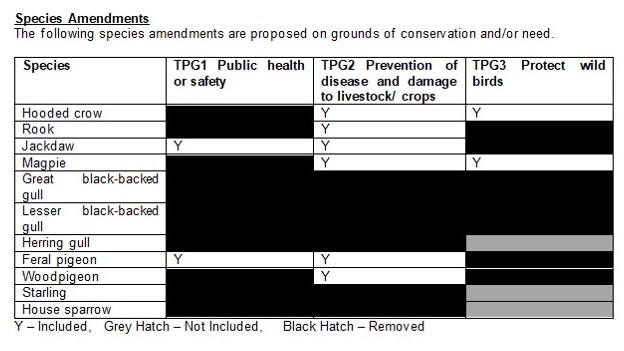
For instance, Wild Justice is arguing that sparrows and starlings should NOT be killed ‘to protect livestock and crops’ because (a) there isn’t any scientific evidence to show these species have an impact; (b) General Licences for this purpose don’t exist anywhere else in the UK; (c) they’re both red-listed species(!) and (d) in the unlikely event that evidence was found that these two species are damaging livestock and crops then an individual (e.g. one-off) licence could be applied for. There is absolutely no justification whatsoever for including these two species on a General Licence where they would be killed in unlimited numbers.

Wild Justice has provided a very easy-to-follow guide on how to respond to the consultation and you can find that information here. Thank you.

If you’d like to see the results of the rapid reform of General Licences across the UK, brought about by Wild Justice’s legal challenges, supported by crowdfunding from the general public, this blog from Wild Justice provides a good analysis.

If you’d like to be kept up to date with Wild Justice activities, you can subscribe to their free newsletter here.

Guest blog: Ospreys in the Glaslyn Valley

This is a guest blog written by Bywyd Gwyllt Glaslyn Wildlife, a small Community Interest Company (CIC) working to protect breeding ospreys and other wildlife in the Glaslyn Valley in north west Wales.

Ospreys in the Glaslyn Valley

Thanks to concerted conservation efforts, the osprey has in recent decades made an encouraging comeback in parts of the UK, none more so than in a stunning corner of North West Wales, the Glaslyn Valley near Porthmadog, where a special success story continues to unfold.

It was in 2004 when a local man first spotted an osprey flying up the Valley carrying a fish. He later found a nest and a temporary viewing area and nest protection scheme was quickly organised.

The male osprey was a Scottish bird born in 1998, Ochre 11(98) who had been translocated to Rutland Water, before making his way to Wales. His partner was an unringed female, now known as Mrs G, who remarkably has this year returned for her 19th year and is Wales’ oldest female breeding osprey.

[Scottish osprey Ochre 11]

It wasn’t the best of starts in 2004 with the nest blowing down in a storm, killing two chicks. The nest was repaired over the winter and happily the pair returned the following year and went on to breed until 2014. Their dynasty has since spread far and wide.

Bywyd Gwyllt Glaslyn Wildlife, now in its tenth year, runs Glaslyn Ospreys and has managed the project since the RSPB’s stewardship of the project came to an end in 2013. BGGW is an entirely volunteer-run operation relying on visitor and supporter donations.

The success story of Glaslyn’s ospreys took a new turn in 2015 when 11(98) Mrs G’s partner of eleven years, failed to return.

There were various potential suitors at the Glaslyn nest including one of Mrs G’s chicks from 2012, Blue 80. After some uncertain weeks, an unringed male, thought to be around three years old, Aran, arrived on the scene and went on to breed successfully with Mrs G producing two chicks that year. By 2020 they had gone on to raise a further 13 chicks, some of which have since been resighted in the UK and Africa. A new chapter had opened in the story of Glaslyn Ospreys.

[Osprey pair Mrs G and Aran]

By 2021, forty-one of Mrs G’s chicks with her two partners had fledged and five of them were continuing to breed in the UK. Furthermore, three grand chicks were also known to be breeding in Northumberland and Scotland. In total there were 112 grand chicks and ten great grand chicks the project knew of. Offspring continue to be spotted in their winter migration grounds in Africa and in 2022, the first male chick from 2005, Yellow 37, returned to breed for the twelfth year at Kielder. A family tree produced this year illustrates the story so far.

In 2021 the Glaslyn pair returned to the nest in the Spring and three eggs were laid. Unfortunately, the hatching of the eggs coincided with a severe storm during which Aran injured his wing and, consequently, was unable to fish. Sadly, the chicks died, the first time since 2005 that none had fledged from the Glaslyn nest. It was a tremendous blow for the project, but gradually over the summer Aran went on to make a full recovery, fishing and re-enforcing his bonds to Mrs G and the nest. He returned in perfect condition from his winter migration in April this year and the pair have had three more chicks, bringing the number of the female’s offspring to 52.

[Chicks from the 2014 season – Blue 7C, 8C and 9C. Chick 9C is breeding in northern England and chick 8C was re-sighted this year at Poole Harbour in Dorset and then Loch of the Lowes in Scotland]

In the Glaslyn Valley alone, no fewer than 19 different ospreys were seen and many of them identified on the Glaslyn nest or in the surrounding area last year. Many were Welsh born returnees. In 2022 there are seven known nests in Wales, three of which are in the Glaslyn Valley.

Today, a popular Visitor Centre and a new Hide (recently opened by Iolo Williams) at Pont Croesor provide a place where people from far and wide can see these magnificent birds. Live pictures are streamed from the nest and followed by thousands. The Centre is open every day between 10.30am and 4.30pm until the birds migrate in September.

The project will be represented at Wild Justice’s forthcoming Hen Harrier Fest at Adlington Hall & Gardens in Cheshire on Sunday 24 July. Call in and see us!

‘Higher, lower’ – Revive coalition takes Play Your Cards Right into Scottish Parliament

The REVIVE coalition has come up with another creative idea to lobby effectively for grouse moor reform in Scotland.

In 2020 the coalition produced a spoof version of Dragon’s Den, where representatives of the grouse shooting industry were seen pitching their case in the Den, only to be met with incredulity by the Dragons (watch the video here).

Last week they took an interactive game based on the game show ‘Play Your Cards Right‘ into the Scottish parliament building, inviting MSPs to choose ‘higher’ or ‘lower’ cards from the board.

The game is designed so that the cards / numbers on the top row become progressively higher and more disastrous (the environmental impact of grouse shooting) while the cards / numbers on the bottom row become progressively lower (the so-called economic ‘benefits’ of grouse shooting).

At the end of the game, the MSPs are left with the juxtaposition of a large number of animals killed (including an estimation of grouse numbers killed) next to the economic contribution figure of 0.02%.

Lots of MSPs were encouraged to have a go, from across the political parties, and even Environment Minister Mairi McAllen was game.

This is a very clever way to engage with the policy-makers and get across a message that is likely to be remembered.

Well done Max Wiszniewski from REVIVE and many thanks to all the participating MSPs.

Special thanks to Scottish Greens MSP Mark Ruskell for sponsoring the event.

Large Scottish estates face fines for ‘nature restoration’ failings in new land reform proposals

Yesterday the Scottish Government moved forward with its latest land reform proposals by launching a consultation for a new Land Reform Bill, which it has committed to bring in during this parliamentary session.

This is a result of the Bute House Agreement in August 2021 when the Scottish Greens and the SNP reached an agreement on a shared draft policy programme which detailed the key areas of policy on which the two parties agreed to cooperate, and that included grouse moor reform.

[Ecologically poor grouse moors dominate the landscape in the eastern Cairngorms National Park. Photo by Ruth Tingay]

The public consultation is seeking views on what measures should be included in the Bill. The Government says:

The Bill will be ambitious. It will address long-standing concerns about the highly concentrated pattern of land ownership in rural areas of Scotland.  At the same time, we want to ensure that our land is owned, managed, and used in ways that rise to the challenges of today: net zero, nature restoration, and a just transition’.

Community empowerment and ‘nature restoration’ (which doesn’t appear to have been defined yet but surely doesn’t include the continuation of ecologically depauperate, intensively-managed driven grouse moors) both feature heavily and, subject to the consultation responses, landowners could face financial penalties for breaches of the new rules in the form of fines and/or subsidy withdrawal.

Sev Carrell has written a good overview piece in the Guardian about the proposals in the consultation – see here.

You can read the Government’s overview here, which includes links to the consultation paper and to the respondent’s form.

The consultation opened on 4th July 2022 and closes on 25th September 2022.

Wild Justice invites you to Hen Harrier Fest, 24 July 2022

Hen Harrier Fest takes place in just under three weeks time on Sunday 24th July at Adlington Hall & Gardens, Cheshire.

To register for this free event, please visit Wild Justice’s Hen Harrier Fest webpage (here) and keep an eye on it as more detail will be uploaded soon!