Hen harrier goes ‘missing’ from a Peak District grouse moor – police confirm his satellite tag had been deliberately cut off

Press release from RSPB (16th March 2023)

MISSING HEN HARRIER HAD SATELLITE TAG CUT OFF

*Anu, a satellite tagged Hen Harrier, vanished after roosting near Upper Midhope in the Peak District National Park – on land managed for driven grouse shooting.

*RSPB Investigations Officers located the bird’s tag three days later and police forensics found it had been deliberately cut off the bird. Investigators fear the bird was illegally killed and his tag removed to hide the evidence.

*Anu joins a long list of birds of prey which have suspiciously disappeared or been killed in relation to land managed for driven grouse shooting. Licensing of grouse shooting as a meaningful deterrent to wildlife crime is needed in England, replicating current proposals in Scotland.

Anu being satellite-tagged before fledging in Bowland in 2021. Photo: RSPB

Yet another mysterious disappearance involving a rare Hen Harrier has been identified by the RSPB and South Yorkshire Police.

Anu, a young male, tagged in Bowland in 2021, was one of several young Hen Harriers fitted with a satellite tag by the RSPB: a small, unobtrusive device which enables scientists to monitor the movements of individual birds and gain greater understanding of this rare and criminally persecuted species.

Anu’s tag indicated that he was roosting on a grouse moor near Upper Midhope on 10 February 2022. However, the tag data showed unusual movement from the bird after 10.25pm that night, when Anu would normally have been stationary.

The tag’s next signal on 11 February was more surprising still, indicating the bird was dead. After an intensive search, the tag was found, some 9km away to the east, on 14 February at Wharncliffe Chase. But suspiciously there was no sign of the body.

This was reported to South Yorkshire Police and forensic analysis confirmed the tag harness had been cut by a human rather than bitten or pulled off. The RSPB suspects that Anu was killed, and the body and tag separated to remove evidence from the crime scene, with the tag then dumped. Anu’s body remains missing, and further enquiries have been unsuccessful.

Tom Grose, RSPB Investigations Officer, said: “To find Anu’s tag detached from his body, having been deliberately cut off, categorically shows human involvement. It is highly suspicious that he roosted on a grouse moor the night before, was unexpectedly active in the hours of darkness and hasn’t been seen since.

We suspect that Anu was killed that night, his tag cut off and then the body dumped away from the grouse moor by someone trying to cover their tracks. The deliberate killing of a wild bird is illegal, yet sadly criminal persecution has been identified is the main reason driving Hen Harrier declines.”

A 2019 study of satellite-tagged Hen Harriers by Natural England revealed that 72% of 58 satellite-tagged Hen Harriers were either confirmed or considered very likely to have been illegally killed. Furthermore, it found that Hen Harriers were ten times more likely to vanish mysteriously or die on a grouse moor than anywhere else.

Tom added: “When only a small percentage of Hen Harriers in the UK are tagged, you can’t help wonder what is happening to the other non-tagged birds. This is a species in trouble, and the UK population remains far below what it should be. As the nature crisis tightens its grip, illegal persecution of raptors must be stopped and that will only happen through the licensing of driven grouse moors – as is happening in Scotland – to bring accountability to this form of land management.

The RSPB would like to thank South Yorkshire Police and the National Wildlife Crime Unit (NWCU) for their work on this case.

If you have any information about this incident, or know of anyone killing birds of prey, please call South Yorkshire Police on 101. The RSPB also has a dedicated confidential Raptor Hotline: 0300 999 0101. This is for information relating to crimes involving birds of prey only.

ENDS

The news of this latest ‘missing’ hen harrier coincides with the publication of some (more) propaganda from Natural England yesterday about how they’re planning to extend their dodgy hen harrier brood meddling trial. I’ll comment on that over the weekend, because that coincides with a recent FoI response I received about NE’s plans for brood meddling, but I won’t have time to write it before the weekend.

Meanwhile, I’ll just update the VERY long list of hen harriers that have been confirmed illegally killed or that have ‘disappeared’ in suspicious circumstances, mostly on or close to grouse moors, since the start of NE’s hen harrier brood meddling trial in 2018. We’re up to 77 and counting… I don’t see Natural England promoting those awkward but damning data.

Anu was already on the list of 77 – his suspicious disappearance was reported in February 2022 (here).

Fascinating new details emerge about investigation into raptor persecution on Shaftesbury Estate in Dorset

Earlier this year, criminal gamekeeper Paul Allen was sentenced for multiple wildlife, poisons and firearms offences committed on the Shaftesbury Estate in Dorset in 2021 (see here).

He first came to the attention of the police after a member of the public discovered a dead red kite on the estate in November 2020. Tests revealed it contained the poison Bendiocarb and this triggered a multi-agency raid in March 2021 led by Dorset Police’s (now former) wildlife crime officer Claire Dinsdale.

The poisoned red kite found on the Shaftesbury Estate by Dorset resident Johanna Dollerson

Officers found the corpses of six dead buzzards by a pen behind the gamekeeper’s house (tests later showed they had all been shot, including one that was was estimated to have been shot in the last 24hrs). Officers also found the remains (bones) of at least three more buzzards on a bonfire.

A loaded shotgun was found propped up behind a kitchen door (!) and 55 rounds of ammunition were found in a shed. Both the gun and the ammunition should have been inside a locked, specifically-designed gun cabinet, by law. The gun and the ammunition were not covered by Allen’s firearms certificate.

Officers also found a number of dangerous, and banned, chemicals, including two bottles of Strychnine, two containers of Cymag and a packet of Ficam W (Bendiocarb) in various locations, including in a vehicle used by Allen.

Some of you may also recall that Allen was initially charged with killing the red kite, but court records showed that this charge, along with two others, was subsequently dropped minutes before the hearing (see here), probably as some kind of bargaining agreement between the lawyers.

Allen was sentenced in February 2023 and escaped a custodial sentence due to his personal circumstances (see here).

If you recall, the Shaftesbury Estate was also where a young satellite-tagged poisoned white-tailed eagle was found dead, a year later, in January 2022. Tests revealed the eagle’s liver contained seven times the lethal dose of the rodenticide Brodifacoum but Dorset Police refused to conduct a search of the estate, despite already running an investigation into gamekeeper Paul Allen’s crimes on the same estate(!), and they still haven’t provided a credible explanation for that appalling decision (see here).

Now new details have emerged about what was found during the investigation into gamekeeper Allen, thanks to Guy Shorrock, a member of the PAW Forensics Working Group and a former Senior Investigator at RSPB. Guy has written a guest blog for Wild Justice to demonstrate how the Raptor Forensics Fund, initiated by Wild Justice in 2020, has been used to help bring a number of criminal gamekeepers to court.

In that guest blog, Guy discusses the forensic testing undertaken on a ‘cut open’ dead rat that had been found next to the red kite’s corpse. Tests revealed it, too, contained the poison Bendiocarb – in other words, it had been placed as a poisoned bait. Forensic testing also confirmed that the kite had consumed part of a brown rat. You don’t have to be Poirot to piece it all together but even though Allen’s vehicle contained multiple pots of Bendiocarb, this still isn’t sufficient evidence to demonstrate without reasonable doubt that he was responsible for placing the poisoned bait that killed that red kite. This is a very good example of just how high the criminal burden of proof is and why so many prosecutions against gamekeepers have failed.

What has also been revealed is that in addition to being poisoned by Bendiocarb, that red kite also contained NINE times the lethal level of the rodenticide Brodifacoum in its system!! Sound familiar? The dead white-tailed eagle, found on the same estate a year later, contained seven times the lethal dose. To me, this makes Dorset Police’s decision not to search the Shaftesbury Estate even more non-sensical than previously thought.

Wild Justice has asked its legal team to examine Dorset Police’s botched handling of the poisoned white-tailed eagle case and expects to have more news on that in due course.

Meanwhile, I’d really encourage you to read Guy’s guest blog on Wild Justice’s website (here), published this morning, for a fascinating insight into the pain-staking forensic work that goes in to prosecuting those who continue to kill raptors.

The Raptor Forensics Fund, initiated by Wild Justice and supported by donations from the Northern England Raptor Forum, Tayside & Fife Raptor Study Group, Devon Birds, and a number of generous individuals who wish to remain anonymous, is now running low (because it’s been used so often!). Wild Justice intends to top up the fund shortly. If you’d like to donate to Wild Justice’s work, please click here. Thank you.

Two poisoned buzzards found dead next to poisoned bait in Wales – appeal for information comes 7 months later

Two dead buzzards have been found next to a dead pigeon in a south Wales wood – all three have tested positive for Bendiocarb, a restricted poison that is currently the most widely-used substance for illegally poisoning birds of prey.

The two dead buzzards and the poisoned bait were found in woodland near HM Prison Parc in Bridgend in August 2022.

One of the poisoned buzzards next to the poisoned bait (a pigeon)

It’s not clear why it’s taken seven months for an appeal for information to emerge but it’s noticeable that the appeal (see below) has been led by the RSPB and not by South Wales Police.

So yet again, another police force has failed to warn the public about the use of a highly dangerous poison in a public area, that’s already killed at least two protected species.

I don’t understand why it’s so difficult for police forces to get this right – we see them cocking this up time and time and time again. Even if there’s a delay getting results back from the lab (as there so often is), it’s pretty obvious from the circumstances in this case that poisoning was the likely cause of death and therefore the public should have been alerted/warned immediately, not seven months after the event. Seriously, how hard can it be? It doesn’t inspire confidence, does it?

RSPB PRESS RELEASE:

Poisoned buzzards prompt police warning to public

*Two Buzzards – a species protected by law – were found poisoned in Bridgend, posing a risk to public safety.

*Police and RSPB Cymru are asking anyone with information to come forward.

South Wales Police and RSPB Cymru are appealing to the public for information after two Buzzards were found illegally poisoned near HM Prison Parc in Bridgend.

The bodies were found by a member of the public alongside a dead feral pigeon in woodland near the prison in August 2022, and South Wales Police launched an investigation.

All three birds tested positive for the insecticide bendiocarb, a fast-acting poison. This is now banned in most forms but is frequently used to target birds of prey.

It has not been possible to identify a suspect.

Niall Owen, RSPB Raptor Officer, said: “It’s clear that these Buzzards were killed after feeding on the pigeon, which was laced with poison in a deliberate act to target birds of prey. This is not only illegal and dangerous to wildlife but represents a serious risk to any person or pet that may have come across it. If you have any information relating to this incident, please contact South Wales Police on 101.”

All birds of prey are protected by law, and to kill or injure one could result in jail and/or an unlimited fine.

If you find a dead or injured bird of prey which you suspect may have been poisoned or illegally killed in some way, call 101 and contact the RSPB via this online reporting form.

You can also get in touch anonymously by calling the RPSB’s Raptor Crime Hotline: 0300 999 0101.

ENDS

Dorset Police response to sentencing of criminal gamekeeper Paul Allen

Well it’s taken them long enough, but finally Dorset Police has managed to issue a statement about the conviction and sentencing of criminal gamekeeper Paul Allen, who pleaded guilty to multiple wildlife, poisons and firearms offences whilst working on the Shaftesbury Estate in March 2021.

You’ll recall I was surprised when Dorset Police failed to mention anything about Allen’s forthcoming court appearance and subsequent conviction back in January, despite the force publishing statements about a wide variety of other criminal cases at various stages of progression through the criminal justice system (see here), but at last, they’ve got around to saying something. Although what they’ve chosen to exclude from this press statement is far more revealing than what they’ve chosen to include.

The following statement was published on the Dorset Police website last Thursday:

A man has been sentenced at court for wildlife and firearms offences in East Dorset following a multi-agency investigation led by rural crime officers.

Paul Scott Allen, aged 54, was sentenced at Weymouth Magistrates’ Court on Thursday 16 February 2023 after admitting a total of seven offences at a previous hearing.

The defendant pleaded guilty to two counts of possessing a live or dead wild bird under schedule 1 of the Wildlife and Countryside Act 1981 and two charges of failing to comply with the conditions of a firearms certificate.

Allen also admitted the following offences:

Using a biocidal product in contravention of the Health and Safety at Work Act 1974.

Possessing an unlawful substance under the Plant Protection Products Regulations 2012

Possessing a regulated substance without a licence under the Poisons Act 1972.

Allen was sentenced to 15 weeks in prison, suspended for 12 months. He was also ordered to pay fines and compensation totalling more than £2,900. 

The investigation was launched by Dorset Police’s Rural Crime Team following reports of suspected bird poisonings on a rural estate in East Dorset.

Following work with partner agencies including Natural England and the National Wildlife Crime Unit, a warrant was executed on Thursday 18 March 2021. During searches a number of dead birds of prey were located.

Officers also searched the address of Allen, a gamekeeper at the estate, and found a shotgun and ammunition, which were not covered by the defendant’s firearms certificate. Further enquiries uncovered a number of prohibited toxins at the premises.

Allen was interviewed by officers and – following detailed enquiries and liaison with experts from the Crown Prosecution Service – was charged with the various offences.

Chief Inspector David Parr, of Dorset Police, said: “We take all reports of wildlife crime and rural criminality very seriously. This case has seen us work with partners including Natural England and the National Wildlife Crime Unit to compile evidence before liaising with the Crown Prosecution Service Specialist Wildlife Prosecutor who agreed to the charges against the defendant.

“Wildlife crime remains a key objective of the recently expanded Dorset Police Rural Crime Team and we will continue to work with our partners to investigate criminal offences and deal with offenders robustly.”

Stephanie Bird-Halton, National Delivery Director for Natural England, said following the hearing: “Natural England is determined to tackle the scourge of persecution of our birds of prey. We assisted Dorset Police in this prosecution, gathering evidence and providing specialist technical advice. We are pleased Allen has been held to account for his offences against our wildlife. 

“Without landowners and land managers complying with the law and reporting illegal activity, the impact on our wildlife will continue.

“If members of the public spot birds of prey they suspect may have been poisoned, we would ask them to contact the police, but not to touch the bird.”

Angharad Thomas, the CPS Wessex Wildlife Lead, said: “We work closely with the police on all wildlife related cases to make sure there is sufficient evidence to meet our legal test for prosecution.

“In this case, the review of extensive and complex evidence made it clear that Allen’s offending posed a significant threat to human and animal life, as well as having a negative impact on the countryside.

“Anyone acting otherwise than in accordance with firearms licences or in contravention of laws intended to protect our wildlife and countryside will be prosecuted.”

ENDS

To a casual observer, this press statement is straightforward, detailed and complimentary about a number of partners involved in the investigation that led to a successful conviction. Hooray! Tea and medals all round! But for those of us who’ve taken more than a passing interest in this case, what this statement actually is is petty and vindictive.

Why do I think that? Well, look closely and you’ll see that one of the significant partners in this multi-agency investigation, the RSPB, has been erased completely from the narrative by Dorset Police.

The statement mentions other partners including the NWCU, Natural England and the CPS, but there’s no mention whatsoever of the RSPB or the specialist role it brought to the case, from initial liaison with the (now former) Dorset Police wildlife crime officer, Claire Dinsdale, to helping plan and then conduct the search under warrant of Allen’s premises, to providing expert guidance on what was found, organising the forensics testing on the exhibits, then having considerable input into the file preparation for submitting to the CPS and then considerable liaison with the CPS itself.

As you can see, the RSPB wasn’t just along for the ride, it made an important and weighty contribution to the case, so why has Dorset Police gone out of its way to exclude it? My guess would be that it’s because the RSPB has been extremely supportive of Claire Dinsdale as she continues to battle senior officers over the botched investigation into the poisoned white-tailed eagle (an on-going saga).

I was also amused to read in the press statement the quote from Chief Inspector David Parr of Dorset Police, who said: “We take all reports of wildlife crime and rural criminality very seriously….. Wildlife crime remains a key objective of the recently expanded Dorset Police Rural Crime Team and we will continue to work with our partners to investigate criminal offences and deal with offenders robustly.”

Yeah, right, as long as it doesn’t involve conducting a police search on a shooting estate to look for evidence about who might have poisoned a white-tailed eagle, especially if a gamekeeper on that estate just happens to already be under investigation for multiple wildlife, poisons and firearms offences, and especially if a local Conservative MP has been kicking off about ‘wasting police resources on investigating wildlife crime’. Yeah, apart from that, Dorset Police will ‘continue to work with our partners [apart from the RSPB] to investigate criminal offences and deal with offenders robustly‘.

RSPB’s response to sentencing of criminal Dorset gamekeeper, Paul Allen

Further to yesterday’s news that criminal gamekeeper Paul Allen had escaped a custodial sentence despite committing multiple wildlife, poisons and firearms offences whilst employed on the Shaftesbury Estate in Dorset (here), the RSPB has issued the following press release:

Gamekeeper fined as dead birds of prey and poisons found on Dorset estate

Gamekeeper Paul Allen (54, of Baileys Hill, Wimborne St Giles) appeared at Weymouth Magistrates’ Court today (16 February 2023) following a guilty plea last month relating to multiple raptor persecution offences.

He was sentenced to 15 weeks in prison, suspended for 12 months for the possession of the buzzards, a £674 fine for failing to comply with firearm regulations, £1,348 for the chemical storage and usage offences, and told to pay £884 compensation [Ed: to Wild Justice’s Raptor Forensics Fund] to cover the cost of the x-rays and post-mortems for the bird carcasses.

The bodies of six shot Buzzards and the remains of three more were discovered in Allen’s yard on the estate in 2021, after a poisoned Red Kite was reported to Dorset Police by a member of the public. The kite contained high levels of brodifacoum, the deadliest rat poison on the market, which also shockingly killed a White-tailed Eagle in the vicinity 10 months later.

The poisoned red kite that triggered a multi-agency search on the Shaftesbury Estate in March 2021, which uncovered gamekeeper Paul Allen’s widespread criminal activities. Photo: RSPB

The search of Allen’s land also uncovered stashes of deadly poisons, including the pesticide bendiocarb – which has been abused for deliberately killing of birds of prey for years – two bottles of the banned substance strychnine, two tins of the banned poison Cymag and the toxic rodenticide brodifacoum. There was also a loaded gun left propped behind a door in Allen’s home.

Allen pleaded guilty to the possession of the dead Buzzards and the poisons.

All birds of prey are protected under the Wildlife and Countryside Act 1981 and killing them is against the law, punishable by an unlimited fine and/or jail. In November, the RSPB published the Birdcrime report 2021, which revealed 108 confirmed incidents of raptor persecution in the UK. 71% of these occurred in relation to land managed for gamebird shooting.

A satelite-tagged White-tailed Eagle, poisoned with seven times the lethal dose of brodifacoum, was found dead 10 months later on the same estate, although it is unknown exactly where it picked up the poison. However, in a disappointing turn of events, the investigation was unexpectedly and prematurely shut down by Dorset Police before a full follow-up search could take place, despite police knowledge that the same substance had been found on the same estate during the investigation at court today.

Mark Thomas, UK Head of Investigations at the RSPB, said: “It is clear that the use of the lethal rat poison brodifacoum needs much tighter regulation and controls over use, as it is clearly being both misused and abused to kill birds of prey. At the very least this product should be restricted to indoor use only, as it was before the Government relaxed its use in 2016. We also suggest that only accredited pest controllers should be able to use it in specific circumstances. If not, then the unnecessary increase in bird of prey deaths, including White-tailed Eagles and Red Kites, will continue.”

ENDS

In addition to this press release, RSPB investigations officer Tom Grose has written an excellent blog about the investigation on Shaftesbury Estate into Allen’s criminal activities, and has also provided some information about the poisoned white-tailed eagle that was found on the same estate 10 months later, the investigation that was prematurely cancelled by Dorset Police, despite them knowing all about Allen’s crimes on the same estate. To read Tom’s blog click here.

The RSPB’s investigation team has also produced a short video about both cases, which can be watched via their Twitter account here:

Death of white-tailed eagle on Isle of Wight recorded as ‘uncertain’ as presence of avian flu restricted toxicology tests

In March last year a young, satellite-tagged white-tailed eagle was found dead on the Isle of Wight in what were considered to be suspicious circumstances and a police investigation was launched (see here).

This was the third white-tailed eagle death since October 2021 and all three birds were from the Isle of Wight Reintroduction Project,  a Government-backed five-year project bringing young sea eagles from Scotland and releasing them on the Isle of Wight to re-establish this species in part of its former range.

The two other dead eagles found during that period included the one found on the Shaftesbury Estate in Dorset in January 2022, which was confirmed to have been illegally killed by ingesting an extraordinary high quantity of the rat poison Brodifacoum but the subsequent police investigation was botched by Dorset Police (see here); and the eagle found dead on a game shoot in West Sussex in October 2021, confirmed to have been illegally killed by ingesting the poison Bendiocarb and whose death is currently the subject of an on-going police investigation (see here).

A preliminary post-mortem on the eagle found dead on the Isle of Wight revealed it was carrying avian flu, but at that time it was unknown whether avian flu had been the cause of death. Later tests revealed it had not.

The presence of avian flu has important consequences for how the corpse is handled and stored under strict government rules, and unfortunately this impacts on the ability to conduct standard toxicology analyses for other potential causes of death, notably the detection of certain poisons.

Last week Hampshire & Isle of Wight Constabulary issued the following statement about the death of this eagle:

Death of White-tailed Eagle remains uncertain after conclusion of police investigation.

A police investigation into the death of a satellite-tracked White-tailed Eagle on the Isle of Wight has found no evidence of unlawful killing.

It comes after Hampshire Constabulary were called shortly after 5pm on Thursday 24 February 2022 to a report of a dead sea eagle on Bowcombe Road on the Isle of Wight.

The circumstances surrounding the death were investigated by local Country Watch officers, along with the support of various partners including the Animal and Plant Health Agency, DEFRA, Forestry England and the Roy Dennis Wildlife Foundation.

Officers explored all possible lines of enquiry into the death, including; analysis of satellite tracking data, evidential land searches in and around the site where the bird was found deceased, obtaining accounts from witnesses in the local area at the time, comprehensive veterinary x-rays as well as conducting specialist post mortem examinations.

The bird initially tested positive for Avian Influenza (AI), but subsequent post-mortem examination carried out under strict AI protocols concluded that this was not the cause of death.

Standard toxicology testing was not possible due to the AI positive test, but the limited analysis that was undertaken did reveal elevated background levels of two rodenticides, brodifacoum and difenacoum, though not at sufficiently high levels to have caused the death of the bird. As such the post-mortem concluded that the actual cause of death of the White-tailed Eagle remains uncertain.

During the post mortem, there was no evidence of any lesions on the sea eagle to explain the cause of death.

Police Sergeant Stuart Ross of Hampshire Constabulary’s Country Watch team, said: “Hampshire Constabulary has carried out a thorough criminal investigation into the death of the White-tailed Eagle and have found no evidence of unlawful killing from the lines of enquires carried out and evidence gathered by officers.

“As such, we are satisfied that there is no evidence of criminal offences having taken place and that the death of the White-tailed Eagle is being treated as uncertain at this time”.

“The criminal aspect of this investigation has now concluded, but we urge all users of rodenticides, particularly brodifacoum, which is known to be highly toxic to wildlife, to follow all guidelines regarding use. Brodifacoum should only be used in and around buildings.”

The reintroduction of White-tailed Eagles on the Isle of Wight is part of a dedicated scheme run, under a Natural England licence, by Forestry England and the Roy Dennis Wildlife Foundation.

ENDS

There are no complaints about Hampshire & Isle of Wight Police’s handling of this investigation. They were responsive, thorough and transparent.

The police statement, above, is fairly detailed and informative. However, caution should be applied when interpreting the statement about the presence of ‘elevated background levels of of two rodenticides, brodifacoum and difenacoum, though not at sufficiently high levels to have caused the death of the bird. As such the post-mortem concluded that the actual cause of death of the White-tailed Eagle remains uncertain‘.

Whilst this is factually accurate, and I’m sure not intended to mislead in any way, readers should be aware that the storage of the eagle’s tissues in formalin (as required for AI positive birds) reduces the laboratory’s ability to determine the significance of these rodenticides.

Here is an excerpt from the final lab report:

‘It was suspected that this white-tailed sea eagle had been poisoned, or possibly exposed to anticoagulant rodenticides. Laboratory analysis for some likely pesticides has been undertaken on samples of fixed tissue only, although it is possible that typical abuse pesticides (such as bendiocarb) would not be detected within this sample type. These tests have detected and confirmed a residue of the anticoagulant rodenticides brodifacoum and difenacoum in the fixed liver from this eagle, but the significance of these residues is uncertain given the prior treatment of the sample with formalin. Therefore, the actual cause of death of this white-tailed sea eagle remains uncertain, but this result confirms that it had been exposed prior to death to brodifacoum and difenacoum’. 

Unfortunately we won’t ever now know whether this eagle had ingested high quantities of rodenticides, or whether it had been poisoned with a banned substance such as Bendiocarb, because of the rules on the handling and storing of tissues containing Avian Influenza. And this may prove to be an issue that hampers other investigations if avian flu is detected in a raptor that has died in what are perceived to be suspicious circumstances.

But at least in this case, the police did conduct searches of the land where the eagle was found dead, and have also included a warning in their press statement about the proper use of rodenticides.

To follow news about the reintroduced white-tailed eagles please visit the Roy Dennis Wildlife Foundation website here.

Hen harrier chicks stamped to death in nest: how the shooting industry manipulated the narrative

I’ve written many times about how the shooting industry is intent on manipulating the narrative surrounding the illegal killing of birds of prey. Whether that be by publishing blatant propaganda about the extent of these crimes, so distorted the truth is barely recognisable (e.g. here, here, here, here), or by simply choosing not to mention, let alone condemn, the ongoing criminal attacks on raptors by gamekeepers (e.g. see here, here, here). Sometimes there will be a condemnation but often it is quickly overridden by a sneering attempt to undermine the integrity and credibility of the investigators, usually the RSPB (e.g. see here and here).

Recently, this manipulation of the narrative around raptor persecution has manifested in attacks by the shooting industry on the police forces issuing appeals for information about suspected crimes (e.g. see here and here for two very recent examples).

Less obvious is the behind-the-scenes manipulation; the conversations that go on behind closed doors that the public rarely gets to see, usually within the so-called ‘partnerships’ such as the Peak District Bird of Prey Initiative (e.g. see here and here) or the national Raptor Persecution Priority Delivery Group (RPPDG – see here). This sly under-handedness only comes to light after freedom of information requests by those of us who are unwilling to believe a word the shooting industry says when it comes to illegal raptor persecution.

And this leads me to the latest example of how the narrative is being manipulated. This time it relates to the media put out by the Yorkshire Dales Bird of Prey Partnership (another sham group) about the brutal stamping to death of a nest of hen harrier chicks last summer on a grouse moor on Whernside in the Yorkshire Dales National Park. To recap the details of that horrific story, which for some strange reason only emerged six months later in December 2022, please see here.

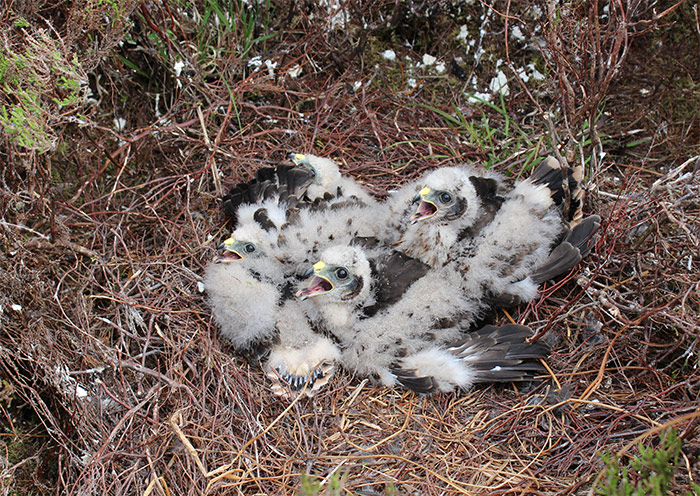
Hen harrier chicks in a nest (not the nest at Whernside where the chicks were stamped on). Photo: Ian Newton

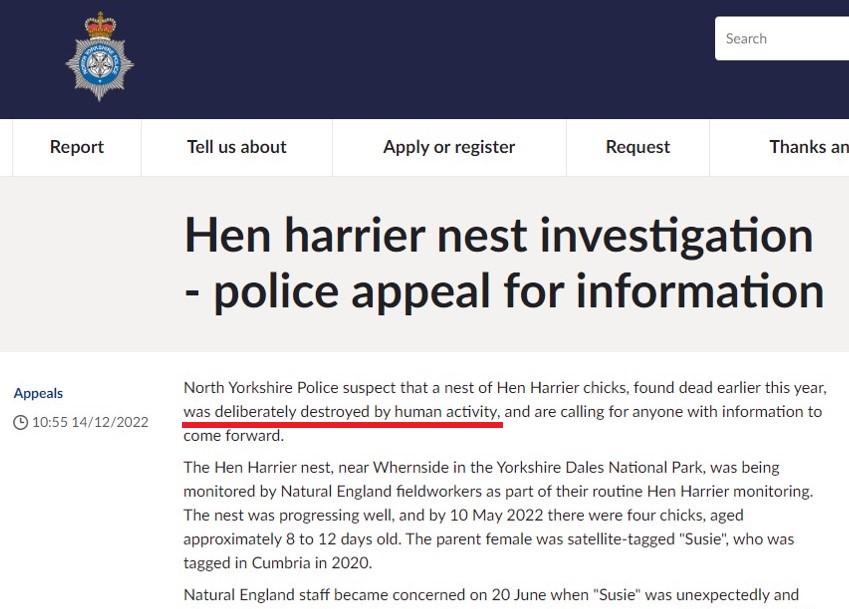
North Yorkshire Police issued an appeal for information about this crime on 14th December 2022 (see here). I want you to pay attention to the unequivocal words used by the police to describe this incident (underlined in red, below): that they suspected the nest of hen harrier chicks had been “deliberately destroyed by human activity“:

Prior to this appeal for information being published, the previous week North Yorkshire Police had sent a final draft to the Yorkshire Dales National Park Authority (YDNPA) so they wouldn’t be unsighted by the news when it was published. We know this because a Yorkshire Dales resident, who also follows this blog, submitted a freedom of information request to the YDNPA in December to ask about internal comms within the Yorkshire Dales Bird of Prey Partnership about this crime. Everything that follows is a result of that FoI (thank you to the blog reader!).

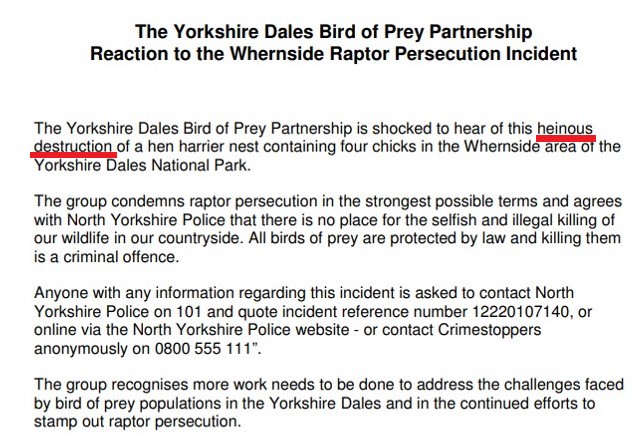
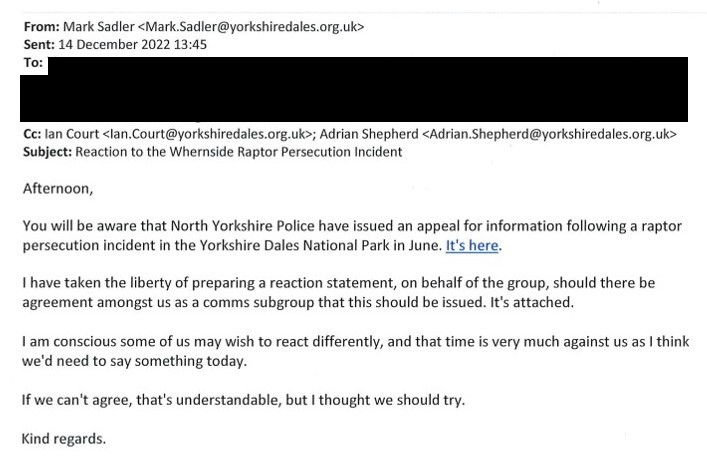
On 14th December 2022, just after North Yorkshire Police had published its appeal for information, Mark Sadler, Communications Manager at the YDNPA sent around a draft press release to the Yorkshire Dales Bird of Prey Partnership’s communications sub-group and asked if all the partners would sign up to it. Here is his draft press release (please pay close attention to the words I’ve underlined in red):

It’s a strong statement, unequivocal in its condemnation, just as North Yorkshire Police’s statement was.

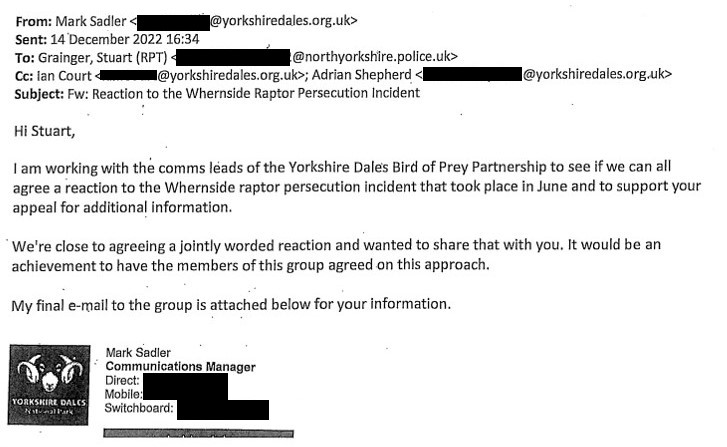
Here is the email Mark sent around to the ‘Partnership’ sub-group:

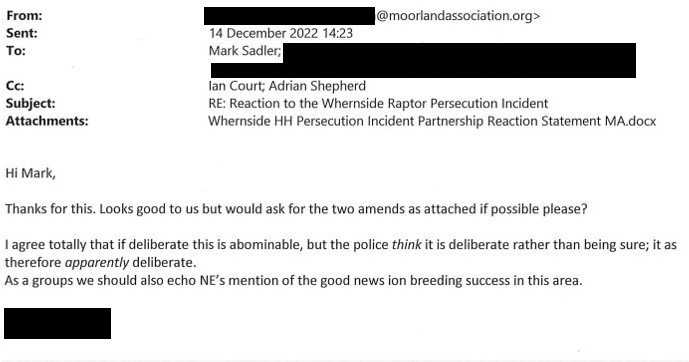
The first ‘partner’ to respond to Mark’s draft statement was the Moorland Association (the grouse moor owners’ lobby group in England). Here’s its response:

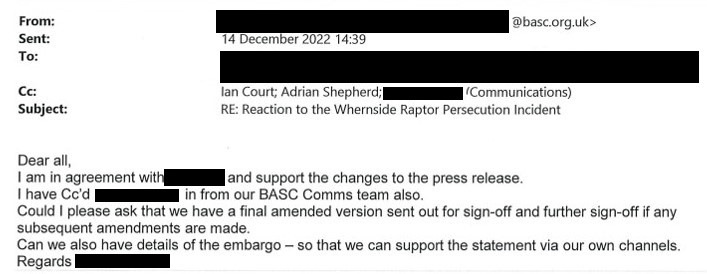
The next partner to respond, shortly afterwards, was BASC:

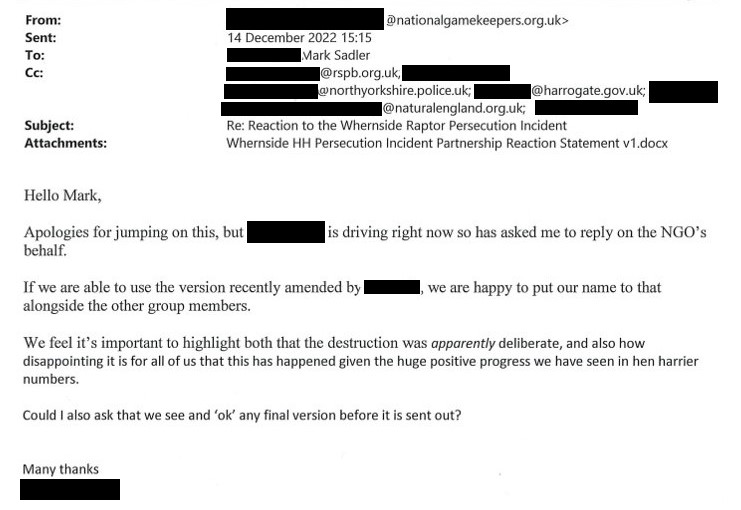
Right on cue, the next ‘partner’ to respond was the National Gamekeepers Organisation, as follows:

You’ll note that all three ‘partners’ from the shooting industry are intent on watering down North Yorkshire Police’s statement, moving the focus away from the police’s assertion that the stamping and killing of the hen harrier chicks in their nest was “deliberate“, and instead suggesting that it was “apparently deliberate“. They also want to big up the increase in the number of breeding hen harriers in the Yorkshire Dales/Nidderdale area that has happened as a result of the ludicrous brood meddling trial, carefully omitting to mention the ongoing persecution of hen harriers (77 illegally killed or ‘missing’ since the brood meddling trial began in 2018, a number of them in the Yorkshire Dales/Nidderdale area – see here).

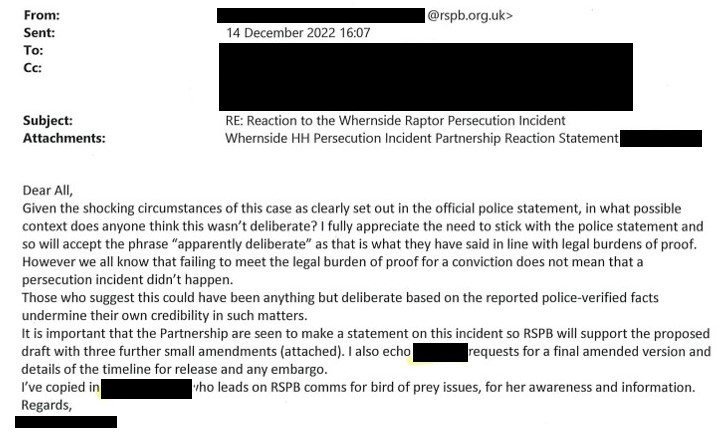
The fourth ‘partner’ to respond was the RSPB, as follows:

The RSPB’s response starts strongly but then caves in and accepts the ‘apparently deliberate‘ narrative because it thinks its more important that the Partnership issues a statement and it knows that without a conviction, the police’s assertion that it was a deliberate act is contestable, even though the police’s view is based on having full sight of all the evidence. The RSPB asks for ‘three further small amendments’ to the draft text but I don’t know what those entailed because they weren’t included in the FoI response.

Mark Sadler from the YDNP adjusts the draft statement to incorporate the manipulations requested by the shooting industry ‘partners’ and he sends the final version to North Yorkshire Police:

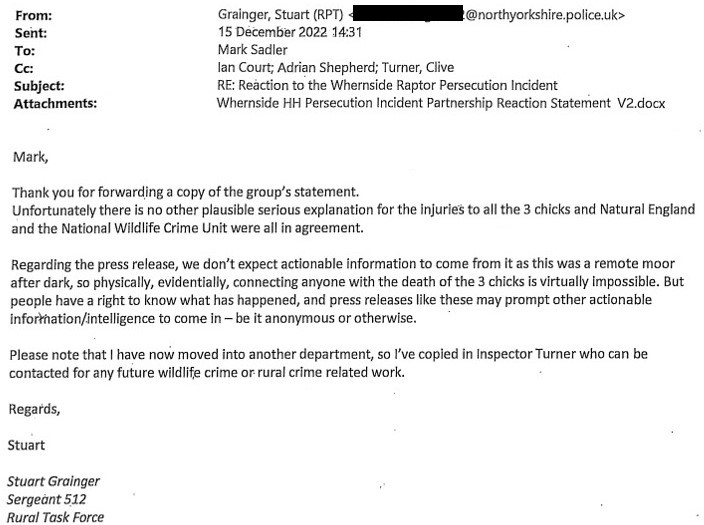
North Yorkshire Police responds to this with a very, very clear message, reinforcing the view that whoever disabled the nest camera and then inflicted horrific injuries to those young hen harriers by stamping them to death, did so deliberately:

Unfortunately there is no other plausible serious explanation for the injuries to all the 3 chicks and Natural England and the National Wildlife Crime Unit were all in agreement“:

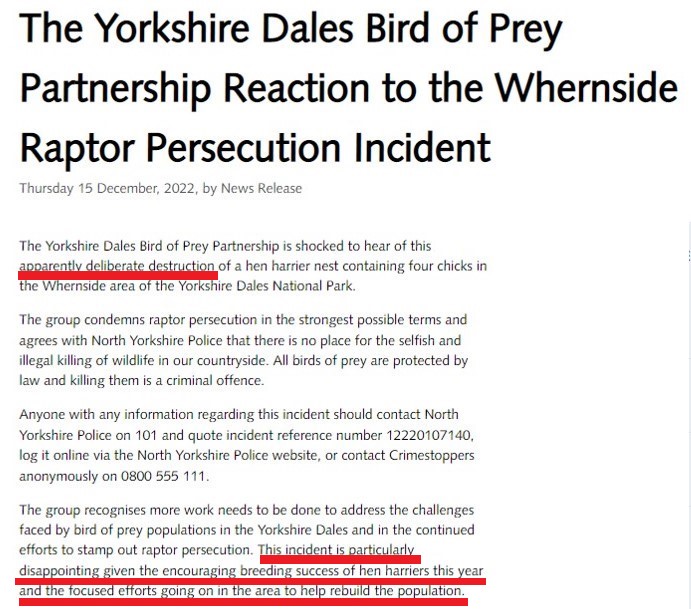
Here is the Partnership’s final statement, which was published on the Yorkshire Dales National Park Authority’s website on 15th December 2022. The parts I’ve underlined in red are the changes made between this final version and the original draft version:

As you can see, the changes are subtle, but are significant. The shooting industry representatives have introduced an element of doubt about the intention of whoever stamped on those chicks, despite North Yorkshire Police’s position (and that of Natural England and the National Wildlife Crime Unit) that the stamping was deliberate with the intention of killing the hen harrier chicks.

The insertion of a statement about increased breeding success for hen harriers and ‘focused efforts in the area to rebuild the population‘ leave the uninformed reader non the wiser about the ongoing illegal persecution of this species on grouse moors in the Yorkshire Dales, Nidderdale and beyond.

What does this charade tell us about the Yorkshire Dales Bird of Prey Partnership? Nothing we didn’t already know – despite a few earnest members, it’s another sham overrun by ‘partners’ with a vested interest in playing down the extent of raptor persecution in the area. It’s quite obvious that publicity about these crimes is bad news for the shooting industry – it damages their reputation and will, sooner rather than later, lead to statutory reform of game shooting as is now happening in Scotland, in large part because the public has been made aware of what’s going on and has demanded the Government takes action.

Reintroduced white-tailed eagle poisoned with banned pesticide Carbofuran

A young white-tailed eagle, released into the wild as part of a conservation reintroduction project, has been found poisoned with the banned pesticide Carbofuran.

The National Parks & Wildlife Service in Ireland is appealing for information after the discovery of the dead eagle in November 2022 on land between counties Cavan and Westmeath.

The juvenile male white-tailed eagle who was just over a year old had been brought in as a chick in 2021 from Norway under phase two of a national re-introduction programme (e.g. see here and here).

It had been fitted with a satellite tag prior to its release on Lough Derg in 2021 and subsequent monitoring showed the eagle had been spending time around Lough Sheelin in Co Westmeath with two other white-tailed eagles, but tag data indicated the eagle had become stationary in November.

The corpse was retrieved and toxicology tests undertaken at the State Laboratory confirmed the eagle had been poisoned with Carbofuran, a deadly pesticide so dangerous it was withdrawn for use in Ireland over a decade ago.

NPWS regional manager, Maurice Eakin, said white-tailed eagles were a protected species under the Wildlife Acts. The death of the bird last November highlighted “once again” the extent of the illegal practice of using poisonous material as pest control.

“In this instance, it is particularly disturbing that the reckless laying of poison has resulted in the death of a white-tailed eagle, one of our largest and most majestic bird species, which had been persecuted to extinction by the early 1900s,” he said.

The NPWS is seeking any information from the public in the Westmeath/Cavan region, particularly anyone who may have seen anyone or any vehicles acting suspiciously in recent weeks in the area between Lough Sheelin and Lough Ramor.

Over 100 white-tailed eagles, donated by Norway, have been reintroduced to the Irish Republic since 2007, with the first successful breeding taking place in 2012 and there have been many successes over the last decade, bringing biodiversity and ecosystem benefits as well as a boost to local economies via ecotourism.

However, a scientific review of the reintroduction project in 2019 indicated that the small population was still vulnerable to illegal poisoning events so additional eagles have been reintroduced as part of phase two of the reintroduction to help bolster the population. It’s sadly ironic that one of those eagles has become the latest poisoning victim.

Five shot goshawks in Suffolk – RSPB offers £5K reward for information

Further to this morning’s blog about Suffolk Police finding five shot goshawks on Monday, that had been dumped at the edge of the King’s Forest near Thetford (see here), the RSPB has issued an appeal for information and is offering a £5K reward, it’s highest ever.

The five juvenile goshawks. X-rays revealed all had been shot.

Here is the joint statement from the RSPB and Suffolk Police:

Five young birds of prey, identified as rare Goshawks, have been found dead in suspicious circumstances in a Suffolk Forest.

The birds were discovered on Monday 16 January at the edge of Kings Forest and reported to Suffolk Police, who x-rayed the birds as part of their investigation and found all five birds to contain multiple pieces of shot.

All birds of prey are protected by law, and to kill or injure one could result in jail and/or an unlimited fine.

The RSPB is working with Suffolk Police to help identify the culprit and has offered a reward of £5,000 to anyone who comes forward with information which leads to a conviction. This is the highest amount ever offered by the conservation charity, which has described the incident as ‘Utterly despicable.’

Goshawks are elusive birds of prey, around the size of a Buzzard, with yellow eyes and streaked undersides. They live quietly in forests in a handful of locations in the UK including Thetford Forest where these birds were found.

Mark Thomas, the RSPB’s Head of Investigations UK, said: “Anyone who values the natural world and abhors those who actively and criminally look to destroy it will feel as outraged as we do about this utterly despicable incident. We are calling on anyone who has information to come forward to the police.”

The RSPB and other specialists are assisting the police with their ongoing investigation.

The illegal killing of birds of prey remains a widespread national problem. The RSPB’s annual Birdcrime report for 2021, published in November 2022, revealed 108 confirmed incidents of birds of prey being shot, trapped or poisoned. However, the true number is likely to be far higher. 

The report also found that Norfolk had the highest number of confirmed raptor persecution incidents than any other county in 2021.

Sergeant Brian Calver from Suffolk Police said: “This is a serious wildlife crime against an amazing schedule one bird of prey that was once driven to extinction in Britain. There is no place for such activity in modern times. Whoever is responsible for this needs to be brought to justice and I’d urge anybody with any information whatsoever to let us know.”

If you have any information, please call Suffolk Police on 101 and quote crime reference 37/3027/23. Alternatively, to get in touch anonymously, call the RSPB’s dedicated Raptor Crime Hotline on 0300 999 0101.

ENDS

UPDATE 5pm: Wild Justice also offers £5,000 reward (here)

UPDATE 19th January 2023: Crowdfunder launched to increase reward for information on five shot goshawks found in Suffolk (here)

“I honestly think that one day we are going to have a human fatality” – Lincolnshire Police warn of danger of bird of prey poisonings

A wildlife crime officer from Lincolnshire Police is warning of the risk to humans, dogs and cats from the dangerous substances used to illegally kill birds of prey.

Detective Constable Aaron Flint, from the Lincolnshire Police Rural Crime Action Team, is quoted in an article published two days ago on the BBC News website (here), where he says he is currently investigating four cases of bird poisonings (some examples here and here).

Detective Constable Aaron Flint from Lincolnshire Police’s Rural Crime Action Team

“It’s too many and it’s only a small proportion of the number of birds killed,” he said.

The wildlife officer said the substances used posed a real danger to dogs and cats, as well as people.

“I honestly think that one day we are going to have a human fatality.”

“Often the offenders will get a pigeon or a pheasant – cut it open and rip out the flesh so the meat is exposed and sprinkle on some poison.

“The poisons are often blue or green – or some other bright colour a child may be attracted to, and I really fear that one day a child is going to come across this, [touch it] and put their fingers in their mouth.”

He said those involved often used poison in an attempt to protect game birds, pigeons and chickens and wild fowl, with offending often fuelled by money.

The BBC article also quotes Howard Jones, an investigator from the RSPB, after the RSPB identified Lincolnshire as a ‘national hotspot’ for bird of prey persecution and reiterated that incidents are often linked to the raptors being targeted to protect pheasants and partridges raised for organised shoots.

“The danger with poisons is that they are completely indiscriminate,” said Howard.

The investigations officer said they had seen a record number of incidents across the UK in recent years, including in Norfolk, Dorset and Yorkshire, with a significant number of reports currently being investigated in Lincolnshire.

According to Mr Jones, the “vast majority” of cases being dealt with by the courts involved gamekeepers.

He said the motivation to kill birds of prey was driven by the fact they were viewed as a predator of game birds, but the sentences handed out were often too lenient to act as a deterrent.

Cases involving poisons or illegal shooting should result in a jail sentence, he said.

“If there is someone out there placing poison baits in the open countryside anything that can come into contact with the poison is at risk,” he said.

“It is highly dangerous – some of the substances being used would be fatal to humans,” he added.

Well done to DC Aaron Flint and his colleagues at Lincolnshire Police. This is exactly the sort of proactive police messaging, and strong partnership-working, that should be routine rather than the exception.