North Yorkshire police warn public of potential poisonous baits at Pateley Bridge

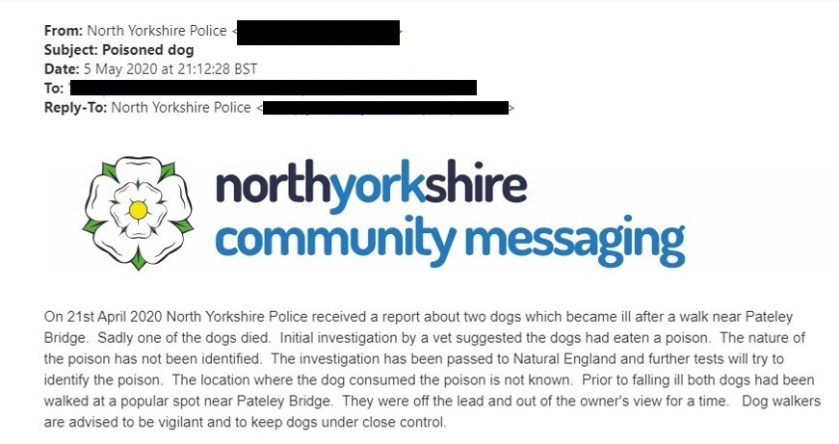
North Yorkshire Police are warning the public of potential poisonous baits at Pateley Bridge in Nidderdale following the suspected poisoning of two dogs in April. [August 2020: See update at foot of blog]

The following message was emailed to members of the local community last week:

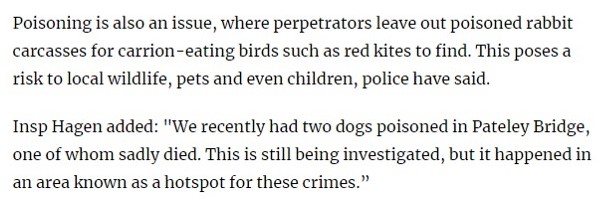
This suspected poisoning incident was referred to by the Police in a recent Yorkshire Post article about raptor persecution in the area:

Nidderdale residents will be used to receiving these warnings; there have been several in recent years (e.g. see here, here, here, here, here, here, here) as illegal poisonous baits have been used routinely to kill off red kites inside this AONB and the surrounding area (e.g. see here).

Dog walkers are urged to keep their pets under close control and report anything suspicious to the police. DO NOT HANDLE A SUSPECTED POISONOUS BAIT – some of the chemicals used as poison are so dangerously toxic they have been banned from use in the UK.

UPDATE 1 August 2020: Dog poisoning confirmed in Nidderdale raptor persecution hotspot (here)

Local politician seeks ‘full investigation’ in to mass poisoning of buzzards

Further to yesterday’s blog about the reported illegal poisoning of 23 buzzards in County Cork and the apparent subsequent silence of the investigating authorities (see here), today there’s some encouraging news.

Local politician Christopher O’Sullivan TD (Teachta Dala, the equivalent of an MP) in whose constituency the poisoned buzzards were found, has just tweeted the following:
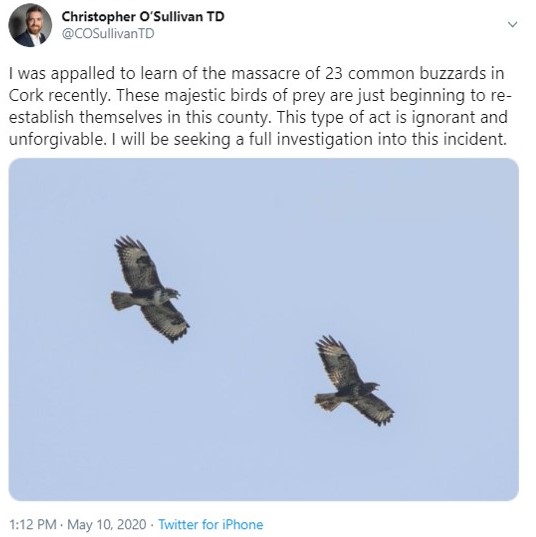
According to our sources, this is a very significant move. As discussed in yesterday’s blog, there have long been concerns about the lack of enforcement measures against raptor persecution in some parts of Ireland and particularly in the south where this latest crime was recorded.

Yesterday’s statement from BirdWatch Ireland highlighted these concerns and they’ve been re-emphasised in a statement from the Golden Eagle Trust (GET), the wildlife charity behind the reintroduction of golden eagles, white-tailed eagles and other important conservation projects across the Irish Republic. Here’s what GET had to say about this on Friday:

An attack on nature protection in Cork

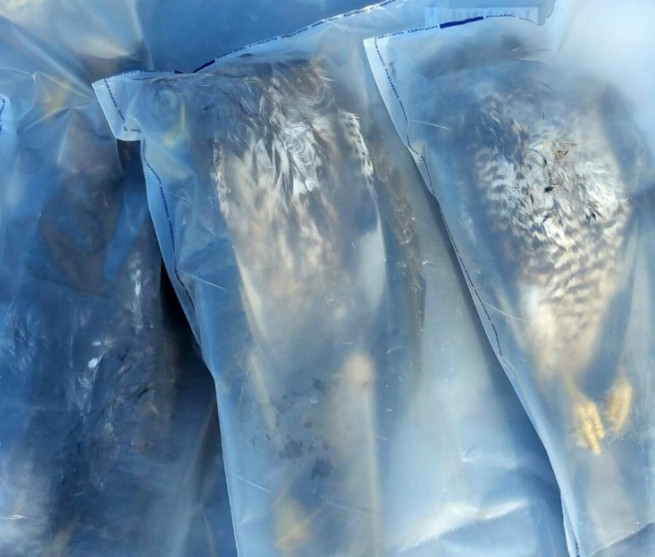
Carbofuran is a banned root crop pesticide that continues to be used to deliberately kill birds of prey across Ireland. Some months ago, a landowner discovered dead Buzzards on his property, near Timoleague, County Cork and contacted the National Parks and Wildlife Service (NPWS). 23 dead Common Buzzards were found during subsequent searches of the adjacent land. Toxicology tests, carried out by the State Laboratory, showed that the Buzzards had consumed Carbofuran, we believe. The landowner was completely unaware that a third party was leaving out poison nearby. This is the biggest illegal act against birds of prey in Ireland, over the last two decades.

The continued wilful persecution of birds of prey is decreasing the population of Peregrines, Hen Harriers, Buzzards and the reintroduced native populations of Eagles and Kites, in some parts of Ireland. It can be very difficult to find the evidence that could link an individual with an act of poisoning and thereby present sufficient evidence before a judge in order to secure a successful prosecution.

Therefore, the Golden Eagle Trust is calling on Government Departments to draft and enact a defined piece of legislation which makes it illegal for anybody to be in possession of Carbofuran and several other lethal substances, whose former agricultural uses have been banned and phased out. We are also calling on the Department of Culture, Heritage and the Gaeltacht to revisit their discussion on whether it would be helpful to establish a small (one or two person) Wildlife Crime Unit within NPWS, in order to provide specialized advice and expertise in responding to reported wildlife crime incidents and presenting a strong legal case to the State Solicitors and to be put before the Courts; whenever the evidence allows a case to be initiated.

It is difficult to assess the effectiveness and enforcement of National and European wildlife legislation in Ireland and the degree of deterrent it might offer, arising from successful Irish wildlife court cases; as court cases or successful wildlife crime prosecution figures are not readily available. However, a crude review of available internet media sources, might suggest that there has not been any successful wildlife crime court case, over the last 4 or 5 years, in Counties Cork or Kerry, for example. The general public have a very important role in reporting dead birds of prey to NPWS and they in turn, need appropriate laws, staff resources and appropriate management facilitation in implementing the law, where the evidence allows it, in some of these ongoing poisoning incidents.

Whilst there may be several legitimate administrative reasons for the lack of clarity surrounding Ireland’s biggest raptor persecution case, arising from the current Coronavirus crisis; there is also a competing responsibility to keep communities informed of nearby risks related to illegal poisoning activity. The wider context reveals an unfortunate pattern of Peregrines being killed at the same nests annually and Common Buzzards and Red Kites being poisoned, in localized areas, on a regular basis. It can be extremely difficult to identify the perpetrators of these crimes against nature and therefore the legislation needs to keep abreast of the collated RAPTOR Protocol dataset and counter, the primary threats that the accruing results suggest.

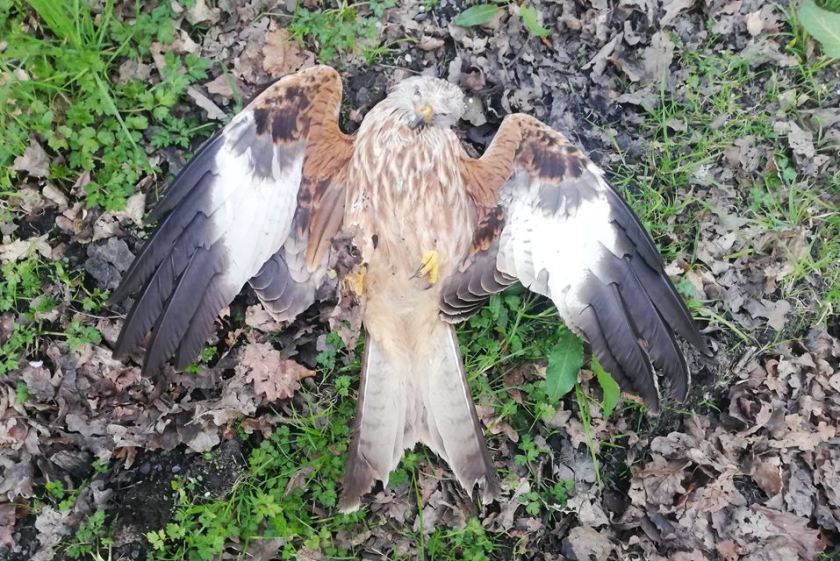
[The corpses of several buzzards found poisoned by Carbofuran in Co Cork in 2018. See here for details. Photo by NPWS]
In July 2010, the Grant Thornton, ‘Organisational Review of the National Parks and Wildlife Service (NPWS), suggested in Section 4.5.1 (Page 55) that:

Enforcement and prosecution activity is represented as being low with only some 30 cases per annum being prosecuted. Progress in this area seems to vary depending on Division.”

The Golden Eagle Trust wonder if the level of nature protection enforcement activity might have fallen even further since 2010? We are concerned that a lack of Ministerial, Departmental or Party-Political support, for some aspects of the Law, may have weakened NPWS managerial resolve, in some areas, over the last decade. In a small number of places, recreational family groups, dog walkers and landowners may need to be especially vigilant as regards the possibility that poisoned meat baits have been left out in the open. This incident revives the independent expert opinion and concern (as set out in the Grant Thornton Organisational Review) whether some NPWS managers need more support and resources in progressing illegal wildlife activity cases? The unpalatable alternative, is that the Department of Culture, Heritage and Gaeltacht transparently seek to repeal defined aspects of Irish or European Wildlife Legislation, which they may no longer endorse.

Regardless of the context; we are shocked by the number of dead Buzzards found in Cork and the 23 associated positive toxicology results – it is a wake-up call to us all.

ENDS

Full credit to Christopher O’Sullivan TD – let’s hope his calls for an investigation lead to significant change, with improvements in investigation and enforcement responses. Judging by the reaction to the news that 23 buzzards were poisoned, he’ll have a great deal of public support.

North Yorkshire Police frustrated at ongoing raptor persecution

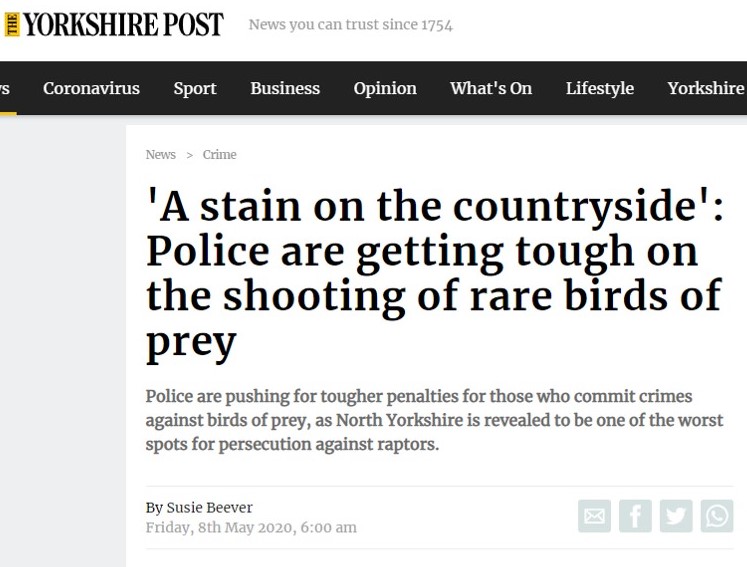
Following on from the news that yet another shot raptor has been found in Nidderdale AONB (see here), there’s a topical news feature in today’s Yorkshire Post about the ongoing illegal persecution of birds of prey in North Yorkshire.

The article starts off well and focuses on quotes from Inspector Matt Hagen, who leads the North Yorks Police Rural Task Force and also from Supt Nick Lyall, Chair of the Raptor Persecution Priority Delivery Group (RPPDG – the so-called partnership approach to tackling raptor persecution).

Here’s an extract:

The shooting, poisoning and trapping of birds such as red kites and buzzards is a crime previously described by the RSPB as “a stain on our countryside” and has risen in recent years after they were introduced to Yorkshire in the late nineties.

It is thought the offences have been happening for a long time, although increased awareness from the national police campaign Operation Owl has led to a rise in reports from the public.

Nidderdale in particular has been highlighted as a hotspot for the crime, while shootings of birds of prey have also been reported around West Yorkshire.

Disturbingly, there have also been reports of pets being killed after eating poisoned meat left out in suspected attempts at targeting scavenging birds of prey.

Between November 2018 and March of this year, there were 15 crimes recorded in North Yorkshire alone of birds being shot, poisoned or trapped, or tagged birds reported missing. Of these, nine had been shot, including a barn owl found shot in Ryedale in December 2019.

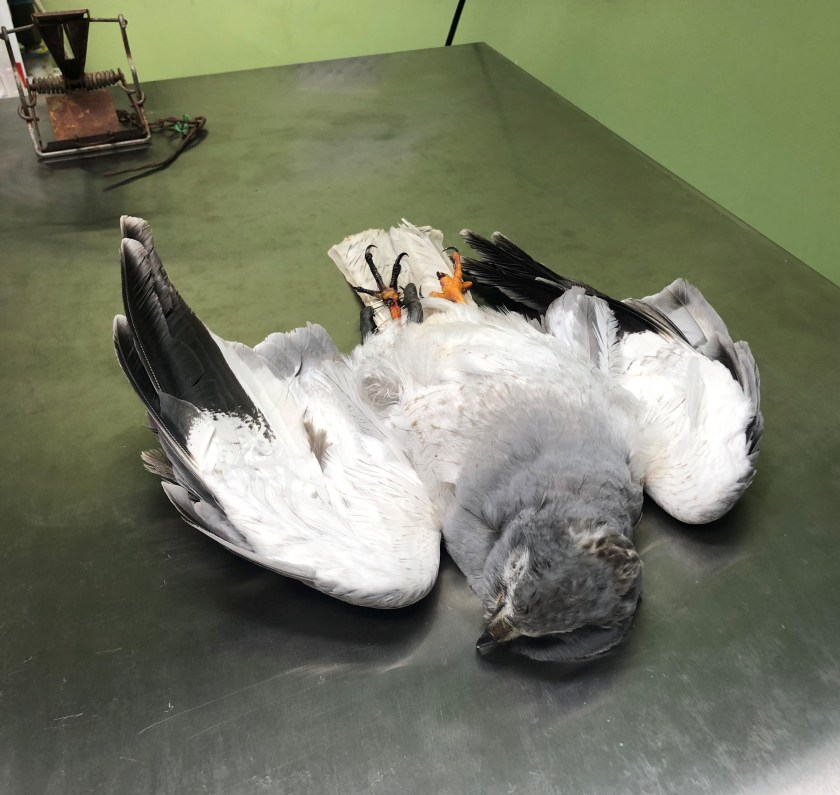
[A shot buzzard found in North Yorkshire in 2018, photo via North Yorkshire Police]

Inspector Matt Hagen, who is Head of North Yorkshire Police’s Rural Taskforce, said: “These crimes are very difficult to investigate because they happen in isolated places and there is often no one around to witness them.

“From what I have seen, some of the people that persecute birds of prey are of the opinion that they diminish the numbers of pheasants, grouse or partridges.

“Many gamekeepers are very pro-conservation, but it just takes one or two individuals in that industry to make a real impact. This is especially the case with hen harriers because they are so endangered. Many birds of prey that are persecuted we find that they were on a grouse moor, or at least near to one of those areas.

“I do know that with the hen harriers, there are not many left in this country, and if this carries on it may well be that they disappear.”

Poisoning is also an issue, where perpetrators leave out poisoned rabbit carcasses for carrion-eating birds such as red kites to find. This poses a risk to local wildlife, pets and even children, police have said.

Insp Hagen added: “We recently had two dogs poisoned in Pateley Bridge, one of whom sadly died. This is still being investigated, but it happened in an area known as a hotspot for these crimes.”

Operation Owl is a campaign originally spearheaded by North Yorkshire Police which has since been made into a national campaign urging the public to be eyes and ears for crimes committed against birds of prey, as most occur in remote areas.

Superintendent Nick Lyall of Bedfordshire Police currently leads the campaign, and has been meeting with the Crown Prosecution Service and senior Government ministers to urge for the crimes to be upgraded from summary-only offences – which can only be dealt with by magistrates and have more lenient sentences – to either-way offences, meaning they can be tried in a crown court.

Supt Lyall said: “We can do search warrants linked to wildlife crimes, but we can’t use our serious crime tactics of covert policing, such as surveillance, to catch these offenders. So for example, if we knew of a nest that was being targeted, we currently can’t put cameras in to see who was disturbing that nest.”

Supt Lyall added that only one or two people are convicted each year for crimes against these birds, with police relying mainly on witnesses as evidence.

“With the remote places these crimes are happening in, that makes it very difficult to prosecute,” he added.

The impact of these crimes is not just felt by the community, but on the environment as well.

A report published by the Nidderdale Area of Outstanding Natural Beauty in September revealed that red kites were failing to expand breeding territory from Wharfedale into neighbouring Nidderdale.

– END OF EXTRACT –

It was pretty accurate reporting up to this point but then it descended in to farce, first with this statement from the journalist:

‘Despite this there is hope, and most gamekeepers and landowners are now strongly committed to conserving all species, with 2019 being a record year for endangered hen harriers breeding’.

There’s a short, but crucially important, word missing from this statement, and that word is ‘say’. As in, ‘…..most gamekeepers and landowners say they’re now strongly committed to conserving all species……’

Of course they’re going to say they’re against raptor persecution – they’ve been saying that for 66 years, ever since the Protection of Birds Act 1954 was enacted. However, all the evidence, of humongous proportions, suggests otherwise!

The article then continues with contributions from Amanda Anderson (Moorland Association) and John Clarke (National Gamekeepers Organisation) both churning out the familiar patter about supposed ‘zero tolerance‘ of raptor persecution and Amanda particularly focusing on the so-called ‘enthusiastic’ support of moorland estates for hen harriers!

She ‘forgot’ to mention the two current police investigations in to the alleged witnessed shooting of hen harriers on two grouse moors and the game shooting industry’s subsequent silence (see here). She also ‘forgot’ to mention the 31 (at least) hen harriers believed to have been illegally killed since 2018, the year when grouse shooting industry reps would have us believe that hen harriers were welcomed back on the grouse moors. She also ‘forgot’ to mention the 2019 research paper that demonstrated that at least 72% of satellite-tracked hen harriers tagged by Natural England were believed to have been illegally killed on British grouse moors.

[This hen harrier was caught in an illegally-set spring trap (which almost severed his leg) on a grouse moor on Leadhills Estate last year. He didn’t survive. Read his grim story here. Photo by Ruth Tingay]

Meanwhile, back in the real world unofficial reports from around the UK but particularly from areas managed for driven grouse shooting in the north of England indicate that raptor persecution crimes are still being committed, and that includes hen harriers being targeted yet again.

There’s a famous quote that springs to mind that some journalists would do well to consider:

If someone says it’s raining, and another person says it’s dry, it’s not your job to quote them both. Your job is to look out the f***ing window and find out which is true“.

Buzzard found shot in Nidderdale Area of Outstanding Natural Beauty (AONB)

North Yorkshire Police are appealing for information after the discovery of a shot buzzard in Nidderdale AONB.

Press release (7 May 2020):

Appeal for information after injured buzzard found near Kirkby Malzeard

North Yorkshire Police investigating after incident in which bird appears to have been shot

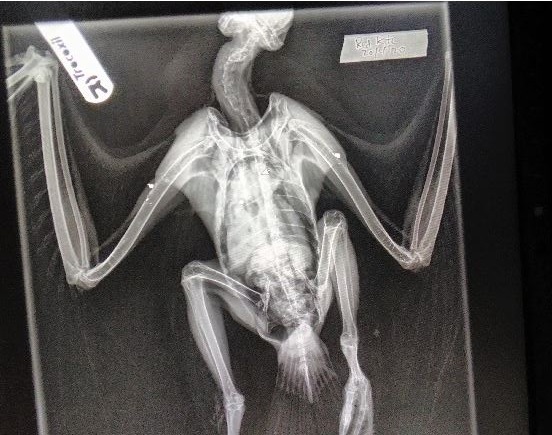
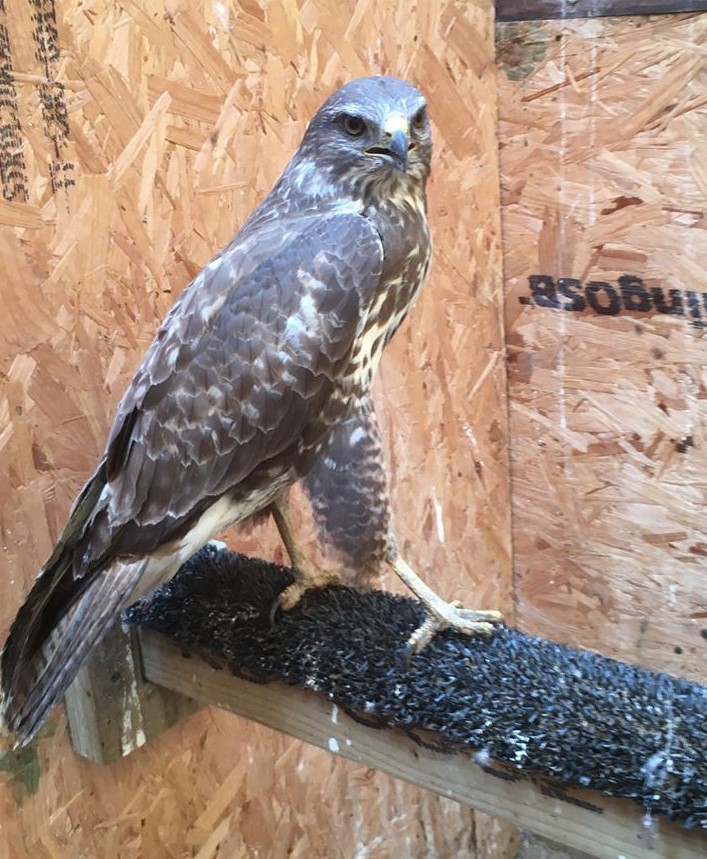
A member of the public was walking on a footpath near Belford Lane, Kirkby Malzeard, on 13 April 2020 when they found an injured buzzard. After seeking expert help, the bird was caught and taken to a local vet where x-rays showed the bird suffering a broken wing and also the profile of a shotgun pellet in the wing.

[Buzzard x-ray, via North Yorkshire Police]

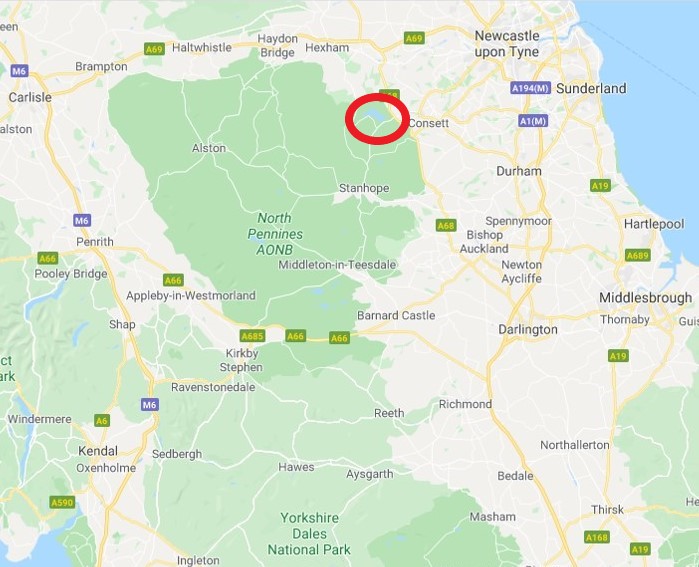
[RPUK map showing approximate location of Belford Lane, Kirkby Malzeard, in Nidderdale AONB]

The bird’s injury was too severe to be treated so it was sadly put to sleep. A specialist avian veterinary surgeon has subsequently reviewed the x-rays, concluding:

The buzzard has suffered an open fracture of the left humerus (upper wing). A shotgun pellet is visible sitting in the axilla/shoulder joint. There appeared to be soft tissue changes and a potential dislocation of the shoulder. No shotgun pellet is present at the fracture site, however it is possible that either

  1. The shotgun pellet entered through the wing, damaging and fracturing the humerus before settling in the axilla region – it is difficult to tell without examining the bird for open wounds or changes to the feathers suggesting shot.
  2. The damage to the shoulder resulted in the bird injuring its wing after being unable to fly

Buzzards, along with all wild birds, are protected under the Wildlife and Countryside Act 1981 and it is a criminal offence to kill or injure any wild bird.  The government has set persecution of birds of prey as one of their wildlife crime action priorities.

If you have any information which could help this investigation please contact North Yorkshire Police on 101 quoting reference number: 12200064619 or alternatively contact the investigating officer PC820 Hickson by email: bill.hickson@northyorkshire.pnn.police.uk

END

Nidderdale AONB, again. What a surprise, said nobody, ever.

Regular readers of this blog will be only too aware of Nidderdale AONB’s reputation as a massive wildlife crime scene. We’ve blogged about it many, many times including the poisoning and shooting of red kiteshen harriersbuzzardsmarsh harriers on Nidderdale grouse moors (as reported by the AONB partnership in September 2019). As recently as January this year the police were appealing for information after a kestrel had been found shot. A bloody kestrel, FFS!

We’ve also seen how the local community is turning against the criminals in their midst which is hardly surprising when according to the Chair of the Nidderdale AONB these crimes are “starting to have a damaging effect on tourism businesses”. 

[Nidderdale AONB sign, photo by Ruth Tingay]

Earlier this year, the game shooting industry issued a statement claiming a ‘zero tolerance’ stance against the illegal killing of birds of prey (see here). It appears to have had zero effect, with raptors still being targeted even though the country is in lockdown in the midst of a national health crisis. This latest victim is just one of a number that we’re aware of – several other recent cases from around the country are still to be publicised.

Well done North Yorkshire Police for the relatively quick appeal for information, especially when many police resources have been diverted to deal with Covid 19. Having a specialist veterinary surgeon review the x-rays and provide an expert opinion was a particularly good move in light of some of the most ridiculous denials we’ve seen from some within the gameshooting industry in recent weeks.

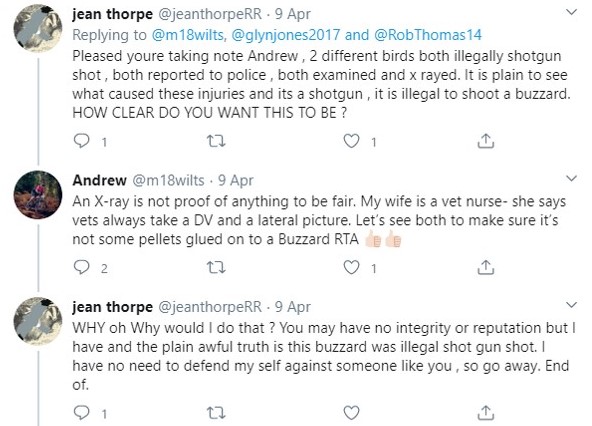
This, for example, following the recent shooting of another buzzard in North Yorkshire, where first it was implied that rehabilitation expert Jean Thorpe might consider faking a crime by using an old x-ray and then that the x-ray shouldn’t be believed anyway because apparently it could easily show a buzzard that had been killed in a road traffic accident with bullets glued on to the corpse to fake a shooting:

You couldn’t make it up, could you?

One more time: If you have any information which could help this investigation please contact North Yorkshire Police on 101 quoting reference number: 12200064619 or alternatively contact the investigating officer PC820 Hickson by email: bill.hickson@northyorkshire.pnn.police.uk

Birds of prey still being killed despite lockdown

Since lockdown began in March there’s been widespread concern that the illegal persecution of birds of prey would escalate, especially on grouse moors (e.g. see here) where fewer people are around to witness the crimes and/or the aftermath.

The UK’s grouse moors have been the epicentre of raptor persecution crimes for years; Mark Avery astutely described the National Parks that are dominated by grouse moors (e.g. Yorkshire Dales, North York Moors, Peak District, Cairngorms) as “massive wildlife crime scenes” (see here).

But of course, the threat to UK raptors isn’t just restricted to areas managed for driven grouse shooting. These birds are targeted and killed in the lowlands too, and quite often (although not exclusively) on land being managed for pheasant and partridge shooting.

Just two weeks ago a red kite was reported as shot on land managed for pheasant shooting, with another two birds also suspected to have been shot at the same location (see here).

It seems that the conservationists’ concerns were well founded. Despite the country being in the midst of a national crisis, and despite the shooting industry’s claims to have a ‘zero tolerance’ of raptor persecution (see here), the killing continues.

Police Supt Nick Lyall, Chair of the Raptor Persecution Priority Delivery Group (RPPDG, the so-called partnership that aims to tackle the illegal killing of raptors) tweeted this yesterday:

Nick singles out North Yorkshire but we’re also aware of a spate of other suspected raptor persecution crimes during lockdown, in a number of other counties across England and Scotland. Most of these have yet to be publicised as police investigations continue but hold on your hats, folks, when they are finally publicised the list is going to be long and damning.

Satellite-tagged red kite ‘disappears’ on grouse moor in North Pennines AONB

Press release from RSPB (30 April 2020)

Red kite vanishes in suspicious circumstances

Durham Police, the RSPB, the North Pennines AONB Partnership and Friends of Red Kites are appealing for information following the disappearance of a red kite in County Durham.

The young bird was fitted with a satellite tag at Rowlands Gill, near Gateshead in June 2019 by Friends of Red Kites (FoRK) with NERF support. It has been monitored since by the RSPB.

[Red kite ‘KK’ being fitted with a satellite tag as a nestling. Photo via RSPB]

The bird, nicknamed ‘KK’, toured northern England, making it as far as the Peak District, then returned north and has been faithful to the Derwent Valley region ever since.

KK’s tag had been functioning normally until it suddenly and unexpectedly stopped transmitting. The last fix came from an area of driven grouse moor near the Derwent Reservoir on 17 April. It has not been heard from since.

Emma Marsh, RSPB England Director, said: “If you’ve seen a red kite wheeling high overhead you’ll know that they’re splendid birds. They enrich our landscapes and bring joy to many.

When a tag which has been functioning reliably suddenly cuts out, this gives us immediate cause for suspicion. The additional fact that the tag’s last data fix came from an area dominated by driven grouse shooting rings serious alarm bells.

The connection between driven grouse shooting and the illegal killing of birds of prey has been well documented. Sudden, unexplained disappearances of tagged birds of prey are happening far too often in these landscapes. Satellite tags continue transmitting even after death, so if this bird had died naturally we would expect to be able to recover it.”

Red kites are specially protected under the Wildlife and Countryside Act (1981) which makes it an offence to deliberately kill or injure this species. Those found to have done so could be given an unlimited fine and/or a prison sentence.

Harold Dobson, spokesman for the Friends of the Red Kites, said: “It’s 15 years since the first red kites were re-introduced in the Lower Derwent Valley. They are faring well in the valley itself and we enjoy watching these impressive, majestic birds of prey.

As mainly scavengers, the red kites are of no threat to anyone. However, we fear that human persecution is preventing them from naturally expanding their range: since 2010, seven red kites have been found poisoned or shot near the Derwent Gorge and surrounding Durham Moorland. We fear that this may be the tip of the iceberg and that many more persecuted kites are never found.”

Inspector Ed Turner, the lead for wildlife and rural crime for Durham Constabulary said: “The fate of this red kite is not yet clear, we are working with the RSPB to establish what has happened since its transmitter unexpectedly stopped on 17 April 2020. Until we can rule out the possibility that a crime has not been committed, then we will be taking this matter very seriously and if anyone has any information please contact the police quoting 22042020-0078.

Chris Woodley-Stewart, Director of the North Pennines AONB Partnership, said: “Though the fate of this bird isn’t certain, the fact that it was carrying two reliable trackers means this looks very like a crime may have been committed. This is an area where a significant number of kites have been shot or poisoned and we’d really appeal to anyone who knows anything that might help shed light on this incident to come forward.”

If you have any information about this incident, please contact the police on 101, quoting the reference number 22042020-0078. Alternatively, if you have information about birds of prey being killed or targeted near you, please call the RSPB’s confidential Raptor Crime Hotline on 0300 999 0101.

ENDS

Red kite found shot dead on land managed for pheasant shooting in Wales

Three red kites have been found dead on land managed for pheasant shooting in Wales.

On Sunday (19 April 2020) two corpses were found by a member of the public and photographed but then ‘disappeared’ before they could be collected. A third corpse was found by TV presenter Iolo Williams and an x-ray confirmed it had been shot.

[The shot red kite found by Iolo Williams]

The RSPB and Dyfed-Powys Police have today issued the following appeal for information:

RED KITES SHOT IN POWYS

Police and the RSPB are appealing for information regarding the shooting of one red kite, and the suspected shooting of two more in Wales.

A protected red kite was found shot dead in Tregynon, near Newtown, Powys on Sunday 19 April 2020. At least two more are suspected to have been illegally killed in the area, which is managed for pheasant shooting.

A local woman found the two dead red kites while out walking with her family on 19 April. She photographed the birds and planned to return the next day.

She posted her photographs on social media, where they came to the attention of wildlife presenter Iolo Williams. The former RSPB employee ventured out that same evening to the location the birds had been seen, but when he arrived the bodies had disappeared. However, he discovered a third bird lying dead on the ground. The body was x-rayed and found to contain three pieces of shot in its chest and each of its wings.

Police officers conducted a patrol of the area but uncovered no leads. They are now appealing to the public for information.

All birds of prey are protected by the Wildlife and Countryside Act 1981. To intentionally kill or injure one is a criminal offence and could result in an unlimited fine or up to six months in jail.

Julian Hughes, head of species at RSPB Cymru, said: “Red kites have made a comeback in Wales after a collaborative effort by farmers, conservationists and communities. For most of us, the sight of these glorious birds – recognisable by their long wings and forked red tail – is a source of joy. They should be celebrated, not persecuted“.

Iolo Williams, broadcaster and former RSPB species officer, said: “The red kite is Wales’ national bird and many of us remember it being incredibly rare and confined to mid-Wales. Hundreds of landowners, wardens and volunteers worked incredibly hard for so many decades to ensure the kite population thrived that I am both baffled and disgusted by this horrific incident.”

PC Charlie Jones, of the Dyfed-Powys Rural Crime Team, said: “It is illegal to intentionally harm or kill a red kite, or any other bird of prey, making this an act of criminality. Wales is home to a significant population of breeding red kites and therefore we take any offences against them very seriously, and wish to hear from anyone who has information which may help with our investigation.”

If you have any information relating to this incident, call Dyfed-Powys Police on 101.

If you find a wild bird of prey which you suspect has been illegally killed, email RSPB Investigations on crime@rspb.org.uk or fill in the online form: https://www.rspb.org.uk/our-work/our-positions-and-campaigns/positions/wildbirdslaw/reportform.aspx

ENDS

Red kite shot and killed in Leeds

West Yorkshire Police press release (15 April 2020)

APPEAL TO PUBLIC AFTER RED KITE SHOT & KILLED IN LEEDS

Police are appealing for information after a protected bird of prey was shot and killed in Leeds.

The red kite was found by a walker on the evening of Friday, April 10, in the Carlton Moor area, close to Leeds Bradford Airport and the High Trees Garden Centre, in Otley Old Road.

He retrieved the dead bird and contacted Yorkshire Red Kites who, with support from the Harewood Estate, arranged for x-rays which showed the presence of at least 12 shotgun pellets.

Officers from Leeds District Wildlife and Rural Crime Team are investigating the incident and would like to hear from anyone who witnessed anything suspicious in the area around the time.

They are also calling on the public to assist their work to combat offences against birds of prey by supporting the national Operation Owl initiative which helps people to recognise and report any suspicious activity and play their part in bringing those responsible for such crimes to justice.

Sergeant Dave Lund, West Yorkshire Police Force Wildlife Officer, said: “People will be understandably appalled that someone has shot and killed one of these majestic birds that are such welcome sight in our skies.

We are investigating this incident and would like to hear from anyone who saw anything unusual in the area or who has any information that could assist in identifying the person responsible.

We need the public to be our eyes and ears in support of our work to tackle wildlife crimes such as this and we would encourage anyone who does pick up on anything in their area to report it so we can take appropriate action alongside our partner agencies.”

Since their reintroduction into Yorkshire, starting in 1999, many kites have been shooting victims. At least 13 are known to have died of their injuries whilst several others either recovered or had been victims of illegal poisoning but had been found to be carrying lead shot from non-fatal shooting incidents.

Doug Simpson, Yorkshire Red Kites Co-ordinator, said “It appears inevitable that we will continue to have a small number of people who persist in flouting the law which protects our wildlife. It once again raises the question of the suitability of some people to be licensed to own guns. This is not the first time that kites have been targeted at their nests – a particularly sickening and cowardly thing to do.

Counting this latest victim, no fewer than 47 Red Kites have been confirmed as victims of illegal persecution since releases began in Yorkshire in 1999. That roughly half of them have been found by people out walking in the countryside shows the importance of everyone keeping their eyes open for anything untoward and reporting it.”

Anyone with information which could relate to this incident is asked to call West Yorkshire Police on 101 quoting crime reference 13200186201 or online via www.westyorkshire.police.uk/101livechat

Anyone wishing to remain anonymous can call the RSPB’s confidential Raptor Crime Hotline on 0300 999 0101.

ENDS

Jean Thorpe successfully releases rehabbed shot buzzard

For those of you not on social media who may have missed this…

Wildlife rehabilitation expert Jean Thorpe has worked her magic again and, after just under two weeks of superb care and attention, has been able to successfully release the buzzard that had been found with shotgun injuries near Shipton, North Yorkshire on 29 March 2020 (see here and here).

To see a short 13 second video of the buzzard’s release back to the wild click here (via Jean’s Facebook page but you don’t need to have a Facebook account to watch it).

[The buzzard during rehab. Photo by Jean Thorpe]

Incredibly, Jean has been on the receiving end of some vile trolling from some within the game shooting industry after news emerged that she was trying to help this latest victim. Here’s a small example:

It’s pretty disgusting but to be honest not entirely surprising. To be fair, there were others within the shooting industry who were supportive of Jean’s efforts and just as appreciative of her work as we all are.

For those still in any doubt, a vet confirmed that this buzzard had been shot and the crime has been reported to North Yorkshire Police, who are investigating. They have issued a crime number and have appealed for information (see here).

Mass poisoning of birds of prey in south Scotland: man charged

Police Scotland press release:

Man charged with wildlife crimes in Stewartry

Police Scotland can confirm that a 64-year-old man has been charged with a number of wildlife crime offences in the Stewartry area of Dumfries and Galloway.

Extensive investigations have been ongoing into the deaths of upwards of 20 birds of prey and other wild birds in the Springholm area near Castle Douglas between 2018 and 2020. Enquiries subsequently established the birds had been poisoned by banned pesticides.

A report has been submitted to the Procurator Fiscal.

Wildlife Crime Officer Constable John Cowan said: “Residents in Springholm and the surrounding area as well as wildlife enthusiasts further afield will be only too well aware of a worrying rise in poisonings in and around the Springholm area over the last few years following on from previous appeals for information.

Working alongside partners such as the RSPB (Royal Society for the Protection of Birds), SSPCA (Scottish Society for Prevention of Cruelty to Animals), SASA (Science and Advice for Scottish Agriculture), SAC (Scottish Agricultural College), SGRPID (Scottish Government Rural Payments and Inspections Division), Scottish National Heritage and Scottish Land and Estates, there has been an overwhelming collective determination to halt these incidents.

I would like to thank members of the public for the information they have provided throughout the investigation. This sends out a strong message that Police Scotland and partners treat wildlife crime very seriously and should act as a strong deterrent to anyone engaging in such activities, irrespective of the underhand tactics that may be used.”

ENDS

We believe this case relates to the illegal poisoning of multiple red kites and buzzards, some of which have been reported here and here.

PLEASE NOTE: As usual, we will not be accepting comments on this case until legal proceedings have concluded. Thanks.

UPDATE 27th February 2021: Mass poisoning of raptors in south Scotland: has there been a conviction? (here)