44 hen harriers ‘missing’ or confirmed killed since 2018

Last month we blogged that at least 43 hen harriers were ‘missing’ in suspicious circumstances or had been confirmed killed since 2018 (see here).

Today the list is updated to 44 hen harriers, ‘missing’ or confirmed killed since 2018.

Here’s the blog we’ll publish every time this list is updated:

It’s getting to that time of year when the grouse shooting industry pumps out its patently misleading propaganda relating to hen harrier conservation in the UK. The aim is to hoodwink the public in to believing that the industry loves hen harriers and is doing all it can to protect and nurture the tiny remnant breeding population (but conveniently forgetting to mention that the breeding population is only in such dire straits because the grouse shooting industry has been ruthless in its maniacal intolerance of this supposedly protected species).

And the industry’s pursuit of the hen harrier is not simply ‘historical’ or indicative of past behaviour, as some would have us believe. It is on-going, it is current, and it is relentless.

[This male hen harrier died in 2019 after his leg was almost severed in an illegally set trap that had been placed next to his nest on a Scottish grouse moor (see here). Photo by Ruth Tingay]

To illustrate this fact, we intend to keep a running tally of all the hen harriers that we know (because most of these victims had been fitted with a satellite tag) to have either ‘disappeared’ in suspicious circumstances or have been confirmed as being illegally killed since 2018.

Why only since 2018 when we know that hen harriers have been a persecution target for years and years and years? Well, 2018 is the year that the grouse shooting industry ‘leaders’ would have us believe that the criminal persecution of hen harriers had stopped and that these birds were being welcomed back on to the UK’s grouse moors (see here).

This assertion was made shortly before the publication of a devastating new scientific paper that demonstrated that 72% of satellite-tagged Hen Harriers were confirmed or considered likely to have been illegally killed, and this was ten times more likely to occur over areas of land managed for grouse shooting relative to other land uses (see here).

We only started compiling this list of dead / missing hen harriers in June 2020 when we learned that all five of last year’s brood meddled hen harrier chicks were ‘missing’, presumed dead (see here). It has since been updated a few times as we learned about more satellite-tagged hen harriers that had vanished during lockdown in suspicious circumstances on grouse moors in the Cairnorms National Park (here) and on a notorious grouse moor in South Lanarkshire (see here).

It’s now time to update the death list again, as we’ve learned of yet another satellite-tagged hen harrier that ‘disappeared’ in suspicious circumstances, this time a bird called ‘Dryad’ who vanished from a grouse moor in the Yorkshire Dales National Park in September 2020 (see here).

That brings the gruesome tally to 44 hen harriers. (We’re still waiting to hear whether three hen harriers, satellite-tagged by Natural England this year and have since vanished (here), are being treated as suspicious disappearances by the police and if so, they will be added to this list).

Four Four.

Forty four.

In the space of two years.

Nobody has been prosecuted for any of these cases. We have every expectation that this list will be updated again in the near future.

For now, here are the 44:

February 2018: Hen harrier Saorsa ‘disappeared’ in the Angus Glens in Scotland (here). The Scottish Gamekeepers Association later published wholly inaccurate information claiming the bird had been re-sighted. The RSPB dismissed this as “completely false” (here).

5 February 2018: Hen harrier Marc ‘disappeared’ on a grouse moor in Durham (here)

9 February 2018: Hen harrier Aalin ‘disappeared’ on a grouse moor in Wales (here)

March 2018: Hen harrier Blue ‘disappeared’ in the Lake District National Park (here)

March 2018: Hen harrier Finn ‘disappeared’ near Moffat in Scotland (here)

18 April 2018: Hen harrier Lia ‘disappeared’ in Wales and her corpse was retrieved in a field in May 2018. Cause of death was unconfirmed but police treating death as suspicious (here)

8 August 2018: Hen harrier Hilma ‘disappeared’ on a grouse moor in Northumberland (here).

16 August 2018: Hen harrier Athena ‘disappeared’ on a grouse moor in Scotland (here)

26 August 2018: Hen Harrier Octavia ‘disappeared’ on a grouse moor in the Peak District National Park (here)

29 August 2018: Hen harrier Margot ‘disappeared’ on a grouse moor in Scotland (here)

29 August 2018: Hen Harrier Heulwen ‘disappeared’ on a grouse moor in Wales (here)

3 September 2018: Hen harrier Stelmaria ‘disappeared’ on a grouse moor in Scotland (here)

24 September 2018: Hen harrier Heather ‘disappeared’ on a grouse moor in Scotland (here)

2 October 2018: Hen harrier Mabel ‘disappeared’ on a grouse moor on the edge of the Yorkshire Dales National Park (here)

3 October 2018: Hen Harrier Thor ‘disappeared’ next to a grouse moor in Bowland, Lanacashire (here)

23 October 2018: Hen harrier Tom ‘disappeared’ in South Wales (here)

26 October 2018: Hen harrier Arthur ‘disappeared’ on a grouse moor in the North York Moors National Park (here)

1 November 2018: Hen harrier Barney ‘disappeared’ on Bodmin Moor (here)

10 November 2018: Hen harrier Rannoch ‘disappeared’ on a grouse moor in Scotland (here). Her corpse was found nearby in May 2019 – she’d been killed in an illegally-set spring trap (here).

14 November 2018: Hen harrier River ‘disappeared’ on a grouse moor in the Nidderdale AONB (here). Her corpse was found nearby in April 2019 – she’d been illegally shot (here).

16 January 2019: Hen harrier Vulcan ‘disappeared’ in Wiltshire close to Natural England’s proposed reintroduction site (here)

7 February 2019: Hen harrier Skylar ‘disappeared’ next to a grouse moor in South Lanarkshire (here)

22 April 2019: Hen harrier Marci ‘disappeared’ on a grouse moor in the Cairngorms National Park (here)

26 April 2019: Hen harrier Rain ‘disappeared’ on a grouse moor in Nairnshire (here)

11 May 2019: An untagged male hen harrier was caught in an illegally-set trap next to his nest on a grouse moor in South Lanarkshire. He didn’t survive (here)

7 June 2019: An untagged hen harrier was found dead on a grouse moor in Scotland. A post mortem stated the bird had died as a result of ‘penetrating trauma’ injuries and that this bird had previously been shot (here)

5 September 2019: Wildland Hen Harrier 1 ‘disappeared’ on a grouse moor nr Dalnaspidal on the edge of the Cairngorms National Park (here)

11 September 2019: Hen harrier Romario ‘disappeared’ on a grouse moor in the Cairngorms National Park (here)

14 September 2019: Hen harrier (Brood meddled in 2019, #183704) ‘disappeared’ in North Pennines (here)

23 September 2019: Hen harrier (Brood meddled in 2019, #55149) ‘disappeared’ in North Pennines (here)

24 September 2019: Wildland Hen Harrier 2 ‘disappeared’ on a grouse moor at Invercauld in the Cairngorms National Park (here)

10 October 2019: Hen harrier Ada ‘disappeared’ on a grouse moor in the North Pennines AONB (here)

12 October 2019: Hen harrier Thistle ‘disappeared’ on a grouse moor in Sutherland (here)

18 October 2019: Member of the public reports the witnessed shooting of an untagged male hen harrier on White Syke Hill in North Yorkshire (here)

November 2019: Hen harrier Mary found illegally poisoned on a pheasant shoot in Ireland (here)

January 2020: Members of the public report the witnessed shooting of a male hen harrier on Threshfield Moor in the Yorkshire Dales National Park (here)

1 April 2020: Hen harrier (Brood meddled in 2019, #183703) ‘disappeared’ in unnamed location, tag intermittent (here)

5 April 2020: Hen harrier Hoolie ‘disappeared’ on a grouse moor in the Cairngorms National Park (here)

8 April 2020: Hen harrier Marlin ‘disappeared’ on a grouse moor in the Cairngorms National Park (here)

21 May 2020: Hen harrier (Brood meddled in 2019, #183701) ‘disappeared’ on a grouse moor in Cumbria shortly after returning from wintering in France (here)

27 May 2020: Hen harrier Silver ‘disappeared’ on a grouse moor on Leadhills Estate, Scotland (here)

7 September 2020: Hen harrier Dryad ‘disappeared’ on a grouse moor in the Yorkshire Dales National Park (here)

To be continued……..

Anybody still wondering why the grouse shooting industry wants conservationists to stop fitting satellite tags?
Satellite-tagged hen harrier Dryad ‘disappears’ on grouse moor in Yorkshire Dales National Park

RSPB press release (15 Sept 2020)

Another hen harrier disappears, last reported on Yorkshire grouse moor

The RSPB is once again urging the Government to step in and support licensing of grouse shooting to address the illegal persecution of birds of prey following the suspicious disappearance of yet another satellite-tagged hen harrier.

Dryad, a female hen harrier, hatched at a nest in the Forest of Bowland this summer. She was fitted with a lightweight satellite tag so that scientists could trace her movements once she fledged. But Dryad barely had time to spread her wings before her tag, which had been transmitting normally, stopped suddenly and unexpectedly on 7 September 2020.

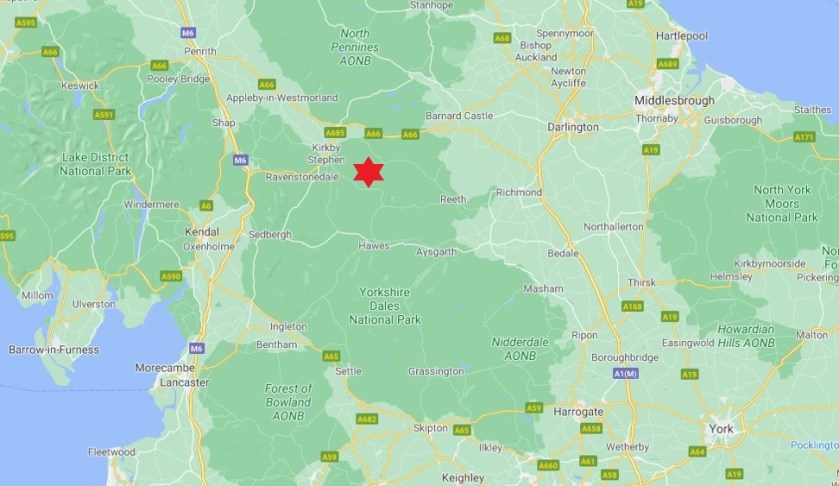
The tag’s last transmission showed the bird had been roosting on a grouse moor between Kirkby Stephen and Ravenseat in the Yorkshire Dales National Park. RSPB staff searched the area but found no trace of Dryad or her tag. Dryad has not been heard from since.

[RPUK map showing approximate location of Dryad’s last known transmission]

Hen harriers, a red-listed species, are legally protected in the UK under the Wildlife and Countryside Act 1981. Yet they remain one of the most persecuted birds of prey in the UK and continue to be illegally killed, or disappear in suspicious circumstances, particularly on or near land managed for shooting. Scientific research published in 2019, based on the UK Government’s own data, showed that 72% of satellite-tagged hen harriers in their study were killed or likely killed on British grouse moors, and that hen harriers were 10 times more likely to die or disappear over grouse moor.

The most significant threat to the English hen harrier population – which is now perilously low – is persecution by humans. 24 hen harrier nests were recorded this summer, of which 19 successfully produced chicks, yet there is enough habitat and prey to support 12 times that number.

Dryad is the 44th hen harrier known to have been illegally killed or gone missing in suspicious circumstances since 2018.

This wider area, which is dominated by driven grouse moors, has become a ‘hotspot’ for suspicious hen harrier disappearances, as revealed by satellite tagging.

In July this year a hen harrier named Harriet, tagged by Natural England, sent her last transmission near Outhgill, just over the border in Cumbria. A further two disappeared, last transmitting near Bowes, County Durham and Askrigg, North Yorkshire respectively in September 2019. And in 2016, the hen harrier Rowan was found shot in Ravenstonedale, Cumbria.

Elsewhere in North Yorkshire, in 2019 the body of another satellite tagged hen harrier known as River was found shot on the Swinton Estate, North Yorkshire.

Mark Thomas, RSPB Head of Investigations UK, said:

Illegal killing is the number one factor stalling hen harrier conservation in the UK. Despite all the positive news around 60 juveniles fledging in England this clearly shows the fate of many of these birds once they disperse. Sadly we expect further suspicious disappearances in the next few months following the well-established pattern of previous years. If Dryad had died naturally, we would expect her tag to continue transmitting, allowing us to find and recover both body and tag. The sudden stop of satellite tags, particularly considering the history of persecution in this area, strongly points to human interference.

Mark continues: “It is blatantly clear that current legislation is failing to protect our birds of prey and that criminality continues unchecked on grouse moors. The Government must act urgently and commit to licensing of grouse shooting with sanctions to withdraw licenses to shoot where criminal behaviours are proven to the satisfaction of the public authorities. Law-abiding estates would have nothing to fear from this approach.”

During August, over 120,000 emails were sent to local MPs by concerned members of the public urging them to take action to end bird of prey persecution, prompted by an e-action by Wild Justice, the RSPB and Hen Harrier Action.

ENDS

More on that gunman filmed with a decoy owl near hen harrier nest site on Whernside

Late on Friday afternoon the RSPB published a blog detailing an incident that was witnessed by a Natural England fieldworker at a hen harrier nest site in Cumbria during this year’s breeding season.

According to that blog (here), ‘…..a Natural England fieldworker was monitoring a hen harrier nest on moorland near Whernside, Cumbria, when he saw a man wearing camouflage carrying a firearm and a live bird of prey, believed to be an eagle owl about 300m from the hen harrier nesting area. He tethered the bird and sat a short distance away with his gun. In the circumstances there seems little doubt the intention was to draw in raptors, presumably the hen harriers, to shoot them. The use of a tethered live bird as a decoy to kill or take a wild bird is in itself illegal, but a method that seems to be increasingly used for targeting raptors. This was no doubt a highly stressful situation, we understand the fieldworker took some video footage and made himself visible. This eventually had the desired effect, and the suspect, realising he was under observation, left. It was reported to the police but due to evidential issues around establishing the identity of the suspect, it was not possible to take the matter forward to court. The RSPB would like to place on record our thanks to Cumbria Constabulary and the CPS for their determined efforts to progress this investigation. We firmly consider that this incident and the video should now be put in the public domain’.

One of the main points being made in the wider RSPB blog was that Natural England had declined to publicise this incident, even though it is understood to have taken place in an area where hen harriers were being brood meddled as part of a Government-sanctioned conservation sham, optimistically called the Hen Harrier Action Plan by those involved.

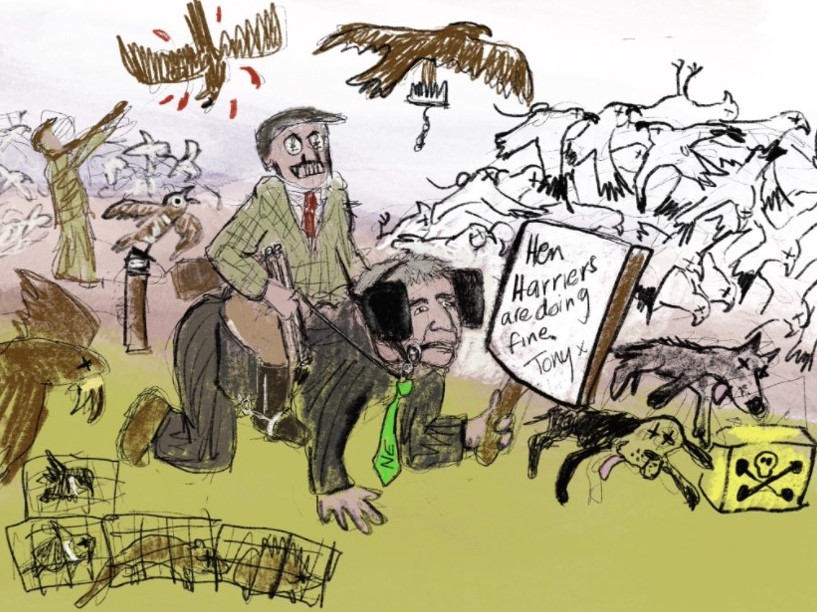
[A much more realistic portrayal of the so-called Hen Harrier Action Plan. Cartoon by Gerard Hobley]

Natural England’s refusal to voluntarily disclose detailed information about its sham hen harrier conservation project or this latest allegation of attempted persecution at a hen harrier nest site shouldn’t come as any surprise to anyone who’s been following this blog for any length of time. Natural England has developed something of a reputation for its lack of transparency and accountability, especially when it comes to meddling with hen harriers, and much of this goes back further than Tony Juniper’s reign (e.g. see here, here, here, here, here, here, here, here, here, here, here etc etc).

Since the RSPB’s blog was published on Friday afternoon, not one of the shooting organisations involved in the hen harrier brood meddling sham have published a statement on their respective websites. Remember, these are the organisations who claim to hold a ‘zero tolerance’ approach to illegal raptor persecution. You’d think they might have something to say about it, wouldn’t you? Especially given the history of raptor-killing in this area (see here).

We’ve heard, from a number of sources, an allegation that, if true, might explain Natural England’s reluctance to discuss this particular incident.

Have another look at this statement from the RSPB blog:

‘It was reported to the police but due to evidential issues around establishing the identity of the suspect, it was not possible to take the matter forward to court’

We’ve been told that the day after the Natural England fieldworker filmed the gunman with his tethered live eagle owl near the hen harrier nest, a Natural England staff member phoned the gunman and asked whether it was him who had been seen at the hen harrier site the day before.

Because Natural England is a statutory authority, its staff have to abide by the requirements of the Police & Criminal Evidence Act (PACE). This Act is primarily concerned with the behaviour of the police (or other relevant authority), the suspect’s rights and the admissibility of evidence. According to our sources, phoning a suspect and asking whether he had been present at a potential crime scene would be a breach of PACE and, even though it’s ‘just’ a technicality, this would be sufficient for a defence agent to have any potential prosecution thrown out at an early stage.

Is this what happened in this case? Did Natural England cock up a potential prosecution, albeit unintentionally? We’re unlikely to ever get a full account out of Natural England but it does raise an important issue – does Natural England have a protocol/procedure in place for how its staff should behave in these situations? And if not, it needs to get one sorted pronto because as we’re all too aware, the illegal killing of hen harriers on grouse moors is an ongoing crime wave.

UPDATE 21 September 2020: Natural England denies cocking up police investigation at Whernside hen harrier site (here)

UPDATE 20 January 2021: Confirmation that hen harrier brood meddling estate was under police investigation for suspected raptor persecution (here)

Gunman filmed at hen harrier nest site with decoy eagle owl

The RSPB Investigations Team has published a blog this afternoon detailing an incident that was witnessed by a Natural England fieldworker at a hen harrier nest site in Cumbria during the breeding season.

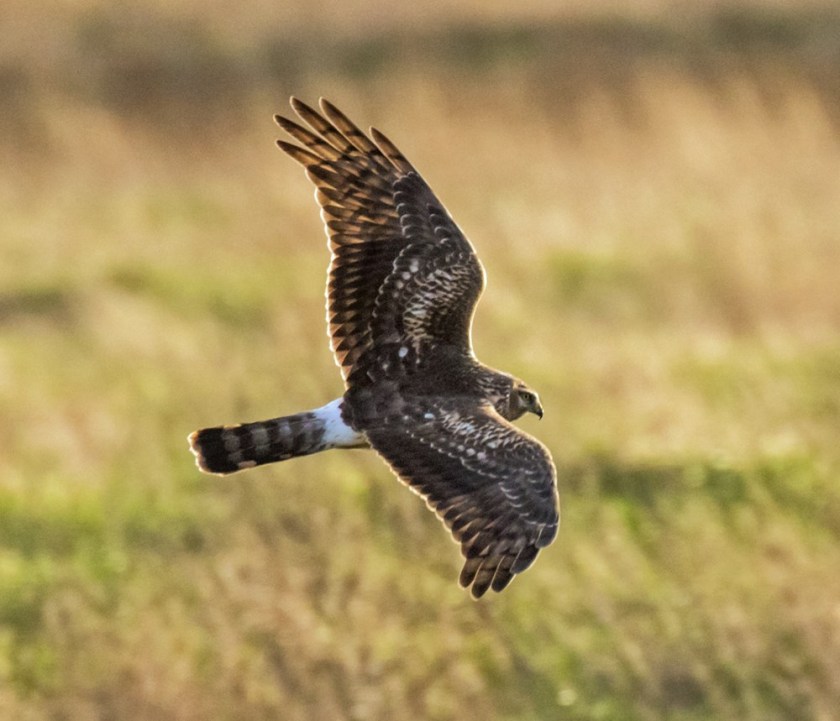
[Hen harrier, photo by Frank Burns]

The full blog can be read here but the pertinent part is reproduced as follows:

‘We understand that a Natural England fieldworker was monitoring a hen harrier nest on moorland near Whernside, Cumbria, when he saw a man wearing camouflage carrying a firearm and a live bird of prey, believed to be an eagle owl about 300m from the hen harrier nesting area. He tethered the bird and sat a short distance away with his gun. In the circumstances there seems little doubt the intention was to draw in raptors, presumably the hen harriers, to shoot them. The use of a tethered live bird as a decoy to kill or take a wild bird is in itself illegal, but a method that seems to be increasingly used for targeting raptors. This was no doubt a highly stressful situation, we understand the fieldworker took some video footage and made himself visible. This eventually had the desired effect, and the suspect, realising he was under observation, left. It was reported to the police but due to evidential issues around establishing the identity of the suspect, it was not possible to take the matter forward to court. The RSPB would like to place on record our thanks to Cumbria Constabulary and the CPS for their determined efforts to progress this investigation. We firmly consider that this incident and the video should now be put in the public domain’.

Now, putting this news out late on a Friday afternoon isn’t helpful to anyone (apart from Natural England and the criminals within the grouse shooting industry who may hope that it’ll all blow over by Monday).

It won’t.

There is a lot to say about this incident as well as about Natural England’s continuing pisspoor conduct on all things hen harrier.

We’ll be coming back to it on Monday morning.

[Cartoon by Gerard Hobley]

UPDATE 15 September 2020: More on that gunman filmed with a decoy owl near hen harrier nest site on Whernside (here)

UPDATE 20 January 2021: Confirmation that hen harrier brood meddling estate was under police investigation (here)

Shot buzzard in Essex: an update

Last week we learned that Essex Police were investigating the shooting of a buzzard found on 4th September 2020 at Davy Down Riverside Park, South Ockendon (see here).

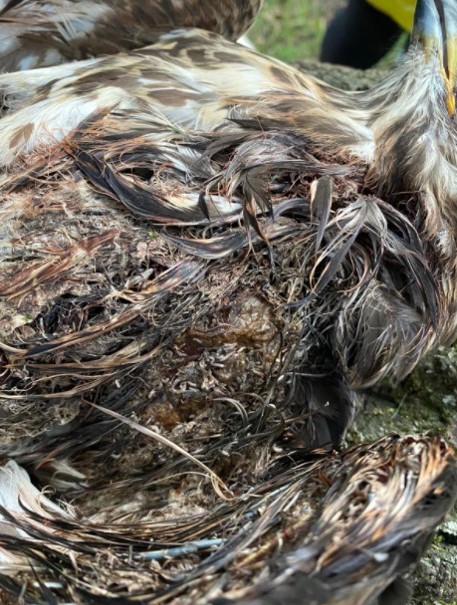
We’ve now been sent photos of the dead bird and an incident number has been issued: 42/141700/20

[Shot buzzard, photos via Essex Police]

There still isn’t any information about the type of weapon used to shoot this buzzard but we do know, judging by the maggots in the second photo, that it was shot well before the discovery of the corpse on the 4th September.

Anyone with information please contact PC Jed Raven from Essex Police Wildlife Crime Unit on 101 and quote reference: 42/141700/20

This is the third bird of prey shooting in Essex in recent months, following a shot buzzard found near Weeley on 2nd June (here) and a shot hobby found at North Fambridge in August (here).

Shot peregrine in Gloucestershire – an update

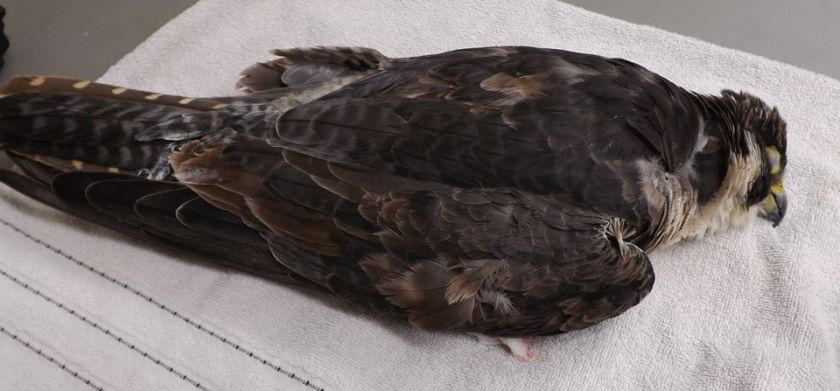
In mid-August we blogged about a shot peregrine that had been found critically injured in Gloucestershire and was later euthanised due to the extent of its injuries (see here).

[The shot peregrine, photo from Vale Wildlife Hospital]

There was very little information available about this crime at the time but now Gloucestershire Police are appealing for witnesses.

The shot peregrine was found near Northleach in the Cotswolds Area of Outstanding Natural Beauty.

Anyone with information is urged to contact PC Ashley Weller on 101, quoting incident # 349/16/08.

Another buzzard shot in Essex

Essex Police are investigating the shooting of a buzzard on 4th September 2020 at Davy Down Riverside Park, South Ockendon.

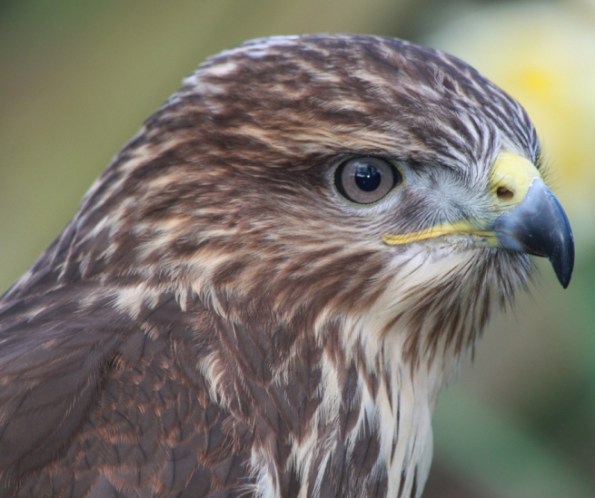
[Buzzard. Photo by Ruth Tingay]

PC Jed Raven from Essex Police’s Wildlife Crime Unit has confirmed the buzzard was shot, however its condition is unknown and the type of weapon used is yet to be reported.

[UPDATE 7 Sept 2020: Police have confirmed the buzzard died]

Anyone with information please contact PC Jed Raven on 101.

UPDATE 11 Sept 2020: Shot buzzard in Essex: an update (here)

This is the third bird of prey shooting in Essex in recent months, following a shot buzzard found near Weeley on 2nd June (here) and a shot hobby found at North Fambridge in August (here).


Four of this year’s satellite-tagged hen harriers already dead or ‘missing’

Earlier today delusional Natural England issued a press statement (along with two organisations that have zero credibility when it comes to hen harrier conservation, the Moorland Association and GWCT) proclaiming this year’s hen harrier breeding season was a ‘wonderful result’ (see here).

The RSPB published its own view, separately (here), pointing out, as if it was necessary, that illegal persecution continues to be ‘the most serious threat’ to hen harrier conservation.

Meanwhile, Natural England, having been justifiably criticised today for publishing inaccurate and ambiguous information about hen harriers (e.g. see here) has quietly updated its spreadsheet on the number of satellite-tagged hen harriers and their fates (see here).

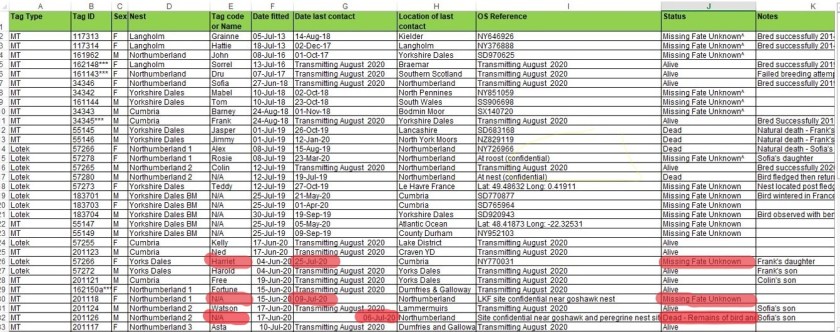
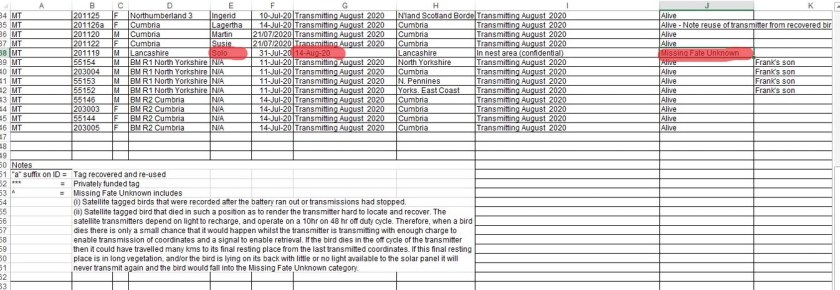
Natural England has fitted satellite tags to 23 of this year’s cohort of 60, but according to the data, four of those 23 are already either dead or ‘missing, fate unknown’.

Here are the details of the four:

Tag #57266, female, Harriet, tagged in Yorkshire Dales on 4 June 2020. Last known fix in Cumbria (actually in the Yorkshire Dales National Park, grid ref NY770031) on 25 July 2020. Listed as ‘missing fate unknown’.

Tag #201118, female, unnamed, tagged in Northumberland (site 1) on 15 June 2020. Last known fix on 9 July 2020 in Northumberland, ‘site confidential nr goshawk nest’. Listed as ‘missing fate unknown’.

Tag #201126, male, unnamed, tagged in Northumberland (site 2) on 15 June 2020. Last known fix on 6 July 2020 in Northumberland, ‘site confidential nr goshawk and peregrine nest sites’. ‘Remains of bird and tag recovered near the nest site post-fledging – most likely avian predation’.

Tag #201119, male, Solo, tagged in Lancashire on 31 July 2020. Last known fix on 14 August 2020 in Lancashire ‘in nest area (confidential)’. Listed as ‘missing, fate unknown’.

It’s not known how many of the three ‘missing, fate unknown’ hen harriers are being investigated as suspicious incidents by the police and without knowing the details or circumstances of the disappearances, it would be unwise to speculate at the moment. We’re not aware of any appeals for information in any of these three cases. We’ll be asking the respective police forces for information on each of them so that the running total of ‘43 dead or missing hen harriers in the last two years‘ can be updated if necessary.

It’s also worth pointing out that one of the ‘missing, fate unknown’ birds was fitted with a Lotek tag rather than the usual MTI tag….we’ve blogged about the apparent unreliability of this tag type previously (see here) and another blog will be published shortly with even more damning commentary on its suitability for tracking hen harriers.

Perhaps the biggest question to ask right now is why Natural England (and its ‘partners’ in the grouse shooting industry) failed to mention in this morning’s press statement the disappearances of three of this year’s cohort?

Can we trust anything Natural England tells us about hen harriers?

Multi-award-winning author Gill Lewis has neatly summarised the view of many of us with this rather telling cartoon:


Update on parliamentary motion on ‘disappearances of birds of prey over driven grouse moors’

Three weeks ago we reported that Alex Rowley MSP (Scottish Labour) had lodged a parliamentary motion relating to the ‘disappearances of birds of prey over driven grouse moors’ (see here).

This motion was triggered not only by the suspicious disappearance of satellite-tagged golden eagle Tom, who vanished in to thin air during lockdown in May this year, along with his fully-functioning satellite tag, with his last known location being on a driven grouse moor in Strathbraan, a well-known raptor persecution hotspot (see here), but also the suspicious disappearance of seven other satellite-tagged golden eagles in the same area, the disappearance of another satellite-tagged hen harrier on another Scottish driven grouse moor (here), the illegal poisoning of a satellite-tagged white-tailed eagle found dead on another Scottish grouse moor (here), and the 43 hen harriers that have either gone missing or have been killed in the UK in the last two years, mostly on or close to driven grouse moors (here).

A quick check today on the progress of this parliamentary motion has revealed it has full cross-party support, with MSPs from all parties signing up:

There are 26 supporters to date, from Scottish Labour, SNP, the Greens, the Lib Dems, an independent, and, surprisingly, the Conservatives. Well done Peter Chapman MSP (Scottish Conservatives, NE Scotland) for being the sole supporter (so far) from this party.

The motion needs four more supporters before it reaches the threshold of 30 MSPs from at least two different political parties to qualify for a Parliamentary debate.

Parliamentary motions are ‘live’ for six weeks before they’re culled (if they haven’t attracted sufficient support) so this one still has about three weeks to run.

If your MSP is not listed, please consider dropping them an email and encourage them to support this motion. If they refuse, it’d be interesting to hear their explanations. NB: Ministers and Cabinet Secretaries are not eligible to support these motions.

If you’re unsure about who your elected representatives are, you can find them here.

Thank you

Lamb euthanised after stepping on illegally-set spring trap in North York Moors National Park

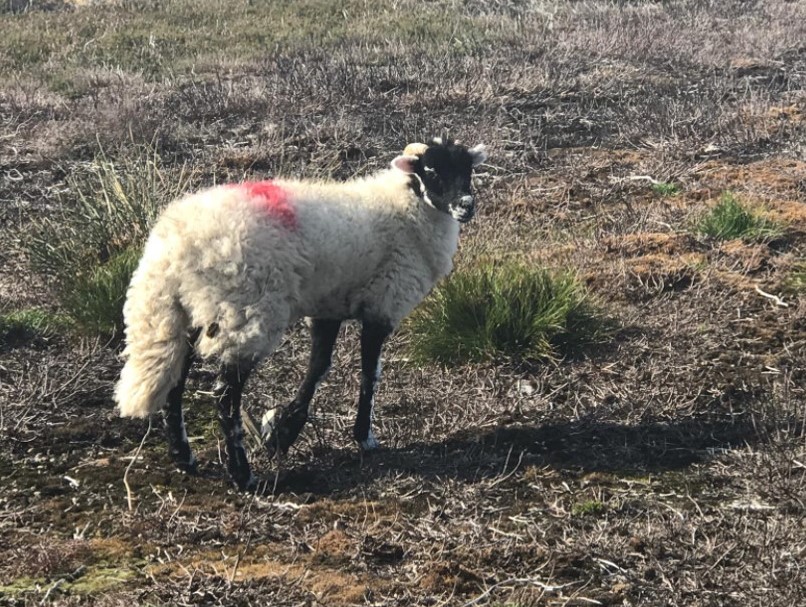
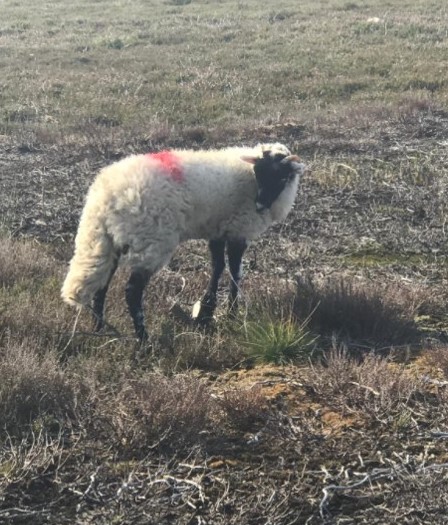
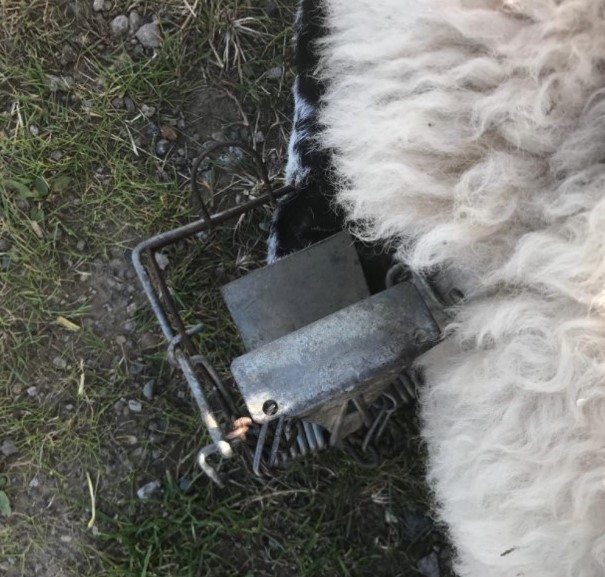
A lamb has been euthanised after being found in the North York Moors National Park with an illegally-set spring-trap attached to its leg.

The lamb was discovered on 8th August 2020 and was seen by a vet, who reported a nasty bone infection tracking up the lamb’s leg from the trap injury. A decision was taken to euthanise the stricken animal.

The use of this type of spring trap (a Fenn trap) became subject to new regulations in April this year as it is no longer considered humane for killing stoats. Gamekeepers have been urged to stop using them altogether in most situations and switch to a trap with a different design (e.g. see here and here).

Nevertheless, even if the operator of this particular trap had a defence for its lawful use, it would appear that it had still been set illegally if this lamb had managed to get its leg caught in it. Spring traps have to be placed inside a tunnel (artificial or natural) with excluders at each end to prevent non-target species entering the tunnel and getting caught.

Of course, even though the police are investigating this incident the chance of anyone being prosecuted is absolutely zero because it would be virtually impossible to determine who had set the trap. Even if there was a lawful requirement for the trap operator to have an identifying tag on the trap (which there isn’t), the police would still have enormous difficulty finding sufficient evidence to demonstrate it had been set by the operator and not by a third party.

What the police can do, though, is to visit the landowners in this area and ‘give them advice’ about the lawful use of traps.

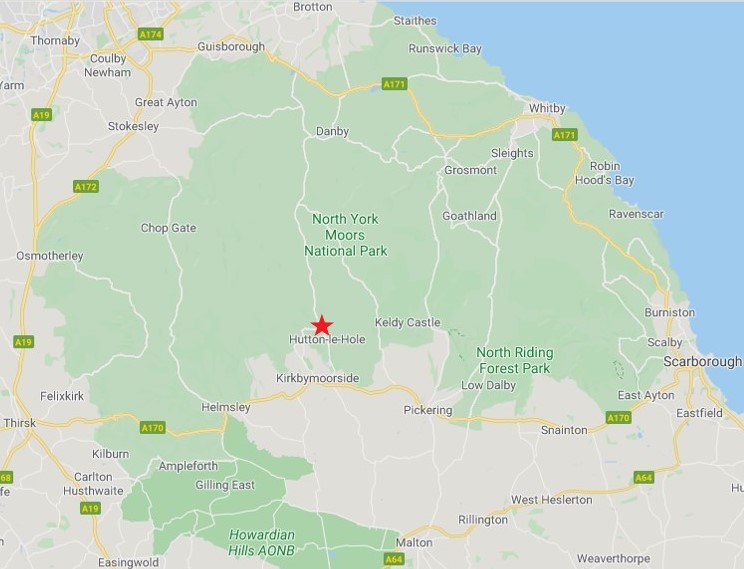
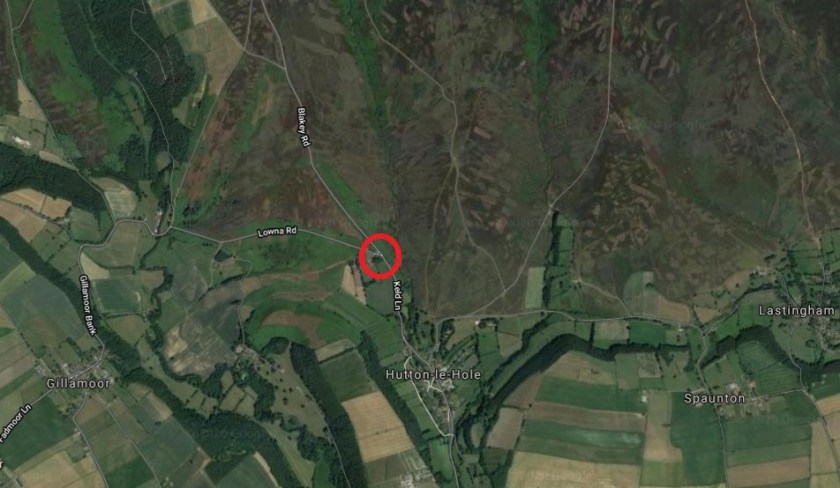
Interestingly, this lamb was found on land close to Hutton-le-Hole, which is remarkably close to where the suspected poisoned sparrowhawk was reported a few days ago (here) and where a satellite-tagged hen harrier ‘disappeared’ in 2018 (see here).

Anyone with information about any of these cases, please contact PC Jez Walmsley at Malton Police Station on 101.