Witness observes buzzard shot dead in Norfolk

From today’s Eastern Daily Press (11/4/18):

BUZZARD SHOT NEAR DOWNHAM MARKET

A buzzard has been shot dead in the West Norfolk fens.

A gardener believes he saw a man shoot the protected bird of prey at Boughton, near Downham Market this lunchtime.

It came down near the home of retired insurance broker Paul Coulten, 77, who is now preserving the carcass until it can be examined by police wildlife crime officers.

My gardener was out walking the dogs on my land when he heard some gunfire,” said Mr Coulten. “The next thing he saw a buzzard come down in the woods and saw a man on a quad bike in the distance.”

Police confirmed the incident had been reported to them and officers had arranged to visit Mr Coulten.

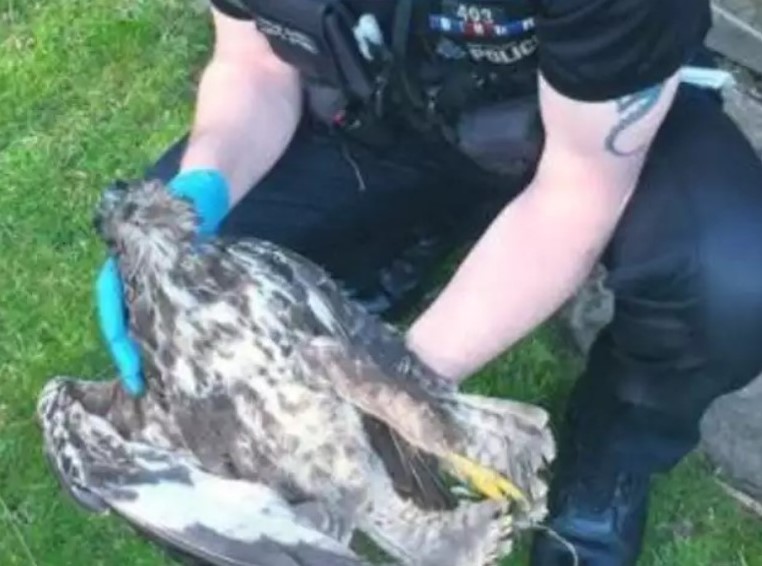
[Photo of the shot buzzard, by Susan Simper]

I hope someone gets nabbed for it,” he said. “We’re getting fed up with it around here, there are no foxes because they all get shot to death, so I’m hopeful the police will progress it.”

Buzzards are one of our commonest birds of prey. They are frequently seen soaring on their large, broad wings, when warm rising air creates convection currents over woods and farmland.

The species is protected by the 1981 Wildlife and Countryside Act. Anyone convicted of killing one could face an unlimited fine and up to six months’ imprisonment.

Despite this, the RSPB says birds of prey are still persecuted. In 2016 – the latest year for which figures are available – some 40 were shot, including 14 buzzards, 11 red kites, seven peregrines and two hen harriers. Some 22 birds, including 13 buzzards, were also poisoned.

The RSPB, which fears the figures are the tip of the iceberg, says there were no prosecutions during that entire year.

Norfolk is one of the worst areas for bird crime. A total of 262 incidents were recorded between 2011 and 2016 across England and Wales, with 146 of these caused by shooting and 66 by poisoning.

Norfolk recorded the second highest number of incidents at 17 after North Yorkshire at 39.

Its senior investigations officer Mark Thomas said of the latest killing: “Raptor persecution, the illegal killing of birds of prey, is really common, it’s widespread across the UK. What should happen now is it should be X-Rayed, there would have to be an investigation, it’s very likely they’ll find out who’s responsible.”

ENDS

UPDATE 12 April 2018: EDP now reporting the buzzard was not shot (here)

Buzzard shot in the head, south Yorkshire

From Yorkshire Post (7/4/18):

‘WILDLIFE CRIME WILL NOT BE TOLERATED’, SAY SOUTH YORKSHIRE POLICE AFTER BUZZARD IS FATALLY SHOT IN THE HEAD

‘Wildlife crime will not be tolerated in our county’ – that’s the message from South Yorkshire Police after they found a buzzard that had been fatally shot in the head.

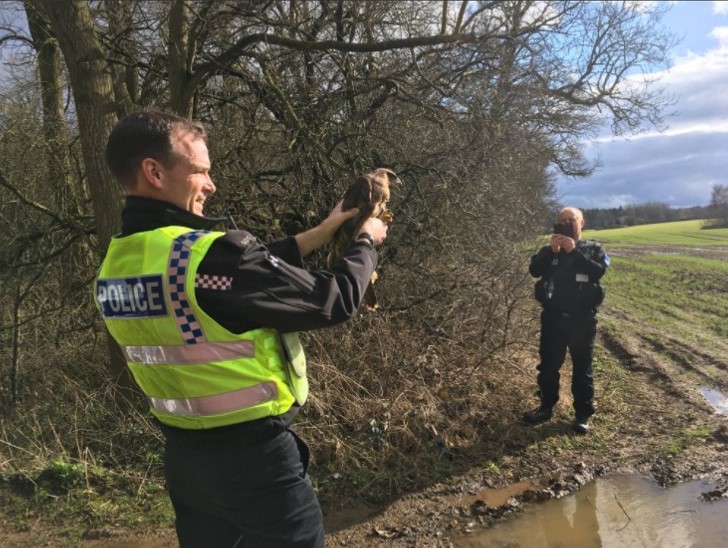
The force confirmed yesterday that the buzzard was found dead in the lower part of Hound Hill Lane, Barnsley, with trauma to its head attributed to either a pellet or shot projectile.

Police Constable Mark Winter, Penistone Community Constable and Wildlife Crime Officer said: “Buzzards, being part of the bird of prey family are protected in law and it is quite obviously an offence to shoot, injure or trap one.

This incident has occurred over the last few days and this is an appeal for information to assist with this investigation. Wildlife crime will not be tolerated in our county, please enjoy the countryside safely, responsibly and leave it as you found it”.

ENDS

[Photo by South Yorkshire Police]

Dead red kite in south Scotland now confirmed poisoned

Further to yesterday evening’s blog about a dead red kite found in south Scotland in January that “may” have been poisoned (see here), the BBC news article has now been updated (6/4/18) to confirm this bird was definitely poisoned:

POLICE APPEAL AFTER PROTECTED BIRD OF PREY POISONED

Police investigating the death of a protected bird of prey have said it was poisoned.

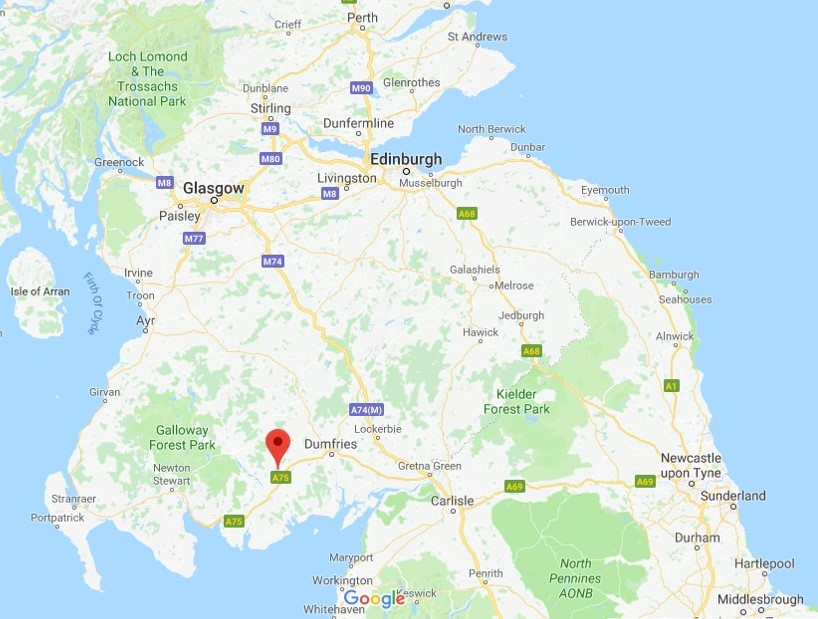
The body of the red kite was found by a member of the public in the Durham Hill Lane area of Kirkpatrick Durham in Castle Douglas on 20 January.

An investigation has been launched and officers involved in it have appealed for information.

[Red kite photo from Scottish Raptor Study Group]

PC Alan Steel, a specialist wildlife crime officer, said the illegal use of poison can be deadly for wild birds.

He said: “Due to the inherent scavenging nature of red kites, they are particularly vulnerable to the illegal use of poisonous bait.

Red kites are legally protected and Police Scotland works closely with partner agencies, including the Scottish Agricultural College (SAC), Science and Advice for Scottish Agriculture (SASA) and the Royal Society for the Protection of Birds (RSPB) to ensure that those responsible are brought to justice.”

RSPB Scotland’s head of investigations said illegal poison use can also harm pets and people.

Numbers of detected cases of illegal poisoning of our birds of prey have, thankfully, been very low in recent years, so this case is of serious concern,” Ian Thomson added.

The Galloway Red Kite trail, just a few miles from where this bird was killed, is a popular tourist attraction and of great benefit to the local economy.”

ENDS

Red kite suspected poisoned in south Scotland

From BBC News (5/4/18):

Police investigating the death of a protected bird of prey have said it may have been poisoned.

The body of the red kite was found by a member of the public in the Durham Hill Lane area of Kirkpatrick Durham in Castle Douglas on 20 January.

An investigation has been launched and officers involved in it have appealed for information.

[Red kite photo from Scottish Raptor Study Group website]

PC Alan Steel, a specialist wildlife crime officer, said the illegal use of poison can be deadly for wild birds.

He said: “Due to the inherent scavenging nature of red kites, they are particularly vulnerable to the illegal use of poisonous bait.

Red kites are legally protected and Police Scotland works closely with partner agencies, including the Scottish Agricultural College (SAC), Science and Advice for Scottish Agriculture (SASA) and the Royal Society for the Protection of Birds (RSPB) to ensure that those responsible are brought to justice.”

RSPB Scotland’s head of investigations said illegal poison use can also harm pets and people.

Numbers of detected cases of illegal poisoning of our birds of prey have, thankfully, been very low in recent years, so this case is of serious concern,” Ian Thomson added.

The Galloway Red Kite trail, just a few miles from where this bird was killed, is a popular tourist attraction and of great benefit to the local economy.”

ENDS

It’s a bit of a strange article, presumably based on a police press release, although we couldn’t find anything on the Police Scotland website.

It’s strange in that it says the kite “may” have been poisoned. Surely, if it was picked up on 20 January, two and half months ago, the toxicology tests will have been done and the results known?

And if poisoning was suspected, why has it taken two and a half months for this news to come out?U

UPDATE 6 April 2018: Red kite now confirmed poisoned (here)

SGA reacts angrily to media coverage of Golden Eagle Fred

Last Friday we published an update on golden eagle Fred, who ‘disappeared’ from the Pentlands on the outskirts of Edinburgh in highly suspicious circumstances in January.

There have been some predictable responses from certain quarters who probably expect everyone to believe that this is what happened to Fred (many thanks to @gill_lewis for this brilliant cartoon):

The Scottish Gamekeepers Association’s response to the latest news on Fred was this:

Hmm, where to begin. Let’s start with some facts, a concept the SGA seems to struggle with.

First of all, on the accusation that our media coverage has been “shambolic” and that this case has made a “total mockery” of the investigative process for dealing with wildlife crime. Let’s just be clear. We haven’t published any details of this investigation without the express agreement of Police Scotland.

In the SGA’s original press statement on Fred (see here), we were accused of “walking away after presenting judgement to the media“. We didn’t “walk away” at all – we presented further evidence to the police and were asked not to publish it until the police’s special technical analysts had been given an opportunity to examine it. Although we were obviously eager to publish as soon as possible, we fully adhered to the police request as not to do so could have compromised their investigation. There is still information that has not yet been released.

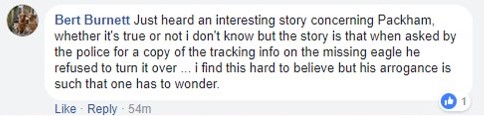
In the meantime, SGA Director Bert Burnett was busily writing outrageous and borderline libellous commentary on social media. He wrote the following on 22 February 2018:

Which leads us on nicely to another statement in the SGA’s latest press statement:

The SGA has not joined in with theorising on blogs or private social media accounts“.

Really? So how does the SGA explain the following social media posts?

Posted 19th February 2018:

Posted 23rd February 2018:

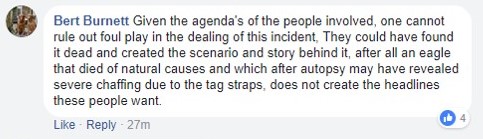
That seems to be pretty conclusive evidence that the SGA, via its Director, has been quite busy “theorising” about this case, doesn’t it? And not only “theorising”, but also trying to whip up unfounded hysteria by accusing Chris Packham of ‘calling for the wives and children of gamekeepers to become homeless’ and Bert then, ironically, calling for people to lobby the BBC to sack Chris!

Ah, but he’s no longer a Director‘ will argue the SGA. That bit, at least, is true – according to documents lodged at Companies House, Bert resigned his Directorship of the SGA on 26th February 2018. However, his social media comments were published prior to the 26th, when he was still an SGA Director. Perhaps this explains Bert’s ‘resignation’? Whatever, who cares.

So after falsely accusing us of commenting inappropriately on a live investigation, the SGA then argues that “…all the evidence in this case should be presented in the open so the truth can be established…”. A good bit of muddled thinking there.

For us, the most revealing section of the SGA’s press statement is this:

The fact that SNH published a paper on satellite tagged eagles between 2004-2016 has nothing to do with any case happening years later, in 2018.

To suggest otherwise is to institutionalise prejudice against a community of people: Scotland’s gamekeepers. We will not tolerate this and are extremely disappointed and angry that this attitude appears to be at large within some sections of our parliament“.

Sorry, SGA, but the 2017 review on the fate of satellite-tagged golden eagles has EVERYTHING to do with this case. The circumstances of Fred’s disappearance mirror the suspicious circumstances of the other 42+ ‘missing’ golden eagles who have ‘disappeared’ on or near to a grouse moor and whose tags suddenly and inexplicably stopped working despite having a proven reliability rate of 98%. The report demonstrated that tagged golden eagles in Scotland were 25 TIMES more likely to ‘disappear’ in suspicious circumstances than anywhere else in the world where these tags have been deployed on eagles.

It’s no use the SGA now pulling out the victim card and falsely claiming “institutional prejudice”. The facts are clear and have been available for a long, long time to those willing to see.

What’s really interesting is that the SGA’s angry response came just hours after Cabinet Secretary Fergus Ewing’s damning condemnation of the criminals within the grouse-shooting sector who continue to kill birds of prey, including golden eagles. We suspect the SGA’s furious reaction about Fred is more to do with the embarrassing fact that Fergus, the SGA’s long-time cheerleader and main political ally, has spoken so openly and frankly about the ongoing persecution of raptors on grouse moors. The significance of Fergus Ewing’s statement should not be underestimated.

The walls are crumbling and the SGA knows it. It’s just a matter of time…..

New information reveals more about Golden Eagle Fred’s suspicious disappearance

RPUK/Chris Packham press release:

NEW INFORMATION REVEALS MORE ABOUT GOLDEN EAGLE FRED’S SUSPICIOUS DISAPPEARANCE

On 21st January, a GPS satellite tag fitted to a young golden eagle called Fred suddenly and inexplicably stopped sending data close to a grouse moor in the Pentland Hills on the outskirts of Edinburgh. Up until that point the tag had been working perfectly and was providing accurate and frequent location information about Fred’s travels.

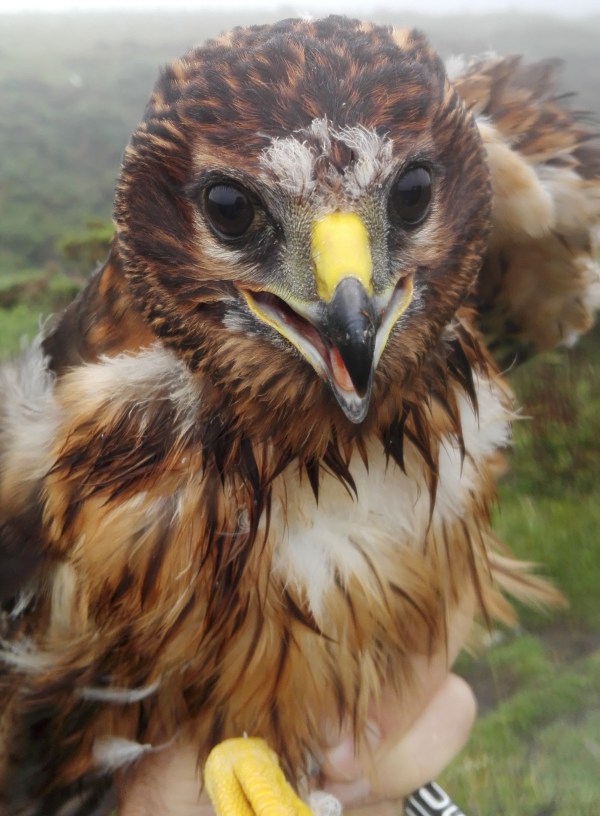
Photo of Fred by Ruth Tingay:

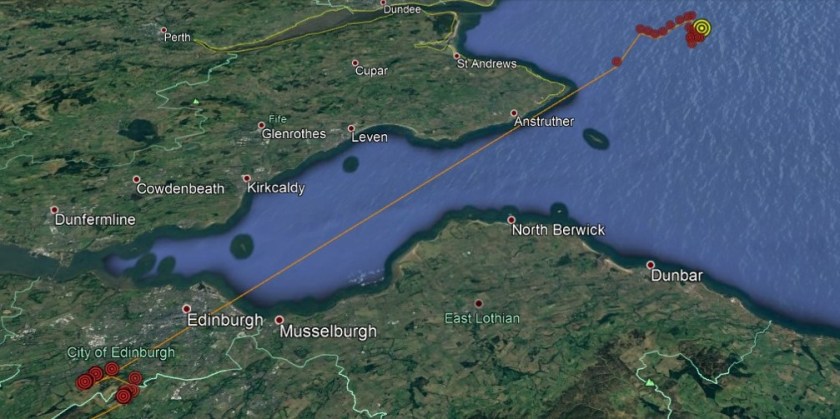
Strangely, three and half days later, the tag began to transmit again for a short period, but astonishingly, it was in the North Sea, 15 miles offshore from St Andrews. No further GPS data have been received.

Map showing Fred’s movements in the Pentland Hills and the last known position of his tag in the North Sea:

The researchers who had been tracking Fred’s movements (Dr Ruth Tingay of Raptor Persecution UK and broadcaster and campaigner Chris Packham) alerted experts at RSPB Scotland who immediately notified Police Scotland who began an investigation into Fred’s suspicious disappearance.

The analysis of new technical data, provided by the tag manufacturer, has now shed some light on the approximate location of Fred’s tag during those three and a half days of lost GPS transmissions.

Although the tag’s GPS transmissions were suppressed, the tag’s technical data, which includes time & date, shows that the tag was still functioning and was periodically communicating briefly with a series of mobile phone masts closest to the tag’s then location. These data, that gave locational information for the phone masts, suggest that in the days after Fred’s disappearance his tag moved eastwards away from the Pentlands, along a route similar to that of the Edinburgh City Bypass and subsequently the A1 towards Haddington, before it travelled to the North Berwick area on the East Lothian coast. From there, it is likely that the tag went into the sea as the data then show that the tag began to connect with phone masts along the Fife coast, across the Firth of Forth. Later, the tag was then able, briefly, to resume giving locational GPS transmissions, but by then it was well offshore.

Map showing the phone masts (red dots) with which Fred’s tag was communicating between 21-25 January 2018. The green dot shows the final known GPS position of the tag on 25th Jan. (Map: RPUK)

Dr Tingay said:That someone might have been travelling around the Edinburgh City Bypass with a dead golden eagle in the boot of a vehicle is sickening.

These new tags we’re using to track golden eagles like Fred offer a highly sophisticated technical opportunity, not just to learn about the eagles’ movements when they’re alive but also, it seems, an insight in to the lengths someone will go to try and remove evidence to cover their crime”.

Chris Packham said:We don’t know whether this tag was still attached to Fred as it travelled across East Lothian and in to the North Sea but we do know that the tag’s movements are a clear indication of foul play.

Whether it was an amateurish attempt to mask the illegal killing of Fred in the Pentlands by dumping the tag, and possibly Fred, in the North Sea to make it look like he had drowned, we’ll never know. We do know that, once again, we’ve lost a young golden eagle in the vicinity of a grouse moor and nobody will be held to account.

The Scottish Government needs to do more, immediately, to protect Scotland’s birds of prey. It’s crystal clear that raptors continue to be killed and the criminals responsible think they are untouchable”.

Ian Thomson, Head of Investigations at RSPB Scotland said:This new information makes the probability of Fred’s death being a wildlife crime even more likely.

The continued denials of any suspicion around the case, and attempts at coming up with elaborate alternative versions of events, have been identical to those in virtually every other case where a satellite-tagged raptor has disappeared.

It is a great shame that some representatives of the gamebird shooting industry, who profess to be “true conservationists” and “guardians of the countryside”, are the same individuals who seek more to shoot the messenger than to face up to and marginalise the criminals who exist in plain sight in their community.

Lothian MSP Andy Wightman said:The evidence uncovered from Fred’s satellite tag is sufficient to convince me that he died in suspicious circumstances. Further details may never be known but it is beyond contempt that protected species such as Golden Eagles continue to be persecuted across Scotland.

I urge all those who use the Pentlands Regional Park on a regular basis to remain vigilant and am extremely grateful to Dr Ruth Tingay and Police Scotland for their diligence and perseverance in a very difficult case.

Last year a Scottish Government-commissioned report showed that 41 of 131 satellite-tagged golden eagles had disappeared (presumed dead) in suspicious circumstances in Scotland, predominantly on or near to some driven grouse moors. In response to that report’s findings, the Scottish Government’s Cabinet Secretary for the Environment, Roseanna Cunningham MSP, ordered a review of grouse moor management practices with a view to introducing a licensing scheme for game-shooting estates.

Anyone with information about Fred’s disappearance is urged to contact Police Scotland on 101, or the RSPB’s confidential raptor crime hotline 0300 999 0101.

ENDS

We’ve produced a video about the location of Fred’s tag between 21-25 January:

The new information we’ve been able to retrieve from the tag (as discussed by Chris Packham in the video) deserves a little bit more explanation.

It’s important to understand that the new data do NOT provide detailed GPS locations of the tag – i.e. the new information only tells us which nearby phone mast the tag was communicating with, it does NOT tell us the exact position of the tag when it was ‘talking’ to the phone masts, as the tag’s GPS function was disabled (more on this below).

Nevertheless, the position of the phone masts and the times/dates the tag was communicating with them does show a very clear direction of travel from the Pentlands and out in to the North Sea. For investigative reasons, we are not yet revealing the times/dates those phone masts were ‘pinged’.

The disabling of the tag’s GPS function is interesting. It is surprisingly easy to suppress the tag’s GPS signal. For obvious reasons, we have no intention of providing a description of how to do that, but needless to say you don’t need a Faraday cage or indeed any specialist equipment to block the signal of this particular tag type.

That begs the question, was Fred’s tag deliberately disabled to hide the GPS data transmissions? Let’s assume for a minute that it was. Whoever did that, was smart enough to know how to suppress the GPS signal but not smart enough to know that the tag would still be trying to communicate with the nearest phone mast. Schoolboy error.

An alternative explanation is that the tag was not deliberately disabled at all. Whoever took that tag (and perhaps Fred’s corpse) from the Pentlands might just have been banking on the idea that the tag only sends data at set periods of time inbetween battery-charging periods (as with the Hen Harrier satellite tags), and so they may have thought they could get it to the coast and in to the sea without anybody who was monitoring the tag’s data knowing that something was wrong. They may have decided to dump the tag (and possibly Fred) in to the sea to make it look as though he flew out there of his own accord and simply drowned. Again, schoolboy error. We are not using the same type of tag as those used on Hen Harriers.

We know from reading various, frankly laughable, theories posted on social media over the last few weeks that the majority of commentators have no clue/understanding of (a) the type of tag we are using, (b) the tag’s capabilities, and (c) the high frequency rate that the tag was transmitting data, throughout every day and night.

We’ve released this new information about the route Fred’s tag took from the Pentland Hills to the North Sea in the hope that someone will come forward to help progress the police investigation into Fred’s highly suspicious disappearance. If you know anything, please contact Police Scotland on 101 or the RSPB’s confidential raptor crime hotline 0300 999 0101.

We’d like to put on record our immense gratitude to the two Police Wildlife Crime Officers who have been leading this case. They have gone way above and beyond what we expected them to do (and again, we are not detailing the specifics of their investigation) and they have impressed us with their diligence and professionalism. Many thanks to them for their efforts to date.

We are also grateful to the tag manufacturer and particularly the senior engineers for providing the additional technical data from Fred’s tag and helping us and the police with the analysis.

Satellite-tagged hen harrier Aalin ‘disappears’ near Ruabon grouse moor, North Wales

They can hide the tags. They can hide the bodies. But they can’t hide the pattern” (Dr Hugh Webster)

RSPB press release (21/3/18):

RARE HEN HARRIER GOES MISSING IN WALES

North Wales Police and the RSPB are appealing for information following the disappearance of a satellite-tagged hen harrier near Wrexham.

The harrier, named Aalin, was tagged as part of the RSPB’s EU-funded Hen Harrier LIFE+ project in July 2016 from a nest on the Isle of Man, in collaboration with Manx Birdlife. Aalin left the Isle of Man in 2016 and spent her first winter in Shropshire, before heading to Wales in the spring of 2017, where she remained ever since.

Hen harrier Aalin (photo by James Leonard)

Aalin’s tag had been transmitting regularly, until it suddenly stopped on the morning of 9 February 2018. Data from Aalin’s tag indicated she spent the last few months in the same area of moorland around Ruabon Mountain near Wrexham, from where the tag unexpectedly sent its last signal at 10.34am. A search was conducted by RSPB Investigations staff, but no tag or body was found and she has not been seen or heard of since.

RSPB map:

Dr. Cathleen Thomas, RSPB Hen Harrier LIFE Project Manager, said: “It’s incredibly disappointing to lose yet another hen harrier in these circumstances, especially as this bird is so scarce in the UK. It’s also the first suspicious loss of a bird in Wales for our project, after the elation of tagging our first chicks there in 2017. We were hopeful that heading towards the breeding season Aalin would have nested in Wales and successfully reared chicks this summer, so her loss also affects future generations of this rare and beautiful bird in the area. We believe the loss of Aalin and other recently tagged hen harriers in the UK is having a devastating impact on their conservation status.”

Rob Taylor, Rural Crime Team Manager, North Wales Police, said: “We have been notified by the RSPB of this incident and we are investigating the disappearance, but at this time we have little to go on. We are appealing to the public for any assistance they can give and we hope that foul play hasn’t played a part in the loss of this rare bird.”

Neil Morris, Managing Director of Manx Birdlife, said: “This is heart-breaking news. As well as the sudden unexplained loss of yet another magnificent bird of prey, we still know so little about the behaviour of Manx-born hen harriers. Clearly there is an impulse for young birds to wander soon after fledging. But we don’t really know why or whether any of those that leave the Isle of Man as juveniles make the return journey as mature adults to breed back in their native hills.”

If you have any information relating to this incident, please call North Wales Police on 101 quoting the reference WO28466. Alternatively, you can call the RSPB Raptor Crime Hotline confidentially on 0300 999 0101. All calls are anonymous.

If you find a wild bird that you suspect was illegally killed, contact RSPB investigations on 01767 680551 or fill in the online form:

https://www.rspb.org.uk/our-work/our-positions-and-campaigns/positions/wildbirdslaw/reportform.aspx

ENDS 

Dr Cathleen Thomas, RSPB’s Hen Harrier Life Project Manager has also written a blog – here.

We’ve produced a habitat map covering the area of Aalin’s last known satellite-tag fix. The tell-tale heather strips show this as, surprise surprise, a grouse moor:

Aalin was one of the 2016 cohort of young satellite-tagged hen harriers. Here’s what happened to the others:

Hen harrier Elwood – ‘disappeared’ in the Monadhliaths just a few weeks after fledging, presumed dead (Aug ’16).

Hen harrier Brian – ‘disappeared’ in the Cairngorms National Park just a few weeks after fledging, presumed dead (Aug ’16).

Hen harrier Donald – missing in northern France, presumed dead (Autumn ’16).

Hen harrier Hermione – found dead on Mull, believed to have died from natural causes (Sep ’16).

Hen harrier Rowan – found dead in Yorkshire Dales National Park. He’d been shot (Oct ’16).

Hen harrier Tarras – ‘disappeared’ in the Peak District National Park, presumed dead (Oct ’16).

Hen harrier Beater – ‘disappeared’ in the Scottish Borders, presumed dead (Nov ’16).

Hen harrier Bonny – ‘disappeared’ in the North Pennines, presumed dead (Dec ’16)

Hen harrier Mick – ‘disappeared’ in the Yorkshire Dales National Park, presumed dead (Dec ’16).

Hen harrier Carroll – found dead in Northumberland, PM revealed a parasitic disease & two shotgun pellets (Jan ’17).

Hen harrier John – ‘disappeared’ in the Yorkshire Dales National Park, presumed dead (Oct ’17)

Hen harrier Aalin – ‘disappeared’ in Wales, presumed dead (Feb ’18)

Twelve down, five to go (DeeCee, Finn, Harriet, Wendy, Sorrel).

More evidence then, that DEFRA’s Hen Harrier Action Plan, launched on 16 January 2016 months before these hen harriers even hatched, is a categorical failure. Will DEFRA or any of the other supporters of this pathetic pantomime (Natural England, Moorland Association, GWCT, Hawk & Owl Trust, International Centre for Birds of Prey etc) re-assess and pull the plug? Of course not.

It looks like Mr Carbo needs to update his sketch:


Responses to ‘missing’ satellite-tagged golden eagle nr Tomatin

Four days ago we blogged about the ‘disappearance’ of yet another satellite-tagged golden eagle, the 12th eagle in seven years to vanish in suspicious circumstances in this particular area managed for driven grouse shooting.

Here are some of the responses:

Environment Cabinet Secretary Roseanna Cunningham –

This golden eagle has disappeared in an area which has long been associated with the illegal persecution of birds of prey. We may never discover exactly what has happened in the case of this latest disappearance. But we do know the illegal killing of Scotland’s magnificent birds of prey continues – primarily in areas which are intensively managed for driven grouse shooting.

No-one should be in any doubt about my determination to act decisively to uphold the law and protect Scotland’s magnificent birds of prey. I look forward to receiving the Werritty Report into how we can ensure grouse shooting is sustainable and complies with the law, which is due to be published early next year”.

We’re in no doubt at all about Roseanna Cunningham’s sincerity on this issue. Like every other sane and law-abiding member of society, she’s appalled that this continues and is probably deeply embarrassed that it continues to happen on her watch, hence her announcement last May of the newly-commissioned grouse moor review panel. We all welcomed that news because finally, after many, many years, it seemed the Scottish Government was finally listening, was in full acknowledgement of the evidence, and was prepared to act.

But it seems from Roseanna’s statement that nothing more will be done for at least another year, and if truth be told, it’ll take longer than a year because as has already been indicated, if the Werritty Report does recommend an introduction of a licensing scheme, the Scottish Government will need to hold a public consultation before any changes are brought in. Can we afford to wait for another year, two years, three years? No, we can’t. The Scottish Government needs to get a grip and tackle the criminal element within the grouse shooting industry with speed and force. There’s absolutely no excuse not to act now.

Rural Economy & Connectivity Cabinet Secretary Fergus Ewing (in whose constiuency this eagle disappeared)  –

Silence. Again.

Utterly, utterly shameful.

UPDATE 20.00hrs: In email correspondence today with a constituent, Mr Ewing MSP said the Environment Cab Sec “has responsibility to make public comment on this [illegal raptor persecution] but I have done so as well“. If anyone has a record of this public comment we’d be happy to share it here.

UPDATE 22 March 2018: Fergus Ewing speaks out here

David Johnstone, Chairman, Scottish Land & Estates – 

RSPB has stated today that a young golden eagle fitted with a satellite tag disappeared three months ago in the Northern Monadhliath mountains. We have no hesitation in urging anyone who can provide information on the matter to contact Police Scotland.

We are, however, deeply concerned by the assumption by RSPB that this eagle is most likely the victim of a wildlife crime perpetrated on a grouse moor. Yet again, we see RSPB acting unilaterally as judge and jury without waiting for those professional experts in the police and the procurator fiscals’ office to reach an informed decision as to the actual facts. We believe this continual smearing of grouse moors actually runs the risk of being counterproductive and directly impacting all the good, productive collaboration that has taken place in recent years.

Incidents such as this absolutely do need to be investigated but it is for Police Scotland to lead investigations. They have very extensive powers to gather evidence as they see fit, and we would expect all our members to assist them in their enquiries.

To be clear, we as an organisation – and on behalf of our members – condemn all forms of wildlife crime. We are not saying that wildlife crime never occurs on land managed for grouse shooting and acknowledge that in the past, there were practices, including raptor persecution, that are simply unacceptable but which have declined markedly in recent years and this trend is borne out by the Scottish Government’s own statistics. We also note that RSPB itself describes the area involved in this case as one where eagles have done well in recent years.

Of course, more work needs to be done ensure the decline in wildlife crime continues and we are an enthusiastic member of the Partnership for Action Against Wildlife Crime Scotland (PAWS). It has been proven time and again that constructive collaboration gets the best results. Alongside this, we and numerous grouse shooting estates are active members of the Heads Up for Harriers project as well as being key drivers in the South of Scotland Golden Eagle reintroduction project. 

Instead, what we have is a sustained effort to blacken the name of grouse shooting without evidence. It is perhaps no coincidence this is happening when the Scottish Government has instigated an independent review into grouse shooting which is ongoing at this very moment. Despite being a member in PAWS, we have seen absolutely no evidence or data from this eagle or from the recent case of Fred which disappeared in the Pentland Hills.

We are fully supportive of the government review into grouse shooting as set up by the Cabinet Secretary, its practices, and the many environmental, economic and social benefits it provides across rural Scotland. We are also fully supportive of the proposals within the Poustie report that recommends the strengthening of penalties with regard to wildlife crimes.

This statement was met with deserved derision on social media.

What we have is a sustained effort to blacken the name of grouse shooting without evidence“, declares Mr Johnstone. Without evidence? Really? Apart from the massively obvious fact that the circumstances of this latest eagle’s disappearance mirror, exactly, the suspicious disappearances of 42 other satellite-tagged golden eagles on or near driven grouse moors in Scotland, as detailed in the Scottish Government-commissioned report published last year. Is Mr Johnstone in open defiance of the findings of that report? If he is, then let’s have the details of his objections.

Once again, with tedious repitition, SLE tries to shoot the messenger (RSPB Scotland) and suggests that the investigation needs to be undertaken by Police Scotland. Perhaps he should re-read the RSPB’s press release which clearly states the police ARE investigating. SLE will also know that the RSPB would not have put out a press statement without agreement from the police. To suggest that the RSPB is acting alone and not in partnership with the police is a wholly disingenuous attempt to discredit the RSPB.

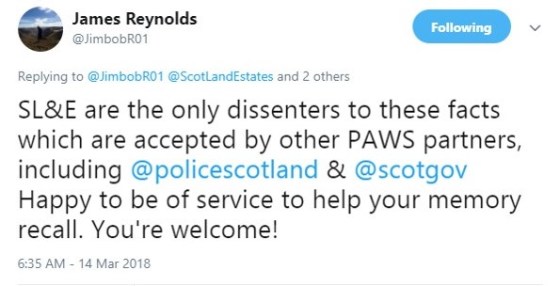
Mr Johnstone also argues that illegal raptor persecution has “declined markedly in recent years and this trend is borne out by the Scottish Government’s own statistics”. SLE was taken to task about this on Twitter by James Reynolds, Head of Media at RSPB Scotland, as follows:
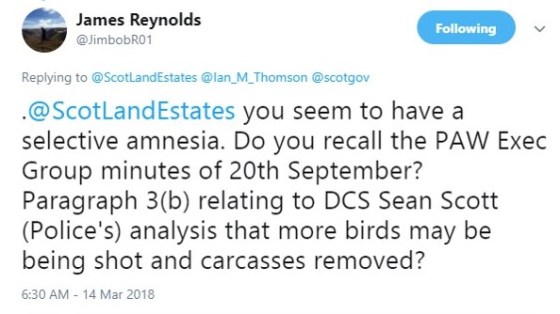
Mr Johnstone cynically infers that the RSPB released the news of this ‘missing’ eagle to coincide with the on-going review of grouse moor management. Ah, sorry, was this news release inconvenient? Hasn’t this argument been used before, with claims made that RSPB news releases on raptor persecution were timed to coincide with the start of the grouse-shooting season? Does it damage the industry’s failing propaganda campaign to portray itself as law-abiding and sustainable? Should the news have been withheld until after the review has been submitted next year?

There was one part of Mr Johnstone’s statement that interested us the most:

“We are not saying that wildlife crime never occurs on land managed for grouse shooting and acknowledge that in the past, there were practices, including raptor persecution, that are simply unacceptable….”

Could Mr Johnstone or anybody else from SLE please tell us which incidents on grouse moors, in the past, he now accepts as being confirmed raptor persecution crime?

Anonymous spokesperson from the Scottish Gamekeepers Association –

If anyone has information they should contact Police Scotland. If it is proven any harm has come to this bird and if it transpires there is evidence that that harm was the responsibility of an SGA member, they will be subject to our very strict wildlife crime disciplinary code.

The legal process deserves respect before people automatically jump to apportioning blame.

It is becoming increasingly impossible to gain full transparency surrounding these incidents when those holding the data are the tag owners who then dictate process and message.

At the same time, these tag owners are actively lobbying to persuade government to legislate against grouse moors.

If investigations were to have the best chance of success and procedural transparency, this data would be held centrally by an impartial body who could look into everything such as the reliability of the tag, who fitted it, the evidence of criminality which exists and the full range of other factors which could cause a mechanical device to stop signalling after many months in the wild.

When a tag from a Hen Harrier stopped signalling on one of RSPB’s own nature reserves in the Cairngorms National Park, the charity stated the last known location of a tag was ‘only an indication of the broad general area’ where that bird was spending time.

That being the case, the public deserve to see the hard evidence which exists that the lost signal was down to grouse management and not any other cause such as a faltering tag, natural mortality, eagles fighting over territory or any of the other land uses in the broad general area which include farming, forestry and wind energy.”

‘The legal process deserves respect’. Good grief!!!! We can hardly be bothered to respond to this unmitigated tosh from the SGA. Let’s just look at what happened the last time the SGA was given access to the data of a satellite-tagged golden eagle (see here) and leave it at that.

On a brighter note, in response to the news of this latest satellite-tagged eagle to go ‘missing’ in highly suspicious circumstances north of Tomatin, the Shooting Times tweeted this:

Whether you agree with shooting or not is irrelevant. The Shooting Times deserves much credit for showing unprompted condemnation and leadership. Perhaps the Editor can be invited to serve on the PAW Scotland Raptor Group in place of the SGA (who are currently refusing to attend meetings), then we might actually start to see some progress.

Police acknowledge golden eagle Fred’s disappearance is highly suspicious

Two weeks ago we blogged about a motion raised by Edinburgh Councillor Chas Booth (Scottish Greens) calling on Edinburgh City Council to take action in response to the highly suspicious disapearance of golden eagle Fred in the Pentland Hills (see here).

Last week we blogged about an attempt by Tim (Kim) Baynes, Director of the Scottish Moorland Group (part of Scottish Land & Estates) to downplay the suspicious circumstances of Fred’s disappearance and to derail Cllr Booth’s motion (see here).

Cllr Booth’s motion was due to be heard by Edinburgh City Council’s Transport & Environment Committee on 1st March 2018 but the meeting was postponed due to the snow.

The meeting was rescheduled and took place yesterday.

Prior to the meeting, Tim (Kim) Baynes sent another letter to the Committee, again attempting to derail the motion, as follows:

This letter, implying (incorrectly) that there is no evidence of criminal activity in relation to Fred’s disappearance, prompted Conservative councillor Nick Cook to call for ‘no action’ on the motion.

However, Cllr Booth sent around an email he’d received from Police Scotland that said they were “happy with the wording” of his motion (i.e. that Fred’s disappearance was indeed highly suspicious) and Cllr Booth argued that the opinion of Police Scotland held far greater weight than the opinion of Scottish Land & Estates.

Cllr Booth further argued that rather than delaying the motion until the police investigation had ended, the timing of the motion was even more pertinent now, in that one of the motion’s statements included referring the matter to the Pentland Hills Regional Park Joint Committee, to ask them to consider writing to landowners in the region highlighting this incident and encouraging them to report any suspicious activity to Police Scotland or the RSPB.

The Committee voted on the motion and despite three Conservative councillors voting against it, the motion was carried by 8 votes to 3.

Well done and thank you, Cllr Chas Booth.

Here’s the motion that was carried:

Green Motion – Suspicious disappearance of ‘Fred’ the Golden Eagle in Pentland Hills

Committee:

  1. Notes with grave concern reports of the suspicious disappearance of ‘Fred’ the Golden Eagle, who hatched from a nest in the Scottish Borders to the only breeding pair of Golden Eagles in the region, and who, according to his satellite tag, was in woodland near Currie in January 2018, within the Edinburgh Council boundary;
  2.  Notes that Fred’s satellite tracker is reported to have suddenly and inexplicably stopped transmitting on 21 January 2018, and then to have mysteriously started transmitting again on 24 January 2018, with a GPS location some 15 miles offshore of St Andrews, Fife.
  3. Further notes that RSPB Scotland and Raptor Persecution UK regard Fred’s disappearance as highly suspicious and believe it is likely that he has been illegally killed;
  4. Notes that the Golden Eagle is a magnificent and majestic bird and one of the largest birds of prey in the British Isles, notes that it is protected under the Wildlife and Countryside Act 1981, but notes that nonetheless it has been illegally killed and persecuted in the past;
  5. Notes that a Scottish Government-commissioned study in 2017 found that 41 of 131 satellite-tagged Golden Eagles had disappeared in suspicious circumstances, most of them at or near to managed grouse moors;
  6. Notes that the Scottish Government have established a working group with a view to establishing a licensing regime for game-shooting estates;
  7. Agrees that the suspicious disappearance of Fred is deeply regrettable, and urges anyone with any knowledge of this incident, or any other incidents of possible wildlife crime, to contact Police Scotland on 101 or alternatively call the RSPB’s new confidential raptor crime hotline on 0300 999 0101;
  8. Agrees that the Council Leader will write to the Cabinet Secretary for the Environment expressing the council’s grave concern at this incident, asking her to outline a timetable for the introduction of the licensing of game-shooting estates; offering the council’s cooperation with any such licensing regime, and offering the council’s support for consideration of stiffer penalties for wildlife crime;
  9. Agrees to refer the matter to the Pentland Hills Regional Park Joint Committee, to ask them to consider writing to landowners in the region highlighting this incident and encouraging them to report any suspicious activity to Police Scotland or the RSPB.

Moved by Cllr Chas Booth, Seconded by Cllr Steve Burgess (Scottish Greens).

Fred the golden eagle: police investigation still very much ongoing

The criminals within the game-shooting industry are deeply concerned about what might be revealed by the police investigation in to the highly suspicious disappearance of our satellite-tagged golden eagle Fred.

The following was posted on the BASC facebook page today and has since been doing the rounds on social media, accompanied by various defamatory accusations that we (RPUK, Chris Packham, and Ian Thomson from RSPB) are all “compulsive liars”:

FOR THE AVOIDANCE OF ANY DOUBT, THE POLICE INVESTIGATION IS STILL ONGOING.

The police have been given the new data we were able to retrieve from Fred’s tag, which very much support our earlier suspicion that Fred was a victim of illegal persecution.

Rest assured, we WILL be publishing these data in due course.

For now, we have to let the police do their job.

But thanks, game-shooting criminals, for keeping Fred’s highly suspicious disappearance in the news. Much appreciated.