Local community raises concerns about grouse moor management in National Park

The picture often painted by the grouse shooting industry is one of community harmony – a rural idyll where local residents are deliriously enthralled by the activities of the local grouse moor managers and thankful for the boost that grouse shooting brings to the local economy, without which the local community would apparently collapse.

Sounds great, doesn’t it? Until, that is, you realise that the various quotes trotted out in support of the industry are word-for-word identical, even though they were supposedly uttered by local residents living hundreds of miles apart! Quite obviously this was part of a determined PR effort by the industry’s spin doctors to portray widespread support (e.g. see here).

Increasingly, though, we’ve been hearing a different point of view, with local residents finding their voices and speaking out against the damage this industry brings to their door. First we heard from local communities in the Yorkshire Dales National Park (see here and here), then from a community in the Nidderdale Area of Outstanding Natural Beauty (see here), and now from a local community in the North York Moors National Park.

Last month, residents of the village of Goathland called a public meeting to discuss their concerns about the environmental consequences of driven grouse moor management in their area, and particularly their concerns about ‘disappearing’ wildlife.

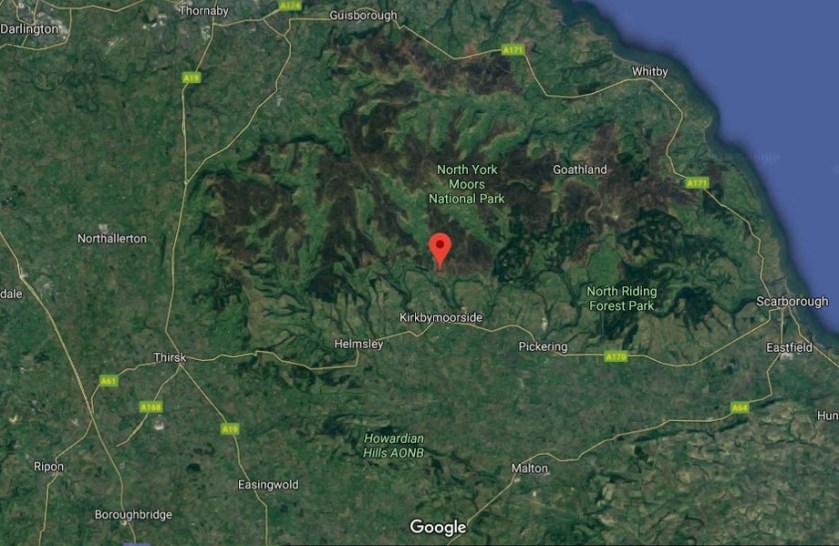
Here’s Goathland, in the heart of this National Park and practically surrounded by driven grouse moors:

This is a National Park – look at the state of it! And those grouse moors spread a lot further west than shown on this map.

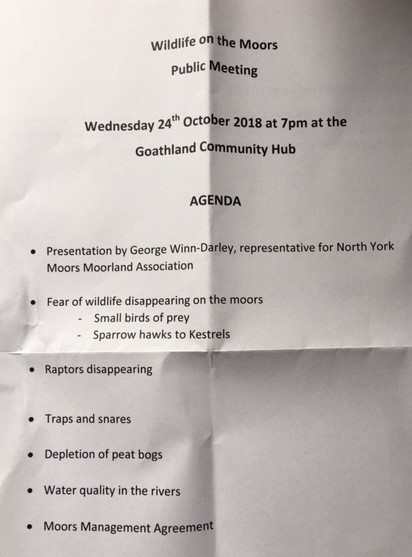
Here’s the agenda for the meeting held on 24 October 2018. We note with some irony the third item listed was ‘Raptors disappearing’. Less than two days after this meeting, the satellite tag attached to hen harrier Arthur sent its last signal from a grouse moor in the North York National Park before both it and Arthur ‘disappeared’.

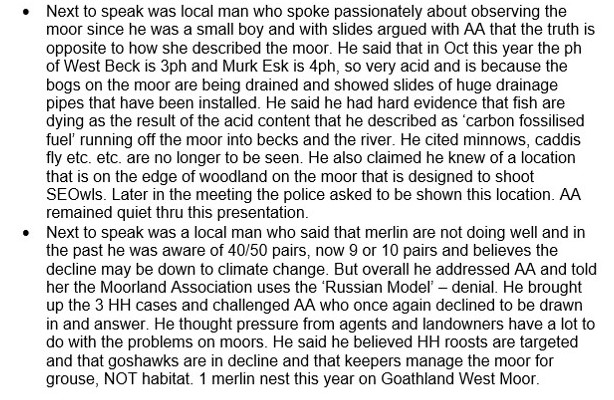
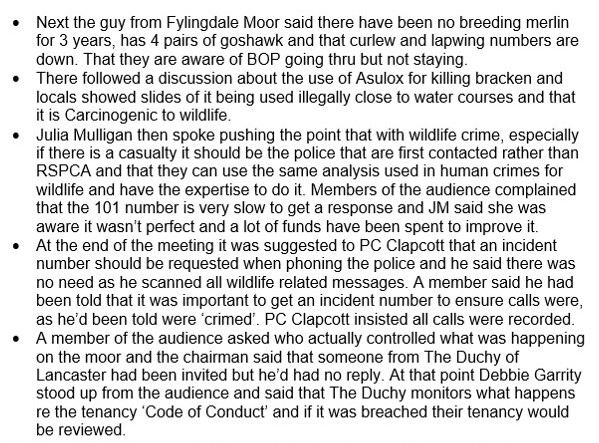
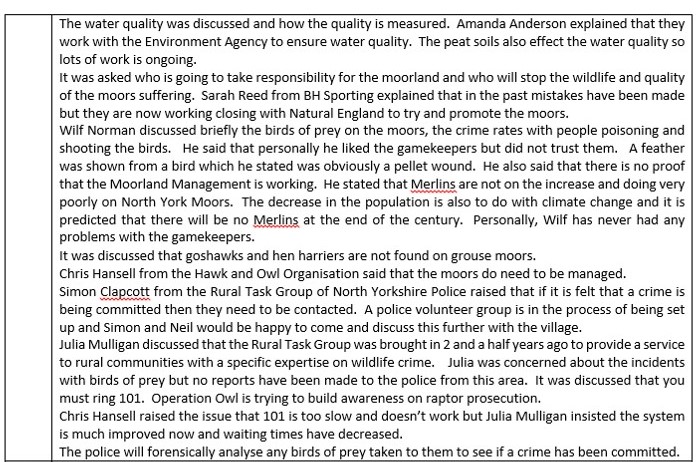
One of our blog readers attended this meeting and made some notes, as follows:

A few days later the official minutes were circulated as follows:

There’s a lot of interesting stuff to work through in both these documents. Many thanks to the blog reader who sent these through.

Very well done to the Goathland residents for raising these issues and for trying to hold someone to account. It’s brilliant to see them challenging the Moorland Association and exposing its propaganda.

If you’d like to support the Goathland residents and add your voice to theirs, you might like to comment on the current Landscapes Review consultation which is gathering evidence on how England’s National Parks and Areas of Outstanding Natural Beauty (AONBs) should be ‘fit for the future’. If you think intensive grouse moor management and its associated wildlife crime should be ousted from the North York Moors National Park, or that the National Park Authority should be given increased enforcement powers to deal with the associated wildlife crime and environmental damage, then this is your opportunity to comment.

UPDATE 11 January 2019: Local community holds 2nd meeting to raise concerns about grouse moor management in National Park (here)

Satellite-tagged hen harrier Arthur ‘disappears’ near grouse moor in North York Moors National Park

RSPB press release (12/11/18):

A rare Hen Harrier has suddenly disappeared in North Yorkshire, triggering an investigation by the police and the RSPB. This is the ninth bird to disappear in suspicious circumstances in the last 12 weeks.

The bird, named Arthur, hatched from a nest in the Peak District this summer. This was the first time Hen Harriers had successfully bred in the Peak District since 2015. Arthur, along with his sister Octavia, was fitted with a lightweight satellite tag by RSPB staff as part of the Hen Harrier LIFE project, which has enabled the RSPB to track his movements since leaving the nest in July.

[Hen harrier Arthur, photo by Steve Downing]

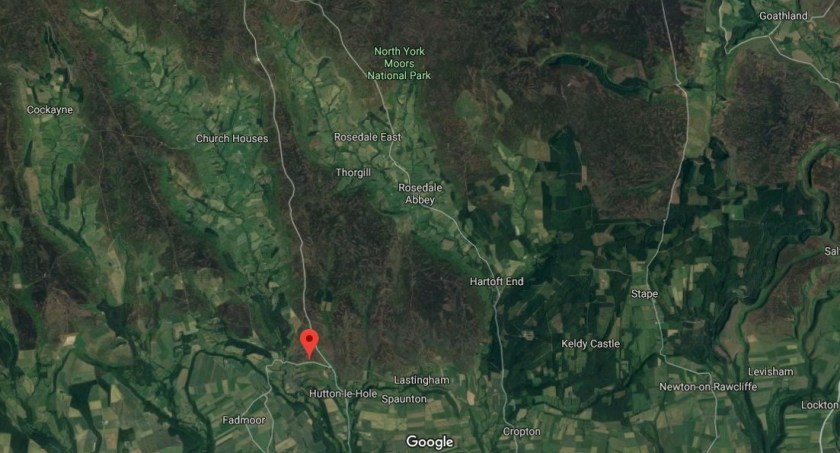
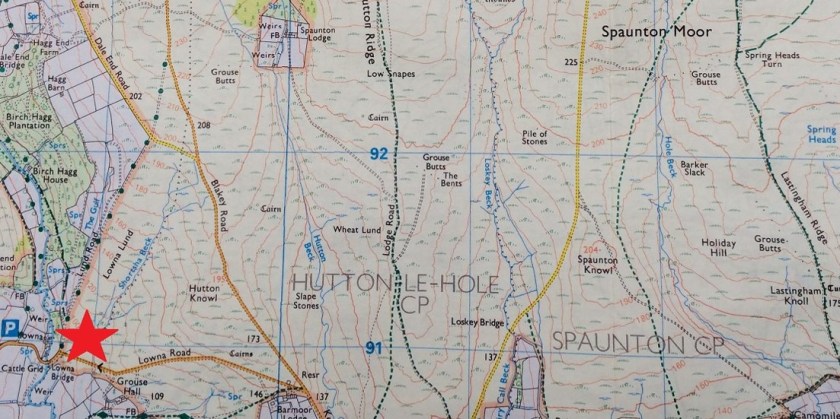
Transmissions from Arthur’s tag showed him fledging from his nest and remaining faithful to that area in the Peak District. He then moved to the Brecon Beacons, South Wales, in mid-October before flying back north to Nidderdale, North Yorkshire. On the morning of Friday 26 October he flew onto the North York Moors National Park. He registered his last position at 0955hrs when he was just north of Lowna Bridge, near Hutton-le-Hole.

[RPUK maps showing approximate last known location of Hen harrier Arthur in the North York Moors National Park, close to Spaunton Moor, owned by George Winn-Darley, the North York Moors representative for the Moorland Association. Red star denotes Lowna Bridge]

RSPB Investigations staff searched the area of the bird’s last known location but found no sign of either a tag or a body – prompting concerns that the bird may have been deliberately killed and the tag destroyed. In August, his sister Octavia’s tag also suddenly cut out, with her last location coming from a driven grouse moor in the Peak District. No trace was found of her either. The police and the RSPB are appealing for information.

RSPB Assistant Investigations Officer Jack Ashton-Booth said: “Arthur’s last location showed he was in an upland area close to several driven grouse moors. When tagged Hen Harriers have died of natural causes in the past, the tags and bodies of the bird are usually recovered. To find no trace of Arthur or Octavia is extremely concerning. Arthur is the ninth Hen Harrier to suddenly disappear in suspicious circumstances since August. This is gravely concerning given that the species is on the brink of extinction as a breeding bird in England.”

Hen Harriers are one of the UK’s rarest and most persecuted birds of prey. They nest on the ground, often on moorland, and are known for their spectacular courtship display, the ‘skydance’. Like all wild birds, they are protected by law under the Wildlife and Countryside Act 1981 which makes it an offence to intentionally harm or disturb them. Anyone found to have done so faces an unlimited fine and/or up to six months in jail. But, despite full legal protection, studies show that the main factor limiting their population is illegal killing by humans.

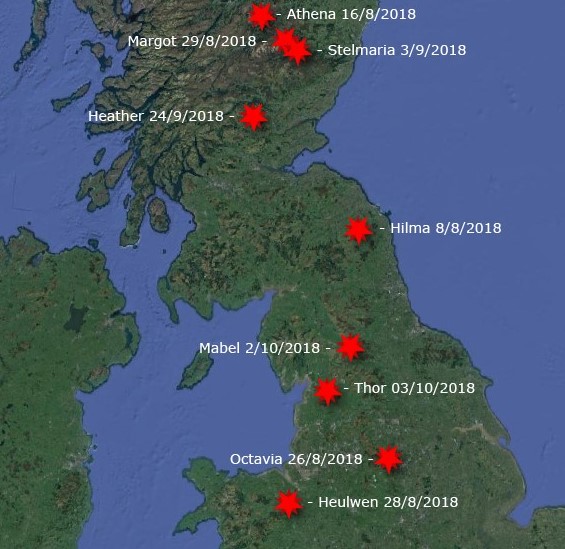
Over 30 Hen Harriers were tagged during June and July 2018 in England, Scotland, Wales and the Isle of Man as part of the RSPB’s Hen Harrier LIFE project. Of those, eight birds (Hilma, Octavia, Heulwen, Thor, Athena, Stelmaria, Margot and Arthur) have since disappeared in suspicious circumstances, along with another bird, Heather, who was tagged in 2017.

Calculations based on habitat and prey availability indicate that England should be able to support around 300 Hen Harrier pairs. But this year only 34 chicks fledged from nine English nests, according to a report by Natural England. In 2017 there were only 10 chicks in the whole of England.

The RSPB’s latest Birdcrime report showed that North Yorkshire is consistently the worst county in the UK for recorded bird of prey persecution, accumulating significantly more confirmed incidents in the last five years than anywhere else. Data showed that 15 of the 55 confirmed incidents in England in 2017 took place in North Yorkshire. Since these only represent known, confirmed incidents, the RSPB believes this is just a glimpse of the true scale of the problem, and that many more crimes will have gone unreported and unrecorded.

ENDS

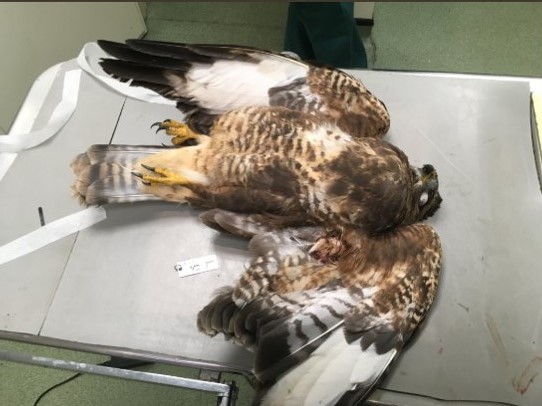
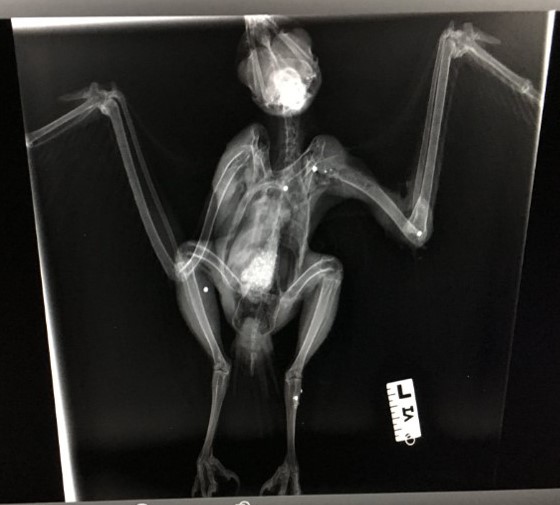
Buzzard found in North Yorkshire with horrific injuries from shotgun

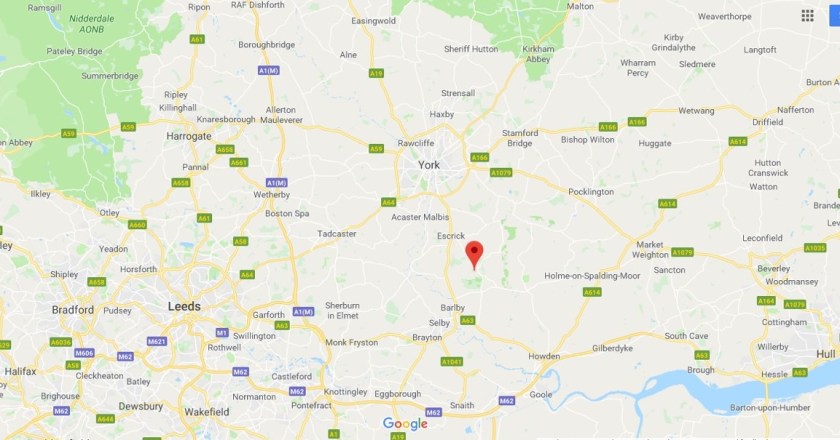
This buzzard was found today at Skipwith in North Yorkshire, with horrific injuries caused by a shotgun.

[UPDATE 11/11/18: This bird was picked up just of King Rudding Lane on Thursday 8 Nov 2018]

According to Jean Thorpe (raptor rehabilitator extraordinaire) the buzzard was found alive but with a broken shoulder and humerus. She thinks its injuries were so severe it would not have been able to fly from the location where it was shot.

If anyone has any information please contact Police Wildlife Crime Officer Jez Walmsley at Malton Police Station (Tel: 101) or the RSPB Raptor Crime Hotline (Tel: 0300-999-0101).

Four more satellite-tagged hen harriers ‘disappear’ on Scottish grouse moors

Press release from RSPB Scotland (6 Nov 2018):

Four rare hen harriers disappear on Scottish grouse moors: RSPB Scotland appeals for information

RSPB Scotland is appealing for information following the suspicious disappearance of four satellite tagged hen harriers over the last 10 weeks.

All of the birds were tagged at various nest sites, three this summer and one in 2017, in Scotland and Northern England as part of the RSPB’s EU-funded Hen Harrier LIFE project. The last known locations of all four birds were over land managed for grouse shooting.

Satellite tagging technology is increasingly being used to follow the movements of birds of prey, allowing scientists to identify areas important for their feeding, roosting and nesting. The tags are fitted by licensed, trained fieldworkers and are designed to transmit regularly, even after a bird has died. In all four cases, the tags had been functioning without any issues before they suddenly and unexpectedly stopped transmitting, suggesting criminal interference has taken place.

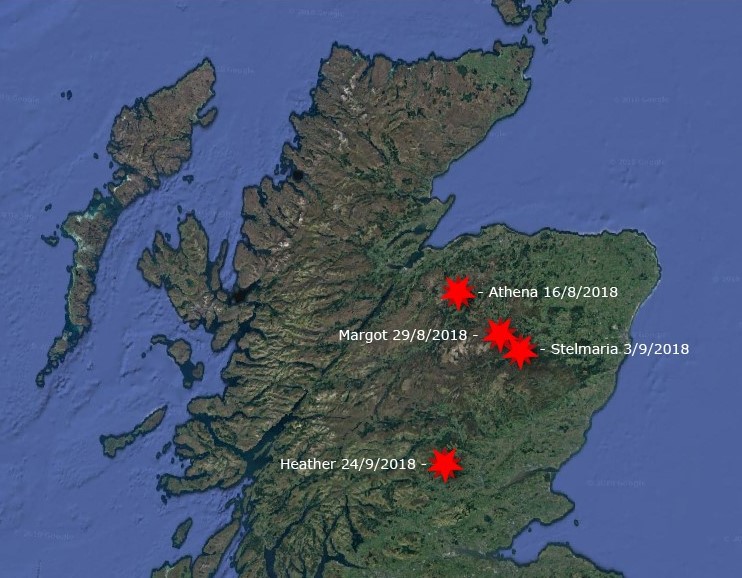
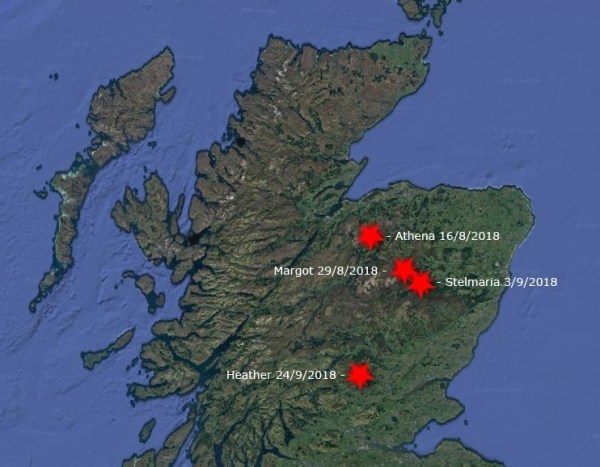
[RPUK map showing the last known locations of the four hen harriers before their satellite tags suddenly and unexpectedly stopped working and the birds ‘disappeared’]

The first bird to disappear, Athena, was one of a small number of chicks to fledge from a nest in Northumberland. She travelled north into Scotland, with her last known position on a grouse moor a few miles north west of Grantown on Spey in Inverness-shire, on 16thAugust.

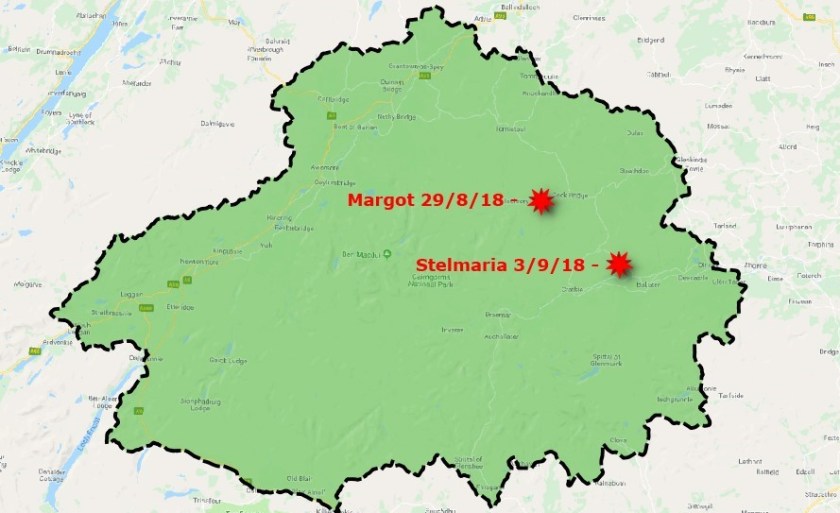
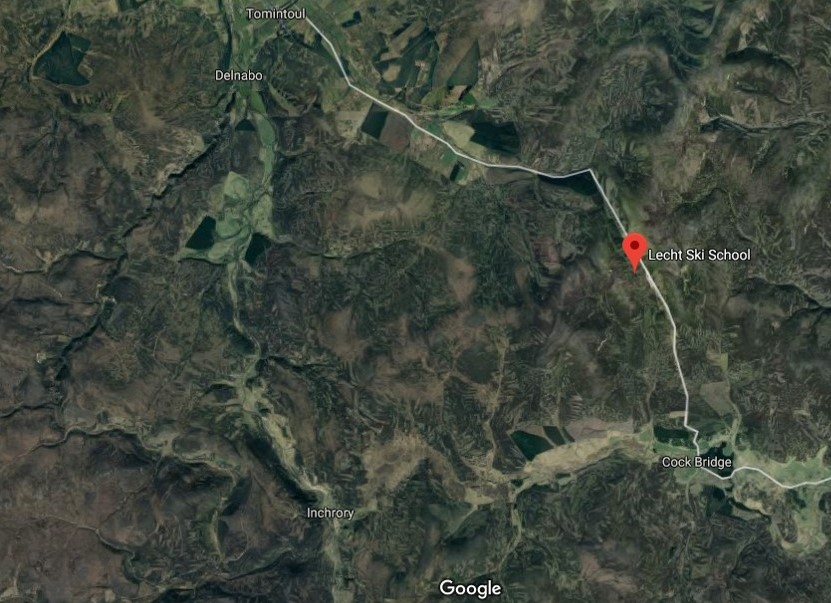
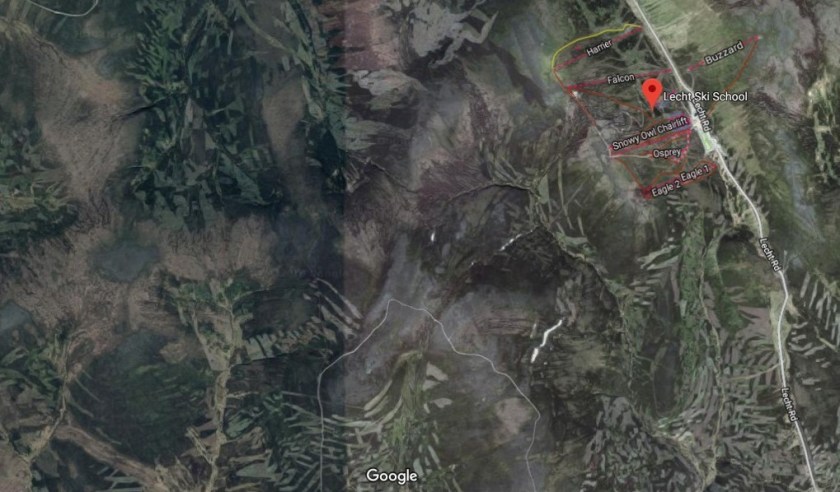
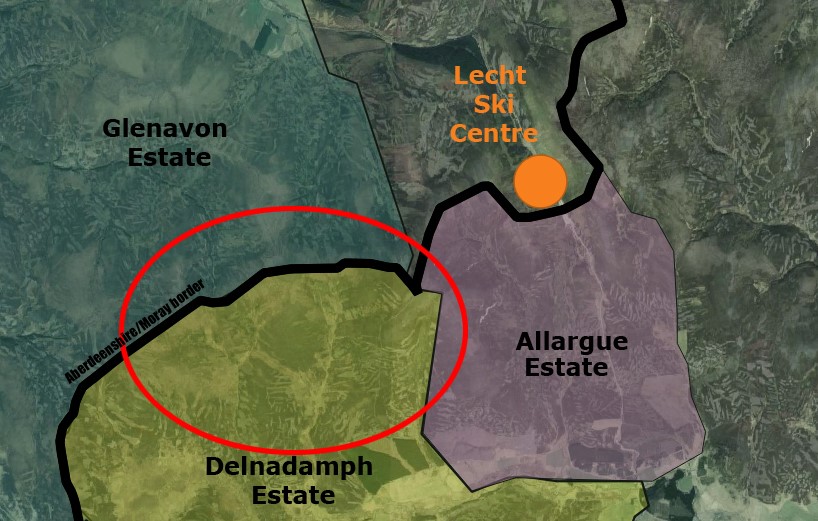
Two of the birds were tagged on the National Trust for Scotland’s Mar Lodge Estate in Aberdeenshire this summer. Margot disappeared on 29th August, with her last known position on a grouse moor on the Aberdeenshire/Moray border, a few miles south west of the Lecht ski centre. Stelmaria was last recorded on grouse moor a few miles north west of Ballater, Aberdeenshire on 3rd September. Stelmaria’s mother was DeeCee, a hen harrier tagged by the project in Perthshire in 2016.

The fourth missing bird, Heather, was a year older than the others. She was tagged at a nest in Perthshire in 2017, and last recorded on a grouse moor to the north of Glenalmond on 24th September.

[Hen harrier Margot – photo from RSPB Scotland]

Dr. Cathleen Thomas, Project Manager for the RSPB’s Hen Harrier LIFE project said: “To have more hen harriers disappear, including three of this year’s youngsters, is devastating for all of us involved in monitoring these hen harrier chicks. These birds have vanished in similar suspicious circumstances to four other birds tagged by the project that disappeared this summer with last recorded locations on or near grouse moors in England and Wales. These eight suspicious disappearances in the past 10 weeks are a further blow for the conservation of a species whose UK population has declined by 24% since 2004.

The main factor limiting the hen harrier population in the UK is illegal killing associated with intensive management of driven grouse moors. Young hen harrier chicks already face huge survival challenges in their first few years of life without the added threat of illegal persecution.

Each year a number of the chicks tagged by the project are lost through natural predation or starvation. So far in 2018 the remains of 12 young hen harriers have been recovered. Their tags continued to transmit after they died allowing their remains to be located and for post mortems to take place. These established that they all died of natural causes.

Ian Thomson, Head of Investigations for RSPB Scotland said: “Given the tiny number of hen harrier chicks tagged each year, the regularity with which they disappear, again indicates that we are only ever aware of a tiny proportion of the true number of protected raptors that are being illegally killed.

In common with so many previous disappearances of satellite-tagged birds of prey, each of these missing birds was last known to be on a moor managed for driven grouse shooting before its transmitter suddenly stopped. The picture is becoming ever more clear – in almost all cases when a tagged birds dies naturally we are able to recover its remains; if it disappears over a Scottish grouse moor, it’s never seen or heard of again.”

Information about the birds’ disappearances were passed to Police Scotland, and while local enquiries have taken place in each case, no further information on what has happened to the birds has been found. Anyone who can provide information about any of these missing birds is asked to contact Police Scotland on 101 or the RSPB’s raptor crime hotline on 0300 999 0101.

ENDS

The criminals within the grouse shooting industry couldn’t give the Scottish Government, nor the public, a clearer message. Despite being under the closest scrutiny the industry has ever faced and with the very real threat of enforced regulation and legislation looming large, the message is still ‘screw you all, we’ll do what we like and we’ll continue to do it safe in the knowledge that we’ll never face any consequences’.

And they’d be right. They won’t face any consequences, at least not for a while. Sure, the Scottish Government is all over grouse moor management like a rash right now but we still have to sit and wait for the findings of the Werritty Review, which isn’t due to report until spring 2019. And if Professor Werritty’s review does recommend licensing grouse shooting estates to bring them under some sort of control (any control would be nice), there’ll then be more inevitable delays while consultations ensue and the dark side uses its mighty influence and power to weaken any proposals put forward.

Actual meaningful regulation, properly enforced, could still be years away. Meanwhile, the illegal killing will continue. Since the analysis was completed in January 2017 for the Golden Eagle Satellite Tag Review (which showed that over 40 golden eagles have vanished in recent years on or close to driven grouse moors) a further 14 satellite-tagged raptors have ‘disappeared’ in highly suspicious circumstances in Scotland, and most of them on or close to intensively managed driven grouse moors ( 4 x golden eagles, 8 x hen harriers, 2 x white-tailed eagles).

How many more will be killed before the Scottish Government brings the criminals to account?

Several of the grouse moors from where the latest four hen harriers ‘disappeared’ are of significant interest to us. We’ll be coming back to those in some more blogs later on.

But of course this isn’t just a Scottish issue. South of the border in England and Wales already this year we’ve seen reports of another five hen harriers all ‘disappearing’ in suspicious circumstances on or close to driven grouse moors (Hilma, Octavia and Huelwen here; Thor here; Mabel here).

[RPUK map showing the last known locations of nine satellite-tagged hen harriers across the UK uplands in 2018 before their tags suddenly and unexpectedly cut out and the birds ‘vanished’]

NINE hen harriers, all gone on or close to grouse moors since August! There is no doubt that this is serious organised crime on a national scale, all exposed by the use of satellite tag technology.

Is anybody still wondering why the grouse shooting industry is so keen to corrode public and political confidence in the use of satellite tags?

They can hide the tags. They can hide the bodies. But they can’t hide the pattern“ (Dr Hugh Webster).

UPDATE 22 Nov 2018: Did hen harrier Margot ‘disappear’ on a royal grouse moor? (Here)

UPDATE 23 Nov 2018: From which grouse shooting estate did hen harrier Stelmaria ‘disappear’? (here)

Parliamentary questions on poisoned peregrine in Pentland Hills

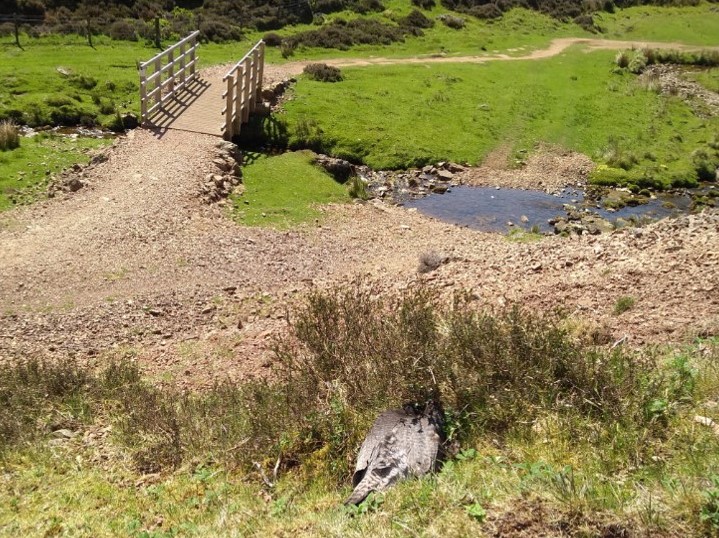
Earlier this month we blogged about the discovery of a dead peregrine in the Pentland Hills Regional Park just south of Edinburgh (see here). The dead adult male, part of a breeding pair, had been found in May and toxicology results confirmed he had been killed with a highly toxic banned poison, capable of killing a human.

[Photo of poisoned peregrine found dead next to footpath]

There was widespread concern that Police Scotland hadn’t bothered to mention this illegal poisoning incident for many months (not until prompted to do so by us). Given the toxicity of the posion and the frequency with which the public use the footpath where the poisoned bird was found, this silence was unacceptable.

The illegal killing of the peregrine is just the latest in a growing list of wildlife crime incidents uncovered close to grouse moors in the Pentland Hills. In addition to the poisoned peregrine and the subsequent disappearance of its mate and chicks in the nest, other incidents include a raven that was found shot dead on its nest, a merlin’s nest that had been shot out, and a satellite-tagged golden eagle (Fred) who had ‘disappeared‘ in highly suspicious circumstances.

It could be argued that there is political gain to be had from keeping quiet, especially at a time when the Scottish Government-supported South Scotland Golden Eagle Project is underway and project partners SNH are keen to pretend that raptor persecution “is no longer an issue” in the area, despite overwhelming evidence to the contrary.

In addition to the incidents in the Pentland Hills, elsewhere in south Scotland there’s Raeshaw Estate, currently operating under a General Licence restriction and an Individual Licence restriction, due to evidence of alleged ongoing raptor persecution (here); there’s a forthcoming prosecution of a gamekeeper in the Borders for a long list of alleged wildlife crime (here); there’s the land managed for driven grouse shooting in South Lanarkshire (close to the golden eagle translocation area) where over 50 confirmed reported incidents of dead raptors and poisoned baits have been recorded since 2003, including a shot golden eagle in 2012 (it didn’t survive, here), the reported shooting of a short-eared owl in 2017 (here), the reported shooting of a hen harrier in 2017 (here), and the reported shooting of a buzzard in 2018 (here); and then there’s been at least four raptor poisonings in south Scotland this year alone (here), five if you include the Pentlands peregrine.

Fortunately not all MSPs are content to remain silent on this issue. Alison Johnstone MSP (Scottish Greens) spoke out earlier this month when news broke of the poisoned peregrine, stating that she would be asking questions of the Scottish Government’s failure to protect birds of prey (see here). She’s as good as her word. Alison has since lodged several Parliamentary questions as follows:

S5W-19574: To ask the Scottish Government, in light of the reported recent cases of illegal raptor persecution, what action it is taking to address wildlife crime in the Pentland Hills Regional Park.

S5W-19575: To ask the Scottish Government what assessment it has made of the risk to (a) the public and (b) wildlife of the use of banned poisons in the countryside, and what action it is taking to address this issue.

S5W-19576: To ask the Scottish Government, in light of it attracting an estimated 600,000 visitors annually, what its response is to reports that the public was not advised about the presence of a highly toxic banned poison in the Pentland Hills Regional Park

Expected answer date for all three questions is 7 November 2018.

Well done, Alison, and thank you.

Red kite shot in Ashwell, Hertfordshire

Press statement from Hertfordshire Constabulary (25 Oct 2018):

Red kite shot in Ashwell

Officers from Hertfordshire Constabulary’s Rural Support Team are currently investigating the shooting of a Red Kite.

The injured bird was spotted by a local gamekeeper on a bridleway called Green Lane, just off Northfields Road in Ashwell, on Saturday September 29. However he was unable to catch it until October 3. He then took the bird to a local vet where x-rays indicated that it had been shot and had also sustained broken wings. Sadly, it was therefore put to sleep.

Officers are appealing for anyone who has any information about the bird and its injuries to contact them as soon as possible.

Detective Constable Amanda Matthews said: “The reintroduction of Red Kites has been a fantastic success story and the expansion of the population into Hertfordshire and Bedfordshire has allowed more people to see these amazing birds.

The persecution of birds of prey is a National Wildlife Crime Priority and we treat all incidents of this nature very seriously. We are therefore urging people to come forward with any information that could assist us to progress this matter.

Anyone who has any information about the incident is asked to contact DC Amanda Matthews via the non-emergency number 101, quoting reference 41/47461/18. You can also report information online.

Alternatively, you can contact the independent crime-fighting charity Crimestoppers anonymously on 0800 555 111 or through their anonymous online form. No personal details are taken, information cannot be traced or recorded and you will never need to go to court.

ENDS

Full credit to the gamekeeper whose persistence enabled this critically-injured kite to be put out of its misery.


Buzzard caught in illegally-set trap near Moy

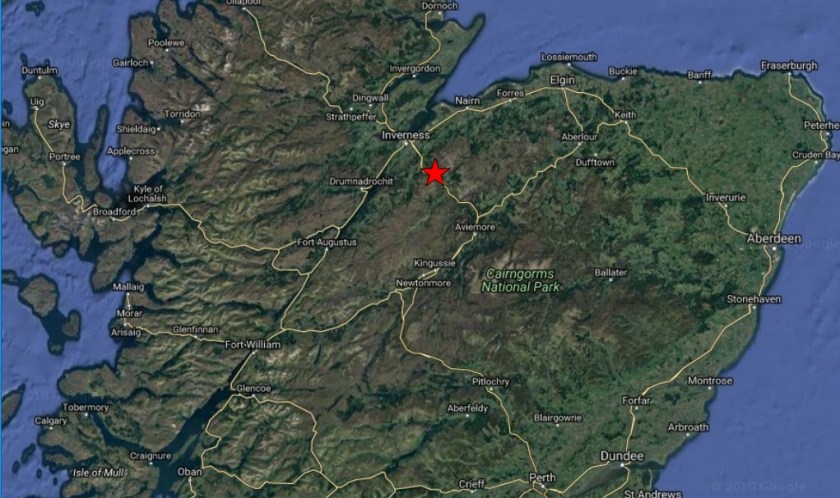
Once again, we’re having to report on the deliberate persecution of a protected bird of prey in the Moy area of Highland Scotland, a well-known raptor persecution hotspot.

RPUK map showing location of Moy:

Police Scotland has issued the following appeal for information this morning:

Appeal after buzzard reported trapped south of Inverness

Police Scotland can confirm that an investigation is ongoing following a report of a trapped buzzard near Moy south of Inverness.

The buzzard was discovered by a member of the public earlier in October. However, following a subsequent search of the area by police the bird has not been located.

The trap was close to a fence near to a rough, marshy grazing area close to the B9174 and the national cycle path between Moy and Craggie.

Inspector Mike Middlehurst said: “This unfortunately appears to be an example of deliberate unlawful use of a legal trap to cause suffering to a bird of prey.

A lot of good work has been done in the Highlands and this has been a good season for raptors locally, so any evidence of continued persecution is disappointing.

The location next to the national cycle network path will hopefully help us identify anyone seen acting in a suspicious manner in the area.

Anyone seen near the fence lines, walking up the fence lines, placing articles on the fence posts would be of great interest to us.

We are appealing for anybody who has information about this incident or any other wildlife persecution in the Highland area contact us on 101 or Crimestoppers on 0800 555 111.”

ENDS

The road number cited in the police press release appears to be inaccurate. The police say it is the B9174 but it looks like this should read the B9154 as this is the road that runs between Moy and Craggie.

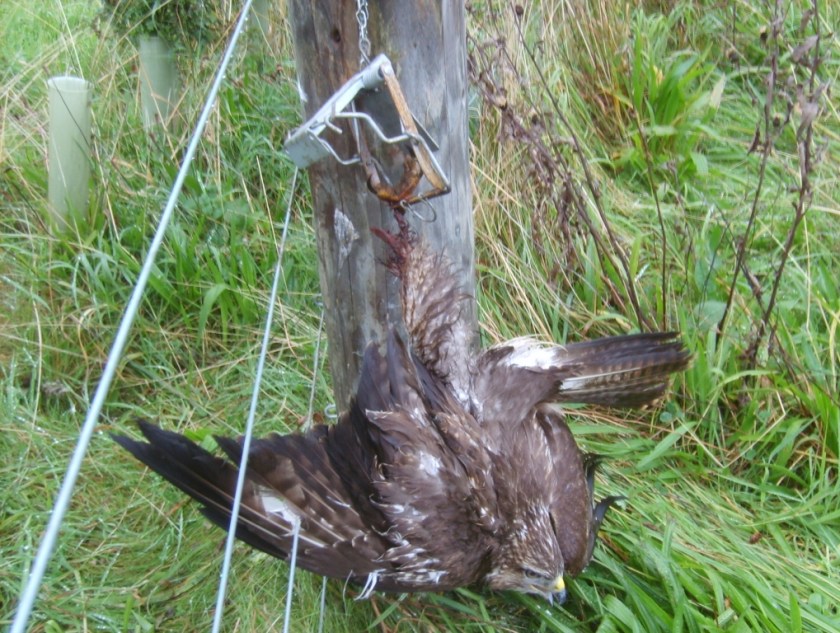
Interestingly, Police Scotland has not published the pictures of the trapped buzzard, photographed by the member of the public who found the bird in distress. However, from the police press release, especially the penultimate sentence, it seems reasonable to conclude that this buzzard was caught in a pole trap. A pole trap is a spring trap that has been fixed to the top of a post. When a bird lands on it, the jaws of the trap smash the birds legs, often breaking them. As the trap is fixed to the post, the bird cannot fly away and it is left to dangle upside down, held by its legs, until it dies or until the trap operator comes along and kills it.

Here’s a photo from our archives of another buzzard that had been caught in a illegal pole trap. It didn’t survive its horrific injuries.

These are barbaric devices that cause immeasurable suffering and as such have been banned from use since 1904. However, pole traps are still routinely used as a weapon of choice on game-shooting estates as we see all too often (e.g. see here, here, here, here, here, here). Anyone caught using these traps deserves a lengthy custodial sentence. There is simply no excuse for such savagery in 21st Century Scotland.

We’ve blogged about raptor persecution in the Moy area many many times, including the illegal use of traps and reports of armed masked gunmen visiting the nest sites of protected species. Here are a few examples: here, here, here, here, here and just last year there was a report of another buzzard that had been caught in an illegally-set trap in this area (here).

[RPUK map showing the B9154 road between Moy and Craggie. The red dots are confirmed raptor persecution incidents in this area]

And of course, this grouse moor dominated area has also been identified as one of the hotspot areas where satellite-tagged golden eagles ‘disappear’:

Responses to missing hen harrier Mabel

We learned about the suspicious disappearance of satellite-tagged hen harrier Mabel on Thursday (here), the same day we learned about the suspicious disappearance of satellite-tagged hen harrier Thor (here).

As usual, we’ve been tracking the official responses of the so-called partners in the Raptor Persecution Priority Delivery Group (RPPDG), which was established in 2011 and one of its main objectives is to raise awareness of illegal raptor persecution.

Yesterday we blogged about the official statements made by ‘partners’ in response to Thor’s disappearance near a grouse moor in the Bowland AONB (here). These statements were made by the Northern England Raptor Forum (NERF), Police Supt Nick Lyall (new Chair of the RPPDG) and Amanda Anderson of the Moorland Association (although Amanda still hasn’t got around to publishing her brass necked statement on the MA website).

[Hen harrier Thor, by Steve Downing]

At the time of writing this, there are no official response statements about Thor on the websites of the other RPPDG ‘partners’ including the National Gamekeepers Organisation, Countryside Alliance and BASC. No surprises there, silence has become the norm in these situations (e.g. see here, here, here, here), even though these groups have signed up to raise awareness of this PRIORITY crime.

So how about official responses to the disappearance of hen harrier Mabel who vanished close to a grouse moor on the boundary of the Yorkshire Dales National Park and the Pennines AONB?

At the time of writing we’ve only seen one response, from NERF. It’s well worth a read (here).

As for the rest of the ‘partners’, well their continued silence speaks volumes.

Responses to missing hen harrier Thor

Yesterday we were hit with the news of two missing hen harriers – ‘Thor’, a young bird tagged by the RSPB who disappeared in a wildlife crime hotspot in the Bowland AONB (here) and then later in the day, ‘Mabel’, a young bird tagged by Natural England who disappeared in a wildlife crime hotspot on the boundary of the Yorkshire Dales National Park and the North Pennines AONB (here).

So far there have been a couple of responses to Thor’s disappearance but nothing (yet) about Mabel.

[Hen harrier Thor, by Steve Downing]

NERF (Northern England Raptor Forum) has published a typically robust response on its website (here), pointing out the depressing predictablity of it all and highlighting the miserable performance of the Bowland AONB as an area designated as a Special Protection Area (SPA) for hen harriers.

Also quick to respond was Supt Nick Lyall, the new Chair of the Raptor Persecution Priority Delivery Group (RPPDG) which was established in 2011 as a ‘partnership’ to tackle raptor crime but so far has achieved absolutely nothing of any use.

Nick has only been in post for what seems like a couple of minutes but we’ve been impressed with his openness and his willingness to share his thoughts via his newly established blog. Yesterday evening he posted his response to the news of Thor’s disappearance – read it here.

He talks about his plans to run the first national raptor persecution workshop in November and he also discusses his previously-stated intention to break the silence of many RPPDG ‘partners’ on each raptor persecution case as it emerges, starting with Thor’s disappearance. We’ll come back to that. First we wanted to look at what he had to say about Thor.

It’s a cautiously written piece:

While it hasn’t been confirmed that this is a result of persecution, the circumstances will naturally lead people to believe this to be the case. I say this because the disappearance has occurred in a location where other hen harriers, namely Hope and Sky also disappeared without trace a few years ago under almost identical circumstances“.

He’s right not to look at Thor’s disappearance as an isolated case and to put it in to context with the disappearance of two other hen harriers (Sky & Hope) who both vanished in the same small area in 2014. However, that’s not the only reason we believe Thor’s ‘disappearance’ is as a result of persecution. Our perspective is wider and we place Thor’s disappearance in the context of all the other young hen harriers that have disappeared in suspicious circumstances on or close to driven grouse moors, time and time and time and time and time and time and time and time and time and time and time and time and time and time and time and time and time and time and time and time and time and time and time and time and time and time and time and time and time again.

There is abolutely no doubt whatsoever about what’s going on here – it is serious and organised crime on a massive scale across the uplands of England, Wales and Scotland. The map below shows just a fraction of the scale in one small region of the UK. No sooner do these young birds fledge and leave their natal area, they are killed. It’s no wonder the English breeding population struggles to reach double figures when the next generation of potential breeders are so relentlessly destroyed. It’s also clear evidence why DEFRA’s ridiculous brood meddling scheme won’t work.

[RPUK map showing the last known locations of ‘missing’ Natural England satellite-tagged hen harriers in the Yorkshire Dales National Park, Nidderdale AONB and Bowland AONB. Red star = HH found dead & confirmed illegally killed; orange star = last known location of missing hen harriers; Black star: missing hen harrier but grid reference withheld by Natural England; orange stars 1, 2 & 3 = last known locations of RSPB-tagged hen harriers Hope, Sky and Thor; Purple star last known location of hen harrier Mabel].

Nick did manage to get statements from two of the RPPDG ‘partners’ – NERF and the Moorland Association. He says he will update his blog as other responses come in.

The statement from the Moorland Association’s Director, Amanda Anderson, deserves special attention:

We join this appeal without hesitation and it is vital the police receive any possible information. This year we have been hugely encouraged by the best hen harrier breeding season in a decade and the fact that 60% of this year’s successfully fledged chicks had help from gamekeepers. At this stage it is not known if anything has happened to Thor beyond that the tag has stopped transmitting. It is widely recognised that that there is a high natural mortality rate for young hen harriers with only two out of every ten expected to survive their first year. We all know that collaboration is the key to successful conservation. As such, enhanced transparency and greater sharing of satellite tag data from the outset of birds’ lives would be a huge step in the right direction“.

It’s a masterclass in deflection and brass neck. She paints a picture that Thor is probably ok and it’s just that his tag has stopped working and besides natural mortality is expected, but that if anything had happened to him it wouldn’t be anything to do with gamekeepers because they’ve played such a big role this year in the successful fledging of some hen harriers.

She ignores the possibility that Thor’s disappearance might be linked to illegal persecution. She ignores the long history of hen harriers vanishing in suspicious circumstances on or near driven grouse moors. She ignores the decades of scientific studies that show illegal persecution is the main factor threatening this species with breeding extinction in England and shrinking the Scottish population’s distribution. She ignores the fact that the majority of those convicted of killing raptors are gamekeepers. She ignores the fact that we’ve all seen the video evidence of what gamekeepers do to raptors when they think nobody is watching.

She then suggests that sharing satellite tag data would be a great idea. A bit like suggesting G4S should publish its timetables and routes for bank cash deliveries.

We note that Amanda’s statement hasn’t yet made it on to the Moorland Association’s website. The current news headline on that site reads: ‘Real progress being made in the fight against wildlife crime‘.

We’ll keep an eye on Nick’s blog during the day and see if any of the other RPPDG ‘partners’ can be bothered to comment.

Hen harrier Mabel ‘disappears’ near grouse moor on Yorkshire Dales National Park boundary

Hot on the heels of this morning’s news that satellite-tagged Hen Harrier Thor ‘disappeared’ in Bowland on 3 October (here), there’s now news of another one.

Hen harrier ‘Mabel’ hatched from the only nest in the Yorkshire Dales National Park earlier this year (you’ll remember, the nest that was declared by the Yorkshire Dales Moorland Group and the National Gamekeepers Organisation as being located on a grouse moor, when actually it wasn’t – see here). She was satellite-tagged by Natural England.

Mabel did a bit of travelling in to Teesdale but her last satellite tag fix came from the Little Smale Gill area, north of Ravenseat Moor, on 2 October 2018. You won’t be surprised to learn that the area is close to some driven grouse moors.

North Yorkshire Police have issued the following appeal for information:

Concerns raised following hen harrier’s disappearance

Concerns have been raised about the welfare of a hen harrier which may have gone missing along the North Yorkshire – Cumbria border.

[RPUK map showing last known location of hen harrier Mabel]

Female hen harrier Mabel was one of four chicks that fledged in July 2018 from a nest site in the Cumbrian area of the Yorkshire Dales National Park. Along with her sibling Tom, she was fitted with a satellite tag on 10 July by Natural England.

Since fledging, Mabel has been into Teesdale and wandered as far north as Allenheads, and also spent time around the Tan Hill area.

The transmitter functioned up until 2 October 2018, with the last signal being received from the Little Smale Gill area in Cumbria, north of Ravenseat Moor – but the bird could have been further afield when something happened to Mabel or the transmitter.

[RPUK map showing the grouse moor habitat close to hen harrier Mabel’s last known location]

Hen harriers are one of the UK’s rarest birds of prey, with just three successful nests recorded in England in 2017. Like all wild birds, they are protected by law under the Wildlife and Countryside Act 1981. However, despite full legal protection, their numbers remain consistently very low.

A search was conducted by Natural England staff but no tag or body was found. Cumbria Constabulary and North Yorkshire Police were informed, and are making enquiries.

Sergeant Stuart Grainger, of North Yorkshire Police’s Rural Taskforce, said: “I was lucky enough to spend some time monitoring Mabel’s nest site, and, despite following birds all my life, this was the very first time I’d ever seen a male or female hen harrier because they are so rare.

It is therefore particularly upsetting that one of the fledglings from the nest has inexplicably gone missing. I would urge anyone with information to come forward.”

PC Helen Branthwaite, Wildlife, Rural and Environmental Crime Co-ordinator at Cumbria Constabulary, said: “It is extremely worrying to hear of Mabel’s disappearance and that we are facing another enquiry into a missing hen harrier. With so few successful nest sites every bird that is lost has a severe impact on the conservation status of this rare bird.”

A spokesperson for Natural England said: “The sudden disappearance of the hen harrier, Mabel, is a matter of grave concern. We urge anyone with information to get in touch with North Yorkshire Police.”

Landowner farmer Andrew Brown said: “It was a pleasant surprise when Natural England staff knocked on my door and let me know these rare birds were likely to breed on my land.

The experience of watching them throughout the spring and early summer from building their nest to fledging four chicks was a real privilege.

NE gave me the chance to see them close up when they were satellite-tagged, and it was an honour to name the tagged birds Mabel and Tom after my grandparents. It is such a shame that something may have happened to Mabel. NE were keeping me regularly updated about Mabel and Tom’s whereabouts, and I was looking forward to hopefully welcoming them back next year.”

David Butterworth, Chief Executive of the Yorkshire Dales National Park Authority, said: “There was delight from all right minded people when four hen harrier chicks fledged earlier this year in the National Park. That has been matched by the despair felt that one of the birds, Mabel, has now gone missing.

The North of England has an unenviable reputation for criminal activity in terms of raptor persecution, so it’s hard not to think the worst in this case. However, for the moment we would strongly support the efforts of North Yorkshire and Cumbria Police to find Mabel, and would urge anyone with information to contact the police as soon as possible.

Anyone with any information about the hen harrier’s disappearance should contact North Yorkshire Police on 101. Alternatively, speak to the RSPB in confidence, by calling the Raptor Crime Hotline on 0300 999 0101.

ENDS

This amounts to blatant and relentless criminality. It’s happening at such a scale that it should now be defined as serious and organised crime.

[RPUK map showing the last known locations of ‘missing’ Natural England satellite-tagged hen harriers in the Yorkshire Dales National Park, Nidderdale AONB and Bowland AONB. Red star = HH found dead & confirmed illegally killed; orange star = last known location of missing hen harriers; Black star: missing hen harrier but grid reference withheld by Natural England; orange stars 1, 2 & 3 = last known locations of RSPB-tagged hen harriers Hope, Sky and Thor; Purple star last known location of hen harrier Mabel].

Here’s the definition of serious and organised crime from the National Crime Agency:

Serious crime planned, coordinated and conducted by people working together on a continuing basis. Their motivation is often, but not always, financial gain‘.

At last week’s wildlife crime conference in London political leaders, including our own, made a commitment to tackle the illegal wildlife trade as ‘a serious crime carried out by organised criminals’ (see here).

How bloody hypocritical when those same political leaders remain wilfully blind to the serious and organised wildlife crime happening on their own doorstep.

It’s abundantly clear to anyone with just a passing interest that the Westminster Government’s vested interests are preventing determined action against these criminals, aka The Untouchables.

UPDATE 20 October 2018: Responses to missing hen harrier Mabel (here)