New independent report reveals locations of poisoned raptors in northern England, 2015-2023 – information that has been suppressed by government

Press release from independent group, Wildlife Poisoning Research UK, 15th November 2025.

WHERE THE POISONED BODIES WERE FOUND!

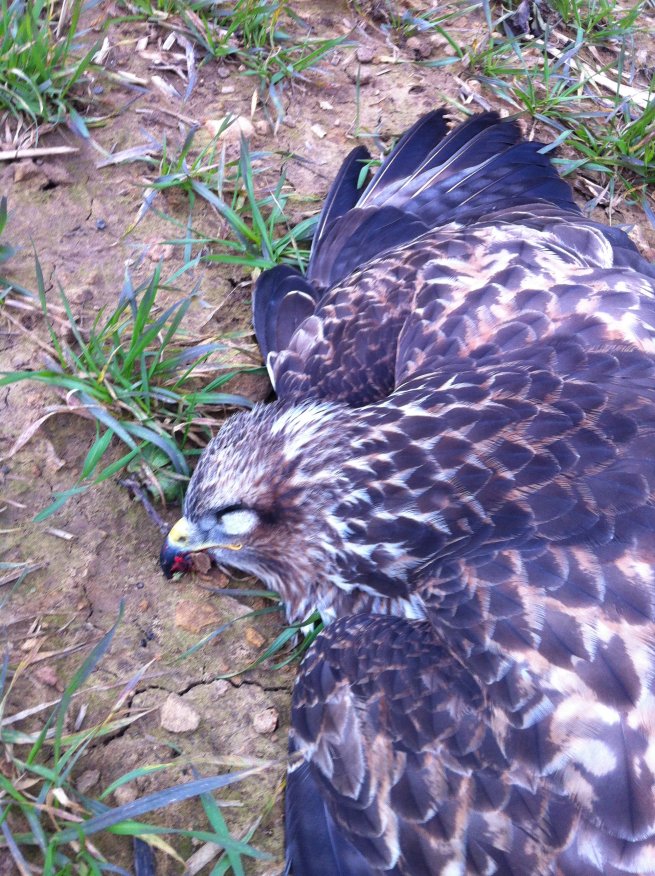
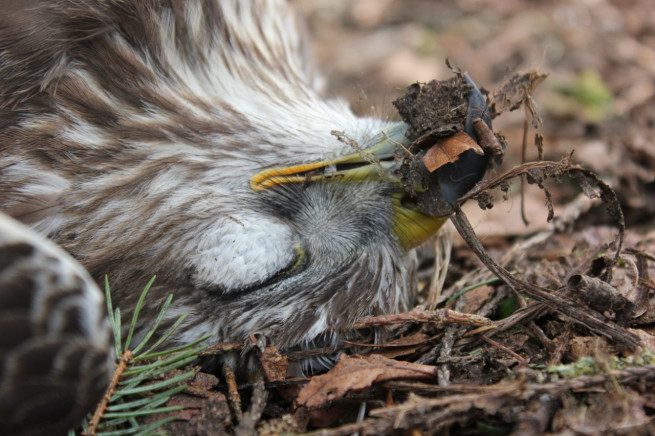
Many people probably imagine that the use of poisons to kill protected wildlife is something out of the pre-Victorian era, like cock fighting and bull baiting.  However, this senseless and cruel slaughter is still happening in Britain, with many mammals and birds of prey suffering horrific and agonising deaths, even though this practice has been banned since 1911.

It is a crime which not only kills wildlife, but also kills much loved family pets and can even kill people.  This is a wildlife crime that frequently occurs on remote and private land where the chance of detection is very low and most victims are never found.  Those cases which are reported and then investigated must be considered to be a very small tip of a very large ‘iceberg’ of sickening rural felonies.

An illegally poisoned Red Kite (photo via WPRUK)

In 2017, in an attempt to combat this wildlife crime, the UK Government initiated a project to map incidents of illegal bird poisonings.  This provided information to the public and other interested parties as to where these crimes were taking place and it was intended that these maps would be updated annually to “provide an invaluable intelligence tool to help fight crimes against birds of prey” (Defra press release 2017).

It now appears that these wildlife poison crime maps have not been updated and there is very little governmental action informing the public that these crimes are still occurring and wildlife is still being deliberately poisoned.

Wildlife Poisoning Research UK (WPRUK) works to place information about the environmental impact of pesticides, biocides and other toxic chemicals into the public domain so that the general public and the media have a better understanding of this situation.  Data on cases of deliberate poisoning of birds has been obtained using Freedom of Information requests.  This has enabled WPRUK to produce maps showing where these poisoned birds have been found.  This is information which the Government, for whatever reason, has now apparently declined to put into the public domain.

WPRUK has now released a report pinpointing where the poisoned birds have been found in Northern England.  Future maps will cover other parts of the UK.

Between 2015 to 2023, the bodies of 73 legally protected birds, mostly birds of prey, were found in Northern England.  These birds had been illegally and deliberately killed using poisons; 31 birds being Schedule 1 Wildlife and Countryside Act (1981) species, which have the highest level of protection.  Due to the very small chance of poisoned birds being found, the real numbers of birds being killed by this criminal activity is likely to be far higher.  To date, no one has been convicted for killing any of these 73 birds.

There were two areas in Northern England where particularly high numbers of poisoned birds were found.  These were Nidderdale in North Yorkshire and the Glapwell area in Derbyshire.

Releasing the report, Dr Ed Blane from WPRUK said: “The fact that 114 years after this sickening practice was banned, individuals are still poisoning our wildlife is deeply disturbing.  People visit the countryside to enjoy nature and they will be truly alarmed to learn that poison is still being used to kill wildlife.”

If this continues it might severely impact on plans to re-introduce white tailed eagles to Northern England.  In the Southern England eagle project, at least 2 birds have been killed by poison.

A comment from Steve Downing Chairman Northern England Raptor Forum:

We proudly, and rightly, identify ourselves as a nation of nature lovers.  Every year tens of thousands of tourists, both domestic and foreign, visit the historic and beautiful countryside throughout the North of England to enjoy the scenery and stunning birds of prey that it supports.  Collectively they spend £millions supporting our rural communities.  What the visitors don’t see is the underbelly of criminality in the countryside where the barbaric practice of deliberately poisoning raptors persists today, as highlighted by the bodies found in Nidderdale, North Yorkshire and around Glapwell in Derbyshire.  Thanks to Ed, a spotlight is being shone on this shocking pernicious activity raising public awareness of the danger presented by these lethal poisons, both to themselves and local birds of prey.

Bob Elliot CEO of Wild Justice said:

Illegal wildlife poisoning hasn’t faded into history; it’s still being carried out in the shadows with very little oversight.  These findings show that wildlife species are still being killed with impunity, and the public is being kept in the dark about the scale of it.  Without transparency, enforcement and the political will to confront those responsible, this criminal abuse of our countryside will continue unchecked.

ENDS

The report can be read / downloaded here:

29 ‘missing’ Hen Harriers & nearly 40 birds of prey poisoned, trapped or shot in Yorkshire Dales National Park since 2015

Media attention has been drawn to the Yorkshire Dales National Park this week, following the RSPB’s press release on the suspicious disappearance of a satellite-tagged Hen Harrier named ‘Sita’.

When it comes to the illegal killing of birds of prey, the Yorkshire Dales National Park is rarely out of the news, and that’s hardly surprising when 29 satellite-tagged Hen Harriers have gone ‘missing’ there and 39 other raptors have been found poisoned, trapped or shot there since 2015, including Peregrines, Hen Harriers, Red Kites and Buzzards.

Yorkshire Dales National Park. Photo by Ruth Tingay

Given these appalling figures, the RSPB has described the Yorkshire Dales National Park as a ‘no-fly zone for birds of prey’.

High profile cases within the National Park have included the conviction of a gamekeeper who was filmed shooting two Short-eared Owls on a grouse moor and then stamping the corpse of one of them into the peat and shoving the other one inside a drystone wall (here); a gamekeeper filmed on a grouse moor using a tethered Eagle Owl to attract Buzzards that he then shot and killed from close range (here); the stamping to death of four Hen Harrier chicks in a nest on a grouse moor (after obscuring the camera pointing at the nest, here); the grisly death of a Hen Harrier caused by his head and leg being pulled off whilst he was still alive (here); and three individuals caught on camera on a grouse moor discussing the shooting and killing of a Buzzard and a Raven before apparently shooting and killing a Hen Harrier (here) – one gamekeeper has been charged with conspiracy to kill a Hen Harrier, he has pleaded not guilty and his case will proceed to trial in January 2026 after his barrister failed in his attempt to have the case thrown out on a legal technicality.

The Yorkshire Dales National Park Authority has also long recognised the extent of this criminal activity and has responded to public concern (e.g. see here and here). Earlier this year the Park Authority terminated its five-year ‘partnership’ with the grouse shooting industry to tackle these crimes, after recognising the futility of this endeavour. Two conservation organisations (the RSPB and the Northern England Raptor Forum) had already walked away from the sham in 2023 and 2024 respectively.

In an article published a couple of days ago by the Craven Herald & Pioneer, Mark Corner, a member of the Yorkshire Dales National Park Authority is quoted saying the continued illegal killing of raptors in the Park was “a crying shame“.

He added: “As the member champion for the natural environment, I’m personally embarrassed that we are the worst spot in the country in terms of the illegal killing of birds.”

In the same article, there’s an hilarious quote from the Yorkshire Dales Moorland Group, which is one of a number of regional groups set up in 2015 to represent local grouse moor owners and their gamekeepers in an attempt to counter the bad publicity about ongoing illegal raptor persecution. I think that members of most of these regional moorland groups have been, or still are, the subject of police investigations into illegal raptor persecution.

A spokesperson for the Yorkshire Dales Moorland Group reportedly told the reporter that ‘hen harrier numbers were at a 200-year high across the uplands’.

That’s simply not true – Hen Harrier breeding attempts on grouse moors across the north of England have been in sharp decline over the last two years – the only areas where they remain stable is on land managed for conservation rather than for Red Grouse shooting.

According to its FaceBook page, the Yorkshire Dales Moorland Group claims to have “around 100,000 acres of managed uplands here in the Dales where the estates are members of this group (virtually all of the moors)“.

Why is it then, there were only two Hen Harrier breeding attempts in 2025 across the whole of the Yorkshire Dales and neighbouring Nidderdale? I’d like the Moorland Group to provide a plausible explanation for these absences.

The Yorkshire Dales Moorland Group also told the Craven Herald reporter:

Our keepers have and will always assist the police in searches for missing persons, lost dogs or missing birds. Tag failure is rare but not unheard of.

The default accusation that persecution is responsible is regrettable. The conservation work undertaken by moor keepers is commendable as can be seen by the abundance of raptors and other rare species in the Dales“.

What “abundance of raptors” are those then? All the dead ones? Or just the ones that are allowed to breed because they don’t pose any threat to Red Grouse stocks?

And if these grouse shooting estates are so keen to help the police, how many of them signed the letter last year agreeing to allow the police to enter the land and use equipment for the purposes of crime prevention and detection? Did any of them sign it?

And if these gamekeepers are so keen to help police investigations, how many of them have given ‘no comment’ responses when interviewed about suspected raptor persecution crimes on these moors? Maybe it’d be quicker to count how many gamekeeper didn’t give a ‘no comment’ interview.

The article also quotes Alex Farrell, Head of Uplands at BASC:

As a committed conservation organisation, we are taking progressive steps with our partners to oversee the continued recovery of hen harriers.

Figures released by Natural England today show that collaborative effort resulted in 106 fledged hen harrier chicks in England this year – up from 80 last year“.

What “progressive steps” is BASC taking?

Oh, and those figures released by Natural England show that the small increase in Hen Harrier fledging rates are in spite of, not because of, any so-called ‘collaborative effort’ from the grouse shooting industry.

The data couldn’t be any clearer (see here).

Thousands of gamebirds culled at breeding facility in N Yorkshire after bird flu outbreak

The number of outbreaks of Highly Pathogenic Avian Influenza is showing no sign of slowing down, with the latest flurry of cases reported in Yorkshire and County Durham.

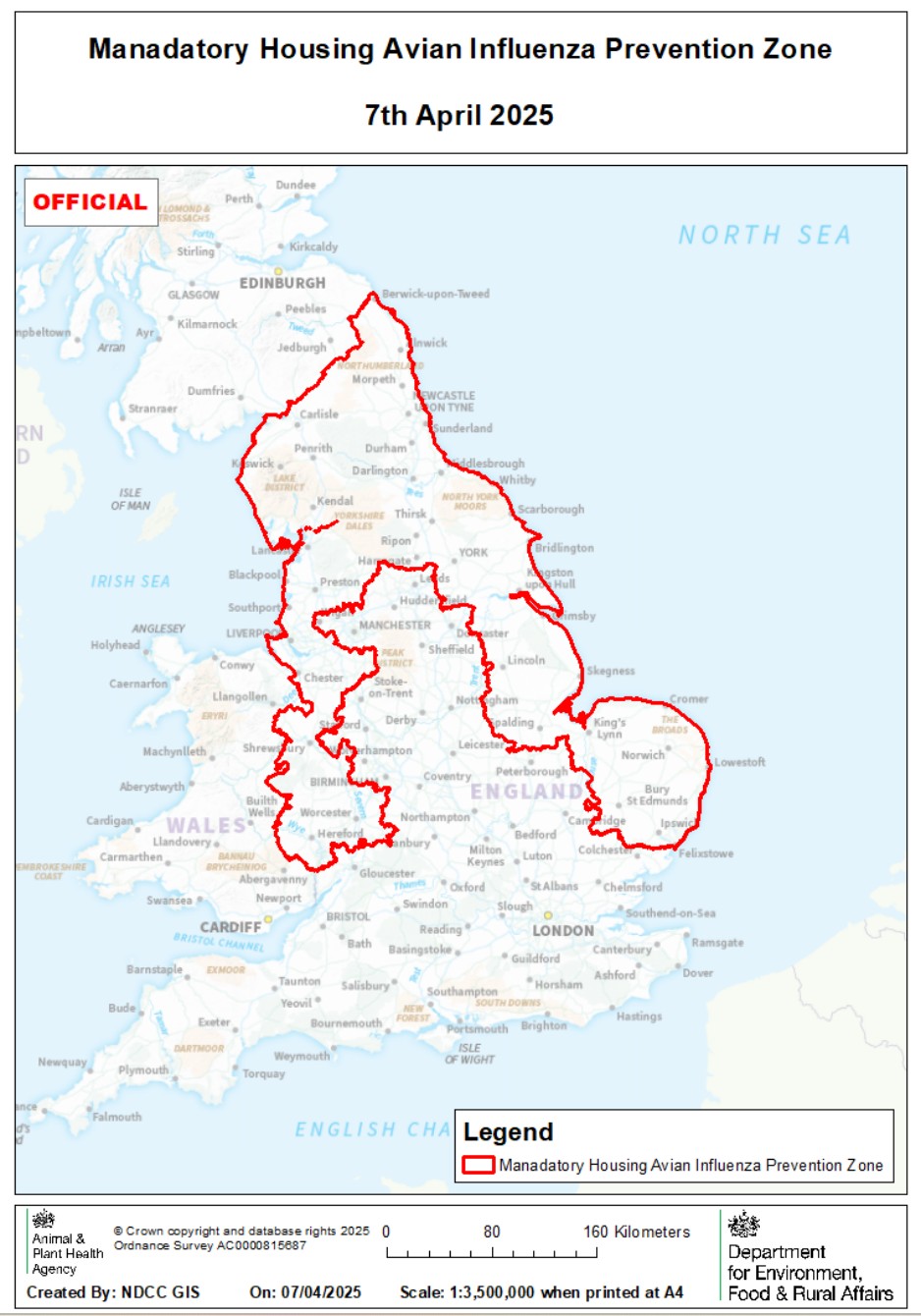
So much so that from today (7th April 2025), the regional Avian Influenza Prevention Zone (AIPZ) mandating enhanced biosecurity and housing for kept birds currently in force across Cheshire, City of Kingston Upon Hull, East Riding of Yorkshire, Herefordshire, Lancashire, Lincolnshire, Merseyside, Norfolk, North Yorkshire, Shropshire, Suffolk, Worcestershire and York has now been extended to cover the following counties:

Cumbria, County Durham, Northumberland, Tyneside.

One of the recent outbreaks reported in North Yorkshire caught my eye. Here’s the report of a case on 30 March 2025:

Highly Pathogenic Avian Influenza (HPAI) H5N1 was confirmed in commercial poultry and other captive birds at a premises near Pickering, Thirsk & Malton, North Yorkshire (AIV 2025/37).

A 3km protection zone and 10km surveillance zone have been declared around the premises. All affected birds on the premises will be humanely culled‘.

The grid reference given for the centre of the protection zone (i.e. the location of the H5N1 outbreak at the centre of the blue circle) is given as: SE7592387464.

This appears to be Westfield Farms, Cropton Lane, Pickering, just on the border of the North York Moors National Park.

Sound familiar?

In 2015 the owner of Westfield Farms, where pheasants, red-legged partridges and ducks are bred and reared to be sold for gamebird shooting was convicted of permitting the use of a pole trap at his game farm after the RSPB filmed him driving past and appearing to look in the direction of a pole trap set above a rearing pen.

Pole traps have been banned since 1904. It’s a barbaric way to kill any animal and causes horrendous suffering and distress, often over a period of many hours. A spring trap is placed on a post where a bird of prey is likely to perch. When the bird lands on the ‘plate’, the trap springs shut on the bird’s legs. When the bird tries to fly off, it ends up dangling upside down because the trap is attached to the post by a chain to prevent it from being carried away. The bird remains dangling, often with severe injuries, until its ultimate demise.

The game farm owner had denied any knowledge of the pole trap but after viewing the RSPB’s footage, magistrates said it was “inconceivable” that he wouldn’t have seen it. In addition to his conviction for permitting the use of a trap, two of his staff were cautioned by police after a total of five set pole traps were found at the game farm (see here).

North Yorkshire Police collecting one of five illegally-set pole traps at Westfield Farm. Photo: RSPB

However, the game farm owner’s conviction was quashed on appeal later that year after judges at York Crown Court declared that “the prosecution had failed to prove its case” (i.e. that the game farm owner had seen the illegal trap) – see here.

Sign at Cropton last week (supplied by RPUK blog reader). Spot the pheasant!

Hunt saboteurs disrupt Inglorious 12th grouse shoot on Wemmergill Estate, Co Durham

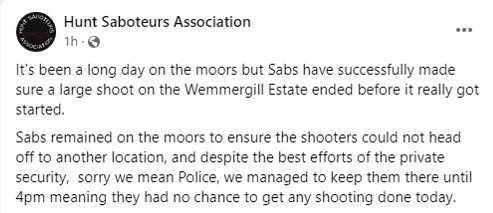
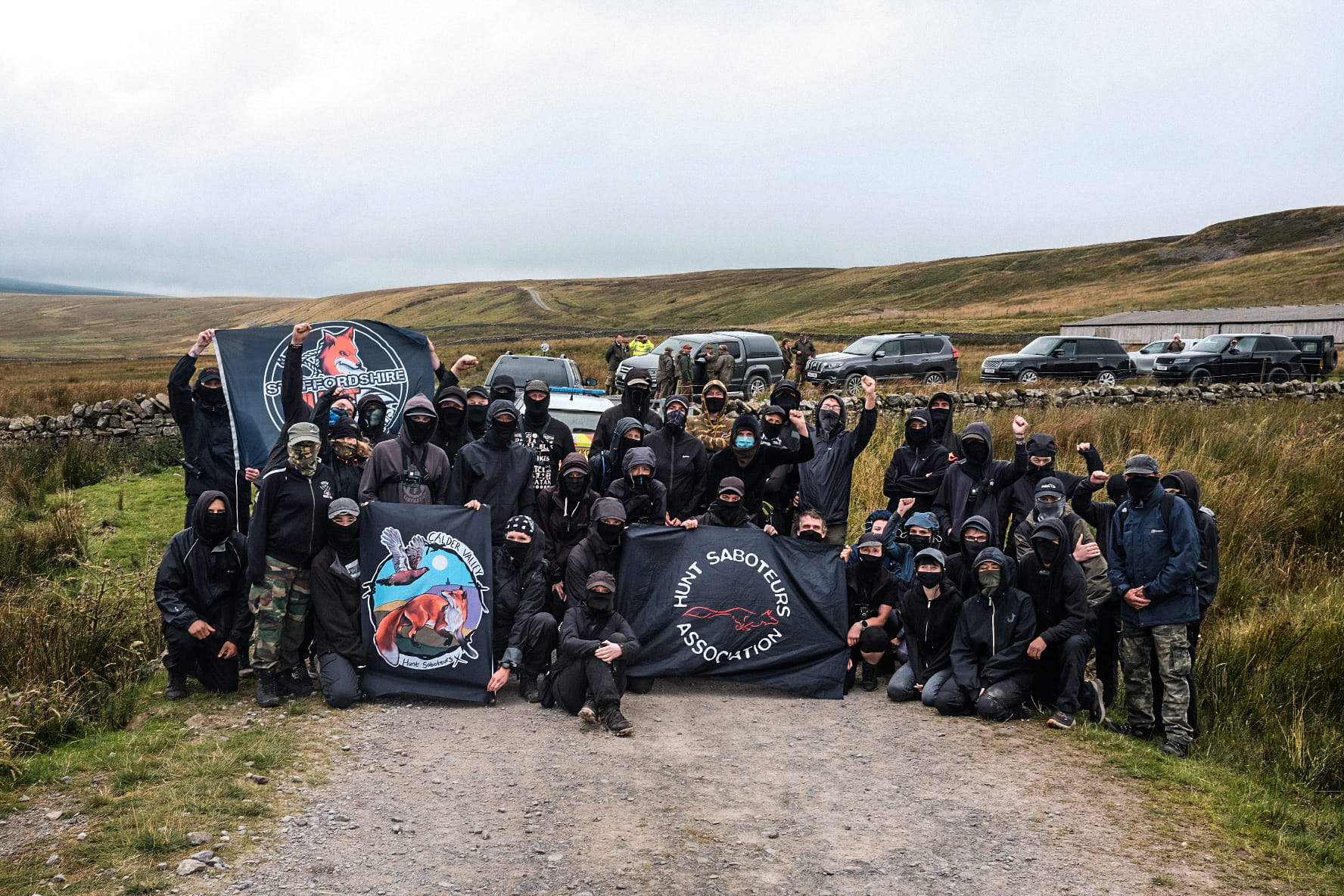
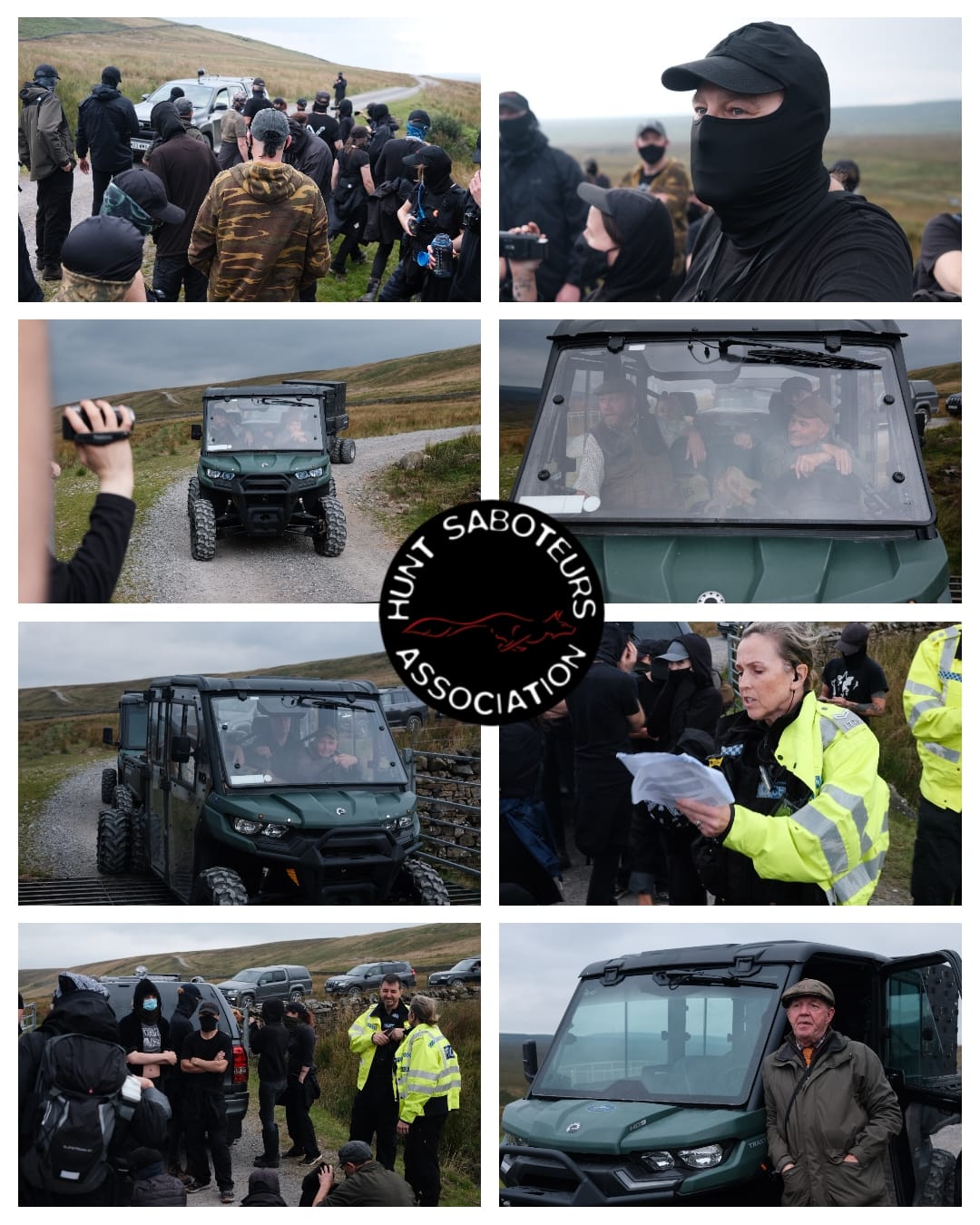
As they’ve done in previous years (e.g. see here), members of the Hunt Saboteurs Association were out in force today in northern England to disrupt grouse shooting on the Inglorious 12th.

Today they were on the Wemmergill Estate in County Durham. If Wemmergill sounds familiar it’s because it’s previously featured on this blog (here, here and here) and on Mark Avery’s blog (here).

Here’s what the Hunt Sabs got up to today:

Further details on the Hunt Sabs’ website here.

I wonder if they’ll be out again this week and if so, where…?

UPDATE 17 August 2024: Hunt Saboteurs disrupt grouse shoot on Stean Moor in Nidderdale, North Yorkshire (here)

Multi-agency searches in raptor poisoning hotspot in Derbyshire

Multi-agency searches were conducted last week at a raptor-poisoning hotspot in Derbyshire.

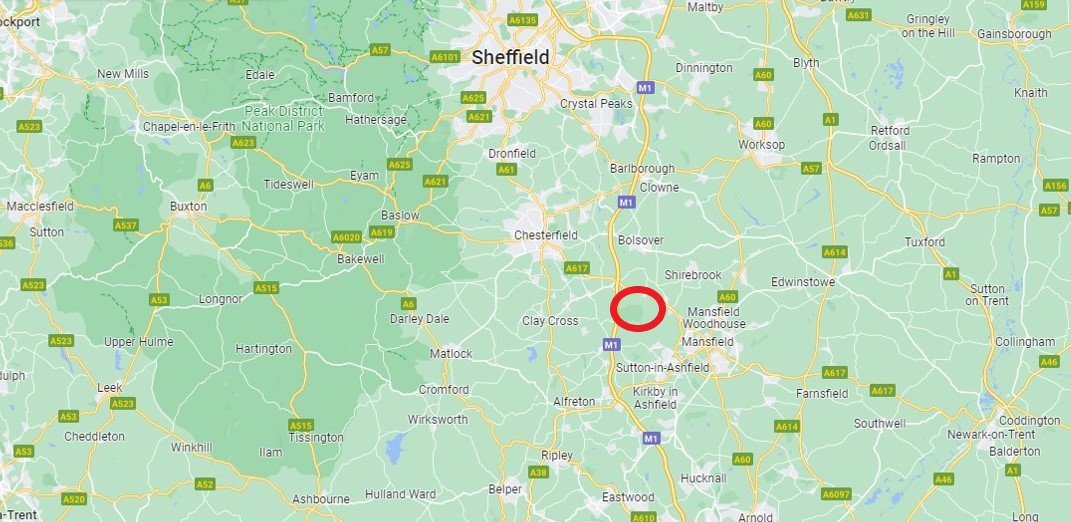
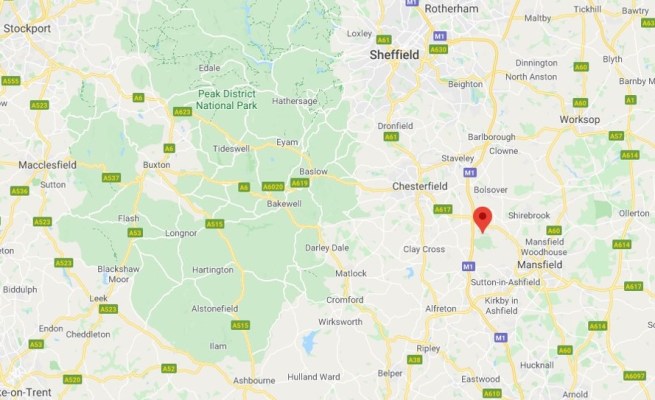
Since 2015, at least eight illegally poisoned birds of prey including buzzards and kestrels, as well as poisoned pheasant baits, have been uncovered on farmland in the Glapwell / Ault Hucknall / Rowthorne / Pleasley area of north east Derbyshire. Toxicology analysis has confirmed they were killed by the poisons Aldicarb and Alphachloralose (see here).

[A dead buzzard found in the area. Photo by Derbyshire Constabulary]

Last week police officers from Derbyshire Police’s Rural Crime Team were joined by staff from the RSPB Investigations Team, Natural England and the National Wildlife Crime Unit to undertake a series of land searches. A number of follow-up investigations are now continuing as a result of those searches.

Derbyshire’s Rural Crime Team posted the following statement on Facebook yesterday:

Consider this post both an appeal for information and a public safety warning.

Over recent years there has been a concerning number of dead buzzards found to have died as a result of poisoning on land around the Glapwell / Ault Hucknall / Rowthorne / Pleasley area.

In response to this issue, last week Derbyshire Rural Crime Team, RSPB Birders , the NWCU and Natural England were involved in a day of action in the area. Land searches were conducted and other lines of enquiry pursued in what proved to be a very positive day.

Clearly these beautiful birds are being targeted. Killing birds of prey in any way is ILLEGAL but laying poison on land that can be easily accessed by the public poses a significant risk to public safety.

When out and about, should you find anything suspicious it is important that you contact the Police immediately. DO NOT touch or handle anything and do not let children or animals go near.

If you have any information that may aid this enquiry please contact Derbyshire Rural Crime Team’.

This is the latest in a surge of multi-agency investigations in response to raptor persecution crimes over the last 14 months, including a raid in Suffolk on 18th January 2021 (here), another raid in Nottinghamshire in January 2021 (here, resulting in a conviction of a gamekeeper in 2022 here), a raid in Lincolnshire on 15th March 2021 (see here), a raid in Dorset on 18th March 2021 (here), a raid in Devon on 26th March 2021 (see here), a raid in Teesdale on 21st April 2021 (here), a raid in Shropshire on 2nd August 2021 (here), a raid in Herefordshire on 12th August 2021 (here), a raid in Norfolk on 14th September 2021 (here), a raid in Wales in October 2021 (here), a raid in Humberside on 10th December 2021 (here) and a raid in North Wales on 8th February 2022 (here).

Buzzard & kestrel confirmed illegally poisoned in Derbyshire

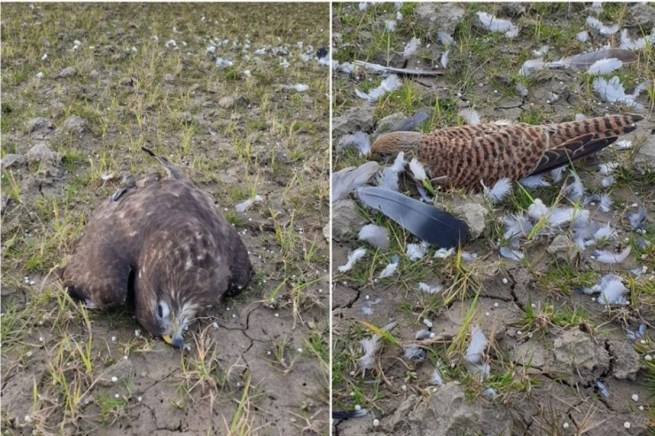
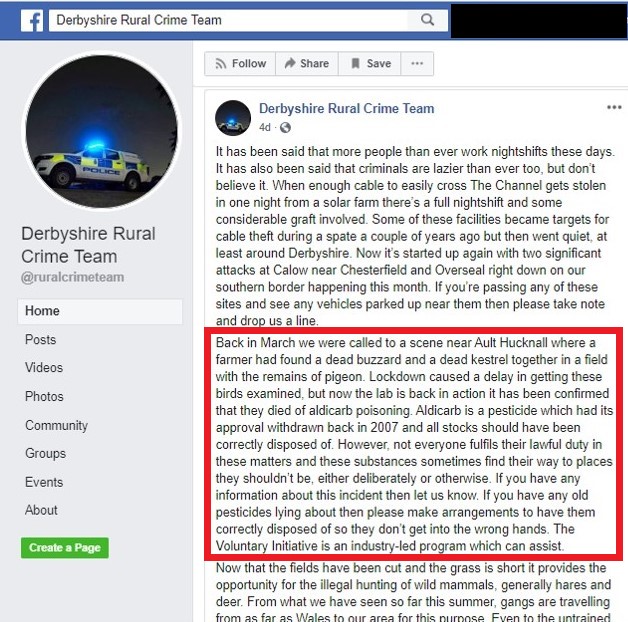
In March 2020, just after the start of lockdown, Derbyshire Constabulary reported the suspected poisoning of a kestrel and a buzzard, both found dead next to the remains of a pigeon at Ault Hucknall near Chesterfield (see here).

[Photo via Derbyshire Constabulary]

Samples were sent for toxicology analysis and last week the police received the findings. Both birds had been illegally poisoned with the banned pesticide Aldicarb.

This news was published on the Rural Crime Team’s Facebook page (see below). We haven’t been able to find any further news reports, for e.g. on the Derbyshire Constabulary website or in the local press.

These latest illegal poisonings are not the first in this area. A total of six buzzards were also illegally poisoned in neighbouring Glapwell between 2015-2016 (2 x buzzards, March 2015; 1 x buzzard & pheasant bait, February 2016; 3 x buzzards & pheasant bait, March 2016). Alphachloralose was the poison used in those cases.

[Some of the poisoned buzzards and a pheasant bait found at Glapwell in 2016, photos via RSPB]

There is a record of those poisonings in the RSPB’s 2016 BirdCrime report (here) and a short video, here:

It is quite clear that somebody in this area has access to banned poisons and is not afraid to set out poisonous baits that could kill anyone unfortunate to come in to contact with them, let alone wildlife and domestic animals and pets.

Let’s hope we see a continued publicity drive from Derbyshire Constabulary – these crimes warrant maximum awareness and exposure.

UPDATE 15th March 2022: Multi-agency searches in raptor poisoning hotspot in Derbyshire (here)

Cairngorms National Park Authority statement on hen harrier persecution

Hen harrier persecution is a National Wildlife Crime Priority and the population in Scotland has suffered a 27% decline in the last 12 years. Losing over a quarter of the population in such a short period is a significant conservation concern and as such, we expect a strong response from the authorities whenever these crimes are exposed.

Earlier this month we learned that two satellite-tagged hen harriers (Wildland hen harrier 1 and Wildland hen harrier 2) had ‘disappeared’ in suspicious circumstances on two grouse moors in September 2019, one within the Cairngorms National Park and one right on the Park boundary (see here). We don’t recall seeing any statement from the Cairngorms National Park Authority.

Yesterday we learned that two more satellite-tagged hen harriers, Hoolie and Marlin, had both ‘disappeared’ in suspicious circumstances from grouse moors in the Cairngorms National Park in April 2020 (see here). We also learned that they both vanished on exactly the same grouse moors from where two other satellite-tagged hen harriers had also disappeared without trace (Hen harrier ‘Lad‘ in 2015 and Hen harrier Marci in 2019).

It’s bad enough that these birds continue to be persecuted even though they’ve had legal protection in the UK for 76 years, but when this keeps happening inside a so-called National Park and nobody is ever held to account, you have to wonder, in terms of species conservation, what’s the point of National Park status?

We asked Grant Moir, CEO of the Cairngorms National Park Authority, for a statement about these latest two suspicious disappearances and this is what he provided this afternoon:

It’s a strong statement in as much as the CNPA CEO recognises and fully accepts that these wildlife crimes continue in some areas of the National Park, which is in stark contrast to statements made by the grouse shooting industry reps today (more on this later) but it doesn’t offer a solution. It’s more of an exasperated shrug of the shoulders and a heavy reliance on the Scottish Government to respond well to the Werritty Review.

Is that it, then? Is the CNPA so impotent it can do nothing more than bemoan the persistent criminality within its boundary? This has been going on since 2002 (the Park wasn’t formally established until 2003 but we’ve included 2002 data as the area had been mapped by then). This list includes just the crimes we know about. How many more went unreported/undiscovered? How many more will we have to read about before the criminals are held to account?

ILLEGAL RAPTOR PERSECUTION INCIDENTS CAIRNGORMS NATIONAL PARK

2002

Feb: 2 x poisoned buzzards (Carbofuran) + rabbit bait. Tomintoul (No prosecution)

Mar: 2 x poisoned buzzards (Carbofuran) + 2 rabbit baits. Cromdale (No prosecution)

2003

Apr: 3 x poisoned buzzards (Carbofuran) + 2 grey partridge baits. Kingussie (No prosecution)

Jun: Attempted shooting of a hen harrier. Crannoch (Successful prosecution)

2004

May: 1 x poisoned buzzard (Carbofuran). Cuaich (No prosecution)

Nov: 1 x poisoned red kite (Carbofuran). Cromdale (No prosecution)

Dec: 1 x poisoned buzzard (Carbofuran). Cromdale (No prosecution)

2005

Feb: 1 x poisoned buzzard (Carbofuran). Cromdale (No prosecution)

Feb: 1 x poisoned buzzard (Carbofuran). Cromdale (No prosecution)

Mar: 3 x poisoned buzzards, 1 x poisoned raven (Carbofuran). Crathie (No prosecution)

2006

Jan: 1 x poisoned raven (Carbofuran). Dulnain Bridge (No prosecution)

May: 1 x poisoned raven (Mevinphos). Grantown-on-Spey (No prosecution)

May: 1 x poisoned golden eagle (Carbofuran). Morven [corbett] (No prosecution)

May: 1 x poisoned raven + 1 x poisoned common gull (Aldicarb) + egg bait. Glenbuchat (No prosecution)

May: egg bait (Aldicarb). Glenbuchat (No prosecution)

Jun: 1 x poisoned golden eagle (Carbofuran). Glenfeshie (No prosecution)

2007

Jan: 1 x poisoned red kite (Carbofuran). Glenshee (No prosecution)

Apr: Illegally set spring trap. Grantown-on-Spey (No prosecution)

May: Pole trap. Grantown-on-Spey (No prosecution)

May: 1 x poisoned red kite (Carbofuran). Tomintoul (No prosecution)

May: Illegally set spring trap. Grantown-on-Spey (No prosecution)

Jun: 1 x poisoned buzzard (Carbofuran) + rabbit & hare baits. Grantown-on-Spey (No prosecution)

Jun: 1 x poisoned buzzard (Carbofuran) + rabbit bait. Grantown-on-Spey (No prosecution)

Jul: 1 x poisoned raven (Carbofuran). Ballater (No prosecution)

Sep: 1 x shot buzzard. Newtonmore (No prosecution)

Sep: 1 x shot buzzard. Grantown-on-Spey (No prosecution)

Dec: 1 x poisoned buzzard (Alphachloralose). Grantown-on-Spey (No prosecution)

Dec: 1 x poisoned buzzard (Carbofuran) + rabbit bait. Grantown-on-Spey (No prosecution)

2008

Jan: 1 x poisoned buzzard (Alphachloralose). Nr Grantown-on-Spey (No prosecution)

Mar: 1 x poisoned buzzard (Carbofuran). Nr Grantown-on-Spey (No prosecution)

Dec: 1 x poisoned buzzard (Alphachloralose). Nr Grantown-on-Spey (No prosecution)

2009

May: 2 x poisoned ravens (Mevinphos). Delnabo (No prosecution)

Jun: rabbit bait (Mevinphos). nr Tomintoul (No prosecution)

Jun: 1 x shot buzzard. Nr Strathdon (No prosecution)

Jun: 1 x illegal crow trap. Nr Tomintoul (No prosecution)

2010

Apr: Pole trap. Nr Dalwhinnie (No prosecution)

Jun: 1 x pole-trapped goshawk. Nr Dalwhinnie (No prosecution)

Jun: Illegally set spring trap on tree stump. Nr Dalwhinnie (No prosecution)

Sep: 2 x poisoned buzzards (Carbofuran) + rabbit bait. Glenlochy (No prosecution)

Oct: 2 x poisoned buzzards (Carbofuran) + rabbit bait. Nr Boat of Garten (No prosecution)

2011

Jan: 1 x shot buzzard. Nr Bridge of Brown (No prosecution)

Mar: 1 x poisoned golden eagle (Carbofuran). Glenbuchat (No prosecution)

Apr: 1 x poisoned buzzard (Carbofuran & Aldicarb). Nr Bridge of Brown (No prosecution)

May:  1 x poisoned buzzard (Carbofuran) + rabbit bait. Glenbuchat (No prosecution)

May: 1 x shot short-eared owl, found stuffed under rock. Glenbuchat (No prosecution)

Jun: 1 x shot peregrine. Pass of Ballater (No prosecution)

Aug: grouse bait (Aldicarb). Glenlochy (No prosecution)

Sep: Satellite-tagged golden eagle ‘disappears’. Nr Strathdon

Nov: Satellite-tagged golden eagle ‘disappears’. Nr Strathdon

2012

Apr: 1 x shot short-eared owl. Nr Grantown-on-Spey (No prosecution)

Apr: Peregrine nest site burnt out. Glenshee (No prosecution)

May: Buzzard nest shot out. Nr Ballater (No prosecution)

2013

Jan: White-tailed eagle nest tree felled. Invermark (No prosecution)

May: 1 x shot hen harrier. Glen Gairn (No prosecution)

May: Satellite-tagged golden eagle ‘disappears’. Glenbuchat

2014

Apr: Satellite-tagged white-tailed eagle ‘disappears’. Glenbuchat

May: Armed masked men shoot out a goshawk nest. Glen Nochty (No prosecution)

2015

Sep: Satellite-tagged hen harrier ‘Lad’ found dead, suspected shot. Newtonmore (No prosecution)

2016

May: 1 x shot goshawk. Strathdon (No prosecution)

Jun: Illegally set spring traps. Invercauld (No prosecution)

Aug: Satellite-tagged hen harrier ‘Brian’ ‘disappears’. Kingussie

2017

Mar: Satellite-tagged golden eagle #338 ‘disappears’. Glenbuchat

Aug: Satellite-tagged hen harrier ‘Calluna’ ‘disappears’. Ballater

2018

May: Satellite-tagged white-tailed eagle Blue T ‘disappears’. Ballater

Aug: Satellite-tagged hen harrier ‘Athena’ ‘disappears’. Nr Grantown on Spey

Aug: Satellite-tagged hen harrier ‘Margot’ ‘disappears’. Nr Strathdon

Sept: Satellite-tagged hen harrier ‘Stelmaria’ ‘disappears’. Ballater

2019

April: Satellite-tagged hen harrier ‘Marci’ ‘disappears’. Nr Strathdon

April: Four geese poisoned and Carbofuran bait found on an estate nr Kingussie (no prosecution)

August: Golden eagle photographed with a spring trap dangling from its foot, nr Crathie, Deeside

September: Satellite-tagged hen harrier Wildland 1 ‘disappears’ on a grouse moor nr Dalnaspidal

September: Satellite-tagged hen harrier Wildland 2 ‘disappears’ on a grouse moor at Invercauld

2020

April: Satellite-tagged hen harrier Hoolie ‘disappears’ on grouse moor nr Newtonmore

April: Satellite-tagged hen harrier Marlin ‘disappears’ on grouse moor nr Strathdon

In addition to the above list, two recent scientific publications have documented the long-term decline of breeding peregrines on grouse moors in the eastern side of the National Park (see here) and the catastrophic decline of breeding hen harriers, also on grouse moors in the eastern side of the Park (see here).


Gamekeepers caught with banned poisons should receive mandatory jail sentence

Yesterday the Scottish Rural Affairs & Environment Minister, Mairi Gougeon, gave evidence to the cross-party Environment, Climate Change & Land Reform (ECCLR) committee which is currently considering Stage 1 of the Animals and Wildlife (Penalties, Protections and Powers) (Scotland) Bill.

We’ll come back to the wider evidence session in another blog because there were some interesting and important discussions but one point raised deserves an immediate reaction:

Possession of banned poisons.

Here’s the mini transcript:

ECCLR Committee Member Rachael Hamilton MSP: I will go back to the categorisation of wildlife offences and the different tiers of the penalty system. We heard evidence that perhaps possession of illegal pesticides should be categorised as a tier 1 offence, because they are currently illegal anyway. Do you have any comments on that point and do you have any plans to have an amnesty on illegal pesticides prior to the bill being passed? People should not possess illegal pesticides anyway, so using them in connection with animal crimes should attract the highest and severest category of penalty.

Environment Minister Mairi Gougeon: That has been the feeling behind that issue. As you said, possession of such pesticides is already illegal and there are offences in place to deal with that individual issue separately. Using such pesticides as part of another offence would attract the higher penalty. As they are already illegal and there are offences attached to them, using them in relation to any other offences could well attract severe penalties.

In relation to your amnesty point, I would be happy to consider looking at the matter.

Scottish Government Wildlife Management Team leader Leia Fitzgerald: Just to clarify, there was a previous amnesty, which was quite successful and resulted in a lot of pesticides being handed in. We could speak to stakeholders about whether that is something that could be done again. We would hope that we got all of what we needed after the last amnesty, but we can look at the matter.

Environment Minister Mairi Gougeon: I will happily get back to the committee and let you know how we get on with that.

ENDS

Is the Scottish Government seriously considering yet another amnesty for banned poisons, which would be the third amnesty in the 15 years since it became an offence to even possess these deadly toxins, let alone use them? (The Possession of Pesticides (Scotland) Order 2005).

The first amnesty took place in 2011 (see here), six years after the ban was first introduced. The second amnesty came four years later in 2015 (see here).

Since then poisoning crimes have certainly dropped in Scotland, probably thanks to the increase in satellite-tagged raptors, whose tags lead researchers to the poisoned corpses that would otherwise remain undetected, and also due to the introduction of vicarious liability legislation in 2012 which made it possible for landowners to be prosecuted for raptor persecution crimes committed by their gamekeeper employees. However, these poisoning crimes haven’t been totally eradicated and we’re still reading reports about illegally-poisoned birds (and some dogs) that have died after ingesting banned poisons in Scotland including some that were killed this year, and some even inside the Cairngorms National Park (e.g. see here, here, here, here, here, here, here, here, here, here, here, here).

[An illegally-poisoned buzzard found on the boundary of a sporting estate in Perthshire. Contributed photo]

How many more chances is the Scottish Government planning on giving to these criminals? How many more get-out-of-jail-free cards will be dished out?

Why can’t the Scottish Government, 15 years on, implement a zero tolerance policy on this vile and primitive crime that not only risks the lives of wildlife and domestic animals but puts humans at risk as well? In the most recent criminal case, a Scottish gamekeeper was found with two cartons containing the banned poison Carbofuran. He was carrying one of these containers in his bum bag – presumably he wasn’t just taking the container out for company every day – and yet 180 schoolchildren were put at risk when they attended the grouse shooting estate on an officially-sanctioned school trip. Can you believe that? The gamekeeper was convicted for possession (along with a litany of other wildlife offences) and received a community payback order. No fine, no jail sentence, no deterrent whatsoever. Compare and contrast to how illegal poisoners are dealt with in Spain (see here, here and here).

The criminals who persist with such reckless activity in Scotland deserve a mandatory custodial sentence – there can be no more excuses, no more discussion and certainly no more amnesties.

Enough.

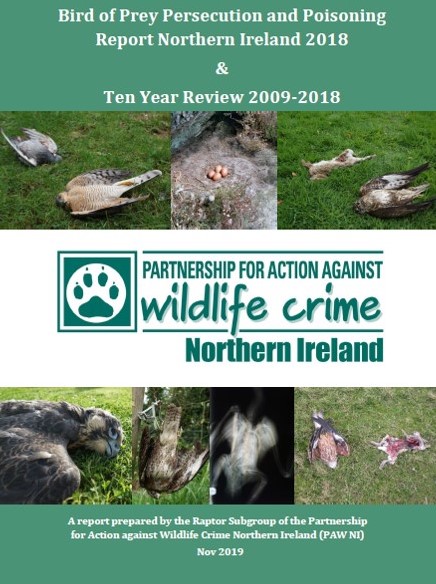
Raptor persecution in Northern Ireland: ten year review and new strategies to tackle these crimes

Press release from the Partnership for Action Against Wildlife Crime Northern Ireland (PAW NI):

Birds of prey to be safeguarded by new technology

Satellite tracking devices are to be fitted onto birds of prey and nesting site surveillance installed, in the latest fight against wildlife crime.

‘Hawk-Eyes’, an advanced technology project, is being launched by the Partnership for Action Against Wildlife Crime Northern Ireland (PAW NI), alongside their ‘10 Years of Persecution’ Report.

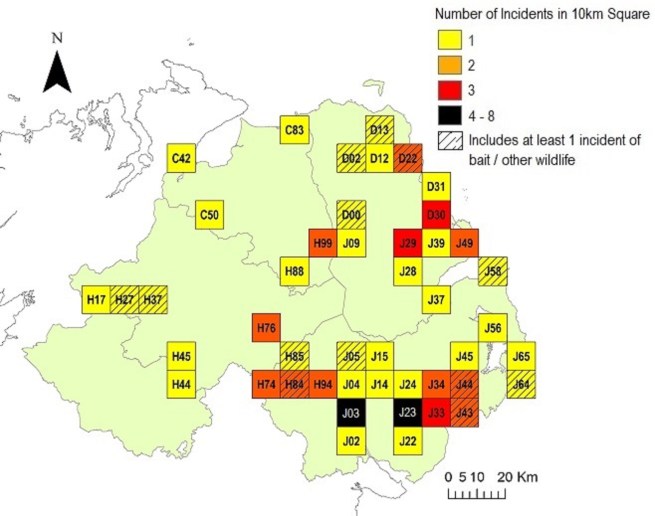
The report reveals that from 2009-18, there were a total of 72 incidents of confirmed raptor persecution in Northern Ireland, resulting in the death or injury of 66 birds of prey and the destruction of two nesting sites.

Department of Agriculture, Environment and Rural Affairs (DAERA) Wildlife Officer Dr Jon Lees said buzzards and red kites are amongst the most common victims of persecution: “Sadly, a small proportion of our population still seem to think it’s ok to destroy these magnificent birds at the expense of the environment and the rest of the community.

“Raptors such as buzzards, red kites, peregrine falcons and Sparrowhawks, have been illegally targeted right across Northern Ireland to such an extent some areas are at risk of losing their natural top predators,” explained Dr Lees.

The methods these criminals use, such as poisoned bait, are often highly dangerous, putting livestock, pets and people at risk. These offenders care little for people’s safety. We rely heavily on the vigilance of the public to report these crimes and any evidence to the police or Crimestoppers,” Dr Lees added.

The “Hawk-Eyes” project, is funded and supported by the Department of Justice, – Assets Recovery Community Scheme (ARCS) and run through PAW NI, which brings together government Departments, PSNI and other enforcement agencies, environmental organisations, animal welfare groups and country sports associations with the common goal of combating wildlife crime through publicity, education and campaigning.

Some of the birds’ tracking information will be publicly available on the project website at http://wildlifecrimeni-hawkeyes.com, which will allow people to help protect these special birds by reporting such crimes.

PAW NI encourages people across Northern Ireland to be vigilant. If anyone sees or knows of any wildlife crime, report it to the PSNI by calling 101 or, in an emergency, 999. Crime can be reported anonymously to Crimestoppers on 0800 555 111.

ENDS

The ten year review report (2009-2018) can be downloaded here: PAW NI Raptor Persecution Report 2009 – 2018
The use of technology (nest cameras and satellite tags) in the Hawk Eyes project is very interesting, especially as it’s being funded by the Department of Justice’s Assets Recovery Community Scheme, where proceeds of crimes are distributed to help community projects. It would be great to see this approach repeated in England, Scotland and Wales.

Of most interest to us is that these tags are being deployed primarily to aid the detection of wildlife crime. Typically, up until now the main reason for deploying satellite tags has been as part of an ecological research project – the subsequent detection of wildlife crime hotspots (through the discovery of poisoned/shot/trapped sat tagged birds or the suspicious disappearance of tagged birds) has been a by-product of that research and not its primary aim. This is a very clear change of approach from the PAW NI and its also very pleasing to see that the police are key partners in it. Good stuff.

Will the use of satellite tag technology help to identify the criminals as well as the hotspots? Quite possibly. It doesn’t work in England, Scotland or Wales where there are large game shooting estates and where evidence can be quickly destroyed with relative ease (no witnesses around and thousands of acres in which to hide corpses/tags) and where multiple gamekeepers can hide in the crowd (a prosecution isn’t possible unless an individual suspect is identified) but the situation in Northern Ireland is quite different.

Raptor killing in Northern Ireland isn’t such an ‘organised crime’ as it is in the rest of the UK because there are very few large game shooting estates. It seems to be more localised and opportunistic in Northern Ireland, so the perpetrators aren’t so clued up on how to avoid detection. The deterrent effect of simply knowing that these birds might be tagged may also be significant in Northern Ireland because the raptor killers there won’t have wealthy employers prepared to fork out thousands of pounds for legal defence as they do on the game shooting estates in England and Scotland. The risk of getting caught and being afraid of the consequences might just do the trick in Northern Ireland.

Well done and good luck to the PAW NI team – a lot of people will be watching this project with interest.

Scottish Environment Minister visits hen harrier nest with Raptor Study Group fieldworkers

Mairi Gougeon is the Scottish Government’s Minister for Rural Affairs and the Natural Environment, and she also happens to be the Species Champion for the Hen Harrier (Species Champions are roles devised to help politicians raise awareness of species conservation).

Mairi has been one of the more active Species Champions in the Scottish Parliament, enthusiastically offering her support for this species by way of a parliamentary debate, speaking at Hen Harrier Day, and going on field visits to see hen harriers in the wild.

Earlier this week she was out again with experts from the Scottish Raptor Study Group and the National Trust for Scotland’s Mar Lodge Estate in the Cairngorms National Park, to watch (from a distance, obviously) a male hen harrier food passing to a female who had four chicks in the nest.

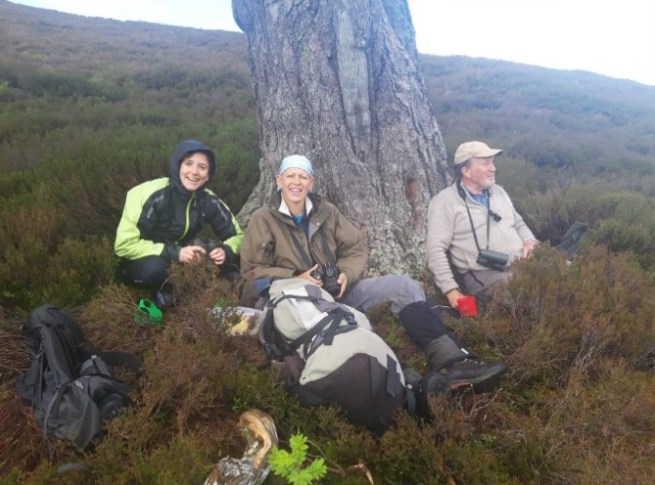
Photos from Kelvin Thomson (@thomsok) of Tayside Raptor Study Group.

That’s the smile of a Minister who’s enjoyed seeing hen harriers.

And although the Scottish Government needs to do much much more to combat the illegal killing of this species on grouse moors (remember Scotland has lost more than a quarter of its hen harrier population in just 12 years), Scotland is fortunate to have a Minister who is so engaged and supportive of the species.

Compare and contrast with Mairi’s Westminster counterpart, Dr Therese Coffey – she’s been in post since 2016 and hasn’t said or done anything of significance in support of hen harriers, even after recent Government-commissioned research showed that 72% of tagged hen harriers were presumed to have been killed illegally on grouse moors.

The Westminster Hen Harrier Species Champion is Angela Smith MP, who appears to have been about as productive as Dr Coffey.

Let’s hope the four chicks that Mairi Gougeon saw being carefully looked after on Mar Lodge Estate all survive and fledge. They’ll need plenty of luck though – four of the five hen harriers tagged here in the last few years have all vanished in suspicious circumstances on other grouse moors in the Cairngorms National Park, presumed to have been illegally killed (Calluna, Margot, Stelmaria and Marci).

And they’re not the only satellite tagged hen harriers to have come to harm inside this National Park. In August 2016 satellite-tagged hen harrier Brian ‘disappeared’ here (see here) and in August 2015 satellite-tagged hen harrier Lad was found dead, suspected shot, inside the Park (see here).

And it’s not just satellite-tagged hen harriers. At least 15 satellite-tagged golden eagles have also ‘disappeared’ in suspicious circumstances in recent years inside the Cairngorms National Park (see here). In 2014 the first white-tailed eagle chick to fledge in East Scotland in approx 200 years also ‘disappeared’ in suspicious circumstances (see here) and last year year another white-tailed eagle also ‘disappeared’ in suspicious circumstances inside the Park (see here).

The political silence on the recent losses of hen harriers Calluna, Margot, Stelmaria and Marci has been noted. We’ll be revisiting this topic soon.