Would you believe it, another guilty gamekeeper!

Another day, another location, another criminal gamekeeper, another wildlife crime conviction, another shit sentence.

This time it’s gamekeeper Shaun Leslie Allanson (37), convicted of crow cage trap misuse on the Blansby Park Estate, nr Pickering, North Yorkshire.

Today at Scarborough Magistrates Court, this ‘professional’ pleaded guilty to intentionally taking a buzzard using a live pigeon in a cage trap on 28 Aug 2012, and using a cage trap with a live pigeon decoy between 31 Aug and 19 Sept.

His punishment? 120 hours community service and £85 costs. Wonder if he’s a member of the National Gamekeepers’ Organisation? We’ll do some asking….

There’s a fuller story in the Telegraph here.

Well done North Yorkshire Police and well done to the Natural England employee who first recognised the crow trap was being used illegally and for releasing the buzzard to safety.

Gamekeeper charged with six offences

North Yorkshire police logoaA gamekeeper from Pickering, North Yorkshire, has been charged with six offences for the illegal use of cage traps to capture a buzzard.

This is the gamekeeper whose arrest was reported last October (see here). He has still not been named, and nor has the estate/shoot where the alleged offences took place. It is not yet known whether he is a member of the National Gamekeepers’ Organisation.

He has been charged with six offences under the Wildlife & Countryside Act and the Animal Welfare Act. He has been bailed to attend Scarborough Magistrates court next month. Article in the Ryedale Gazette & Herald here.

In other court news, the long-awaited verdict in the Lochindorb Estate hare snare trial is due tomorrow…..

Buzzard shot in the Irish Republic

Many thanks to the contributor who sent us the following article from the Leinster Express (dated 15 January 2013).

Take note of the strong words of condemnation from the Director of the National Association of Regional Game Councils.

Bird of prey dies after shooting

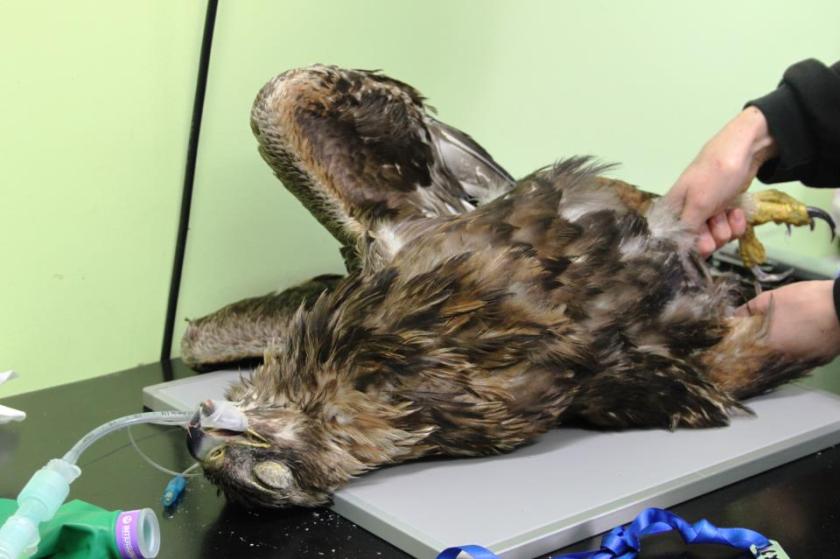
A protected bird of prey was shot and left for dead on New Years Eve near Ballacolla. The female common buzzard, believed to be one of a mating pair in the area, was rescued and treated, but so badly wounded it had to be later put to sleep.

The buzzard was initially brought to Dan Donoher, wildlife rehabilitator with Kildare Animal Foundation on New Years Day.

We got a call from the man who had found the bird injured in the Ballacolla Abbeyleix area. When he arrived up with it, the buzzard was cold and starving, so we put it into a special incubator, gave it fluids and painkillers and bandaged its wing. We thought maybe a car had hit it, or it had hit off wires. We took it to the vet the next day who x-rayed the wing, and found it had been shot with a shotgun. It had to be euthanized, because the damage was too great. It was upsetting to think someone would do this on purpose, buzzards are beautiful birds”, said Dan.

He said buzzards are not a threat to farm animals or humans. “They usually go for carrion or roadkill. This bird was probably one of a breeding pair, they are ony making a comeback”, he said.

The National Parks and Wildlife Service are investigating the shooting. Noel Bugler, conservation manager is appealing to the public for any information.

We are very concerned, this bird is a protected species and it is against the law to shoot it. It was gone from Ireland but came back after the practice of laying poison was banned twenty years ago. It normally feeds on carrion, rats or birds, it is harmless, it has got its place in Irish wildlife”, he said.

The NPWS have informed the Gardai about the incident. If traced, the person responsible for shooting the buzzard could face a fine from €1,000 if it is a first time offence, up to €5,000, under the Wildlife Act.

There is a higher fine for this because birds of prey need more protection”, said Mr Bugler.

The crime has been strongly condemned by the National Association of Regional Game Councils, who promote hunting, game preservation and conservation.

The shooting of birds of prey, who are all protected, can only be condemned in the strongest possible terms. The person who shot this bird is not fit to have a firearm. I would urge the authorities, if the person is identified, that they are prosecuted, have their firearm licence revoked and never allowed have one again. This is inexcusable. If I ever found one of my members was responsible for something like this, he would be out of the association so fast his feet wouldn’t touch the ground”, said Des Crofton, Director of the NARGC.

To help [people are] asked to contact the National Parks and Wildlife Service on 057 9137811.

Another poisoned buzzard in Scotland

SASA (the Government’s Science & Advice for Scottish Agriculture) have just published their latest ‘Summary of Incidents’ where they report on the number of animals that have been submitted for poisoning analysis, dating from January – September 2012 (see here).

It’s an interesting read. The results from the first three-quarters of 2012 suggest a decline in the number of reported raptor poisoning incidents. Does this reflect an actual decline in poisonings, or does it mask something more cynical, such as a change of tactics in the method of persecution used? Nobody can tell for sure at this stage, although you’d have to be pretty naive to believe the first explanation, especially after the recent shocking non-poisoning incidents such as the dead golden eagle found in a lay-by with two broken legs, believed to have been illegally trapped on an Angus grouse moor and then moved by vehicle in the dead of night and dumped by the side of the road, barely alive and left to suffer an horrific death. Then there was the golden eagle that was found shot and critically injured on a grouse moor in Dumfrieshire, now making a slow recovery. And then the shot hen harrier found dead on another grouse moor in Grampian. And these are just the ones we know about.

The latest SASA results show that a buzzard was found dead in Grampian in September 2012, confirmed to have been poisoned by the illegal pesticide Carbofuran. We don’t remember seeing any police reports about this incident. Perhaps they kept it quiet so as not to hinder their investigation? Fair enough, but it’s now four months later…Perhaps Grampian Police will report where was it found, and whether anyone is being charged. They probably won’t though; yet another incident being quietly swept under the carpet? We blogged about these poisoning incidents going unreported the last time SASA published their stats (see here).

There were a number of dead buzzards that were submitted to SASA for testing between Jan-Sept 2012, including the satellite-tagged ‘Buzz’, believed to be the first sat-tracked buzzard in Scotland (see here). His last signal came from near Brechin, Angus in late September. His corpse was picked up by the side of the road. Given the location and the on-going history of raptor persecution in the nearby area, his body was submitted for a post-mortem. He hadn’t been poisoned though – SASA concluded that his probable cause of death was starvation. It would have been nice if Tayside Police had provided information about this result, given so many were following his movements on Roy Dennis’ website…

Buzz wasn’t the only buzzard to starve to death. There are four other buzzards listed in the report with the same probable cause of death; strange really, when there are some people who maintain that buzzards are gorging themselves silly on gamebirds.

Interestingly, the dead golden eagle found in suspicious circumstances on Harris in June did not not appear in the SASA results, even though the press reported at the time that poisoning was suspected (see here). Perhaps Northern Constabulary will provide an update on the outcome of this one? Yeah, you’re right, of course they won’t.

Here comes 2013….the year of natural scotland

imagesHappy Hogmanay!

Tomorrow marks the start of another Scottish government themed year: The Year of Natural Scotland, in which we’re encouraged to celebrate Scotland’s stunning natural beauty and biodiversity. Good job it wasn’t this year’s theme as there might have been some red faces in the government:

  • SGA gamekeeper Whitefield sentenced for poisoning four buzzards (he already had an earlier wildlife crime conviction). His sentence this time? 100 hours community service.
  • Scottish gamekeeper McLachlan, convicted for possession of the banned poison Carbofuran. Fined £635.
  • Scottish gamekeeper Barrie lost an appeal for his sentence of £520 for illegal possession and control of a wild bird.
  • COPFS choosing not to prosecute a Scottish gamekeeper who had been filmed beating birds to death with a stick inside a crow cage trap.
  • Scottish gamekeeper Christie convicted for wildlife crimes relating to the illegal use of a crow cage trap. His sentence? An admonishment (a telling off).
  • Scottish gamekeeper Graham convicted for allowing a buzzard to starve to death inside a crow cage trap. Fined £450.
  • Scottish gamekeeper McKellar convicted for possession of banned poison. Fined £1,200.
  • Scottish gamekeeper Scobie convicted for using banned poison. Fined £270.
  • A satellite-tagged golden eagle mysteriously ‘disappeared’ in the Angus glens.
  • A satellite-tagged golden eagle mysteriously ‘disappeared’ to the North East of the Cairngorms National Park.
  • Peregrine chicks mysteriously ‘disappeared’ from a nest site in Dumfries & Galloway.
  • A golden eagle was found dead, poisoned in Lochaber.
  • A golden eagle was found dead in suspicious circumstances on the Isle of Harris. Still awaiting results.
  • A satellite-tagged golden eagle mysteriously ‘disappeared’ in the Monadhliaths.
  • A poisoned raven, crow, and three poisoned baits were found in the Borders.
  • A satellite-tagged golden eagle was found dead near a lay-by in Aberdeenshire. Its injuries and its sat tag data suggested it had been illegally trapped on an Angus grouse moor and then dumped during the night and left to die.
  • A golden eagle was found shot and critically injured on a grouse moor in Dumfries & Galloway.
  • Barry, the sat-tagged hen harrier from Langholm mysteriously ‘disappeared’.
  • Buzz, the sat-tagged buzzard mysteriously ‘disappeared’ in the Angus glens. (More on this case in the New Year).
  • Willow, a sat-tagged marsh harrier mysteriously ‘disappeared’ in Galloway.
  • A hen harrier was found shot dead on an Aberdeenshire grouse moor.

These are just a few of the ‘highlights’ from Scotland this year – there are a few more that we can’t yet report but we will in the New Year. And of course this list doesn’t include other confirmed incidents from other parts of these fair isles such as England, Wales, Northern Ireland and the Irish Republic; a list that includes shot and poisoned sea eagles, buzzards, kites, harriers, peregrines and sparrowhawks. Nor does it include the incidents that went undiscovered.

We’ll be blogging quite a lot about the Year of Natural Scotland, which hopefully won’t be just a banner-waving exercise by the government but an opportunity for them to put their money where their mouths are. You don’t think so? No, neither do we. Why should 2013 be any different from the previous three decades of ineffective action?

A hint of what’s to come is the revelation that the theme will be highlighted during several events throughout the year. Two particular locations caught our attention: the Scone Game Fair and the Moy Game Fair.

The Scone Game Fair is of course organised by the GWCT. That’s the same GWCT that has recently asked for the addition of buzzards and sparrowhawks to the General Licences (that means they want permission to kill them…we’ll be blogging about that shortly). It’s also the same Game Fair that has previously attracted sponsorship from some very, how shall we put it, ‘surprising’ sources.

The Moy Game Fair is held on the Moy Estate near Inverness. If you’re unaware of this place, try googling it.

Thanks for all your interest and support in 2012…we’ll see you soon. Sláinte!

This golden eagle was found shot, critically injured &left to die on a Scottish grouse moor. Photo SSPCA
This golden eagle was found shot, critically injured and left to die on a Scottish grouse moor. Photo SSPCA

RSPB walks out of hen harrier ‘dialogue’

tec_logo_16271This isn’t especially new news, as it happened in the summer, but we were reminded of it today after reading something on Mark Avery’s blog – more on that later – and it does seem pertinent to blog about it now.

So, most readers will be aware of the Environment Council’s ‘Hen Harrier Dialogue’ – a process that started in 2006 that aimed to bring ‘stakeholders’ together to try and work out a way of resolving the hen harrier / grouse moor conflict in England (see here for website). Those stakeholders involved in these dialogue meetings included the usual suspects such as BASC, Countryside Alliance, Country Land and Business Association, GWCT, Moorland Association, National Gamekeepers’ Organisation, RSPB, Hawk & Owl Trust, Northern England Raptor Groups etc.

The ‘dialogue’ process has produced an awful lot of documents (and a lot of awful documents, see here) and meeting reports (see here), and a strong interest in pursuing a trial on a ‘quota system’ for hen harriers – a controversial idea spawned by Steve Redpath several years ago. In simplistic terms, this quota system would mean that grouse moor owners would ‘allow’ a certain number of breeding pairs (number yet to be established) and once a ‘ceiling’ had been reached, then they would be ‘allowed’ to remove harrier broods (non-lethally) to other parts of the UK away from grouse moors. This idea is still being discussed, although it brings with it obvious ethical and legal debates.

Hen harrier being removed from illegal trap on Moy EstateSome argue that conservation groups shouldn’t be sitting at the table with representatives from an industry that has been responsible for killing off England’s breeding hen harrier population. Others argue that the quota scheme may be the best way forward because at least there’d be some harriers, which is a better proposition than having none. Others have suggested that the quota system would never get off the ground anyway because the grouse moor owners would have to ‘allow’ a certain number of breeding hen harriers on their estates and they’ve shown themselves incapable of tolerating any.

Whatever your point of view, the bottom line is that six years on from the start of the dialogue process, and after all that talking over egg sandwiches and coffee, the English hen harrier breeding population has been reduced to one known pair. That’s it. Just the one pair. In a country that has suitable habitat to support over 300 breeding pairs.

This summer, the RSPB made a bold move and decided to walk away from the dialogue process. They said that as hen harriers have been systematically eradicated from English grouse moors then there was no longer any conflict and therefore no point in spending any more time talking about it. Instead, they intended to get on with their own plans for hen harrier recovery.

It’s not yet known what will happen to the Environment Council dialogue process now a major player has walked away. As far as we’re aware, there are still many questions about the lawfulness of the proposed trial quota scheme so it’s unclear whether attempts will still be made to push that through.

So what next for English hen harriers? After the recent sad story of the illegal shooting of Bowland Betty (see here), in addition to all the other horror stories we keep reading about from English and Scottish grouse moors (e.g. see here, here, here, herehere), is it time for a different approach? It’s obvious that the authorities can’t, or won’t deal with illegal persecution, and the grouse-shooting industry can’t, or won’t put a stop to it either. An alternative suggestion has been put forward by Mark Avery – unless things miraculously improve for breeding hen harriers in Northern England in 2013 then it will be time to start the campaign, on 12 August 2013, to end grouse shooting (see here for Mark’s blog).

Up until now we’d been supporters of the idea of estate-licensing schemes rather than an outright ban. Licensing seemed a fair and reasonable approach to regulate an industry so clearly incapable of expelling its criminal elements. But now?  The time for being reasonable has long since passed. Count us in, Mark.

For our anagram fans: Grouse moor – morgue or so

Sea eagle ‘Irish Brian’ found dead in County Kerry

More bad news from Ireland…

One of the reintroduced Irish white-tailed eagles, known as ‘Irish Brian’ after his exploits in East Scotland last year, has been found dead in County Kerry. Apparently his body, which was found on a hillside near Glencar, was too decomposed for any conclusive tests but this is an area where three other reintroduced sea eagles were found poisoned in 2008 (see the Golden Eagle Trust’s website here for details of the sea eagle reintroduction project).

Rhian Evans, the RSPB’s East Scotland Sea Eagle Project Officer has blogged about Irish Brian here.

Buzzard shot in Ireland

Less than two weeks after BirdWatch Ireland reported the illegal shooting of a hen harrier in  Co. Wexford (see here), they are today reporting the illegal shooting of a buzzard in County Meath.

The buzzard was found alive near the Rossnaree area but had to be euthanised due to the extent of its gunshot injuries.

The press release from BirdWatch Ireland is critical of the lack of strategy, resources and enforcement of wildlife crime in Ireland. Sound familiar?

Read their press release here

Hen harrier found shot dead on Yorkshire grouse moor

A young hen harrier has been found shot dead on a Yorkshire grouse moor. Regular blog readers will not be surprised to learn that it has taken over 5 months for an appeal for information to be made by North Yorks police.

The harrier was raised in a nest in Bowland, Lancashire in 2011. She was nick-named ‘Bowland Betty’ and was fitted with a satellite tag as part of Natural England’s so-called ‘Hen Harrier Recovery Project’. During her first year of life she was tracked through the uplands of Northern England and as far north as Caithness in northern Scotland. In June 2012 she was back in the Yorkshire Dales. Predictably, by late June her sat tag data suggested she was stationary and her dead body was found on 5 July on Thorny Grain Moor in Colsterdale in the Yorkshire Dales. Post-mortem results confirmed she had been shot.

This area is dominated by moorland managed for grouse shooting. We understand her body was found on Swinton Estate, although it is not known where she was actually shot as she could have flown for several miles before succumbing to her injuries.

RSPB and government data show the Yorkshire Dales as a hot spot for illegal raptor persecution, with at least 20 birds of prey illegally poisoned, trapped or shot between 2007-2011. This figure includes 10 poisoned red kites, 4 poisoned buzzards, 2 shot red kites, 2 shot buzzards, 1 shot kestrel and 1 trapped sparrowhawk. In addition there were at least 4 incidents of poisoned baits and a number of dogs were also poisoned.

Hen harriers have been tracked from Bowland since 1999. Wing tags were used to monitor hen harrier dispersal and survival between 1999-2002 (data from at least 42 birds). From 2002-2010, 118 hen harriers have been tracked either via radio transmitter or satellite tag. Astonishingly, Natural England have released very little detail about the results of this project, ten years on. They did produce a report in 2008 (see here) although this related to hen harriers over a broad geographic area and didn’t include specific detail about individual birds. What happened to all those birds? Where are their data? Why, when a satellite tag suggests that a harrier’s movements are suspicious (i.e. it’s been stationary on a grouse moor for several hours), do NE researchers have to seek the estate owner’s permission before they can go and search for the (presumably dead) bird? We’ve used an analogy before but it’s worth repeating – would you expect a police officer to call ahead to a suspected drug dealer to ask permission to go and search his house?

We all know only too well what will happen now. The death of this harrier will be added to the never-ending list of illegally-persecuted raptors found dead on UK grouse moors. Nobody will be prosecuted for shooting it. The public will express outrage for a few days but it’ll soon be forgotten, just like all the others that have been illegally killed before and all the others that undoubtedly will be killed in the future. The people who hold the positions of power that could bring this disgraceful practice to an end will continue to show wilful blindness and downplay the extent of the problem. The police will continue to form ‘partnerships’ with organisations who harbour the criminals responsible for this systematic killing. Nothing will change. Tune in next month to read about the latest victim. (Actually, tune in later this month….)

What can we do? The only thing we can do is to keep publicising these incidents. We can all play a part; don’t leave it to someone else. Tweet it, Facebook it, blog it, talk about it, email your MP about it. Do it.

Hen harrier shot in Ireland

The Kerry Birding blog in Ireland (see here) is reporting that a hen harrier has been shot at a winter roost site. There’s no further information about whether the bird survived.

The author emphasises the importance of confidentiality in relation to known raptor sites and especially hen harrier winter roosts. It’s not just at their nest sites where this species is vulnerable; winter roosts are known to be targeted by armed criminals  intent on wiping out hen harriers, and this happens in England and Scotland too, not just in Ireland.

Press release from BirdWatch Ireland here