Last month the SGA released a report into their ‘investigation’ into the death of the Deeside golden eagle (see here to read their report).
At the time we said we would comment on their report once we’d received responses to some pending Freedom of Information requests. We’re now in a position to comment.
So, the motivation for the SGA’s ‘investigation’ into the circumstances of this eagle’s death was because of what they perceived as “irregularities” in the media reports put out by the RSPB. Let’s have a look at those ‘irregularities’ in turn.
 The SGA don’t believe that the eagle was caught in an illegally-set trap because during their discussions with the estate’s staff, it was claimed they only ever use Mark 4 Fenn traps as opposed to Mark 6 Fenn traps (and of course statements made by those involved with grouse moor management should always be believed). The SGA say the Mark 4 Fenn trap is too weak to smash the legs of a golden eagle and it would be impossible for an eagle to get both feet caught inside the trap at the same time. However, if you read the RSPB’s original media statement about this incident (released 24th September 2012 – here) nowhere do they mention a Fenn trap. All they mention is a “spring type trap”, which covers a wide array of different traps, both legal and illegal, that could have caused the injuries sustained by that eagle. Indeed, independent veterinary pathology experts at the Scottish Agricultural College laboratory concluded that the two broken legs sustained by this eagle “could be consistent with an injury caused by a spring type trap”. It’s up to the reader to decide whether the statements made by the estate’s staff and the SGA are more authoritative than those of the independent veterinary pathologist experts at the SAC lab.
The SGA say they visited the precise location of the ‘alleged’ trapping on the estate. They say, “Close by, on one side, was a large multi-catch crow cage. On the other was a 7-8 foot deer fence”. This is an interesting interpretation of what “close by” means. We understand that the deer fence is actually at least 80m away from the location where the bird was static for 15 hours.
The SGA say that the eagle could have broken both its legs by crashing into the fence at a speed that could have been in excess of 50mph (according to their falconer friend). However, the post mortem report clearly states that the eagle’s injuries could be consistent with being caught in a spring type trap, not crashing into a static object at high speed. In the event of crashing into the fence with an estimated speed in excess of 50mph, you might expect injuries to the feet and to the pelvis, as a bare minimum. The post mortem report documented two broken legs as the bird’s only injuries. It’s up to the reader to decide whether the statement of an un-named falconer with an unknown level of ‘expertise’ holds more authority than the statements of the independent veterinary pathologist experts at the SAC lab.
The SGA say that after hitting the fence the eagle “would then have undoubtedly tried to regain flight. This is consistent with the GPS signals which we were shown by the RSPB, which appeared to show variations in the readings. The readings do not show that the bird was “static” for 15 hours”. It seems that the SGA have a limited understanding of how to interpret GPS sat tag signals. The variations in the readings are entirely within the +/- 18m variation quoted by the manufacturer (Microwave Telemetry). In other words, all of the signals received during the 15 hour period in question were within an 18m circle radius. To all intents and purposes the bird was “static”. It’s up to the reader to decide whether the SGA’s interpretation of the satellite data is more authoritative than those of the sat tag manufacturer or the experienced biologists tracking this eagle.
The SGA say, “The RSPB state that the eagle could no longer become airborne. We disagree, having witnessed on several occasions various bird species gaining flight with leg injuries”. But it wasn’t the RSPB who said that the eagle could no longer become airborne, it was the independent veterinary pathologists at the SAC, who said the injuries were so severe “they would prevent the bird from being able to take off”. If anyone has ever watched a golden eagle take off they will know that the bird bends its legs to push off from the ground/perch. Clearly, two broken legs would prevent this from happening. The SGA suggest that the bird could have used the “advantageous slope of the ground” to “get air below its wings”. Actually the area where this bird was static for 15 hours is relatively flat – not on the edge of a high cliff where an injured bird might be able to roll off and find a thermal uplift. So, imagine an eagle with two broken legs on the flat ground – it will be lying on its side, back or front – do you think it could get airborne? It’s up to the reader to decide whether the SGA’s explanation is more plausible than that of the independent veterinary pathologist experts at the SAC lab.
The SGA say that the eagle could have flown 15km in the dark, tried to land but crashed into the tree and fell to its final resting place underneath a tree branch. This crash would, according to them, explain the eagle feathers found between the road lay-by and the dead eagle. Unfortunately the post mortem report doesn’t show any evidence of the eagle having crashed into a dense conifer tree. It’s up to the reader to decide whether the opinion of the SGA is more authoritative than that of the independent veterinary pathologist experts at the SAC lab.
To conclude then, the SGA’s version of what happened to this eagle was that it died as a result of a terrible accident. However, they haven’t been able to provide any convincing evidence and what they propose happened is not supported by the evidence provided by the independent veterinary pathology experts.
The RSPB’s reaction to the SGA’s report included this statement:
“This is a rather desperate statement from the SGA, which seemingly does more to reveal their nature as apologists for the worst types of wildlife crime, as they try to defend the indefensible. Indeed, it calls into question their very commitment to the aims and objectives of the partnership for Action Against Wildlife crime Scotland (PAWS)”.
It’s interesting (and obviously totally unrelated) to learn that in a recent meeting with the Environment Minister Paul Wheelhouse, the SGA were told very clearly that they would not be issued with licences to kill raptors for the foreseeable future due to the ongoing incidents of criminal raptor persecution. According to the police, the case of this particular eagle obviously falls within that category.
Unfortunately we’ll probably never find out who was responsible for this eagle’s death. Had a full police search, under warrant, taken place then further supporting evidence might have been retrieved. As it stands, it appears that this supposedly ‘on-going investigation’ is as dead as the eagle.
This bird will simply join the long list of other dead or ‘missing’ eagles whose killers have never been brought to justice: 26 eagles in six years at our last count, including ‘Alma’ who was found poisoned in 2009 on, er, this estate.

 A Scottish gamekeeper has today been convicted for a number of wildlife crime offences, including the poisoning of a buzzard.
 An article in the Scotsman today suggests that the recent death of the shot golden eagle (see
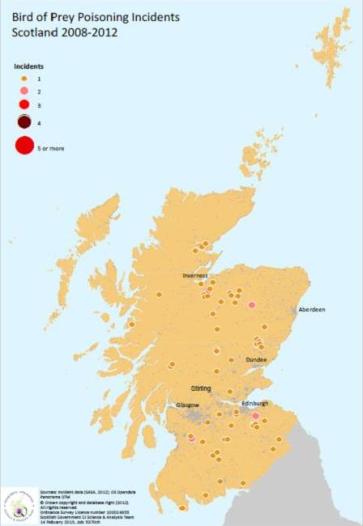 The ‘official’ 2012 incidents of confirmed poisoned raptors in Scotland have just been published and show a marked decline in the number of poisoning incidents. According to the latest figures, the number of reported poisoned raptors fell from 16 in 2011 to three in 2012 (one golden eagle and two buzzards).

