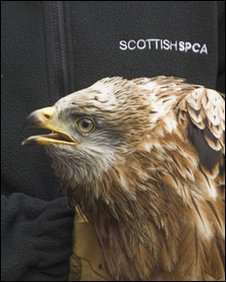
Environment Minister Roseanna Cunningham was asked some pretty incisive questions by Rhona Brankin MSP during parliamentary questions and answers on Wednesday 16th June 2010.
Questions were asked in relation to the mass rearing and release of pheasants and red legged partridges, the value of these birds, the value of Scotland’s biodiversity and natural heritage, the persecution of buzzards, applications for licences to kill buzzards, and the status of the goshawk and sparrowhawk in Scotland etc.
Full details of the parliamentary question and answer session can be found here: http://www.scottish.parliament.uk/business/pqa/wa-10/wa0616.htm#2
Questions and answers regarding raptors and game birds are listed below. Apologies for the long post but it’s well worth a read.
Rhona Brankin (Midlothian) (Lab): To ask the Scottish Executive , further to the answer to question S3W-33201 by Richard Lochhead on 30 April 2010, what particular species of pheasant it considers to be naturally occurring in Scotland and what the taxonomic basis is for this view.
(S3W-34201)
Ms Roseanna Cunningham MSP :
The common pheasant (phasianus colchicus) has been breeding in the wild in Scotland for hundreds of years.
Rhona Brankin ( Midlothian ) (Lab): To ask the Scottish Executive whether it considers (a) biodiversity and (b) the natural heritage to have intrinsic value.
(S3W-34231)
Ms Roseanna Cunningham MSP :
The Scottish Government considers that there are two important ways in which the Scottish people derive benefit from biodiversity and the natural heritage. In the first place, significant value is derived from user benefits, ranging from ecosystem services such as water purification and nutrient recycling, to the pleasure provided by visiting natural areas and seeing plants and animals. In addition, although it less readily susceptible to quantification or analysis, we recognise that for a variety of moral or precautionary reasons, many people also place significant value on the simple existence of natural heritage and biodiversity.
Rhona Brankin ( Midlothian ) (Lab): To ask the Scottish Executive whether it considers that buzzards are subject to deliberate ill-treatment in areas where pheasants are released for shooting.
(S3W-34188)
Ms Roseanna Cunningham MSP :
Buzzards are widespread and frequently the victims of wildlife crime. It is likely that at least some of this wildlife crime will be associated with pheasant rearing.
Rhona Brankin (Midlothian) (Lab): To ask the Scottish Executive , should large numbers of licence applications to kill protected predatory birds meet guidance requirements for approval, what contingency plans exist to prevent a reduction in the population of the protected species being killed.
(S3W-34189)
Ms Roseanna Cunningham MSP :
We would not expect a large number of applications to be approved. No application would be approved that threatens the conservation status of the species concerned. The detail of any further guidelines is yet to be finalised.
Rhona Brankin (Midlothian) (Lab): To ask the Scottish Executive , should large numbers of licence applications to kill protected predatory birds meet guidance requirements for approval, what contingency plans exist to prevent a reduction in the capacity of the population to continue its expansion to previous natural levels.
(S3W-34190)
Ms Roseanna Cunningham MSP :
I refer the member to the answer to question S3W-34189 on 16 June 2010. All answers to written parliamentary questions are available on the Parliament’s website, the search facility for which can be found at http://www.scottish.parliament.uk/Apps2/Business/PQA/Default.aspx.
Rhona Brankin ( Midlothian ) (Lab): To ask the Scottish Executive what contingency plans exist should evidence of illegal killing arise in or near sites subject to applications for licences to kill predatory birds in order to protect game birds released to be shot.
(S3W-34191)
Ms Roseanna Cunningham MSP :
The detail of any further guidelines is yet to be finalised but it should be a condition of any licence that it could be withdrawn if there was evidence of illegal activity.
Rhona Brankin ( Midlothian ) (Lab): To ask the Scottish Executive what proportion of released pheasant poults survive to such an age that they are shot as part of a commercial operation.
(S3W-34192)
Ms Roseanna Cunningham MSP :
The Scottish Government does not hold this information.
Rhona Brankin ( Midlothian ) (Lab): To ask the Scottish Executive what estimates it is aware of regarding the total number of pheasant poults released each year.
(S3W-34193)
Ms Roseanna Cunningham MSP :
The Scottish Government does not hold this information. UK figures quoted by the GWCT state that 35 million pheasants are released each year (http://www.gwct.org.uk/research__surveys/species_research/birds/pheasant/default.asp).
Rhona Brankin ( Midlothian ) (Lab): To ask the Scottish Executive what the average value is of a pheasant poult at release age.
(S3W-34194)
Ms Roseanna Cunningham MSP :
The British Association for Shooting and Conservation estimate that the average price in 2010 for a pheasant poult, assuming that release age means the point at which the birds are put into a release pen at around 6-8 weeks of age, is
£3.25 – £3.75.
Rhona Brankin ( Midlothian ) (Lab): To ask the Scottish Executive what average income shooting businesses receive per pheasant shot by their clients.
(S3W-34195)
Ms Roseanna Cunningham MSP :
The British Association for Shooting and Conservation estimate that shooting businesses that charge for pheasant shooting would expect anything from £25-£40 per bird, plus VAT if applicable, assuming that this would be driven pheasant shooting. A number of these businesses could also offer clients walked-up shooting and it could be that the average cost per pheasant for walked-up shooting would be around £15-£20.
The majority of pheasants shot in Scotland each year are shot on driven shoots.
Rhona Brankin ( Midlothian ) (Lab): To ask the Scottish Executive whether research evidence supports the claims that raptors cause damage to game birds.
(S3W-34179)
Ms Roseanna Cunningham MSP :
Yes, available research does confirm that raptors cause damage to game birds.
Rhona Brankin ( Midlothian ) (Lab): To ask the Scottish Executive what key tests are applied before an agricultural licence is granted to kill buzzards.
(S3W-34180)
Ms Roseanna Cunningham MSP :
No licence to kill buzzards for this purpose has been granted. However any application to carry out licensed control of avian predators to prevent serious damage to livestock would have to meet two tests as set out in the Wildlife and Countryside Act 1981 ;
- that the proposed licensed control will prevent serious damage;
- that there is no satisfactory alternative to licensed control of the predator;
The Scottish Government would also not grant any licence that threatened the conservation status of the species concerned. Further detailed guidance has been discussed with stakeholders. This process has not been completed.
Rhona Brankin ( Midlothian ) (Lab): To ask the Scottish Executive whether it is considering changing the key tests applied to the granting of agricultural licences to kill buzzards.
(S3W-34181)
Ms Roseanna Cunningham MSP :
There is no change planned in relation to any of the tests used in considering applications to control predatory birds to prevent serious damage to livestock.
Rhona Brankin ( Midlothian ) (Lab): To ask the Scottish Executive what alternatives to killing buzzards it is considering in relation to changes to agricultural licences.
(S3W-34182)
Ms Roseanna Cunningham MSP :
Any guidance should contain a list outlining alternatives solutions that must be shown to be unsatisfactory before any licence can be considered. This would include: increasing cover in release pens, changes to pen construction or placement, disrupting predator flight lines, the use of deterrents and diversionary feeding. The detail of any further guidelines is yet to be finalised.
Rhona Brankin (Midlothian) (Lab): To ask the Scottish Executive whether it considers that stakeholders were given adequate time to respond to its drafts of guidance on how to apply for licences to kill protected birds for the protection of game birds released in order to be shot and how the relevant timescale complied with its guidance on the management of consultations.
(S3W-34184)
Ms Roseanna Cunningham MSP :
The guidance is being drafted in accordance with discussions at stakeholder meetings and supporting correspondence. Stakeholders have been given adequate time to contribute to this process. Discussions have been ongoing since October 2009.
Rhona Brankin (Midlothian) (Lab): To ask the Scottish Executive what changes were made, following consultation, to its drafts of guidance on how to apply for licences to kill protected birds for the protection of game birds released in order to be shot; how these changes related to consultees’ comments; what analysis it did in relation to the comments and changes, and how this approach complied with its guidance on the management of consultations.
(S3W-34185)
Ms Roseanna Cunningham MSP :
The guidance seeks to clarify how the Scottish Government will operate a particular aspect of existing legislation. A wide range of comments from stakeholders have been considered, but ultimately, the content of the guidance will be the responsibility of the Scottish Government.
Rhona Brankin (Midlothian) (Lab): To ask the Scottish Executive what the conservation status of the goshawk is in Scotland .
(S3W-34186)
Ms Roseanna Cunningham MSP :
Overall the species status is unfavourable due to population growth and distribution of birds being limited despite suitable habitat being available.
Best current estimates date from 2007 and place the breeding population at a minimum of 130 pairs (Birds in Scotland ), and 136 territories (Scottish Raptor Monitoring Scheme Report).
Rhona Brankin (Midlothian) (Lab): To ask the Scottish Executive what the conservation status of the sparrowhawk is in Scotland .
(S3W-34187)
Ms Roseanna Cunningham MSP :
The overall conservation status of the Sparrowhawk is favourable.
The sparrowhawk is one of the most widespread and common raptors in Scotland, although there has been some suggestion of a decline since the 1980s within conifer forest nesting pairs due to changes in age structure of the forest estate.
Rhona Brankin ( Midlothian ) (Lab): To ask the Scottish Executive what research evidence it has considered in relation to licensing landowners to kill buzzards.
(S3W-34175)
Ms Roseanna Cunningham MSP :
The research evidence taken into account includes:
Allen, D.S., Packer, J.J., Blanchard, C. and Feare, C.J., 2000. Raptors and the rearing of Pheasants: problems and management needs. ADAS Consulting Ltd. Unpublished report to the British Association for Shooting and Conservation.
Allen, D.S., 2001. Raptors and the rearing of Pheasants, Part II: A preliminary evaluation of techniques to reduce losses of young pheasants to raptors at release pens. ADAS Consulting Ltd. Unpublished report to the British Association for Shooting and Conservation.
British Association for Shooting & Conservation leaflet. Birds of prey at pheasant release pens.
Clements, R., 2000. Range expansion of the Common Buzzard in Britain . British Birds, 93: 242-248.
Clements, R., 2002. The Common Buzzard in Britain : a new population estimate. British Birds, 95: 377-383.
Cramp, S., 1977. Handbook of the Birds of Europe, the Middle East and North Africa . Volume II, OUP.
Forester, R.W., Andrews, I.J., McInerny, C.J., Murray, R.D., McGowan, R.Y., Zonfrillo, B., Betts, M.W., Jardine, D.C. and Grundy, D.S. (Eds), 2007, vol II. The Birds of Scotland . The Scottish Ornithologists’ Club, Aberlady.
Game & Wildlife Conservation Trust (formerly GCT), Review of 2003. Fate of released pheasants, page 74-75.
Harradine, J., Reynolds, N. and Laws, T., 1997. Raptors and gamebirds. A survey of game managers affected by raptors. Wrexham: British Association for Shooting and Conservation.
Kenward, R.E., 1999. Raptor predation problems and solutions. Journal of Raptor Research, 33(1): 73-75.
Kenward, R.E., Hall, D.G., Walls, S.S., Hodder, K.H., Pahkala, M., Freeman, S.N. and Simpson, V.R., 2000. The prevalence of non-breeders in raptor populations: evidence from rings, radio-tags and transect surveys. Oikos, 91(2): 271-279.
Kenward, R.E., Hall, D.G., Walls, S.S., and Hodder, K.H., 2001. Factors affecting predation by buzzards (Buteo buteo) on released pheasants (Phasianus colchicus). Journal of Applied Ecology, 38: 813-822.
Kenward, R.E., 2002. Management tools for reconciling bird hunting and biodiversity. European Concerted Action within the 5th Framework Program: Reconciling Gamebird Hunting and Biodiversity (REGHAB).
Lloyd, D.E.B., 1976. Avian predation of reared pheasants. Report to the British Field Sports Society, The Game Conservancy, The RSPB and the Wildfowlers Association of G.B. and Ireland .
JNCC, 2000. The report of the UK Raptor Working Group.
Manosa, S., 2002. The conflict between gamebird hunting and raptors in Europe . European Concerted Action within the 5th Framework Program: Reconciling Gamebird Hunting and Biodiversity (REGHAB).
Park, K.J., Calladine, J.R., Graham, K.E., Stephenson, C.M. and Wernham, C.V., 2005. The Impacts of Predatory Birds on Waders, Songbirds, Gamebirds and Fisheries Interests. A report to Scotland ’s Moorland Forum.
Redpath, S. and Thirgood, S., 1997. Birds of prey and red grouse. London : Stationery Office.
Reif, V., Jungell, S., Korpimaki, E., Tornberg, R. and Mykra, S., 2004. Numerical response of common buzzards and predation rate of main and alternative prey under fluctuating food conditions. Ann. Zool. Fennici, 41: 599-607.
Robertson, P.A., 1988. Survival of released pheasants, Phasianus colchicus, in Ireland . Journal of Zoology, 214: 683-695.
Thompson, D.B.A, Redpath, S.M., Fielding, A.H., Marquiss, M. and Galbraith , C.A. , 2003. Birds of prey in a changing environment. Edinburgh : The Stationery Office.
Walls, S.S. and Kenward, R.E., 1998. Movements of Common Buzzards, Buteo buteo, in early life. Ibis, 140: 561-568.
Rhona Brankin ( Midlothian ) (Lab): To ask the Scottish Executive whether it considers that any legislative changes that would allow landowners to kill buzzards would comply with EU tests and regulations.
(S3W-34176)
Ms Roseanna Cunningham MSP :
No legislative change is required to allow the control of predatory birds under licence.
Rhona Brankin ( Midlothian ) (Lab): To ask the Scottish Executive whether it will list ongoing research projects looking at alleged damage by raptors to other birds.
(S3W-34177)
Ms Roseanna Cunningham MSP :
The Langholm Demonstration Project is the main ongoing research project.
This topic has been looked at several times and was reviewed by Park et al in 2005 The Impacts of Predatory Birds on Waders, Songbirds, Gamebirds and Fisheries Interests (report to Moorland Forum) and 2008 Impacts of birds of prey on game birds in the UK: a review (Ibis 150 (Suppl. 1), 9–26).
Wider research that is available includes, spatial and temporal associations between recovering populations of common raven Corvus corax and British upland wader populations. Arjun Amar et al 2010 Journal of Applied Ecology is relevant, as is the BTO/Songbird Survival research – Population change of avian predators and grey squirrels in England : is there evidence for an impact on avian prey populations? Newson S et al. 2010 Journal of Applied Ecology.
Rhona Brankin ( Midlothian ) (Lab): To ask the Scottish Executive what the cost to the taxpayer has been of undertaking research into alleged damage to other birds by raptors.
(S3W-34178)
Ms Roseanna Cunningham MSP :
Public sector funding contributions to recent research into impact of raptors on other birds is as follows:
- Racing Pigeons: Impact of Raptor Predation CSL report to SNH & SHU 2004 £122,000.
· Sparrowhawks & Racing Pigeons – SG/SHU/SNH Research Trial 2009 c£25,000.
· The Impacts of Predatory Birds on Waders, Songbirds, Gamebirds and Fisheries Interests. Moorland Forum Report (2005) £24,000.
Langholm Moor Demonstration Project (2007-date) – £357,000 (including £52,500 from Natural England).