Blog

The real reason English hen harriers are on brink of extinction

The news media are full of stories today about the dire situation for breeding hen harriers in England. With only a single known breeding pair this year, we are about to lose this species. Many think that persecution by gamekeepers is to blame, but we can now exclusively reveal that blade-wielding eagle thugs are responsible for wiping out hen harriers.

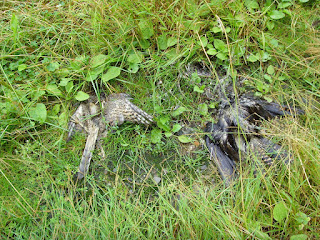
Undercover operatives from the Modern Poisoners’ Society have sent us photographic evidence of a knife-handling training camp where hundreds of eagles gathered last year to sharpen their blades and practice stabbing and slicing actions. Readers will be shocked to learn that this secret camp was not in Yemen or Pakistan, but was actually in the heart of England. Squadrons of eagles secretly practised their low-level night flights over the Derwent reservoir in preparation for Operation Chastise: their revenge on hen harriers for eating all the red grouse. Unfortunately there weren’t any hen harriers in the area so the eagles stabbed all the Upper Derwent goshawks instead. The bodies of the dead goshawks were wrapped in carpet and weighted down with stones before being dumped in the reservoir. The sneaky eagles then removed the goshawk eggs from the nests and smashed them on the ground to make it look like gamekeepers had been responsible.

Albert Hogburn, Head of Truth at the Modern Poisoners’ Society said: “Gamekeepers have been vindicated. Perhaps now people will see eagles for the vermin they really are, destroying all biodiversity in their path. The best way to teach eagles about knife crime is to poison them. Once they’ve stabbed all the harriers they’ll just move on to innocent children. It’s basic ecology. We’ve applied for lottery funding so we can put rings of poison around every school in England. It’s the only way to keep our children safe”.

Donald Spewing-Moore from the Royal Bird Protection Society said: “I wish that twat Hogburn would cut it out. Cut it out, geddit? Did you see what I did there? Did you? But in all seriousness, I can think of better uses for that knife, although I would prefer to use a triple X30 stainless steel model with an official Rockwell hardness rating of 52 + 2 and combine 0.3% carbon and 13% chrome for long-lasting cutting performance and high corrosion resistance”.

English hen harriers right on the brink

The RSPB has issued a press release warning that the future for England’s most threatened raptor – the hen harrier – is looking perilous as the species teeters on the brink of extinction as a breeding bird.

Early reports suggest that only one pair is showing signs of nesting in England this year, down from the heady heights of four known breeding pairs last year.

The reason? Well you already know it – persecution. For the persecution deniers,  the government-funded report that spells it out can be found here.

RSPB press release here

Crow traps: what you should know part 2

Following on from our earlier blog – Crow traps: what you should know part 1 (here)

The following information concerns the use of crow cage traps in Scotland; they are also used in other parts of the UK although the terms of use differ slightly (see here for information on their use in England, here for Wales and here for Northern Ireland).

What is a crow trap and why should we be concerned about them?

There are various types of animal traps in use in the countryside but the two we focus on in this article are the ‘ladder’ and ‘funnel’ crow cage traps. These are large, walk-in traps usually constructed with a wooden frame and wire mesh netting. A decoy bird (often a carrion crow but certain other decoy species are also permitted) is placed inside the trap to attract corvids or other target species. Birds that are attracted to the trap can enter via the roof, either through the horizontal slots of the ‘ladder’ or via a ‘funnel’. Once inside the trap it is virtually impossible for the birds to escape unaided. These trapped birds are usually destined to certain death at the hands of the trap operator who is legally authorised to kill them, subject to certain conditions (discussed in Part 3). In some rare circumstances, raptor workers deploy temporary crow cage traps to capture buzzards for marking projects, such as wing-tagging etc. Obviously these buzzards are released as soon as they’ve been marked; they aren’t killed by the trap operator!

There are many concerns surrounding the use of crow cage traps (some we’ll discuss below) but the over-riding concern is the indiscriminate nature of these traps, which means that species other than the target species can be, and often are, caught by gamekeepers, e.g. buzzards, goshawks, golden eagles etc. It is not illegal to (accidentally) trap these non-target species, but it is an offence for the trap operator not to release them, unharmed, at the earliest opportunity. More on this in Part 3.

Crow trap use is governed by a general licence, issued annually by Scottish Natural Heritage (see here). These licences are issued for the purpose of either (a) the conservation of wild birds, (b) to prevent serious damage to livestock, foodstuffs for livestock, crops, vegetables and fruit, and (c) to protect public health, public safety and prevent the spread of disease. Trap operators need not ‘apply’ for an individual licence, hence the name ‘general’ licence. Each general licence is subject to strict conditions (discussed in Part 3). If the trap operator complies with all the conditions of the general licence then the use of the crow trap is legal. However, in practice some of these conditions are ambiguous at best, and this is recognised by SNH who undertake regular consultations aimed at clarifying the terms of use (e.g. see here for their latest consultation plans).

Before we get in to the nitty gritty of how to recognise a legal trap from an illegal trap it’s worth mentioning that the RSPB (and other groups such as OneKind) has long campaigned for a more thorough review of the legal framework concerning these general licences for crow traps, particularly in relation to potential breaches of European legislation, including the EC Birds Directive. For anyone interested in the RSPB’s position, this document from 2007 (here) is informative.

Other concerns include the fact that there isn’t any effective monitoring of the impact these traps have on both target and non-target species. Crow traps are in use across Scotland year-round but are especially associated with upland grouse moors. It isn’t known exactly how many crow traps are in operation in Scotland but a conservative estimate would be in the hundreds, but probably nearer the thousands. There is currently no requirement for trap operators to record and/or report the number of target and non-target species caught and killed inside a trap (and even if there was such a requirement, who would believe the submitted figures? No gamekeeper is going to admit to illegally killing a protected species!). So how can the regulatory body (SNH) monitor the impact of crow trap use when they haven’t got a clue just how many traps are in use and how many birds and of what species are being killed each year? The follow-on question is, how can these general licences still be issued when the regulatory body cannot justify, in quantifiable terms, the need for lethal control measures?

Some may argue that there is now a record of the number of traps in use because recent changes to the general licences now require that a sign is attached to each trap with a unique identifying code issued by the local police force. However, this unique code is not assigned to an individual trap or to an individual trap operator, but rather to a landowner (or occupier) such as a sporting estate or a farm. This means that an estate owner can use the same code for multiple traps on his/her land (e.g. they may have just one trap or they may have 50+ traps depending on the size of the estate); the point is that the authorities do not have any means of knowing how many traps are in use on a particular estate because they only issue one code per estate.

From a law enforcement perspective, this use of a single identifying code for multiple traps makes it almost impossible to prosecute an individual for illegal use of the trap. For example, if a golden eagle is found dead inside a trap, and it’s obviously been there for a long time, then an offence has probably been committed (because traps must be checked at least once in every 24 hour period – see Part 3). Investigators may attend the scene but find that the trap is located on a large estate that employs multiple gamekeepers. None of the gamekeepers admit responsibility, so how does the investigator identify the individual responsible? A prosecution cannot commence unless an individual suspect is identified. It’s the same loophole we’ve seen used so many times when poisoned bait has been found on a large estate; nobody admits responsibility for laying the bait and thus the perpetrator(s) escape justice. It is only when the trap is located on a smaller estate where a single gamekeeper is employed that there is any chance of a prosecution.

Talking of loopholes….we’ve touched on this briefly in previous posts….in 2008 a new condition was added to the terms of use of the general licences. That new condition was that anyone who had a previous wildlife crime conviction was not allowed to use the general licence unless their conviction was considered ‘spent’, i.e. after five years from conviction. (Although even if you did have a recent conviction you could still apply for use of the licence and each case would be considered on merit, so it’s not quite the draconian condition that some imply). However, in 2009 the condition (of being banned for five years) was modified and we don’t recall any consultation about the insertion of this modification! The new modification says that you can still use the general licence if the sentence you received for your wildlife crime was an ‘admonishment’. Talk about a get-out clause! You might think this modification was quite reasonable, after all, an admonishment (effectively a telling off) is only given for minor offences, right? WRONG!!! Because there aren’t any mandatory sentences for wildlife crime offences in Scotland, a sheriff can choose a sentence at will (within the boundaries of sentencing limits at a Sheriff court, of course). In 2010, a sheriff imposed an admonishment on Graham Kerr, a gamekeeper on the Redmyre Estate, for possession of the banned pesticides Carbofuran and Alphachloralose (see here). The maximum penalty available was a £5000 fine and/or a six month prison term, reflecting the gravity of this type of offence. Had Kerr not also been handed a £400 fine for shooting a buzzard on the Redmyre Estate, his admonishment would have allowed him to continue using the general licence to operate a crow cage trap. In our opinion this is outrageous. What’s the point of having a condition of a five-year ban for a wildlife criminal if that condition is modified based on the whim of a sheriff’s sentencing choice rather than the nature of the actual criminal offence committed? It’s total nonsense. Why was this modification added to the terms of the general licence and who instigated its inclusion in 2009 and who approved it? Was anyone given the opportunity to object to its inclusion? Perhaps a Freedom of Information request is called for here…

This leads on to another concern…who is actually monitoring the trap operators? How do we know that someone with a recent criminal conviction (who was given a stronger sentence than an admonishment) is not still operating a crow cage trap? We know that many estates don’t sack their gamekeepers following a wildlife crime conviction, and we know of at least one estate where a previously convicted gamekeeper (guilty of raptor persecution) is now employed as a ‘gardener’!!

The potential for the misuse of crow traps is well known amongst raptor workers.  Previous reports on this issue have been produced by the RSPB (e.g. see here). Although this 2004 report is now fairly dated and some of the report’s recommendations have since been implemented, there is still a great deal of concern that crow traps are still being deliberately used to target raptor species, particularly buzzards and goshawks and in some areas, golden eagles.

So what can we do about it? In Part 3 we’ll explain the basics of what makes a crow cage trap legal, what makes one illegal, and the blurred line in between the two. We’ll also explain what members of the public should and shouldn’t do if you find a crow trap that you suspect is being operated illegally.

Gonshaw: banned from Scotland for life (during breeding season)

Top, top, top news! Serial egg collector, Matthew Simon Gonshaw, has today been jailed for his latest egg-theft crimes but more importantly, he has been banned from entering Scotland during the bird breeding season, FOR LIFE!

Gonshaw, recently the recipient of an ASBO giving him a ten-year ban from Scotland, was also sentenced to six months in jail (his 5th jail term!) after he was caught nicking bird eggs off the Isle of Rum last year.

BBC news release here

COPFS press release here

Well done to everyone involved and massive kudos to Sheriff Margaret Neilson at Inverness Sheriff Court for finally delivering a decent sentence for a persistent wildlife crime offender. Now let’s see if other Sheriffs can start to follow suit…

Previous Gonshaw posts here, here and here.

Another golden eagle mysteriously ‘disappears’

Thanks to Dave (contributor) for highlighting this one:

http://www.raptortrack.org/category/golden-eagle/angus-26/

Crow traps: what you should know part 1

Without even the tiniest weeniest hint of irony, the Scottish Gamekeepers Association is complaining about ‘criminal activity in the countryside’ in reference to the recent alleged release of crows from a trap on a Scottish sporting estate.

Oh and it gets better…. according to the SGA, in response to this criminal activity Northern Constabulary has “issued an appeal for information”. Although we should point out that we’ve been unable to find any public record of this ‘appeal for information’ so we only have the SGA’s word to rely upon. But let’s assume the SGA is telling the truth…

Is this the same Northern Constabulary who apparently failed to fully investigate the suspected decapitation and shooting of a white-tailed eagle on Skye (see here) and the discovery of a poisoned red kite on the boundary of Skibo Estate (see here)?

That’s not the end of the irony either – the SGA goes on to suggest that cameras could be installed at crow traps, presumably to film any member of the public who may be inclined to interefere with the trap (which may amount to a criminal offence). Wouldn’t it be interesting to see whether that film footage would be considered as acceptable evidence in any subsequent prosecution, especially after recent film footage showing the activities of a Scottish gamekeeper using a stick to beat crows to death inside a crow trap on a Speyside sporting estate (see here), was deemed inadmissable evidence?

One rule for one but not the other? Surely not!

In light of the SGA’s recent one-sided promotion of crow traps and their encouragement to SGA members to report suspected trap interference (see here for their article) as well as the landowners’ representative body, Scottish Land and Estates, encouraging their members to do likewise (see here), we thought it only fair that we provide an alternative view on the use (and more importantly the mis-use) of crow traps on Scottish sporting estates and give the public the neccessary information about how to recognise the difference between a legal and an illegal trap, and what to do if you find an illegal one.

Watch this space…

Red kites found poisoned in Chilterns

The RSPB and Hertfordshire Police are appealing for information following the discovery of two poisoned red kites in the Chilterns.

The first bird was discovered by a member of the public in January 2012, close to a public footpath near the village of Hexton. The second bird was also found by a member of the public, hanging in a bush in March 2012 less than one mile away on the Pegsdon Hill Nature Reserve run by Bedfordshire Wildlife Trust.

Tests have apparently revealed both birds had been poisoned with a highly toxic banned pesticide, although the name of the poison has not been given. On May 2nd, a multi-agency search of the area recovered a number of samples that have been sent for analysis.

The RSPB is offering a £1,000 reward for information leading to a conviction.

It’s interesting to note that neither of these poisoned kites were mentioned in the national press at the time they were discovered, nor is there an explanation for why it took four months from the first discovery for a search to be conducted. There is no mention of this investigation on the Hertfordshire Police website – the only publicity appears to be on the RSPB website. Whilst the investigation and (rather late) publicity is to be welcomed, the chances of anybody being charged for these offences now seem pretty slim.

RSPB news release here

More delay in case against Inverness man accused of buying/selling raptor eggs

The long-running case against Keith Liddell, first reported on this blog in July 2011 (see here) has been continued at Inverness Sheriff Court, again.

Liddell is alleged to have bought or offered for sale 202 eggs, including those of Egyptian vultures (a listed endangered species) and tawny owls. He is further accused of having 136 wild birds’ eggs in his possession. These charges, which Liddell has denied, relate to alleged offences between 2004 – 2009. The case has dragged on and on and on with numerous hearings in November and December 2011, and in February and May 2012. The next hearing will be in June 2012.

Outrage at (more) Peak District bird of prey persecution

The RSPB and Severn Trent Water have today expressed their outrage at the ‘wanton destruction’ over the last few days of the nest of one of Britain’s most persecuted raptors. Goshawk eggs, only days from hatching, were found smashed underneath a nest in the Upper Derwent Valley on land managed by Severn Trent Water.

It is the latest in a long line of raptor persecution incidents in the Peak District (see here for a 2006 RSPB report aptly named Peak Malpractice, and here for a 2007 updated report). The last reported incident was the case of gamekeeper Glenn Brown, who was convicted last year after RSPB investigators filmed him using a caged pigeon to lure raptors into a trap on National Trust-owned Howden Moor (see here). This latest incident demonstrates just how ineffective Brown’s sentence was (100 hours community service ‘ain’t gonna deter anybody – sure, he also had to pay costs but do you really think he’ll be paying those from his own pocket?). That this latest attack has happened at all should come as no surprise to anybody.

The RSPB says this now leaves only one known active goshawk nest in the entire Derwent Valley, which previously had held six pairs. The RSPB is offering a £1,000 reward for information leading to a conviction.

RSPB press release here

Another poisoned raptor, another well-kept secret?

Last week we blogged about Des Thompson’s presentation at the Scottish Wildlife Crime Conference (see here). Here’s a reminder of what he had to say about Northern Constabulary and the problem of red kite persecution in northern Scotland:

So 40% of the dead, just over 100 red kites were poisoned in north of Scotland, without poisoning we should have had 300 plus birds, poisoning of red kites in the north of Scotland is attracting a lot of criticism nationally, and we now know the location of the hotspots problem areas where red kites have been found, poisoned, and we’re working closely with the police to tackle this. And I want to put on record here how grateful we are to Northern Constabulary, er, senior staff at Northern Constabulary for meeting with us to discuss the scientific issues and for taking forward the very ambitious programme of work to tackle this problem“.

So what is this “very ambitious programme of work” and why is it that Northern Constabulary appear to need persuasion to carry out what is its statutory duty to investigate wildlife crime?

If you look at the Force’s website you’ll see that they have 13 police Wildlife Crime Officers (see here) who are overseen by a Force Wildlife Crime Coordinator, Chief Inspector Matthew Reiss. The website also includes a ‘statement of intent’ in relation to tackling wildlife crime and the Force says it is committed to tackling wildlife crime (see here). Further, Chief Inspector Reiss is on record (according to Highland News) as saying Northern Constabulary treats wildlife crime “extremely seriously” (reported here after the convictions of Skibo Estate and Moy Estate employees for wildlife crime offences).

All sounds very convincing and reassuring, doesn’t it? Why is it then that Northern Constabulary has remained tight-lipped about the discovery, 15 months ago, of a poisoned red kite allegedly found on moorland at the boundary of Skibo Estate? We have been told that the satellite-tagged kite was allegedly found in February 2011. SASA documents show that only one red kite from the Highland region was tested in February 2011  and  it had been poisoned by Alphachloralose and was the subject of on ongoing police investigation (SASA ref #11020, see here).

Was there any publicity about this bird? We think we might have remembered if there had been, but we checked back to Northern Constabulary’s archived news items on their website for the month of February 2011 in case we’d missed it – but no, plenty on there about theft of handbags and damage to tractors but not a whisper about the discovery of a poisoned red kite.

Was there a police raid on the surrounding properties where this bird was allegedly found poisoned? If it was found at this location, and given that this is one of the supposed ‘hotspot’ areas for raptor poisoning (three golden eagles and a sparrowhawk found poisoned in 2010 – no convictions; a staked-out poison-laced grouse bait found in 2010 – no convictions) wouldn’t a police raid be the obvious first step in an investigation?

So is that it? No further action? If we hadn’t received a tip-off would it ever have come to light? Where was the RSPB in all of this? Did they know that one of their satellite-tagged kites had allegedly been found poisoned? If they did, why wasn’t the incident publicised? Where was SNH and PAW Scotland in all of this? Did they know that one of the satellite-tagged kites that they’d helped fund had allegedly been found poisoned? Where was their publicity? Where was the NWCU in all of this? Were they notified? Was this alleged incident the trigger for setting up the meeting with senior staff at Northern Constabulary to discuss the red kite persecution ‘science’?

This is the second time in the last few weeks that Northern Constabulary has been at the centre of allegations of secrecy and cover-up when it comes to wildlife crime (see here for earlier report on the suspected shooting and decapitation of a white-tailed eagle on Skye that went unpublicised). How many more incidents are there left to be uncovered? To be fair, Northern Constabulary does sometimes get it right, with current ongoing court cases including the alleged hare snaring at Lochindorb (here) and alleged egg theft (here), but ‘sometimes’ just isn’t good enough. Nobody’s suggesting these investigations are easy – we’ve all seen how difficult it can be to get COPFS to agree to a prosecution – but Northern Constabulary (and others) don’t help themselves when they choose not to publicise, or sometimes even investigate these alleged crimes.

How about everyone stops all the politically-motivated soundbites about commitment and very ambitious work programmes and just focuses on getting the basics right?