Blog

New research suggests Langholm buzzards not that fussed about eating red grouse

Richard Francksen BOUEarlier this month, the British Ornithologists’ Union held its annual conference at the University of Leicester. The theme of this year’s conference was the Ecology and Conservation of Birds in Upland and Alpine Habitats.

Conferences like these allow research scientists to present their latest findings to their peer group. This particular conference was of great interest to us, given the high levels of illegal raptor persecution associated with upland moors that are managed intensively for grouse shooting.

There were several presentations worthy of note (and you can read the abstracts in the PDF below) but we wanted to highlight one that many of you will probably be interested in. The presenter, Richard Francksen, a PhD student at Newcastle University, won an award for this research: Best poster presentation by an early career researcher.

Research Title: Common buzzard Buteo buteo diet in relation to changes in vole abundance.

Researchers: Richard Francksen, Mark Whittingham and David Baines.

Here’s the abstract:

Predators whose most important prey are field voles Microtus agrestis are often assumed to increase their predation on other prey groups when vole abundances decline. However, this assumption may not be valid for all prey groups and habitats available to predators. In Britain, voles are an important prey item for common buzzards Buteo buteo, and often form a principal component of the diet throughout much of their geographic range. Langholm Moor in south-west Scotland is an area of upland moorland managed for red grouse Lagopus lagopus scoticus, in which vole indices typically cycle over a three to four year period. We studied vole abundance and buzzard diet at Langholm Moor between 2011 and 2013, which encompassed a complete vole cycle. Breeding buzzards on Langholm Moor have previously been shown to eat red grouse in small numbers alongside their preferred vole prey. Buzzard diet was monitored at 13-16 nests each year using motion triggered cameras, analysis of prey remains and pellet content. An Index of Relative Importance was used to assess the importance of various prey groups to buzzard diet and it was found that the proportion of voles in buzzard diet decreased in line with vole indices. We hypothesised that when vole availability diminished, buzzards would switch to increased predation of red grouse and their chicks, However, grouse were less frequent in buzzard diet when vole indices were low. Instead, buzzards switched to eating more lagomorphs, moles, shrews and corvids; prey groups typically associated with moorland fringe and farmland habitats. This may suggest that when provisioning their chicks, buzzards take red grouse only incidentally while hunting for voles within moorland habitats. When assessing diet and investigating predator impact on prey species, knowledge of all resources and habitats that are available to predators is important.

Other presentations of note include:

Weston et al. Prospecting forays inform young golden eagles prior to emigrating from their natal home range. [Page 10, abstracts book).

Amar & Redpath. Hen harriers in the UK: a tale of contrasting fortunes. [Page 11].

Carroll et al. Impacts of drainage and climate change on keystone insects and upland breeding birds. [Page 21].

Baines et al. Grouse moor management: effects on other upland birds in the UK. [Page 25].

Thompson et al. Does intensive grouse moor management benefit the UK uplands? [Page 26].

Roos et al. Predation and upland birds. [Page 28].

Redpath and Young. The role of ecology in addressing conflicts over upland birds. [Page 33].

Downloadable book of abstracts: BOU Uplands Conference 2014 – abstracts

Photos from the conference here

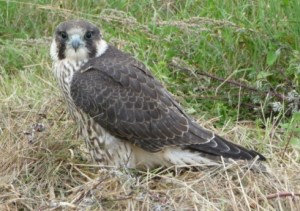
That poisoned peregrine at Leadhills

Leadhills peregrine Sunday Express April 2014Last week we blogged about a poisoned peregrine that had been found in the Leadhills area of South Lanarkshire and the alleged response of Police Scotland and the National Wildlife Crime Unit (NWCU) to the incident (see here).

There have now been some official responses.

The NWCU has stated: “Formal operational procedures have been followed throughout and whilst the investigation is on-going further comment is inappropriate. The investigation is being conducted with utmost care, and third-party reports in the media of improper conduct are wholly uninformed” (see here for full statement).

NWCU has chosen to use the ‘it’s an on-going investigation so we can’t comment’ card. Quite how explaining their response to an initial telephone call would impact on an investigation is unclear, but there you have it. Transparency and accountability don’t seem to be high on the agenda.

Police Scotland are quoted in an article that was published in the Sunday Express yesterday: “There was no suggestion from the person reporting the dead bird that it had been poisoned or appeared in any way suspicious, and we responded accordingly“. The article can be read here: Leadhills peregrine Sunday Express April 2014

The member of the public who reported the dead peregrine to the police has told us they are furious with this response and they have put in a complaint to Police Scotland. They argue that Police Scotland are well aware of the long history of raptor persecution in the area: 45 reported incidents since 2003, and of those, 34 incidents involved the poison Carbofuran – the same poison that killed this peregrine. Of course the discovery of this poisoned peregrine was suspicious – how could it not be?

The member of the public also told us about the ‘on-going investigation’. The police contacted this person to advise of their theory about who might have poisoned the bird (we can’t publish that theory but it’s quite astonishing). The member of the public asked the police officer whether they needed a statement about the discovery of the dead bird: they said ‘no’.

That’s that then. The Untouchables: 45. Justice: 0.


Ross-shire Massacre: today’s public protest

What a great turn out in Inverness this afternoon for the public protest demonstration against illegal raptor persecution!

The protest was triggered following the recent mass poisoning of at least 19 raptors (14 red kites and 5 buzzards) in the Conon Bridge area of Ross-shire, all found during the last three weeks.

Well done to RSPB Scotland for organising the demo and allowing ordinary members of the public an opportunity to tell the Scottish Government that they’ve had enough and to demand they now take action. A big well done also to everyone who was able to attend. Special mention goes to the two people from Friends of Red Kites in Gateshead who made the long journey north to participate.

For those of you who weren’t able to be there, you can still show your support by contributing to the reward fund, which is currently at a whopping £26,800. Click HERE if you’d like to donate.

s1_2a

Press coverage of today’s event:

BBC News here

Courier here

Herald here

Other media coverage:

Chris Townsend Outdoors website here

WalkHighlands website here

Mark Avery’s blog here

Blog by Stuart Benn, RSPB Scotland Conservation Manager here

Previous blog posts on the Ross-shire Massacre here, here, here, here, here, here, here, here, here, here, here, here, here and here.

Man arrested for attempted raptor trapping on Deeside

copfsAn un-named man has been arrested and reported to the Procurator Fiscal following an investigation into the alleged attempted trapping of birds of prey on Deeside.

The Crown Office & Procurator Fiscal Service (COPFS) now has six months in which to decide whether there’s sufficient evidence to prosecute.

This is another interesting case from Aberdeenshire – one of three from the region on the go at the moment – and we’ll be taking a special interest in this one, as no doubt will one of our blog followers who has what we’ll call a special interest in driven game-shooting on Deeside.

Ross-shire Massacre: death toll rises to 19 – public protest this Saturday

The number of dead raptors found in the Conon Bridge area of Ross-shire has risen to 19. These include 14 red kites and five buzzards.

Toxicology tests so far have determined that 12 of them (9 kites and 3 buzzards) had been poisoned. Tests have not yet been completed on all the corpses.

In response to one of the worst mass poisoning incidents in recent times, RSPB Scotland is organising a public protest in Inverness town centre this Saturday. The key aim of this protest is to let the Scottish Government know that we all want action to prevent this criminal persecution of our raptors from happening again.

Protest Date: Saturday 12th April at 2pm.

Meet at the top end of the pedestrianised High Street, Inverness (near Marks & Spencer & Santander).

All welcome (including children) and protesters are encouraged to make their own banners.

If you can’t attend the protest, please consider showing your support by donating to the reward fund HERE.

Previous blog posts on the Ross-shire Massacre here, here, here, here, here, here, here, here, here, here, here, here and here.

Here are some pitiful images of some of the victims (via @RossKites)

RK7

RK5

RK6

RK3


Ross-shire Massacre: police searches underway

Bird poisoning farm searchesThe Inverness Courier is reporting that up to ten police cars and vans pulled up outside a number of farms in the Conon Bridge area this morning. The police officers were reportedly searching farm houses, outbuildings, barns and bins.

A Police Scotland spokesperson is quoted as saying: “Police are currently conducting searches in the Conon Brae area as part of ongoing enquiries into a wildlife crime investigation regarding the death of 17 birds of prey consisting of 13 red kites and four buzzards. Landowners in the area are cooperating with the searches“.

Inverness Courier article here.

Also reported on STV here.

Also reported in Ross-shire Journal here.

Previous posts on Ross-shire Massacre here, here, here, here, here, here, here, here, here, here, here and here.

Ross-shire Massacre: reward rises to Â£26,000

Well this is good to see. A group of landowners and farmers from the Moray Firth area have pledged £12,000 to the reward for information about the mass poisoning of at least 18 red kites and buzzards near Conon Bridge.

This donation takes the reward to over £26,000, following contributions of £5,000 by RSPB Scotland, £5,000 by an anonymous donor and over £4,000 raised so far by donations from the general public.

News article in the Northern Times here

What’ll be interesting is whether this extra £12,000, if unclaimed as a reward, will be donated to the RSPB Scotland Investigations Team, as the rest of the reward money will be. Probably not, given landowners’ organisation Scottish Land and Estates‘ constant criticism of the RSPB’s investigations work.

Let’s hope the lure of a £26,000 reward will draw out somebody who may be shielding the criminal(s) involved in this incident.

If you’d like to donate to the reward fund, please go HERE.

Previous blogs on the Ross-shire Massacre here, here, here, here, here, here, here, here, here, here and here.

Ross-shire Massacre: death toll rises to 18, and counting….

This is the story that just won’t go away.

This morning we reported that a 13th dead red kite had been found (see here).

Now, a 14th red kite has been uncovered in the Ross-shire Massacre, bringing the total of confirmed dead birds to 18 (14 red kites & 4 buzzards). We fully expect this figure to rise again.

As the death toll grows, so does the reward fund, reflecting the public’s increasing frustration and anger. If you’d like to donate, please click HERE.

Previous blogs on the Ross-shire Massacre here, here, here, here, here, here, here, here, here and here.

Red Kite F8 Ross-shire Massacre

Ross-shire Massacre: death toll rises to 17

The number of dead raptors found in the mass poisoning incident at Conon Bridge, Ross-shire, has now risen to 17 corpses following the discovery of another dead red kite.

So far, 13 red kites and four buzzards have been dead.

The search of the surrounding area continues.

If you’d like to contribute to an on-line fund to help increase the reward for information (currently stands at over £13,000), please click this link HERE.

[£5,000 donated by RSPB Scotland; £5,000 donated by an anonymous donor; £3,000+ (to date) donated by members of the public].

If the reward goes unclaimed, the funds will be given to the RSPB Scotland Investigations Team to help their important work.

Previous blogs on the Ross-shire Massacre here, here, here, here, here, here, here, here and here

Red Kite F8 Ross-shire Massacre


Official statements about the Leadhills poisoned peregrine

Following on from Saturday’s blog post about the poisoned peregrine that was found in the Leadhills area and the appalling response from the police (see here), we expected to read some official statements today from the likes of Environment Minister Paul Wheelhouse, PAW Scotland, Police Scotland, National Wildlife Crime Unit, Scottish Land & Estates, the Scottish Gamekeepers’ Association etc etc.

Here’s what we found:

NOTHING.

Why did we expect a response? Well, partly because of all the rhetoric we’ve been fed over the past few years about how stamping out wildlife crime is a priority for Police Scotland, for the Government, for SLE, for the SGA etc etc, and partly because this particular incident is number 45 on a long list of other raptor persecution incidents reported from the Leadhills area since 2003 (and we know there are many more incidents that went unrecorded because we’ve reported some of them ourselves!).

We know that over 50 of you have emailed the Minister (thank you) to demand some specific action, including an inquiry into PC Everitt’s alleged refusal to accept this incident was probably a wildlife crime, and to insist that SNH now use their new powers to restrict the use of General Licences in the Leadhills area.

The Minister has 20 working days in which to respond. For those of us who wrote to him over the weekend, that means he has to respond by 2nd May 2014. However, we know from previous incidents that the Minister usually waits until the very last day of that 20-working day period before he actually does respond. If we were cynics we would think that these delayed responses were designed to ‘wait out’ the public’s anger which will probably have subsided by the time the 20 working day deadline has expired.

We also know from past experience that the Minister will likely tell us that he can’t comment about Police Scotland procedures (e.g. “it’s a police matter and it would be inappropriate for me to comment”) and that he can’t comment about the potential withdrawal of General Licences (e.g. “it’s an SNH matter and it would be inappropriate for me to respond”).

He might surprise us but none of us are expecting him to. So, in anticipation of a feeble, question-dodging response, we thought we’d bypass him and go directly to those agencies ourselves.

If any of you are also interested in doing this, here are some useful contact details:

To find out why Police Scotland and the NWCU failed to act when this crime was reported to them, there are three key players to contact –

The Police Scotland Wildlife Crime Portfolio is led strategically by Assistant Chief Constable Malcolm Graham. Email: Acc.CrimeMCPP@scotland.pnn.police.uk

Police Scotland Wildlife Crime Portfolio Lead Officer is Det. Sup. Cameron Cavin. Email: Cameron.Cavin@scotland.pnn.police.uk

Police Scotland Wildlife Crime Coordinator is Sgt. Andrew Mavin. Email: Andrew.Mavin@scotland.pnn.police.uk

We’re sure all three gentlemen would love to have the opportunity to explain what happened (or more to the point, why nothing happened) and how their failure to respond fits in with their much-publicised approach to tackling wildlife crime (see here for details).

To ask SNH whether they will be enacting the new enabling clause in the 2014 General Licences and thus restricting their use in the Leadhills area, contact the Chief Executive of SNH, Ian Jardine. Email: ian.jardine@snh.gov.uk

We’re still interested in what the Environment Minister has to say about it all, of course. For those of you who haven’t yet emailed him to demand robust action, here’s his email address: Ministerforenvironment@scotland.gsi.gov.uk

They might all think that by keeping quiet for a few days we’ll all forget about it and move on to something else. They’d be pretty stupid to think so.