Blog

Crown Office drops 5th case of alleged wildlife crime

Public prosecutors from Scotland’s Crown Office have dropped yet another case of alleged wildlife crime.

According to an article in the Sunday Post (see here), gamekeeper John Charles Goodenough, 32, had been charged after he was allegedly caught with illegal gin traps covered in animal blood, with dead fox cubs found nearby, in May 2016. It is reported Goodenough was employed at the time by Dalreoch Farming & Sporting Estates, owned by the well-connected Wellesley family. It was alleged that Goodenough was using the illegal traps on a neighbouring farm in Ayrshire.

The case was due to be heard at Ayr Sheriff Court on 27 March 2017 but two days prior to the hearing, the Crown Office dropped the case ‘after getting the dates wrong on its paperwork’.

This latest case brings the total of recently abandoned prosecutions for alleged wildlife crime to five. That’s five abandoned cases in the space of two months:

25 March 2017 – gamekeeper John Charles Goodenough (Dalreoch Estates), accused of the alleged use of illegal gin traps. Prosecution dropped due to paperwork blunder by Crown Office.

11 April 2017 – landowner Andrew Duncan (Newlands Estate), accused of being allegedly vicariously liable for the actions of his gamekeeper who had earlier been convicted for killing a buzzard by stamping on it and dropping rocks on to it. Prosecution dropped due to ‘not being in the public interest’.

21 April 2017 – gamekeeper Stanley Gordon (Cabrach Estate), accused of the alleged shooting of a hen harrier. Prosecution dropped as video evidence deemed inadmissible.

25 April 2017 – gamekeeper Craig Graham (Brewlands Estate), accused of allegedly setting and re-setting an illegal pole trap. Prosecution dropped as video evidence deemed inadmissible.

21 May 2017 – an unnamed 66 year old gamekeeper (Edradynate Estate), suspected of alleged involvement with the poisoning of three buzzards. Crown Office refused to prosecute, despite a plea to do so by Police Scotland.

Given how difficult it is to get just one wildlife crime case anywhere near a court, to have five abandoned in the space of two months does not inspire confidence in the criminal justice system.

In fact such was the public concern about some of these cases being abandoned due to the supposed inadmissibility of video evidence, last month the Scottish Parliament’s Environment Committee wrote to the Crown Office to ask for an explanation (see here).

The Crown Office has now responded with this: COPFS letter to ECCLR_EvidenceAdmissibility_May2017

We are not legally qualified to comment in depth about how good or how poor the Crown Office’s response is. If any of our legally-minded readers (Adam?) would like to comment, please do so.

However, what we can say is that this response does not address the question of why the Crown Office made the decision about inadmissibility instead of allowing a court to decide, as has happened in previous cases (e.g. see here).

Nor does this response address the question of why the Crown Office did not believe the RSPB ‘s explanation for their use of video surveillance for monitoring a hen harrier breeding attempt at Cabrach Estate. The Crown Office maintains, without explanation, that the RSPB had installed the video ‘for the purpose of detecting crime’, whereas the RSPB maintains the camera was installed as part of a legitimate monitoring study, an explanation which had been accepted by both the Crown and the court in a similar situation in another case (here).

The RSPB’s case is not so strong in the Brewlands Estate case, where a camera was installed to monitor an illegal pole trap (a trap that the RSPB had since made safe by flicking on the safety catch), although the circumstances might have been different had the police been able to attend the scene as soon as they were notified of an illegally-set trap. Nevertheless, the fact that the Crown Office allowed a year’s worth of court hearings to pass by before deciding to abandon this case, and their unwillingness to communicate their specific concerns to the RSPB, is yet to be adequately addressed by the Crown Office.

The Crown Office’s response also does not explain (although to be fair, it wasn’t asked to) why dropping the prosecution against Andrew Duncan for alleged vicarious liability was deemed to be ‘not in the public interest’, and nor does it explain why a prosecution was not brought against the unnamed Edradynate Estate gamekeeper for the alleged poisoning of three buzzards, despite pleas from Police Scotland to do so.

The Crown Office’s letter to the Environment Committee ends with this:

COPFS remains committed to tackling wildlife crime, including raptor persecution. There is a strong presumption in favour of prosecution in cases reported to the Service where there is sufficient admissible evidence and prosecution is in the public interest‘.

You could have fooled us.

To be honest, as frustrating as it was to see these cases abandoned for what seem to us to be spurious reasons, the Crown Office’s unimpressive performance has probably helped move things along, because these dropped cases came at the time when the Scottish Government was already under severe public pressure to do something other than make vague promises to tackle wildlife crime. That’s not to say we are pleased with the outcome of these cases – far from it – but it’s quite likely that these failed prosecutions helped tip the balance and persuaded the Scottish Government that actually, the current system is failing and they need to find new ways of addressing the problem.

Scottish Gamekeepers’ Association’s response to eagle satellite tag review

We’re slowly making our way through the recently published Golden Eagle Satellite Tag Review.

What an incredible piece of research! It goes far deeper than answering the simple question, ‘Is there a pattern of suspicious activity surrounding the ‘disappearance’ of many satellite tagged golden eagles?‘ (Answer: an unequivocal YES). The authors, Dr Phil Whitfield & Dr Alan Fielding, deserve much credit not only for their forensic analysis and clarity of presentation, but also for the extent of their review, demolishing long-held myths about the supposed unreliability of satellite tags, the supposed harmful effect of satellite tagging golden eagles (at an individual and population level), and the notion that wind farms are responsible for the ‘disappearance’ of many satellite-tagged golden eagles in Scotland. If you have the time to read beyond the headlines in this review, you’ll be rewarded with some really useful information that exposes the grouse shooting industry’s interminable denial about what’s been going on, some of which we discuss below.

Last Wednesday, the day the review was published, the Scottish Gamekeepers’ Association responded with this official statement:

Statement (in full, as given to media early today): SNH Report into missing tagged eagles

A Spokesman for the Scottish Gamekeepers Association said: “Losing, on average, 4 tagged eagles per year across Scotland is totally unacceptable. The illegal killing of any eagle is condemned wholeheartedly by the SGA and all law abiding gamekeepers.

Although this study assimilates 12 years of evidence and makes difficult reading, it does acknowledge recent improvements in some grouse moors areas previously associated with suspected persecution. This change has contributed to the overall betterment of the golden eagle’s conservation status, as recently reported.

That said, problems clearly still exist in some hotspot areas and, in our view, this can only be tackled by all partners having access to the same telemetry data in order to arrive at shared and targeted solutions. If this had been happening over the past decade, there is a high likelihood these problems could have been tackled satisfactorily before now.

The SGA does not believe the report adequately tackles the threat wind farms pose to raptor species as there is a significant amount of published data from other countries which show a negative correlation between bird survival and turbine strike.

However, that is not an attempt in any way to detract from the report’s findings“.

END

The SGA says the report “made difficult reading“. It’s apparent, from their official statement, that the report also made for difficult comprehension (for them). They refer to recent improvements in some grouse moor areas which led to the golden eagle’s national conservation status changing from ‘unfavourable’ (largely due to illegal persecution) to ‘favourable’, as we blogged about here. However, what the SGA has conveniently forgotten to mention is the following statement from the golden eagle satellite tag review:

We also expect that there may have been some recovery in some parts of the central and eastern Highland regions where the species’ conservation status was previously unfavourable due largely to illegal persecution. These regions, however, still yield evidence of continued illegal persecution in parts, and so we would not expect recovery to the full capability of breeding birds being evident‘.

In other words, the recent improvements in some areas do not off-set the continued illegal persecution that is, quote, “still hampering overall recovery from historic, widespread persecution“.

The SGA does acknowledge that “problems still clearly exist in some hotspot areas” but then claim that “this can only be tackled by all partners having access to the same telemetry data in order to arrive at shared and targeted solutions. If this had been happening over the past decade, there is a high likelihood these problems could have been tackled satisfactorily before now”.

Eh? Are they suggesting that before the publication of this review, they were totally unaware of where these hotspot areas were? Talk about disingenuous. They’ve been made fully aware, for many years, of where these persecution hotspots are (some intensively managed grouse moors in the Monadhliaths, eastern Cairngorms, Angus Glens and parts of north Perthshire), through their participation in the PAW Scotland Raptor Group and also from widespread media coverage every time a sat tagged raptor has ‘disappeared’ or every time a raptor has been found illegally poisoned, shot or trapped in these, and other areas. Their feigned ignorance is ludicrous.

They argue that if they’d had access to the sat tag data, the illegal killing “could have been tackled satisfactorily before now“. How? By telling gamekeepers on the ground which tagged eagles are in the area so don’t shoot those ones? It’s worth remembering how the SGA reacted when they were given access to detailed information about one tagged golden eagle, that was illegally trapped on a grouse moor in the Angus Glens, suffering two broken legs as a consequence (both almost severed, according to the Golden Eagle Sat Tag Review), and then was moved, while still alive, in the middle of the night to be dumped in a lay by on Deeside 15km away and left to suffer an excruciating and miserable death (see here). Did the SGA accept the findings of the independent expert veterinary pathologist and come down like a tonne of bricks on the estate? No, they concocted the most outlandish explanation for what might have happened to that eagle and then slagged off the RSPB for suggesting a crime might have taken place (see here). If that’s the SGA’s idea of ‘tackling the problem satisfactorily’ then it’s no wonder the illegal killing continues.

Photo of the ‘Deeside’ golden eagle (RSPB)

This sat tag review has validated the long-held concerns of conservationists that parts of the grouse shooting industry are out of control, aided and abetted by the blind-eye turning of industry representatives, and this example is just one of many that shows the industry’s inability to self-regulate and why licensing is now very much on the cards.

The SGA’s response to the satellite tag review then comes back to one of their old favourites, wind farms. Not for the first time have wind farms been cited as being a more serious threat to Scottish raptors than illegal persecution (a myth we’ve debunked at least twice, see here and here). In the SGA’s latest statement it says:

The SGA does not believe the report adequately tackles the threat wind farms pose to raptor species as there is a significant amount of published data from other countries which show a negative correlation between bird survival and turbine strike”.

Dear God. Do they not understand that the potential collision risk of a wind farm will be calculated on innumerable variables (e.g. topography, altitude, wind speed, wind farm size, turbine size, species behaviour, etc etc etc) so just because a wind farm in one country has proven disastrous for some raptor species, it doesn’t then mean that all wind farms, wherever they are sited, are going to have the same negative impact. Of course there are issues, and these are well documented, but had the SGA bothered to read the in depth chapter on wind farms in this sat tag review, they’d have realised that wind farms have been ruled out for causing the ‘disappearance’ of so many satellite-tagged golden eagles. And not ruled out on a whim, but ruled out based on almost half a million location ‘fixes’ of 112 tagged eagles.

In fact, the review has more than adequately tackled the threat of wind farms to golden eagles in Scotland, and in addition to the review’s headline that ‘Wind farms were not associated with any recorded golden eagle deaths‘ the report also includes some startling revelations. Here are some direct quotes:

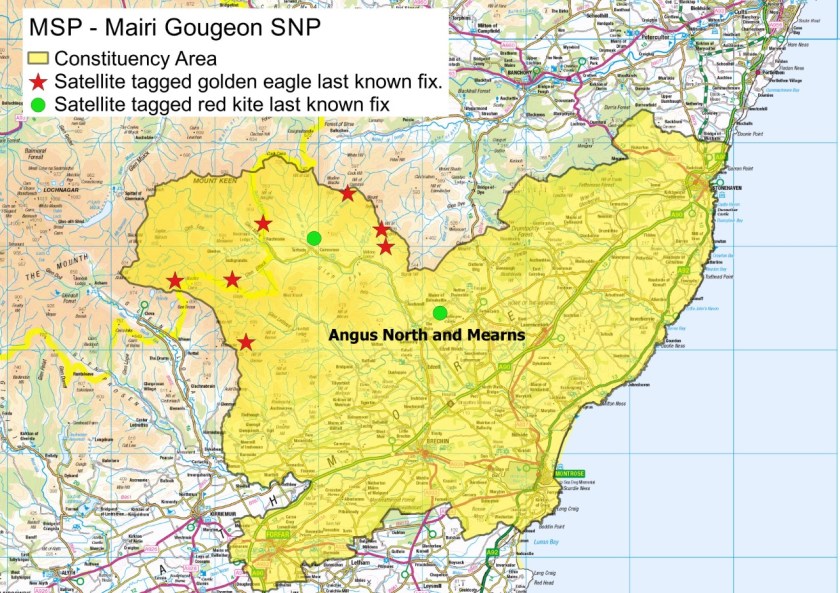
  • No ‘stopped no malfunction’ last fixes [i.e. abruptly ‘disappearing’ eagles] were within 1 km of an operational wind farm [see map below]. It is difficult to envisage a situation whereby a trauma sufficient to suddenly destroy a tag would allow a bird to travel afterwards for more than 1 km.
  • Moreover, records of tagged eagles close to wind farms were rare with only 0.005% of 360,711 fixes being within 150 m of an operational turbine. This indicated that even the risk of collision with a turbine blade was miniscule. Furthermore, it would add no support to a notion that technicians visiting turbines were discovering and then ‘covering up’ victims of collision, including moving dead birds away from the wind farm before, or then, curtailing the operation of the tag.
  • Overall, there was no evidence that wind farms were a direct or indirect agent of anthropogenic influence on the sudden tag failures of many young golden eagles. The reverse was more evidentially likely – that young golden eagles appeared to avoid operational wind farms.
  • Addressing the frequently heard accusation that wind farm technicians are removing and thereby ‘covering up’ the deaths of raptors that have been struck by a turbine blade, the report says: In Scotland this possibility seems remote given that: a) on incentive, the continued operation of no wind farm in Scotland is conditional on operational monitoring feedback in planning; b) technicians are not employed directly by the developer and are contracted independently by the turbine manufacturer and according to the projected lifespan of the wind farm; c) independent checks on reporting fatalities can be conducted at several wind farms by other contractors, and at least some developers (P. Robson pers. comm.) further blind-check these in staged exercises due to additional baseline legal requirements on environmental liability reporting; and d) many dead birds of prey (including tagged birds) have been routinely recorded incidentally by technical engineers and reported through several channels (e.g. Sansom et al. 2016, Urquhart & Whitfield 2016). In other words there are several checks and balances in Scotland to circumvent the possibility that carcasses of dead birds of prey would not be reported at wind farms and not disposed of once discovered (and even when relatively few birds will have been tagged). Nevertheless, our analyses were grounded to consider such a possibility; however remote.
  • Interestingly, and by contrast, from the many data sources we have received and examined, we are not aware of dead tagged raptors having being reported by managers or employees of game bird shooting estates in Scotland.

So, after trying to muddy the water with commentary about the potential impact of wind farms, even though the review has clearly shown wind farms are not implicated in the ‘disappearance’ of over 40 satellite-tagged golden eagles, the SGA’s official response to the sat tag review concludes with the line:

However, that is not an attempt in any way to detract from the report’s findings”. 

Really? That’s exactly what it looks like to us.

Presumably, then, now the SGA has been made fully aware of where the persecution hotspots are (certain grouse moors in the Angus Glens, Monadhliaths, eastern Cairngorms and north Perthshire), not to mention the other well-known persecution hotspots that didn’t feature in this golden eagle report (e.g. certain grouse moors in the Moorfoots, Lammermuirs and Lowther Hills), we can now expect to see the SGA setting up some ‘targeted solutions’ in these areas? Can’t wait.

Pair of breeding peregrines suspected poisoned, 3 chicks rescued

A pair of breeding peregrines has been found dead at a quarry in Clee Hill, Shropshire, leaving three vulnerable chicks in the nest.

Thanks to the swift actions of the Shropshire Peregrine Group, the RSPB and others, the three chicks have been rescued and are currently receiving expert care from the amazing Jean Thorpe. It is hoped they will be placed in foster nests early next week.

RSPB Investigations Officer Tim Jones has written a blog about this case here

Clee Hill is a notorious blackspot for raptor persecution. Two peregrines were poisoned here in 2010, another was found poisoned in 2011 and another was found poisoned in 2015 (see here). Tests revealed all four had been illegally poisoned with Diazinon.

Photos from the latest incident (RSPB)

Job opportunity: Project Manager, RSPB’s Hen Harrier LIFE Project

The RSPB is recruiting for a new Project Manager to run its Hen Harrier LIFE Project for the final two years of its duration.

Details of the role and how to apply can be found here

Closing date for applications is 26 June 2017.

Whoever gets this job will have some pretty big shoes to fill. Blanaid Denman has steered this award-winning project with passion, drive and outstanding professionalism. And apart from anything else, she’s an absolute star. The RSPB has been lucky to have her, and they’re even luckier to be keeping hold of her as she moves to a more senior role as Area Manager for the Northeast and Cumbria.

Here she is (on the right) with Amanda Miller collecting a National Lottery Best Education Project Award in 2014.

Well done, Blanaid, and best of luck with your next adventure!

Hen harrier brood meddling – a quick update (of sorts)

As a brief interlude from what’s going on in Scotland, we thought we’d turn our attention back to England and the Government’s bonkers Hen Harrier brood meddling scheme….

As you know, in January 2016, DEFRA published its Hen Harrier (In)Action Plan (see here). There are six ‘action’ points, including #6, a brood management (meddling) trial, where it is proposed to remove hen harrier eggs/chicks from driven grouse moors when breeding pairs have reached a certain density on that moor or on nearby moors, hatch and rear them in captivity, and then release them back to the uplands at fledging age.

As you’ll also know, last year we spent quite a bit of time trying to find out the details of this brood meddling scheme and through a series of FoIs we learned what was being planned (here), a bit more about what was being planned (here), who was likely to be involved in the practicalities of brood meddling (here), and a bit about an even more bonkers social science survey that was to run parallel with the bonkers brood meddling scheme (here).

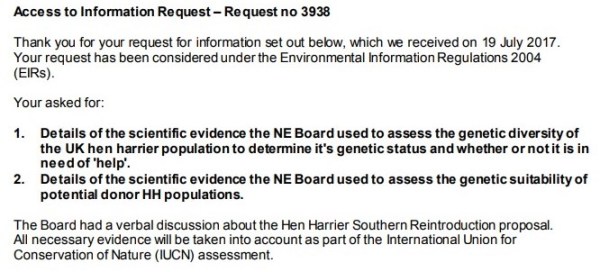
Since November 2016 it all went a bit quiet. So on 23 February 2017 we submitted another FoI asking Natural England for copies of more recent correspondence relating to the brood meddling and southern re-introduction schemes. Natural England responded on 21 March 2017 with a bit of information (see below), but told us that other information related to the wildlife licensing process had been withheld ‘as it would prejudice the process of determining the licence application and potentially the quality of that licence‘. They also told us, ‘The discussions are confidential up until the point the licence application has been determined. Once this has happened then details of the licence are available to the public‘.

Hmm.

What they did release were the notes from the 5th meeting of the Brood Meddling Project Team, held on 2 February 2017, see here: HH Brood meddling team meeting_No5_2Feb2017 (not especially informative) and a copy of an email from Philip Merricks (Hawk & Owl Trust) to Rob Cooke (Natural England) dated 31 January 2017:

Apart from being amused at Philip’s delusional expectation that criticism of brood meddling will cease once brood meddling actually begins, the information contained within the second paragraph is actually quite useful. We presume James Cross is the same James Cross who is listed as the chief executive of Natural England – take note that at the end of January 2017, James Cross and Teresa Dent (GWCT) were anticipating the imminent submission of a ‘BM application’, which we assume is a brood meddling licence application (although of course we could be wrong). The relevance of this date will become clear in a minute….

So, having had our FoI rejected in February 2017, we thought we’d give it a couple of months to allow time for Natural England to get the licence application sorted out – we know that the plan was for brood meddling to begin in the 2017 breeding season (assuming they can find any active nests on any grouse moors) and we assumed from Merricks’ email that the submission of the licence application was expected to be imminent in January/February 2017.

Three months later on 29 May we submitted a further FoI to Natural England, asking for all the relevant information about HH brood meddling, assuming the licence application had now been sorted. On 31 May we received this response:

The application you refer to is still being determined. I’m afraid that we do not have an estimate of when it will be. With that in mind, would you like to withdraw your request, and submit it at a later date?

Eh? The licence application is still to be determined? At the end of May, when any brood meddling, if it’s going to happen this year, would probably start in May/June? Isn’t that cutting it a bit fine?

And Natural England doesn’t have an estimate of when the licence application will be determined? Eh? Isn’t Natural England the licensing authority for this, er, Natural England-led project? And they can’t say when they’ll decide to licence their own project?

Is it just us or does this all sound a bit dodgy? Is anybody else convinced by this or is it Natural England once more bending the truth when it comes to hen harriers?

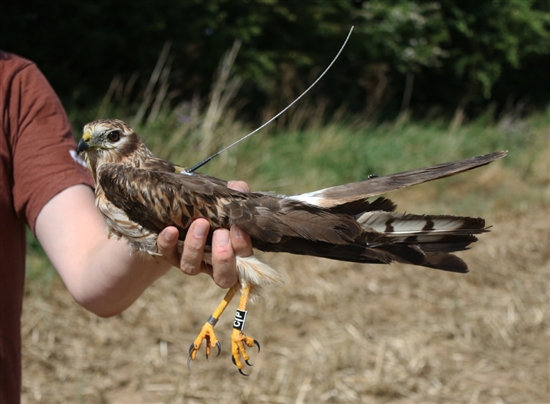
Photo of hen harrier by Mark Hamblin

Scottish Government announces significant action in fight against raptor persecution

Today is an historic one in the fight against illegal raptor persecution in Scotland. This is the day that the Scottish Government has finally agreed to take bold, innovative action against a criminal sector of society that has got away with so much for so long.

This afternoon, Cabinet Secretary for the Environment, Roseanna Cunningham, has announced a package of measures to tackle wildlife crime, and specifically the illegal killing of protected birds of prey on some driven grouse moors.

This package has been triggered by the publication of the much anticipated review of golden eagle satellite tag data, which shows clear evidence of deliberate and sustained illegal raptor persecution over a number of years.

Here is a copy of the report: Analyses of the fates of satellite tracked golden eagles in Scotland

Here is a brief summary of the review’s findings:

We will be blogging about this review extensively in due course, but for now, have a look at these maps we’ve created. The first one shows the locations of the last known fixes of satellite-tagged golden eagles that have disappeared in suspicious circumstances across Scotland, and the second map zooms in on some significant clustering on several driven grouse shooting estates in and around the Cairngorms National Park (including the Monadhliaths, Angus Glens and North Perthshire).

NB: These maps are copyright of RPUK and may not be reproduced without written permission

In response to this latest evidence demonstrating the appalling scale of illegal raptor persecution, the Cabinet Secretary has announced the following measures designed to protect birds of prey, the wider Scottish environment and the reputation of those who abide by the law:

We will comment on each of these measures in due course when we’ve had time to consider the implications. As an immediate response, we very much welcome the majority of them, but we’re disappointed that the SSPCA will not be given increased investigatory powers. Nevertheless, we are delighted to see both long and short-term action, which is exactly what we asked for.

Roseanna Cunningham said:

This day has been a long time coming. Many, many people have been involved in this protracted battle for several decades and each and every one has played an important part. From the highly skilled raptor fieldworkers, to the RSPB and particularly its Investigations and behind-the-scenes advocacy teams, to the academics who have analysed and published the scientific data, to the campaigners who have brought this scandal to the attention of the wider public. It is the efforts of all of these people combined that has influenced public opinion and brought us to this watershed moment.

We would like to pay tribute to Cabinet Secretary Roseanna Cunningham. Be under no illusion about the strength and power of the dark forces that have influenced and manipulated this situation for so many decades. It takes considerable courage to go up against that and we applaud her all the more for it. Please, take the time to send her a message of thanks and let her know that you welcome and support her announcement. Emails to: CabSecECCLR@gov.scot

RESPONSES & MEDIA COVERAGE

Scottish Government statement here

RSPB Scotland press statement here

Blog from RSPB Scotland’s Head of Investigations, Ian Thomson here

Scottish Land & Estates press statement here (PS. they’re still in denial)

Scottish Gamekeepers’ Association statement here (still clinging on to the wind farm myth)

BBC News here

Cairngorms National Park Authority statement here

Herald here

Independent here

UPDATE 5 June 2017: Our analysis of the SGA’s response here

Gift of Grouse issues statement on game shoot licensing proposals

As you know, last week the Scottish Parliament’s Environment Committee voted to recommend that the Scottish Government undertakes further exploration for the introduction of a licensing system for driven grouse moors (see here).

The game-shooting industry responded with a joint statement that included a set of proposals for ‘reform’ – none of which included licensing and basically just called for the maintenance of the status quo (see here).

Wildlife conservationists responded to the Environment Committee’s decision with a joint statement that included the offering of an olive branch to “forward-thinking representatives” and “progressive elements” of the game-shooting industry (see here).

Now the Gift of Grouse has responded with this statement, written by Tim (Kim) Baynes (Director of SLE’s Scottish Moorland Group):

WILDLIFE CRIME: PARTNERSHIP, PREVENTION AND PUNISHMENT IS THE WAY FORWARD

The shooting community was pleased to see the press release from RSPB, Scottish Raptor Study Groups and the Scottish Wildlife Trust calling for a progressive partnership. The press release marks a welcome change from some of the recent comment and allegations and backs up our community’s approach, embodied in the set of proposals put to the ECCLR Committee on 19th May and noted in the Committee’s decision on 23rd May to write to the Cabinet Secretary.

All six organisations have working relationships with RSPB, SRSG and SWT in certain areas and we are all conservationists – we just take different management approaches.  Many raptor study volunteers help estates and vice versa.  We work with RSPB on many projects,  for instance the South Scotland Golden Eagle Project, and we have a long standing relationship with SWT.  There is much more to unite than to divide, but we do need to resolve the issue of bird of prey persecution and put it into context.

The issue is not one of raptor “body counts” which all acknowledge is now at a historically low level.  It is about what might be happening unseen, with areas of relatively low populations of certain raptor species raising suspicion.  We are very keen to work with SNH, and any other organisation with constructive intentions, to find out more about these areas and have welcomed the Government’s satellite-tagging review to get clarity on all the conflicting facts and comment.

We have been disappointed at the muddled thinking behind the petition for a licensing system.  Initially it was for all types of game shooting, but soon became clear that it was really another attack on driven grouse moors.    The idea of licensing specific types of shoot management or parts of land holdings in multiple use has not been thought through either in terms of practicality, collateral impact, unintended consequences or even whether it would hit the target specifically identified by the Cabinet Secretary in her letter to the ECCLR Convenor of 7th March. The set of proposals put forward by our sector were to home in on the difficulty of evidence and enforcement which has been elusive. The solution to that is prevention, working with police, SNH and any other expert body such as RSPB and SRSG.  A storm of media coverage is trying to put pressure on Government to implement yet more regulation but that is the wrong solution. To be clear we wholeheartedly believe that a combined strategy of punishment and prevention is the most effective way forward. This would be in keeping with the view of Police Scotland in relation to all forms of crime.

If there is to be a genuine partnership, there does need to be an understanding that driven grouse shooting is an important land use in specific parts of Scotland, with benefits for many species such as waders (the subject of a major new national conservation project) black grouse and white hares – all protected species.  It is also important for rural investment, jobs and tourism which are of lesser concern to organisations with a focus on birds, but vitally important in the wider world.  Those public benefits only come with proactive management.  Walked up grouse shooting is not a solution; it may look nice superficially and is certainly an important part of our community, but it  cannot generate the income necessary to pay for long-term, sustainable moorland conservation; it is often a stage in the progression towards loss of birdlife, as can be seen only too clearly on the abandoned moors in south west Scotland or Wales.  We want the opportunity to explain these facts in a calm atmosphere so welcome the idea of a constructive partnership which could build for instance on the solid work of  Scotland’s Moorland Forum.  We also have the model of the SNH led raptor survey protocol signed in 2016 by RSPB and SRSG, which although adherence was not 100% is still a workable model, setting out what is expected of all parties, and the ability to learn lessons from it.

There needs to be a pause for reflection in the current social media frenzy. Raptor incidents are at a historically low level.  There have been difficult issues with historic cases not coming to court and a more recent problem with adherence to GL restriction order and there will be incidents which the law will deal with as appropriate, but the underlying situation has never been better and we cannot risk letting extremists force their agenda on upland management policy, which is so important for Scotland.

We look forward to arranging a scoping meeting to discuss how such a partnership can be structured.

ENDS

Before we comment on this statement, it’s worth reminding ourselves about the Gift of Grouse. This is the grouse-shooting industry’s propaganda machine that made great claims in 2015 about the number of bird species that had been recorded ‘feeding and breeding’ on three driven grouse moors – Invermark & Glenogil (both in the Angus Glens) and Glenturret in Perthshire. We blogged about these claims (here) and we made repeated requests to see the actual data/reports (as did others – e.g. Andy Wightman here), but all to no avail. The Gift of Grouse refused to publish the reports and instead pointed everyone to a summary, written by The Gift of Grouse and not by the ecological consultants who had conducted the surveys. Indeed, on the back of these apparent survey results, the Gift of Grouse even held a prestigious Parliamentary reception at Holyrood, hosted by Graeme Dey MSP on 23 November 2015,  with wide media coverage, to “celebrate diversity through grouse moor management“.

A year later, the ecological consultants published their report and surprise surprise, it turned out that the Gift of Grouse had, how shall we put this, ‘somewhat embellished’ the results (see here).

The Gift of Grouse has also made the unbelievable claim that raptors are ‘thriving’ on Scottish grouse moors (see here); a claim refuted by RSPB Scotland as “risible, make-believe tosh” (see here).

Going by their track record then, the Gift of Grouse’s latest statement should come as no surprise. Once again, Tim (Kim) tries to deny the prevalence of illegal raptor persecution, saying it’s ‘at a historically low level’ (it isn’t) and suggests it needs to be ‘put in to context’, which implies that the extent of raptor persecution has been exaggerated. He just doesn’t get it, does he? The context is there for all to see, and has been for several decades. How many scientific surveys, reports and reviews do we need? We’ve said this so many times but we’ll repeat it, again:

Systemic, illegal raptor persecution on intensively managed driven grouse moors is having population level impacts on several raptor species (e.g. golden eagle, peregrine, hen harrier, red kite). These aren’t the embellished results of some crappy, one-off, four-day ‘survey’ conducted in snow, rain and hail by a bunch of German students (which is the Gift of Grouse’s idea of sound evidence); they are the findings of multiple, long-term, rigorously conducted, peer-reviewed scientific studies published in high quality academic journals. To continue to deny this wealth of evidence is as bone-headed as President Trump’s denial of climate change data. Tim (Kim) does say that the industry has ‘welcomed’ the Government’s satellite-tagging review – it’ll be interesting to see whether the industry ‘welcomes’ the findings of that review, which is due to be published imminently, and is expected to demonstrate, once again, that satellite-tagged raptors ‘disappear’ with disproportionate regularity in certain areas where intensively managed driven grouse shooting is the predominant land use.

Tim (Kim) claims that ‘prevention and punishment’ is the way forward, not licensing. That might have been the way forward 63 years ago when raptors were given protected status but this approach has patently failed, which is why we’re in the position we are today. The game-shooting industry has been unsuccessful at reigning in the criminal element within its ranks – indeed, these criminals have often been shielded and defended by the industry. How many of these raptor-killing criminals have ever been reported to the Police by industry representatives? The industry has been gifted opportunity after opportunity after opportunity to clean up its act and yet still the illegal killing continues. Stamping their feet and shouting ‘it’s so unfair’ just doesn’t cut it anymore.

Tim (Kim) also suggests that the licensing petition ‘was really another attack on driven grouse moors’. Actually, it was nothing of the sort. As Tim (Kim) acknowledges, the petition called for the licensing of ALL types of game bird shooting; it was the politicians on the Environment Committee who honed in on driven grouse shooting (because that’s where the majority of illegal raptor persecution takes place), not the petitioners. And actually, Tim’s (Kim’s) derision about licensing only ‘specific types of shoot management’ could well backfire during the forthcoming inquiry. If it’s an impractical solution, as Tim (Kim) suggests, the political decision-makers could well turn the licensing proposal back on to ALL types of game bird shooting and not just driven grouse shooting, which we’d be very happy with.

And then finally, Tim (Kim) draws his thesis to a close with this:

There needs to be a pause for reflection in the current social media frenzy…….The underlying situation has never been better and we cannot risk letting extremists force their agenda on upland management policy, which is so important for Scotland“.

It’s not the first time he/his organisation has complained about too much media coverage of raptor persecution (e.g. see here) and he needs to understand that coverage is high because it reflects the huge level of public, and now political, concern about the persistence of these abhorrent crimes in 21st Century Scotland. If nobody cared, nobody would read it and thus nobody would bother writing it. More and more people are being made aware, they are incredulous that not only does this continue but that it has been allowed to continue without proper regulation, and as a result, media coverage is only going to increase – this is not going away, Tim (Kim).

Oh, and by the way, we’re not ‘extremists’ and it’s pretty distasteful to label us as such in the week when an actual extremist blew up himself and 22 others in Manchester. We, and everyone else, including those politicians on the Environment Committee who voted to progress the licensing petition, are law-abiding, rational human beings who expect to see the law upheld and criminals brought to justice. That’s as ‘extreme’ as we get.

Letter from Environment Committee Convener to Cabinet Secretary re: game shoot licensing

Last week the Scottish Parliament’s Environment Committee voted in the majority to write to the Environment Secretary recommending a Government-led exploration, with stakeholders, in to the implementation of a licensing regime for game bird shooting (here).

The Environment Committee’s Convener, Graeme Dey MSP, has wasted no time in getting on with it as the following day he wrote to Cabinet Secretary Roseanna Cunningham. Here is a copy of his letter:

We’ve taken it as a given that the Cabinet Secretary will agree to the Committee’s recommendation because it’ll reflect badly on the Government if she rejects it, and why would she reject it given the overwhelming evidence on which the Committee based its decision? However, nothing is certain until Roseanna responds in writing to the Committee, and the deadline for this has been set as Wednesday 21 June 2017.

For those who missed it, the video of the Environment Committee’s discussions about how to proceed with this licensing petition can be watched here (starts at 1:04:05) and the official transcript of proceedings can be read here (starts on page 21).

We’d highly recommend watching the video and/or reading the transcript, if only to see Alexander Burnett MSP (Conservative, Aberdeenshire West) claim, “Game bird licensing would apply to the whole of Scotland and would also cover pheasant, partridge and duck shoots, in relation to which there has been no suggestion of wildlife crime“. Er, doesn’t Alexander represent the very same constituency where gamekeeper George Mutch was convicted in a high profile trial (he subsequently became the first gamekeeper to be jailed for raptor persecution crimes) on the pheasant-shooting Kildrummy Estate?

Buzzard found shot dead in Yorkshire Dales National Park

North Yorkshire Police are appealing for information following the discovery of a dead buzzard.

It was found by a farmer in a field off Hawthorns Lane, Gordale, near Malham in the Yorkshire Dales National Park. An x-ray revealed a shotgun pellet lodged in the bird’s head.

Police appeal for information here

The Grough website is also carrying an article about this dead buzzard and has included details of other recently-killed raptors and associated wildlife crime within this National Park:

‘The bird’s death is the latest in a number of incidents of raptor persecution in the Yorkshire Dales. A buzzard that was found with gunshot wounds in the Cowgill area in Dentdale earlier this month and taken to a veterinary centre, where it was expected to make a full recovery.

A tagged hen harrier that went missing in upper Swaledale in December last year and a shot peregrine falcon was found near Grassington in October.

In July, North Yorkshire Police admitted it had been wrong not to pursue a prosecution through the courts of a junior gamekeeper who admitted setting illegal cruel traps on the Mossdale Estate near Hawes. He was given a police caution for the offence.

The incident prompted the Yorkshire Dales National Park Authority chairman Peter Charlesworth to say: “At a time when the Yorkshire Dales is receiving such widespread recognition as a wonderful place to visit, it’s incredibly disappointing that the criminal persecution of birds of prey continues to damage the reputation of the area.

“We know that birds of prey are a big attraction to the millions of visitors that come here, so these acts are causing economic damage as well as appalling harm to wildlife.”’

Peregrine found shot in Ninfield, East Sussex

Press statement from Sussex Police, 25 May 2017:

A protected peregrine falcon has been found shot in Ninfield, East Sussex, sparking an investigation by police and the RSPB.

The bird – a female – was discovered alive but injured by woods at Lunsford Cross on 10 May, and staff from East Sussex Wildlife Rescue & Ambulance Service were called to recover the bird.

An X-ray revealed a recent fracture to its right wing consistent with a shot injury. While undergoing examination, a further three shot gun pellets were discovered: two in the bird’s stomach and one in its left wing. These were considered historic and the vet concluded that the bird had also been shot at an earlier date.

The peregrine has undergone surgery and is recovering at the rescue centre.

Daryl Holter, Wildlife and Heritage Officer for Sussex Police, has urged anyone with information about the incident to come forward.

He said: “Peregrine falcons are a protected species under Schedule 1 of the Wildlife and Countryside Act. It is an offence to intentionally take, injure or kill a peregrine. To shoot it in this way was a vile and senseless act. Had the injured bird not been found it would almost certainly have faced a lingering death, possibly through starvation.”

Chris Riddington from East Sussex Wildlife Rescue said: “The bird is incredibly lucky to have been found and we are liaising with experts with regards to its care. It is still uncertain whether the fracture will heal, but our vets are happy with its progress. It’s hard to believe anyone would shoot a bird – but this is becoming far too common in today’s society. These birds are shot and left to suffer and we have to pick up the pieces.”

Jenny Shelton, RSPB investigations liaison officer, said: “It is appalling to hear that someone has shot a peregrine falcon – a bird which is already of conservation concern in the UK. Peregrines are magnificent, agile birds and will be breeding at this time of year, so taking out this young female may impact her chances of producing young this year.

This incident is part of an ongoing problem with raptor persecution in the UK. This is the fifth report of a peregrine with shotgun wounds we have received already this year, but as yet no-one has been brought to account. This, as most people would agree, is simply not acceptable.”

If you have any information relating to this incident, contact Sussex Police online, email 101@sussex.pnn.police.uk or phone 101, quoting serial 420 of 19/05. Alternatively contact Crimestoppers anonymously on 0800 555 111.

If you find a wild bird which you suspect has been illegally killed or harmed, contact police or RSPB investigations on 01767 680551, or fill in the online form here