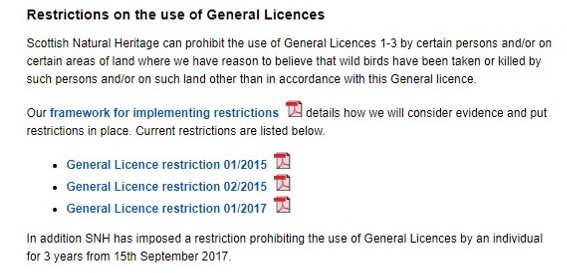
Further to this morning’s blog about the mystery gamekeeper from north east Scotland who was filmed allegedly setting an illegal trap near a goshawk nest and who has subsequently been slapped with a General Licence restriction order by SNH, but whose name and employment details have been withheld.
Who could he possibly be and where, exactly, did this take place? There are some clues….
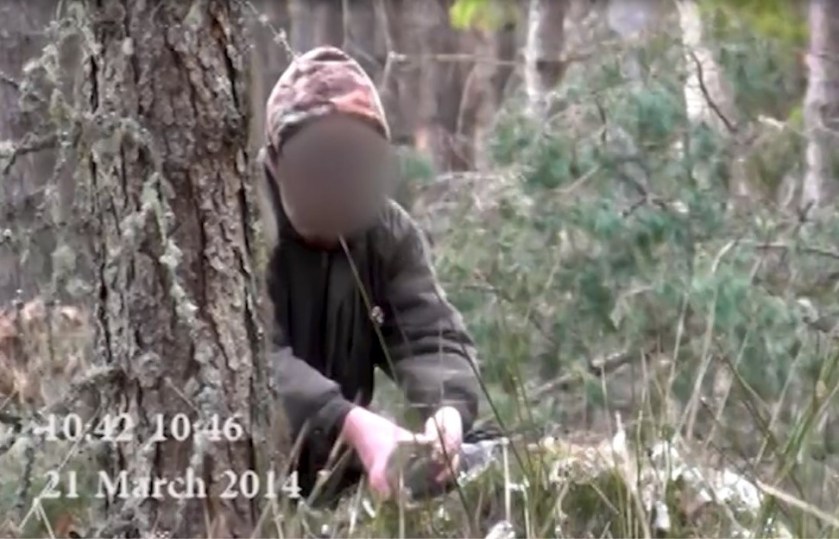
Have another look again at the short video clip of this gamekeeper in action, released by RSPB Scotland:
The video is date stamped: 21 March 2014.
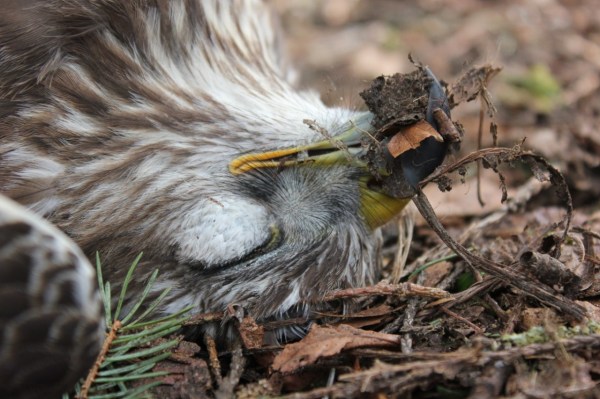
Now have a look at RSPB Scotland’s 2014 persecution report, and note the confirmed incident of raptor persecution recorded in March 2014 relating to the setting of spring traps (with pigeon bait) on a plucking post close to a goshawk nest:
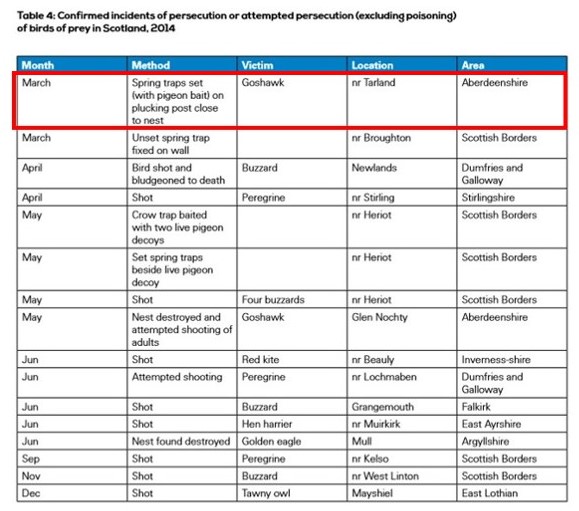
The location is given as ‘nr Tarland, Aberdeenshire’.
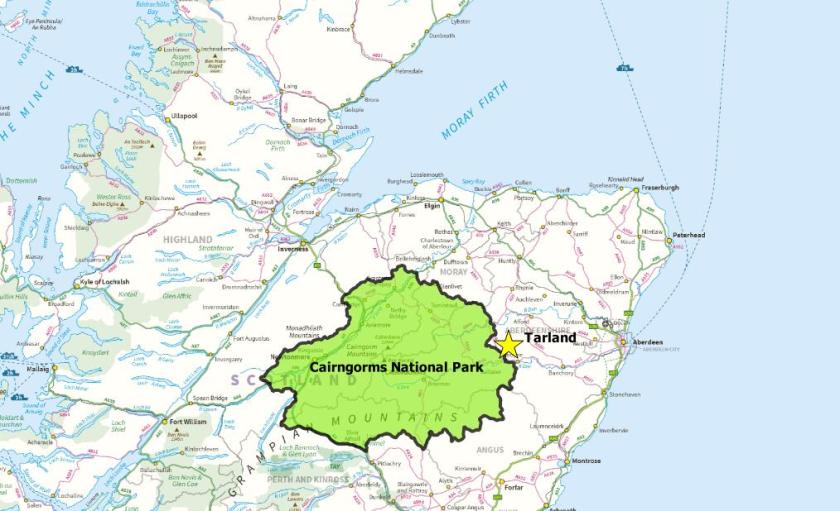
Where’s Tarland? Here it is, just to the east of the Cairngorms National Park boundary:
If we accept that the gamekeeper caught on video was allegedly trying to target a goshawk with an illegal trap, the motive for doing so would most likely be to protect game birds from predation. This is illegal, of course – goshawks have been legally protected since 1954, but as we know only too well, this doesn’t stop some gamekeepers from trying to kill them.
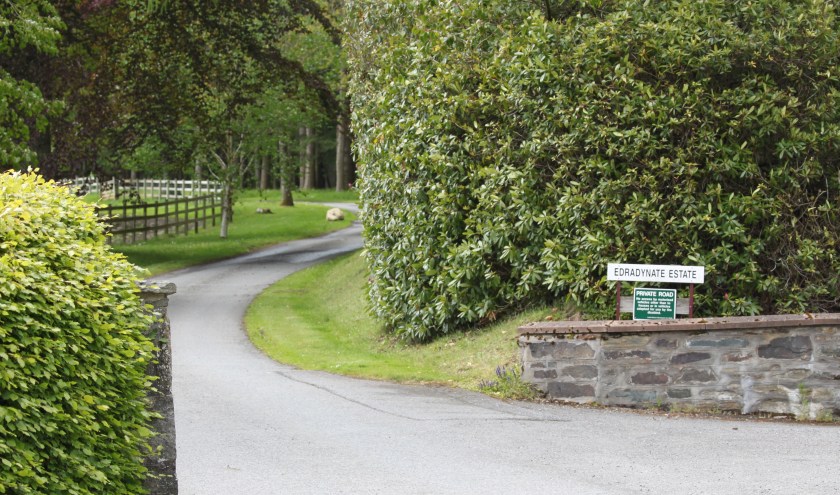
So we thought we’d look at how many game shooting estates are located ‘nr Tarland’. It’s a pretty vague location but consulting Andy Wightman’s brilliant Who Owns Scotland website, it turns out there are three big game-shooting estates in the area that could, reasonably, be defined as being ‘nr Tarland’: the MacRobert Trust Estate, the Tillypronie, Deskrie and Towie Estate, and the Dinnet Estate. There is also an area of ‘dead ground’ whose ownership is not included on Andy’s website, although we do know that GWCT’s new demonstration farm, Auchnerran, sits in this ‘dead ground’.

This map is useful, but it doesn’t really help draw many conclusions. What we can say is that all three estate owners would be both horrified, and embarrassingly compromised, if it turns out that this gamekeeper was employed by, or associated with, any of the estates.
The MacRobert Trust Estate is, as the name suggests, administered by a well-respected charity and the estate website suggests ‘an exemplary approach to estate management‘. There is a pheasant shoot here, which was advertised as a three-year ‘prestigious sporting lease’ in 2010.
The Tillypronie Estate was owned, at the time of the video recording, by Philip Astor. The estate, described as ‘One of Scotland’s most famous sporting estates’, went on the market last year valued at a cool £10.5 million and is now believed to have been sold to a ‘mystery buyer’. Gosh, there’s a lot of mystery in this part of the world, isn’t there? There is pheasant and grouse shooting here. Phil is a Vice Chairman of the GWCT.
The Dinnet Estate has long been owned by the Humphrey family and there is a designated National Nature Reserve on the estate, managed by SNH. A Dinnet Estate gamekeeper was convicted in 2006 of trespassing on a neighbouring estate with a firearm back in 2002 but that was a long time ago. A Dinnet Estate grouse moor was mentioned on this blog last month as being a potential location of satellite-tagged hen harrier Calluna’s last tag transmission but there’s been no further news on that. Dinnet Estate is a direct neighbour of the GWCT’s demonstration farm, Auchnerran, and the Dinnet Estate grouse moor is summer-grazed by some of GWCT’s sheep.
Given the GWCT’s indirect links and direct interests in the area ‘nr Tarland’, they must be concerned about the General Licence restriction being applied to a local, unnamed gamekeeper. If we ran an upland farm in the area, and were setting out to demonstrate good conservation benefits for both agriculture and wildlife, we too would be concerned. What if we employed him without knowing any of his history?
Shall we ask the GWCT for a comment? Perhaps, given their local contacts, they know something we don’t? Emails to: info@gwct.org.uk
May be all will become clear when we submit an FoI to SNH asking for further details about this particular General Licence restriction, although we’re not holding our breath!
Another avenue for information-seeking might be Police Scotland. We know from the RSPB’s press release that the police were investigating this alleged crime, so presumably the police know the name of the gamekeeper and where, exactly, this allegedly illegal trap had been filmed. Given that the case is now time-barred, meaning that the Crown Office couldn’t prosecute even if they wanted to (highly doubtful), there is no reason why Police Scotland can’t release relevant details as there’s no chance of it interfering with a live case. Let’s ask them. Emails to National Wildlife Crime Coordinator for Police Scotland, Andy Mavin: andrew.mavin@scotland.pnn.police.uk