Blog

Convictions for raptor persecution “must be the tip of the iceberg”, admits BASC chief

Further to this morning’s blog about BASC’s acting chief exec Christopher Graffius urging his members to stop killing raptors (here), here’s some more detail.

The Times article had suggested that Christopher had written a letter to BASC members, in response to the publication yesterday of the RSPB’s 2016 Birdcrime report. It turns out that ‘letter’ was an opinion article in the Nov/Dec 2017 edition of BASC’s magazine, Shooting & Conservation:

For those struggling to read the small text, here’s a PDF of the article:

Christopher Graffius BASC Raptor Persecution threatens us all_Nov2017

How refreshing to see a senior member of the shooting industry acknowledge that convictions for illegal raptor killing “must be the tip of the iceberg“.

He writes: “I know it’s not all keepers, but the figures of those caught and convicted must be the tip of the iceberg and in 2017 the cases continue: a buzzard and a red kite in Yorkshire, a peregrine in Cambridgeshire, a buzzard in Hertfordshire, a peregrine in Lancashire, a red kite in Northern Ireland, a peregrine in Suffolk and a short-eared owl in Scotland. Those are some of the confirmed cases of shooting in the space of three months from July“.

This comes after years and years and years of denials from ‘leaders’ within the game-shooting industry who have argued that raptor persecution is an ‘historical’ problem and everything’s just fine now (e.g. see here and here).

Well done, Christopher Graffius. Until now, the shooting industry’s collective denial has been one of the main reasons (along with poor enforcement of the law) for the failure to make progress on this issue – there’s no point having dialogue with those who won’t admit there’s even a problem.

Is this the beginning of a new start? Time will tell….although the industry doesn’t have that much time left before change is enforced….

“There are criminals among us” – BASC chief condemns raptor killers

Christopher Graffius, acting chief executive of the British Association of Shooting & Conservation (BASC) has spoken out against the raptor killers within the shooting industry, according to an article in today’s edition of The Times.

For those who can’t read the small text, here’s a transcript:

SHOOTING CHIEF GUNS FOR RAPTOR KILLERS

By Jerome Starkey, Countryside Corrrespondent

For years shooting enthusiasts had refused to accept that some of the sport’s devotees were targeting endangered birds of prey.

Now the country’s biggest shooting group has broken ranks and admitted that its members have been killing harriers and falcons.

Christopher Graffius, acting chief executive of the British Association of Shooting and Conservation (BASC), said that killing the birds to protect pheasants and grouse was a “fool’s bargain” that his members had to stop or risk their sport being banned.

In a letter to his organisation’s 150,000 members he said that there were “criminals among us” who risked “wrecking shooting for the majority“.

All of us need to realise that the killing of raptors is doing us no favours. It risks terminal damage to the sport we love“, he said.

He made the comments after the RSPB’s annual Birdcrime report found that 81 raptors, including buzzards and kites, were killed last year. The charity blamed gamekeepers for trapping, poisoning and shooting the birds and called for driven grouse shoots to be licensed so that they operated “legally and sustainably”.

Mr Graffius said that expelling members who were convicted of raptor persecution was not enough. Shooting needed a cultural shift to make such people pariahs. “Peer pressure is a powerful force in shooting. We must make clear that wildlife crime has no place in our community“, he said.

Mr Graffius, 59, was appointed acting chief executive last year after his predecessor as head of BASC, Richard Ali, was suspended and then sacked over allegations of bullying.

Mr Graffius said that the Conservatives, Labour and the Liberal Democrats had all raised concerns about raptor persecution at their party conferences this year. “This should matter to everyone who shoots, and particularly the keepers, shooting tenants and landowners who rely on their living from the sport. If the killing doesn’t stop, their jobs and the income they earn from shooting is at risk“, he added.

Hen harriers are among Britain’s most endangered birds after their population fell by 18 per cent in six years. There are fewer than 550 breeding pairs left, according to the RSPB, with only four pairs in England, down from 12 in 2010.

A spokesman for the National Gamekeepers Organisation, representing those in England and Wales, said that “very few stupid keepers and landowners” broke the law. “These dinosaurs sully the good name of modern shooting, putting at risk its long-term future“, he said. “The only effective solution lies in changing the collective mindset of those involved“.

The Scottish Gamekeepers Association said that it had expelled six members in five years over alleged wildlife crime but that the majority of its 5,300 members were law-abiding. “In Scotland, the greatest issue we wrestle with is the lack of access to legal measures to solve species conflicts. We feel this would have more impact than any other measure to prevent wildlife crime“, a spokesman said.

Patrick Galbraith, the editor of Shooting Times, said that some young gamekeepers felt pressured by their employers to kill raptors. “If the shooting community refuse to admit it, the future for our sport could be bleak“, he said.

Tim Bonner, head of the Countryside Alliance, which campaigns in favour of shooting, said that historically gamekeeping techniques had devastated hen harrier populations but that there was a “generational shift” taking place towards better conservation. “It’s our role to encourage that change of attitudes“, he said.

Jeff Knott, head of nature policy at the RSPB, said that it was “good to see BASC stand out from others in the shooting community. Decisive action is certainly harder to deliver than fine words, but this willingness to lead change is to be welcomed“, he said.

ENDS

Blimey. Christopher Graffius deserves real credit here – this is the first time we can remember that one of the shooting industry’s big organisations has admitted culpability for illegal raptor persecution and condemned it with any sincerity. It’ll be interesting to see how his BASC members respond and for how long he’ll remain in post.  We welcome his comments, with some caution because they’re just words after all, but nevertheless we think that his intentions are good and this could be the beginning of a significant positional shift.

However, the responses from the gamekeeping organisations (National Gamekeepers Organisation and Scottish Gamekeepers Association) do not give cause for such optimism. It’s just more of the same old, same old – a collective denial that widespread raptor persecution continues and that when it does occur, it’s just the work of a handful of gamekeepers. Unfortunately for them, the overwhelming evidence does not support this claim.

This pie chart was published yesterday in the RSPB’s Birdcrime 2016 report:

Have a close read of the SGA’s response – they say they’ve expelled six members in five years for ‘alleged wildlife crimes’, suggesting that these wildlife crimes might not actually have happened, even though those gamekeepers were expelled precisely because they had been convicted in a court of law. They had criminal convictions for actual raptor persecution crimes, not alleged crimes.

The SGA then argues that the only effective measure to prevent wildlife crime would be to give gamekeepers licences to kill raptors, bcause then killing raptors wouldn’t be a criminal offence any more. We’ve heard this many times before – the SGA has been lobbying for years to get licences that would enable them to kill species such as buzzards, sparrowhawks, and even red kites and white-tailed eagles (e.g. see here). So far they’ve been unsuccessful, although licences have been issued to a gamekeeper in England permitting him to kill buzzards ‘to protect pheasants’, even though the licence applicant, supported by the National Gamekeepers Organisation, had a prior conviction for having a stash of illegal poison.

Let’s hope that other industry chiefs follow Christopher Graffius’ example and start to apply pressure across the whole shooting community. He’s seen the writing on the wall and knows that the continued illegal killing of raptors will bring the game-shooting industry to its knees. Time’s running out……

UPDATE 11.45: Here’s a copy of the ‘letter’ from Christopher Graffius to BASC members to which The Times journalist refers. It’s actually an article from BASC’s Nov/Dec newsletter, Shooting & Conservation:

Christopher Graffius BASC Raptor Persecution threatens us all_Nov2017

Reactions to RSPB’s 2016 Birdcrime report: compare & contrast

Following this morning’s publication of the RSPB’s 2016 Birdcrime report (see here), it’s fantastic to see such widespread media attention on the continued illegal killing of birds of prey in the UK.

Guy Shorrock (RSPB Investigations) gave a cracking interview on BBC Breakfast (available to watch on iPlayer here, but only for the next 24hrs. Starts at 1:50:10).

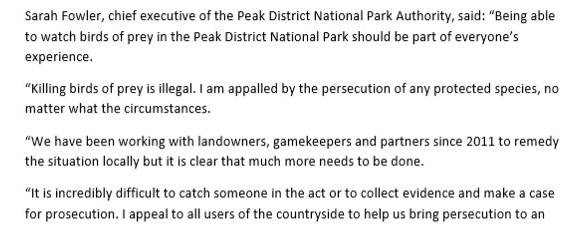
Given North Yorkshire’s atrocious track record (again) for illegal raptor killing, we were particularly pleased to read a statement from the Chairman of the Yorkshire Dales National Park Authority (YDNPA), which is featured prominently on the YDNPA website:

We should expect this level of condemnation from a National Park Authority as a given, but the fact we’re even blogging about it shows how rare an occurrence this is. But it’s very, very welcome, and probably a reflection of how public opinion is forcing the YDNPA to take note and act.

Kudos to Carl Lis – he clearly ‘gets it’ (see his reference to an increase in successful nests being the only indicator of real progress) and he didn’t have to say anything at all, let alone post it on the National Park website. Well done that man.

But not everybody’s happy about today’s high media coverage. In contrast to the statement from the YDNPA Chair, have a look at the Countryside Alliance’s twitter response to the publication of the Birdcrime 2016 report (interestingly, this hasn’t been published on the CA’s website):

It’s not the first time, and probably won’t be the last, that the Countryside Alliance has criticised the RSPB’s annual Birdcrime report. In 2014 they made a formal complaint to the Charity Commission. The Charity Commission rejected the complaint outright – well worth a read (see here).

Does anyone believe this organisation is intent on stamping out illegal raptor persecution? Perhaps if they put as much effort in to this as they do trying to silence the RSPB, or trying to get Chris Packham sacked just because he speaks out about wildlife crime, we might actually start to get somewhere.

RSPB publishes Birdcrime 2016 report

Press release from RSPB:

REPORT REVEALS CONTINUED PERSECUTION OF BIRDS OF PREY IN UK

  • RSPB’s Birdcrime report reveals a minimum of 81 confirmed incidents of bird of prey persecution in the UK during 2016, but many illegal killings are going undetected or unreported.
  • There were no prosecutions for these persecution offences, the first time this has happened in 30 years.
  • Illegal killing is not only robbing people of the chance to see birds of prey in the UK but has serious consequences for their populations.
  • The RSPB is calling for police and other enforcing authorities to make full use of all existing powers to protect birds of prey as well as the introduction of a licensing system for driven grouse shooting to ensure shoots are operating legally and sustainably.

Without urgent action some of UK’s birds of prey face a bleak future after the latest Birdcrime report revealed a minimum of 81 confirmed incidents of illegal raptor persecution in 2016, without a single person prosecuted.

Birdcrime 2016 – the only report summarising offences against birds of prey in the UK – revealed 40 shooting, 22 poisoning, 15 trapping and four other incidents of illegal persecution against raptors. Among the victims were hen harriers, peregrine falcons, red kites and buzzards. However, evidence suggests these figures are just the tip of the iceberg with many illegal killings going undetected or unreported.

[Photo: this Marsh harrier was found shot next to a partridge release pen on a shooting estate in Yorkshire. Image via Jean Thorpe]

The report also revealed close to two-thirds (53) of the confirmed incidents took place in England, with particular concern for raptors in North Yorkshire. Over the last five years the county recorded the highest number of confirmed bird of prey persecution incidents in the UK, with 54 incidents since 2012 and 19 last year alone.

The problem wasn’t confined to England, with the report highlighting confirmed cases in Wales, Northern Ireland and Scotland, where there is growing concern over the repeated suspicious disappearance of satellite tagged birds of prey. This year, a study by Scottish Government examined the fate of 131 golden eagles fitted with satellite tags between 2004-16 concluding that ‘as many as 41 (one third) disappeared, presumably died, under suspicious circumstances connected with records of illegal persecution.’

Increasingly, people in the UK are being robbed of the chance to see these spectacular birds because of these illegal incidents, yet in 2016, there wasn’t a single prosecution arising from a confirmed incident, the first time this has happened in 30 years.

Martin Harper, RSPB Conservation Director, said: “Birds of prey bring our skies to life. There is nothing like seeing a diving peregrine or a skydancing hen harrier. The sights of these spectacular birds are something we should all be able to enjoy, unfortunately illegal activity is stopping this and preventing the birds from flourishing. There are laws in place to protect these birds but they are clearly not being put into action. We need governments across the UK to do more to tackle illegal killing to protect our raptors for future generations to enjoy.”

Previous research has shown that illegal killing of birds of prey is associated with land managed for intensive driven grouse shooting, leaving vast areas of our uplands without raptors. A Natural England study revealed ‘compelling evidence’ that persecution of hen harriers – associated with driven grouse moors – was the main factor limiting their recovery in England.

The RSPB believes the introduction of a licensing system for driven grouse shooting would help tackle the ongoing illegal persecution that occurs on these grouse moors. This would also help tackle the wider problems of intensive management of ‘big bag’ driven grouse shooting, like the draining of and burning on fragile peat bogs. A fair set of rules in the form of a licensing system could help ensure shoots are operating legally and sustainably and introduce the option of restricting or removing a licence in response to the most serious offences, for example where staff on an estate have been convicted of illegally killing birds of prey.

The RSPB welcomes a recent announcement by Scottish Government that will see an independent panel established to review options for regulation of grouse shooting and to look at the economic and environmental costs and benefits of the industry.

Bob Elliot, RSPB Head of Investigations, said: “This latest Birdcrime report continues to highlight that in the UK we have a major issue with birds of prey being deliberately and illegally killed, despite having full legal protection. This type of crime has serious consequences for the populations of species, such as the hen harrier, and we must see a change in attitude and more effective law enforcement to protect these birds for years to come.”

ENDS

Read the online Birdcrime 2016 report here

Birdcrime 2016 data appendices here

Well done to the RSPB Investigations Team for once again compiling and publishing these annual data, which help to dispel the oft-cited myth from the game-shooting industry that raptor persecution ‘is a thing of the past’. Have a look at this useful graph and draw your own conclusions – the data don’t lie, unlike the game-shooting industry:

Of course, it comes as no surprise that those within the bird shooting industry would want to mislead the public – as this pie chart reveals, gamekeepers are responsible for the vast majority of UK raptor persecution crimes:

The county of North Yorkshire once again comes top of the raptor-killing leader board, way ahead of every other county. Many of these crimes have taken place on driven grouse moors:

Tune in around this time next year, to read more of the same. Nothing has changed and nor will it change until the filthy and unregulated driven grouse shooting industry has been closed down. You can help hasten its demise by signing this e-petition calling for a ban: please join over 10,000 others and sign here.

MEDIA COVERAGE

BBC Breakfast news: Great interview with Guy Shorrock (RSPB Investigations). Available on iPlayer but only for 24 hrs (starts at 1:50) here

BBC news: here

New Scientist: here

Guest blog by Bob Elliot, Head of RSPB Investigations: here

Daily Telegraph: here (including a quote from Amanda Anderson, Moorland Association)

The Times: here (behind paywall)

The York Press: here

Statement from Yorkshire Dales National Park Authority: here

Yorkshire Post: here

UPDATE 1.30hrs: Reaction to RSPB’s 2016 Birdcrime report, compare & contrast (here)

Video of THAT Chris Packham talk at Birdfair 2017

The three-day-long British Birdfair takes place annually at Rutland Water in August and attracts thousands of visitors from around the world. Every year, Chris Packham is given a prime time Saturday morning slot in the huge Events marquee, to talk about whatever he likes.

This year, Chris used his slot to highlight the ongoing work to tackle the illegal killing of birds in Malta, Cyprus and the UK – work he personally has been involved with for a number of years – and he generously invited a number of us (film maker Ruth Peacey from LUSH, Mark Sultana from BirdLife Malta, Andrea Rutigliano from the Committee Against Bird Slaughter (CABS), and Ruth Tingay from Raptor Persecution UK), to help explain the situation to his audience. Mark Avery made a cameo appearance at the end.

The marquee was rammed, with an estimated 1,000 people inside and a hoard of people outside who couldn’t get in but apparently sat with their ears pressed up against the canvas trying to hear. We’re told this was unprecedented at any previous Birdfair and is undoubtedly testament to Chris’s popularity but perhaps also reflects a growing public awareness and interest in illegal bird persecution.

The standing ovation at the end of this presentation was incredibly moving for those of us on the stage. It seemed to go on forever and will stay with us all for a very long time. On behalf of all the presenters, thank you, we appreciated it. Here’s what it looked like to us (photo by Mark Avery).

For those of you who couldn’t make it to Birdfair, or for those who did make it to Birdfair but couldn’t get in to the marquee, or for those who did get in and want to re-live it, the presentation was filmed and is now available to watch on YouTube (thanks to Anneka Svenska from Green World TV).

Incidentally, Ruth Peacey has a well-deserved nomination for Conservation Hero of the Year in this year’s Birders’ Choice Awards, hosted by Birdwatch magazine. Please vote for her here.

SNH says ‘no General Licence restrictions currently under consideration’ but what about these 9 cases?

The ability for Scottish Natural Heritage (SNH) to impose a General Licence (GL) restriction order on land where there is evidence of raptor persecution taking place came in to force on 1 January 2014. This measure, based on a civil burden of proof, was introduced by then Environment Minister Paul Wheelhouse in response to the continuing difficulties of meeting a criminal burden of proof to facilitate a criminal prosecution.

Whilst these GL restrictions are not without their limitations (because estates can simply apply for an individual licence instead –  see here, but also see here where SNH recently revoked an individual licence for alleged non compliance), Wheelhouse argued that as the restriction notices will be made public, they should act as a ‘reputational driver‘.

Since 1 January 2014, SNH has only imposed four GL restrictions. The first two were imposed in November 2015 (one for Raeshaw & Corsehope Estates in the Borders and one for Burnfoot & Wester Cringate Estates in Stirlingshire). Then there was a temporary halt for almost two years as Raeshaw & Corsehope Estates made a legal challenge which ended up with a judicial review in January 2017. The court’s decision was announced in March 2017 and SNH was found to have acted properly and lawfully. Since that decision was announced in March 2017, SNH has imposed two more GL restrictions: one for Edradynate Estate in Perthshire in September 2017 and one for an unnamed mystery gamekeeper in Aberdeenshire in September 2017.

Whilst we were pleased to see SNH impose these latest GL restrictions last month, we were also aware of a number of other raptor persecution incidents that have been recorded since 1 Jan 2014 that would potentially meet the criteria required for a GL restriction so we wanted to find out whether SNH was getting on with these.

Photo: an illegal pole trap filmed by RSPB Scotland on the Brewlands Estate in the Angus Glens, July 2015. These traps have been outlawed for over 100 years.

In early October we submitted an FoI to ask SNH how many cases were currently under consideration for a GL restriction. We are pretty shocked by the response received last week:

At the time of your request, no General Licence restrictions were under consideration“.

Really? Why the hell not? We know of at least nine cases that should be being considered, and these are just off the top of our heads – there will be others, as we know Police Scotland is still withholding information about a number of other raptor persecution incidents.

Here are the nine incidents we know about that have all occured since 1 January 2014 when SNH was given the power to impose a GL restriction:

Newlands Estate, Dumfriesshire. Gamekeeper William (Billy) Dick was convicted in 2015 for killing a buzzard on the estate in April 2014. He threw rocks at it and then stamped on it. The estate owner was prosecuted for alleged vicarious liability but then the Crown Office dropped the prosecution in April 2017, saying it wasn’t in the public interest to proceed (see here).

Brewlands Estate, Angus Glens. A gamekeeper was prosecuted for the alleged repeated setting of a pole trap on this estate between 9-17 July 2015. The Crown Office dropped the prosecution case in April 2017 because the video evidence was deemed inadmissible (see here). Another gamekeeper on this estate thought this result was hilarious.

Unnamed pheasant-shooting estate, Lanarkshire. In September 2015 a set pole trap was discovered on a bench directly outside a pheasant-rearing pen on an unnamed estate. Police Scotland apparently dropped the case, for unknown reasons.

Gamekeeper in Ayrshire. In May 2016 a named gamekeeper was charged after allegedly being caught using gin traps on a neighbouring farm of the estate on which he was employed. The Crown Office dropped the prosecution in March 2017 after reportedly ‘getting the dates wrong on its paperwork’ (see here).

Invercauld Estate, Aberdeenshire. In June 2016, walkers discovered a number of illegally-set spring traps staked out on a grouse moor. Two of the traps had caught a Common Gull by the legs. The bird had to be euthanised. There was no prosecution. ‘Some action’ was taken by the estate but whatever this action was it has remained a closely-guarded secret between the estate, the Cairngorms National Park Authority and the Scottish Government (see here).

Glendye Estate, Aberdeenshire. In January 2017 a number of illegally-set spring traps were discovered on a grouse moors on this estate. The Estate Factor and gamekeeper reportedly removed the traps and denied all knowledge of who had set them (see here). There was no prosecution.

Leadhills Estate, South Lanarkshire. On 4th May 2017, witnesses observed the shooting and killing of a hen harrier on this estate. Police Scotland appealed for information (see here & here). As far as we’re aware, there are no impending prosecutions.

Leadhills Estate, South Lanarkshire. On 31 May 2017, witnesses observed the shooting and killing of a short-eared owl on this estate. The corpse was retrieved and sent for a post-mortem. Police Scotland appealed for information. As far as we’re aware, there are no impending prosecutions.

Unnamed grouse shooting estate, Monadhliaths. On 7 June 2017, a member of the public found a buzzard caught in an illegally-set spring trap that had been staked out on an unnamed grouse moor in the Monadliaths. The buzzard was released. Police Scotland appealed for information. Inspector Mike Middlehurst of Police Scotland commented, “Unfortunately, there are some who continue to deliberately target birds of prey; there is nothing accidental in the setup of these traps“. As far as we’re aware, there are no impending prosecutions.

So why haven’t any of these cases been considered for a GL restriction? Is it because SNH is still waiting for Police Scotland to provide ‘formal information packages’ on these cases? (Remember, SNH can only consider potential GL restrictions based on evidence provided to them by Police Scotland). We know that Police Scotland has been slow in delivering this info to SNH in the past (e.g. see here) – are they still dragging their feet?

Or, is it the case that Police Scotland has already provided information to SNH about each of these nine cases and SNH has, for whatever reason, decided not to impose a GL restriction?

Isn’t it in the public interest to know, and importantly to understand, what is happening with these cases? We think so. And that’s why we’ve submitted an FoI to find out.

Botham crowned King of Bollocks

Congratulations to the newly-crowned King of Bollocks, Ian Botham.

Here’s his acceptance speech.

Here’s why he’s talking bollocks.

Here’s the King of Bollocks celebrating his coronation with You Forgot the Birds Board Directors George & Zippy

“I couldn’t let those words go to waste” – Finn Wilde

I couldn’t let those words go to waste“, writes 15 year old Findlay Wilde.

If you want to know what he’s talking about, and how you can get involved, have a read of Finn’s blog HERE

Scottish gamekeepers complain about alleged escalation of trap vandalism

The Scottish Gamekeepers’ Association is today complaining about an alleged escalation in the vandalism of animal traps on shooting estates.

This supposed increase has been attributed to ‘activists’ and the SGA wants the law tightened up so that the alleged perpertrators can be prosecuted.

There’s widespread media coverage about it today e.g. in The National (here), The Times (here) and on the SGA website (here).

Photo of an allegedly vandalised trap (from The National)

This isn’t the first time we’ve heard such claims. Back in 2013 it was discussed during a Rural Affairs Parliamentary Committee meeting, when then Environment Minister Paul Wheelhouse acknowledged that trap tampering might be taking place but that there was no hard evidence to show how widespread the problem might be so at that time it was considered all conjecture.

In 2015 the issue was raised again by a Fife landowner and an article in the local press suggested that “Police Scotland is reporting a rise in the number of traps being tampered with“.

We challenged that claim by looking at the results of a year-long trap tampering study carried out across Scotland by BASC between April 2014 and March 2015. The results showed that the issue was not widespread at all, but seemed to centre on a handful of local areas.

Whether the problem has increased since then is hard to tell without independently collected data. The problem might have increased. It’s not hard to understand the motivation that might lead to someone damaging a trap. It might be on animal welfare grounds (someone might see a non-target species dead in a trap). It might be because someone can’t tell whether a trap is legally or illegally-set – it’s not always easy to judge. It might be because someone objects to predator control just to maximise a landowner’s profits. Or the motivation might simply be because so many cases of illegally-set traps rarely result in a prosecution, even when a known gamekeeper has been filmed setting an illegal trap. That doesn’t make trap vandalism ‘right’, we’re just saying it’s easy to understand why it might be happening.

Photo of a young red grouse killed by a lawfully-set trap (photo by RPUK)

It’s equally plausible to suggest that some gamekeepers may be deliberately vandalising one or two of their own traps and then reporting it to the police as the work of ‘activists’ in an attempt to smear those whose campaign to put game-shooting under political scrutiny is gaining such traction.

Whatever might be happening, it’s ironic that the SGA doesn’t make this much noise when cases of illegally-set traps on game-shooting estates are reported in the media.

It’s very hard (virtually impossible) for us to sympathise with the SGA when it remains silent (or concocts outlandish alternative explanations) about the on-going abuse and use of illegal traps, by gamekeepers, to target birds of prey on game-shooting estates.

Speaking of which, we’re still waiting for the findings of the SGA’s inquiries in to who set the illegal traps that were discovered on a grouse moor on Invercauld Estate last year.

Hen harrier brood meddling: Natural England delays release of information

Two days ago we blogged about how Natural England has delayed the release of information about the proposed reintroduction of hen harriers to southern England (see here).

Today, we’re blogging about how Natural England has delayed the release of information about the proposed hen harrier brood meddling scheme.

Anyone seeing a pattern emerging here?

So, hen harrier brood meddling. As with the proposed southern reintroduction, brood meddling is one of six ‘action’ points of DEFRA’s Hen Harrier Inaction Plan, launched in January 2016.

As with everything-hen-harrier, Natural England has been reluctant to provide any information about the brood meddling scheme unless it’s been forced to do so under a series of FoI requests. Here’s what we’ve managed to drag out of them so far:

14 November 2016: Hen harrier brood management working group: what they’ve got planned (here)

15 November 2016: More brood meddling revelations (here)

16 November 2016: Brood meddling: the role of the International Centre for Birds of Prey (here)

22 November 2016: Brood meddling: the proposed social science study (here)

That information was released almost a year ago. Since then, despite repeated requests for information, Natural England has gone all secret squirrel and refused to tell us anything more about this highly controversial project.

In February 2017 we submitted another FoI asking for an update on brood meddling. NE responded in March 2017 telling us that the  information was being withheld “as it would prejudice the process of determining the licence application and potentially the quality of that licence”. They also told us, “The discussions are confidential up until the point the licence application has been determined. Once this has happened then details of the licence are available to the public”. 

We knew, from reading the minutes of an NE Board Meeting, that the brood meddling licence application (from Natural England to, er, Natural England!) had been submitted by March 2017. We didn’t understand how releasing more updates about the brood meddling scheme would “prejudice” the internal licensing process but nevertheless we gave NE the benefit of the doubt and didn’t submit another FoI for a few months.

At the end of May 2017 we submitted another FoI asking for an update on the brood meddling scheme. NE refused to provide any information because the brood meddling licence application was still being considered. NE said:

“‘The application you refer to is still being determined. I’m afraid that we do not have an estimate of when it will be”.

In early July 2017 we submitted another FoI asking for an update on the brood meddling scheme. NE refused to provide any information because the brood meddling licence application was still being considered. NE said:

I can confirm that the licence application is still being determined and we do not have an estimate of when it will be“.

In early October 2017 we submitted another FoI asking for an update on the brood meddling scheme. NE has just responded with this:

Ah, right. Natural England is now saying it needs extra time to prepare its response “because of the complexity/voluminous nature of the request“. Are they taking the piss?! It’s only “voluminous” because NE has refused to release any information for almost a year!!

Mind you, NE’s interpretation of “voluminous” is probably very different to ours. Remember, this is the organisation that told us it couldn’t release information about the number of successful hen harrier breeding attempts in England in 2017 (n = 3) because apparently it needed a super computer to “quality assure and analyse” the data!

It’s fine. We’ve waited all year so what’s another month between friends? We can wait until the end of November and who knows, by then NE might have also responded to our requested Internal Review of its refusal to release hen harrier satellite tag data, and it might also have managed to tell us something (anything) about the latest ‘missing’ sat-tagged hen harrier that recently vanished on a grouse moor in the Yorkshire Dales National Park.