Blog

Heads Up for Hen Harriers Project: total greenwashing propaganda

It’s that time of year again when the Heads Up for Hen Harriers Project trots out more propaganda in an attempt to greenwash the criminal activities of the driven grouse shooting industry.

This project began a few years ago and we’ve criticised it many times for being a partnership-working sham (e.g. see here, here, here, here, here). You won’t be surprised to learn we’re going to do so again.

The idea behind this project is that sporting estates agree to have cameras installed at hen harrier nests to identify the causes of nest failure. This is a flawed idea right from the off. We all know the main reason behind the declining hen harrier population – illegal persecution on intensively managed driven grouse moors – it has been documented time and time and time again, in scientific papers and government-funded reports. So, if you put an ‘official Project camera’ on a hen harrier nest situated on a driven grouse moor, the gamekeepers will know about it and won’t touch that nest (although they’re quite likely to try and bump off the young once they’ve left the nest but are hanging around the grouse drives, away from the nest camera). So if the nest then fails for natural reasons (e.g. poor weather, predation), the Project will only identify those issues as the cause of failure, and not the illegal persecution issue. The grouse-shooting industry will then use those (biased) results to shout about illegal persecution not being an issue. We’ve seen this many times already.

This year, once again, SNH put out a misleading press release that claimed a ‘bumper’ year for project success, with 37 hen harriers successfully fledging from 7 of the 21 participating estates.

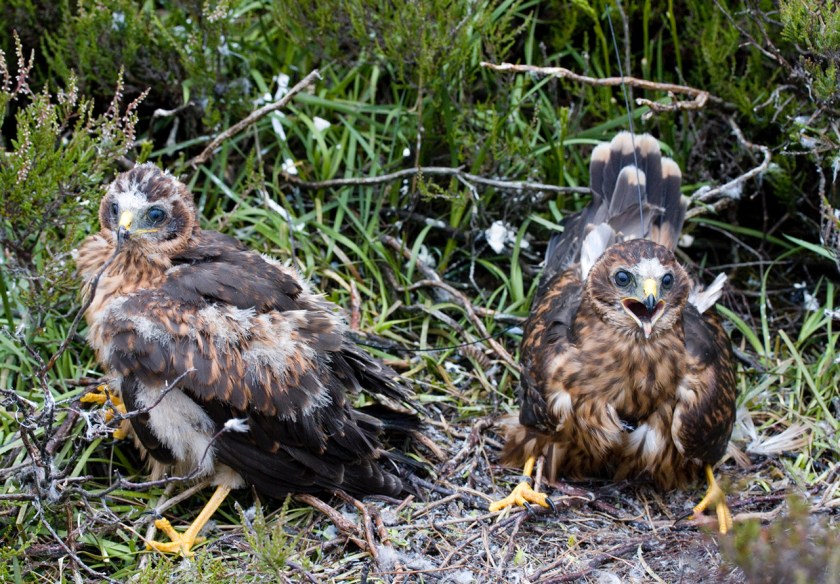
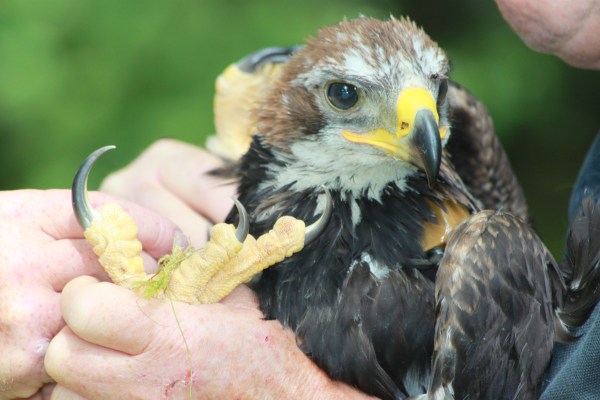
Photograph from one of this year’s nest cameras:

Sounds great, doesn’t it? And it is, in a way. We have no problem recognising the efforts of these seven estates – they’ve all hosted successful hen harrier breeding attempts and they absolutely should be applauded for their efforts. But, and here’s the rub, not one of these estates is on our radar as being a raptor persecution hotspot and we question how many of them operates as an intensively managed driven grouse moor. Hen harriers would just as likely have nested on these seven estates even if they hadn’t signed up to be part of the Heads Up Project, so for the Heads Up Project to claim these breeding successes as a Project success is highly disingenuous.

Several of these estates are managed as re-wilding projects, some of them have low ground shooting/stalking or walked-up grouse shooting and at least one of them has no game shooting whatsoever. One that comes anywhere near being a driven grouse moor is Langholm, and given that this is a highly-scrutinsed demonstration project (i.e. no illegal raptor killing allowed), and they’re not shooting grouse there, it doesn’t qualify as an intensively managed driven grouse moor, nor an estate of (current) concern.

So while SNH and the driven grouse shooting industry are busily trumpeting this as a great partnership success and real hope for hen harrier population recovery, the reality is that illegal persecution on intensively managed driven grouse moors remains out of the spotlight.

In our opinion this is a total greenwashing propaganda exercise. We expect nothing else from the driven grouse shooting industry but for SNH to be heralding it as anything but a sham is an embarrassment.

Unfortunately, Hen Harrier Species Champion Mairi Gougeon MSP appears to have had the wool pulled over her eyes. We have a lot of time for Mairi, and appreciate her efforts in using her political status to draw attention to this species’ plight, but have a look at this recent Parliamentary motion, lodged by Mairi but with the Dark Side’s fingerprints all over it:

This motion acheived cross-party support (by no doubt similarly well-intentioned MSPs) and as such will result in a Members Debate in Holyrood a week today:

We look forward to watching this debate (it’ll be available on Scottish Parliament TV – we’ll add a link nearer the time) and we especially look forward to some well-informed MSPs asking some probing questions to expose the Heads Up for Hen Harriers Project for the greenwashing scam that it is.

Update on our shedload of satellite-tagged golden eagles

Earlier this year we satellite-tagged a shedload of golden eagles in Scotland as part of a joint initiative with Chris Packham, funded by two very generous philanthropists (see here for project background).

Our eagles are doing well, all of them still hanging out in their natal territories although a few have started to make some short exploratory excursions beyond these local areas. For obvious reasons, we will not be providing location information until the young birds have dispersed far from their parents’ territories.

We’re getting fantastic data from the tags. These are different tags to those used to track hen harriers so there’s none of this, say, ‘on for a few hours/off for 48 hours’ cycle – our tags are providing positional data around the clock, sometimes at just a few minutes’ interval, so we know EXACTLY where our eagles are at all hours of the day, and night.

Here’s one of our eagles (#929) caught on camera a few weeks ago coming in to feed on a carcass, along with her Mum! (Our field team tell us 929’s Dad has also visited this carcass but is not photographed here).

More updates in due course.

Natural England invites MoD and Yorkshire Water to get involved with hen harrier brood meddling plan

Brood meddling is one of the six action points in DEFRA’s Hen Harrier Action Plan, launched in January 2016.

Regular blog readers will know that we initially got some information out of Natural England about this controversial action point (see here, here, here, here), but for the last year all our requests have been refused for one reason or another, but mainly because NE considered the release of information would “prejudice” the internal licence application. This is, of course, complete nonsense.

In early October 2017 we submitted yet another FoI request, only to be told by Natural England that more time was needed to gather the requested information “because of the complexity/voluminous nature of the request“.

Natural England has now had the extra time it requested and the information it has released was neither “complex” nor “voluminous”. Once again, requested information has been withheld (for “confidentiality” purposes this time) but some info has been released.

The Hen Harrier Brood Meddling Group held its sixth meeting in June 2017 and here are the notes from that gathering:

Unfortunately these notes provide little information, mainly because much of the discussion was centred on the Brood Meddling Draft Project Plan, which has not been made publicly available.

We have submitted another FoI to ask for a copy.

The only other bit of information that NE released as part of this “complex and voluminous” request was a couple of letters to the Ministry of Defence and to Yorkshire Water, inviting them to get on board with the hen harrier brood meddling plan. Here is a copy of the letter to the MoD (the letter to Yorkshire Water was virtually identical so we won’t reproduce it here):

We have no idea whether the MoD or Yorkshire Water has agreed to sign up to the hen harrier brood meddling plan (i.e. to permit the removal of hen harrier eggs/chicks from their land).

Despite a thoughtful (but some might argue naive) position (see here), Yorkshire Water does permit grouse shooting on its land.

So does the MoD – here are a couple of photos of grouse butts photographed on a military firing range in North Yorkshire [photos by Ruth Tingay].

We await the Brood Meddling Draft Project Plan with interest.

UPDATE 7 December 2017: Yorkshire Water agrees to hen harrier brood meddling on its landholdings (here)

Grouse shooting industry’s histrionics over proposed estate licensing

Following on from Saturday’s news that the SNP’s National Council has voted to adopt an official policy of grouse moor licensing (see here), the grouse shooting industry has responded with a fine display of histrionics.

A quick look on social media shows the usual buffoons shrieking about potential job losses and how everyone should get together for a march/demonstration, which would probably result in about four quad bikes being parked on the new Queensferry Bridge for an hour or so.

BASC has issued a press statement claiming the SNP’s new policy would “harm rural Scotland“, The Sunday Times ran with an article yesterday with the headline, ‘SNP votes to curb fox hunting and grouse shooting‘, and an article in today’s Daily Mail headlined with ‘War on the Countryside‘. They’re good at amateur dramatics, this lot.

There’s also a comment piece in the Mail by Lord David Johnstone, Chairman of Scottish Land & Estates, who argues (as he has before) that there is no need for estate licensing and everything would be just fine if only we’d all work with the shooting industry because, he says, “this does deliver results“. No, Dave, it doesn’t deliver results, unless you consider the never-ending news of poisoned, shot, trapped & bludegeoned raptors a ‘result’.

What we’re really struggling to understand is why the grouse shooting industry is so certain that estate licensing would result in the loss of jobs. Why would it? Unless this is a tacit admission that the grouse shooting industry does in fact rely on the illegal killing of birds of prey in order for shooting estates to remain viable and so the loss of a shooting licence (and possible subsequent closure of an estate) would be inevitable?

If driven grouse shooting is lawful and sustainable, as the industry so often claims, what on earth is there to worry about? There’d be no loss of licences for lawful or sustainable practices, so why is this industry so fearful of the scrutiny and regulation that the rest of us accept as part of our daily lives? Not got something to hide, surely?

There are the usual claims that ‘activists’ will ‘set-up’ estates by planting poisoned or shot raptors on grouse moors in an attempt to implicate the landowner and/or gamekeepers. Lord Johnstone used this excuse way back in 2012 when objecting to the introduction of vicarious liability for raptor persecution offences (see here). Five years on, we’re not aware of a single case where this has been shown to have happened, but we’ve seen plenty of cases where gamekeepers have been caught committing criminal offences as part of their daily routine.

The grouse shooting industry needs to face facts. Estate licensing is on its way and the industry only has itself to blame. It’s been given hundreds of chances to reform, and has received repeated warnings from the Scottish Government that further action would be taken if the industry didn’t clean up its act.

And if/when estate licensing is shown not to work, the grouse shooting industry should know what to expect next.

SNP adopts policy to support licensing of driven grouse shooting estates

RSPB press release:

RSPB Scotland welcomes official SNP policy support for licensing shooting estates

Motion approved at National Council

A landmark decision by Scottish National Party (SNP) delegates to adopt officially a policy supporting licensing of driven grouse shooting estates has been welcomed by RSPB Scotland.

At today’s (Saturday December 2nd 2017) National Council in Perth, SNP activists voted in support of a resolution calling for shooting estate licensing to be introduced in Scotland, making it certified party policy to support licensing for driven grouse estates.

The move adds considerable momentum to the campaign for shooting estate licensing, backed by RSPB Scotland.

The Scottish Government have recently set up an expert group to consider issues around grouse moors, including licensing.

Ian Thomson from RSPB Scotland said: “RSPB Scotland commends the National Council of the SNP for approving this resolution, committing the party to the licensing of driven grouse shooting.

It has become increasingly clear that self-regulation by the gamebird shooting industry has failed, with frequent incidents of illegal killing of protected birds of prey, unsustainable culls of mountain hares and repeated damage to vulnerable peatland habitats.

While we have welcomed steps taken by successive Scottish Governments to bear down on wildlife crime, it is evident that the increasingly intensive management of some areas, solely aimed at producing ever-larger grouse bags, flies in the face of public opinion and that better regulation of this industry, to ensure legal, sustainable management of our uplands, is long overdue.”

Jennifer Dunn, a member of the SNP’s National Council, who proposed the motion said: “I’m delighted that fellow delegates voted in favour of shooting estate licensing. Raptor persecution is a huge issue that many, many people care deeply about.

Although the conference floor cannot dictate policy to the Government, I’m hopeful that Ministers will listen to party activists and introduce tough new policies to combat wildlife crime.”

ENDS

[Photo: a landscape of intensively managed driven grouse moors in Scotland. Photo by Ruth Tingay]

Here’s the text of the motion:

Council notes with concern that wildlife crime, particularly raptor persecution, continues to damage Scotland’s reputation, natural heritage and tourism industry. Council further notes that a recent report by Scottish Natural Heritage found that a third of satellite tagged golden eagles had disappeared in suspicious circumstances in and around grouse moors. Council therefore:

• Welcomes the response from the Cabinet Secretary for Environment to this report, including plans to set up an expert group to look at managing grouse moors

• Commends the Scottish Parliament’s Environment Committee for scrutiny of this issue and recommending such a study

• Calls on responsible land managers and their representative bodies to engage with this process and encourage improved compliance with the law

• Supports the establishment of a licensing system for driven grouse estates, in order to help to prevent wildlife crimes.

What brilliant news!

The pressure continues to mount on the previously untouchable driven grouse shooting industry, and there is now real momentum for change, in Scotland at least, what with this agreed resolution and the recently-established grouse moor management review group, tasked with advising the Scottish Government on what will inevitably be the introduction of a grouse moor licensing scheme.

Well done Jennifer Dunn for getting this motion onto the National Council’s agenda and well done to each and every person who has helped draw public and political attention to the filthy, criminal activities of the driven grouse shooting industry.

It’s been a long time coming but it feels like the balance has finally tipped in our favour.

UPDATE 4 December 2017: Grouse shooting industry’s histrionics over proposed estate licensing (here)

New report reveals abject failure to protect birds of prey in the Peak District National Park

The Peak District Bird of Prey Initiative (BoPI) was launched in 2011, mainly in response to two damning reports from the RSPB about the continued illegal killing of raptors in the Dark Peak area of the Peak District National Park (see here & here), as well as all the publicity from a criminal prosecution, and subsequent conviction, of a Derbyshire gamekeeper who had been caught illegally using a trap (see here and here).

The BoPI comprises five organisations (Peak District National Park Authority, National Trust, Moorland Association, RSPB and Natural England), with additional support from two local raptor study groups, who are supposed to be working in partnership to increase the populations of several raptor species within the Dark Peak area of the National Park.

It was initially launched as a five-year project (2011-2015), and at the end of that period a report revealed the BoPI had failed to meet every single target set (see here).

Photo of an osprey found in the Peak District National Park in September 2015. It had two broken legs and succumbed to these injuries soon after being found. The post-mortem stated its injuries were consistent with being caught in a spring trap (Photo by RSPB)

Nevertheless, despite missing each and every one of the five-year targets, the Peak District National Park Authority decided the project would continue and announced a ‘renewed commitment’ from the Project partners, which was derided by us and by Mark Avery (here), who said it was just an opportunity for the National Park authorities to hide behind a failing project for a few more years and avoid taking any real action, like, for example, banning driven grouse shooting within the National Park.

The latest report (read it here), just published, covers the years 2016 and 2017 and surprise surprise, aboslutely nothing has changed.

Interestingly, this latest report has just been slipped out without any fanfare or publicity, presumably because the Peak District National Park Authority doesn’t want to draw attention to this on-going fiasco. The only reason we knew it was available was because we’d asked for a copy via FoI last month and had been told it would appear on the PDNPA website ‘shortly’, so we’ve been checking for it every day.

So, to summarise. No progress, no increased raptor populations, no statements of “renewed commitment”, and absolutely no point continuing with this charade of partnership-working.

More on the grouse-shooting industry’s desire to kill Marsh harriers

Following on from yesterday’s blog where we reported that grouse moor owners want licences to kill Marsh harriers (see here), this news has obviously stirred up a lot of interest and commentary.

We just want to clarify something here. We were not at the RPPDG meeting where this conversation took place; we simply reported information that had been sent to us, by a number of different sources. Obviously, we did a lot of background research before we published and although we can’t be sure of the actual words that Amanda used (because we weren’t there), we are confident that the conversation about grouse moor owners wanting licences to lethally control Marsh harriers did take place. We are looking forward to seeing the minutes of the meeting (probably not available until they’ve been signed off at the next RPPDG meeting early in the New Year).

Seeing the official minutes (assuming they haven’t been doctored) is one of three ways this news can be verified.

Another way would be for the representatives of the various organisations who were in attendance to actually confirm or refute that the conversation took place. There are a lot of organisations who send representatives to these RPPDG meetings, in addition to the Moorland Association, such as the Countryside Alliance, BASC, Natural England, RSPB, National Gamekeepers Org, Welsh Government, DEFRA, NERF, NWCU, CLA, various police forces, and the meetings are currently chaired by the Police Superintendent of Greater Manchester Police.

It’s quite telling that none of them has issued a statement to deny the conversation took place, nor indeed has the RPPDG as a collective umbrella group.

If we were at a meeting and an outsider claimed that something as controversial as this was discussed, when it actually wasn’t discussed, we’d be making it very clear that as a meeting attendee, the conversation didn’t happen.

The other way the news can be verified would be for Amanda Anderson to clarify what was actually said. So far, her only public response has been on twitter, where she wrote:

Unfortunately, when asked to clarify which part of the news article she deemed to be “complete nonsense”, she has refused to comment further. This is quite unhelpful. Surely, if she didn’t tell the RPPDG meeting that grouse moor owners want to apply for licenses to kill Marsh harriers, she would take every opportunity to be crystal clear about that? We’d be more than happy to retract the information if it can be shown that the conversation didn’t take place and that our sources have provided misinformation. Her refusal to enter into a discussion looks more like a damage limitation exercise than a desire to clear up a supposedly inaccurate report. That’s a shame.

We’ll be coming back to this topic in the New Year once we have the official minutes of the meeting.

UPDATE 19 January 2018: Update on claim that grouse moor owners want licences to kill Marsh harriers (here)

UPDATE 12 November 2018: Licences to kill Marsh harriers on grouse moors – an update (here)

Grouse moor owners want licences to kill Marsh harriers

Yes, you did read the headline correctly.

We’ve received reports from a number of independent sources that at the November 2017 meeting of DEFRA’s Raptor Persecution Priority Delivery Group (RPPDG), the Director of the Moorland Association (the mouthpiece for grouse moor owners in England), Amanda Anderson, said that grouse moor managers would be submitting applications to Natural England for licences to kill Marsh harriers.

That’ll be the Marsh harriers that are Amber listed on the UK Birds of Conservation Concern.

The Marsh harriers that are recovering from a virtual population wipeout – down to one known breeding pair in 1971 thanks to a combination of illegal persecution, habitat loss and DDT and currently with an estimated breeding population of 400-450 pairs.

The Marsh harriers that are locally common in some areas such as East Anglia but still extremely rare or absent in many other areas.

The Marsh harriers that most commonly breed in lowland wetland habitat, particularly reedbeds but increasingly on farmland too.

The Marsh harriers that very rarely breed on upland grouse moors although when they do, they are illegally targeted by men dressed as gamekeepers.

[Photo by George Reszeter]

It’s hard to comprehend the news that grouse moor owners want licences to kill this species. It’s so utterly ludicrous to think that a handful of Marsh harriers would pose any serious threat to the hundreds of thousands of red grouse that are raised on grouse moors just to be shot, for fun.

And yet these are the grouse moor owners who claim to want breeding Hen harriers back on these moors!

This latest move makes it quite clear that the grouse-shooting industry is beyond redemption. There’s no reasoning with people who think that Marsh harriers need to be killed because they’re perceived to be a threat to the viability of an upland grouse shoot.

If you’ve managed to pick up your jaw off the floor, you might want to consider signing this e-petition calling for a ban on driven grouse shooting. It really is time to throw this filthy, regressive, Victorian ‘sport’ on to the bonfire of history.

UPDATE 30 November 2017: More on the grouse-shooting industry’s desire to kill Marsh harriers (here)

UPDATE 19 January 2018: Update on claim that grouse moor owners want licences to kill Marsh harriers (here)

UPDATE 12 November 2018: Licences to kill Marsh harriers on grouse moors – an update (here)

Natural England’s progress report on the Hen Harrier Action Plan (summer 2017)

In September this year, Natural England told blog reader Mike Whitehouse that “work on the six actions set out in the [2016] Joint Hen Harrier Action Plan is progressing as expected. Ultimately we believe these actions will result in an increase in the numbers of hen harriers breeding in England“.

Earlier this month, in its response to Gavin Gamble’s e-petition calling for a ban on driven grouse shooting, DEFRA said this:

The [Hen Harrier] Action Plan was developed with senior representatives from organisations including Natural England, the Moorland Association, the National Gamekeepers’ Organisation, the Game & Wildlife Conservation Trust, National Parks England and formerly the RSPB. These organisations, led by Natural England, will monitor activities and report annually on progress to the Defra Uplands Stakeholder Forum and the UK Tasking and Co-ordinating group for Wildlife Crime’.

Naturally, we were curious about this ‘as expected progress’, nearly two years after the Hen Harrier Action Plan was launched, especially given the high number of dead or ‘missing’ satellite tagged hen harriers that have been reported since the Action Plan was launched.

[Photo of Hen Harrier Carroll, found dead in Northumberland in January 2017. A post mortem revealed she had died with a parasitic infection, but it also revealed two shotgun pellets lodged under healed wounds, one in the leg and one in the throat. Photo by Northumberland Police]

We were keen to see the annual report to which DEFRA referred in its response to Gavin Gamble – the one that had been submitted to the DEFRA Uplands Stakeholder Forum.

We’ve managed to get hold of a copy.

Here’s the report’s introductory blurb, highlighting the fact that no hen harriers bred on any English grouse moors in 2016, nor in 2017. Not a great start to a report about ‘progress’.

Now let’s examine the ‘progress’ that has been made on each of the six action points:

ACTION POINT 1 – MONITORING OF HEN HARRIER POPULATION IN ENGLAND

So, a number of hen harriers were satellite-tagged in 2016 and 2017. That is good, but this tagging effort started long before the launch of the Hen Harrier Action Plan and would have happened even if the Action Plan hadn’t been launched, so this can hardly be claimed as Action Plan ‘progress’. And most of these tagged birds (except two) have since been found shot dead or have ‘disappeared’ in suspicious circumstances.

Progress rating: 2/10 (and that’s being generous).

ACTION POINT 2 – DIVERSIONARY FEEDING

Progress rating: 0/10

ACTION POINT 3 – WORK WITH THE RAPTOR PERSECUTION PRIORITY DELIVERY GROUP (RPPDG) TO ANALYSE MONITORING INFORMATION AND BUILD INTELLIGENCE PICTURE

The RPPDG might well have been ‘focusing its efforts on the production of poison maps‘, but as we pointed out the other day, this so-called ‘delivery group’ hasn’t managed to deliver a single thing since the publication of its 2007-2011 poisoning map.

And what’s this about ‘hen harriers do not feed on carrion so the poisons map is not directly applicable to this species‘? Er, aren’t there records of hen harriers being killed by ingesting illegal poison? Yes, there most certainly are – see here. And what’s diversionary feeding if it isn’t the provision of dead food (i.e. carrion)? Of course hen harriers feed on carrion! And here’s a photograph of one doing exactly that, caught on a camera trap by SRSG member Stuart Williams in Orkney in 2015:

Progress rating: 0/10

ACTION POINT 4 – NEST & WINTER ROOST PROTECTION

Again, roost and nest watches started long before the launch of the Hen Harrier Action Plan and would have happened even if the Action Plan hadn’t been launched, so this can hardly be claimed as Action Plan ‘progress’. However, the development of a roost monitoring scheme with the Yorkshire Dales National Park Authority seems to be a new thing, which is good, although this progress report doesn’t actually tell us whether it’s up and running yet.

Progress rating: 1/10

ACTION POINT 5 – SOUTHERN REINTRODUCTION

We’re not going to comment too much about this Action Point because we’ve got a more detailed blog planned for the very near future, based on some more information that has been dragged out of Natural England via FoI requests.

Nevertheless, ‘progress’ on this highly controversial Action Point has certainly been made (here’s what we know so far), even though we totally oppose this action.

Progress rating: 7/10

ACTION POINT 6 – TRIAL BROOD MANAGEMENT SCHEME

Again, we’re not going to comment too much on this Action Point because we’ve got a more detailed blog planned for the New Year, when Natural England will have finalised the brood meddling licence and thus will have to release it to the public for scrutiny. At the moment we know very little because NE has refused to tell us anything for a whole year.

Nevertheless, progress on this highly controversial Action Point has certainly been made, even though we totally oppose this action.

Progress rating: 5/10

So there we have it. Almost two years on from the launch of the Hen Harrier Action Plan, ‘progress’ has been made by the organisations already carrying out these so-called Action Points (e.g. RSPB, Natural England, Northern England Raptor Study Group, Forestry Commission), regardless of the Hen Harrier Action Plan. But there is absolutely no sign of ‘progress’ from the grouse-shooting industry on anything other than the two Action Points that are designed either to remove hen harriers from grouse moors (brood meddling) or to detract attention from the illegal killing of hen harriers on grouse moors (southern reintroduction).

Oh, and satellite-tagged hen harriers keep ‘disappearing’ or being found shot dead.

Perhaps this is what Natural England meant when they told Mike Whitehouse in September that progress is “as expected“.

Watch this space for further updates on brood meddling and the southern reintroduction, coming soon.

Parliamentary recognition for award-winning Scottish Raptor Study Group members

Following last week’s excellent news that three Scottish Raptor Study Group members had won top prizes in the RSPB’s Nature of Scotland Awards (here), further congratulations are due as an MSP has lodged a motion asking the Scottish Parliament to recognise the efforts of two of these raptor conservationists.

Well done, Logan & Andrea!