Blog

Case against Bleasdale Estate gamekeeper collapses as RSPB video evidence ruled inadmissible

We’ve been reporting on the case against Bleasdale Estate gamekeeper James Hartley since September 2017 (see here, here, here, here for previous posts).

Mr Hartley faced 9 charges as follows:

  1. Disturbing the nesting site of a Schedule 1 wild bird (13/04/2016)
  2. Killing a Schedule 1 wild bird (13/04/2016)
  3. Killing a Schedule 1 wild bird (14/04/2016)
  4. Setting trap / gin / snare etc. to cause injury to a wild bird (between 13-14/04/2016)
  5. Taking a Schedule 1 wild bird (14/04/2016)
  6. Possessing a live / dead Schedule 1 wild bird or its parts (14/04/2016)
  7. Possessing an article capable of being used to commit a summary offence under section 1 to 13 or 15 to 17 (13/04/2016)
  8. Possessing an article capable of being used to commit a summary offence under section 1 to 13 or 15 to 17 (between 12/04/2016 – 27/04/2016)
  9. Causing unnecessary suffering to a protected animal – Animal Welfare Act 2006 (between 14/04/2016 – 15/04/2016)

The case collapsed last week after District Judge Goodwin ruled the RSPB video evidence inadmissible at a hearing at Preston Magistrates Court on 28 March 2018.

Reporting restrictions imposed early on in the case prevented us from blogging in detail until the case had concluded. We’re now able to report what happened.

This blog is the first in a series about this case. In this one, we set out the Crown’s case against Mr Hartley, and the defence’s skeleton argument against the admissibility of the video evidence.

Here are the details of the case as presented to the court by the Crown Prosecution Service (barrister: Mr Yip):

On the 11th April 2016 RSPB Investigations Officer [name redacted], in the presence of RSPB Investigations Officer [name redacted], installed a covert video camera pointed towards a peregrine falcon nest site within the boundary of Bleasdale Game Estate in the Forest of Bowland.

The red star denotes the location of the Bleasdale Estate:

The Bleasdale Estate is owned by Jeremy Duckworth. Mr Duckworth describes the upper moorland as managed for grouse shooting and he employs one gamekeeper for this area, that being the defendant James Hartley.

It is the Crown’s case that the covert camera captured footage which revealed incidents on the 13 and 14 April 2016 where the nest site and birds were interfered with.

The Crown say that a number of clips show that on 13th April 2016 at 19.53hrs an incubating peregrine leaves the nest scrape. This is immediately followed by what appears to be four shotgun discharges. A few minutes later at 19.57hrs a person wearing a camouflage suit and in possession of a hammer attends the nest site for a number of minutes before leaving.

The following morning, 14th April 2016 at 10.29hrs, a peregrine, believed to be the male parent, lands on the edge of the nest ledge and walks in to the nest scrape area. The bird becomes trapped all day in what the Crown say is a spring trap. At 20.25hrs the peregrine is still present. At 23.12hrs a person with a torch visits the site. It is the Crown’s case that the inference is this person had removed the peregrine and the trap as the bird was no longer present the following day.

On 21st April 2016 a number of officers from Lancashire Constabulary and the RSPB attended the nest site area and recovered four eggs and some feathers.

On 26th April 2016 a search warrant was executed and a search was conducted at the defendant’s home address and outbuildings. A green bag containing a number of items was seized from an outbuilding. Forensic DNA analysis from Dr Lucy Webster provides extremely strong support to the proposition that two of the items within this exhibit, an orange handled knife and a wooden handled hammer have been in contact with peregrine falcon.

Between 17.37hrs and 19.11hrs on 24th May 2016 the defendant was interviewed under caution when he declined to answer any questions put to him.

Between 13.16hrs and 13.50hrs on 2nd November 2016 the defendant was interviewed under caution for the second time when he declined to answer any questions put to him.

END

Here is the skeleton argument presented to the court by the defence (barrister: Mr Justin Rouse QC):

The defence seek to exclude the video footage obtained by [RSPB Investigator, name redacted] and the items recovered in the search on the 21 April 2016 under s78 Police & Criminal Evidence Act [PACE] 1984.

S78 PACE provides as follows:

‘…..In any proceedings the court may refuse to allow evidence on which the prosecution proposes to rely to be given if it appears to the court, that, having regard to all the circumstances, including the circumstances in which the evidence was obtained, the admission of the evidence would have such an adverse effect on the fairness of the proceedings that the court ought not to admit it’.

The defence submit that the RSPB have sought to circumvent the provisions of RIPA 2000 [Regulation of Investigatory Powers Act 2000] together with s93 of the Police Act 1997; that they have breached Code B of PACE 1984; that RSPB Investigator [name redacted] was not a data handler for the purposes of the Data Protection Act 1998; that the RSPB chose not to voluntarily adopt the Surveillance Camera Code and/or that the police were bound by that code and that the RSPB were trespassing on the land unlawfully, having failed to seek the permission of the landowner.

END

The full details of the defence’s legal argument will be published in a second blog, along with the judge’s commentary on each of the components of the defence’s argument. For those of us interested in such details it was a fascinating and well-presented argument. And therein lies the crux of this case. In our opinion, the court’s ruling on the video evidence was inevitable, not necessarily because of the strength of the defence’s legal argument, but because of the weakness in the prosecution’s counter-argument against it.

For those of us who sat in the public gallery to observe the legal argument hearing on 14 March 2018, it became apparent, very quickly, that the outcome of this case (and thus, supposed ‘justice’) would be determined by the amount of money available to pay for legal representation.

The representative for the defence was the highly-regarded Mr Justin Rouse QC. We have no idea who paid for his time and expertise (e.g. the defendant? His family? His employer? A representative membership body, e.g. National Gamekeepers Org or BASC?) but whoever it was will no doubt consider it money well spent. It was very clear that Mr Rouse (or his junior) had probably spent a long time in preparation for this case: his presentation was meticulous and thoroughly organised, with every aspect labelled and referenced in a bundle of documents that he’d provided to the judge. On every single point he raised, he was able to tell the judge on which page she should be looking. He was calm, measured and in complete control. A bit of a masterclass.

In contrast, the representative for the prosecution was Mr Yip, who turned up completely unprepared. He arrived without his bundle of evidential documents, muttering something about having left them behind, so he was unable to look up the detail of points raised by the judge. At one point Mr Rouse passed over his own copy of the evidential documents to Mr Yip, to try and help him out. The judge asked Mr Yip several questions about the video evidence and asked to see it (she was particularly interested in the angle of the covert camera and how wide a view it was able to record – a crucial element in deciding whether this was ‘directional’ surveillance, as detailed in RIPA 2000). Astonishingly, Mr Yip told the court he hadn’t seen the video evidence and he didn’t have a copy with him. He was able to produce a couple of still photos from the video but when the judge asked him to point out the position of the nest in the photos, he was unable to do so.

It has been reported on social media that the RSPB “failed to support” this case by “declining” to attend court on 14 March 2018 to answer questions raised by the judge during the legal argument hearing. What utter nonsense. The statement is categorically untrue and is a false claim being made by a group with a long-held and well-documented grudge against the RSPB, presumably with the intention of portraying the RSPB in a bad light. What actually happened was Mr Yip declined to call the RSPB as a witness during that hearing, even after being prompted by the judge, and nor did he ask for an adjournment to allow for him to call an RSPB witness at a later hearing. His reason for this decision is not known (to us) and it proved to be catastrophic for the prosecution’s case.

We think it is fair comment to describe Mr Yip as being ill-prepared for the hearing. However, there may be many reasons for that, beyond his control. It isn’t unusual for the financially-squeezed and under-resourced CPS to drop cases on lawyers at the last minute so for all we know Mr Yip might not have ‘seen’ this case until the night before the hearing. If that is what had happened, it would partly explain the gulf in quality between Mr Rouse’s and Mr Yip’s presentations. That being said, if Mr Yip had not had adequate time to prepare, he could probably have called for an adjournment.

His poor performance did not go unnoticed by the judge and in her ruling delivered to the court on 28 March her criticism was evident. More on this subject in the second blog.

Putting aside for a moment the legal arguments and the standard of presentation, the bottom line is that yet another case of alleged raptor persecution, caught on covert camera, has failed on a technicality (or in this case, several technicalities).

Although the identity of the alleged perpetrator in the Bleasdale case has not been tried and tested in court, there’s no getting away from the fact that the CPS believed the video footage to show that two peregrines appear to have been illegally killed at a nest site on the Bleasdale Estate in 2016. The unidentified perpetrator of this alleged crime will not face justice. Given the catalogue of failed cases under similar circumstances (i.e. covert video footage ruled inadmissible on a technicality), the perpetrators of these crimes have been given yet more impetus to continue, as the chances of successful prosecution these days are almost nil.

No doubt the grouse-shooting industry will jump on this result as an excuse to vilify the RSPB and its approach to investigating raptor persecution crimes. But when the RSPB publishes the video footage of this latest incident, the public will be in a position to judge for itself whether or not the RSPB’s actions were discreditable. Whether the grouse shooting industry likes it or not, public opinion, not court convictions, will ultimately be the deciding factor in addressing the ongoing illegal killing of birds of prey.

UPDATE 13 April 2018: Why the video evidence was ruled inadmissible in the Bleasdale Estate case (here)

UPDATE 16 April 2018: Why other evidence was also ruled inadmissible in the Bleasdale Estate case (here)

UPDATE 16 April 2018: Grouse-shooting industry’s reaction to the failed Bleasdale Estate case (here)

UPDATE 8 August 2018: Peregrine persecution on a grouse moor: Bleasdale video footage finally released (here)

Buzzard shot in the head, south Yorkshire

From Yorkshire Post (7/4/18):

‘WILDLIFE CRIME WILL NOT BE TOLERATED’, SAY SOUTH YORKSHIRE POLICE AFTER BUZZARD IS FATALLY SHOT IN THE HEAD

‘Wildlife crime will not be tolerated in our county’ – that’s the message from South Yorkshire Police after they found a buzzard that had been fatally shot in the head.

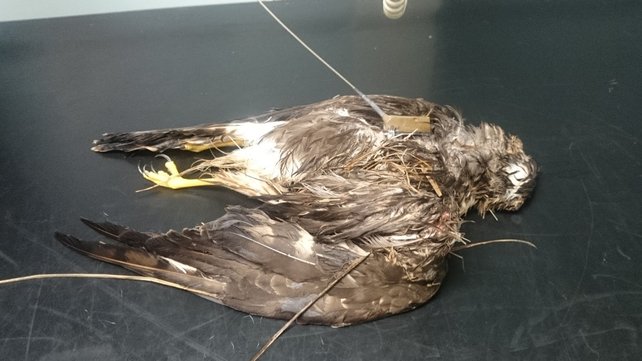
The force confirmed yesterday that the buzzard was found dead in the lower part of Hound Hill Lane, Barnsley, with trauma to its head attributed to either a pellet or shot projectile.

Police Constable Mark Winter, Penistone Community Constable and Wildlife Crime Officer said: “Buzzards, being part of the bird of prey family are protected in law and it is quite obviously an offence to shoot, injure or trap one.

This incident has occurred over the last few days and this is an appeal for information to assist with this investigation. Wildlife crime will not be tolerated in our county, please enjoy the countryside safely, responsibly and leave it as you found it”.

ENDS

[Photo by South Yorkshire Police]

Red kites “hammered” by persistent persecution, says Chair Yorkshire Dales National Park Authority

The Yorkshire Dales National Park Authority continues its recent efforts to highlight and condemn illegal raptor persecution in and around the National Park.

Last month we blogged about some of these efforts, which have included the Park’s involvement with ‘Operation Owl’, a police-led multi-agency initiative designed to target the raptor-killing criminals in North Yorkshire, the Park’s publication of a raptor persecution ‘evidence report’, a wildlife crime seminar organised for Park staff teaching them how to recognise and report suspected wildlife crimes, and an article on raptor persecution published in the Yorkshire Post and written by the Park Authority’s CEO, David Butterworth.

The latest in this commendable series of activities is an article published in the Craven Herald, written by the Chair of the Yorkshire Dales National Park Authority, Carl Lis, entitled, ‘Red kites ‘hammered’ by persistent persecution on national park borders’.

Read the article here

Mr Lis focuses on the ‘barbaric’ persecution of red kites taking place on the eastern border of the National Park in the Nidderdale Area of Outstanding Natural Beauty. He is quoted:

There is no doubt that the eastern fringes, where the grouse moors start, is the real problem area. Red kites have attempted to spread east from their reintroduction sites but have got hammered“.

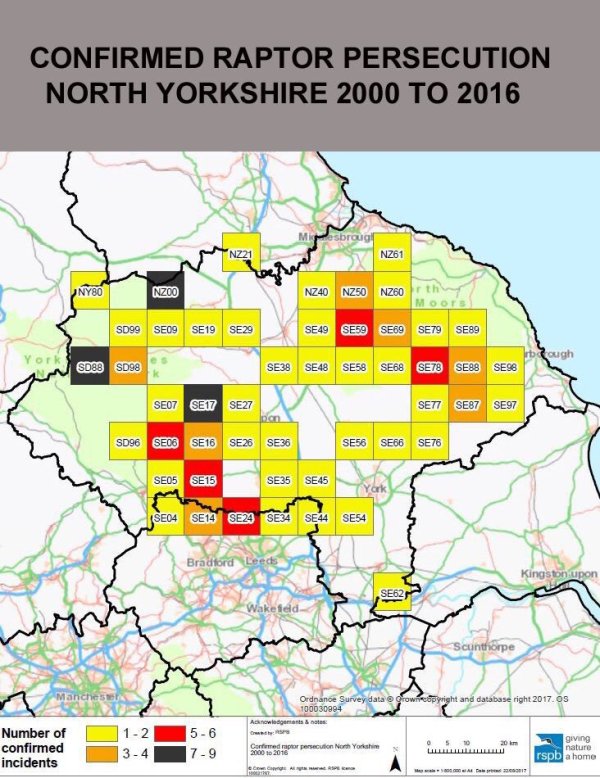
Here is an RSPB map detailing the illegal killing of 22 red kites in the Nidderdale AONB between 1999-2017 – read this blog for more information:

Mr Lis goes on to say, “I want to stress that the national park authority is not against grouse shooting, and we have had fantastic cooperation from a number of grouse moor managers and owners. What the authority is against is the barbaric and persistent persecution of birds of prey“.

This public condemnation of raptor persecution is very, very welcome, but Mr Lis needs to understand that by continuing to support driven grouse shooting, he is indirectly supporting the continued illegal killing of raptors. There’s no separating the two: driven grouse shooting, in its current format where bag size is king, is reliant on the illegal killing of raptors.

The article ends with some commentary from Amanda Anderson of the Moorland Association who talks about the “great success” of red kites and how “large numbers of red kite are spotted on grouse moors within the Yorkshire Dales on a regular basis including Bolton Abbey in North Yorkshire as well as across the eastern fringe of the national park“.

She forgets to mention how many of those red kites haven’t made it alive off those grouse moors.

Interestingly, we are currently looking in to a claim that the Moorland Association, on behalf of its grouse moor owning members, is apparently concerned about the number of red kites on grouse moors and is seeking advice from Natural England on legal measures to ‘remove’ them. More on this in due course, along with the similar claim about how the Moorland Association has apparently asked Natural England about licences to ‘control’ Marsh harriers.

Gamekeepers invite First Minister to visit estates where mass slaughter of mountain hares takes place

Scottish gamekeepers have invited First Minister Nicola Sturgeon & Environment Cabinet Secretary Roseanna Cunningham to visit estates “to learn about mountain hare culls”.

The invitation comes after the First Minister’s angry response to recent video evidence showing the brutal, military-style killing of mountain hares undertaken by gamekeepers on several Scottish grouse moors and filmed by OneKind, Lush & the League Against Cruel Sports (Scotland) in February this year. Ms Sturgeon commented in Parliament that this mass killing was “not acceptable”.

Here’s the footage for those who missed it:

Presumably the invitation isn’t for the First Minister & the Cabinet Secretary to take part in a hare cull, or perhaps it is? Perhaps the gamekeepers envisage the pair kitted out in tweeds, riding on a quad bike across the moor, blasting hares in the face and legs with a shotgun, all in the name of ‘sport’ and ‘conservation’? Perhaps then they could go on to visit a stink pit to toss in the bloodied corpses on top of the pile of festering bodies already dumped there, with just enough time to set a few snares and batter to death a few cagefuls of trapped corvids before heading back to the big hoose for tea. How could they refuse such an invitation?

Here’s the press release from the gamekeepers:

GAMEKEEPERS INVITE FIRST MINISTER TO LEARN ABOUT MOUNTAIN HARE CULLS

Gamekeepers have invited the First Minister to visit their estates to find out about mountain hare management after she warned filmed culls were “not acceptable”.

Nicola Sturgeon said she was “angry” at footage filmed by animal rights charities which showed the animals being killed on shooting estates.

She warned large-scale mass culls could put the conservation status of the species at risk and said legislation to protect the hares is among options being considered by government.

Currently, landowners operate a voluntary restraint agreement regarding numbers culled.

Now, gamekeepers shown in the footage have written to the First Minister and Environment Secretary Roseanna Cunningham to invite them to their estates to learn more about the rationale behind the killings.

Head gamekeeper for the Clune and Corrybrough Estates in Inverness-shire, Duncan MacKenzie, said: “We’d really like to be able to show the First Minister around rather than discuss these issues in Edinburgh.

I think it would be beneficial for everyone to get an understanding of why the hares need to be managed, here.”

He said the footage filmed by OneKind, League Against Cruel Sports and Lush showed “working people being secretly filmed carrying out a legal management activity which is no different to other forms of species management and is well within the laws passed by Scottish Government“.

The ironic thing is that those who are seeking the end of grouse management would also be signalling the beginning of the end for the mountain hare in Scotland,” he added.

Populations are thriving on grouse moors but are struggling badly elsewhere due to predation and loss of their preferred heather habitat and we hope to have the opportunity to explain this in full to the First Minister.”

Mr MacKenzie said the estates are not hiding anything, adding: “We have good records of the amount of hares in comparison to the amount we have taken off the hill, covering a number of years, and there are still high numbers of hares on the ground.”

The animal rights charities behind the footage claim it shows the agreement for voluntary restraint over culls has “failed” and along with broadcaster Chris Packham are calling for a cull ban until a review on the issue concludes.

ENDS

And here’s a press release in response from RSPB Scotland:

RSPB SCOTLAND RESPONDS TO GAMEKEEPERS’ MOUNTAIN HARE INVITE TO FM

In response to an invitation to the First Minister by gamekeepers to find out about mountain hare culls RSPB Scotland’s James Reynolds said: “If the First Minister is minded to accept this invitation she will of course also wish to visit and observe land of a similar nature, but managed more sustainably. A good example is the Cairngorms Connect project, which is being supported by The Scottish Government’s own Cairngorms National Park Authority – where multiple stakeholders involving the state, charities and the private sector are co-operating in partnership to deliver habitat restoration at a landscape scale for the benefit of local communities, local economy and Scottish environment.

RSPB Scotland is delighted that the current Scottish Government grouse moor enquiry is addressing the issue of unsustainable mountain hare culls, and undertaking an economic comparison of intensive management versus alternative models; we are sure the First Minister will also wish to give her full support to this initiative by her Cabinet Secretary Roseanna Cunningham MSP.

The notion that the survival of mountain hares is entirely dependent on intensive grouse moor management is of course absolute nonsense.  Mountain hares existed quite happily in balance with their natural habitat since the last ice age before intensive grouse moor management began in the Victorian era. They will do so again if given the chance to flourish without needless mass culls.”

ENDS

Dead red kite in south Scotland now confirmed poisoned

Further to yesterday evening’s blog about a dead red kite found in south Scotland in January that “may” have been poisoned (see here), the BBC news article has now been updated (6/4/18) to confirm this bird was definitely poisoned:

POLICE APPEAL AFTER PROTECTED BIRD OF PREY POISONED

Police investigating the death of a protected bird of prey have said it was poisoned.

The body of the red kite was found by a member of the public in the Durham Hill Lane area of Kirkpatrick Durham in Castle Douglas on 20 January.

An investigation has been launched and officers involved in it have appealed for information.

[Red kite photo from Scottish Raptor Study Group]

PC Alan Steel, a specialist wildlife crime officer, said the illegal use of poison can be deadly for wild birds.

He said: “Due to the inherent scavenging nature of red kites, they are particularly vulnerable to the illegal use of poisonous bait.

Red kites are legally protected and Police Scotland works closely with partner agencies, including the Scottish Agricultural College (SAC), Science and Advice for Scottish Agriculture (SASA) and the Royal Society for the Protection of Birds (RSPB) to ensure that those responsible are brought to justice.”

RSPB Scotland’s head of investigations said illegal poison use can also harm pets and people.

Numbers of detected cases of illegal poisoning of our birds of prey have, thankfully, been very low in recent years, so this case is of serious concern,” Ian Thomson added.

The Galloway Red Kite trail, just a few miles from where this bird was killed, is a popular tourist attraction and of great benefit to the local economy.”

ENDS

Man charged with stealing eagle & osprey eggs from nests

From DevonLive news, 6 April 2018:

A man has been charged with a number of offences against the Wildlife and Countryside Act 1981, in relation to the taking of and disturbing of protected birds, their nests and eggs.

Jason North, aged 49, from Plymouth has been charged with 14 offences including the disturbance of Schedule 1 birds at or near the nest and the taking of eggs.

These include rare species such as Golden Eagle and Osprey in Scotland.

Further offences relate to nest disturbance and the taking of eggs of rare Devon birds namely Hobby, Peregrine Falcon and Little-Ringed Plover from sites on Dartmoor, Devon.

These offences are alleged to have taken place in Devon and Scotland during 2016.

Mr North is due before Plymouth Magistrates court on 3 May.

ENDS

Thanks to Police Wildlife Crime Officer Josh Marshall from Devon & Cornwall Police for alerting us to this case. Great partnership working between the Police, RSPB & CPS to get this case to court.

Red kite suspected poisoned in south Scotland

From BBC News (5/4/18):

Police investigating the death of a protected bird of prey have said it may have been poisoned.

The body of the red kite was found by a member of the public in the Durham Hill Lane area of Kirkpatrick Durham in Castle Douglas on 20 January.

An investigation has been launched and officers involved in it have appealed for information.

[Red kite photo from Scottish Raptor Study Group website]

PC Alan Steel, a specialist wildlife crime officer, said the illegal use of poison can be deadly for wild birds.

He said: “Due to the inherent scavenging nature of red kites, they are particularly vulnerable to the illegal use of poisonous bait.

Red kites are legally protected and Police Scotland works closely with partner agencies, including the Scottish Agricultural College (SAC), Science and Advice for Scottish Agriculture (SASA) and the Royal Society for the Protection of Birds (RSPB) to ensure that those responsible are brought to justice.”

RSPB Scotland’s head of investigations said illegal poison use can also harm pets and people.

Numbers of detected cases of illegal poisoning of our birds of prey have, thankfully, been very low in recent years, so this case is of serious concern,” Ian Thomson added.

The Galloway Red Kite trail, just a few miles from where this bird was killed, is a popular tourist attraction and of great benefit to the local economy.”

ENDS

It’s a bit of a strange article, presumably based on a police press release, although we couldn’t find anything on the Police Scotland website.

It’s strange in that it says the kite “may” have been poisoned. Surely, if it was picked up on 20 January, two and half months ago, the toxicology tests will have been done and the results known?

And if poisoning was suspected, why has it taken two and a half months for this news to come out?U

UPDATE 6 April 2018: Red kite now confirmed poisoned (here)

Grouse moor management “treats nature with contempt”

Last week saw the widespread media broadcast of a film produced by Lush, OneKind and The League Against Cruel Sports (Scotland) depicting the brutal, military-style mass killing of mountain hares on a number of Scottish grouse moors, filmed in February this year. For those who missed it, here it is again:

Inevitably, public outrage ensued and resulted in First Minister Nicola Sturgeon stating in the Scottish Parliament that these culls are “not acceptable” (see here).

The fall-out continued yesterday with an article by Jim Crumley in The Courier, who wrote about how grouse moor management “treats nature with contempt“.

It’s a brilliant piece, taking apart word by word what he calls an “ill-advised response” to the film from the Scottish Moorland Group’s Director, Tim (Kim) Baynes.

It’s well worth a read, from a journalist who frequently hits the nail on the head when describing the grouse-shooting industry – he’s previously referred to the Scottish Gamekeepers Association as “the UKip of the natural world” (here) and has described sporting estates as “a rural perversion” (here).

In case the article disappears, we’ve produced it below. It’s also worth reading one of the Reader’s Letters, by David Mitchell, (here).

MOUNTAIN HARE SLAUGHTER FILM SHOWS HOW MOORLAND MANAGEMENT TREATS NATURE WITH CONTEMPT

By Jim Crumley (published in The Courier, 3 April 2018)

The reputation of Scotland’s landowners took another hefty blow in the solar plexus in the seven days since I made the case for legislation to protect the red fox from the worst excesses of what passes for land management, after a protest outside the Scottish Parliament about abuse of foxhunting legislation.

This time, it was film of a “cull” of mountain hares so militaristic in its strategy and so devastating in the scale of its slaughter that it would not have looked out of place in a newsreel clip from Syria.

The First Minister, who was suitably horrified like the rest of us – most of the rest of us, of which more anon – said the Scottish Government would explore “all available options to prevent mass culls of mountain hares and one of those options is legislation and a licensing scheme”.

Good. Please do it very, very quickly.

Because as the delay in implementing legal protection for the Tayside beavers demonstrates on a regular basis, the legal vacuum is being filled by men with guns and traps to kill as many as possible in the shortest possible time, and heavy machinery to wreck their dams and lodges.

Just when you thought things could hardly get any worse for the landowning fraternity, widespread screening of the film on television news and online was followed by an ill-advised response to the film by the director of the Scottish Moorland Group.

And just in case you thought the Scottish Moorland Group was a balanced, multi-interest coalition including community associations and nature conservation professionals, membership comprises the chairmen of seven regional groups of moorland owners and managers, and representatives from the Scottish Gamekeepers Association and the Game and Wildlife Conservation Trust. This is a hardcore self-interest group.

So what its director said was this:

This footage has been filmed by animal rights activists who actively campaign against this type of land management and have no interest in managing the balance of species and habitat on Scotland’s heather moor.

Mountain hare management is not only legal but necessary…”

Let’s go through that bit by bit. Firstly, it really doesn’t matter if the footage has been filmed by animal rights activists, the SWI or the Tufty Club.

The fact is that it exists and it is a film of slaughter that demonstrably treats nature with contempt.

Secondly, when it comes to criticising the activists’ level of interest in managing the balance of species and habitat on Scotland’s heather moors, the director is taking the art of pots calling kettles black to previously unplumbed depths.

There is nothing – nothing at all – in the entire repertoire of the landscapes of Scotland that is more hideously imbalanced in its relationship between species and habitat than a grouse moor.

Grouse moors are denuded of natural vegetation other than heather, which is routinely burned and manipulated so that – in theory at least – the moors produce the required harvest of grouse.

[An east Highlands grouse moor, photo by Chris Townsend]

And let’s not be deluded by the industry into thinking that the grouse is treated as anything other than a crop, a crop to be harvested at great expense by rich people with guns. And instead of spraying the crop, the grouse is fed medicated grit.

That is what Scottish moorland management amounts to. Anything that gets in the way of that ambition – anything at all from hares and foxes to eagles and harriers – is the enemy, and is treated as such.

The hare’s problem is not that it savages grouse or eats their eggs (it’s a vegetarian), but rather that it carries a tick, and some people think that increases the presence of the tick in grouse.

There is no evidence to suggest an abundance of hares is bad for grouse numbers, but there is such enthusiasm on estates for shooting hares by the truckload that they do it anyway.

The American wildlife writer and artist David M. Carroll, wrote in his book, Swampwalker’s Journal:

“The term ‘wildlife management’, often used in environmental polemics of the day in reference to human manipulations, is an oxymoron. We should have learned long ago to simply leave the proper space, to respectfully withdraw, and let wildlife manage wildlife.”

In Scotland, the Victorians ushered in new perversions and depravities in the matter of “wildlife management”, but evidence of the chill hand they brought to bear on nature still pervades the air in the 21st Century, still poisons the land with its prejudices, and still calls it wildlife management.

And to return to the SMG director’s response to the hare cull – no, mountain hare management may be legal for the moment, but it is most certainly not necessary.

For thousands of years before the Victorians lost the plot, there were widespread and healthy populations of both mountain hares and red grouse. There just weren’t any grouse moors.

ENDS

Illegal trap use on GWCT Vice Chair’s shooting estate

Well, well, well.

Last September we blogged about SNH imposing a three-year General Licence restriction on a ‘mystery’ Scottish gamekeeper in response to evidence provided by Police Scotland of alleged raptor persecution crimes. At the time, SNH gave very little information about this case (see here).

After a bit of digging, we worked out that this restriction related to an alleged crime that had happened near Tarland in Aberdeenshire in 2014 where the RSPB had filmed a gamekeeper allegedly baiting an illegal trap close to a goshawk nest:

However, we were unable to establish the name of the estate on which this alleged offence took place and the name of the individual caught on camera setting the trap, as SNH refused several FoI requests and insisted on withholding the information. The name of the individual was withheld under the Data Protection Act – that was fair enough. But we argued that the name of the estate should have been publicised – SNH disagreed.

An article by Severin Carrell in today’s Guardian has finally solved the mystery.

It turns out the individual filmed setting the alleged illegal trap was none other than the Head Gamekeeper of Tillypronie Estate, a grouse and pheasant-shooting estate which at the time was owned by Philip Astor, who was and still is, er, Vice Chair of the Game & Wildlife Conservation Trust (GWCT).

[Estate boundary details from Andy Wightman’s brilliant Who Owns Scotland website]

Gosh, that’s all a bit embarrassing for the GWCT, isn’t it?

Is this why there wasn’t a prosecution and why great efforts were made to keep the details of this alleged crime hushed up?

We wonder if this relationship also had any bearing on SNH’s strange decision to impose a General Licence restriction on an individual, as opposed to the usual practice of imposing it on an estate? Astor sold the estate last year – here is the sales brochure: Tillypronie sales brochure Aug 2016 A three-year General Licence restriction hanging over the estate could have caused obvious difficulties for the sale.

Another unanswered question relates to the Head Gamekeeper’s employment status. The alleged crime took place in March 2014, but according to Sev Carrell’s article, the [unnamed] Head Gamekeeper was still employed at Tillypronie in 2016. That seems a bit odd, doesn’t it? Why would a law-abiding landowner continue to employ an individual who had been caught on camera setting an allegedly illegal trap close to a goshawk nest?

And what of Philip Astor’s position as Vice Chair at the GWCT? Business as usual, eh?

Angus Glens Moorland Group wins Complete Bollocks Award

Congratulations to the Angus Glens Moorland Group, winners of this year’s Complete Bollocks Award.

The group won the Conservation & Environment category, which highlights ‘the ultimate benchmark of excellence in rural Scotland’.

We tried to look on the awards website for details of this group’s achievements in this category but the website is listed as ‘UNSAFE’. Oh the irony.

Here’s some history about conservation activities in the Angus Glens. Of course, we don’t know who is responsible for any of these crimes because there hasn’t been a single successful prosecution for any of them!

2004 May, near Edzell: long-eared owl and two short-eared owls starved to death in crow cage trap.  No prosecution.

2004 May, Invermark Estate: peregrine nest destroyed. No prosecution.

2006 March, Glenogil Estate: poisoned rabbit bait (Carbofuran). No prosecution.

2006 April, Easter Ogil: poisoned buzzard (Alphachloralose). No prosecution.

2006 April, Easter Ogil: poisoned tawny owl (Alphachloralose). No prosecution.

2006 May, Glenogil Estate: poisoned rabbit bait (Carbofuran). No prosecution.

2006 June, Glenogil Estate: poisoned woodpigeon bait (Carbofuran). No prosecution.

2006 June, Glenogil Estate: Traces of Carbofuran found in estate vehicles & on equipment during police search. No prosecution. Estate owner had £107k withdrawn from his farm subsidy payments. This was being appealed, but it is not known how this was resolved.

2006 July, Millden Estate; poisoned sheepdog (Lindane). No prosecution.

2007 November, Glenogil Estate: Disappearance of radio-tagged white-tailed eagle ‘Bird N’ coincides with tip off to police that bird allegedly been shot. No further transmissions or sightings of the bird.

2008 May, ‘Nr Noranside’: poisoned white-tailed eagle ‘White G’ (Carbofuran, Isophenfos, Bendiocarb). No prosecution.

2008 May, ‘Nr Noranside’: poisoned buzzard (Bendiocarb). No prosecution.

2008 May, ‘Nr Noranside’: poisoned mountain hare bait (Carbofuran, Isophenfos, Bendiocarb). No prosecution.

2008 May, Glenogil Estate: 32 x poisoned meat baits on fenceposts (Carbofuran, Isophenfos, Bendiocarb). No prosecution.

2008 October, ‘Glenogil Estate: poisoned meat bait on fencepost (Carbofuran). No prosecution.

2009 March, Glenogil Estate: poisoned buzzard (Carbofuran). No prosecution.

2009 March, Glenogil Estate: poisoned buzzard (Carbofuran). No prosecution.

2009 April, Millden Estate: poisoned buzzard (Alphachloralose). No prosecution.

2009 July, Millden Estate: poisoned golden eagle ‘Alma’ (Carbofuran). No prosecution.

2009 August, Glenogil Estate: poisoned white-tailed eagle “89” (Carbofuran). No prosecution.

2010 May, ‘Nr Noranside’: poisoned red kite (Carbofuran). No prosecution.

2010 September, Glenogil Estate: poisoned buzzard (Chloralose). No prosecution.

2010 October, Glenogil Estate: poisoned buzzard (Carbofuran). No prosecution.

2010 October, Glenogil Estate: poisoned pigeon bait (Carbofuran). No prosecution.

2010 October, Glenogil Estate: poisoned pigeon bait (Carbofuran). No prosecution.

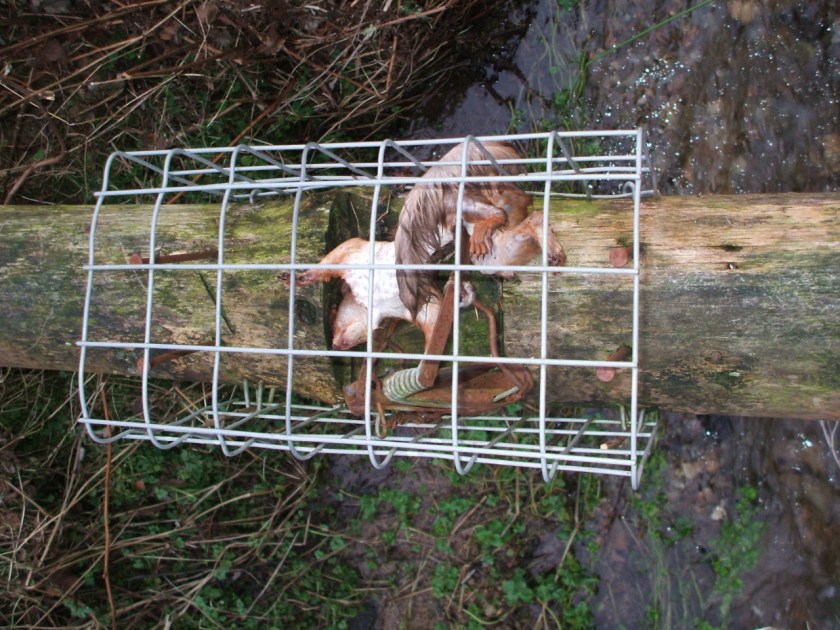
2011 February, Airlie Estate: buzzard caught in illegal crow trap. (see below)

2011 March, Airlie Estate: 3 x buzzard caught in illegal crow trap. Prosecution (!) but dropped after statement from suspect given to SSPCA deemed inadmissible.

2011 April, Millden Estate: shot buzzard. No prosecution.

2012 April, ‘Nr Noranside’: Remains of buzzard found beside pheasant pen. Suspicious death.

2011 June, Rottal & Tarabuckle Estate: dead kestrel inside crow cage trap. No prosecution.

2012 February, ‘Nr Edzell’: spring-trapped buzzard. No prosecution.

2012 February, ‘Nr Bridgend’: remains of buzzard found under a rock. Suspicious death.

2012 May, Millden Estate: satellite-tagged golden eagle seemingly caught in spring trap, then apparently uplifted overnight and dumped on Deeside with two broken legs & left to die. No prosecution.

2012 May, Glen Esk: disappearance of sat-tagged red kite. No further transmissions or sightings of bird.

2013 January, Invermark Estate: white-tailed eagle nest tree felled. No prosecution.

2013 June, Glen Ogil: shot buzzard. No prosecution.

2013 July, Glen Moy: illegal hawk trap. No prosecution.

2013 September, nr Edzell: unset spring trap next to bait. No prosecution.

2013 November, Glen Lethnot: poisoned golden eagle ‘Fearnan’. No prosecution.

2014 August & September, Glenogil Estate: alleged snaring offences. Prosecution dropped.

2014 October, Nathro: shot buzzard. No prosecution.

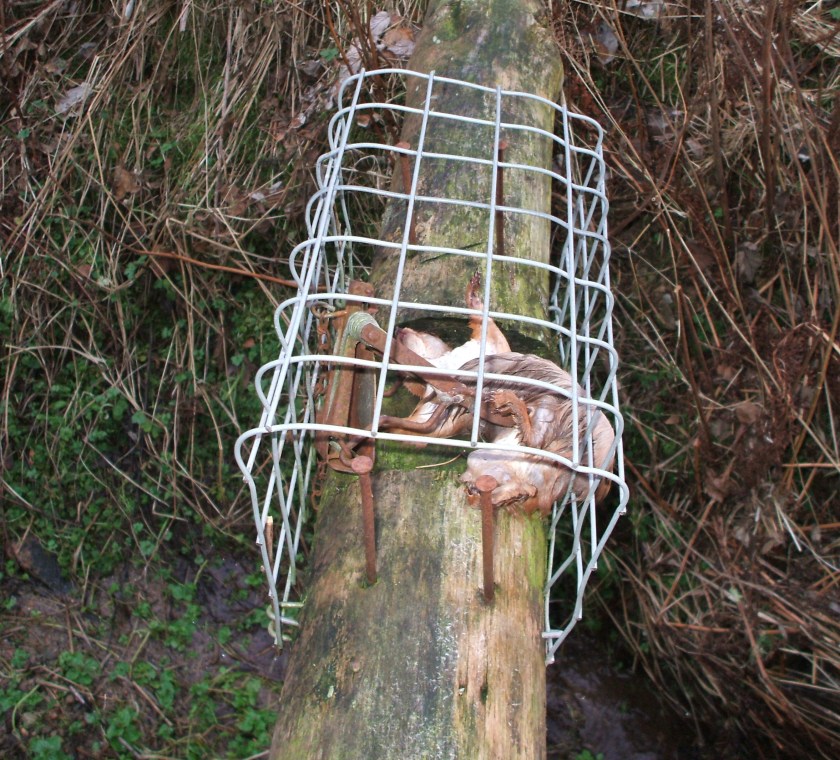
2015 July, Brewland Estate: illegal pole trap. Prosecution dropped.

2017 October, Angus Glens grouse moor: alleged suspicious incident (details not public), ongoing investigation

2018 March, Angus Glens grouse moor: alleged suspicious incident (details not public), ongoing investigation

In addition to the above incidents, there hasn’t been a single successful hen harrier breeding attempt in the Angus Glens since 2006, and the area is also one of the areas identified as a hotspot for satellite-tagged golden eagles that have ‘disappeared’ in suspicious circumstances. In addition to the eagles that have ‘disappeared’ here, and the ones that have been found illegally poisoned or illegally trapped, a further golden eagle tag was found on a grouse moor here, “whose housing had been stabbed by a sharp implement and whose harness had been cut cleanly by a sharp instrument”, according to the golden eagle satellite tag review.

Map showing the last known positions of satellite-tagged golden eagles that either ‘disappeared’ in suspicious circumstances or were found illegally poisoned/trapped, 2004-2016 [data from Golden Eagle Satellite Tag Review]

MSP Liam Kerr (Conservative, NE Scotland) is very proud of the group’s Conservation & Environment Award; so proud, he’s submitted a motion to the Scottish Parliament seeking congratulations and recognition for the group:

So far, 13 April Fool MSPs have signed it. Strangely, they’re all conservatives:

Michelle Ballantyne MSP, Margaret Mitchell MSP, Miles Briggs MSP, Tom Mason MSP, Maurice Corry MSP, Jeremy Balfour MSP, Jamie Greene MSP, Peter Chapman MSP, Liz Smith MSP, Murdo Fraser MSP, Bill Bowman MSP, Alexander Burnett MSP, Gordon Lindhurst MSP.