Blog

Red kite found shot in Yorkshire Dales National Park

Press release from North Yorkshire Police (23 July 2018):

APPEAL FOR INFORMATION AFTER RED KITE FOUND DEAD IN THE YORKSHIRE DALES

Police are appealing for information after a red kite was found dead in the Yorkshire Dales.

The bird was found on Thursday 12 July 2018, at Barden, near to the popular area known as the Strid. Enquiries are ongoing to establish the cause of death.

Sergeant Kevin Kelly, wildlife crime lead for North Yorkshire Police, said: “We have commenced an investigation and aim to establish the circumstances leading to the bird’s death.

It is key to examine whether the bird has flown to the location injured and subsequently died or whether it has been shot near to where it was found. A detailed pathology report will assist us in establishing this.

What we know at this time is that a triage x-ray shows a small piece of shot inside the bird. This will be recovered and forensically tested. We will be working with partner agencies and the Bolton Abbey Estate to establish the facts that will assist an effective investigation.

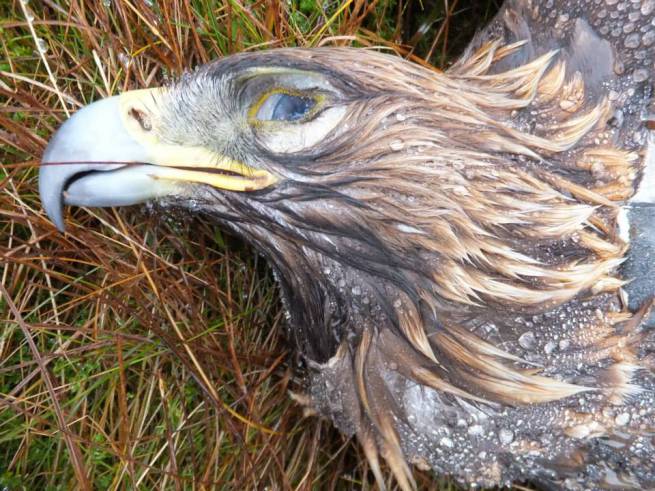
[Photo of the shot red kite via North Yorkshire Police]

Doug Simpson, Yorkshire Red Kite Co-ordinator, said: “This latest incident brings the total confirmed Yorkshire red kite illegal persecution victims up to 42 since releases began in 1999, thirteen of these birds having been shot.

It is sickening that a small minority of people appear intent on breaking the law by targeting these birds, which have become an integral part of our beautiful North Yorkshire countryside.

Benedict Heyes, from the Bolton Abbey Estate, said: “We were disappointed to be notified by a member of the public that they had found a dead red kite on the Bolton Abbey Estate.

Red kites and other birds of prey are often seen at Bolton Abbey and are enjoyed by many visitors to the Estate. The Estate alerted the authorities and would ask that anyone who has any knowledge or information in relation to the death of this bird to contact North Yorkshire Police, so as to assist them in their investigation.”

Sonya Wiggins, who coordinates Yorkshire Dales Moorland Group, said: “We have been made aware of this incident and fully support a police investigation. At Yorkshire Dales Moorland Group we believe in good practice and accountability, we work closely with the local police and other agencies to tackle wildlife crime.

Killing wild birds is unacceptable and we would ask for anyone with any information to contact the police.”

Anyone with any information is asked to contact North Yorkshire Police on 101, select option 2 and ask for Sgt Kevin Kelly, or email kevin.kelly@northyorkshire.pnn.police.uk

Please quote reference number 12180131874 when passing information.

ENDS

Buzzard shot dead in Dorset

RSPB press release (23 July 2018):

DEAD BIRDS OF PREY FOUND IN DORSET

A shot buzzard and dead barn owl spark concerns of a local persecution problem

Dorset Police and the RSPB are appealing for information after a dead buzzard and a dead barn owl were found near Melplash, Dorset in May 2018.

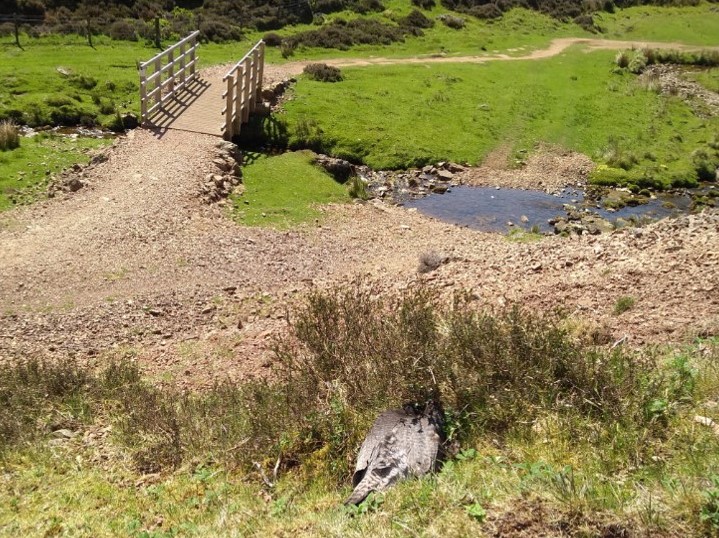
[Photo of the shot buzzard via RSPB]

The buzzard was taken to a nearby vets, where an X-ray revealed the presence of a piece of shot in the bird’s skull, which is believed to be the cause of death. A barn owl was also found dead in suspicious circumstances under its nest box, though the body was too decomposed to determine cause of death. Sadly there are also previous reports of another dead barn owl and a number of dead buzzards in this area, though the bodies were not recovered for testing.

Local enquiries by Dorset Police have not uncovered any leads so far, and they are appealing to the public for information.

Birds of prey and owls are protected by law under the Wildlife and Countryside Act 1981 which makes it an offence to intentionally harm them. Anyone found to have shot or killed these birds faces an unlimited fine and/or up to six months in jail.

Tony Whitehead from RSPB South West Regional Office said: “The deliberate persecution of birds of prey is not only brutal but illegal. Raptors are an essential part of a healthy ecosystem, not to mention a glorious sight to see. We are grateful to the member of the public who took the trouble to report these incidents and we urge anyone with information to come forward.”

The illegal persecution of birds of prey is a widespread and unrelenting problem which continues to affect the conservation status of some raptor species in the UK. As a result, the RSPB has set up a confidential ‘Raptor Crime Hotline’ to give whistleblowers a chance to speak out in confidence and help end this culture of criminality.

Claire Dinsdale of Dorset Police’s Rural Crime Team said: “Raptor persecution is one of the UK Wildlife Crime Priorities which includes poisoning, shooting, trapping, habitat destruction and nest destruction or disturbance. There is a clear responsibility with legitimate firearm users to accurately identify the species before any shot is taken. It is totally unacceptable to act outside the law and shoot these protected birds. I would urge anyone with any information to speak to us or the RSPB in confidence.”

If you have any information relating to this incident, please call Dorset Police online in confidence at www.dorset.police.uk/do-it-online and quote reference 55180073229. Or contact the RSPB’s confidential Raptor Crime Hotline on 0300 999 0101.

If you find a wild bird which you suspect has been illegally killed, contact RSPB investigations on 01767 680551 or fill in the online form here.

ENDS

Surprise! Gamekeeper in raven cull area declares cull a success

Here is a fine example of the sort of idiotic reporting we’re up against.

A gamekeeper who works in Strathbraan, the area where SNH authorised the licensed killing of ravens earlier this year on the basis of ‘seeing what happens’, has declared the cull ‘a success’.

Of course he’s declared it ‘a success’. He’s got a vested interest in wanting SNH to issue more and more raven cull licences. He’s a committee member of the Scottish Gamekeepers’ Association, an organisation that has been lobbying for licences to kill predatory birds since the turn of this century.

Incredibly, on the basis of this gamekeeper’s word alone, and without any scientific analysis, evidence or justification whatsoever, the press has regurgitated this nonsense. It’s no coincidence that this half-witted ‘news’ broke shortly after the announcement was made that the Scottish Raptor Study Group had lodged its application calling for a judicial review of SNH’s decision to issue the licence in the first place.

Here’s a headline from the Daily Record on 10th July 2018:

The Daily Telegraph has now also joined in with an article published this morning. At least this journalist had the good sense to include the phrase ‘has been a success’ in inverted commas and also includes a quote from RSPB Scotland dismissing the gamekeeper’s claim as “meaningless“:

There’s an interesting meme doing the rounds on Twitter that seems appropriate to include here:

Meanwhile back in the real world, SNH’s response to the judicial review application is keenly awaited (it’s due very soon) and we also await with great interest the report of SNH’s Scientific Advisory Committee who was asked to consider the scientific basis of the raven cull licence. It’s our understanding that the report was given to SNH’s Board at the end of June. Interestingly, SNH has not yet put it in the public domain.

To read all the associated blogs about the Strathbraan raven cull, please see here.

Prosecutors accused of ‘failing to take raptor persecution seriously’ in North Yorkshire

A few days ago we blogged about a proposal by the North Yorkshire police watchdog to implement an inquiry in to why the county has the worst record for raptor persecution crimes in England and why efforts to crackdown on the criminals have failed (see here).

This proposal was due to be discussed at the North Yorkshire Police and Crime Panel meeting last Wednesday.

That discussion did take place, and although we’ll have to wait until September for the official minutes to be published and to find out what the panel agreed to do, a couple of articles have since appeared in the media.

The following is an amalgamation of two of those articles, one published in The Northern Echo (today) and one in The Yorkshire Post (yesterday). The articles were almost identical apart from a few minor differences, so we’ve joined them together to ensure all the information is available in one post:

The Crown Prosecution Service (CPS) has been accused of failing to take bird of prey persecution seriously in a county with an “appalling” record over the crime, a meeting has heard.

A leading councillor has been backed by North Yorkshire Police and Crime Commissioner Julia Mulligan in calling for the CPS to revisit how it tackles offenders, ahead of a National Rural Crime Summit in Harrogate on Wednesday.

A meeting of the North Yorkshire Police and Crime Panel heard there had been 70 convictions in the county for poaching over the last year, 54 of which went to court, and there had been others for badger-baiting, but none for raptor persecutions.

Last November, the RSPB said the county’s history of bird of prey persecution was “appalling” and has repeatedly claimed the crimes are linked to land managed for intensive driven grouse shooting.

Panel members were told techniques being used to develop the persecution cases were the most advanced used by the police and there had been no bird of prey persecutions reported since the force and wildlife experts launched Operation Owl, in which officers are sent to raptor persecution hotspots, in February. Panel members were told there were, however, some prosecutions ‘in progress’.

The panel’s deputy chairman, Councillor Peter Wilkinson, praised the professionalism and enthusiasm of wildlife officers.

He added: “I do believe the police are handicapped by the lack of proactivity from the Crown Prosecution Service. I’m not convinced they take it seriously. I’m not convinced they have the resources or capability to tackle this.

I was given an example of the CPS turning up with a solicitor that had had the paperwork for half a day and they were faced with a QC that had already spent £200,000 on preparing a defence for that case.

He added legislative change was needed to mirror Scottish law, in which landowners can be held legally responsible for wildlife crimes on their land, even if they were committed by other people.

Mrs Mulligan responded: “With regard to the Crown Prosecution Service I agree with you. I chair the Local Criminal Justice Board in North Yorkshire and I have brought this up previously with the LCJB and will bring it up again with the Crown Prosecution Service.”

A CPS Yorkshire spokeswoman said it was unable to issue an immediate response but would do so in the coming days.

ENDS

This might sound odd, given the lengthy criticisms of the CPS (and its Scottish counterpart, the Crown Office & Procurator Fiscal Service, COPFS) that have appeared on this blog over the years, but we don’t think the fundamental problem lies with the CPS. Sure, there have been some unfathomable decisions and displays of what look like dumbfounding incompetence over the years, and the prosecutors’ subsequent refusal to discuss or explain these decisions has been exasperating, but all this has to be set in context of the criminal justice system which is, according to many leading lawyers, “at breaking point”. [For an excellent analysis we’d recommend reading The Secret Barrister: Stories of the Law and How It’s Broken (Macmillan, 2018)].

Central to this ‘breakdown’ is a lack of resources which leads to chronic understaffing which then has a knock-on effect for individual public prosecutors and the cases they are working on.

As an example, last week we met a CPS solicitor at a court in northern England. She’d travelled some distance to be there first thing and said she’d been up until 1am that morning prepping her cases. Her schedule for that day alone included two separate trials and one other hearing to deal with complex legal argument. Imagine how soul destroying that must be for someone who spent all those years studying hard for a qualification, who is diligent, committed and wants to do a good job, but just isn’t given the time to prepare in full.

Now imagine that one of those cases she’s dealing with is a prosecution for alleged raptor persecution on a grouse moor. The accused’s employer will have stumped up hundreds of thousands of pounds to engage the services of a top QC, and the main evidence is likely to be covert video footage captured by the RSPB’s Investigations team (it won’t be police footage because the police are not permitted to undertake covert surveillance for what is officially regarded as a low-level crime). The QC will have had the luxury of several (many!) months to focus on getting the case thrown out on a technicality, and, as we’ve seen with increasing regularity, the QC’s painstakingly-crafted argument will win. The hard-working-but-pushed-for-time CPS solicitor doesn’t stand a chance.

Calls for a change in the legislation to introduce vicarious liability for raptor crimes in England are understandable, but what would that achieve? Before a prosecution for alleged vicarious liability can proceed, you first have to demonstrate that the original offence was committed by a named individual working under the supervision of the person being accused of vicarious liability. As we keep seeing, identifying (let alone convicting) a named individual for the original offence is becoming increasingly difficult, especially in cases involving grouse shooting estates that employ multiple gamekeepers where they’ve all given ‘no comment’ interviews to the police.

And even if you did get to the unusual stage of convicting the original offender, a subsequent prosecution for vicarious liability is not straightforward. As we’ve seen in Scotland, where vicarious liability for raptor persecution was introduced on 1 January 2012, there have been only two convictions in six and half years! A third prosecution wasn’t possible because the landowner couldn’t be identified (here) and a fourth prosecution was dropped by the Crown Office because, apparently, ‘it wasn’t in the public interest to proceed’ (here).

So what is the answer? There are those who would argue for a specialist wildlife crime prosecution unit in England, and there are definite merits in that, but again, look at the experience of Scotland where a specialist wildlife crime unit was set up at COPFS in 2011. Has this led to an increase in successful prosecutions for raptor persecution? No, it hasn’t.

There are those who would argue for a specialist environmental court – again, there are definite merits in that but as someone pointed out to us during a discussion on this topic just the other day, what happens if, within the small pool of judges available, one or several of them has vested interests in gamebird shooting and/or strong links to the ‘establishment elite’ (many of whom are involved in grouse shooting)? It doesn’t take much imagination to predict the outcome.

It’s a difficult issue if we’re going to rely upon the justice system to solve the problems although a few of us will be sitting down with some very bright legal minds in the near future to discuss exactly that.

Another option of course is to stem the problem at source – just ban driven grouse shooting. That seems a long way off but an interim step of licensing driven grouse shooting (and thus being able to withdraw the licence of those estates that persist with the illegal killing of raptors) is becoming an inevitable outcome, at least in Scotland.

We look forward to hearing the suggestions put forward by the North Yorkshire Police and Crime Panel about how they intend to address the ongoing problems in their county.

Salisbury peregrine ‘Peter’ – shot last year, Dad this year

A good news story!

Last year we blogged about a peregrine that had been found shot in Hampshire. His colour ring (Blue GX) identified him as ‘Peter’, one of the chicks that successfully fledged from Salisbury Cathedral in 2014. He’d suffered a fractured wing from the gunshot fragments.

Peter spent a few months in the care of the Hawk Conservancy Trust in Andover where he received specialist veterinary attention and rehabilitation that allowed him to be released back to the wild several months later (see here).

[Photo of Peter’s release by James Fisher]

This year, thanks to his colour ring, Peter has been recorded nesting at a quarry in Hampshire. This breeding attempt has resulted in two successfully fledged chicks. Full details here on the Salisbury Cathedral website.

What a fantastic outcome for all those involved with his rescue and rehabilitation. Well done and thank you!

[Digiscoped photo of Peter at the quarry, by Keith Betton]

Osprey ringing accident fuels malicious and hypocritical abuse

Yesterday the RSPB posted a blog about the death of an osprey chick that died when two staff members were visiting the nest to ring the chick. It’s an exceptionally rare incident and the blog is well worth a read for a bit of perspective, here.

[Photo of an osprey chick by Lewis Pate]

This unfortunate accident has been picked up by the usual game-shooting trolls on social media who are, unsurprisingly, using this story to incite the usual anti-RSPB rhetoric and cast doubt on the professionalism of the ringers, including calls for them to be prosecuted! One of the main instigators is Bert Burnett of the Scottish Gamekeepers Association, who crassly headlined with this sensationalist nonsense:

OSPREY DIES, RSPB INVOLVED

and went on to say:

Careless behaviour by ordinary members of the public connected to wild birds can and does result in prosecutions, will those responsible for this birds tragic death feel the weight of the law?“.

By ‘careless behaviour’ he’s presumably referring to the deliberate and pre-meditated actions of gamekeepers who have been caught illegally poisoning, shooting and trapping protected raptor species year after year after year, crimes which of course should lead to a prosecution. That’s clearly quite different from the circumstances of this osprey chick’s death.

Inevitably, the trolls’ faux outrage has quickly moved on to the malicious abuse of anyone involved in raptor tagging projects and includes calls for the satellite tagging of raptors to be halted on ‘welfare grounds’, despite an extensive review published last year that showed there are currently zero grounds for concern.

What happened to this osprey chick was an accident. A tragic, horrible accident. Mistakes can happen, and, as the RSPB blog states, there will be a review of the circumstances and all recommendations taken on board to ensure the chance of this happening again is minimised.

The ringing team will be devastated. These are qualified, highly skilled and experienced bird ringers, operating under a hard won licence, motivated by the opportunity to contribute towards osprey research and conservation. That an osprey chick died whilst in their care will probably haunt them for a considerable number of years.

The vitriolic response from the game shooting trolls is entirely predictable. They don’t like the idea of raptors being fitted with any sort of marker, and especially not satellite tags, because they know that the data being generated by those tags are all pointing, overwhelmingly, towards the illegal killing of raptors on grouse moors, despite the shooting industry’s best efforts to hide these crimes. Any opportunity they get to try and discredit the RSPB and raptor workers, they’ll take it, as we’ve seen today.

Oh, and let’s not forget, some of these trolls were actually begging to be allowed to ring raptors in the Cairngorms National Park not so long ago, presumably with the idea of taking control of the data and hiding it from public view (hiding stuff seems to be one of their special skills – we’re still waiting to hear what happened to the dead red kite found on an Angus Glens grouse moor back in February). Their hypocrisy is staggering.

Before the trolls hyperventilate from their latest bout of frothing hysteria, they might want to take a breath and read about another incident where a species of high conservation concern died as a result of an unfortunate miscalculation by an expert ringing team, this time employed by the trolls’ comrades at the Game and Wildlife Conservation Trust (GWCT).

We weren’t going to blog about this because, having read the associated reports and documents, it’s quite clear that, like the osprey incident, the outcome was unintentional, but given the abuse currently being thrown at the RSPB ringers and anyone else associated with tagging raptors, this other incident demonstrates that, sometimes, things can go wrong, mistakes can be made, and lessons will be learned.

The case in point relates to a study of Capercaillie in the Scottish Highlands. Last year, staff from the GWCT fitted necklace radio tags to a number of Capercaillie, which resulted in the deaths of at least two male birds (a third bird has not been found). The necklace loops were the wrong size (way too large) and one bird got its leg caught in the neck loop and the other bird got its mandible caught.

Should we be calling for the prosecution of the GWCT ringing team? Should their licences be revoked? No, absolutely not. According to the reports we’ve read, the GWCT team quickly recognised their error and caught up the remaining tagged males and removed their neck tags. The incident was reported to the licensing authorities (SNH and BTO) who both conducted a thorough review and found that the ringing team had operated within the terms of the licences. The GWCT ringers didn’t deliberately set out to kill these birds, just as the RSPB ringers didn’t deliberately set out to kill the osprey chick. The Capercaillie died as a result of a miscalculation, nothing more, nothing less. Lessons have been learned, and as a result permission for anyone to fit tags to the necks of male Capercaillie has now been withdrawn (no such issues have been identified for female Capercaillie and special licences are still available for experts wishing to tag the females).

What was interesting about the Capercaillie incident wasn’t the actions of the ringing team, but the actions of the GWCT’s project management team. SNH raised serious concerns about this and as a result has now pulled out of this particular partnership. This news is of particular interest to those of us currently challenging SNH’s raven cull licence, as GWCT is heavily involved with the planning, data analysis and reporting of that ‘study’.

For those who will undoubtedly accuse us of peddling fake news, here are some excerpts from the SNH report:

What interests us about the Capercaillie tagging incident is the complete lack of publicity about these deaths, which occurred almost a year ago. This is a red listed species of high conservation concern, and yet we’ve only been able to find out about these deaths after several months of submitting FoI requests to various authorities.

Contrast the GWCT’s public silence with the RSPB’s response to the osprey death – a blog was published within a week of it happening.

But that particular point wasn’t our intended focus of this particular blog. Our point is that mistakes can be made, those fieldworkers involved will be inconsolable (whether they work for the RSPB, GWCT or anyone else), and none of them deserve to be on the receiving end of such caustic and malicious abuse, especially from those who work in an industry that doesn’t think twice about routinely and deliberately causing pain and suffering to wildlife, legally and illegally, in the name of a so-called ‘sport’.

Questions being asked about a dead red kite found in the Angus Glens

A series of questions have been asked of the Angus Glens Moorland Group about a dead red kite that was found by a member of the public in February 2018.

The dead kite was found in Glen Lethnot and reported to the gamekeepers, who apparently then collected the corpse.

What happened next remains a mystery as the Angus Glens Moorland Group is refusing to provide answers to questions posed by Ian Thomson, Head of Investigations at RSPB Scotland.

Why are they being so coy?

Red kite shot dead in Kent

Back in May there was a report (and several photographs) on social media of a dead red kite that had been found on 9th May 2018 by a member of the public, “10-12ft up in a bush” at Woodchurch, Kent.

We believe this was reported to Natural England who eventually arranged for the corpse to go for a post mortem.

A few days ago there was an update from the member of the public, again on social media, who said this:

Re: red kite I discovered at Woodchurch in May and retrieved. The District Officer phoned today and confirmed the bird had been shot. So sad, they are holding on to the bird and investigating“.

We don’t have any further information.

Thanks to the blog reader who drew our attention to this case.

[Photo of the shot red kite by Ian Stewart]

North Yorkshire police watchdog plans inquiry on raptor persecution

Article reproduced from Richmondshire Today (16 July 2018):

BIRD OF PREY PERSECUTION INQUIRY PLANNED

A wide-ranging inquiry examining why North Yorkshire has the country’s worst bird of prey persecution record and efforts to crack down on the crime have failed is set to be launched.

A move has been proposed to create a select group of the county’s Police and Crime Panel to collect evidence from bodies ranging from the Crown Prosecution Service to the RSPB to find potential solutions to the persistent issue.

One of the possible solutions the inquiry will focus on is expected to be ‘vicarious liability’, where landowners are deemed responsible for the actions of their gamekeepers.

Another key line of inquiry will be resolving how to bolster prosecutions, as defendants’ specialist lawyers are regularly seen to “outgun” prosecutors, using legal loopholes.

The latest Government maps of recorded bird of prey shootings, trappings, poisonings and cases where nests have been destroyed between 2011 and 2015 show there were 39 in North Yorkshire – the same number as the next worst three counties, Norfolk, Cumbria and Derbyshire.

The county has been named as the worst area in the UK for criminal attacks on birds of prey for more than a decade.

[Graph from RSPB’s Birdcrime 2016 report]

A report by the county’s Police and Crime Commissioner to the panel outlined a range of actions North Yorkshire Police were running to tackle the issue, but did not highlight any successful prosecutions.

The report states to address wildlife crimes issues, the force had increased the number of wildlife crime officers from 14 in 2015 to 20, and would further increase the number of officers looking at wildlife crimes in November.

It said while the county’s ‘abundance of natural habitat which suits raptors’ contributed to its bird of prey persecution ranking, it would be ‘naive to believe this was the sole cause of the problem’.

The report also highlighted Operation Owl, a joint initiative launched by the force, the RSPB and the RSPCA, and the North York Moors and Yorkshire Dales national parks in February, which features surveillance checks on known raptor persecution hot-spots to disrupt offender activity.

Councillor Peter Wilkinson, deputy chairman of the police watchdog, said a change of culture was needed on a minority of shooting estates, alongside more effective prosecutions.

He said the Government figures represented just the tip of the iceberg and more solutions that got to the root of the issue were desperately needed.

The Northallerton politician, who is a keen ornithologist, said: “Birds of prey persecution is a disgrace for North Yorkshire, but my view is the police are taking it very seriously.”

ENDS

This is encouraging news. It looks like this proposal for an inquiry will be discussed at the next North Yorkshire Police and Crime Panel meeting, due to take place tomorrow (19 July 2018).

The report by the North Yorkshire Police & Crime Commissioner to the panel, as mentioned in the above article, can be read here: Wildlife Crime in North Yorkshire_Police and Crime Panel Report_July2018

The more pressure that is brought to bear on the raptor killers in North Yorkshire, the better, given this county’s appalling track record. For an overview of the scale of ongoing raptor persecution in North Yorkshire, which is what the Police and Crime Panel are faced with, this recent map from the RSPB says it all:

There is news circulating on social media today about a successful hen harrier nest on a grouse moor in the Yorkshire Dales National Park, the first since 2007(!). That is clearly the result of increased pressure and is to be welcomed, although one token pair in such a vast county won’t persuade anyone that illegal persecution is in decline – we’ll need to see many more successful nests, over a sustained period of years, to be convinced that things are changing for the better. And of course successful nests are meaningless if the young harriers from those nests are still routinely killed on other grouse moors once they’ve fledged.

UPDATE 22 July 2018: Prosecutors accused of ‘failing to take raptor persecution seriously’ in North Yorkshire (here)


More wildlife destruction on the Angus Glens grouse moors

Thanks to the blog reader who sent us these gruesome images of wildlife destruction (aka 21st Century grouse moor management), photographed on a grouse moor in the Angus Glens.

Fox, rabbits and a cat:

Cat slung over a tree above a stink pit:

A song thrush:

A stoat:

Amusingly, the Angus Glens Moorland Group (part of the Gift of Grouse propaganda campaign) is launching what it calls a ‘wildlife campaign’ this weekend, presumably in an effort to get favourable press coverage as the opening of the grouse shooting season draws ever closer. They’re asking the public to post images of wildlife on to social media platforms using the hashtag #WeHaveWildlife.

Wouldn’t it be awful if these images of what really goes on (#We Have Wildlife But We’ll Kill It If It Threatens Our Grouse Shooting Profits) were to be seen instead?