Blog

Join Chris Packham this weekend to highlight lack of hen harriers in our skies

Press release:

Chris Packham to highlight lack of hen harriers in our skies with mass kite-flying event this Saturday at Box Hill, Surrey

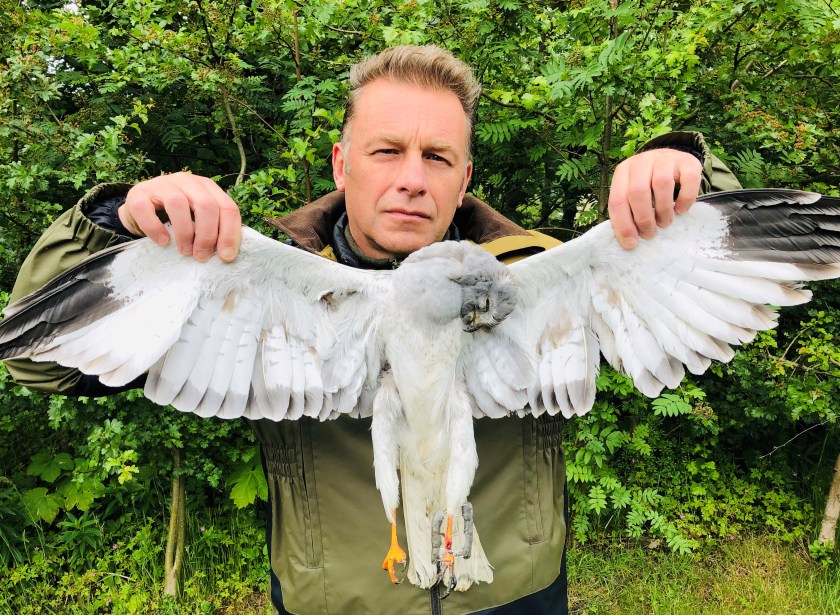
Naturalist and television presenter Chris Packham is hoping for good kite flying weather this Saturday at Box Hill in the Surrey Hills. To highlight the plight of Hen Harriers he’s had 100 paper kites made, with their image, for kids and adults to fly at the National Trusts’ Box Hill property, Saturday afternoon at 2.30pm.

Chris Packham: “Saturday is about having an enjoyable day out for people and to raise awareness that our Hen Harriers are in deep trouble. If we are able to fly 100 kites it will represent many times more than the actual number of Hen Harriers that are flying in the skies of England. This a shameful situation.” 

There’s been more in the news this week about two young Hen Harriers disappearing in suspicious circumstances in North Yorkshire and Durham. These two were part of a ludicrous government ‘trial’ to see whether removing Hen Harrier chicks from a grouse moor (to prevent their parents catching Red Grouse to feed to them), rearing the young Harriers in captivity and then later returning them to another grouse moor, would help boost the dwindling Hen Harrier population. Based on all the scientific evidence and previous knowledge of what happens to young Hen Harriers in the UK, it’s probably a safe bet to predict these two Harriers have been illegally killed on grouse moors. The police are currently investigating.

Although a serious message, Saturday at Box Hill is very much a family day out where kids and adults can have fun flying the kites as well as learn more about these precious raptors.

ENDS

Moorland Association’s brood meddling press release amounts to abuse of process

Whichever way you look at it, the Moorland Association’s press release on hen harrier brood meddling amounts to an abuse of process.

First of all there’s the abuse of process in terms of the internal governance of the brood meddling project. We know, from the formal brood meddling project plan, that there’s a Project Board whose responsibilities include:

(a) ensuring that reporting from the project team is timely and acted upon;

(b) to oversee project external communications

We now know that the Moorland Association released its press release on Sunday without the knowledge and consent of project partner Natural England. How do we know this? Because Tony Juniper stated as much in a tweet yesterday:

Not only that, but we’ve also been informed via another source that the satellite tag data released by the Moorland Association was incorrect – apparently one of those harriers had not travelled to southern Ireland at all, but the Moorland Association had simply misunderstood / misinterpreted the data!

Now, the issue of whether the Moorland Association, or anyone else connected to an industry that’s been identified as being responsible for the mass illegal killing of hen harriers, should have access to hen harrier satellite tag data is a topic for another time (for the record – no, of course they bloody shouldn’t for what should be plainly obvious reasons) but the abuse of process from an internal (Project Board) perspective is quite clear. At least one of the Project Board team (Natural England) was excluded from the decision to publish, let alone what to publish.

Will the Moorland Association suffer any consequences/sanctions for this abuse of process, let alone leaving the Project Board’s credibility and integrity in pieces? Probably not.

A far more serious apparent abuse of process is the external one. That is, the suspicious disappearances of two satellite-tagged hen harriers are currently the subject of live police investigations and yet the Moorland Association chose to publish the information WITHOUT THE PRIOR KNOWLEDGE OR CONSENT OF THE POLICE. It was also published before the police had conducted any land searches at the locations of the tags’ last known fixes as part of the investigation. We know this from a conversation we had yesterday with Police Supt Nick Lyall.

That is absolutely outrageous and wholly unacceptable. It could also potentially be a criminal offence and have jeopardised the police investigation by alerting any suspect and providing them with an opportunity to remove evidence and clean up their tracks before the police arrive.

Amanda Anderson, Director of the Moorland Association, can’t claim ignorance on this issue. As a long-term member of the RPPDG, and a frequent critic of the RSPB’s role in police investigations, the Moorland Association knows the police-led investigative process very well.

For those who don’t know the process, here’s what happens when we suspect something has happened to one of our satellite-tagged golden eagles:

  1. First of all there’s a detailed discussion and analysis of the eagle’s recent movements and satellite tag data undertaken by a group of researchers who are recognised international experts in this field and have extensive experience of golden eagle ecology and satellite tag functioning.
  2. Immediate contact is made with the National Wildlife Crime Unit (NWCU) to provide them with an early warning heads up. Tag data are shared with the NWCU, in confidence, and the NWCU is fully appraised of the analysis to date.
  3. The NWCU carries out its own analysis of the tag data and puts together its own confidential intelligence package about the tag’s last known location.
  4. The NWCU and the tag owner decide an appropriate course of action, e.g. no action required because the circumstances aren’t suspicious; or wait for a bit longer (depending on the tag type and the data duty cycle etc) before deciding a further course of action; or agree that the researchers can go and retrieve the corpse and submit for a post mortem if the circumstances don’t indicate anything suspicious; or agree that the police will either go and retrieve the corpse (assuming there is one and the circumstances look suspicious) or agree the police will go and conduct a detailed search of the tag’s last known location if the circumstances suggest any hint of suspicious activity.
  5. Any subsequent media statements are made only after discussion and agreement between the police and the tag operator.

This is the protocol we follow for our satellite-tagged golden eagles and we’re also aware it’s the same protocol the RSPB follows for their satellite-tagged hen harriers. Contrary to the myths, lies and slurs constantly churned out by the Scottish Gamekeepers Association and Scottish Land and Estates et al, we have worked hard to build up a mutually trusting working relationship with the NWCU (helped enormously, it has to be said, by the new head of unit, Chief Inspector Lou Hubble) and this protocol is working exceptionally well. Indeed, we’ve been using it this very week.

[Chief Inspector Lou Hubble, head of the National Wildlife Crime Unit (NWCU) at a satellite tag workshop in North Yorkshire earlier this year. Photo by Ruth Tingay]

We’ll be commenting at length, in the near future, about the SGA’s recent petition to the Scottish Parliament calling for the police to be ‘allowed access’ to sat tag data – those morons at the SGA are obviously oblivious to the fact the police already have access and not only do they have access, several of them are now trained to comprehend and interpret the complex array of engineering and locational data of different tag types.

So, in light of this protocol that we all have to adhere to (and when I say ‘have to adhere to’ we do so voluntarily and willingly because it’s working well and why wouldn’t we want to help the police to investigate crimes against our raptors?!), we fully expect other satellite-tagging projects to also have to adhere.

Does it look like the Moorland Association has adhered?

No, it doesn’t because clearly they haven’t.

The question now is, what sanction, if any, will the Moorland Association face for such blatant abuse of process?

Outstanding Contribution award for Chris Packham

Huge congratulations to Chris Packham who was honoured at last night’s Mirror Animal Hero Awards 2019, winning the Outstanding Contribution Award.

His citation read as follows:

Chris Packham

Television presenter, campaigner, author and environmentalist who has inspired the nation to celebrate and care for British wildlife.

Naturalist, television presenter, writer, photographer, conservationist, campaigner and filmmaker is one of Britain’s most powerful voices for the natural world.

Chris has translated a childhood passion for wildlife into a career as one of our best-loved TV presenters, who has instilled a love and concern for animals and the environment in millions of viewers of all ages.

Since he could crawl Chris has been an ardent nature lover – as a toddler he would search the family garden in Southampton for ladybirds to rescue and he spent his teenage years studying birds, badgers and other wildlife.

He also played in a punk band, but despite trading in his pink platforms for a comfortable pair of walking boots, the music’s ethos left an indelible mark on Chris who learned to never take ‘no’ for an answer. 

He went on to study Zoology at Southampton University and trained to be a wildlife cameraman, working on A Toad’s Tale with Stephen Bolwell in 1983. 

He soon swapped for a career in front of the camera, presenting award-winning The Really Wild Show from 1986 until 1995, instilling a love of animals in a whole generation of kids. 

He has become one of our best-loved wildlife presenters, with the hugely popular Springwatch, and its BBC spin-off shows.

Chris has always used his platform to campaign for the natural world.

Throughout his career, he has been a vociferous opponent of the badger cull and a leading campaigner against driven grouse shooting.  

He is vocal about wildlife and conservation injustices, travelling to Malta in 2014 to conduct an award-winning investigation into the horrifying slaughter of migrating birds. 

Chris, 58, co-founded the Wild Justice campaign group which takes legal action on the behalf of wildlife against public bodies who are failing to protect species and their habitats. 

He said: “Our wildlife has been abused, has been suffering, exploited or destroyed by criminals for too long. Well, no longer.” 

His work has won him numerous accolades including a CBE earlier this year for his services to nature conservation. 

ENDS

There’s also an exclusive interview with Chris in today’s Mirror (here) covering death threats, intimidation, Wild Justice, Extinction Rebellion and the youth climate strikers.

There was another familiar face amongst the winners last night – congratulations to Inspector Kev Kelly from North Yorkshire Police who received a Special Recognition award for his efforts tackling wildlife crime (including raptor persecution) across the county.

Two of the five brood meddled hen harrier chicks have ‘disappeared’

Well, well, well.

As predicted by absolutely everybody with half a brain, some of this year’s brood meddled hen harrier chicks have ‘disappeared’ and it’s not even the end of September. Quelle surprise!

However, if you’d just seen the Moorland Association’s headline and first few paragraphs of their press release you’d never know that two of the five have disappeared in suspicious circumstances. This latest media output is perhaps the most disingenuous we’ve ever seen from the Moorland Association, and that’s saying something from an organisation notorious for distorting the facts!

In fact you have to get down as far as paragraph six before you’re told that two have disappeared, although the text doesn’t actually tell you that they’ve disappeared. Here’s the full press release, just for the record:

It’s quite the masterclass in distraction techniques, isn’t it?!

Mark Avery has already pulled apart some of this press release (see here) including comments about the maps not matching the text.

What we’re interested in is this:

  1. When did these two birds disappear? No dates are provided in the press release.
  2. In which county or counties did these two birds disappear? There is no geographic location provided in the press release. [See update at foot of blog]
  3. On what type of habitat did the last known fix come from for each tag? Was it a grouse moor in one or both cases?
  4. Were the last two locations on land owned/managed by Moorland Association members?
  5. What sort of tags were the two birds carrying and what were the details of each tag’s transmission cycle? (i.e. how many data transfer cycles have now passed without data being transmitted)?
  6. Who is monitoring the tag data?
  7. Have the police been informed? If so, who informed them? Was it the Moorland Association or was it somebody else?
  8. Are these two disappearances the subject of a live police investigation? [See update at foot of blog]
  9. Have the police been given access to the tag data?
  10. Have any police searches been carried out? If yes, were these searches undertaken without giving the landowner prior notification?
  11. Why hasn’t Natural England made a statement?
  12. What is Natural England’s policy for declaring the brood meddling trial a failure? i.e. How many satellite tagged brood meddled chicks have to ‘disappear’ before Natural England makes that declaration? One? Two? Three? Four? Five? This question was actually put to Natural England during a recent meeting between Wild Justice & Natural England’s interim CEO and one of its Directors. Natural England said they didn’t know but would find out. So far they haven’t come back with an answer.
  13. When will DEFRA acknowledge that the grouse shooting industry is completely out of control and unable to self-regulate?
  14. And when will DEFRA do something about it?

For those who might have missed it, here’s what the Government-commissioned science says about satellite-tagged hen harriers in northern England – 72% of those tagged so far [by Natural England] have been done in on grouse moors (see here). We await the results of the RSPB’s five-year tagging data with interest.

And for those who might have missed it, here’s the Moorland Association practically begging its members not to kill any hen harriers this year (see here).

UPDATE midnight:

Police Supt Nick Lyall has tweeted the following this evening:

UPDATE 1 October 2019: Moorland Association’s brood meddling press release amounts to abuse of process (here)

UPDATE 3 October 2019: When will Natural England pull the plug on hen harrier brood meddling? (here)

UPDATE 4 October 2019: Brood meddled hen harrier chick vanished from grouse moor on Bowes Estate, County Durham (here)

UPDATE 8 October 2019: 2nd brood meddled hen harrier chick vanished from grouse moor in Yorkshire Dales National Park (here)

UPDATE 15 October 2019: 3rd brood meddled hen harrier ‘disappears’ in suspicious circumstances (here)

10,000 consultation responses for proposed bill to ban fox & mountain hare killing in Scotland

Press release from Scottish Greens (22 Sept 2019)

Fox and Hare Bill receives almost 10,000 consultation responses

Alison Johnstone MSP has welcomed the astonishing response to her Fox and Hare member’s bill consultation, which has received almost 10,000 responses from organisations and members of the public. This means the proposal is now the second most responded to member’s bill consultation of all time.

The consultation on the proposed bill, which will officially be known as the Protection and Conservation of Wild Mammals (Scotland) Bill, received 9850 electronic submissions with around 100 paper submissions.

The Scottish Government have previously stated they would act to end the mass slaughter of Scotland’s iconic wildlife, but given the absence of proposals in the programme for government, and recent revelations that a senior cabinet minister supports hunting (see here), it’s clear that Ms Johnstone’s bill is now the only game in town.

[Alison Johnstone MSP launched her fox and hare bill consultation in June. Photo by Gordon Terris]

Alison Johnstone MSP said:

I’m delighted that the consultation on my proposed bill has received such an astonishing response. I’m grateful for the support I’ve received from constituents, colleagues and stakeholders. Although the responses need to be individually analysed over the coming months, I am confident that the they will show overwhelming support for bring the indiscriminate killing of Scotland’s foxes and hares to an end.

Foxes and hares are iconic species that are widely celebrated in popular culture and valued by rural and urban Scots alike. They deserve our compassion and respect, yet they are routinely slaughtered across the country in huge numbers.

Fox hunting was meant to have been banned in Scotland in 2002, but little has changed. Hunts still go out, pursuing and killing foxes, and foxes are still being killed by hunting dogs. My proposal would remove the loopholes and result in a watertight ban, ending hunting for good. Politicians have repeatedly promised to end hunting, and the Parliament passed the Protection of Wild Mammals Act back in its very first session. For hunting to continue despite this leads to distrust in our institutions and those leading them. My proposals would represent a new contract between land managers and the wider public that could help restore good faith.

Mountain hares are routinely being killed in huge numbers on grouse moors in particular, with an average of 26,000 killed every year. This is a native species whose population has crashed in some parts of the Highlands, and there is simply no justification for the killing.”

ENDS

Red kite illegally poisoned in North Yorkshire

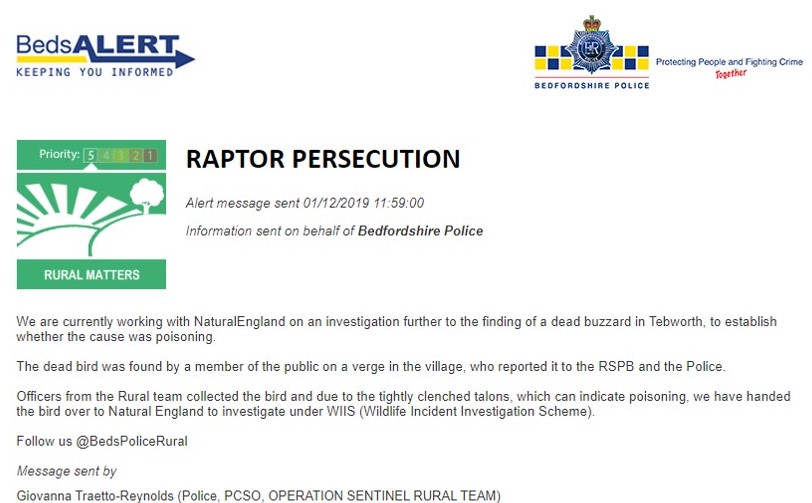
Toxicology testing (by WIIS – Wildlife Incident Investigation Scheme) has confirmed that a dead red kite that was found ‘recently’ near Thixendale, North Yorkshire was illegally poisoned with the banned pesticide Carbofuran, according to local raptor rehabilitator Jean Thorpe.

We haven’t been able to find any further information about this crime.

[The poisoned red kite. Photo from Jean Thorpe]


Wales leads the way with impressive new General Licences

Earlier this year Wild Justice successfully challenged Natural England over the unlawfulness of three General Licences, which, Wild Justice had argued, authorised the casual killing of millions of birds without adequate monitoring or regulation.

Whilst we await the outcome of the subsequent Government consultation and review of new General Licences for England by DEFRA and Natural England, the Welsh statutory conservation agency, Natural Resources Wales (NRW) has quietly and efficiently got on with its own review of the Welsh General Licences after seeking legal advice and realising that, just like the English General Licences, the Welsh ones were actually unlawful too.

A couple of weeks ago Wild Justice wrote a blog about the proposed new Welsh General Licences, including rumours about how good they might be and the game-shooting industry’s hysteria about the as yet unpublished new regulations.

Yesterday, NRW confirmed that it would be issuing three brand new General Licences on 7 October 2019 and explained some of the big changes that have been made, including changes to the species covered by the new General Licences where NRW felt the evidence to retain them on the General Licence approach was not strong enough, as follows:

  1. GL001 – Prevent serious damage to livestock, foodstuffs for livestock, crops, vegetables or fruit or to prevent the spread of disease to livestock, foodstuffs for livestock, crops, vegetables or fruit. This will not now include rook, jay or collared dove. We have also revised the purpose of this General Licence so as to be for the spread of disease to livestock, foodstuffs for livestock, crops, vegetables or fruit.
  2. GL002 – Preserving public health and preventing the spread of disease. This will not now include carrion crow, magpie, jackdaw, rook, jay, collared dove or wood pigeon.
  3. GL004 – Conservation of wild birds. This will not now include rook, feral pigeon or Canada goose.

These changes are significant, particularly for the Rook which has now been removed from all three licences, and the Jay which has been removed from two licences.

It’s probably worth emphasising here (in advance of inaccurate headline hysteria by the Daily Mail, Telegraph, shooting press et al) that this doesn’t mean that Rooks and Jays can’t ever be killed; it just means that in those circumstances where land managers can demonstrate a need and can provide evidence that non-lethal control methods have failed, then NRW will consider issuing individual licences to kill these species under very specific and controlled circumstances. There’ll be no more casual killing as there was before.

For GL004 – Conservation of Wild Birds – the removal of the Rook was exactly what Wild Justice had argued for in England, because there is simply no scientific justification for it on the grounds of protecting wild birds (nor Jays, Jackdaws or Magpies).

NRW hasn’t yet published the new General Licences and probably won’t until they become active on 7th October so it’s a bit difficult to comment in detail at the moment, although NRW has provided a series of Q&As (here). It’s clearly not possible to comment on the legality of these new licences until they have been seen in full.

Naturally, NRW’s announcement about the revised General Licences has been met with a furious reaction by the National Gamekeepers Organisation (see here) and no doubt their mates at BASC, Countryside Alliance, GWCT etc will all be claiming the sky is falling in by this morning. There’ll be warnings of a plague of Rooks bringing pestilence across the nation and how their wings will block out the sun and their beaks will peck out the eyes of babies and toddlers.

The Gamekeepers are apparently considering a potential legal challenge against NRW’s decision-making (in the form of a Judicial Review) which is really quite funny when you consider the slurs chucked at Wild Justice by the game shooting industry for er, undertaking a legal challenge (for example ‘another extremist attack’ and engaging in ‘childish eco-politics’).

It’s not yet clear whether there will be grounds for a Judicial Review (although that’s a decision for a judge to make) but NRW’s statement about undertaking a formal review of all bird control licensing in 2020 may well just scupper the chance of an immediate Judicial Review application being accepted anyway – because why waste a court’s time when a review is already planned? (This is the same legal tactic that’s been used by Natural England and DEFRA to delay Wild Justice’s legal challenges against the General Licences and the release of millions of non-native gamebirds).

Well done to Natural Resources Wales for refusing to be bullied in to submission by those with vested interests in the status quo, and particularly well done for placing importance on scientific evidence and the law above old wives’ tales and rural myths.

We look forward to seeing the details of the new Welsh General Licences and particularly watching how Natural England/DEFRA reacts as well as SNH, also currently consulting and reviewing the Scottish General Licences and apparently ‘considering the merits’ of adding Ravens to at least one of the General Licences for unregulated slaughter. Rest assured, there will be another legal challenge if they try and pull that stunt.

UPDATE 4 February 2020: NRW – your general licences are unlawful (see here)

5 October: Celebrate Hen Harriers at Chris Packham’s kite flying event, Box Hill

Chris Packham has organised another pop-up conservation event, this time with the focus on Hen Harriers.

Saturday 5th October from 1pm at Box Hill, Surrey:

Pre-Werritty propaganda from grouse shooting industry

As we all continue to wait for the publication of Professor Werritty’s report on driven grouse shooting, the usual suspects have been busy putting together a damage limitation programme to save their sorry necks.

An ‘informal alliance’ has been created under the banner of RELM (Rural Environment Land Management) ‘to help co-ordinate and streamline responses and communications ahead of the publication of the final report‘ and its first offering is this briefing document for MSPs which was distributed by Scottish Land & Estates a couple of weeks ago:

Here’s the intro blurb:

Grouse moor management has been the subject of much attention during the summer period across a range of issues such as the environment and species conservation, satellite tagging and wildlife crime, mountain hares and the start of the season on August 12.

With the Scottish Government’s review into grouse moor management due to be published shortly, rural organisations wished to provide the following update to parliamentarians. We would be pleased to provide additional detail where required.

Ah, how thoughtful. Amusingly, several MSPs have sent us a copy of this briefing document with comments along the lines of ‘You might want to say a few things about this’.

We’re grateful to those MSPs because yes, we do want to say a few things about the document’s contents and we wouldn’t otherwise have had an opportunity had they not shared the briefing with us.

We’re not posting the full briefing document here, yet. Instead we intend to blog about different aspects of it in turn.

Today we’re looking at the page entitled ‘Wildlife Crime’ and its five paragraphs of propaganda:

Propaganda paragraph 1:

Yes, significant media attention does remain focused on wildlife crime, and particularly illegal raptor persecution because everyone else finds it abhorrent and can’t understand why it still goes on and why the grouse shooting industry continues to shield the criminals involved. It’d be interesting to know what, exactly, these five organisations have done to crack down on raptor persecution as part of their claimed ‘full commitment to improving prevention, detection and prosecution’.

Propaganda paragraph 2:

No surprises here. This is a blatant attempt, yet again, to discredit the RSPB’s annual Birdcrime Report which was published a couple of weeks ago and showed that confirmed raptor persecution crimes in Scotland in 2018 had doubled from those recorded in 2017. These cases included a peregrine poisoned in the Pentland Hills, near Edinburgh; a buzzard found to have been shot twice, in South Lanarkshire; a buzzard caught in an illegal trap, in Inverness-shire; and a hen harrier caught in a spring trap in Perthshire. All of these incidents occurred on, or close to, land being managed intensively for driven grouse shooting.

With this level of relentless criminality, it’s no wonder the grouse shooting industry apologists want to infer that the RSPB’s data are ‘unofficial’. Fine. We’ll come back to this later this autumn when the Government publishes its annual wildlife crime report, which we know will include all of the confirmed incidents already reported by the RSPB.

Propaganda paragraph 3:

This is perhaps the most cynical of attempts to downplay the disgusting reality of the criminality still being committed on some driven grouse moors. And the first sentence of paragraph 3 is actually a lie. Not being pursued by Police Scotland? Er, ALL the cases of alleged raptor persecution that have been reported from grouse moors over the last few months are still considered to be live criminal investigations by the Police, according to the investigations officer we spoke to yesterday.

So, the satellite-tagged hen harrier that was found dead on a grouse moor in Strathbraan with an illegal spring trap clamped to its leg – it’s still the subject of a criminal investigation by the police.

The two satellite-tagged golden eagles (Adam and Charlie) that ‘disappeared’ in suspicious circumstances on another grouse moor in Strathbraan, on the same morning as each other – they’re still the subject of a criminal investigation by the police (as are several other alleged offences uncovered during the police search).

The hen harrier that was found caught by its leg in a spring trap that had been set illegally next to its nest on a grouse moor in South Lanarkshire – it’s still the subject of a criminal investigation by the police.

The buzzard that was caught inside a legal cage trap on the same South Lanarkshire grouse moor but was then allegedly beaten to death by someone arriving on a quad bike after dark and using a key to open the padlocked door of the cage – it’s still the subject of a criminal investigation by the police.

The young golden eagle that was photographed flying around in the Cairngorms National Park with an illegal trap clamped to its leg – it’s still the subject of a criminal investigation by the police.

And as for the claim that estates have issued ‘unprecedented and emphatic rebuttals’ – er, there’s nothing unprecedented about that! Estates have always denied any involvement in any of the wildlife crimes that have been uncovered on their land – it’s what they do!

Propaganda paragraph 4:

Ah yes, convicted gamekeeper Alan Wilson, dubbed by the press as ‘Scotland’s worst wildlife killer‘. Yet again, the link between Wilson’s filthy criminal activity uncovered at Henlaw Wood and driven grouse shooting is kept well hidden. Yes, the Longformacus Estate was managed for low ground pheasant shooting but it was also managed for driven grouse shooting – a fact that Scottish Land & Estates doesn’t like to mention!

And speaking of Scottish Land & Estates and it’s so-called ‘full commitment’ to tackling wildlife crime, it still hasn’t said whether the Longformacus Estate was a member at the time these crimes were committed and if so, whether that membership has now been terminated? We asked SLE this question on 22 August 2019. Still waiting for an answer….

Propaganda paragraph 5:

Of course they continue to call for tougher penalties – how can they not? But they know as well as we do that the severity of the penalty is utterly irrelevant if the perpetrators of these crimes can’t even be identified, let alone prosecuted.

And as long as evidence continues to be destroyed and employers continue to shield their criminal employees by instructing them to give ‘no comment’ interviews to the police, nothing will change.

Fortunately, there are more and more savvy MSPs in the Scottish Parliament who have seen through the greenwash and know exactly what’s going on. If you think your MSP isn’t one of those, it’d be worth dropping them an email with a link to this blog.

Damning report highlights illegal killing of birds of prey on Nidderdale AONB grouse moors

The Nidderdale Area of Outstanding Natural Beauty (AONB) is an absolute hell hole for many birds of prey.

[Photo: Ruth Tingay]

This is no secret. The illegal killing of raptors on the grouse moors of this AONB has been documented and reported on for years, by the RSPB and by this blog. The area is notorious amongst raptor conservationists for the number of hen harriers that ‘disappear’ in suspicious circumstances (that’s a euphemism for ‘they have been killed’) and the number of red kite corpses that have been found either shot or poisoned, or sometimes both.

It’s a gaping black hole on the breeding distribution maps of many raptor species and despite this being a so-called protected area, in the words of Mark Avery it’s actually a massive wildlife crime scene.

Here’s a map we produced a while ago showing the boundary of the Nidderdale AONB (yellow line), illegally killed red kites (red dots), missing satellite-tagged hen harriers (orange stars), shot hen harrier Bowland Betty (red star), shot hen harrier River (red triangle, which we now know should be closer to the red star on the Swinton Estate).

Nidderdale AONB lies directly east of the Yorkshire Dales National Park, another raptor persecution hell hole. Last year, the Park Authority responded to public concerns about the killing of raptors on grouse moors by producing an evidence report on the scale of the problem. As we wrote at the time, ‘This report, which is very well written and referenced, is a significant move. There’s no attempt to deny or hide or obfuscate the facts, as we’ve seen so often before. It is a clear description of what’s been happening in this National Park and places grouse moor management at the centre of it all. It’s well worth a read‘.

Fast forward a year and now the Nidderdale AONB has done exactly the same:

You can download the report here: BoP-in-NiddAONB-Evidence-Report-FINAL-Sept-2019

It’s another well-written, fully-referenced report and there’s no hint of denial or obfuscation. It is particularly pleasing to see the use of RSPB persecution data, not just the inaccurate, out of date, watered-down RPPDG data that some pro-shooting organisations rely upon to minimise the perceived scale of the problem. Once again, the report’s conclusion is that grouse moor management is in the frame.

Well done to the author(s) of this report and well done to the Nidderdale AONB for having the balls to publish it.