DEFRA is currently running a consultation about the harmful impacts of releasing gamebirds (pheasants and partridges) for recreational shooting on and near to protected sites of nature conservation value.
DEFRA is running this consultation as part of a review it committed to take after Wild Justice took it to court last year (a legal challenge to which many of you contributed and supported, thank you).
The exact number of gamebirds that are released in the UK for shooting every year is not known because, incredibly and unlike virtually every other European country, the game bird shooting industry in the UK is under-regulated. Nobody even knows how many game bird shoots there are because the people involved do not have to register anywhere, nor report on the number of birds released / shot each year. It’s been a great old wheeze for decades.
The most recent figures, still considered to be a conservative estimate, were for the year 2018 and included 49.5million pheasants and 11.7 million red-legged partridges, making a total of 61.2 million non-native gamebirds released into our countryside. These figures emerged as a result of Wild Justice’s recent successful legal challenge on gamebird releases (see Mark Avery’s blog here for more details).
DEFRA’s consultation closes on Monday (15th March 2021) so if you want to have your say, you only have this weekend to do it.
For those who would like advice and guidance about how to respond to the consultation questions, please visit the Wild Justice blog here, where you’ll find an easy step-by-step guide.
It’s important that as many people as possible respond to this consultation so that DEFRA understands this is an issue of concern. If the majority of responses that DEFRA receives are responses from the game-shooting industry, demanding the status quo and zero changes, then that’s what DEFRA will do.
Responding to the consultation is not as daunting as you might think. Hundreds of supporters have already done it and have told Wild Justice how straightforward it was (e.g. read some of their comments here, here and here).
Here’s the link again on how to respond if you’d like to participate – click here
In January 2020, five pro-shooting organisations issued a statement that professed ‘zero tolerance’ for raptor persecution. Coming 66 years after it became illegal to kill birds of prey in the UK, this was progress indeed.
I said at the time it was a sham (here). I haven’t seen anything since that has convinced me of their collective sincerity.
Take the most recent, high-profile raptor persecution crime reported earlier this week – a gamekeeper on a grouse moor in the Yorkshire Dales National Park filmed using a tethered live eagle owl decoy to draw in two buzzards which he shot on sight (see here). North Yorkshire Police Inspector Matt Hagen said of these offences:
“We conducted a search warrant and interviewed an individual in relation to this incident. Ultimately, however, the identity of the suspect on the film could not be proved, and it was not possible to bring about a prosecution. However this does not mean the event didn’t happen. We know that a gamekeeper on a grouse moor has been shooting buzzards, using a live eagle owl decoy to bring those buzzards into a position where they could be shot”.
Details of this offence emerged on the morning of Tuesday 9th March 2021.
There was silence from the major shooting organisations. And for most of them, at the time of writing this at six pm on Friday evening, that deafening silence has continued.
The three main ones that should have been at the forefront of vocal condemnations and a commitment to boot out the estate and the gamekeeper from any memberships they may hold within the industry, have said absolutely nothing on their respective websites:
The Moorland Association (the grouse moor owners’ lobby group in England) – silence
The National Gamekeepers Organisation – silence
British Association for Shooting and Conservation – silence
The Country Landowners Association (CLA) was also one of the original five signatories to ‘zero tolerance’ but they’ve said nothing either.
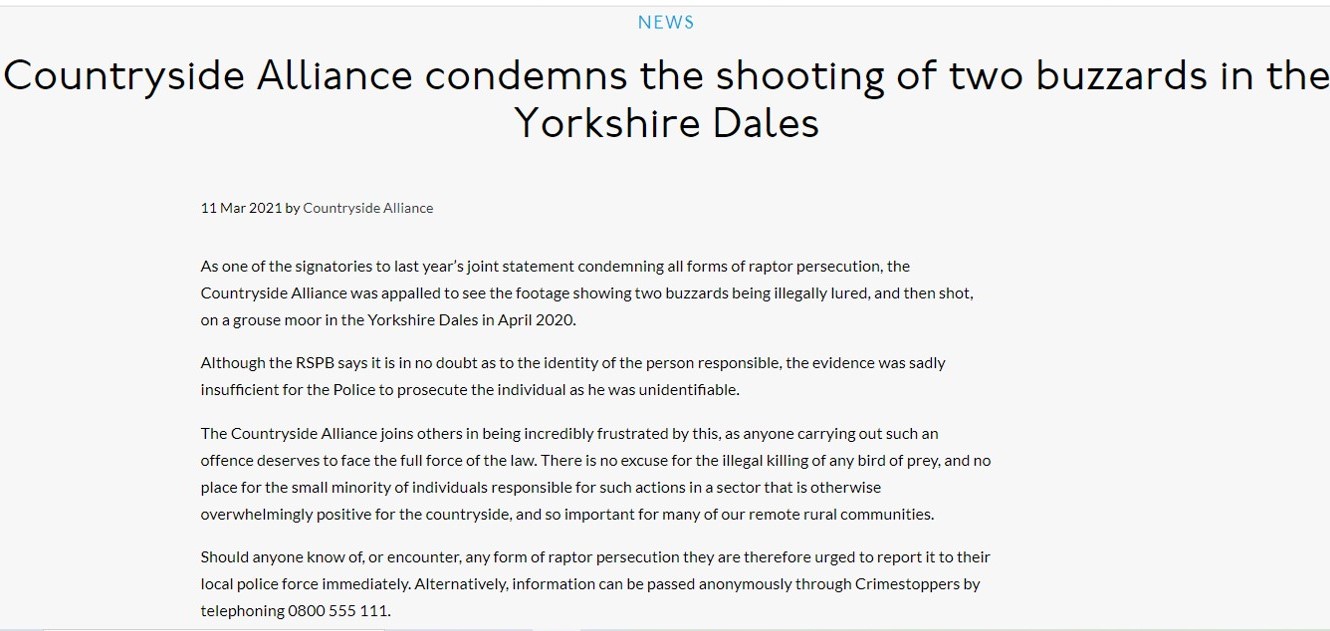
The only one of the five groups who in January 2020 professed a ‘zero tolerance’ policy for raptor persecution and said anything about this latest disgraceful display of criminality was the Countryside Alliance. They published this statement two days after the story hit the headlines:
Whether you believe the sincerity of this statement or not is another matter but at least the CA published something.
Of course, the three main groups that have remained silent are all members of the Raptor Persecution Priority Delivery Group (RPPDG), whose objectives include prevention of, and awareness-raising of, illegal raptor persecution. Anyone seen them doing any of that? No. Once again it looks like they’re just using their membership of the RPPDG as a convenient cover to pretend they care. When are they going to be expelled?
Other members of the RPPDG, notably those who don’t have a vested interest in closing ranks and saying nothing, have issued statements on the crimes.
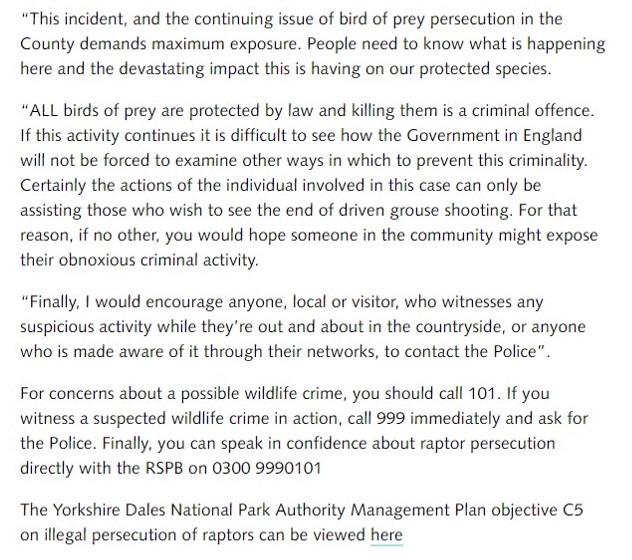
The Northern England Raptor Forum has published a characteristically damning statement (here) and the Yorkshire Dales National Park Authority has done pretty well with this:
So, the illegal killing continues, the majority of the shooting industry organisations say nothing, and public anger grows.
Thanks, Moorland Assoc, National Gamekeepers and BASC – this is only heading in one direction and you’re all helping it reach the end game so much more quickly than we could get it there on our own. Cheers.
The Scottish Gamekeepers Association (SGA) held its AGM last Friday (5th March 2021) – here are two earlier blogs about that event (here and here).
The vast majority of the 2.5 hour event was taken up by a political hustings. Candidates from five different parties were invited to introduce themselves and tell the SGA members ‘what they would do for gamekeepers’ if elected in May, and then there was a tortuous period of questions for the candidates that had been submitted by SGA members.
The participants of the hustings were (from top left): Peter Fraser (Vice Chair, SGA), Carol (one of the ‘girls‘ from the SGA office who’s actually a woman, who was in charge of time-keeping and recording – unseen in this screengrab), Jamie Blackett (All For Unity [George Galloway’s new party, say no more] and author of spectacularly crap articles in Shooting Times), Alex Hogg (Chair, SGA), Edward Mountain MSP (Scottish Conservatives and the un-fiercest critic of raptor persecution), Catriona Bhatia (Scottish Lib Dems), Ian Davidson (Scottish Labour) and Fergus Ewing (Cab Sec for Rural Economy & Tourism, SNP).
You’ll notice the Scottish Greens weren’t represented and at one point Catriona Bhatia asked why they weren’t there. Alex Hogg admitted they hadn’t been invited because before Xmas the SGA had asked for a meeting with Andy Wightman and apparently he hadn’t responded. Er, ok. He does realise Andy left the Greens in December, doesn’t he? Still, the Greens’ absence didn’t stop some of the panellists slagging them off, even though they weren’t there to defend themselves.
I’m not going to post about the entire tedious session because I fear I’d lose the will to live but as an overview of what each of these candidates had to say about what they’d deliver for gamekeepers, I think it’s useful to blog about their introductory speeches.
Jamie Blackett (All for Unity): I’m Jamie Blackett, I’m the leader of All for Unity, we’re a new party founded by my good friend George Galloway, with the intention of unifying the pro-UK anti-nationalist vote to feed[?] the SNP green government and install a government of national unity in May.
Some of you will know me, I write a column each month in the Shooting Times, I’ve written a book, Red Rag to a Bull, about the countryside, I’m a passionate campaigner for the countryside and I hope that if we achieve what we want to achieve in May we will all have a much stronger voice for the countryside and get the government off all our backs so we are no longer looking over our shoulders as we look after the countryside and conserve its wildlife. Thank you.
Alex Hogg: What would you do for gamekeepers if you got elected, Jamie?
Jamie Blackett: Well, we’re running a full slate of candidates across all regions. We’re still looking for some candidates and we hope very much that there may be some people in the SGA who will join us. As I say, I have a strong stake in the countryside, I actually run my own shoot here. George Galloway, as you all know, is not a countryman but he has moved to the countryside and believe it or not I’m teaching him to shoot, er, or I will do when Covid conditions allow.
And we feel very strongly that the justice system needs reforming so that gamekeepers are no longer presumed guilty before they’ve even started in court, we must sort out the burden of proof, corroboration of evidence and all these things so that we in the countryside no longer have this threat hanging over us.
We also want to, er, completely obliterate the Greens in George Galloway’s terminology, the SNP gardening section, who we believe are grinos, greens in name only, they know absolutely nothing about the environment and care even less. We will act rather as the Greens do on the list. The Greens mop up all the spare separatist votes. We will do the same with on the unionists side of the argument and return more pro-UK MSPs to the Parliament. And, er, as I say, we want to get rid of the Green party, diminish the voice of the RSPB and others, and hear more of the voices of people like your members who are the true experts who care about the environment because they spend every waking moment looking after it.
Edward Mountain MSP (Scottish Conservatives): I’m Edward Mountain, I’m a Conservative member of the Parliament on the regional list at the moment, and I’m standing in Inverness and Nairn at the next election. If I can say, at the outset, Alex, that I’m really sad that we’re not all meeting in person. I’ve had some really happy memories of past AGMs. I’ve been a proud member of your Association as you know, almost since its inception, and for 40 years I’ve shared your passions and your experiences.
And I stood for election because I felt that the Scottish Parliament was letting the countryside down. It was clear to me that many politicians relied on briefings by pressure groups such as Revive, RSPB and the League Against Cruel Sports and not from those people who work the lands, people like your membership. And in the Parliament I haven’t been surprised, we’ve had debates on deer management, led by the Green party who’d be happy to see all deer shot all year round. And when I questioned them about it their retort to me is that it was clear that I know nothing about deer management. Well, I wonder. I wonder what 40 years of experience gives you. Perhaps I would suggest to you and your members, as they know, it gives you more than you can read in a book.
And when it comes to hare control the decision to set culls should be done locally, that’s something that I believe, not by a national ban, something that Fergus Ewing, despite his warm words outside the Parliament, meekly followed his party line on and voted for.
And when it came to wildlife crime which I’ve always called out, Claudia Beamish called me out when I suggested that accidental damage of a badger sett should be viewed differently to malicious damage to a badger sett. Her suggestion was that all farmers should walk through the field before harvest to ensure they were free from badgers and setts. Well Claudia, what I say to you is lead the way. I’m happy to follow you through every field in Scotland.
So in summary in the last five years I’ve stood up for you and your industry based on my knowledge and belief. I’ve had your group leaders, Alex and his team, in to the Parliament on numerous occasions to brief me and my members. I’ve never promised to do one thing when I talk to you and do another in the Parliament. And I’ve ensured that my party fully considers your views at all times. And in the next five years if our party is in a strong position and I’m re-elected I will ensure that you get not just warm words of platitudes but actions and results, which is what I think we’ve delivered in the last five years. Thank you.
Fergus Ewing (Cab Sec Rural Economy & Tourism, SNP): Good morning everybody and thank you very much indeed for this invitation. May name is Fergus Ewing. I have spent around 20 years working as a solicitor with my own legal practice and the last 21 years as the MSP for Inverness and Nairn, 13 years as a Scottish Government Minister and for the last five years the Rural Secretary in the Scottish Government.
I have been a supporter of country sports. I am and always will be a supporter of the good work, the excellent work, Alex, that your members do. And I made it my business as somebody who didn’t have that background to learn about it by visiting estates, speaking to you, by learning from the late great Ronnie Rose, from Peter, from many others, and I think it’s essential going forward that we continue to listen to what you have got to say in formulating all policy.
Over the past couple of decades in public life I have done a few things which I hope have helped and I think action speaks louder than words. In the Watson Bill I worked cross-party with others to secure the future of legitimate, necessary and valuable control of foxes by more than one dog flushing the foxes to be despatched. I learnt why that was necessary and we delivered that result.
Over the years I’ve launched the good guidance on snaring at Moy, I voted against the ban on tail docking, I thought that caused cruelty to hunting dogs because their elongated tails became wounded by gorse and bracken and the nerves in the tail mean it was difficult to heal. So it was actually a cruel measure and I really campaigned very hard with you and others to restore that and the tail shortening can now be carried out and I’m pleased about that.
It’s essential that we carry on with muirburn. We might come to that later. It’s absolutely essential to protect peatland. I’ve seen the Mars Bar film – I get it.
Lastly, on positive things, over the past year in Covid, last year I made sure that country sports qualified for support as a branch of hospitality and tourism. This year and very recently working with you and BASC and others, who understand the countryside very well, we’ve set up a million pound support for compensation, particularly for businesses that have really lost all their custom, guides, agents, who bring in valuable business to Scotland. Country sports are worth £155 million a year to the Scottish economy, there’s four million participants, and contrary to what some may believe, they’re not all titled or landowners. They’re ordinary people, up and down the UK, who enjoy taking part in lawful country sports.
In conclusion, I know that there are serious criticisms of your members of my Government but I hope I can say and I genuinely believe that I am a friend in Government and my objective is to continue to be your friend, in Government, acting on the basis of the evidence and making sure that we can continue to see country sports form a hugely important part of the life of Scotland’s rural societies. Thank you very much.
Catriona Bhatia (Scottish Lib Dems): I’m Catriona Bhatia and I’m the lead candidate for the Lib Teams in the south of Scotland and I’m also their spokesperson for the rural economy and tourism. Formerly I was a councillor in the Scottish Borders for about 14 years and Deputy Leader of the council there.
In terms of what I can do for gamekeepers, ghillies and other land managers, well I grew up in the Scottish Borders, my family are keen shooters, keen anglers and my daughters like to partake in the odd hunting when they get the opportunity on hunting land so I 100% get the contribution that country sports make to the rural economy and not just the rural economy but the wider economy in Scotland. I don’t think we should look at ourselves as just distinct. If you look at the 11,000 jobs that are within the industry that’s equivalent to say a shipyard on the Clyde, there’s no politician who would say we’re gonna just close that overnight because we don’t like what they do and I think we should avoid doing the same sort of attrition that we’re trying, that some members of Parliament and political parties are trying to do to the country sports sector.
So I think in terms of what I would like to see, I think we need to lower the temperature, we need to work together because it’s in everybody’s interest to address some of the issues which, you know, there are in any profession, and as politicians we have problems in our profession the same way that you all have within the country sports sector so we need to lower the temperature, we need to work together to look at the issues around raptors, around licensing on grouse moors, but what we don’t need to do is to say that we’re just not gonna have grouse shooting, we’re not going to have deer-stalking, we’re going to ban all these things because people don’t understand them, it’s not just a question they don’t like them, they don’t understand them.
These 11,000 jobs are not just jobs, it’s a way of life. And I think the other key thing which I’d really like to see is more promotion and education, as Fergus was saying it’s not just the titled landlords, there’s many people working in here who probably need better housing, who may need better wages, here are people who partake in the sports who are just ordinary mean and women in the countryside who just like a day out and I think we need to educate the wider public on that and I think we also need to provide better routes in to the country sports industry from schools and from colleges and that again is across Scotland, there’s no reason why a young girl growing up in Glasgow shouldn’t become a ghillie in the Highlands and yet they probably don’t even know there is such a thing so I think we need to look at how we can get more in to schools and that way get more understanding so that’s what I would like to see, I would like to see a lot more dialogue, a lot more positive engagement with yourselves but also with the wider public within Scotland and stop us being quite so distinct from the urban areas but get them to see that we’re part of the wider Scottish economy not just the rural economy.
Ian Davidson (Scottish Labour): Ian Davidson, I was born and brought up in the Borders, I may be the only candidate here that’s prepared to admit having been chased off land by some of your members at various points when I was a youngster but like so many in the Borders and in rural areas I had to leave and go abroad and into the city to get employment, I then became a Labour MP for 20 years representing part of Glasgow and I retired by public demand in 2015, and now I’m a candidate in Ettrick, Roxburgh and Berwick for the Labour party.
Boris Johnstone [sic] said, not somebody I am often quoting, said that allegedly that devolution was a disaster. I don’t disagree that devolution has been a disaster but I do think it has been a disappointment. I think it has grossly under-delivered, particularly for rural issues and for rural areas. And particularly, for the south of Scotland and the rural areas there, that’s the neglected part of a neglected area.
And I think that your members are more than just simply their jobs, they’re also sons and daughters or spouses or parents, they’re concerned about where they live as well as just simply how they’re employed and that’s why I think that for your members, the fact that Scottish education has deteriorated considerably over the years of devolution, that health over the last decade has consistently failed to meet the targets for waiting times, is relevant.
I think the fact that rural transport is a disgrace affects your members and their families. The idea that it’s free for the elderly is a great thing. The idea that it’s gonna be extended to be free for young people is excellent as well and we would support it. But there’s no point in having free travel if there’s no buses.
And I think that the way in which all of these services have been allowed to deteriorate, partly by the under-funding of local Government in Scotland has been a disgrace and it has impacted considerably on the life opportunities of your members and their children and the quality of life that’s experienced by people in the countryside and that’s not to mention the question of care of the elderly in the countryside which is a particular issue even pre-Covid.
And I don’t think that all of these difficulties are the fault of the English, or somebody else, I think that these questions could have, and should have, been addressed under devolution.
Turning to your jobs, I think that there’s growing interest in nature, in rural and in land issues. Change is coming and I think that your organisation has got to take some strategic decisions about whether or not you’re going to be campaigning basically for a better yesterday or whether or not you’re going to be dragged resisting into the future, or you’re going to try and mould the future in the interests of your members.
And can I just say as an aside, when I was just preparing for this I got one of your staff to send me some information about salaries, I’m surprised how badly paid many of your members are considering the experience and ability that they’ve got. In a way I shouldn’t be surprised because the feudalism, the class divisions that are so prevalent in rural areas in Scotland…..
[Carol (SGA) interrupts to say he’s got five seconds left]
Last month Andy Wightman announced he was standing as an Independent candidate for the Highlands & Islands in the May elections (see here).
To be elected he says he will need around 15,000 votes.
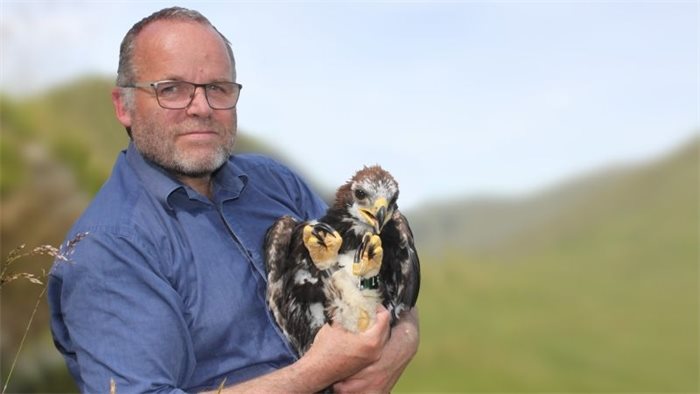
[Andy (Scottish Parliament’s Golden Eagle Champion) with golden eagle ‘Adam’, who later disappeared in suspicious circumstances on a grouse moor in Strathbraan (here). Photo by Ruth Tingay]
Andy has now launched a crowdfunder to raise £10,000 to help support his election campaign to include the development of a digital campaigning platform, newsletters and media and communications support.
For more detail about his campaign please read his latest blog here
To contribute to his crowdfunder please click here
The RSPB Investigations Team has published a blog this morning, detailing their undercover work filming a gamekeeper on a grouse moor in the Yorkshire Dales National Park, who used a tethered eagle owl to draw in two buzzards close enough for them to be shot.
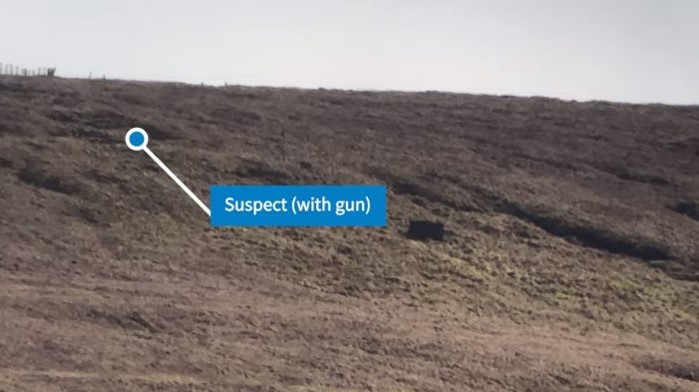
The blog, authored by RSPB Investigations Officer Howard Jones, describes the circumstances of the crimes, which include the obvious ones of shooting two protected buzzards but also the use of a tethered decoy (in this case, the eagle owl). Howard and his colleague Jack were filming through a telescope from approx 5km away and witnessed a gamekeeper drive across the grouse moor with the eagle owl, tether the owl to a post close to a grouse butt while he lay in wait close by with his gun.
[Screen grabs from the RSPB’s video]
Unfortunately, once again, despite a police investigation this case will not result in a prosecution because the identity of the gamekeeper committing the crimes could not be verified. However, importantly, Inspector Matt Hagen of North Yorkshire Police is quoted as follows:
“We conducted a search warrant and interviewed an individual in relation to this incident. Ultimately, however, the identity of the suspect on the film could not be proved, and it was not possible to bring about a prosecution. However this does not mean the event didn’t happen. We know that a gamekeeper on a grouse moor has been shooting buzzards, using a live eagle owl decoy to bring those buzzards into a position where they could be shot. We urge the public to report incidents like this to the police, and to come forward if they have information about this or any other incident involving the illegal killing of birds of prey“.
The Yorkshire Dales National Park has been a known raptor persecution hotspot for many, many years, with wildlife crimes disproportionately taking place on the Park’s driven grouse moors. These crimes have been raised as a concern by both residents and visitors alike (see here).
The National Park Authority has its hands tied behind its back to some extent because these crimes are taking place on privately-owned grouse moors, but the Authority can’t be accused of ignoring the issue, e.g. see here for some of the work it’s been doing.
So how about the grouse shooting industry? What are they doing, exactly, to tackle these ongoing crimes?
The name of the estate in this latest case hasn’t been published, presumably to protect the identity of any other gamekeeper not directly involved, but the estate manager and owner will be well aware of this police investigation. Will they sack this gamekeeper?
What about the Moorland Association? As members of the Raptor Persecution Priority Delivery Group (RPPDG), I’d expect the MA to be informed and for them to take action against the estate if it turns out to be one of their members.
Other RPPDG members include BASC and the National Gamekeepers Organisation – what action will they take if this gamekeeper is one of their members?
And the Yorkshire Dales Moorland Group, representing estates and gamekeepers in the region – what action will they take?
There is no evidence of there being zero tolerance because it’s a total sham. Some gamekeepers continue to break the law, in broad daylight, because they know the chances of getting caught are minimal and even when they are caught the industry in which they work will close ranks, call ‘foul’ on the RSPB and carry on as normal.
I haven’t seen any evidence, since the industry’s purported ‘zero tolerance’ announcement, that serious efforts are being made to oust the criminals within. Which is why these crimes continue, week after week after week.
Well done to the RSPB and North Yorkshire Police for their work on this case.
UPDATE 12th March 2021: ‘Zero tolerance’ for raptor persecution? They’re fooling no-one (here)
The Scottish Gamekeepers Association (SGA) held its AGM online last Friday (4th March 2021).
The majority of the two and a half hours was taken up with a political hustings – more on that event later.
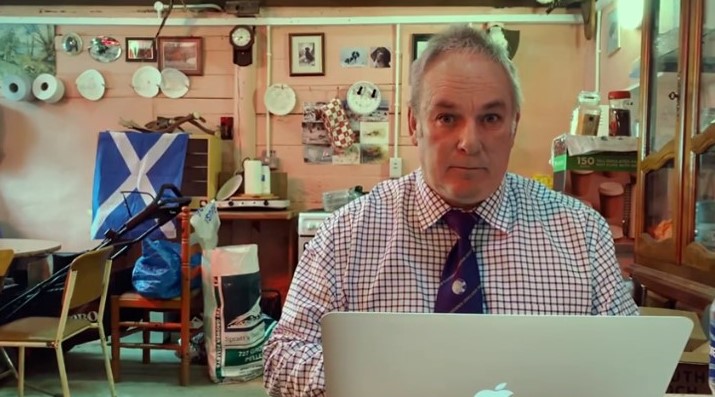
To kick off proceedings, SGA Chairman Alex Hogg delivered an opening speech, read deadpan from his laptop. It’s an interesting insight in to what, exactly, it is that the SGA is intending to protest about later this month, as so far it hasn’t been clear to many of us, including the Scottish Government (see here).
It turns out, judging from Alex’s embittered speech, that it’ll be a protest against progress and modernisation. From the restrictions imposed by drink driving limits, to no longer being allowed to slaughter mountain hares in their thousands with zero accountability, the resentment about being dragged in to the 21st century is clear. Personally I don’t think the SGA can legitimately argue that it doesn’t get a fair hearing – it gets just as much opportunity to be heard as everyone else and some of its members and supporters are anything but the so-called ‘quiet people’ described in the speech (e.g. see here and here). Sorry, Alex, it ‘ain’t the 1950s anymore, the world’s moved on massively and so must the SGA if it’s to survive.
Here is the transcript:
“Welcome everybody to our 2021 SGA AGM in our bothy. It’s fantastic to see everyone, albeit through the lens of a video camera.
Can I take a moment to thank the girls in the office, Carol and Sue, and the Committee for all the hard work and diligence which has gone on in this difficult Covid year.
On behalf of our protected wildlife, can I say a huge thanks to our keepers who carried on working throughout Covid saving countless numbers of endangered waders and other keystone species. As well as trying to make the most of an interrupted and difficult season. Even as we speak low ground keepers are still feeding out game and all the other declining wee birds. Whether they manage to get any shooting or not.
Members are also helping to control foxes and crows during the lambing time. This is a huge benefit for the farmers and crofters as well as ground-nesting birds. Many crops would never have gotten away if they’d not gained the protection by the keepers and shooters, keeping crows and pigeons at bay. Public land managers and RSPB on other hand were largely on furlough. Orkney being a case in point with stoat traps lying unattended for months. What an embarrassment given the millions of public cash doled out. Our work during lockdown was carried out with no public money. People were out, seven days a week, getting their hands dirty for Scotland.
The keepers’ skills when it comes to fire fighting are recognised as being up there with the best. The fire service has recognised these important facts and we hope to work with them on things like training days in the future. Again, all of this will be offered at no cost to the public purse.
We have managed more than a million deer in the last decade with reference to best practice and almost all going back in to the food chain. Again, at no cost to the public purse. Sustainable natural protein, low food miles, respect for management. Do we have to down tools and stop providing these services for free before people actually sit up and actually realise what they are getting and acknowledge the great work you, our members, do.
How many ghillies will run mink traps and keep the river banks free of invasive species? Or plant trees just for beavers just to chew them down. It shouldn’t have to be the case that you have to take something away before people realise why they get from gamekeepers, ghillies and deer managers but sadly decision makers in Edinburgh would rather listen to campaigners and then get out in the countryside and see the work first hand.
When the SGA invited MSPs out to see a local foot pack in operation to control foxes, only one MSP turned up willing to see how things actually work. Then a foxhunting bill was rushed through by Scottish Government. No wonder people want to take action. I will come on to how you can do that later.
Where is the old fashioned idea that you make a decision after seeing the situation for yourself, first hand? What about mountain hares? There is absolutely no doubt in my mind that mountain hares will be extinct in the not-too-distant future. Protectionism will actually kill them. Their habitat will get wiped out for the ever-increasing tree planting targets, they will die of disease on our moors cos their numbers can’t be thinned out to preserve a healthy population.
The new law is a disaster and translocations from grouse moors, SGA’s idea, is probably the only chance for them now. The politicians who made the decision are about to find out the bitter and inconvenient truth about how few there actually are away from grouse moors. They didn’t listen but their decision will come back to haunt them.
Government interference generally in rural life has not helped sustain community. The drink driving limits. It’s great in the city, trains, buses and taxis everywhere. Try finding a bus or taxi in the rural areas where most of us live and work. This policy has seriously affected social cohesion in the countryside, along with rural pubs having to close.
Access without responsibility. How the hell were we ever actually going to work in the countryside. People and dogs popping up all over the place. I’m very sure that the police in this day and age wouldn’t allow this to happen near their firing range yet we’re expected to carry out our work with high velocity rifles, it is an accident waiting to happen.
When Holyrood first opened, I was a great supporter. This was a chance to influence decisions at a local level. It was a fantastic voice for the people in rural Scotland, but as has happened with the police force, everything, all the power has become centralised. Remember getting your firearms certificates from the police locally? The Scottish Government has removed power from the local rural communities faster than snow melting from a dyke. Holyrood is not too different from Westminster now in that it operates from the centre in Edinburgh.
We must continue to do what we do for the countryside. To manage best practice and to deliver economic and biodiversity benefits. Even if we have to do it despite the capital law makers putting barriers in the way. Perhaps with the economy shaken people may begin to wake up and realise which people are getting their hands dirty for Scotland and those who will barely get out of bed without a tick on a public grant application form.
I was reminded recently that there are some out there in the world who do appreciate our work and it was heart-warming to hear”.
[Ed: Alex spent the next 7 minutes slowly reading out a letter from a health professional called Ewan (or Euan) with links to an estate in Angus, who was basically blowing smoke up the SGA’s arse, questioning what governance is in place to ensure the RSPB meets its stated objectives, and asking why so much parliamentary time was given to the issue of grouse moor licensing. It’s someone else’s opinion so it’s excluded here to save time].
Back to Alex:
“Ewan’s words and his questions are relevant and they’re similar to what I hear amongst the members and others who work in traditional rural industries today. Our quiet people are finding their voice, we must speak often and clearer than ever.
On the subject of questions for MSPs we asked members to send us some questions that we could ask election candidates in our political hustings which we recorded last week. You can now watch the event here and I hope you enjoy it.
Following that we will move on to our annual accounts so members please stick around for the next part of the 2021 AGM and thanks very much everybody for your time today”.
ENDS
UPDATE 12th March 2021: Political hustings: who’s promising what to the Scottish Gamekeepers Association (here)
Fergus Ewing, the Scottish Government’s Cabinet Secretary for Rural Economy and Tourism, was speaking at the Scottish Gamekeepers Association’s political hustings last Friday (and more on that soon!), and this is a direct quote from his two-minute position statement on what the SNP can do for gamekeepers:
“It’s essential that we carry on with muirburn. We might come to that later. It’s absolutely essential to protect peatland. I’ve seen the Mars Bar film. I get it“.
Good grief. Let’s hope Fergus, if re-elected, isn’t part of the delegation attending the 26th UN Climate Change Conference of the Parties (COP26) in Glasgow on 1 – 12 November 2021; a summit to bring together parties to accelerate action towards the goals of the Paris Agreement and the UN Framework Convention on Climate Change.
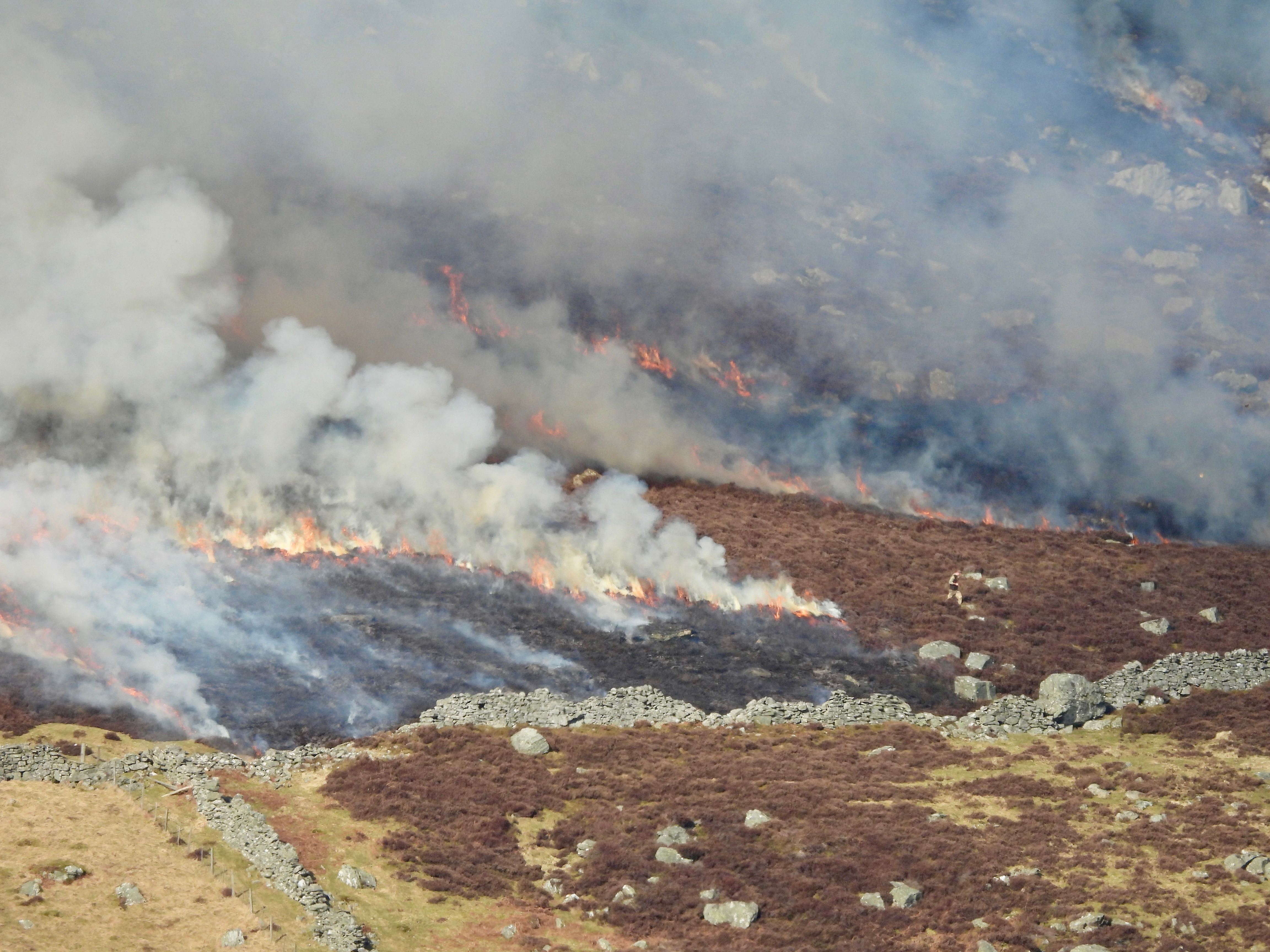
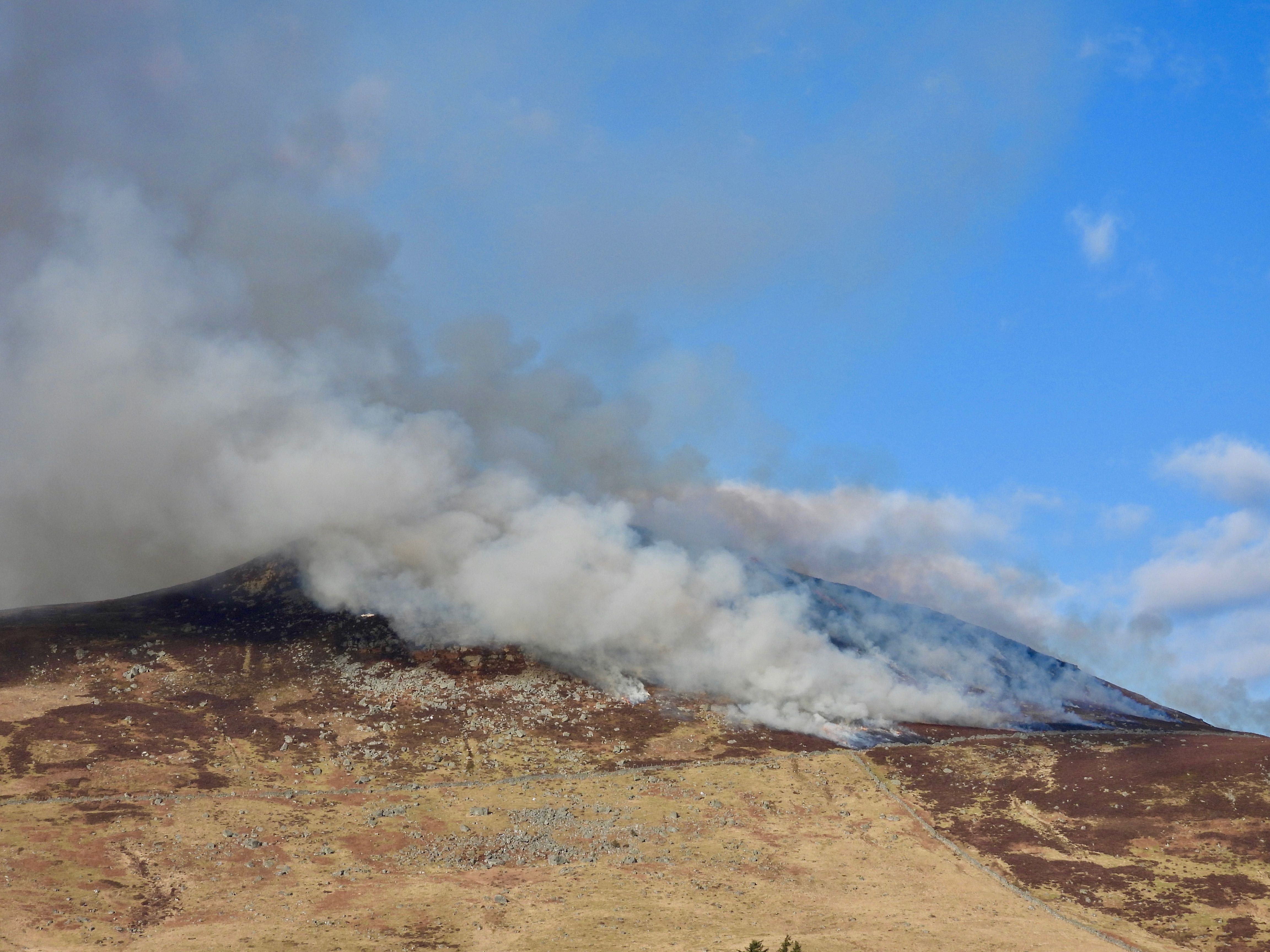
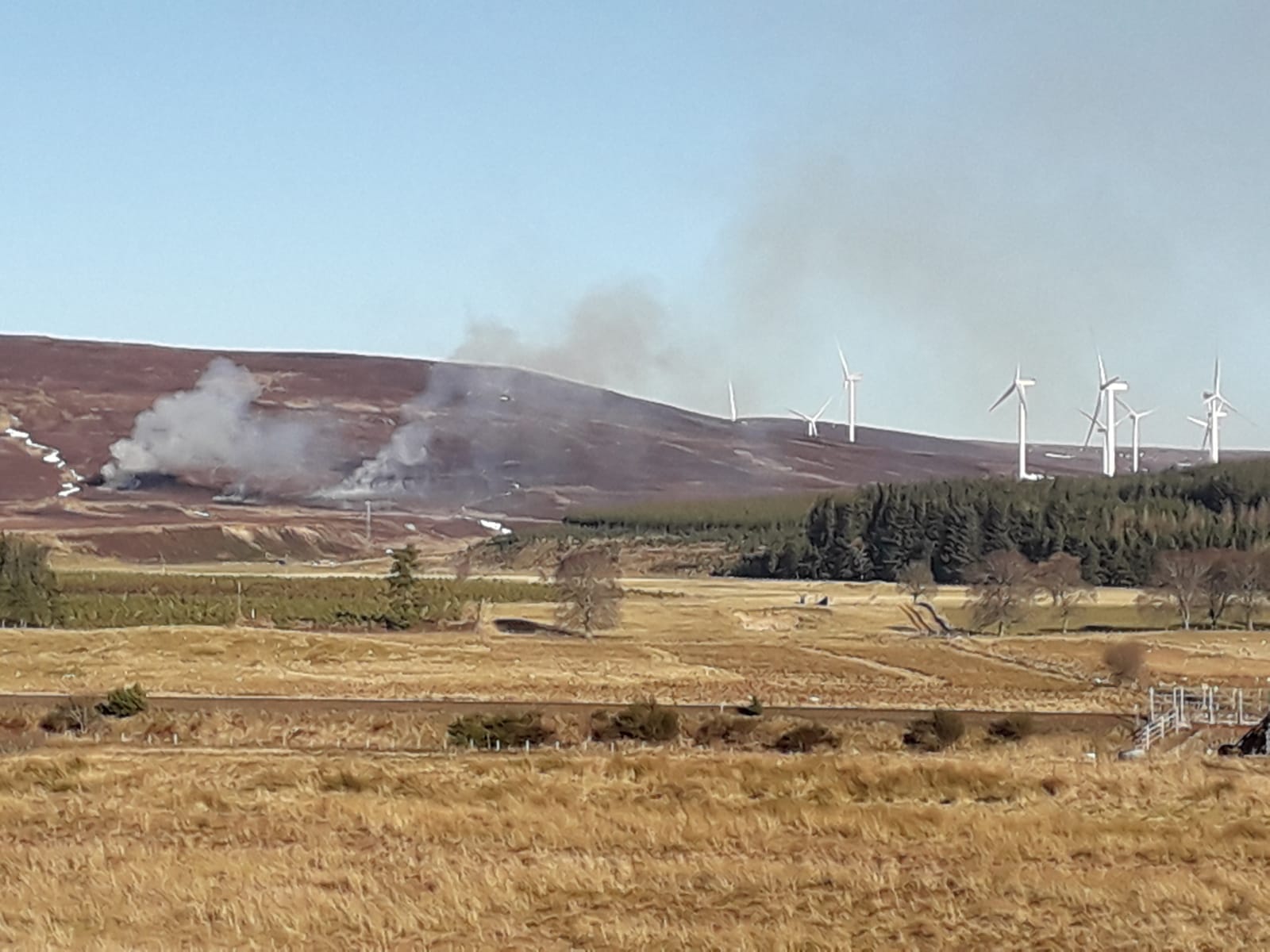
Meanwhile, as we wait to find out what the proposed muirburn licensing scheme will look like, post-Werritty, the grouse moors are once again being set alight up and down the country.
Here are some photographs of the moors on Lochan Estate in Strathbraan this week, sent in by a blog reader:
And not for the first time (see here, here and here), here is the grouse moor on Moy Estate in the Monadhliaths, set alight last week, perversely next to the wind turbines installed to to create renewable energy and thus reduce the carbon emissions that would otherwise be created from burning fossil fuels:
The ParkswatchScotland blog has also reported on grouse moors being set alight inside the Cairngorms National Park this week (see here).
But not to worry – we’re only in a climate emergency and these fires are just like having your hair cut. And besides, the Cabinet Secretary has watched an amateur video made by some gamekeepers to convince himself that muirburning “is essential“. Who needs scientific research, eh?
If you’re in England, where DEFRA has announced a pathetic proposal to ban burning on moorland that isn’t anywhere near as strong as it should be (see here), the RSPB has launched a burning reporting system where members of the public can report any upland burning that they see. Please report your sightings here.
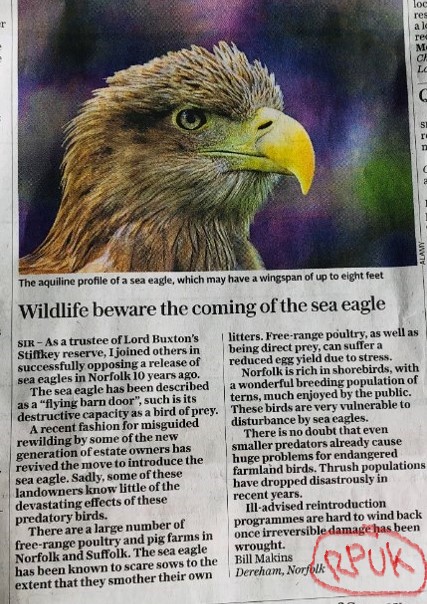
The letter was published in The Telegraph today (thanks to the blog reader who sent it to me).
If ever you’ve wondered why birds of prey are killed so frequently in the UK, here’s your answer.
Bill Makins is 89 years old. I wouldn’t be surprised to find he was a fully signed-up member of Songbird Survival.
For those who want a more up-to-date perspective on the reintroduction of white-tailed eagles to England, based on scientific evidence and hard-earned experience instead of wild hysteria and 200-year-old rural myths, you might be interested in this presentation by Dr Tim Mackrill, who is one of the conservationists behind the reintroduction of white-tailed eagles to the Isle of Wight (here) and is advising on the proposed reintroduction to Norfolk (see here), where fortunately there are a fair few more enlightened landowners these days.
Tim delivered this presentation three days ago to the Leicestershire and Rutland Wildlife Trust and they’ve made it available for everyone. Let’s hope someone shows it to Bill Makins.
A snare is a thin loop of wire, anchored and positioned to catch an animal around the neck. Snares are, quite literally, Stone Age technology and have been used globally for centuries to catch a variety of species. In Scotland today they are mainly used to target foxes on or near grouse moors, due to the species’ perceived threat to the grouse. They may also be used to target rabbits and hares. They are required by law to be ‘free-running’ so that the wire relaxes when the animal stops struggling.
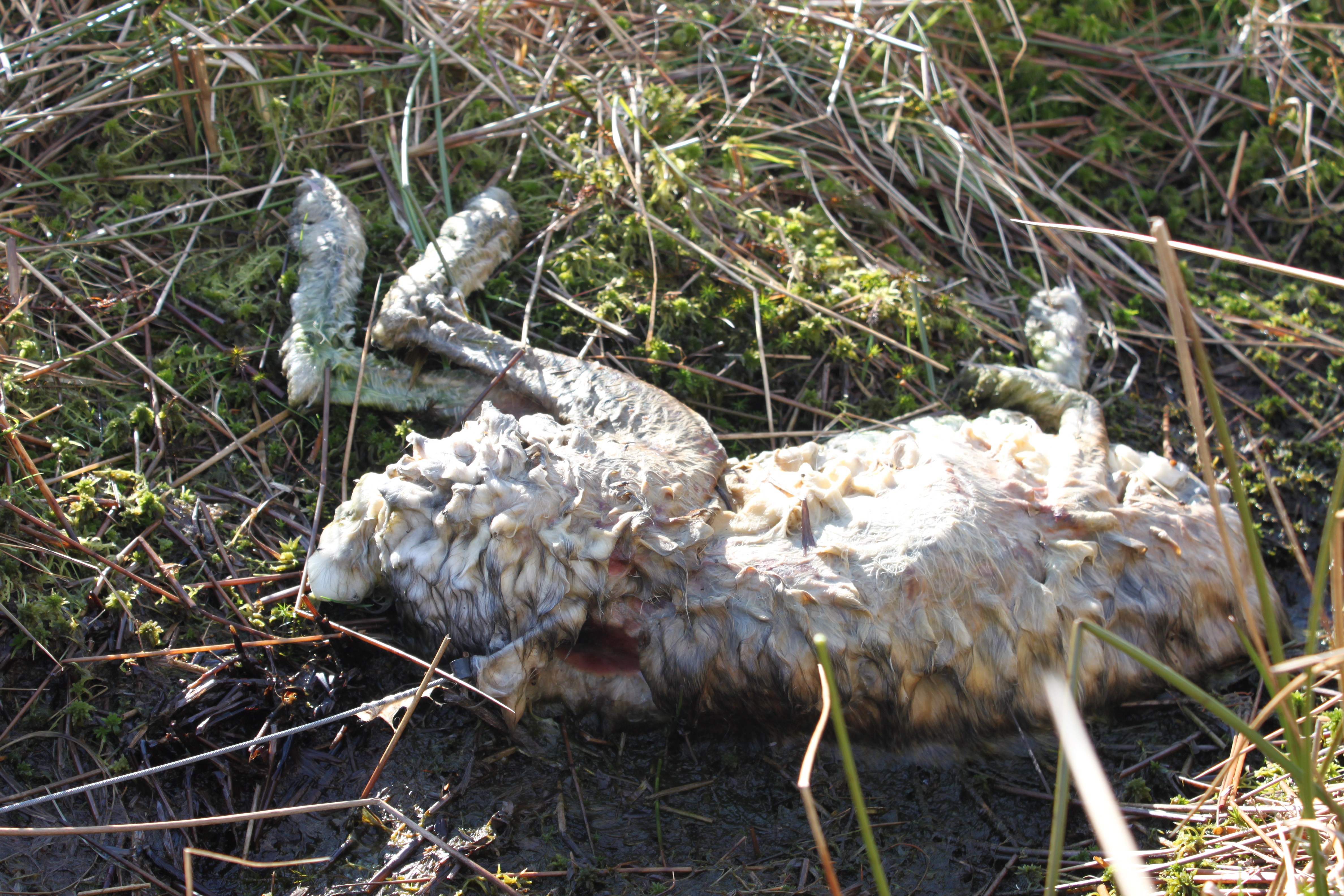
[A snared mountain hare on a Scottish grouse moor, killed and left to rot. Photo by Ruth Tingay from a few years ago]
The report encompasses snaring incidents involving target species, such as foxes, and also non-target species including dogs, cats and farmed animals. Most of the animals that were found alive, but injured, required veterinary attention.
OneKind Campaigner, Eve Massie, said:
“Our new report,SnareWatch Annual Report 2020: Case studies of snare use in the UK, raises awareness of the suffering that wire snares inflict upon animals. Snares can cause the animals trapped in them considerable stress and pain, yet astonishingly, are still legal in the UK. Our report highlights several cases of animals that were found alive in the snares and required veterinary attention. This includes a fox that had to be treated for the fly eggs and parasites on his body after he was trapped in a snare, suggesting he may have been there for an extended time.
Wire snares are not only cruel but are also indiscriminate as to the species caught in them. Indeed, up to 70% of all animals caught in snares are non-target species. As evidenced in our report, dogs, cats, foxes, badgers and even lambs are caught in snares across the UK. In one particularly upsetting incident, a dog required 25 stitches for a hole in his chest that exposed muscle. The vet who treated him suspected that his injuries were consistent with being entangled in a snare.
By highlighting snaring incidents in this new report, we aim to show how widespread snaring can be in the UK and just how much suffering these archaic traps can inflict upon animals“.
On OneKind’s snare reporting website, SnareWatch.org, Eve said:
“Since 2011 we have been appealing for reports about snares found by members of the public through our snare reporting tool website, SnareWatch.org. So long as snares are legal in the UK, we believe it is imperative to gather information about the nature and extent of snaring“.
On calling for a ban on snares, Eve continues:
“OneKind has long-campaigned for a complete ban on the sale, use and manufacture of snares in Scotland. Our Parliamentary petition to assess the welfare risks of wildlife ‘control’ in Scotland, including the use of snares, was closed by the Scottish Parliament. This was, in part, because the Scottish Government is due to review snaring this year. We hope this report will encourage the Scottish Government to reconsider the use of snares in Scotland. In 2017, NatureScot stopped issuing licenses for the snaring of mountain hares. Its time snares are banned for all species of animal. Suffering is suffering, no matter what species of animal it is inflicted upon“
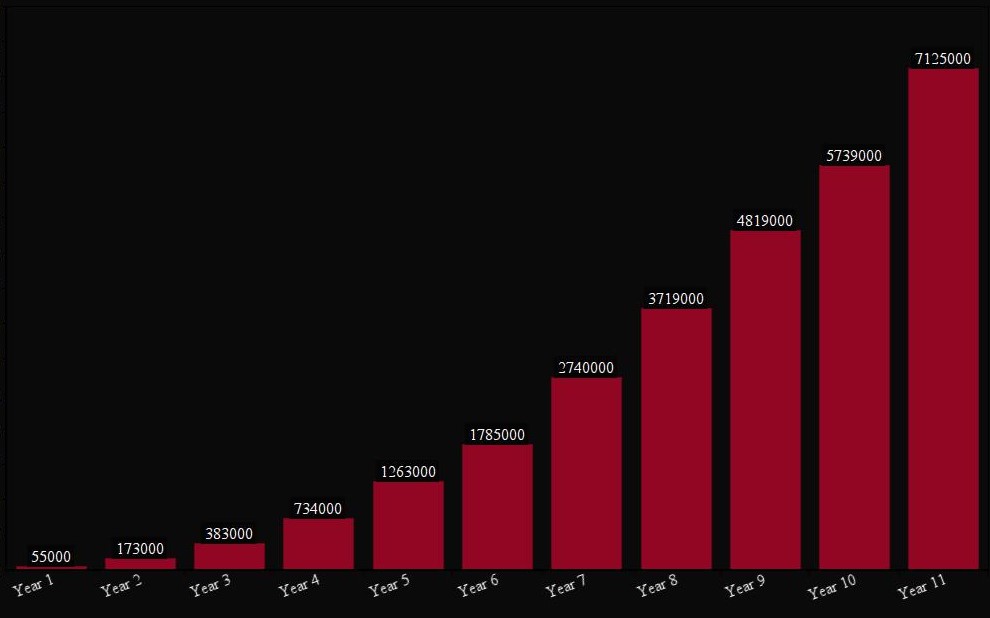
Yesterday this blog passed its 11-year anniversary.
Is it still attracting readers? Yep, it seems to be, looking at these blog viewing stats.
As ever, huge thanks to those who help fund my time, those who work with me behind the scenes (you know who you are), to those who send me information, to those who take the time to comment here, and especially to those who share blog posts on social media channels – raising awareness of the illegal killing of birds of prey was the main driver behind setting up this blog and it continues to be one of its main objectives.