osprey dies from deliberately-inflicted injuries in Highlands

Northern Constabulary have launched an investigation after an osprey has died from what the police are calling ‘deliberately-inflicted injuries’. The osprey was rescued from close to the River Dunbeath in Caithness on Monday. It received veterinary attention but died from its injuries.

BBC news story: http://www.bbc.co.uk/news/uk-scotland-highlands-islands-11310240

Northern Constabulary appeal for information: http://www.northern.police.uk/News-and-Media/news-item.htm?item_id=PR2614_2010

UPDATE 18 Sept: It has now been confirmed this osprey had been shot: https://raptorpersecutionscotland.wordpress.com/2010/09/18/osprey-that-died-in-caithness-had-been-shot/

Young red kite shot dead in Cumbria

30 young red kites were released into the Grizedale Forest in August 2010

Just five weeks after being released as part of the latest red kite reintroduction scheme, a young male kite has been found dead in Artengill, Cumbria. A post mortem examination revealed the young bird had been shot 4 times in the chest.

Police have begun an investigation, in partnership with the Forestry Commission and Natural England.

Will the culprit be brought to justice? Unlikely. It is yet another disgusting mindless act of violence by someone in the shooting community who knows he/she will get away with it. How many more of these incidents are we going to have to read about?

BBC news story here: http://www.bbc.co.uk/news/uk-england-cumbria-11264438

Cumbria Police Appeal for Information here: http://www.cumbria.police.uk/news/latest-news/police-appeal-after-cumbrian-red-kite-found-shot

The young male was identified by his wing tag

SGA wants buzzards back on the vermin list

A recent episode of Fieldsports TV was dedicated entirely to the views of the Scottish Gamekeeper’s Association Chairman, Alex Hogg, who, according to the programme’s presenter, wants buzzards back on the ‘vermin’ list. And there was me thinking we were in 2010, not 1910.

What justification does Alex use to support this Victorian attitude?  “The biodiversity in Scotland is seriously being threatened by buzzards“. Presumably then, Alex doesn’t view buzzards as a fundamental component of biodiversity! I would argue that biodiversity in Scotland is seriously being threatened, but not by buzzards, nor any other predator for that matter, but by the actions of those gamekeepers who persecute raptors and also release millions of non-native gamebirds into the environment with little apparent consideration for the ecological impact of these birds.

In the revealing interview, Alex argues for the provision of government-endorsed licences to kill buzzards. He then realises that this view probably does not fit with the recent image he has been trying to portray of the gamekeeper, and that his view is probably going to be distasteful to the majority of the general public, so he modifies it by saying, “We don’t need a licence to kill that many – it’s just a few rogue buzzards“. Are these “few rogue buzzards” in addition to the many buzzards (and kites, eagles, harriers, peregrines, goshawks, sparrowhawks, owls) that continue to be illegally persecuted by gamekeepers across Scotland? And how many is “just a few“? In his recent application for a licence to kill buzzards on the estate where he works, he asked to kill 12. Let’s do a crude estimate here – let’s say there are approximately 400 sporting estates in Scotland, and each one wants to kill 12 buzzards a year – that would be a total of 4,800 buzzards killed per year. Hardly “a few“.

If you want to hear more of Alex’s views, the episode is available on YouTube here: http://www.youtube.com/watch?v=8nlcfdmUX4I

dead buzzards spark police probe in Badenoch

A dead buzzard

Police have begun an investigation into the possible poisoning of buzzards in the Scottish Highlands area of Badenoch.

Northern Constabulary said a member of the public had found a dead buzzard on an un-named (of course) sporting estate at the weekend. A follow-up search by the police led to the discovery of a second buzzard.

Tests are currently being carried out to determine whether the birds were poisoned.

BBC news story: http://www.bbc.co.uk/news/uk-scotland-highlands-islands-11204012

Northern Constabulary appeal for information: http://www.northern.police.uk/News-and-Media/news-item.htm?item_id=PR2588_2010

Is Edradynate Estate the place where the red kite was found poisoned?

The location where the dead red kite was found in July (now confirmed to have been poisoned – see earlier blog below) was given by Tayside Police as “Strathtay, near Aberfeldy”, Perthshire. I mentioned a number of sporting estates in my earlier post that have their addresses in this area. I’ve since investigated further and look what I’ve found –

According to Tayside Police’s press release about the latest dead red kite, over the last 15 years the following have been found poisoned in the same area where the recent red kite was found dead – 9 buzzards, 2 sparrowhawks, 2 crows, 1 common gull, 1 tawny owl, 1 pole cat and 1 domestic cat. In addition, they say 12 poisoned baits have also been found.

Compare the above list of dead animals & poisoned baits with the following list of dead animals & poisoned baits, which was reported in the RSPB’s Legal Eagle newsletter (January 2005, #43, page 3) – “In 14 separate incidents since 1998, 16 poisoned victims (9 buzzards, a cat, a tawny owl, 2 sparrowhawks, a common gull, a pole cat and a crow and 12 poisoned baits [rabbits, woodpigeons and a pheasant]) have been found, with traces of the pesticides mevinphos, carbofuran and alphachloralose“.

The 2005 RSPB report relates to the Edradynate Estate, which is situated in Strathtay, near Aberfeldy. Coincidence? You decide.

Nobody was convicted for the earlier alleged offences at Edradynate Estate  thanks to the apparent chronic mishandling of the prosecution case. The Edradynate Estate head gamekeeper (aged 55) and underkeeper (22), both of Aberfeldy, were arrested in 2002 and charged with nine offences relating to the use of poisoned baits and also bird cruelty, including the use of spring traps. On 22 July 2004, two years after the original arrests and 13 court hearings later, the Fiscal dropped the case against them at Perth Sheriff Court. A spokeswoman for the Crown Office admitted the time taken to prepare the case for a trial had been a major factor in the decision to scrap it.

Link to RSPB Legal Eagle #43 here: legal_eagle_43_Jan2005

News report about the failed 2004 court case here: http://www.thefreelibrary.com/Fury+after+’bird+killers’+walk+free.-a0119726014

and here: http://scotlandonsunday.scotsman.com/nature/RSPB-Fury-as-gamekeepers-escape.2548762.jp

Tayside police investigate after dead red kite confirmed poisoned

Poisoned red kite

Tayside police have launched an investigation after yet another incident of illegal raptor poisoning. A red kite was found dead in the Strathtay area (near Aberfeldy, Perthshire) at the end of July, and government toxicology reports have confirmed the kite was poisoned.

According to Tayside police, 5 buzzards and a tawny owl met with the same fate in the same area last year. In addition, 9 buzzards, 2 sparrowhawks, 2 crows, 1 gull, 1 tawny owl, 1 pole cat and 1 domestic cat have also been found poisoned in the same region over the last 15 years.

According to the Scottish Raptor Study Groups website, a total of 12 poisoned baits have also been recovered from the same estate where the red kite was found dead.

Tayside Police’s Wildlife Crime Officer Alan Stewart had the following insight:

There is no doubt that the scourge of poisoning wildlife in Scotland has decreased in general terms in recent years. However, there remain a number of ‘hotspots’ that blight our civilisation and our reputation worldwide“.

Alan Stewart

It’s an interesting perspective from someone closely involved with the PAW Scotland group and who really should know better. Has he not read the latest figures that were only published in August this year that demonstrate an increase in illegal wildlife poisoning events? The only thing that has decreased in recent years is probably Tayside Police’s track record of successful prosecutions for raptor persecution incidents.

It’s also interesting to note that once again, the name of the estate involved has not been made public, even though poisoned baits have been found there. There are a number of sporting estates in this area, and it could be any one of the following:

Finynate Estate, Innerwick Estate, Edradynate Estate, Glen Lyon Estate, Chesthill Estate, Remony Estate.

Or may be it’s another estate? Who knows. That’s reassuring for those of you who live in the area, whose children play in the area, whose pets walk in the area, and also for you visitors who come to our countryside to enjoy it, not to find dead raptors or have your dog/child poisoned while out on your holidays.

BBC news story: http://www.bbc.co.uk/news/uk-scotland-tayside-central-11098865

Scottish Raptor Study Groups website: http://www.scottishraptorgroups.org/news.php

Glen Tanar Estate supports hen harriers & golden eagles

Some very welcome good news for a change –

Michael and Claire Bruce, the forward-thinking owners of Glen Tanar Estate, near Aboyne on Royal Deeside, have this year demonstrated that there is no need to persecute hen harriers or golden eagles to accomodate driven grouse shooting.

Glen Tanar Estate forms a substantial part of the Cairngorms National Park, and the Estate includes several EU Natura 2000 sites as well as a National Nature Reserve. Golden eagles and hen harriers have bred successfully on the Estate for many years. However, shooting parties have been absent since the late 1990s when the local grouse population dropped below a sustainable level – partly due to predation by hen harriers but also partly due to land management practices.

In 2010, in addition to normal moor management, Michael started a hen harrier diversionary feeding experiment to try and discourage the harriers from taking too many grouse. Feeding started when there were three eggs in the harriers’ nest and continued until the chicks fledged. The supplementary food included chopped up white rats and poultry. Three chicks fledged successfully, and a satellite transmitter was attached to one male and one female chick so that the dispersal movements of these young birds can be monitored. In addition to the successful harrier breeding attempt, driven grouse shooting began on August 12th 2010 for the first time in over a decade.

Michael said: “Estates where shooting forms an important part of the economy have to find innovative ways of reducing conflict between raptors and red grouse. Supplementary feeding may be one way of doing this“.

He added that at Glen Tanar Estate, concerns over boosting the hen harrier population were mitigated by the presence of golden eagles. “Some estates fear that feeding hen harriers will simply increase the harrier population and increase predation on grouse, and there is a risk this may be true. However, feeding hen harriers has never been tried before in the presence of golden eagles, which themselves predate harriers. The hope in Glen Tanar is that eagles, harriers and grouse will all find a level that allows commercial shooting of driven grouse to take place“.

Golden eagles on the Glen Tanar Estate this year produced two of the heaviest chicks ever recorded. The resident adult eagles had been fed over the winter with thin, un-saleable deer carcasses. The food was given partly to attract the eagles to a regular winter-feeding site where it is hoped to provide a photographic hide in the future. However, Michael believes that winter feeding of golden eagles should also reduce predation on grouse.

Michael Bruce and his team on the Glen Tanar Estate deserve our full admiration for their efforts, and it is hoped other estate owners will follow his lead.

If you wish to show your support of Glen Tanar Estate, encourage your friends, family, colleagues, everyone, to visit them for holiday cottages, walking, wildlife safaris, fishing etc. More information can be found on the Glen Tanar website: http://www.glentanar.co.uk/

Jail for man convicted of persecuting raptors – not in Scotland, obviously

Take note, Scottish sheriffs. Here is an example of how to deal with a wildlife criminal who persecutes birds of prey.

Today, convicted wildlife criminal Jeffrey Lendrum was sentenced to 2.5 years in prison by Judge Christopher Hodson at Warwick Crown Court, England. He had been arrested in May at Birmingham International Airport when he was found to have 14 peregrine eggs wrapped in socks and strapped to his body. The eggs had been stolen from four separate nests in South Wales. Investigators believe they were stolen to order for an Arab falconer in Dubai.

During sentencing, Judge Hodson said: “These were eggs you had removed from the wild in Wales and you would have reduced the number of these high-level endangered species in the wild, birds which enhance the attraction of the countryside to all. I quote the words of a Lord Justice of Appeal (Lord Justice Sedley) when he says, ‘environmental crime, if established, strikes not only at a locality and its population but in some measure to the planet and its future’. Nobody should be allowed to doubt its seriousness or to forget that one side of the environmental story is always untold‘. I adopt these words to express the gravity of what you did.”

The court was also told that Lendrum had previous convictions for similar offences in Zimbabwe and Canada. Of the 14 eggs stolen in this case, 12 chicks hatched and 11 survived. 7 of these were fostered into nests in southern Scotland and 4 were reared and released in England.

BBC news story: http://www.bbc.co.uk/news/uk-england-birmingham-11024315

Scottish Countryside Alliance’s interesting Statistics

On the run up to “the glorious twelfth” as many gamekeepers and their employers wait to see how effective their pest control regimes have been, various pro-game shooting bodies spew out some new statistics which “reveal” that grouse shooting is worth £zillion to the Scottish economy or supports 99% of all Scottish jobs. One that caught my eye this week was the survey conducted by the Scottish Countryside Alliance (SCA) and publicised fairly widely.  Here’s an extract:

“An online survey has revealed a great deal of support for grouse shooting in Scotland, with 95% of respondents saying it would be ‘bad news for the Scottish countryside’ if grouse shooting were to stop.”

“The depth of support for one of the country’s most famous sporting events is highlighted by a survey carried out by the Scottish Countryside Alliance, a campaigning organisation which represents rural interests.”

“The survey also showed that 26% reported having a direct business interest in grouse shooting; 44% have an indirect business interest; and 69% think the sport is good for their community”

Anyone could be forgiven for thinking, Impressive figures! Who would have thought that grouse shooting was so important to the Scottish economy? This is until after some research, we discover that the survey was conducted online by visitors to the SCA website and restricted to the first 100 respondents. It’s like the first 100 visitors to a golf website saying that they like golf!

Only an idiot would be impressed by the biased results of this straw poll and pathetic attempt to generate a positive profile for driven grouse shooting.

Ross Montague, Director of SCA commented on the results of this survey, saying:  

This bolsters what we have been saying for quite some time now, that land management for country sports in general is important for the bio-diversity of the land and especially jobs. And it seems people living in the countryside agree.

Shooting is worth £240 million to the Scottish economy and this survey reveals that people realise its benefits. To lose grouse shooting would be akin to stopping golf throughout the country.

I think this last sentence demonstrates just how far into the world of fantasy the SCA is willing to go to portray a positive image of driven grouse shooting and ignore the illegal raptor persecution that this industry generates.

“the 12th is glorious for conservation” – is it really?

“The 12th is glorious for conservation”, according to the Countryside Alliance. In a remarkable and desperate piece of journalism, their website heralds new survey results collected by the Moorland Association:

“Everyone who loves country sports loves a good statistic: shooting contributes £1.6bn to the economy; 4 million people go angling every year; 57% of people believe the Hunting Act is not working. Now, to celebrate its 25th anniversary, the Moorland Association has carried out a survey that shows how much time and money is put into shooting and conservation in upland areas, and there are plenty of positive statistics to enjoy. 

Where moorland has been managed for grouse shooting, everything flourishes – the landscapes, the people and the economy. An uplands future based on shooting’s successful management model, with responsibility lying with those who already manage the land is common sense and we hope the healthy snapshot described by the Moorland Association’s survey can continue for many decades to come. Grouse moors are a true conservation success story, and something glorious to be celebrated.”
 
Hmm. Given they like statistics so much, how about this one, which they conveniently ‘forgot’ to include:
IN SCOTLAND, 85% OF PEOPLE CONVICTED FOR RAPTOR PERSECUTION CRIMES FROM 2003-2008 WERE GAMEKEEPERS. 
 
Not what I’d call “glorious for conservation”.
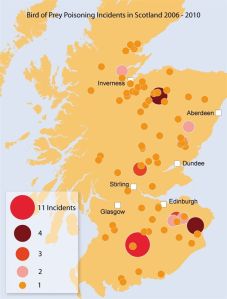
Figures from the latest RSPB report of illegal raptor persecution: