
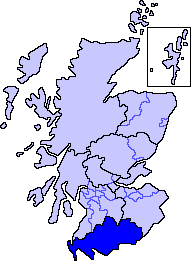
 Well here’s some welcome news about a Scottish police force taking a proactive stance against the criminals who commit raptor persecution. According to the BBC website, Dumfries & Galloway Police have responded to recent raptor persecution incidents by installing covert cameras at some raptor nest sites in the region.
The cameras, supplied by Vemotion Interactive, are rigged to an alarm that activates an alert in the control room at Police HQ. Police Wildlife Crime Officer P.C. Jim Drysdale said: “If anyone is thinking of coming to Dumfries and Galloway to commit crimes against birds of prey, think again, you will be caught and you will be prosecuted“.
Dumfries & Galloway Police’s intent and commitment is admirable and they deserve a lot of credit for taking the lead with this initiative. If only some of the other Scottish police forces would take these crimes so seriously then our raptors would stand a much better chance of survival, at least at their nest sites. It does seem an odd time to be releasing this news story though – at the end of the breeding season! Nevertheless, we wish them well with this endeavour.
It will be interesting to see whether the covert camera footage is accepted as bona fide evidence in a court of law. Several investigations undertaken by RSPB Scotland in recent years, in which they employed covert surveillance techniques, have failed in court because lawyers argued that the covert filming was inadmissable evidence (e.g. see here). All very strange, especially when the technique is accepted as a legitimate tool in England (e.g. see here).
BBC News article here
Alive Radio (Dumfries) article here
 I recently read a nasty little editorial in the September 2011 edition of ‘Modern Gamekeeping’ (we’ve mentioned them before – see
  Cast your minds back to February and you may recall the story about the white-tailed eagle that was reportedly found dead in the snow by a member of the public on Logie Estate, Moray in December 2010. The Scotsman newspaper said at the time that when the police arrived ‘the next morning’ to collect the body, it had ‘disappeared’. The paper reported that the estate owner, Mr Alasdair Laing (Game & Wildlife Conservation Trust’s Scottish Committee Chairman) and his gamekeepers were questioned by the police. The police said they couldn’t do anything without the body. Mr Laing wrote to the Scotsman and said it was mis-leading for them to report that he and his keepers had been ‘questioned’ and for them to say that the sea eagle had ‘disappeared’: “Use of words such as ‘questioned’ and ‘disappeared’ imply a level of suspicion of guilt which is unwarranted by the circumstances“, he wrote (See
 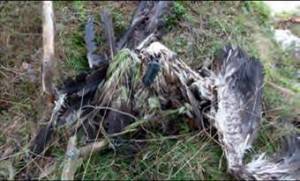 “On 11 December 2010, a member of the public found and photographed the carcass of a white-tailed eagle, lying under a tree on a remote moorland near Lochindorb in Nairnshire. The police were notified, but when they attended the scene a few days later to recover the carcass for a post-mortem, it had disappeared. There were no tracks of scavengers in the surrounding snow, and there was not a feather remaining from the well-decomposed carcass. In fact, the only new tracks that were in the area were those of a quad bike, leading to near the finding location, and the footprints of the person who had walked over to the body, removed it, returned to the quad bike, and left the area“.
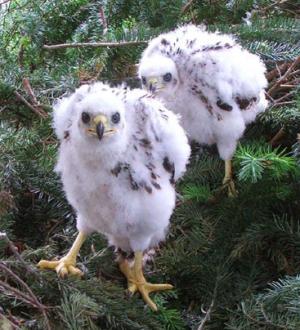 Yesterday we commented on an article being run on the BBC News website that was reporting on the shooting of goshawk chicks in the Borders (
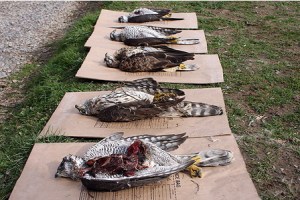
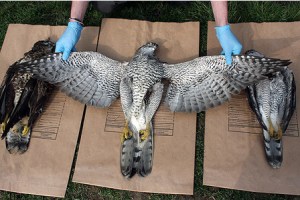 The RSPB has put up a reward of £1,000 for information about the deaths of four goshawks and one buzzard which have been found poisoned in Devon. They were discovered in Forestry Commission woods near to Exeter and had been poisoned with the bannned pesticide Carbofuran.
 Anyone with information about these crimes is urged to call Crimestoppers, in confidence, on: 0800-555-111, or email Devon & Cornwall Police Wildlife Crime Officer P.C. Josh Marshall directly:
  Police are investigating after four birds of prey were poisoned and dumped in a lay-by in Midlothian, according to a report in today’s Scotsman.
 They’ve started already. Landowner and game-shooting representatives are responding to yesterday’s publication of the RSPB’s 2010 persecution report. We’ll add to this page throughout the day as the predictable denials and counter claims emerge…
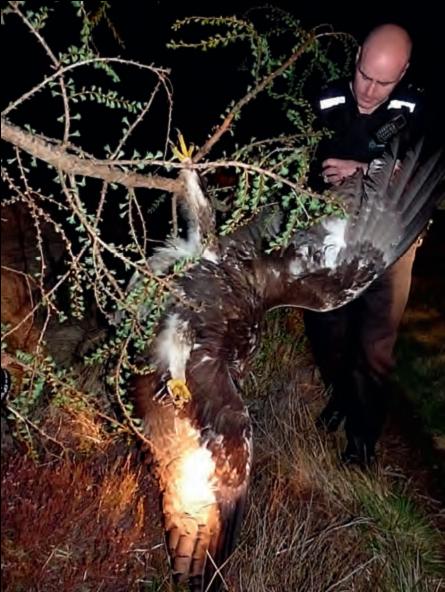 The RSPB has just published its annual report on raptor persecution in Scotland. The report, ‘The Illegal Killing of Birds of Prey in Scotland 2010‘ is the only known published record of all known persecution incidents including poisoning, shooting and trapping, in contrast to the PAW Scotland annual report which only details poisoning incidents. As well as the confirmed incidents of persecution, the report also provides information about ‘probable’ incidents (those where the available evidence points to illegality as by far the most likely explanation but where the proof of an offence is not categorical) and ‘possible’ incidents (where an illegal act is a possible explanation but where another explanation would also fit the known facts).
