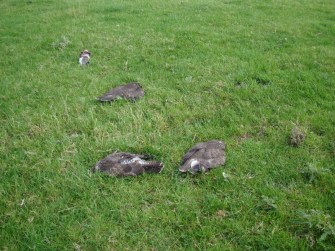
Inverness man accused of buying & selling raptor eggs

According to the BBC, a 51-year-old man accused of buying and selling hundreds of eggs of rare birds is to face trial.

Keith Liddell is alleged to have bought or offered for sale 202 eggs, including those of Egyptian vultures and tawny owls from August 2004 to June 2009. He has also been accused of having 136 wild birds’ eggs at his Inverness property on 24 June 2009. He denies the charges.

At Inverness Sheriff Court, Sheriff Ian Abercrombie set four days for the trial in December. There will be a preliminary hearing to be called on 8 November.

Mr Liddell has been accused of purchasing, offering to purchase, keep for sale or transport for sale, all for commercial gain, eggs from a number of endangered species. He also faces a further charge of being in possession of wild birds’ eggs at his home.

How unusual to see so much detail of alleged wildlife crimes in Scotland being provided in the public domain.

BBC news story here

Masters of spin

A news article (here) has appeared on the SGA website this morning claiming that “Gamekeepers are the unsung heroes of conservation“. Let’s look at the ‘evidence’ produced to back up this claim.

It apparently comes in the form of a new report by “independent” charity GWCT, detailing the results of a UK-wide gamekeeper survey. Earlier this year, gamekeepers were asked to write down what species were found on their shoots. It’s not clear what scientific field surveys, if any, were conducted, because the GWCT report has not yet been published. Let’s give them the benefit of the doubt and assume that scientifically-rigorous transects were repeated across the shooting lands to support these ‘scientific’ findings.

According to the SGA website, “over 80% of respondents reported having kestrels, buzzards, sparrowhawks, barn and tawny owls on their patch.” The article doesn’t say if these were dead or alive. It also doesn’t say how many reported having golden eagles, white-tailed eagles, hen harriers, goshawks, red kites, short-eared owls or peregrines on their patch, which would have been far more interesting. We’ll have to wait for the publication of the report.

The article continues – “The area of land managed by gamekeepers who took part in the survey (1,337,454 ha) is five times the total area of all Britain’s National Nature Reserves (255,789 ha) and 13 times the total area of all RSPB reserves (101,581 ha).” SGA chairman, Alex Hogg interprets this as: “It’s clear that there’s more wildlife on the land managed by keepers in Britain than on all the nature reserves and special protection areas put together.” Erm, I don’t think that’s clear at all, Alex. What these figures show, if they are accurate, is that gamekeepers ‘manage’ five times the total area of NNRs and RSPB Reserves (which is a worrying statistic in itself). What the figures do not show is a comparison of wildlife density between these managed areas. Unless of course gamekeepers have been conducting their scientifically-rigorous transects across NNRs and RSPB Reserves as well. Again, we’ll have to wait for the publication of the report.

The article goes on to disclose the ‘informal’ working relationship between gamekeepers and the law enforcement agencies and generally tells us all what great guys (“heroes“) the UK’s gamekeepers are. Most sensible people will look at the annual raptor persecution statistics and the annual convictions of gamekeepers for wildlife crime offences, and make up their minds about how ‘heroic’ some of these keepers are. It’s a shame, because undoubtedly there are a handful of truly ‘good guys’ in the industry, but as we keep seeing, there are an awful lot who repeatedly bring the industry into disrepute by their criminal activities.

An article about the forthcoming report appeared in The Telegraph (here). Written by Environment Correspondent Louise Gray, it’s littered with inaccuracies including, “A number of gamekeepers have even been imprisoned for illegally poisoning rare birds of prey“. Er, no they haven’t.

A note of interest – the “independent” charity GWCT who organised this survey (see here for a recent post on this so-called ‘independence’) has listed William Powell amongst its list of “dedicated supporters and corporate partners” (sponsors?) at this year’s CLA Game Fair (see here). Would this be the same William Powell (Gunmakers) that was sold to Mark Osborne in January 2008?

Police raid sporting estate in Scottish Highlands

Police have today raided a sporting estate near Inverness to investigate allegations of wildlife crime.  Although we know the name of this estate, we are acting upon advice not to release it at this time.

Twenty five police officers were joined on the raid by representatives of the RSPB, SSPCA and the Scottish Government Rural Payments and Inspections Directorate.

Northern Constabulary press release here

BBC news story here

More news on this in due course.

Reintroductions “a threat to biodiversity”

An astonishing display of ignorance was on show in The Telegraph this week. The group calling themselves the Veterinary Association of Wildlife Management (VAWM) has claimed that the reintroduction of native species, formerly wiped out by persecution (e.g. sea eagle and red kite) are “potential man-made threats to biodiversity“. Really?  Methinks someone at the VAWM needs to read up on the Convention of Biological Diversity.

The VAWM, formerly known as Vets for Hunting (hmm, another group with a PR-induced name change – sound familiar?), also claim that the UK’s population of red kites was ‘threatening songbird species’. Ha ha ha ha ha ha ha ha ha ha ha ha ha ha ha ha! Perhaps VAWM spokesman Dr Lewis Thomas (a retired veterinary pathologist) should swap his rusty old scalpel for a shiny pair of binoculars. Ignorance is no excuse. Telegraph article here.

Interestingly, according to their facebook page, the Scottish Gamekeepers Association agrees with the VAWM’s sentiments on reintroductions. And this from a group whose members routinely rear and release millions of non-native gamebirds into our countryside every year, without any accountability for the environmental damage this may cause. Amazing.

Meanwhile, back in the real world of conservation, RSPB Scotland has secured major funding from the Heritage Lottery Fund to extend their fantastic sea eagle reintroduction project for another year (see here).

Update on the outcome of the Holkham gamekeeper trial

Further to Saturday’s blog post, more information has come to light in the form of a press release from Knights Solicitors, who instructed the defence.

It’s well worth a read, particularly the last paragraph. Please also note that the statement says Nicholas Parker resigned his position as head gamekeeper at Holkham Estate shortly after the allegations were made.

Knights Solicitors press release here

Also an article (here) with Nick Parker being interviewed by The Shooting Times after the trial.

Former Holkham Estate head gamekeeper gets conditional discharge

The case against former Holkham Estate Head Gamekeeper Nicholas Parker was finally heard yesterday at Norwich Magistrate’s Court. He was given a conditional discharge.

Several charges against him had been dropped; one of them reportedly because much of the prosecution’s evidence related to allegations from 2008 and the Wildlife & Countryside Act 1981 required evidence to be within two years.

The District Judge, Philip Browning, gave the conditional discharge after hearing how much Parker had already ‘suffered’, after his firearms certificate had been confiscated and because the case had been given significant public attention. Clever defence barrister. A barrister of the same name is listed as also being a Council Member of the British Association of Shooting and Conservation (BASC) and an expert in firearms law here.

Court report here

Background to this story here, here, here and here

An explanation of what a conditional discharge is here

JULY 18 2011 UPDATE here

SNH agrees to collaborate with GWCT – should we be concerned?

Scottish Natural Heritage (SNH), the government’s statutory advisory body on nature conservation, has recently pledged its intent to work closely with the Game and Wildlife Conservation Trust (GWCT – formerly known as The Game Conservancy). Here is their published joint statement of intent – unfortunately a rather turgidly written set of objectives – that includes reference to predators such as buzzards and ravens.

It’s an interesting alliance and one which will no doubt be a cause of concern for some.

The GWCT  defines itself as an “independent charity”. Some commentators suggest that the GWCT is not independent of the shooting industry; a claim based on the interests of its good directors and officers (see here).

The GWCT accepts sponsorship from Artemis Investment Management Ltd (see here). All perfectly lawful of course but open to scrutiny nevertheless.

The GWCT’s Scottish Committee Chairman was questioned over the mysterious disappearance of a dead white-tailed eagle, reported to have been discovered on his estate but then it apparently vanished in to thin air when the police arrived the following day (see here). He denied any involvement.

The GWCT is reported to be involved with controversial ‘research’ commissioned by Songbird Survival. This ‘research’ is aimed at killing corvids and it has been suggested that in future it could extend to killing raptors (see here).

The GWCT was at the forefront of criticism into the SNH-funded Hen Harrier Conservation Framework Report. Basically, the GWCT did not accept the peer-reviewed scientific findings that hen harriers are being systematically slaughtered on UK grouse moors. Instead they wanted to deflect attention on to golden eagle/hen harrier interactions (a bit difficult seeing as golden eagles are also absent breeders on most grouse moors) and on to predation of harriers by foxes (foxes are just as unwelcome on grouse moors as hen harriers so the impact must be minimal, and certainly not enough to cause two-thirds of the harrier population to ‘disappear’).

So, a joint partnership a cause for concern? You decide.

GWCT website here. SNH website here.

Poison hunt called off and incidents ‘missing’ from official SASA figures

In April, we reported on a series of suspected poisoning incidents at Fullerton Woods, Troon, Ayrshire. Poisoned rabbit baits were reported to have been found in February and March 2011 and were believed to be implicated in the deaths of a fox, two dogs and possibly two buzzards (story here).

In an article published in the Troon Times on 31 May 2011, wildlife police were reported to be “no longer hunting poachers after dead animal bodies were found in Troon Woods“. The on-line article does not provide any more information about this decision.

Interesting then that in the SASA animal poisoning report released earlier this week, the dead animals from Fullarton Woods were not included in the list of suspected poisoning incidents in Scotland between January and March 2011. Does this mean the dead animals were not submitted for poison analysis? Or does this mean that they were submitted somewhere other than SASA? Or has SASA deliberately excluded them from their interim report?

There’s another missing incident in the SASA report. Remember the allegedly poisoned buzzard discovered on Mountquhanie Estate, Fife, in January 2011? The news report at the time stated that the dead bird had been sent for post-mortem to establish the cause of death. Where is this bird in the SASA report? Was it sent to SASA for post-mortem, or somewhere else? If it was sent somewhere else then surely the SASA figures cannot be used by the government as the official reporting mechanism for poisoning incidents, because they are excluding a number of suspected incidents?

Latest SASA figures reveal widespread poisoning incidents in early 2011

The latest figures detailing illegal animal poisoning incidents in the first quarter of 2011 have just been released by Science and Advice for Scottish Agriculture (SASA) on behalf of the Scottish Government.

The figures cover the period January to March 2011, and show that criminal raptor poisoning incidents were detected in each of the three months. They include 3 buzzards, 1 golden eagle, 1 red kite and 2 peregrines.  Poisoning incidents were widespread, taking place across Scotland, including in the Borders, Strathclyde, Tayside, Grampian and the Highlands. The illegal poisons used included Carbofuran, Chloralose and Strychnine. So much for the game-shooting industry’s self-regulation. I guess 2011 will not be the year they ‘stamp out’ illegal raptor persecution.

Not for the first time, two of the five recorded incidents were apparently unpublicised in the media: 1 x buzzard poisoned with Carbofuran in the Borders in January 2011, and 1 x red kite poisoned with Chloralose in the Highland region in February 2011.

SASA poisoning figures for period Jan – Mar 2011 available here

Chairman of The National Trust described as ‘raptor hater’ by former RSPB Director

Dr Mark Avery, the former Conservation Director of the RSPB, writes an insightful blog. He’s recently started a series called The Raptor Haters, which he describes as: “….an occasional series of articles on people who slag off birds of prey“.

The most recent installment in this series is all about Sir Simon Jenkins, who, since November 2008 has been the Chair of the National Trust.

Have a read of Mark’s short blog piece, read what Sir Simon Jenkins had to say about raptors in his Guardian article in May 2008, and then read what some better informed commentators had to say. I wonder what Sir Jenkins would write about the criminal activities of  gamekeeper Glenn Brown on the National Trust’s Howden Moor?

PS. For those interested in reading other entries in Mark’s ‘The Raptor Haters’ series, see here for his piece on Richard Ingrams. Thanks Mark, we look forward to more…