 The first annual Scottish Bird Fair will be held in May 2012 at………Hopetoun House, which is managed by Hopetoun Estates!
The new Scottish Birdfair website is now up and running here.

The first annual Scottish Bird Fair will be held in May 2012 at………Hopetoun House, which is managed by Hopetoun Estates!
The new Scottish Birdfair website is now up and running here.
 Earlier this year, a subsidised pesticide and biocide disposal scheme was set up for a three month period (Jan-Mar), so that gamekeepers, farmers, pest controllers etc could safely and cheaply get rid of certain redundant and/or illegal substances. The scheme was organised by the bafflingly-named Project SOE (Security in the Operational Environment) and was supported by government funding, which allowed collection and disposal for the bargain rate of £20 per application.
It was pleasing to see that the scheme was supported by the National Gamekeepers Organisation and also the Scottish Gamekeepers Association, given the on-going and widespread problem of keepers using illegal pesticides, especially Carbofuran, to poison raptors and other wildlife. Credit to the two organisations for doing this (publicly supporting the disposal scheme, not poisoning raptors, obviously).
According to the Project SOE website, the scheme was so successful that it will now be continued for a further limited period, offering collection and disposal at favourable rates. The scheme could be viewed as a sort of ‘poisons amnesty’, with no questions asked of the participants. This seems too good an opportunity to miss and we hope that landowners and gamekeepers (and their representative organisations) will jump at the chance to advertise this extended scheme and participate in it if they haven’t already done so.
Project SOE website here
How many of the eight Scottish police forces have a dedicated wildlife crime unit? How many of them have a full-time Wildlife Crime Officer? How many of them have a Wildlife Crime Education Officer? How many of them publish quarterly wildlife crime statistics for their region? Answer = not many. But one of them has all of the above, and more.
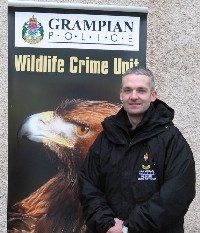 Grampian Police Force, covering the north-east region of Scotland, is way ahead of all the other Scottish police forces when it comes to tackling wildlife crime. This police force has employed a full-time Police Wildlife Crime Officer since 2006 – the excellent and highly effective Dave MacKinnon, who apparently stepped down earlier this year. Much of the Grampian Police Wildlife Crime Unit’s success is as a result of Dave’s hard work and commitment. In addition, there are up to 11 part-time Police Wildlife Crime Officers spread throughout the Grampian region.
In July 2010, Grampian Police appointed the UK’s first ever Wildlife Crime Education Officer to the Unit. Andy Turner, a former National Nature Reserve Manager with SNH, took on the three-year secondment to raise awareness of wildlife crime and to provide educational inititatives to schoolchildren and communities throughout the region.
As far as we know, Grampian Police is the only force that publishes quarterly wildlife crime statistics (see here), although oddly, these figures do not explicitly include raptor persecution incidents. The North East of Scotland has been recently reported as having some of the highest rates of wildlife crime in the UK (see here).
But the Grampian Police Wildlife Crime Unit is not content with just regional coverage of its own area. In recent months, it has worked to produce resource material that is useful to other police forces as well as to the general public. For example, it has produced a set of 11 ‘Aide-Memoir’ cards that have been issued to Wildlife Crime Officers throughout Scotland. These cards cover issues such as raptor persecution, badger persecution and deer poaching. Each card provides basic information on the subject, straightforward instructions on how to deal with alleged incidents, and contact details for specialist advice (see here).
In addition, it has produced an information card called ‘Wildlife Crime: How to Report It’. This card provides simple information, including a list of essential do’s and don’ts when at the scene of a suspected wildlife crime, as well as a list of contact details for every police force in Scotland. With the help of a PAW Scotland grant, Grampian Police has printed an initial 30,000 cards that are being distributed throughout Scotland (see here).
 Grampian Police deserve recognition for their proactive stance on tackling wildlife crime. This police force puts many of the other Scottish police forces to shame. The Grampian Police Wildlife Crime Unit isn’t perfect, but then who is? What’s important is that this group has taken giant steps towards a zero tolerance policy on wildlife crime. Some might say, ‘Well, it’s their statutory duty to deal with wildlife crime so why are you congratulating them for doing what they’re supposed to be doing?‘ It’s a fair point, but when you compare what Grampian Police has been doing with what most of the other Scottish police forces have (or haven’t) been doing, then we would argue that Grampian Police has actually gone further than its statutory duties and has demonstrated a meaningful commitment far greater than any other police force in the UK, let alone in Scotland.
For further information about the Grampian Police Wildlife Crime Unit:
Grampian Police (wildlife crime) website here
Introduction to Andy Turner, Grampian Police Wildlife Crime Educator here
Aug 2011 article about Grampian Wildlife Crime published in Aberdeen Voice here
The Game and Wildlife Conservation Trust (GWCT) are advertising a grouse keeper’s training course, to be held in November. Their advert for the training course includes the following statement:
“This highly acclaimed, practical training will take place on working estates in Glen Esk, Angus, where well respected grouse keepers, along with GWCT advisory and research staff, will impart their knowledge based on a wealth of experience“.
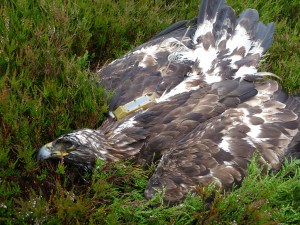 Glen Esk is, of course, where golden eagle ‘Alma’ was found poisoned two years ago (see here). She had been poisoned by Carbofuran. Police raided one of the three sporting estates in Glen Esk where Alma’s body was found (Millden Estate), but no arrests were made. A report in the Brechin Advertiser one month later (see here) included the following statement: “It had previously been confirmed by Tayside Police that the bird “certainly” picked up the poison in the local area“. It is not clear what this ‘certainty’ was based upon. Local residents apparently shared this view though, and Brechin Community Council vice-convenor, David Adam, was reported in the Advertiser article as saying: “I think it is fairly conclusive that the bird was poisoned and that the bird was poisoned in Glenesk“.
It is not known whether the police extended their investigations to the other two sporting estates in Glen Esk – Gannochy Estate and Invermark Estate. As far as anyone can tell, the police investigation is still on-going.
Interesting then, that the GWCT would select Glen Esk as the venue for their ‘highly acclaimed’ grouse keeper’s training course, don’t you think? And also interesting that Scottish Land and Estates and the Scottish Gamekeepers Association should choose to advertise this training course on their websites.
Training course advert on GWCT website here
Training course advert on Scottish Land and Estates website here
Training course advert on SGA website here
In a feature article in the latest edition of Shooting Times, the Chairman of the National Gamekeepers Organisation, Lindsay Waddell, laments the sale of Millden Estate in Angus (see our earlier story about the sale here).
He questions the reasons behind the sale, “just as the moor is coming good“. It’s a strange description for an estate where two-year-old golden eagle Alma was found poisoned in 2009 (see here). His theory about why Millden has come on the market goes like this:
“It would appear the answer lies in the recent legislation passed by the Scottish Parliament which holds landowners liable for the actions of their staff [vicarious liability], and that is something, it appears, some will not entertain at any cost. So it’s sell up, and get out. It may well turn out to be a sad day for the inhabitants of many glens if more and more of the modern-day owners decide to take the same course of action“.
Interesting.
Waddell goes on to acknowledge that there are still landowners (he says “a few”, we say ‘too many’) who won’t manage their land without the use of [illegal] poison and says these individuals have to shoulder a lot of the blame for the introduction of vicarious liability. No disagreement there, Lindsay – the criminals within your industry are finally having to face the music after 60 long years of relentless and systematic illegal raptor persecution.
He also comments that the new legislation (vicarious liability) is ‘open to abuse’. He writes: “It is all very easy for items to be ‘found’ on a piece of land“. By ‘items’, does he mean poisoned birds and poisoned baits, and enormous caches of illegal poison? Much like what was found on Skibo Estate in 2010? The ‘items’ that Dean Barr, sporting manager at Skibo Estate, claimed in the press had been planted by the RSPB (see here)? Obviously his press statement was made before he was found guilty of possessing 10.5 kg of Carbofuran – the UK’s biggest haul of this banned pesticide to date (see here).
Waddell continues by suggesting that Millden may be the first of many Scottish sporting estates to be sold. Let’s hope so. I can think of more than just ‘a few’ whose closure is long overdue.
Shooting Times article here
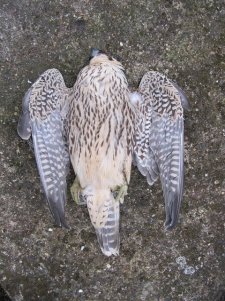 The BBC News website is running a story today about another poisoned peregrine. The young bird was apparently discovered three months ago at Whitecleaves Quarry near Buckfastleigh in Devon. The toxicology results, which have only just been released, indicate the bird was poisoned with the banned pesticides Carbofuran and Aldicarb.
This is the third reported poisoning incident in the region in recent weeks, following the reports of four poisoned goshawks and one buzzard in Devon (see here) and two poisoned peregrines in Cornwall (see here).
According to the BBC article, peregrines at Whitecleaves Quarry have been targeted before, with poisoned birds being discovered in 1992, 2004 and 2005.
Devon & Cornwall police are investigating the latest incident, and the RSPB has once again put up a £1,000 reward for information leading to a conviction.
The obvious question – why has it taken three months for this incident to be publicised?
BBC News article here
In February this year, an announcement was made about the pending appointment of three specialist prosecutors to deal exclusively with wildlife and environmental crime in Scotland (see here).
In August, an announcement was made that two specialist prosecutors had now been appointed (see here). We commented at the time that COPFS (Crown Office & Procurator Fiscal Service) had not provided any information about the prior experience of these two new fiscals in this specialist area of law, and that no mention had been made of the appointment of a third wildlife crime fiscal.
There still isn’t any word on the appointment of a third specialist fiscal, but there is now a statement from COPFS about the two new appointees – Kate Fleming and Shona McJannett:
“Kate has been an environmental specialist prosecutor for several years and is based at the Procurator Fiscal’s office in Glasgow. Shona’s interest in environmental law goes back to her days at university and she has prosecuted both wildlife and environmental cases in her previous post in Fife. She is now based in the PF office in Edinburgh.”
We wish them both well and look forward to following their progress. We particularly look forward to seeing a substantial increase in the number of successful prosecutions for wildlife crime.
 The case against gamekeeper Andrew Malcolm Slaughter, which opened at Inverness Sheriff Court in March 2011, has been delayed once again.
The case opened in mid-March (see here for details) and was continued until 7th April.
On 7th April, it was adjourned until 28th April (see here).
On 28th April the case continued without plea until 19th May (see here).
On 19th May the case was put back until 12th October (see here).
The case has now been postponed until 17th November, eight months after the trial first started.
 Well finally, on behalf of the Scottish Government, SASA (Science and Advice for Scottish Agriculture) has published the poisoning figures from the second quarter of 2011 (covering the period from April to June), and guess what? More raptors were illegally poisoned during this period. Seems a bit of a coincidence that these figures have been published four months late and on the very day that people were encouraged to make a Freedom of Information request to SASA to obtain the 2011 poisoning data. Nevertheless, the publication of these data is still welcome and provides us with cold hard facts about the continuing illegal poisoning of our native species.
The latest report shows that there were three confirmed ‘abuse’ incidents during this period, including:
April 2011: 1 x buzzard poisoned by Aldicarb & Carbofuran (Highland region)
May 2011: 1 x raven poisoned by Carbofuran (Dumfries & Galloway)
May 2011: 1 x red kite poisoned by Bendiocarb & Carbofuran (Highland)
All three incidents are reported to be the subject of on-going police investigations. How many of these were reported in the media at the time of the incidents? These latest figures can now be added to the figures from the first quarter (Jan – Mar 2011 – see here) to show that in the first half of this year the following have been confirmed poisoned by illegal pesticides:
4 x buzzards; 1 x golden eagle; 2 x red kites; 2 x peregrines; 1 x raven.
And of course these are only the ones that have been discovered. And the figures do not include all the other incidents of non-poisoning persecution reported this year (e.g. shot goshawks here, shot peregrine here), nor the suspected poisoning incidents that were not included in the earlier SASA report (see here), nor the birds reported to have been poisoned since June (e.g. see here). It is clear that the widespread problem of illegal raptor persecution still exists, despite the (now apparently premature) comments from the game-shooting industry that this criminal behaviour has been eradicated. It clearly hasn’t been eradicated, but have the numbers dropped? Given the chronic delays in reporting these incidents in the media, we’ll have to wait for the next two SASA reports before that assessment can be made.
I wonder how long will we have to wait until the figures from the 3rd quarter (July – Sept) are released? If their publication is as late as this current one, we can expect to see them in four months time (February 2012). Perhaps that FoI request is still worth pursuing after all..
Latest SASA figures available for download here.
A news item posted today on the RSPB website reveals that a buzzard and two ravens were found dead in Monmouthshire in July. Tests reveal they had been poisoned by the banned pesticide Carbofuran. Two dead pigeons were also found which had been laced with an un-named pesticide and the news report suggests these were put out as illegal poisoned bait. Last year, two dead peregrines, poisoned with Carbofuran, were found at the same site (see here).
The article reports that Gwent Police, the Welsh Government and the RSPB are appealing for information. The RSPB is reported to be offering a £1,000 reward for information leading to a conviction.
Three months after the incident? What’s the point? Why is it that media reports about wildlife crime, and particularly illegal raptor persecution incidents, are now consistently delayed for several months? What other areas of crime are reported this way? If my house was burgled in July and I waited for three months before I reported it to the police, what do you think the chances would be of catching the burglar? About the same as catching the raptor poisoners, I reckon.
Talking of delayed reports…why is it that the 2011 SASA poisoning report, which is supposed to be updated every quarter, has not been updated since March 2011? Are we to believe that raptors are no longer systematically poisoned in Scotland because none have been handed in for analysis for the last seven months? If anyone feels like doing a Freedom of Information Request, this would seem to be a good place to start (FoI on SASA website here).
News story about the poisoned buzzard & ravens on RSPB website here
 Raptor Persecution UK