 This is the fifth blog in the series focusing on presentations made at the recent police wildlife crime conference in Scotland, this time from Des Thompson, Policy and Advice Manager at Scottish Natural Heritage (SNH is the government’s statutory advisory body on nature conservation, paid for by our taxes).
Des Thompson, SNH
“Well, good, good morning and thank you, thank you Nevin [Hunter], er, I must say it’s been terrific to, to meet Nevin and to, to work with him already and Charlie [Everitt] as well, what a, what a remarkable difference, we’re seeing a real step change in the work we’re doing to tackle, er, wildlife crime. And I’d also publicly like to pay tribute to Brian [Stuart], who’s, as Head of National Wildlife Crime Unit has been a fantastic person to work with him, a great enthusiast and became a very good friend and I was delighted to see that he got a special award recently so well done Brian.
I’m slightly apprehensive, er, being in front of you all, especially with a, a sheriff sort of sitting in front of me and that civil servant glowering at me, erm, because I’m, I’m primarily going to talk about, about natural history and to explain to you the work we’re doing on birds of prey in Scotland, how we’re developing some, some area profiles but really how we’re trying to develop our understanding, er, of what makes, er, birds of prey tick and the factors affecting them, and you’ll see here I’ve acknowledged a huge number of people who have helped out. Oh they’re wonderful birds, I mean, I knew Charlie would show some nice, nice photos because he’s a superb photographer so I thought I had to show, lovely picture of an osprey here, er, they are wonderful birds and today what I want to do is to, to introduce the raptors to you, to tell you how we’re developing the evidence base on raptors, and giving some examples from work we’re doing on golden eagles, hen harriers and red kites, and finishing off with some thoughts on, on next steps and some, some wider issues that you might wish to, to discuss further.
Huge number of people have worked on birds of prey in Scotland, in fact in Europe our birds of prey are probably better studied in Scotland than anywhere else. We’ve a fantastic pedigree of research, P.K. Stirling-Aird down in the bottom right-hand corner there, people like Adam Watson, the late Jeff Watson, erm, Ian Newton the top left-hand corner, Roy Dennis, huge number of people have contributed to our knowledge on birds of prey.
We have 19 species nesting in Scotland, we have some great causes célèbres species like the osprey, now we have more than 250 pairs which is quite remarkable, white-tailed eagle more than 55 pairs, red kites more than 200 pairs compared with 2,000 in the UK. Of course some of these birds are icons of Scotland, real icons of Scotland such as the golden eagle, of course some still recovering from pesticide and persecution impacts and a few of course are not just recovering, they’re expanding, certainly there when you think about buzzards.
 A lot of the information we’re pulling together comes from Scottish Raptor Study Groups under the umbrella of the Scottish Raptor Monitoring Scheme, I think Charlie touched on this, it was formed by seven organisations back in 2002, building on the experience and expertise of around 300 volunteer fieldworkers in Scotland, and working with, er, Brian Etheridge the Raptor Monitoring Officer, wide range of parties here from the government agencies, SNH and JNCC, through to some of the prominent NGOs working with wildlife in Scotland such as the RSPB and the Scottish Ornithologists’ Club, and I’m delighted to say that the Forestry Commission will be joining us shortly.
It’s largely about cooperation, getting much better collaboration between parties, providing the robust information, evidence based on raptors, and maintaining high and uniform standards of data collection, analysis and reporting.
Sounds very simple but actually a huge amount of effort went in to forming the, this scheme in the first place, an example of a raptor worker checking on osprey nest here, and these, the are remarkable individuals these, these members, they collect data on numbers and distribution of raptors, breeding success, nesting success, clutch size chicks, reasons for failure, and often may cover the same area for ten years and therefore they have, er, really what I’d call a crucial knowledge, er, of their area and of the issues, the side range of issues affecting birds of prey.
And we have a phenomenal amount of data falling in to the scheme as a result of this, back in 2003 we had 3,500 records, these are individual records from raptor workers, through to not far off 5,000 records in 2010, and now we have more than 30,000 records on raptors in Scotland, which is a European record.
We produce annual reports, the data of course goes in august organisations such as the Rare Breeding Birds Panel, of course they’re used by SNH and government for a range of casework issues.
 So let’s get in to some detail of what we’re doing. We’ve developed a number of, er, raptor conservation frameworks, er, notably for golden eagles and hen harriers, really trying to drill down to the factors affecting the viability of these birds at a regional scale. And yes, er, one of the issues we’ve identified is an association between some grouse moors, and, and poisoning of birds, of course the Minister today has touched on the newsflash, much better news, in 2011 reported today, great to see the lowest, er, recorded incidents of poisoning since 2006, think this does represent real progress but of course we need to be mindful that there are other forms of persecution.
Of the golden eagle conservation framework we identified problem areas for golden eagles. Some empty or abandoned territories, some struggling to be productive and really identifying the range of factors, er, identifying, er, affecting the birds.
We’ve been satellite-tagging the birds working closely with RSPB, er, Roy Dennis and Highland Wildlife Foundation and Natural Research, and these are the packs that are attached to the birds, these satellite tags are about the size of a pack of playing cards, and we get fantastic information on a monthly basis, here very sadly for Alma, er, young golden eagle tagged by Roy Dennis, where you can see the movements it made from October through to July, er, and, and very sadly, er, it ended up, ended up, er, dead, but hugely important information we can build on range use of these birds.
Er, I’ve shown this slide of, er, golden eagle flying in to a nest with, er, one sibling attacking another, er, this brilliant picture taken by Laurie Campbell, one of our very finest, er, wildlife photographers, he noticed, er, sitting in this hide every time a golden eagle, an adult here, it was a male here, flew in with prey item, the, er, older sibling, here, would attack, would attack the smaller young, younger sibling and eventually killed it. And I show this because what we are finding in the west of Scotland now is a very marked increase in rainfall, those of you who live in the west of Scotland won’t be er, surprised to hear this, but over the last 30, 35 years there’s been an, an almost doubling of rainfall in May, and the upshot of this for golden eagles is that these birds are finding it far harder, er, to find prey, in particular live prey and so we’re seeing, er, a greater incidence of these sorts of problems for golden eagles, we’re seeing significantly fewer twins being fledged from golden eagle nests.
So a variety of factors affecting golden eagles and we’re busy trying to develop the evidence base on these birds, this is a, a, very funny portrait painted by, er, Keith Brockie, developing our knowledge of the conservation status, range use and movements, survival rates and causes of death, we’re getting a lot of important information here from the satellite-tagged birds, and of course this is supporting the day to day casework that we’re doing on the effects of forest expansion on these birds, windfarms and persecution, because we’re building up a very accurate picture of the range use and habitat use by these birds.
Moving on to hen harriers, we published, er, last year a conservation framework for hen harriers, in Scotland only five out of 20 regions were at, er, had populations that were favourable, three of the regions good for hen harriers were also good for golden eagles, and we found persecution risk, er, and food shortage were two key constraints, er, acting on these birds and now we’re looking at these much more carefully.
 I’m going so show some slides to indicate just how difficult it is to determine what’s happening to hen harriers, this is one of our largest, er, Special Protection Areas for hen harriers, south of Scotland the Muirkirk Uplands, and the North Lowther, erm, Uplands SSSI all make up this Special Protection Area, we monitor hen harriers and other birds, numbers and productivity, and if you look at the trend here, in red you’ve got, er, numbers of breeding birds and in blue you’ve got fledging success, and you can see there’s been sort of great variation in numbers of hen harriers and for fledging success, the number of fledged chicks produced, sort of two, er, declines, a decline down to 2000 and then up to 2003 and a decline down to 2010. But when you pull these areas apart, er, you look at the Muirkirk Uplands, SSSI one part, and you find that really there is variation in numbers but not the sort of decline we’re recording and there’s one major peak in the fledging success of the birds, and part of this may well be due to variation in vole numbers which go through a cycle. But then we look at, drill down to the North Lowther Uplands you see there has been a decline in numbers and there has been a decline in fledging success. And it shows really that you have to drill down to very specific areas to try and understand what’s happening, when we talk about downward trends we need to be careful in describing these downward trends, we need to be very specific. But we’re talking about the factors and here there’s a complexity of factors affecting hen harriers, actually predation by foxes and crows, prey availability, er, persecution and habitat deterioration, they’ve all been influencing these birds, and interestingly, with the decline in keepering on one estate down there, er, there appears to have been an increase in numbers of predators which is having an adverse effect on hen harriers.
On the line for us at SNH is the Special Protection Area is unfavourable, erm, that status is declining and that’s serious because that means we’re not making, meeting our conservation, er, targets.
So for hen harriers, there is of course a history of persecution because hen harriers prefer grouse moors over other habitat, but important to know, complex range of factors at play here, when in some areas actually effective control of foxes and crows may help the birds and it’s important for us to note that, and there’s a growing evidence base on the movements and population viability of these birds so again science is helping us.
The final example I want to give you is for red kites in the UK, and Charlie touched on this, and on the map here I’ve shown a number of release locations for red kites in the UK. And on the right-hand side a number of years since reintroduction from one to 17, and the population in the Chiltern Hills in the south and in north Scotland in the sort of north Highland area. Really the, the, the conditions in terms of prey base are very similar for these two areas but for some reason the Chiltern population has increased much better than in the north of Scotland. And we can look at a range of factors such as prey availability, productivity of birds in different areas, and when we look at north of Scotland we actually find that within Europe, north of Scotland is, is ranked 5th out of 25 areas that have been studied in detail, so really the north of Scotland population should be doing incredibly well because of the very rich prey base available to these birds.
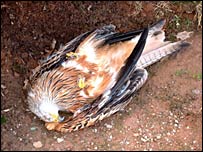 Some quite excellent, er, science led by RSPB and Jen Smart in particular, has drilled down to look at the cause of mortality, er, in these birds, and there’s a whole range of factors, poisoning and other illegal practices, and of course collision, electrocution, a variety of natural causes, to build up a very clear understanding of what’s affecting these birds. And in a fairly recent paper in the scientific journal Biological Conservation they were able to quantify the relationship between persecution and the annual survival of birds, so for first-year birds they were able to say that the annual survival is 0.37, 37% of the birds survive, but in the absence of persecution it would be much higher, just over half of the birds would survive, they did this for second-year birds and for the other birds, building up a very precise understanding of what’s affecting these birds. And then by modelling the sort of persecution effects, er, on the red kites, they were able to show that the population at the moment is only bumping along at 50, but critically, if persecution was removed, if it was wiped out, then the population would be far higher, it would be up to about 350 pairs. And this is really a compelling example of how science is giving an insight into the effects of persecution here, and other factors affecting these birds. So 40% of the dead, just over 100 red kites were poisoned in north of Scotland, without poisoning we should have had 300 plus birds, poisoning of red kites in the north of Scotland is attracting a lot of criticism nationally, and we now know the location of the hotspots problem areas where red kites have been found, poisoned, and we’re working closely with the police to tackle this. And I want to put on record here how grateful we are to Northern Constabulary, er, senior staff at Northern Constabulary for meeting with us to discuss the scientific issues and for taking forward the very ambitious programme of work to tackle this problem.
So I’ve given you some examples of some work we’re doing on these birds of prey. We’re very keen to try and develop this further, really as a form of indicators, birds of prey are top of the food chain, they’re well surveyed in monitoring, we’ve got a mass of datasets, they may be good indicators of change, where birds of prey are missing, birds of prey such as peregrines say are missing, that, that, that can tell you something very important about the prey base and other conditions, the public of course, most of the public love to see and enjoy birds of prey, a lot of political interest in birds of prey, we saw that this morning from the Minister, and there is growing collaboration, notably through the PAW raptor group which Charlie took us through.
Well we’re trying to produce raptor trends for different regions of Scotland, we call them Natural Heritage Zones, just common regions of Scotland, for peregrine here now for these different regions in the Eastern Lowlands, the Border Hills, building up a very clear picture of how numbers are changing, for birds such as white-tailed eagle, huge amount of information for the different areas, we can build up a picture of trends in clutch size, brood size, numbers fledged, and therefore developing our understanding of what’s happening to these birds, and we’re trying to do this now for a whole range of species.
Charlie’s mentioned sort of persecution statistics, we have, er, pulled together a lot of information on persecution, that’s now sitting with the National Wildlife Crime Unit, er, and I want to say here it’s, it’s not our job, it’s not SNH’s job or the raptor workers’ job to pronounce on these data, that’s a matter for the National Wildlife Crime Unit and for the police and that’s why these data now sit with that unit.
So all of this is helping us with the area profile, and in particular we’re working very closely with the raptor priority group but of course we’re building up this picture of where there are problems. Since, er, Charlie showed a nice slide I wanted to show this as well without the writing, erm, you, you know, a golden eagle in a sort of north Highland landscape, what a fantastic picture.
So I want to finish with some concluding thoughts and I thought this would come across very clearly so I repeated the slide in black and white. I’ve got six thoughts here:
1. The evidence base is crucial, erm, it’s clear we need to be objective on issues and the area priority depends on that. I think actually from what we heard from, from Sheriff Drummond earlier on it is critical at all stages that we are objective, er, and we play strongly to the evidence base.
2. A lot of talk about grouse moors. Grouse moors, really there’s huge variation in operations and practices on grouse moors. Let’s just remember, when people talk pejoratively about grouse moors, just remember there’s a huge amount of variation and the great majority of these are very well managed.
3. Predator management is important and there are some real benefits to be derived from predator management. If any of you were present at the ten year celebration of the Moorland Forum a couple of weeks ago, Stuart Housden gave a very important presentation and in that presentation he quite deliberately pointed to the work that the RSPB is pulling together to show the benefits of predator management. I think it’s important that we, we move on with predator management and we recognise that predator management can be important for a whole range of bird species.
4. The traditions of grouse moor management will persist. Let’s focus on the positives. I am fed up of colleagues and others saying to me, ‘Why are you worrying about grouse moor issues and the persecution issue, grouse moors won’t exist in five or ten years time’. Nonsense. Grouse moors, grouse moors will be with us for as long as we have Scotland. They will persist for centuries, not just decades and we need to remember that and focus on the positives associated with good management of grouse moors.
5. Scrutiny of management practices, er, Nevin and Charlie touched on this, the need for self-regulation and vicarious liability.
6. My final plea really is that we need to think out of the box and I like to think this is what we are doing in the PAW raptor group. I mean we’ve got, Charlie listed the individuals, some of the early meetings were quite difficult, they were quite fraught and as we’ve developed trust in one another and in the data that we’re dealing with, we are mindful that we have common objectives here, and frankly, and I say this deliberately, I think we’ve never had a better chance to eradicate, er, raptor persecution in Scotland, so thank you very much.”
[What a very revealing presentation. Last July we blogged about SNH’s stated intent to work more closely with GWCT and we asked whether this collaboration should be a cause for concern (see here). Listening to Des’s characteristic simpering flattery during this presentation it now seems very clear that those concerns were justified.
Yes he did acknowledge that persecution was an issue for golden eagles, hen harriers and red kites (how could he not, seeing as SNH commissioned two studies on golden eagle and hen harrier and both studies concluded persecution was the main issue?!) but what was interesting was how he then tried to shift the focus away from persecution when he was discussing the problems faced by golden eagles and hen harriers. The uninformed members of the audience might well now think that rainfall is the main constraint on overall golden eagle survival and that fox and crow predation is responsible for the ‘disappearance’ of over 2,000 harriers. Yes it’s accurate to suggest that rainfall may be impacting on golden eagle productivity in the western regions, but it has not been shown to be responsible for the ~ 273 empty known or potential golden eagle territories in the northern, central, eastern and southern regions; persecution has! In fact, the golden eagle conservation framework identified that only 3 of 16 regions in Scotland were of favourable conservation status for the golden eagle, and all of those regions were in the west! The framework identified the highest national priority for the conservation and management of golden eagles in Scotland is to tackle persecution. The promotion of a greater availability of live prey in western regions (through changed land management practices relating to deer and sheep) was only a secondary priority, so why focus on it in this presentation, unless Des was keen to deflect attention away from the continuing persecution issue on northern, central, eastern and southern grouse moors?
It was also a concern to hear Des suggest that the buzzard population was not recovering (from previous persecution) but rather it was now expanding (based on what data?). Given that SNH are now in charge of issuing licences for the ‘control’ (killing) of ‘pest’ species, and the mounting pressure from the game shooting lobby for licences to kill ‘problem’ buzzards, are we now looking at the strong possibility that these buzzard licences will be issued? It will be interesting to see how SNH can justify the killing of a relatively uncommon, and protected, native species in favour of a relatively abundant, non-native, unprotected species (e.g. pheasant).
We’re incredulous to hear Des trying to convince us that the vast majority of grouse moors are ‘very well managed’ when we know, after decades of what he calls an ‘evidence base’ (i.e. scientific publications) that these areas are directly linked to the mass destruction of native wildlife, and not just illegal raptor persecution, we’re also talking about the legal killing of hundreds of thousands of other animals, all to produce artificially high numbers of game birds which are then shot for sport by a ‘privileged’ few. If that’s the marker that SNH uses as the standard for nature conservation in Scotland then there isn’t much of a future to look forward to, is there?]

 Top, top, top news! Serial egg collector, Matthew Simon Gonshaw, has today been jailed for his latest egg-theft crimes but more importantly, he has been banned from entering Scotland during the bird breeding season, FOR LIFE!
 The RSPB and Hertfordshire Police are appealing for information following the discovery of two poisoned red kites in the Chilterns.
 All sounds very convincing and reassuring, doesn’t it? Why is it then that Northern Constabulary has remained tight-lipped about the discovery, 15 months ago, of a poisoned red kite allegedly found on moorland at the boundary of Skibo Estate? We have been told that the satellite-tagged kite was allegedly found in February 2011. SASA documents show that only one red kite from the Highland region was tested in February 2011 and it had been poisoned by Alphachloralose and was the subject of on ongoing police investigation (SASA ref #11020, see
  Raptor Persecution UK