Northern England Raptor Forum (NERF) responds to RSPB’s Birdcrime 2016 report

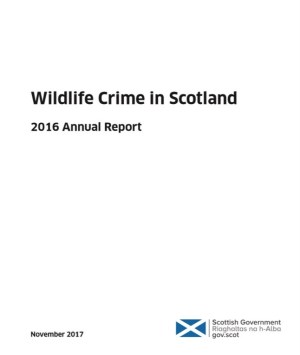
The Northern England Raptor Forum (NERF) has just published its response to the publication of the RSPB’s Birdcrime 2016 report.

Read it here

NERF’s unreserved condemnation of the continued illegal killing of birds of prey is everything you would expect from an organisation that works at the frontline of raptor conservation. In addition, NERF welcomes the recent statements of condemnation from senior representatives of the Yorkshire Dales National Park Authority (here) and the Nidderdale Area of Outstanding Natural Beauty (here). NERF is particularly appreciative of the frank admission and call for a halt to the illegal killing from BASC’s acting CEO, Christopher Graffius (here).

Incidentally, there are still places available to attend NERF’s annual conference on 18 November 2017, at Northumbria University (City Campus East) in Newcastle. Programme & booking details here.

Costs/benefits study of driven grouse shooting due to begin spring 2018

In September 2017 the Scottish Parliament’s Public Petitions Committee considered petition # PE01633, submitted by Les Wallace, calling on the Scottish Government to sponsor a comprehensive and independent study into the full economic impacts of driven grouse shooting.

The Petitions Committee agreed that a full independent study was needed but was unsure whether this topic would be covered as part of the Scottish Government’s earlier commitment in May to undertake a review of grouse moor management practices.

There was also confusion as to whether the Scottish Government had actually commissioned this research yet, and the Committee agreed to contact the Scottish Government to ask for an update on progress and to ask for a timescale (e.g. start / finish date) of that proposed work.

The Scottish Government has now responded to the Petitions Committee with this:

It’s our understanding that this commissioned research on the economic and biodiversity costs/benefits of driven grouse shooting (and other types of upland land use) is separate to the other main piece of work announced by Roseanna Cunningham five months ago in May 2017 – that being ‘to set up an independently-led group to look at the environmental impact of grouse moor management practices such as muirburn, the use of medicated grit and mountain hare culls, and to recommend options for regulation including licensing and other measures which could be put in place without new primary legislation‘.

We are expecting details of this independently-led environmental impact review group to be announced by Friday 10th November, as requested by the Scottish Parliament’s Environment Committee last month.

SNH refuses to disclose details of individual General Licence restriction

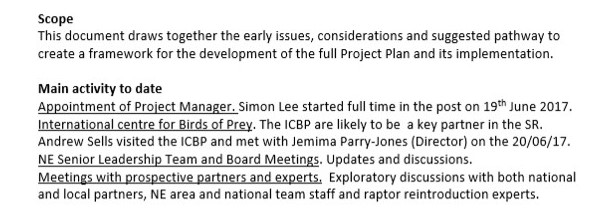
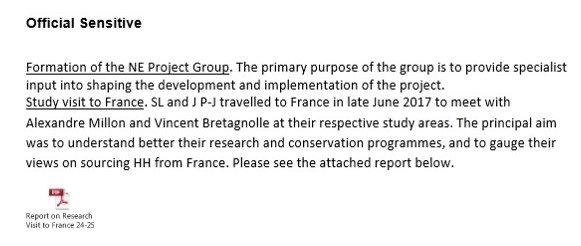
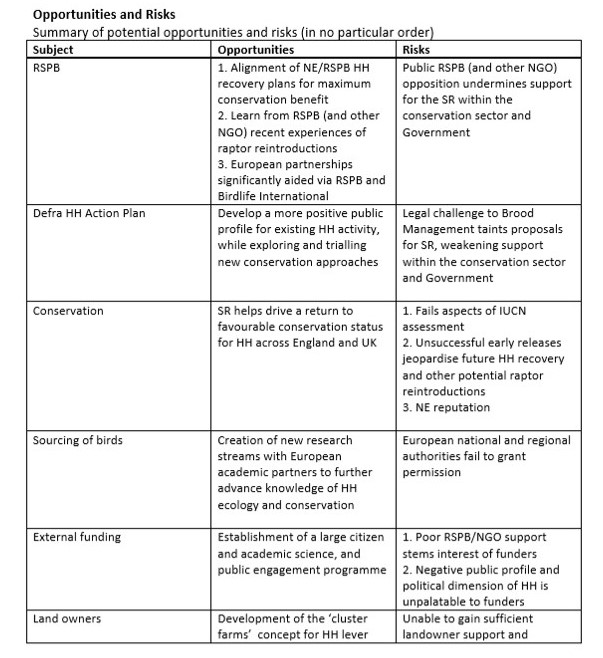
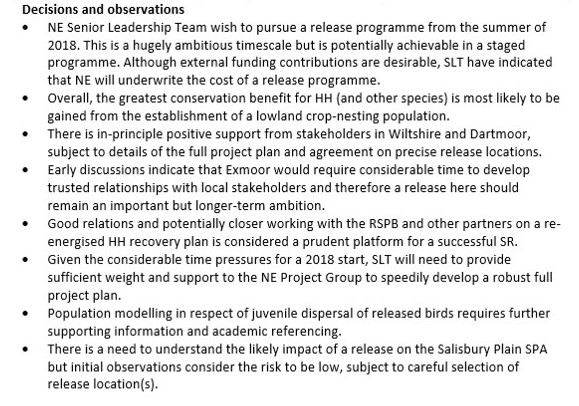
In September 2017 we learned that SNH had imposed a General Licence restriction on an individual for alleged criminal activity in relation to raptor persecution (see here).

This was a highly unusual restriction because it applied to an individual rather than to an estate.

At the time the restriction was announced, SNH provided virtually no information other than to say a General Licence restriction had been imposed and that it would apply for three years.

However, RSPB Scotland released a press statement in relation to this restriction order which included the following quote from RSPB Scotland’s Head of Investigations, Ian Thomson:

The restriction was imposed after RSPB investigations staff passed video footage to police of a gamekeeper allegedly setting illegal traps, baited with a dead woodpigeon, very close to a goshawk nest in NE Scotland”.

Here’s a clip from that video evidence:

From this, we were able to deduce that this alleged wildlife crime took place in March 2014 ‘nr Tarland, Aberdeenshire’, although the specific location was not given.

This alleged offence was reported by Police Scotland to the Crown Office in April 2014 (see here). It is clear, now, that the Crown Office did not prosecute the gamekeeper, probably on the grounds that the video evidence was deemed ‘inadmissible’. That’s the sixth alleged wildlife crime case, that we know about, that the Crown Office has dropped in recent months.

So at this stage we know that an alleged wildlife crime had taken place, we know that a criminal prosecution is not going to happen (because the case is now time-barred), and we know that SNH has imposed an individual General Licence restriction on a gamekeeper as a supposed sanction. The identity of the alleged offender remains a secret, as does the name of the estate where the alleged offence was committed. This lack of transparency is, frankly, appalling, especially when former Environment Minister Paul Wheelhouse had stated when he first introduced General Licence restrictions in 2014 that he expected them to function as “a reputational driver”. Not much chance of that happening when the details of a case are kept secret.

In early October 2017 we submitted an FoI to SNH to try and find out more details about this case. We asked for:

  1. The name of the person who had been given a General Licence restriction (we didn’t expect to be told but thought we’d ask anyway – you never know)
  2. The occupation of that person (we already knew from the RSPB press statement that he was a gamekeeper but we wanted SNH to confirm this)
  3. The name of the county in which this individual resides (we already knew from the RSPB press statement that the alleged offence had taken place in Aberdeenshire but we wanted SNH to confirm this)
  4. The name of the estate from where the Police evidence of alleged raptor persecution had been collected
  5. An explanation about why an individual and not an estate was the recipient of the General Licence restriction
  6. An explanation about how SNH intends to monitor the activities of the individual for potential breaches of his General Licence restriction.

SNH has now responded and it’s astonishing:

It looks like SNH has been taking lessons from Natural England in the withholding of information that should be in the public domain. It’s understandable that SNH can’t disclose the alleged offender’s identity, but withholding details of his occupation and the county in which he resides because “this would allow them to be identified” is obviously nonsense, and we already know this information from the RSPB press release!

We would argue that it is in the public interest to know the name of the estate on which this alleged offence took place (and we do know from various local sources it was on a game-shooting estate and that this gamekeeper was employed by that estate). Why should that information be kept secret? Who is SNH shielding, and why?

And does anyone actually believe that Police Scotland, no matter how well-intentioned, has the resources to track this gamekeeper’s activities for the next three years to ensure he’s not breaching the terms of his General Licence restriction?!

Whilst this response doesn’t get us any further forward in knowing the specifics of this case, what it does demonstrate, quite clearly, is that the General Licence restriction, introduced as a way of publicly embarassing estates where there is evidence of wildlife crime but, due to perceieved evidential difficulties, the cases don’t ever reach the courts, is simply not working.

Tomorrow’s blog, on another General Licence restriction case, will emphasise this point again but on a whole bigger scale.

Jim Shannon MP tells Westminster “there are too many birds of prey”

Dim-witted dinosaur Jim Shannon MP (DUP, Strangford, NI) is back making a fool of himself again.

Just a few weeks after being told that the UK Government “is not considering any further controls on the number of raptors” (see here), here’s what the Countryside Alliance member said in the Westminster Parliament yesterday:

From Hansard (2 Nov 2017)

The number of birds of prey across the United Kingdom of Great Britain and Northern Ireland has risen astronomically to the detriment of songbirds. The Department for Environment, Food & Rural Affairs does occasionally grant licences to cull birds of prey, but many country people and landowners who want to avail themselves of such licences in order to achieve a balance in the countryside find the process to be off-putting. Indeed, sometimes they cannot get a licence. There are too many birds of prey and too few songbirds and mammals, so will the Leader of the House grant a debate on that or call for a statement from DEFRA?

Here’s the response from Andrea Leadsom MP:

The hon. Gentleman shares with me a love of nature and wildlife, but we have seen a reduction in this country’s wildlife over many years. As my right hon. Friend the Secretary of State for Environment, Food and Rural Affairs [Michael Gove MP] has said, it is vital that we take steps as we leave the EU to improve our biodiversity and the prevalence of songbirds and mammals. He is taking steps to ensure that that happens, and there will be further opportunities as we leave the EU“.

There was a good feature about this on Northern Ireland’s BBC Newsline this evening, with a response from Dr Marc Ruddock of the Northern Ireland Raptor Study Group, who managed not to laugh and instead calmly explained that the scientific evidence does not support Jim Shannon’s ludicrous claims. You can watch it on iPlayer here (starts 12:05) but it’s only available for 24 hrs.

Apparently Jim Shannon wasn’t available for interview. Too busy practising his lines for The Simpsons, perhaps.

Interesting bedfellows: 4

Every now and then we blog about who’s (figuratively) getting in to bed with whom within the grouse-shooting industry. Previous installments in this revealing series have included this, this and this.

Today’s fascinating bedfellows are the Game & Wildlife Conservation Trust (GWCT) and Mark Osborne, joint owner of William Powell and grouse moor management ‘guru’, who, according to our research, has links to at least 70 grouse and pheasant shooting estates across the UK, including some very familiar names to this blog such as Leadhills, Glenogil, Raeshaw, Glenlochy, Snilesworth, Abbeystead.

Last year in one of it’s never-ending fundraising drives, the GWCT held a raffle, with a pair of shotguns, a day’s driven grouse shooting and 500 cartridges on offer, all worth an estimated £25,000 and all donated to the GWCT raffle by William Powell. That was extraordinarily generous.

A few days ago a blog apeared on the GWCT website (here) describing the winner’s ‘fantastic day’ on a grouse moor in Derbyshire called Ashop Moor.

Here’s a map showing Ashop Moor, which is part of the Park Hall & Hope Woodlands Estate inside the Peak District National Park:

And here’s a photo of Ashop Moor (photo by RPUK):

It looks lovely, doesn’t it? Just the sort of landscape where you might expect to see a pair of breeding hen harriers. But there aren’t any breeding hen harriers there.

The name of the estate and the name of the moor may not be familiar with blog readers, but you’re more likely to know it for what was filmed there on 24th February 2016 at around 11am:

A few months after we published this video, the National Trust announced it had pulled the shooting lease on this estate four years prematurely and the shooting tenant, believed to be Mark Osborne, was given notice to leave by April 2018.

Very interesting bedfellows indeed.

Chair of Nidderdale AONB condemns illegal raptor persecution

Don’t ever underestimate the power of public pressure.

You know that big solid wall of silence we’re all so used to looking at every time a raptor crime is discovered and reported? It looks like it’s finally beginning to crumble.

The latest to speak out, spontaneously (i.e. without prompting), about the continued illegal killing of birds of prey is the Chair of the Nidderdale Area of Outstanding Natural Beauty’s Joint Advisory Committee, Councillor Nigel Simms:

He’s obviously taken a lead from the spontaneous statement made by the neighbouring Yorkshire Dales National Park Authority yesterday.

The publication of this statement from the Nidderdale AONB is really, really welcome. The Nidderdale AONB in North Yorkshire is notorious as a raptor persecution hotspot and has been for many years. We’ve lost count of the number of red kites that never make it out of this particular hell hole, although the RSPB has been keeping track – 22 poisoned or shot in the last ten years, and that’s only the ones that were found.

Nidderdale red kite persecution incidents 2007-2017, map by RSPB:

Illegally-killed red kite (photo Marc Ruddock):

We also know that hen harriers rarely get out of Nidderdale alive – unfortunately we can’t show you a detailed map because Natural England wants to keep the details a secret. Natural England is supposed to protect hen harriers but it’s clearly more interested in protecting the reputations of criminal landowners and gamekeepers. Anyway, here’s a photo of an illegally-killed satellite-tagged hen harrier – something you might see if you visit Nidderdale AONB, assuming you get to it before the gamekeeper who shot it:

It’s interesting to see that these crimes are “starting to have a damaging effect on tourism businesses“, according to Cllr Simms. Good, not for the businesses affected, obviously, but good that it will drive increased local pressure to bring these crimes to an end.

Cllr Simms’ comment that illegal raptor persecution “undermines the work of law-abiding landowners and gamekeepers who are actively working alongside us to improve prospects for all forms of wildlife in the AONB” is slightly odd. Which law-abiding landowners and gamekeepers are those? Presumably not anyone involved with any of the aforementioned red kite killings or hen harrier disappearances, nor, presumably, anybody involved with the attempted shooting of a nesting marsh harrier and the removal of its eggs, as filmed on a Nidderdale AONB grouse moor by the RSPB earlier this year?

There’s much work to do in this AONB but this very public condemnation of illegal raptor persecution from the Chair of the AONB Advisory Committee is encouraging. Well done, Cllr Nigel Simms.

Now, who’s next to speak out and bring that wall of silence crashing down?

BASC Chairman Peter Glenser calls for “honesty” in raptor debate

Have we moved in to a parallel universe? It feels like it today.

First we have BASC’s acting chief executive, Christopher Grafficus, admitting there are “criminals among us” and urging his members to stop killing raptors (see here) before also admitting that the number of convicted gamekeepers “must be the tip of the iceberg” (see here).

And now BASC’s chairman, Peter Glenser, has written a short piece on BASC’s website calling for “honesty in the raptor debate”:

Hmmm. To be honest (as Peter Glenser wants), we’re not as convinced by Peter’s statement of intent as we were this morning with Christopher Graffius’ sincerity. There are a number of reasons for this.

Where was BASC’s ‘honesty’ in the evidence they submitted to last year’s Westminster debate on driven grouse shooting, about the extent of criminal behaviour on driven grouse moors? They claimed it was only undertaken by “a small minority of individuals”.

Where was BASC’s ‘honesty’ in December last year when a senior staff member was telling a Scottish Parliamentary Committee there was no need for game shoot licensing because

“Shotgun certificate holders are among the most law-abiding sector of society and any hint of illegal activity can lead to the right to hold a certificate, and the ability to shoot, being withdrawn”

when on the very same day, Peter Glenser (in his capacity as a barrister) was defending the right of a gamekeeper to have his firearms returned even though it was accepted by the court that this particular gamekeeper had been involved with storing poisons in a secret underground stash on a grouse moor?

Where was the ‘honesty’ last year when BASC’s Director of Northern England, Duncan Thomas, reportedly told a conference that it was ‘an absolute fact’ that disturbance from birdwatchers was the major factor in the losses of hen harriers from grouse moors and it wasn’t much to do with illegal persecution?

There are probably plenty of other examples we could cite if we could be bothered to look for them, and then there’s also BASC’s cynical attempts (e.g. hereherehere) to silence Chris Packham, on the pretence of being concerned about BBC impartiality but in reality probably being more concerned about Packham’s ‘celebrity’ status allowing him to reach a wide audience with his concerns about raptor persecution on driven grouse moors.

We’re also a bit suspicious of Peter Glenser’s use of the phrase “the raptor debate”. There is no ‘raptor debate’. This is about the criminal offence of killing of birds of prey, that’s it. What we suspect Peter might be getting at by the use of this phrase is perhaps he thinks there should be a debate and the focus of that debate would be how many licences gamekeepers can get for legally killing raptors.

That debate, if it ever comes, is a long way away. The immediate issue, as Christopher Graffius recognised, is getting gamekeepers and land owners to stop killing raptors. And while we very much welcome BASC’s apparent commitment to this objective, the immediate and dismal response of the two gamekeeping organisations (NGO and SGA) shows just how difficult that will be.

We don’t know what has sparked these sudden declarations from BASC, although we’d love to know, but it might just be too little, too late. Scotland is already well down the path towards the introduction of a licensing scheme, mainly because the gamebird – shooting industry has comprehensively failed to self-regulate, since 1954! They’ve shown time after time, for decades, they simply can’t be trusted.

Whether BASC can organise the other members of the shooting community (i.e. the non-gamebird shooters) to rally against the criminals within the grouse and pheasant shooters, which is what BASC appears to be trying to do, then maybe, just maybe, they can salvage something from the train wreck that’s thundering their way.

Convictions for raptor persecution “must be the tip of the iceberg”, admits BASC chief

Further to this morning’s blog about BASC’s acting chief exec Christopher Graffius urging his members to stop killing raptors (here), here’s some more detail.

The Times article had suggested that Christopher had written a letter to BASC members, in response to the publication yesterday of the RSPB’s 2016 Birdcrime report. It turns out that ‘letter’ was an opinion article in the Nov/Dec 2017 edition of BASC’s magazine, Shooting & Conservation:

For those struggling to read the small text, here’s a PDF of the article:

Christopher Graffius BASC Raptor Persecution threatens us all_Nov2017

How refreshing to see a senior member of the shooting industry acknowledge that convictions for illegal raptor killing “must be the tip of the iceberg“.

He writes: “I know it’s not all keepers, but the figures of those caught and convicted must be the tip of the iceberg and in 2017 the cases continue: a buzzard and a red kite in Yorkshire, a peregrine in Cambridgeshire, a buzzard in Hertfordshire, a peregrine in Lancashire, a red kite in Northern Ireland, a peregrine in Suffolk and a short-eared owl in Scotland. Those are some of the confirmed cases of shooting in the space of three months from July“.

This comes after years and years and years of denials from ‘leaders’ within the game-shooting industry who have argued that raptor persecution is an ‘historical’ problem and everything’s just fine now (e.g. see here and here).

Well done, Christopher Graffius. Until now, the shooting industry’s collective denial has been one of the main reasons (along with poor enforcement of the law) for the failure to make progress on this issue – there’s no point having dialogue with those who won’t admit there’s even a problem.

Is this the beginning of a new start? Time will tell….although the industry doesn’t have that much time left before change is enforced….

“There are criminals among us” – BASC chief condemns raptor killers

Christopher Graffius, acting chief executive of the British Association of Shooting & Conservation (BASC) has spoken out against the raptor killers within the shooting industry, according to an article in today’s edition of The Times.

For those who can’t read the small text, here’s a transcript:

SHOOTING CHIEF GUNS FOR RAPTOR KILLERS

By Jerome Starkey, Countryside Corrrespondent

For years shooting enthusiasts had refused to accept that some of the sport’s devotees were targeting endangered birds of prey.

Now the country’s biggest shooting group has broken ranks and admitted that its members have been killing harriers and falcons.

Christopher Graffius, acting chief executive of the British Association of Shooting and Conservation (BASC), said that killing the birds to protect pheasants and grouse was a “fool’s bargain” that his members had to stop or risk their sport being banned.

In a letter to his organisation’s 150,000 members he said that there were “criminals among us” who risked “wrecking shooting for the majority“.

All of us need to realise that the killing of raptors is doing us no favours. It risks terminal damage to the sport we love“, he said.

He made the comments after the RSPB’s annual Birdcrime report found that 81 raptors, including buzzards and kites, were killed last year. The charity blamed gamekeepers for trapping, poisoning and shooting the birds and called for driven grouse shoots to be licensed so that they operated “legally and sustainably”.

Mr Graffius said that expelling members who were convicted of raptor persecution was not enough. Shooting needed a cultural shift to make such people pariahs. “Peer pressure is a powerful force in shooting. We must make clear that wildlife crime has no place in our community“, he said.

Mr Graffius, 59, was appointed acting chief executive last year after his predecessor as head of BASC, Richard Ali, was suspended and then sacked over allegations of bullying.

Mr Graffius said that the Conservatives, Labour and the Liberal Democrats had all raised concerns about raptor persecution at their party conferences this year. “This should matter to everyone who shoots, and particularly the keepers, shooting tenants and landowners who rely on their living from the sport. If the killing doesn’t stop, their jobs and the income they earn from shooting is at risk“, he added.

Hen harriers are among Britain’s most endangered birds after their population fell by 18 per cent in six years. There are fewer than 550 breeding pairs left, according to the RSPB, with only four pairs in England, down from 12 in 2010.

A spokesman for the National Gamekeepers Organisation, representing those in England and Wales, said that “very few stupid keepers and landowners” broke the law. “These dinosaurs sully the good name of modern shooting, putting at risk its long-term future“, he said. “The only effective solution lies in changing the collective mindset of those involved“.

The Scottish Gamekeepers Association said that it had expelled six members in five years over alleged wildlife crime but that the majority of its 5,300 members were law-abiding. “In Scotland, the greatest issue we wrestle with is the lack of access to legal measures to solve species conflicts. We feel this would have more impact than any other measure to prevent wildlife crime“, a spokesman said.

Patrick Galbraith, the editor of Shooting Times, said that some young gamekeepers felt pressured by their employers to kill raptors. “If the shooting community refuse to admit it, the future for our sport could be bleak“, he said.

Tim Bonner, head of the Countryside Alliance, which campaigns in favour of shooting, said that historically gamekeeping techniques had devastated hen harrier populations but that there was a “generational shift” taking place towards better conservation. “It’s our role to encourage that change of attitudes“, he said.

Jeff Knott, head of nature policy at the RSPB, said that it was “good to see BASC stand out from others in the shooting community. Decisive action is certainly harder to deliver than fine words, but this willingness to lead change is to be welcomed“, he said.

ENDS

Blimey. Christopher Graffius deserves real credit here – this is the first time we can remember that one of the shooting industry’s big organisations has admitted culpability for illegal raptor persecution and condemned it with any sincerity. It’ll be interesting to see how his BASC members respond and for how long he’ll remain in post.  We welcome his comments, with some caution because they’re just words after all, but nevertheless we think that his intentions are good and this could be the beginning of a significant positional shift.

However, the responses from the gamekeeping organisations (National Gamekeepers Organisation and Scottish Gamekeepers Association) do not give cause for such optimism. It’s just more of the same old, same old – a collective denial that widespread raptor persecution continues and that when it does occur, it’s just the work of a handful of gamekeepers. Unfortunately for them, the overwhelming evidence does not support this claim.

This pie chart was published yesterday in the RSPB’s Birdcrime 2016 report:

Have a close read of the SGA’s response – they say they’ve expelled six members in five years for ‘alleged wildlife crimes’, suggesting that these wildlife crimes might not actually have happened, even though those gamekeepers were expelled precisely because they had been convicted in a court of law. They had criminal convictions for actual raptor persecution crimes, not alleged crimes.

The SGA then argues that the only effective measure to prevent wildlife crime would be to give gamekeepers licences to kill raptors, bcause then killing raptors wouldn’t be a criminal offence any more. We’ve heard this many times before – the SGA has been lobbying for years to get licences that would enable them to kill species such as buzzards, sparrowhawks, and even red kites and white-tailed eagles (e.g. see here). So far they’ve been unsuccessful, although licences have been issued to a gamekeeper in England permitting him to kill buzzards ‘to protect pheasants’, even though the licence applicant, supported by the National Gamekeepers Organisation, had a prior conviction for having a stash of illegal poison.

Let’s hope that other industry chiefs follow Christopher Graffius’ example and start to apply pressure across the whole shooting community. He’s seen the writing on the wall and knows that the continued illegal killing of raptors will bring the game-shooting industry to its knees. Time’s running out……

UPDATE 11.45: Here’s a copy of the ‘letter’ from Christopher Graffius to BASC members to which The Times journalist refers. It’s actually an article from BASC’s Nov/Dec newsletter, Shooting & Conservation:

Christopher Graffius BASC Raptor Persecution threatens us all_Nov2017

Reactions to RSPB’s 2016 Birdcrime report: compare & contrast

Following this morning’s publication of the RSPB’s 2016 Birdcrime report (see here), it’s fantastic to see such widespread media attention on the continued illegal killing of birds of prey in the UK.

Guy Shorrock (RSPB Investigations) gave a cracking interview on BBC Breakfast (available to watch on iPlayer here, but only for the next 24hrs. Starts at 1:50:10).

Given North Yorkshire’s atrocious track record (again) for illegal raptor killing, we were particularly pleased to read a statement from the Chairman of the Yorkshire Dales National Park Authority (YDNPA), which is featured prominently on the YDNPA website:

We should expect this level of condemnation from a National Park Authority as a given, but the fact we’re even blogging about it shows how rare an occurrence this is. But it’s very, very welcome, and probably a reflection of how public opinion is forcing the YDNPA to take note and act.

Kudos to Carl Lis – he clearly ‘gets it’ (see his reference to an increase in successful nests being the only indicator of real progress) and he didn’t have to say anything at all, let alone post it on the National Park website. Well done that man.

But not everybody’s happy about today’s high media coverage. In contrast to the statement from the YDNPA Chair, have a look at the Countryside Alliance’s twitter response to the publication of the Birdcrime 2016 report (interestingly, this hasn’t been published on the CA’s website):

It’s not the first time, and probably won’t be the last, that the Countryside Alliance has criticised the RSPB’s annual Birdcrime report. In 2014 they made a formal complaint to the Charity Commission. The Charity Commission rejected the complaint outright – well worth a read (see here).

Does anyone believe this organisation is intent on stamping out illegal raptor persecution? Perhaps if they put as much effort in to this as they do trying to silence the RSPB, or trying to get Chris Packham sacked just because he speaks out about wildlife crime, we might actually start to get somewhere.