From North Wales Police Rural Crime Team:


From North Wales Police Rural Crime Team:
Press release from Police Scotland / Cairngorms National Park Authority (16 March 2018):
WILDLIFE SPECIAL CONSTABLES TAKE UP DUTIES IN CAIRNGORMS
An initiative to tackle wildlife crime in the Cairngorms was launched today when the first Police Scotland Special Constables to tackle wildlife and rural issues within Cairngorms National Park formally took up their duties.
The Scottish Government and the Cairngorms National Park Authority is funding the pilot project, which will see five officers, who are all currently Special Constables and based across the three Police Scotland divisions which are covered by the National Park area, concentrate on wildlife and rural crime issues. They will engage with other agencies to prevent wildlife crime and build on existing relationships with those living and working in the Cairngorms National Park.

Detective Chief Superintendent David McLaren from Police Scotland said, “Tackling wildlife crime in Scotland is something that Police Scotland takes very seriously. Our priority should be preventing these crimes in the first place and we can only do this through strong partnership working and with the help of the public.
It is our hope that by having this additional policing resource within the Cairngorms National Park we will be able to deter wildlife criminals. By building good relationships with those using the park, for work or leisure, we will also seek to better educate the public in identifying and reporting suspicious activity.”
Grant Moir, CEO of Cairngorms National Park Authority said, “Wildlife crime is unacceptable and damages the reputation of the Cairngorms as an outstanding National Park for nature. I am pleased to see the start of the special constable pilot with Scottish Government and Police Scotland to tackle this issue, but of course I would much prefer that this sort of resource was not needed to tackle an issue that should not be happening in 21st century Scotland.
This is just part of the work that we are all undertaking to tackle this issue and the CNPA look forward to working closely with the Special Constables and Police Scotland.”
Environment Secretary Roseanna Cunningham said, “Scotland’s wildlife is precious and a huge part of our national identity, and these additional officers will be a valuable resource in tackling wildlife crime in the Cairngorms National Park.
I announced this programme following a report that found many of our golden eagles are disappearing in suspicious circumstances. Golden eagles are in the news again with reports of another missing bird, which further underlines the importance of this work.
It is my hope that the success of this pilot scheme will allow us extend it more widely across Scotland. We are absolutely determined to crack down on those who commit crime against our wildlife.”
Anyone with any relevant information on the fates of missing golden eagles or suspected wildlife crime in general, is urged to report this to Police Scotland on 101.
ENDS
This initiative is one of a number of measures announced by Environment Cabinet Secretary Roseanna Cunningham last May, in response to the findings of the golden eagle satellite tag review which showed clear evidence of deliberate and sustained illegal raptor persecution, particularly on some driven grouse moors in and around the Cairngorms National Park.
This map shows the last known location of satellite-tagged golden eagles that were either found illegally killed or had disappeared in suspicious circumstances in and around the Cairngorms National Park.

And it’s not just satellite-tagged golden eagles that have been killed / disappeared in suspicious circumstances in this area. A number of satellite-tagged red kites and hen harriers have suffered the same fate, and since the golden eagle report was published (May 2017), another golden eagle has vanished in the area (see here) as has another hen harrier (see here).
Not one of these incidents, depicted on this map below, has resulted in a prosecution:

With the greatest of respect to the five wildlife special constables, who undoubtedly want to make a difference by volunteering in their spare time, will this pilot scheme really make any difference? It’s hard to know, of course, until the nine month scheme has ended, but even then, we don’t know the criteria by which success will be measured.
We don’t even know the details of the scheme’s operational framework – how will these special constables carry out their wildlife crime duties within the Park? Will they be targeting specific estates? If so, how? They can’t just rock up and do spot searches without having good reason to suspect a wildlife crime has taken place. Nor can they undertake covert surveillance without authority under the Regulation of Investigatory Powers (Scotland) Act (RIP(S)A), authority which will not be forthcoming because wildlife crimes are not formally categorised as being serious enough to warrant RIP(S)A authority.
There was mention of “strong partnership working” within the official press release – we’ve come to learn that this is a mostly meaningless phrase often used in the field of raptor persecution detection and prevention as a bit of window-dressing, simply trotted out to portray a harmonious relationship between the good guys and the bad guys but with few, if any, tangible results.
It’s easy to see why the Scottish Government chose the Cairngorms National Park to trial this pilot scheme. It has the full support of the Cairngorms National Park Authority (and presumably any resources the CNPA is able to provide) and some areas of the Park are well-known hotspots for wildlife crime, particularly the illegal killing of birds of prey.
Here is a map of raptor persecution crimes recorded in and around the Cairngorms National Park since 2005. As far as we’re aware, only one of these, just beyond the Park boundary (Kildrummy Estate, 2012), resulted in a successful prosecution:

The following list, which we’ve compiled from various data sources but predominantly from the RSPB’s annual persecution reports, documents over 60 illegal raptor persecution incidents inside the Cairngorms National Park (CNP) since 2002. (The Park wasn’t formally established until 2003 but we’ve included 2002 data as the area had been mapped by then). This list includes just the crimes we know about. How many more went unreported/undiscovered?
2002
Feb: 2 x poisoned buzzards (Carbofuran) + rabbit bait. Tomintoul (No prosecution)
Mar: 2 x poisoned buzzards (Carbofuran) + 2 rabbit baits. Cromdale (No prosecution)
2003
Apr: 3 x poisoned buzzards (Carbofuran) + 2 grey partridge baits. Kingussie (No prosecution)
Jun: Attempted shooting of a hen harrier. Crannoch (Successful prosecution)
2004
May: 1 x poisoned buzzard (Carbofuran). Cuaich (No prosecution)
Nov: 1 x poisoned red kite (Carbofuran). Cromdale (No prosecution)
Dec: 1 x poisoned buzzard (Carbofuran). Cromdale (No prosecution)
2005
Feb: 1 x poisoned buzzard (Carbofuran). Cromdale (No prosecution)
Feb: 1 x poisoned buzzard (Carbofuran). Cromdale (No prosecution)
Mar: 3 x poisoned buzzards, 1 x poisoned raven (Carbofuran). Crathie (No prosecution)
2006
Jan: 1 x poisoned raven (Carbofuran). Dulnain Bridge (No prosecution)
May: 1 x poisoned raven (Mevinphos). Grantown-on-Spey (No prosecution)
May: 1 x poisoned golden eagle (Carbofuran). Morven [corbett] (No prosecution)
May: 1 x poisoned raven + 1 x poisoned common gull (Aldicarb) + egg bait. Glenbuchat (No prosecution)
May: egg bait (Aldicarb). Glenbuchat (No prosecution)
Jun: 1 x poisoned golden eagle (Carbofuran). Glenfeshie (No prosecution)
2007
Jan: 1 x poisoned red kite (Carbofuran). Glenshee (No prosecution)
Apr: Illegally set spring trap. Grantown-on-Spey (No prosecution)
May: Pole trap. Grantown-on-Spey (No prosecution)
May: 1 x poisoned red kite (Carbofuran). Tomintoul (No prosecution)
May: Illegally set spring trap. Grantown-on-Spey (No prosecution)
Jun: 1 x poisoned buzzard (Carbofuran) + rabbit & hare baits. Grantown-on-Spey (No prosecution)
Jun: 1 x poisoned buzzard (Carbofuran) + rabbit bait. Grantown-on-Spey (No prosecution)
Jul: 1 x poisoned raven (Carbofuran). Ballater (No prosecution)
Sep: 1 x shot buzzard. Newtonmore (No prosecution)
Sep: 1 x shot buzzard. Grantown-on-Spey (No prosecution)
Dec: 1 x poisoned buzzard (Alphachloralose). Grantown-on-Spey (No prosecution)
Dec: 1 x poisoned buzzard (Carbofuran) + rabbit bait. Grantown-on-Spey (No prosecution)
2008
Jan: 1 x poisoned buzzard (Alphachloralose). Nr Grantown-on-Spey (No prosecution)
Mar: 1 x poisoned buzzard (Carbofuran). Nr Grantown-on-Spey (No prosecution)
Dec: 1 x poisoned buzzard (Alphachloralose). Nr Grantown-on-Spey (No prosecution)
2009
May: 2 x poisoned ravens (Mevinphos). Delnabo (No prosecution)
Jun: rabbit bait (Mevinphos). nr Tomintoul (No prosecution)
Jun: 1 x shot buzzard. Nr Strathdon (No prosecution)
Jun: 1 x illegal crow trap. Nr Tomintoul (No prosecution)
2010
Apr: Pole trap. Nr Dalwhinnie (No prosecution)
Jun: 1 x pole-trapped goshawk. Nr Dalwhinnie (No prosecution)
Jun: Illegally set spring trap on tree stump. Nr Dalwhinnie (No prosecution)
Sep: 2 x poisoned buzzards (Carbofuran) + rabbit bait. Glenlochy (No prosecution)
Oct: 2 x poisoned buzzards (Carbofuran) + rabbit bait. Nr Boat of Garten (No prosecution)
2011
Jan: 1 x shot buzzard. Nr Bridge of Brown (No prosecution)
Mar: 1 x poisoned golden eagle (Carbofuran). Glenbuchat (No prosecution)
Apr: 1 x poisoned buzzard (Carbofuran & Aldicarb). Nr Bridge of Brown (No prosecution)
May: 1 x poisoned buzzard (Carbofuran) + rabbit bait. Glenbuchat (No prosecution)
May: 1 x shot short-eared owl, found stuffed under rock. Glenbuchat (No prosecution)
Jun: 1 x shot peregrine. Pass of Ballater (No prosecution)
Aug: grouse bait (Aldicarb). Glenlochy (No prosecution)
Sep: Satellite-tagged golden eagle ‘disappears’. Nr Strathdon
Nov: Satellite-tagged golden eagle ‘disappears’. Nr Strathdon
2012
Apr: 1 x shot short-eared owl. Nr Grantown-on-Spey (No prosecution)
Apr: Peregrine nest site burnt out. Glenshee (No prosecution)
May: Buzzard nest shot out. Nr Ballater (No prosecution)
2013
Jan: White-tailed eagle nest tree felled. Invermark (No prosecution)
May: 1 x shot hen harrier. Glen Gairn (No prosecution)
May: Satellite-tagged golden eagle ‘disappears’. Glenbuchat
2014
Apr: Satellite-tagged white-tailed eagle ‘disappears’. Glenbuchat
May: Armed masked men shoot out a goshawk nest. Glen Nochty (No prosecution)
2015
Sep: Satellite-tagged hen harrier ‘Lad’ found dead, suspected shot. Newtonmore (No prosecution)
2016
May: 1 x shot goshawk. Strathdon (No prosecution)
Jun: Illegally set spring traps. Invercauld (No prosecution)
Aug: Satellite-tagged hen harrier ‘Brian’ ‘disappears’. Kingussie
2017
Mar: Satellite-tagged golden eagle #338 ‘disappears’. Glenbuchat
Aug: Satellite-tagged hen harrier ‘Calluna’ ‘disappears’. Ballater
In addition to the above list, two recent scientific publications have documented the long-term decline of breeding peregrines on grouse moors in the eastern side of the National Park (see here) and the catastrophic decline of breeding hen harriers, also on grouse moors in the eastern side of the Park (see here).
Four days ago we blogged about the ‘disappearance’ of yet another satellite-tagged golden eagle, the 12th eagle in seven years to vanish in suspicious circumstances in this particular area managed for driven grouse shooting.

Here are some of the responses:
Environment Cabinet Secretary Roseanna Cunningham –
This golden eagle has disappeared in an area which has long been associated with the illegal persecution of birds of prey. We may never discover exactly what has happened in the case of this latest disappearance. But we do know the illegal killing of Scotland’s magnificent birds of prey continues – primarily in areas which are intensively managed for driven grouse shooting.
No-one should be in any doubt about my determination to act decisively to uphold the law and protect Scotland’s magnificent birds of prey. I look forward to receiving the Werritty Report into how we can ensure grouse shooting is sustainable and complies with the law, which is due to be published early next year”.
We’re in no doubt at all about Roseanna Cunningham’s sincerity on this issue. Like every other sane and law-abiding member of society, she’s appalled that this continues and is probably deeply embarrassed that it continues to happen on her watch, hence her announcement last May of the newly-commissioned grouse moor review panel. We all welcomed that news because finally, after many, many years, it seemed the Scottish Government was finally listening, was in full acknowledgement of the evidence, and was prepared to act.
But it seems from Roseanna’s statement that nothing more will be done for at least another year, and if truth be told, it’ll take longer than a year because as has already been indicated, if the Werritty Report does recommend an introduction of a licensing scheme, the Scottish Government will need to hold a public consultation before any changes are brought in. Can we afford to wait for another year, two years, three years? No, we can’t. The Scottish Government needs to get a grip and tackle the criminal element within the grouse shooting industry with speed and force. There’s absolutely no excuse not to act now.
Rural Economy & Connectivity Cabinet Secretary Fergus Ewing (in whose constiuency this eagle disappeared) –
Silence. Again.
Utterly, utterly shameful.
UPDATE 20.00hrs: In email correspondence today with a constituent, Mr Ewing MSP said the Environment Cab Sec “has responsibility to make public comment on this [illegal raptor persecution] but I have done so as well“. If anyone has a record of this public comment we’d be happy to share it here.
UPDATE 22 March 2018: Fergus Ewing speaks out here

David Johnstone, Chairman, Scottish Land & Estates –
“RSPB has stated today that a young golden eagle fitted with a satellite tag disappeared three months ago in the Northern Monadhliath mountains. We have no hesitation in urging anyone who can provide information on the matter to contact Police Scotland.
We are, however, deeply concerned by the assumption by RSPB that this eagle is most likely the victim of a wildlife crime perpetrated on a grouse moor. Yet again, we see RSPB acting unilaterally as judge and jury without waiting for those professional experts in the police and the procurator fiscals’ office to reach an informed decision as to the actual facts. We believe this continual smearing of grouse moors actually runs the risk of being counterproductive and directly impacting all the good, productive collaboration that has taken place in recent years.
Incidents such as this absolutely do need to be investigated but it is for Police Scotland to lead investigations. They have very extensive powers to gather evidence as they see fit, and we would expect all our members to assist them in their enquiries.
To be clear, we as an organisation – and on behalf of our members – condemn all forms of wildlife crime. We are not saying that wildlife crime never occurs on land managed for grouse shooting and acknowledge that in the past, there were practices, including raptor persecution, that are simply unacceptable but which have declined markedly in recent years and this trend is borne out by the Scottish Government’s own statistics. We also note that RSPB itself describes the area involved in this case as one where eagles have done well in recent years.
Of course, more work needs to be done ensure the decline in wildlife crime continues and we are an enthusiastic member of the Partnership for Action Against Wildlife Crime Scotland (PAWS). It has been proven time and again that constructive collaboration gets the best results. Alongside this, we and numerous grouse shooting estates are active members of the Heads Up for Harriers project as well as being key drivers in the South of Scotland Golden Eagle reintroduction project.
Instead, what we have is a sustained effort to blacken the name of grouse shooting without evidence. It is perhaps no coincidence this is happening when the Scottish Government has instigated an independent review into grouse shooting which is ongoing at this very moment. Despite being a member in PAWS, we have seen absolutely no evidence or data from this eagle or from the recent case of Fred which disappeared in the Pentland Hills.
We are fully supportive of the government review into grouse shooting as set up by the Cabinet Secretary, its practices, and the many environmental, economic and social benefits it provides across rural Scotland. We are also fully supportive of the proposals within the Poustie report that recommends the strengthening of penalties with regard to wildlife crimes.”
This statement was met with deserved derision on social media.
“What we have is a sustained effort to blacken the name of grouse shooting without evidence“, declares Mr Johnstone. Without evidence? Really? Apart from the massively obvious fact that the circumstances of this latest eagle’s disappearance mirror, exactly, the suspicious disappearances of 42 other satellite-tagged golden eagles on or near driven grouse moors in Scotland, as detailed in the Scottish Government-commissioned report published last year. Is Mr Johnstone in open defiance of the findings of that report? If he is, then let’s have the details of his objections.
Once again, with tedious repitition, SLE tries to shoot the messenger (RSPB Scotland) and suggests that the investigation needs to be undertaken by Police Scotland. Perhaps he should re-read the RSPB’s press release which clearly states the police ARE investigating. SLE will also know that the RSPB would not have put out a press statement without agreement from the police. To suggest that the RSPB is acting alone and not in partnership with the police is a wholly disingenuous attempt to discredit the RSPB.
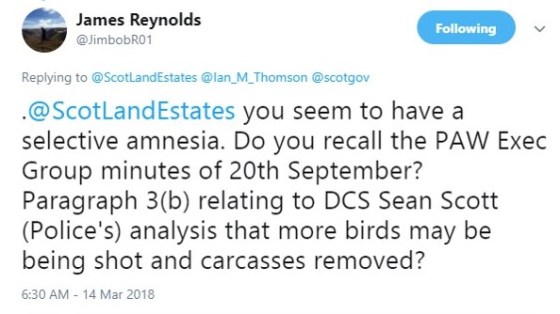
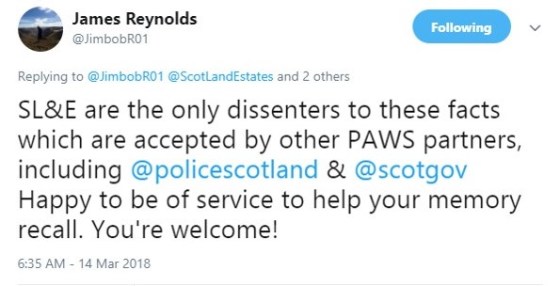
Mr Johnstone also argues that illegal raptor persecution has “declined markedly in recent years and this trend is borne out by the Scottish Government’s own statistics”. SLE was taken to task about this on Twitter by James Reynolds, Head of Media at RSPB Scotland, as follows:

Mr Johnstone cynically infers that the RSPB released the news of this ‘missing’ eagle to coincide with the on-going review of grouse moor management. Ah, sorry, was this news release inconvenient? Hasn’t this argument been used before, with claims made that RSPB news releases on raptor persecution were timed to coincide with the start of the grouse-shooting season? Does it damage the industry’s failing propaganda campaign to portray itself as law-abiding and sustainable? Should the news have been withheld until after the review has been submitted next year?
There was one part of Mr Johnstone’s statement that interested us the most:
“We are not saying that wildlife crime never occurs on land managed for grouse shooting and acknowledge that in the past, there were practices, including raptor persecution, that are simply unacceptable….”
Could Mr Johnstone or anybody else from SLE please tell us which incidents on grouse moors, in the past, he now accepts as being confirmed raptor persecution crime?
Anonymous spokesperson from the Scottish Gamekeepers Association –
“If anyone has information they should contact Police Scotland. If it is proven any harm has come to this bird and if it transpires there is evidence that that harm was the responsibility of an SGA member, they will be subject to our very strict wildlife crime disciplinary code.
The legal process deserves respect before people automatically jump to apportioning blame.
It is becoming increasingly impossible to gain full transparency surrounding these incidents when those holding the data are the tag owners who then dictate process and message.
At the same time, these tag owners are actively lobbying to persuade government to legislate against grouse moors.
If investigations were to have the best chance of success and procedural transparency, this data would be held centrally by an impartial body who could look into everything such as the reliability of the tag, who fitted it, the evidence of criminality which exists and the full range of other factors which could cause a mechanical device to stop signalling after many months in the wild.
When a tag from a Hen Harrier stopped signalling on one of RSPB’s own nature reserves in the Cairngorms National Park, the charity stated the last known location of a tag was ‘only an indication of the broad general area’ where that bird was spending time.
That being the case, the public deserve to see the hard evidence which exists that the lost signal was down to grouse management and not any other cause such as a faltering tag, natural mortality, eagles fighting over territory or any of the other land uses in the broad general area which include farming, forestry and wind energy.”
‘The legal process deserves respect’. Good grief!!!! We can hardly be bothered to respond to this unmitigated tosh from the SGA. Let’s just look at what happened the last time the SGA was given access to the data of a satellite-tagged golden eagle (see here) and leave it at that.
On a brighter note, in response to the news of this latest satellite-tagged eagle to go ‘missing’ in highly suspicious circumstances north of Tomatin, the Shooting Times tweeted this:

Whether you agree with shooting or not is irrelevant. The Shooting Times deserves much credit for showing unprompted condemnation and leadership. Perhaps the Editor can be invited to serve on the PAW Scotland Raptor Group in place of the SGA (who are currently refusing to attend meetings), then we might actually start to see some progress.
From North Star News, 16 March 2018:
WALKERS WARNED BY POLICE AFTER DEATH OF A DOG IN MUIR OF ORD AREA
THE death of a dog has prompted a police probe and sparked a warning to members of the public to avoid walking in an area of Muir of Ord.
Police said this afternoon that acting on information received following the death of a local dog, searches were carried out in the vicinity of Faebait Farm near Muir of Ord yesterday.
A statement released today said: “Following consultation with the Scottish Government Rural Payments Directorate, Police Scotland is requesting that dog walkers and members of the public do not enter the fields in the area of Faebait Farm or the immediate vicinity until further notice.”
Inspector Mike Middlehurst said: “This is a precautionary request until the investigation is complete.
Traces of a banned pesticide has been detected in the area and we do not wish a member of the public, another dog or any other animal to become unwell where it can be avoided.
I can confirm that the dog that died belonged to the owners of Faebait Farm.
They are co-operating fully with the investigation and support this request to other members of the public and dog owners.”
Police have asked that anybody who has information about banned pesticide possession or misuse should contact Police Scotland immediately on 101 or pass on information anonymously via Crimestoppers on 0800 555 111.
ENDS
So far, the police have not revealed the name of the banned pesticide(s) involved. It has to be one of eight active ingredients banned by the Possession of Pesticides (Scotland) Order 2005:
Aldicarb, Alphachloralose, Aluminium Phosphide, Bendiocarb, Carbofuran, Mevinphos, Sodium Cynaide, Strychnine.
Four years ago, almost to the day, 22 birds of prey (16 red kites and 6 buzzards) were found dead in a small area of Ross-shire close to Conon Bridge. Toxicology tests revealed poisoning by the banned pesticides Aldicarb, Carbofuran and Carbosulfan. The case became known as the Ross-shire Massacre, for which nobody was ever prosecuted.
The Muir of Ord lies 3.5 miles to the south of Conon Bridge.

Police Scotland is to start reviewing the social media accounts and domestic abuse history of applicants for firearms licences, a new HM Inspectorate of Constabulary in Scotland (HMICS) report has revealed.
Inspectors identified that online activity is a key source of information when deciding whether someone is suitable to own a gun. Amazingly, social media has not been routinely scrutinised in the past, but Police Scotland told Inspectors it now plans to start using it more often.
Police Scotland Assistant Chief Constable Mark Williams said: “Where concerns are raised, we may use social media as one of a number of sources of information during our checks. Looking to the future, we are considering expanding this approach as part of the national licensing process.”
Excellent news! We can think of a number of individuals who may now encounter difficulties when it comes to renewing their firearms certificates, based on the comments they’ve posted on social media.
Download the full report here: HMICS Inspection of Firearms Licensing March 2018

Legal proceedings continued at Preston Magistrates Court yesterday in the case against gamekeeper Timothy David Cowin, 44, who is alleged to have shot two protected short-eared owls in April 2017 at Whernside, Cumbria in the Yorkshire Dales National Park. It is further alleged he was in possession of items (a shotgun and an electronic calling device) capable of being used to kill wild birds (see here for first blog about this case).

At a case management hearing yesterday Mr Cowin was invited to enter a plea but was stopped by his defence lawyer, Michael Kenyon. There followed an extraordinarily fractious series of submissions by the defence and the CPS prosecutor, Ms Parker.
The defence argued that not all the paperwork had been received from the CPS, despite many requests, and that some of the paperwork that had been received was “defective in its wording” and some witness statements were incorrectly dated. The defence submitted that the case should be dismissed on these technicalities.
The prosecution argued that some papers hadn’t been served because of the uncertainty of the address that had been provided (Mr Kenyon’s home address as opposed to a legal company’s business address) and that some communication from the defence had not been answered promptly due to the prosecutor being on annual leave. The issue of missing paperwork and incorrectly dated statements had been raised with the police and the CPS was awaiting a response.
District Judge Goodwin, looking quite exasperated by this farcical and ill-tempered display, suggested the lawyers improve their communications with each other. She directed the CPS to review the evidence by 29 March 2018. Once reviewed and revised as appropriate, the defence was directed to submit skeleton arguments and provide documents in support. The CPS was directed to serve a skeleton argument in response and provide documents in support, to be lodged with the court by 26 April 2018.
Mr Cowin was released on unconditional bail and was told he must attend the next court hearing, scheduled for 11 May 2018.
UPDATE: 14 May 2018: Case against grouse moor gamekeeper Timothy Cowin part 3 (here)
Legal proceedings continued yesterday in the case against James Hartley, a gamekeeper from the Bleasdale Estate in Bowland who is accused of a number of offences in relation to the alleged killing of two peregrines in April 2016 (see first court report for details here). Mr Hartley has pleaded not guilty to the alleged offences.
Yesterday’s case management hearing focused on legal argument relating to the admissibilty of evidence. Due to reporting restrictions imposed by District Judge Goodwin at a previous hearing, we are unable to publish the specifics of the legal argument until the case concludes.
District Judge Goodwin reserved judgement at yesterday’s hearing and is expected to deliver judgement to the court on 26 March 2018.
PLEASE NOTE: given the sensitivity of this case we won’t be accepting comments on this particular blog post. Thanks.
“They can hide the bodies. They can hide the tags. But they can’t hide the pattern” (Dr Hugh Webster)
RSPB Press release:
ANOTHER SATELLITE-TAGGED GOLDEN EAGLE ‘DISAPPEARS’ IN INVERNESS-SHIRE
Conservationists are concerned about the safety of a young pair of eagles after news emerged that another satellite-tagged golden eagle has disappeared in the northern Monadhliath Mountains of Inverness-shire.
Data from the two-year old male’s transmitter showed that he had been living in an upland area, mainly managed for driven grouse shooting, north of Tomatin, since early last year. He had stayed almost exclusively in this area until mid December, when his tag, that had been functioning as expected, inexplicably stopped transmitting.
A follow-up investigation by Police Scotland has not yielded further clues as to the bird’s fate, and no further data has been received from the satellite tag.
The young bird, fitted with a tag sponsored by SSE, before it fledged from a nest in the Cairngorms National Park, was paired to a 2 year-old female, coincidentally also fitted with a transmitter. Data from her tag shows that she left the same area for several days following the male’s sudden disappearance, possibly searching for her missing mate, before returning to the territory. She has subsequently been joined there by another young male, also reinforcing the case that the two year old bird has disappeared.
Duncan Orr-Ewing, RSPB Scotland’s Head of Species and Land Management said: “A report published by the Scottish Government last May, prompted by the regular disappearance of satellite-tagged eagles in this same area, provided unequivocal evidence that the sudden disappearance of these birds is highly suspicious. This is now the twelfth tagged eagle to go missing in this “black hole” in just seven years and is entirely consistent with the systematic and ongoing illegal persecution of eagles in this area.”
The missing bird and its mate were occupying a traditional golden eagle territory, but one where the nest has not been successful for decades despite good habitat and prey. In 2016, the area was occupied by a lone adult male, but he too disappeared.
Duncan Orr-Ewing continued: “Despite very recent and high level public warnings from Scottish Government, it appears that criminals intent on killing golden eagles continue to target these magnificent birds, especially in areas managed for driven grouse shooting. Patience with self-regulation is at an end and meaningful deterrents are now urgently required. We support the introduction of new measures to license driven grouse shooting, including powers for the public authorities to remove such licences, where there is good evidence of criminal behaviour”.
“In parts of the Monadhliaths, such as the area from where this bird fledged, golden eagles are doing well, but the efforts by some landowners, farmers and gamekeepers to protect these magnificent birds are constantly being undermined by persecution when eagles move out of these safe areas. There can be little doubt that current legislation and enforcement have proven to be insufficient deterrents to those criminals, invariably linked to the management of driven grouse shooting, who are intent on killing protected birds of prey.”
Anyone who can provide information about the disappearance of this bird, or other raptor persecution incidents, is asked to contact Police Scotland on 101, or to phone the confidential RSPB Raptor Crime Hotline on 0300 999 0101.
ENDS
The location information provided by the press release is a bit vague: ‘an upland area, mainly managed for driven grouse shooting, north of Tomatin‘. Hmm. According to Andy Wightman’s brilliant Who Owns Scotland website, this might be Moy Estate. Moy is an upland area, it is mainly managed for driven grouse shooting, and it is north of Tomatin. It’s also an estate where in 2010 a police search uncovered the leg rings of four young golden eagles being kept in a jar at a gamekeeper’s home. The gamekeeper apparently couldn’t provide an explanation for how he came to have them in his possession. Yes, this eagle might have disappeared from Moy Estate but it’s impossible to be certain without more detailed information.
[Estate boundary derived from Who Owns Scotland]
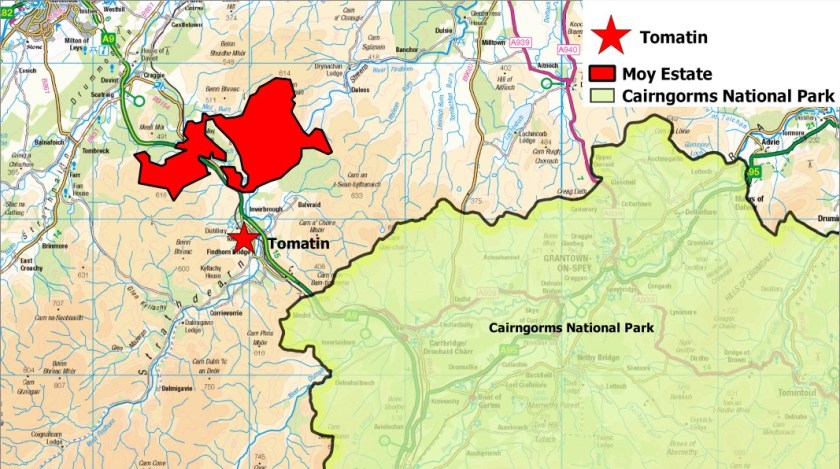
What is certain, is that this is yet another highly suspicious disappearance of a satellite-tagged golden eagle on or close to a Scottish grouse moor. What number is this one, 42? No, that was Fred. Number 43, perhaps? It’s hard to keep up.
And this latest eagle, according to Duncan Orr-Ewing (RSPB Scotland) is the 12th tagged eagle to vanish in this area in just seven years. That is scandalous.
The area in question is part of Cabinet Secretary Fergus Ewing’s constituency. There’s one hell of a record of illegal raptor persecution on his patch. You’d think, being a senior member of the governing SNP (Cab Sec for the Rural Economy & Connectivity) and with all this crime going on on his own doorstep in the Monadhliaths, he’d be jumping up and down, beetroot-faced with rage, determined to bring this to a halt. But so far, in all the years we’ve been writing about these crimes, we’ve heard nothing from him but praise and adulation for the grouse-shooting industry.
What we can also be certain of is the reaction from the grouse-shooting industry. There’ll be denials, there’ll be claims this disappearance isn’t suspicious, there’ll be attacks on the RSPB for daring to publicise it, there’ll be accusations of a set-up, there’ll be a refusal to believe these tags have a 98% reliability record, there’ll be imaginary windfarms, there’ll be real windfarms, there’ll be irrelevant data from satellite-tagged Olive Ridley Turtles in Bangladesh, there’ll be claims he was blown out to sea on a gust of wind, there’ll be claims he flew in to a fence, broke his legs and rolled himself off a hill to fly through the night before crashing in a forest, there’ll be calls for Chris Packham to be sacked from the BBC, there’ll be claims the eagle fell in to a burn and was washed away downstream. There’ll be every possible explanation under the sun, except, of course, for the glaringly obvious.
Why is it, satellite-tagged golden eagles on or close to grouse moors in Scotland are 25 times more likely to ‘disappear’ than anywhere else in the word where this species has been tagged?
We keep coming back to a recent quote from Dr Hugh Webster, because it says everything:
“They can hide the bodies. They can hide the tags. But they can’t hide the pattern“.
The grouse shooting industry is making fools of the Scottish Government. Again and again and again. But for how much longer?
UPDATES
Response from Scottish Gamekeepers’ Association here (we’ll be blogging about this later – see below)
Response from Scottish Land & Estates here (we’ll be blogging about this later – see below)
Article in Scotsman here
Article in the Herald here
Article on BBC website here
Article in Press & Journal here
Article on STV here, including a quote from Cabinet Secretary Roseanna Cunningham, as follows:
“This golden eagle has disappeared in an area which has long been associated with the illegal persecution of birds of prey.
We may never discover exactly what has happened in the case of this latest disappearance.
But we do know the illegal killing of Scotland’s magnificent birds of prey continues – primarily in areas which are intensively managed for driven grouse shooting.
No-one should be in any doubt about my determination to act decisively to uphold the law and protect Scotland’s magnificent birds of prey.
I look forward to receiving the Werritty Report into how we can ensure grouse shooting is sustainable and complies with the law, which is due to be published early next year“.
Article in Scottish Daily Mail here
New blog post: Responses to missing satellite-tagged golden eagle nr Tomatin (here)
As many of you will know, part of DEFRA’s ludicrous Hen Harrier Action Plan is the proposed reintroduction (not really a reintroduction) of hen harriers to southern England.
We know, through a series of FoIs, that Salisbury Plain in Wiltshire is the currently proposed reintroduction site and the proposed start date is 2018.
We also know, via FoIs, that several countries had been approached as potential hen harrier donors, including the Netherlands, Spain, Poland and France (see here). Of these, only France seemed a realistic prospect and the Southern Reintroduction Project Team has been spending a lot of time (and tax-payers’ money) on seeking approval from the French authorities.
However, there is a persistent rumour (and we emphasise that this is nothing more than a rumour at the moment, albeit a frequently spoken one by several different sources) that the French Government has said “Non!” to providing the UK with French hen harriers for relocation to Salisbury Plain. The reason for this refusal, according to rumour, might have something to do with Natural England’s outrageous decision to issue a hen harrier brood meddling licence permitting the removal of hen harrier eggs and chicks from grouse moors across northern England.
That would seem a perfectly legitimate reason for the French authorities to refuse – why on earth would they donate hen harriers if those very same hen harriers (assuming they’re not shot on sight) might end up having their future offspring removed from the wild and taken in to captivity, just so a bunch of grouse shooters can kill more red grouse for fun?
Of course, the French authorities’ decision (if true) may have nothing to do with brood meddling at all – it may simply be based on the UK’s complete and utter failure to protect hen harriers from illegal persecution.
We’ve submitted another FoI to Natural England to try and find out what’s going on, but on past performance we’re not holding our breath.
Meanwhile, where does that leave the proposed reintroduction project? Perhaps the Project Team will now approach Scotland for donor birds? We know, via an FoI to SNH, that as of 6 February 2017 SNH had not received any correspondence about being a potential donor source. SNH wrote:
“We can advise there has been no approach from Natural England or others involved with this project, but that if SNH received such a request we would assess it by our own normal licensing processes and the Scottish Translocation Code, as it would relate to a reintroduction project seeking Scottish involvement / donor stock“.
But then there’s Russia. We know, again via FoI, that Philip Merricks of the Hawk & Owl Trust told a Reintroduction Project Team meeting in October 2016, ‘that Russian counterparts had suggested that sourcing birds there was relatively straight forward provided that proper channels were followed’. The Project team ‘agreed to pursue sources closer to home for now’.
So will they now approach Russia to ask them to donate hen harriers for release on Salisbury Plain? Current political sensitivities suggest this might be a bit, er, awkward.
SENIOR CAMPAIGNER (GROUSE MOORS)
Organisation: The League Against Cruel Sports
Salary: £28,000
Full time position
Closing date: 26 March 2018
Location: Edinburgh – some home working may be possible
ROLE:
The League Against Cruel Sports is a leading UK charity that works to expose and end the cruelty inflicted on animals in the name of sport such as, fox, deer and hare hunting, game bird shooting and wildlife crime. We rely on public support to carry out our work, which includes: campaigning, investigating, police liaison, prosecutions, research, publishing reports, and generating media coverage.
The League Against Cruel Sports is looking for a Senior Campaigner to develop and implement a coalition campaign aimed at reforming Scotland’s grouse moors for the benefit of people and wildlife. We are looking for candidates with proven experience of bringing about social change.
While the League opposes killing animals for entertainment, grouse shooting is firmly established in Scotland and claims to be integral to rural communities and provide them a significant financial benefit. The successful candidate will build upon an existing coalition of like minded organisations who want to see radical change on the moors to benefit wildlife, the environment, local communities, and the nation. They will also help give local communities a voice on this issue and engage with the Government review of grouse moor management.
Candidates should ideally have proven experience of campaigning, event management, commissioning research, political lobbying, public speaking and facilitation of coalitions.
The coalition campaign is being founded by the League in partnership with OneKind. The role will be hosted by OneKind in their Edinburgh office; some home-working may be possible.
For further information about this role, please download the Job Description below.
Job description: senior-campaigner-grouse-moors
To apply, please send cv and supporting statement to: applications@league.org.uk
CLOSING DATE: 26th March 2018
 Raptor Persecution UK