“It can’t go on” – Mark Ruskell MSP speaks out against illegal raptor persecution

Press release from white-tailed eagle species champion Mark Ruskell MSP (19/4/18), following the recent suspicious disappearance of sea eagle Blue X in grouse moor dominated Glen Quaich, Perthshire:

WILDLIFE CRIME IS HIGHLAND PERTHSHIRE’S SHAME

Green MSP for Mid-Scotland and Fife Mark Ruskell has branded Highland Perthshire a wildlife crime hotspot after a further disappearance of a White Tailed Eagle around the Glen Quaich area and called on the Scottish Government to finally act by bringing in a licensing regime for driven grouse shooting estates.

Raptor Persecution UK highlighted Perthshire North, as a hotspot for raptor disappearance. Six satellite-tagged eagles have disappeared in suspicious circumstances in what is a relatively small area. Green MSP Mark Ruskell called on the Scottish Government to face up to Perthshire’s shame and ensure those responsible for eagle disappearances face justice.

The individual eagle who recently vanished was named Blue X and was fledged in NE Fife. In his role as the Parliament’s White Tailed Eagle champion Mr. Ruskell last year visited the nest site where the bird fledged and spoke to volunteers who had spent hundreds of hours guarding the site from wildlife criminals. Mr. Ruskell also sits on the Scottish Parliament’s Environment Committee which last year agreed that a licensing regime for driven grouse moor estates should be put in place.

Mark Ruskell said: “Highland Perthshire is renowned for the beauty of the landscape and phenomenal wildlife, but this latest incident brings shame to the area. It’s quite clear from the satellite tags that these birds are disappearing around driven grouse moors. Some disreputable estates and gamekeepers have a bizarre Victorian attitude that wildlife should be exterminated, despite wildlife tourism bringing millions into the Scottish economy. Driven grouse estates in particular are attempting to deliver unsustainable levels of grouse populations which lead them to cull mountain hares for example.

It can’t go on; the Scottish Government is prevaricating over the setting up of a licensing scheme for driven grouse moor estates that would separate the good from the bad. Wildlife crime is notoriously difficult for the Police to track down and there is a wall of silence in communities, no-one wants to call out the illegal actions.

I’m particularly gutted to see this bird disappear, volunteers had spent months on end guarding its nest site in Fife and I even saw the bird myself from afar last year.”

ENDS

Well done, Mark, and thank you.

UPDATE 21 April 2018: Green MSP angers gamekeepers over missing bird of prey (article in The National, here)

Why shooting estates should fear eagle disappearances

An interesting and insightful Leader Comment in today’s Scotsman: (whoever wrote this, well done!) –

As the RSPB Scotland points out, the disappearance of a fourth satellite-tracked eagle in a part of Perthshire that’s home to several shooting estates over four years is “highly suspicious”.

The Scottish Gamekeepers Association complains its members are the “first to be accused when any bird of prey goes missing”, but the illegal killing of raptors undoubtedly happens, as a 2016 report on red kites by Scottish Natural Heritage found, and few others have a motivation. Each case is a further challenge to the rule of law that will eventually force parliament to react.

And that could lead to the licensing of shooting estates – with the threat of licences being revoked over killings of birds of prey – or a strict liability offence so that a landowner would be found responsible for the unnatural death of any raptor on their land.

Both are measures that estates would – and should – fear.

The sooner the shooting community realises that the death of a sea eagle represents a greater threat to their business than a live bird, the better the chances will be of protecting these magnificent creatures.

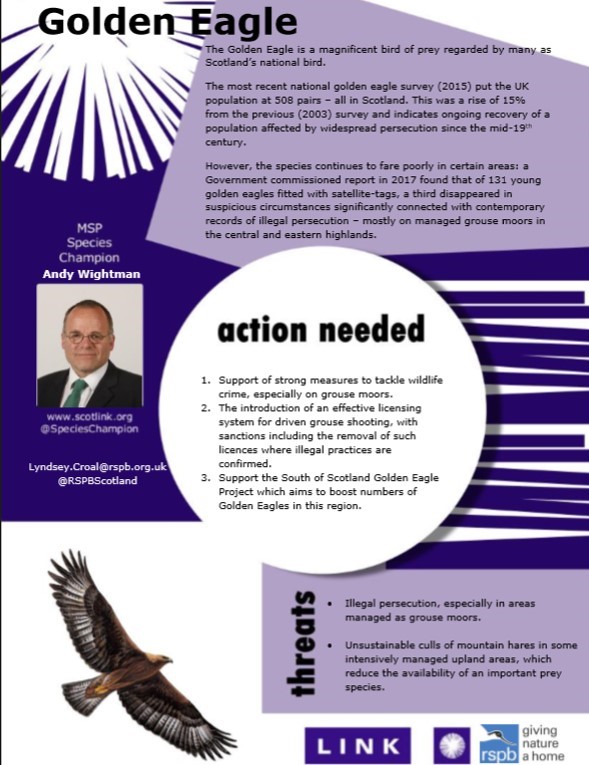
Andy Wightman MSP becomes Golden Eagle Species Champion

Some brilliant news, for a change!

Press release from Scottish Greens (19/4/18):

WIGHTMAN TO CHAMPION UNDER PERSECUTION GOLDEN EAGLES

Scottish Green MSP Andy Wightman is the new Scottish Environment Link species champion for the Golden Eagle.

The Golden Eagle is Scotland’s most iconic bird of prey but, despite decades of legal protection in Scotland, continues to be the victim of illegal persecution.

In a recent review commissioned by the Scottish Government and published by Scottish Natural Heritage, it was found that almost a third of young satellite-tagged golden eagles had disappeared in “suspicious circumstances” in the Highlands over a 12 year period. These incidents largely occurred in areas dominated by intensive driven grouse-shooting management.

Moreover, in the last few months, there have been further suspicious disappearances of “Fred” in the Pentland Hills and of another young male eagle in the wildlife crime blackspot of the northern Monadhliath mountains in Inverness-shire.

Reports published by both Scottish Natural Heritage and RSPB Scotland have repeatedly shown that while incidents of illegal poisoning have declined in recent years, other forms of persecution continue to have a proven and significant impact on not just golden eagles, but also species such as hen harrier and red kite. While wildlife criminals may go to considerable efforts to hide the evidence of their crimes, the absence of these species from significant areas of our uplands, particularly in eastern and southern Scotland, gives a clear indication that levels of illegal killing of our birds of prey have not declined.

On the back of the Scottish Government review’s findings, Environment Cabinet Secretary Roseanna Cunningham set up a review of grouse moor management practices, a clear indication of the increasing concern that this issue is impacting on Scotland’s reputation.

Andy Wightman MSP commented:

“I am delighted to be the species champion for Golden Eagle. It is clear that much work still needs to be done to ensure that this iconic species continues to thrive across Scotland and that the species returns to parts of the country that it has for too long been absent.

“I look forward to meeting those involved in conservation and monitoring of Golden Eagle populations over the coming years and to work with them to tackle the ongoing challenges facing this magnificent bird.”

Duncan Orr-Ewing, Head of Species and Land Management at RSPB Scotland said:

“It is great to have Andy on board as a passionate species champion for this special bird, which is arguably Scotland’s national bird. The golden eagle is an indicator species for the health of our uplands, however sadly it still faces many conservation challenges, most significantly the continuing threat of illegal persecution in moorland areas managed for driven grouse-shooting.

“This appointment comes at a time when the important South of Scotland Golden Eagle Project, designed to reinforce the population of golden eagles in this area, and to bring wide ranging rural development opportunities to local communities is also about to begin. I am sure that partners in this project will look forward to involving Andy as part of his role in due course”.

ENDS

This is fantastic news. Species Champions are members of the Scottish Parliament who have agreed to lend their political support to the protection of Scottish wildlife.

Andy is already species champion for the Mountain Everlasting wildflower and we’re delighted that he has agreed to lend his considerable influence to help highlight the on-going illegal persecution of golden eagles on some driven grouse moors and champion the conservation of this magnificent species.

We’ve known and admired Andy for several years and he’s been a long-time and vocal supporter of this blog. His skills as a fearless advocate will be much welcomed by those of us working to protect golden eagles.

He joins several other MSPs who work as species champions for raptors in Scotland:

Mark Ruskell MSP (Scottish Greens) – White-tailed eagle

Mairi Gougeoun MSP (SNP) – Hen harrier

John Mason MSP (SNP) – Kestrel

Donald Cameron MSP (Conservative) – Merlin

Bill Kidd MSP (SNP) – Red kite

Iain Gray MSP (Labour) – Short-eared owl

Deputy First Minister’s constituency a hotspot for ‘disappearing’ sat-tagged eagles

Following the recent news that satellite-tagged white-tailed eagle ‘Blue X’ has ‘disappeared’ in suspicious circumstances in the grouse moor dominated Glen Quaich, Perthshire, we’ve taken a closer look at this area.

It was one of the areas identified as a hotspot for ‘disappearing’ satellite-tagged golden eagles in last year’s expert review of Golden Eagle Satellite Tag Data, with a cluster of five golden eagles vanishing without trace in recent years:

It turns out that this area sits within the constituency boundary of North Perthshire, held by John Swinney MSP, Deputy First Minister and Cabinet Secretary for Education:

Another star now needs to be added to this map, representing the last known position of white-tailed eagle ‘Blue X’, although unlike the missing golden eagles we don’t know the precise location of her last known fix, other than it being in Glen Quaich.

That’s six satellite-tagged eagles that have vanished in suspicious circumstances in a small area of John Swinney’s Perthshire North constituency.

We have no idea of John Swinney’s views on illegal raptor persecution and its undisputed link to driven grouse moor management but as a respectable, law-abiding member of society we’d expect him to be as outraged as the rest of us.

What’s different about John Swinney is that he’s a senior member of the Scottish Government and so he’s in a much stronger position than the rest of us to push the Government in to action.

We haven’t seen any commentary from John about the suspicious disappearance of sea eagle ‘Blue X’ in his constituency and it may be that as a busy senior politician it has escaped his attention.

If you are one of John Swinney’s local constituents and you want to know what he thinks, and more importantly what he intends to do about these missing eagles, please drop him an email: john.swinney.msp@parliament.scot

If you are not a constituent but would still like to bring this issue to his attention, and register your disgust that such blatant lawlessness is apparently allowed to continue without sanction, please use this email address and mark it for the attention of John Swinney: Scottish.Ministers@gov.scot

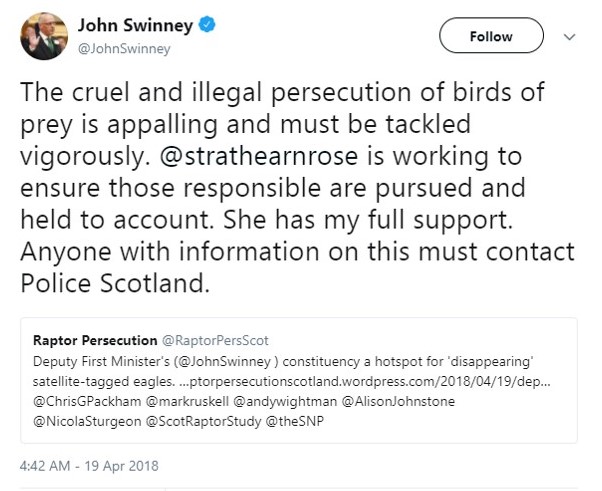
UPDATE 4pm: John Swinney has responded on Twitter as follows:

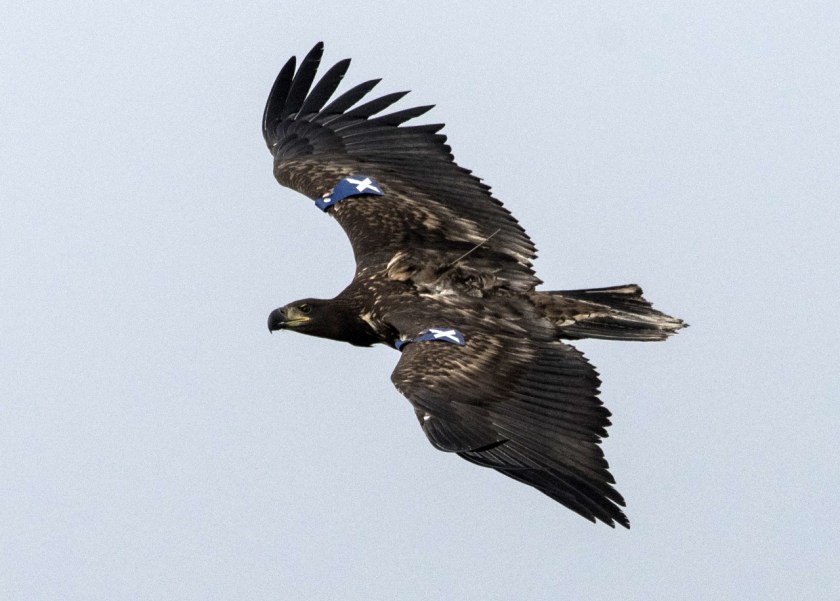
Photo of missing sea eagle ‘Blue X’, by RSPB Scotland.

UPDATE 20 April 2018: “It can’t go on” – Mark Ruskell MSP speaks out against illegal raptor persecution (here)

Pointless search for missing sea eagle ‘Blue X’

Yesterday’s police search for missing satellite-tagged sea eagle ‘Blue X’ was a complete waste of time.

Why? Because Police Scotland invited some gamekeepers (also known as potential suspects) to join the search. Since when has inviting potential suspects to help search for potential evidence of a potential crime been a good idea?

[Photo of white-tailed eagle Blue X, by RSPB Scotland]

Some might think that calling gamekeepers ‘potential suspects’ is a bit harsh, but we’d disagree, and here’s why:

Blue X’s satellite tag had been working perfectly since it was deployed last summer. Suddenly, and inexplicably, it stopped working last month when Blue X was visiting the grouse moor-dominated Glen Quaich, in Perthshire. Had this been the first tagged eagle to ‘disappear’ on a grouse moor in Scotland, then sure, it might be reasonable to assume it was just a rare faulty tag and that nothing untoward had happened to this eagle. But Blue X wasn’t the first sat-tagged eagle to disappear in such circumstances – she is one of over 40 tagged eagles to have mysteriously vanished in recent years, the majority of them on or close to a driven grouse moor. Oh, and Blue X  just happened to vanish in an area where three other sat-tagged eagles had also disappeared. Clearly, Blue X’s disappearance was highly suspicious.

[Red stars indicate last known fixes of sat-tagged golden eagles, orange circle denotes area where Blue X vanished; data from Golden Eagle Satellite Tag Review]:

The government-commissioned analysis of where these eagles have been disappearing (mostly on or near to driven grouse moors) was so unequivocally damning that in response to the report, the Scottish Government urgently convened a special panel to review grouse moor management practices with a view to introducing sanctions for those who continue to defy the law. It was the Government’s view (and the view of every other intelligent observer) that some grouse moor gamekeepers were under reasonable suspicion of involvement with the disappearance of these eagles, and thus its reasonable to refer to them collectively as ‘potential suspects’. [NB: this does not imply any level of guilt on any individual; for that, we’d need to see a criminal conviction and as yet there hasn’t been a single successful prosecution for the illegal killing of an eagle in Scotland. Ever.]

You’d think, then, given this bigger picture of eagles routinely disappearing in suspicious circumstances on or near grouse moors, that Police Scotland, on learning of Blue X’s disappearance, would follow the protocol as devised by the Partnership for Action against Wildlife Crime (PAW) to treat this disappearance as suspicious and NOT alert the landowner(s) or their employees prior to any search:

So what did Police Scotland do? Ignored the PAW protocol, notified the potential suspects several weeks ago that a tagged eagle had ‘disappeared’ in the area (thus allowing any potential suspect to hide any potential evidence of a crime) and then invited the potential suspects to ‘help’ on the search several weeks later when the snow had melted. Genius.

If that wasn’t bad enough, the Scottish Gamekeeepers Association issued a press release yesterday, while the search was underway (so against PAW protocol), telling the world that a search was taking place. This information was leaked on Twitter by some half wit, thus allowing any other potential suspect in the area the chance to remove any potentially incriminating evidence.

Is there any wonder there has never been a successful prosecution for the illegal killing of an eagle in Scotland?

Politicians need to be asking some serious questions about this farcical and pointless investigation.

UPDATE 19 April 2018: Deputy First Minister’s constituency a hotspot for ‘disappearing’ sat-tagged eagles (here)

Satellite-tagged white-tailed eagle ‘disappears’ in grouse moor blackspot in Perthshire

Press release from RSPB Scotland (17/4/18):

RSPB SCOTLAND ASSISTS IN SEARCH FOR ‘MISSING’ EAGLE

Another satellite tagged eagle has disappeared in highly suspicious circumstances. RSPB Scotland has today (17th April 2018) been assisting Police Scotland in the search for the white tailed eagle in the Glen Quaich area of Perthshire.

Photo of White-tailed eagle ‘Blue X’, by RSPB Scotland

[RPUK map. Red stars indicate last known fixes of satellite-tagged golden eagles that have ‘disappeared’ in suspicious circumstances. Orange circle indicates area of interest. Data from the Golden Eagle Satellite Tag Review, published last year]:

Duncan Orr-Ewing, Head of Species and Land Management at RSPB Scotland said: “This is the fourth satellite tagged eagle (three golden eagles and now one white-tailed eagle) to disappear in highly suspicious circumstances in this very area since 2014. This location around Glen Quaich is dominated by driven grouse moor estates, and has been highlighted previously as a ‘black hole’ for wildlife crime against raptors”.

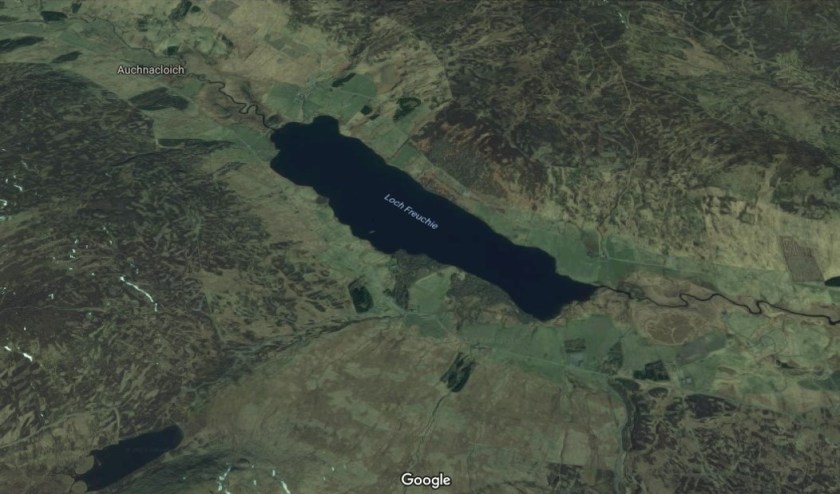
[Google map of Glen Quaich, surrounded by driven grouse moors]

Duncan continues: “A report published by the Scottish Government last May, prompted by the regular disappearance of satellite-tagged eagles, provided unequivocal evidence that the sudden disappearance of these birds when reliable tags suddenly stop transmitting is highly suspicious.

“This is the third of five white-tailed eagle chicks to have fledged from the first successful nest in East Scotland –  the product of a Scottish Government-sponsored reintroduction project – to have disappeared in such circumstances, suggesting it has also been illegally killed.

“We call on the Scottish Government to introduce a robust licencing system for driven grouse shooting with sanctions for removal of licences where criminal patterns of behaviour are established to the satisfaction of the authorities. Those that obey the law and conduct their operations within it have nothing to fear from such a regulatory framework.”

ENDS

Eagle Blue X was the 5th chick to fledge from the well known Fife pair. Only one is still alive: one died after landing on power lines (and was recovered for post mortem) and two others disappeared under suspicious circumstances. This is a very high attrition rate for the most important generation in the reintroduction project.

In 2017, 21 volunteers gave up a total of 815 hours to watch the Fife nest and make sure the breeding attempt was successful. They stopped a photographer from continuing to disturb the incubating female and undoubtedly saved the eggs from chilling.

Blue X hatched in 2017 and she was ‘gone’ by March 2018.

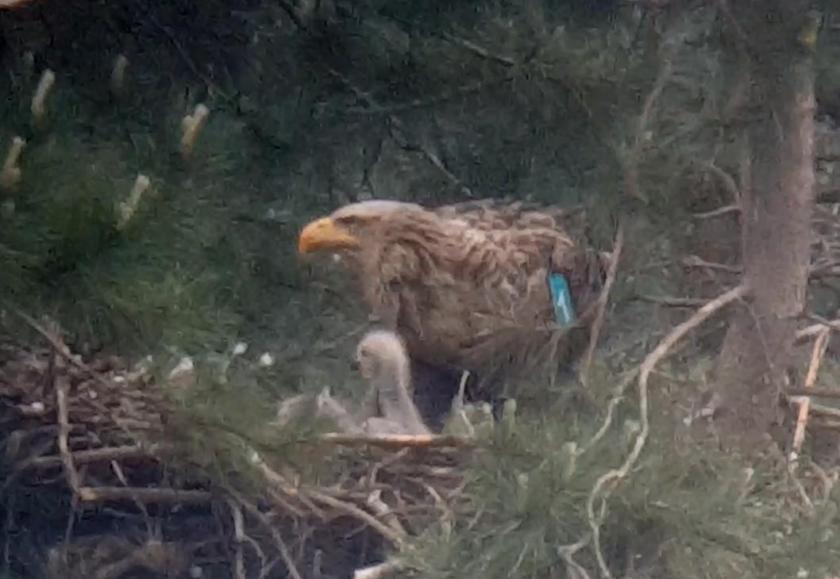
Here she is in the nest as a chick (photo RSPB Scotland). All that effort, for nothing.

For how long do you think the Scottish Government will tolerate this blatant criminality that brings shame and embarrassment to the decent, law-abiding citizens of Scotland?

They’ll tolerate it for as long as we allow them to.

Please, consider writing to Environment Cabinet Secretary Roseanna Cunningham, who undoubtedly will be as appalled as we all are about this ongoing, out of control lawlessness, and ask her to act. Emails to: CabSecECCLR@gov.scot 

UPDATE 18 April 2018: Pointless search for missing sea eagle ‘Blue X’ (here)

UPDATE 19 April 2018: Deputy First Minister’s constituency a hotspot for ‘disappearing’ sat-tagged eagles (here)

UPDATE 20 April 2018: “It can’t go on – Mark Ruskell MSP speaks out against illegal raptor persecution (here)

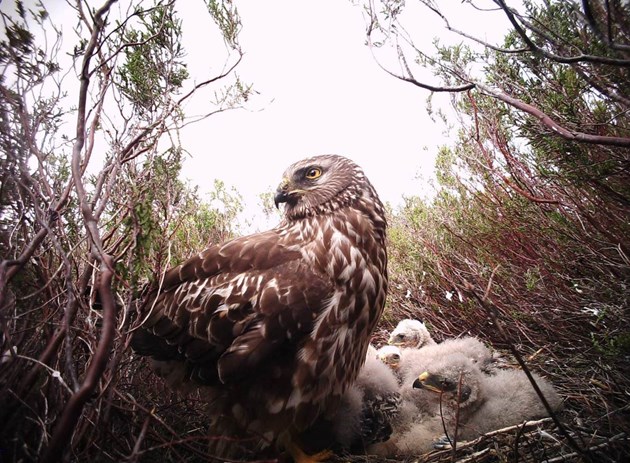
Legal challenge against hen harrier brood meddling continues, x2

Two separate High Court applications have been submitted this week, seeking a judicial review of Natural England’s highly controversial decision to issue a hen harrier brood meddling licence.

As a quick re-cap for new blog readers, in January this year, Natural England issued a licence to Jemima Parry-Jones (International Centre for Birds of Prey [ICBP], Newent, Glos) permitting the removal of hen harrier eggs and chicks from some nests on grouse moors in Northern England, to protect artificially-high stocks of red grouse being farmed for shooting. The licence permits the ICBP to rear the young hen harriers in captivity and then release them in August back to the same grouse moor areas from where they were removed, where they will once again be put at risk of being illegally killed.

This licence is fundamental to DEFRA’s hen harrier brood meddling plan, which forms part of its ludicrous Hen Harrier Action Plan. For background reading on hen harrier brood meddling, please see here.

The ICBP is being paid by the Moorland Association to undertake the brood meddling work, and the licence is supported by the members of the Hen Harrier Brood Meddling Project Board, which includes Rob Cooke (Natural England), Adrian Jowitt (Natural England), Steve Redpath (Aberdeen University), Jemima Parry-Jones (ICBP), Adrian Smith (GWCT), Philip Merricks (Hawk & Owl Trust), Amanda Anderson (Moorland Association), Robert Benson (Moorland Association).

In early February, lawyers acting on behalf of Mark Avery decided to challenge the lawfulness of Natural England’s decision to issue this licence by way of a judicial review. The lawyers agreed to work at reduced rates and Mark successfully raised over £26,000 via crowdfunding to support the legal action.

In late February Mark’s lawyers sent a ‘pre-action protocol letter’ to Natural England, outlining the perceived legal inadequacies of the decision to issue the licence. The letter also invited Natural England to revoke the licence and undertake a proper public consultation on the issue of hen harrier brood meddling.

In March the RSPB also sent a pre-action protocol letter to Natural England on the same issue.

Natural England’s response letters have been seen as unsatisfactory by Mark and by the RSPB and so yesterday Mark submitted an application to the High Court seeking permission for a judicial review, because, as Mark’s lawyer says,  “My client believes that the decision to grant this licence is unlawful as it is in breach of EU law – it takes criminal activity as its starting point and looks to ease the path for those who break the law, often for profit, for the purpose of shooting red grouse“.

Today the RSPB has also announced it, too, has submitted an application seeking a judicial review.

Good stuff.

There was an article in The Guardian yesterday about Mark’s application.

Grouse-shooting industry’s reaction to the failed Bleasdale Estate prosecution

The prosecution of a gamekeeper, employed by the Bleasdale Estate in Bowland to manage a grouse moor, collapsed recently on a series of legal technicalities (see here, here and here).

We’ve been wondering how the grouse-shooting industry would react to this failed case. Would they condemn the alleged illegal killing of two breeding peregrines at a nest site on a driven grouse moor? And, seeing as all charges against the defendant were dropped, would the industry put out a public appeal for information to help find the alleged perpetrator?

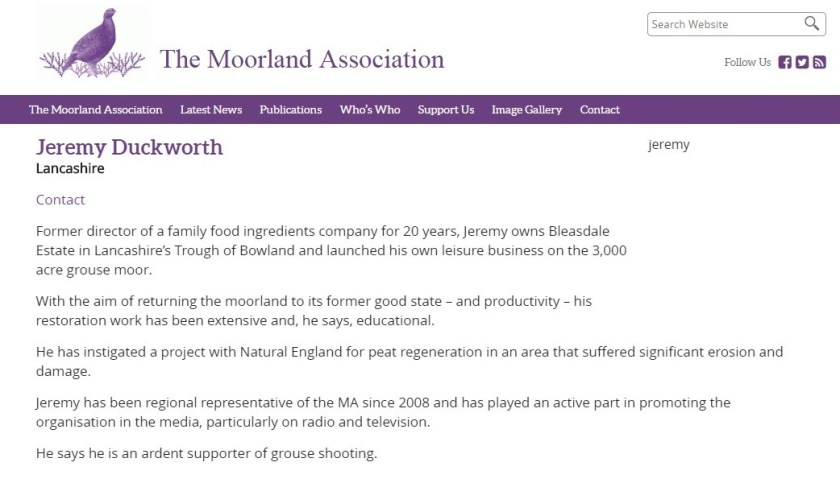
So far we haven’t seen any public commentary from the owner of the Bleasdale Estate, Mr Jeremy Duckworth. This is a bit surprising. At the time of the alleged offences (April 2016), Mr Duckworth was a Director and a regional representative of the Moorland Association (a group representing the interests of grouse moor owners in England):

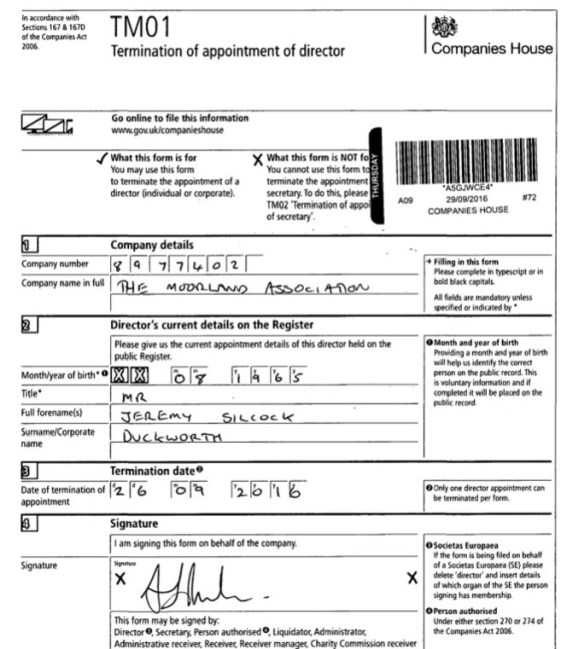
According to documents lodged at Companies House, Mr Duckworth resigned his Directorship of the Moorland Association in September 2016. The timing of his resignation coincided with the early stages of the police investigation in to the alleged offences on his grouse moor – obviously nothing to do with damage limitation and purely and simply coincidental, of course:

As well as silence from Mr Duckworth, nor have we seen any commentary from the Moorland Association (MA) itself. As a member of PAW (Partnership for Action against Wildlife Crime), it’s not unreasonable for us to expect the Moorland Association to have provided comment. Surely the MA must be concerned that an unidentified individual appears to have repeatedly visited the grouse moor nest site of a specially protected species and allegedly killed two peregrines, no?

What we have seen though, is a press release issued by You Forgot The Birds (YFTB), an astroturfing lobby group funded by the grouse shooting industry.

Perhaps this press release from YFTB was issued on behalf of the Moorland Association, or with the MA’s blessing, or funded by members of the MA? No, that can’t be right, because the YFTB press release wasn’t concerned at all about the alleged killing of two peregrines on a grouse moor, but instead, just like all its other press releases (funded by the grouse-shooting industry) this press release was focused entirely on attacking the RSPB and attempting to undermine its credentials.

The press release was sent out to media journalists last Friday, embargoed until one minute past midnight on Saturday morning, obviously designed to hit the weekend papers. We’re grateful to the journalist who sent us a copy. It read as follows:

Judge accuses RSPB of ‘deliberate circumvention’ of law

A judge in Lancashire has accused the RSPB of “deliberate circumvention” of the law regarding covert surveillance. In a case concerning alleged wildlife crime the judge said the RSPB had “effectively taken on the role of a police officer” and that wildlife crime police officers were “turning a blind eye” to how the RSPB was seeking to avoid complying with the law.

Sitting in Preston last month District Judge Jane Goodwin examined the use of covert videoing by the RSPB of a peregrine falcon nest in the Forest of Bowland. James Hartley, a gamekeeper, had been accused of persecuting the birds.

The judge ruled that the RSPB investigators – who were both former police officers – should have informed the police about their proposed videoing but did not because that would have triggered the safeguards of the Regulation of Investigatory Powers Act.

In her decision Judge Goodwin said that “the deliberate circumvention of the RIPA legislation… leaves an air of disquiet.” The RSPB had also “trespassed… without justification [and] breached the PACE Codes of Practice…The RSPB have acted improperly and out with their remit”.

The judge noted two previous occasions when RSPB evidence had been deemed inadmissible by prosecutors because of irregularities.

Last month an FOI response revealed that national police officers had been highly critical of the RSPB’s attempts to dominate the investigation of bird crime. The Defra official in charge of wildlife crimes had written that the charity’s approach could “prejudice the integrity of investigations.”

Commenting on the latest case Ian Gregory of the pro-grouse moor group You Forgot The Birds said: “The RSPB is facing a crisis of trust. It should reflect on why so many find it difficult to work with it. Only through good relations with the justice system and gamekeepers can it help to reduce bird crime.”

ENDS

Interestingly, two contacts were provided for editors who wanted more information. One was Ian Gregory (the usual YFTB contact) but the second contact was none other than the Bleasdale defendant’s solicitor, Tim Ryan! Imagine that!

Blog readers who have been following this case and have read the farcical court proceedings (see here, here & here) will see how YFTB has cherry-picked all of District Judge Goodwin’s criticisms of the RSPB and then tried to present them as a coherent representation of what happened in court, completely ignoring the ridiculous legal technicalities which caused the collapse of this case. YFTB’s intentions are clear: ignore the details of the horrific alleged peregrine persecution and instead besmirch the integrity and reputation of the RSPB’s Investigations Team.

Unfortunately for YFTB, this attempted smear against the RSPB didn’t really go to plan. We saw two articles in the weekend press that were clearly informed by YFTB’s press release (one in The Times on Saturday [behind a paywall] & one in the Mail on Sunday [not behind a paywall]) but neither of those articles presented the case as YFTB had intended. Instead, those two papers took a rather more balanced view and as well as mentioning the judge’s criticism of the RSPB, they also both focused on the alleged crimes, particularly the Crown’s case that one of the peregrines had been caught in a trap for over ten hours, and that peregrine DNA had been found on a knife and a hammer recovered from the defendant’s home/outbuildings. They both also included a response from the RSPB which said similar evidence [to the Bleasdale Estate case] had been accepted in other court cases.

Blimey, is this an indication that mainstream journalists have finally got the measure of YFTB and understand that YFTB press releases require detailed scrutiny to get beyond the spin?

It certainly looks that way.

Why other evidence was also ruled inadmissible in the Bleasdale Estate case

This is the third blog in a series about the recent failed prosecution of a Bleasdale Estate gamekeeper.

Gamekeeper James Hartley was accused of nine offences in relation to the alleged killing of two peregrines at a nest site on the Bleasdale Estate, Bowland, in April 2016. He denied all charges.

In blog 1, we outlined the prosecution’s case against Mr Hartley, and the skeleton argument put forward by the defence (see here).

In blog 2 we examined why the judge ruled the RSPB’s covert video evidence inadmissible (see here).

In this blog we examine why other evidence was also ruled inadmissible by the judge. This relates to two points: (1) the legality of the first search of the nest site and surrounding grouse moor on 21 April 2016, and (2) the alleged breach of the Data Protection Act in relation to the way the RSPB handled the ‘data’ (recordings made by the video camera).

Let’s start with the land search. Here is an extract from the judge’s ruling on this point:

Basically Mr Rouse QC for the defence argued that the Police and the RSPB breached Code B of the Police and Criminal Evidence Act (PACE) because they did not notify the landowner of their intention to search the nest site area and surrounding grouse moor.

It seems to us that the Police and RSPB did not notify the landowner due to the exemption listed under 6.4 (iii) (see above) because ‘there are reasonable grounds for believing that alerting the occupier or any other person entitled to grant access would frustrate the object of the search….’

This exemption is routinely used by the police in wildlife crime cases like this one, for obvious reasons. If the landowner, or an employee, was suspected of either committing, or being complicit to an alleged wildlife crime, telling them in advance that a search was about to be conducted would alert any potential suspect who could then hide any evidence in advance of that search.

In this specific case, had the landowner been notified of the search in advance, what do you think would be the chance of the police finding the tool bag & equipment, found on a later search of the defendant’s house and outbuildings, and found on subsequent forensic DNA analysis to contain peregrine DNA?!

That’s an obvious point, isn’t it?

Well apparently not. Mr Yip for the prosecution did not raise this point and nor did he call for a live witness to explain to the court why the exemption applied in this case. The judge was left with no option but to rule a breach of the PACE code.

The other line in the defence’s argument was that the RSPB Investigator (name redacted) had breached the Data Protection Act as he wasn’t a registered data controller:

Mr Yip for the prosecution submitted that the RSPB Investigator did not need an individual licence of registration as he was operating lawfully under the collective registration licence of the RSPB. He wasn’t acting an an individual, but as an employee of a registered organisation. Unfortunately, the collective registation document was not submitted to the court as evidence. As the judge said in her ruling:

“Without the evidence, and in the absence of live witnesses to address the point, how am I supposed to be satisfied that what the Crown say is indeed correct?“.

Again, she was left with no other option than to rule a breach of the Data Protection Act.

What a bloody shambles.

As you’ve seen from blog 2 and this blog, the collapse of this case on a series of technicalities was wholly avoidable had the prosecution got its act together.

Now we wait to see whether legal advice will allow the RSPB to release the video footage, which is believed to show one of the peregrines frantically struggling for more than ten hours on the nest ledge as it tried to escape the jaws of an allegedly illegally-set trap clamped around its leg.

Perhaps when the public sees this footage they’ll understand why the defence went to such lengths to have this evidence ruled inadmissible.

And perhaps when the public sees the footage they’ll gain an insight as to why peregrines are doing so badly on many driven grouse moors in northern England and Scotland.

UPDATE 16 April 2018: Grouse-shooting industry’s reaction to the failed Bleasdale Estate prosecution (here)

Buzzard found shot dead at Leadhills, south Scotland

From the Carluke Gazette (13/4/18):

POLICE NEED INFO ON BUZZARD THAT WAS SHOT

Police Scotland officers at Lanark are seeking the public’s help as they investigate the shooting of a bird of prey.

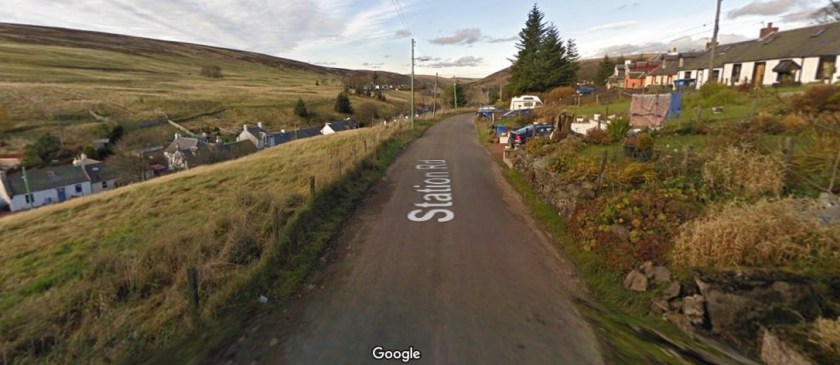
A deceased buzzard was found near to Station Road in Leadhills. Examination of the bird showed that it had likely been shot, had managed to recover, before then being shot a second time and killed.

Officers are seeking witnesses to any shooting activity which is suspicious.

Those with information on the dead bird are urged to contact police on 101, or Crimestoppers on 0800-55511, quoting incident number 0571 of 03/04/18.

ENDS

There is no information about when this buzzard was found dead although a local source advises it was earlier this year.

Here is a photo of Station Road, surrounded on either side by the grouse moors of Leadhills Estate:

Here is the position of Leadhills Estate (and the neighbouring Buccleuch Estate boundary in red dashes) in south Scotland. [Boundary details from Andy Wightman’s Who Owns Scotland website]. It’s in close proximity to the Moffat Hills, the proposed release site for the South Scotland Golden Eagle Project, due to begin later this year.

Leadhills is a notorious raptor persecution hotspot, with over 50 confirmed crimes recorded in the area since 2003. Only two of these have ever resulted in a successful prosecution (gamekeeper convicted in 2004 for shooting a short-eared owl; gamekeeper convicted in 2009 for laying out a poisoned bait).

Last year, witnesses reported the alleged shooting of a hen harrier on Leadhills Estate (here) and the alleged shooting of a short-eared owl (here). We’re not aware of any pending prosecutions in relation to these incidents.

We have been waiting to see whether SNH would impose a General Licence restriction but so far SNH has refused to comment, saying it’s not in the public interest to explain these decisions.