Buzzard found with shotgun injuries at Ryton, North Yorkshire

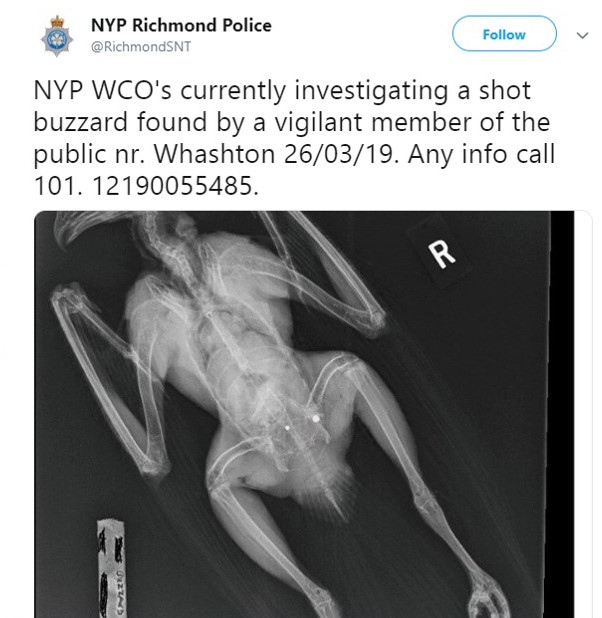
An injured buzzard was found on Ryton flood bank in North Yorkshire last week.

The bird was still alive but unable to fly – its broken humerus was sticking through the skin (see the x-ray below) and the wound site was infected.

Unfortunately the bird had to be euthanised.

If anyone has any information about this crime please contact Police Wildlife Crime Officer Jez Walmsley at Malton Police Station (Tel: 101) or the RSPB’s Raptor Crime Hotline (Tel: 0300 999 0101).

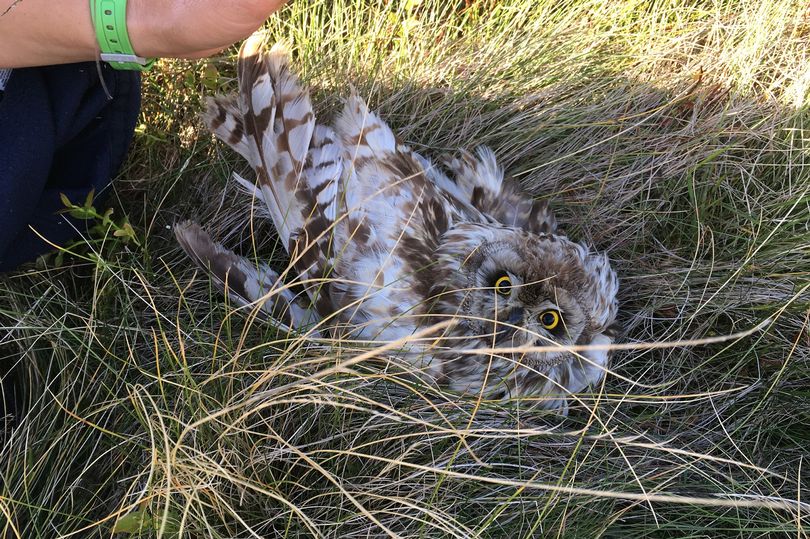
[Photos via Jean Thorpe]

New report published: Socio-economic & biodiversity impacts of driven grouse moors in Scotland

Remember back in May 2017 when Environment Secretary Roseanna Cunningham commissioned the Werritty Review to examine the environmental impact of grouse moor management and to make recommendations for how the industry might be regulated (see here)?

Part of that announcement also included a commitment to commission additional research in to the costs and benefits of large shooting estates to Scotland’s economy and biodiversity. This research would then be fed in to the Werritty Review.

Well, while we’re still waiting for the Werritty Review to report (not expected until later this year), the other research has now been completed, written-up and has just been published.

The research was undertaken by the James Hutton Institute and Scotland’s Rural College (SRUC), overseen by a steering committee which included representatives from the Scottish Government, SNH, University of St Andrews, BASC, RSPB Scotland and Scottish Land & Estates.

The research has been separated in to four reports and published as follows:

A summary report which can be downloaded here: Summary Report_Final

This summary report is a useful and concise guide to the other more detailed three reports and provides an outline of what to expect from those three reports:

The three more detailed reports can be downloaded here:

Part 1: Socio-Economic Report_Final

Part 2: Biodiversity Report_Final

Part 3: GIS Report_Final

PLEASE NOTE: We have not read any of the reports in detail and due to other commitments we probably won’t get to them for at least a couple of weeks. We hope to comment in due course.

Why did this gunman (+ 2 dogs) visit this hen harrier roost site on this Yorkshire grouse moor?

If you’re new to this blog and you’ve ever wondered what happens to satellite tagged hen harriers that suddenly ‘disappear’ in suspicious circumstances on driven grouse moors in Yorkshire (and elsewhere!), the latest video from the RSPB’s investigations team might just provide a clue. Just a little teeny tiny one.

The video was filmed by two members of the RSPB Investigations team shortly after they’d watched three young hen harriers settle down at the roost site for the night. Just as dusk fell, an armed man turned up with a labrador and a terrier and walked through the roost. He spent a few minutes crouching down amongst the vegetation whilst his dogs ‘worked’ the area. Fortunately none of the harriers flushed and the gunman later left in a vehicle.

The RSPB has published a blog describing the evening’s events (see here) and the blog includes the video footage, which is obviously of low quality given the fading light but clear enough to see what’s going on.

Here is a still from the video and we’ve added a red circle to highlight the gunman:

Who might this have been and what do you think he was doing there? How many implausible explanations will be churned out from the grouse shooting industry?

Didn’t sat tagged hen harrier ‘River‘, ‘disappear’ in this area in November 2018, the day before this video was recorded?

Look how many sat-tagged hen harriers have ‘disappeared’ in the Nidderdale AONB in Yorkshire in recent years, along with illegally killed red kites:

[RPUK map: Nidderdale AONB = yellow boundary. Illegally killed red kites = red circles; sat-tagged hen harriers that have vanished in suspicious circumstances = orange stars & red triangle; illegally shot hen harrier Bowland Betty = red star]

There hasn’t been a single prosecution for any of these incidents.

Do you think the [unnamed] estate has offered its full cooperation to North Yorkshire Police’s enquiries?

Do you think the Moorland Association will publicise this video?

Is anybody still unclear about what happens to hen harriers on driven grouse moors?

VIP guests attend Scottish Raptor Study Group conference

The Scottish Raptor Study Group (SRSG) held its annual conference last weekend – a day of fascinating presentations from a series of expert speakers on the latest developments in the field of raptor research and conservation, and a chance for SRSG members from across Scotland to catch up with one another.

This year the SRSG welcomed five MSPs who had given up their Saturday to attend the conference and meet informally with raptor workers. As Species Champions for several raptor species, some of these MSPs were already familiar with the SRSG’s huge voluntary contribution to raptor conservation in Scotland (estimated to be worth approx £1.8 million if Scot Gov had to pay consultants to do the same work!) and it was an excellent opportunity for them to learn in more detail about the successes and on-going threats to Scottish raptors.

Thank you for coming along Alison Johnson MSP (Scottish Greens, Species Champion for brown (and mountain!) Hare); Andy Wightman MSP (Scottish Greens, Species Champion for Golden eagle (and Mountain everlasting); Claudia Beamish MSP (Labour, Species Champion for Forester moth); John Mason MSP (SNP, Species Champion for Kestrel); Mark Ruskell MSP (Scottish Greens, Species Champion for White-tailed eagle).

[Photo by Logan Steele]

Also accepting an invitation to the conference was Charlie Everitt, Police Investigative Support Officer from the National Wildlife Crime Unit (NWCU), standing in for Chief Inspector Lou Hubble, Head of the NWCU who was unable to attend due to a prior booking.

Another senior police officer attending was Supt Nick Lyall, the Chair of the Raptor Persecution Priority Delivery Group (RPPDG). Not only was Nick supposed to be on annual leave, but he also made a 14hr round trip to attend this conference. His committment to the subject of tackling illegal raptor persecution is outstanding. (As was his rapper coat, for which he tolerated some good humoured stick!).

[Nick Lyall chatting with Kelvin Thomson, Patrick Stirling-Aird and Logan Steele of the SRSG, photo by Ruth Tingay]

The benefits of having senior police wildlife crime officers attending a conference like this are many, not least to help develop ongoing partnership opportunities which haven’t always been maximised in the past. With new faces and a renewed sense of determination, things have been changing and we look forward to seeing continued progress on this front.

Our ninth birthday

This blog turns nine years old today!

We’ve come a long way, as the number of blog views approaches five million, but we’ve barely scratched the surface.

Thank you to everyone who contributes and supports this effort – it is much appreciated.

Kestrel shot in North Yorkshire

A kestrel has been euthanised after being found shot in North Yorkshire.

It’s a kestrel, FFS. You’d have to be a gun-toting psychopath to shoot one of these. Unsurprisingly, it’s not the first kestrel to have been shot in North Yorkshire, England’s raptor-killing capital (see here here and here).

News of this latest shooting appeared on Twitter yesterday. We’ve been unable to find any more details:

Another workshop on raptor satellite tagging for police wildlife crime officers

On the day we learned that yet another satellite-tagged hen harrier has ‘disappeared’ in suspicious circumstances (the 12th since last summer), this forthcoming training workshop for police wildlife crime officers can’t come soon enough.

Following on from the success of a raptor satellite tag training workshop in Scotland earlier this month (see here), a similar workshop has now been announced for law enforcement officers in England and Wales.

Spearheaded by Police Supt Nick Lyall, Chair of the Raptor Persecution Priority Delivery Group (RPPDG), this will be another genuine partnership opportunity to share expertise and understanding.

As we saw at the Scottish workshop, it’s crucial that wildlife crime investigators understand the capabilities and constraints of satellite tag data – what they can and can’t tell us about a bird’s movements, and critically, how to identify evidence from the data to differentiate between a suspected crime against the tagged bird and a genuine technical malfunction of the tag. This understanding can help speed up investigations and help ensure resources can be targeted at the right location as a priority.

From a researcher’s perspective it’s also important that we have reassurances from the police about how our tag data will be handled and kept secure as part of the police’s investigative process. Police officers may not previously have considered this but given the sensitivity of the data (e.g. known nest and roost sites of highly threatened species) the police need to be aware of the researchers’ expectations of confidentiality. For this to work there has to be trust, and a workshop like this provides an excellent opportunity to continue to build that trust.

Well done to Nick Lyall for his leadership and to all the partners involved – this is a fantastic initiative.

Satellite tagged hen harrier ‘Vulcan’ disappears nr proposed reintroduction site in southern England

RSPB press release (28 Feb 2019)

Rare hen harrier vanishes in Wiltshire

A young male hen harrier has disappeared in suspicious circumstances in Wiltshire and is believed most likely to be dead.

The harrier, named Vulcan, was one of five chicks to fledge from a nest in Northumberland last summer. He was fitted with a satellite tag as part of the RSPB’s EU-funded Hen Harrier LIFE project, which enabled the nature conservation charity to track his movements.

[Hen harrier ‘Vulcan’, photo by RSPB]

Vulcan was tracked by the RSPB moving from Northumberland down to the Peak District where he remained throughout September. He then continued to head further south through Hampshire and Dorset. On 16 January 2019, Vulcan’s tag sent out its final transmission, from a location south of Calstone Wellington in Wiltshire.

RSPB Investigations staff searched the area, which is farmland and heavily managed for pheasant and partridge shooting, but there was no sign of Vulcan or his tag. He has not been heard from since and the matter was reported to Wiltshire Police.

Satellite tagging technology is commonly used to follow the movements of birds. Tags continue to transmit regularly, even when the bird dies, and until the tag reaches the end of its lifespan. Vulcan’s tag was providing regular updates on the bird’s location, so the sudden and unexpected ending of transmission is suspicious and could suggest criminal interference. Vulcan is the 11th satellite-tagged hen harrier to disappear since last summer.

Hen harriers are one of the UK’s rarest birds of prey with only nine successful nests recorded in England in 2018 despite sufficient habitat for over 300 pairs. An overwhelming body of scientific evidence suggests that the main reason for their low numbers is illegal killing associated with driven grouse shooting.

Dr Cathleen Thomas, RSPB Hen Harrier LIFE Project Manager, said: “When a bird you’ve been following since it was a chick suddenly disappears without a trace, it’s a crushing blow. Vulcan’s tag had been performing brilliantly, so for it to suddenly stop transmitting makes us very suspicious that something has happened to him.

Wiltshire is not the only place where hen harriers have disappeared in unexplained circumstances. Since last summer 10 other satellite-tagged hen harriers have also vanished suddenly across the UK including in Northumberland, the Peak District, Wales and Scotland. There is a very worrying trend here.”

PC Marc Jackson of Wiltshire Police said: “Wiltshire Police have received a report from the RSPB in relation to the missing harrier ‘Vulcan’, and the Rural Crime Team are working with the RSPB to establish the full circumstances surrounding the incident.

To find no trace of this bird raises obvious concerns about what may have happened to it. If anyone has information please contact Wiltshire Police on 101 or Contact Crime stoppers on 0800 555111 if you would prefer to remain anonymous.”

Vulcan’s suspicious disappearance may prove a hurdle for the proposed southern reintroduction of hen harriers. Natural England is currently looking into the feasibility of introducing hen harriers from the continent to Parsonage Down National Nature Reserve, near Salisbury Plain.

Gareth Cunningham, RSPB Head of Nature Policy, said: “The disappearance of Vulcan raises serious concerns over the safety of any planned reintroduction. The RSPB has serious reservations about this approach to hen harrier conservation in England and we believe ending hen harrier persecution is the key to restoring the UK’s population of these magnificent birds. As such, the RSPB does not support the proposed reintroduction.”

If anyone has any information relating to this incident, please call Wiltshire Police on 101. Alternatively, call the RSPB Raptor Crime Hotline confidentially on 0300 999 0101.

ENDS

As the RSPB points out, this ‘may provide a hurdle’ (read: should be a bloody great big red flashing light) for the proposed reintroduction of hen harriers to southern England as part of DEFRA’s mad hen Harrier (In)Action Plan.

The location of Vulcan’s last known tag signal is less than 20 miles from Natural Engand’s proposed reintroduction site at Parsonage Down National Nature Reserve:

[RPUK map showing 1: Vulcan’s last known location; 2: Natural England’s proposed hen harrier reintroduction site]

We’ve blogged a lot about this proposed ‘reintroduction’ of hen harriers to southern England although technically it’s not a reintroduction because the species is not regionally extinct here and it should more aptly be called the ‘Let’s divert attention from the criminal killing of hen harriers on grouse moors plan’. We have been strong critics of the plan, not least because those young hen harriers tipped out in Wiltshire will likely roam far and wide during their post-fledgling dispersal period (as we know from sat tag data) and if they end up anywhere near a grouse moor they’ll be shot on sight. Releasing birds in to southern England will not solve the cause of the species’ decline in the first place, which undeniably is illegal persecution on driven grouse moors. And now there’s a strong possibility that Vulcan was a victim of illegal persecution, just a few miles from the proposed hen harrier release site. Which country is going to be stupid enough to donate hen harriers to the UK when we can’t even safeguard those birds hatched here, let alone any that are donated for a so-called ‘reintroduction’ project?

For previous blogs on this topic see:

28 Nov 2016 – Hen Harrier reintroduction to southern England: an update (here)

3 Jan 2017 – Hen harrier reintroduction to southern England: the feasibility/scoping report (here)

8 Jan 2017 – Hen harrier reintroduction to southern England: the project group and their timeline (here)

9 Jan 2017 – Hen harrier reintroduction to southern England: who’s funding it? (here)

9 Jan 2017 – Hen harrier reintroduction to southern England: a bonkers proposal for Exmoor National Park (here)

12 Jan 2017 – Hen harrier reintroduction to southern England: Wiltshire (here)

14 Feb 2017: Leaked email reveals Natural England’s views on Hen Harrier Action Plan (here)

23 Feb 2017: Hen harrier reintroduction to southern England: donor countries (here)

19 July 2017: Hen harrier reintroduction to southern England: new project manager appointed (here)

20 July 2017: Hen harrier reintroduction to southern England: Dartmoor as potential new release site (here)

20 July 2017: Hen harrier reintroduction to southern England: revised costs (here)

21 July 2017: Hen harrier reintroduction to southern England: project team vists France (here)

27 July 2017: RSPB statement on hen harrier reintroduction to southern England (here)

15 Aug 2017: Natural England Board making up justification for hen harrier southern reintroduction (here)

24 October 2017: Hen harrier reintroduction to southern England: Natural England delays release of information (here)

11 December 2017: Hen harrier reintroduction to southern England: report of fieldtrip to France (potential donor country) (here)

12 December 2017: 2018 start date for reintroduction of hen harrier to southern England? (here)

14 January 2018: Stop illegal persecution then no need for reintroduction of hen harrier to southern England, says DEFRA Minister (here)

13 March 2018: Hen harrier reintroduction to southern England: has France said “Non”? (here)

We’ve no idea what the latest is as Natural England is being true to form and keeping everything secret, although there are persistent rumours that birds may be donated by Spain, this year. Time for some more FoIs……

UPDATE 11.20hrs: The RSPB has published a blog about Vulcan’s disappearance (here)

UPDATE 12th March 2019: Gamekeepers’ rep suggests disappearance of hen harrier Vulcan was ‘set up’ by RSPB (here)

New podcast: Ian Thomson, Head of Investigations RSPB Scotland

Ian Thomson, Head of Investigations at RSPB Scotland is never one to mince his words, especially on the subject of the illegal persecution of birds of prey.

Here’s his latest straight-talking podcast with Charlie Moores (a digital producer at Lush) where the discussion includes topics such as the under-recording of wildlife crime, satellite tagging of golden eagles, the suspicious disappearance of golden eagle Fred, satellite-tagging of hen harriers, the recent outlandish claims that tagged hen harrier Saorsa had been “re-sighted”, the Scottish Gamekeepers Association, the Revive Coalition, the Werritty Review, General Licences, General Licence Restrictions, and raising public awareness of raptor persecution.

If you have an hour to spare, it’s well worth a listen on the Lush Player HERE

[Ian Thomson, photo by Charlie Moores]

Questions on grouse shooting for Tony Juniper but not on hen harrier persecution

Tony Juniper, the nominated candidate for taking on the role of Chair of Natural England, faced a pre-appointment hearing yesterday in front of members of the Environment, Food & Rural Affairs Committee and the Environmental Audit Committee.

If you weren’t able to watch it, the proceedings have been archived and can be viewed here.

And was that Amanda Anderson (Moorland Association) arriving late to join the public gallery, along with grouse moor-owning Richard Benyon MP?

They wouldn’t have been disappointed. The subject of grouse shooting and moorland management was raised a couple of times by two Conservative MPs (Julian Sturdy MP at 15.16 mins and Robert Goodwill MP at 15.43 mins) who were looking for assurances from Tony Juniper that he wouldn’t be looking to rewild grouse moors and he wouldn’t be campaigning to prevent rotational heather burning.

Disappointingly, Angela Smith MP (hen harrier species champion) failed to use this opportunity to ask Tony for his view on the illegal persecution of hen harriers on driven grouse moors, a long-standing issue that is yet again about to be confirmed by the imminent publication of a new research paper based on Natural England’s hen harrier satellite tag data.

Perhaps the most amusing ‘hardcore questioning’ came from Sheryll Murray MP (Conservative) at 15.09 mins who spoke as if she was reading from a script and it was the first time she’d seen it. In painfully slow speech, she questioned Tony’s integrity about his claim that he hadn’t been politically active for several years. She accused him of making a £50 donation in 2017 to support the election of a Green Party candidate and then, horror of horrors, accused him of attending a vegan breakfast at a Green Party fringe event in 2018. She wanted assurance that Tony was capable of managing these political ‘conflicts of interest’ should he be appointed Chair of Natural England. Good grief.

Her fellow Conservative, Zac Goldsmith MP, put the £50 donation accusation in to context at 15.57 mins: “I have to put on the record if it hasn’t already been put on the record that Andrew Sells, the previous [Natural England] Chairman gave £111,000 to the Conservative Party before he was appointed“. Sniggers all round.

The entire hearing was a masterclass on retaining one’s composure when confronted by some idiotic questions (although to be fair there were some decent questions, too) and a bullish, arrogant Chair – Neil Parish MP. What is it with these Westminster committee chairs? Are they always so rude? Mr Parish kept interrupting Tony Juniper and insisting on having a ‘Yes/No’ answer to some questions, despite Tony explaining that his responses needed to be more nuanced, and Parish went on and on and on (at 15.25 mins) about wanting assurances that Tony wouldn’t ‘interfere’ with the Government’s badger cull (presumably Tony knew that Neil Parish has a family farm in Somerset and has been a vociferous supporter of the badger cull).

It turns out that the Committee’s decision on whether to approve Tony’s appointment or not is not a binding decision – Ministers can take the Committee’s comments in to consideration but they don’t have to listen to them – which made yesterday’s hearing a bit of a pointless exercise, although it was useful to have some transparency for the public and no doubt useful for Tony Juniper to find out which issues are likely to be raised with him in the future, if he didn’t already know.

UPDATE 28 Feb 2019: Full transcript of the pre-appointment hearing now available here