DEFRA has published the following statement today:
England’s ‘national rainforests’ to be protected by new rules
Legislation will be brought forward to prevent the burning of heather and other vegetation on protected blanket bog habitats.
The government has today announced plans to bring forward legislation to prevent the burning of heather and other vegetation on protected blanket bog habitats.
The new regulations will prevent the burning of any specified vegetation on areas of deep peat (over 40cm depth) on a Site of Special Scientific Interest that is also a Special Area of Conservation or a Special Protection Area unless a licence has been granted or the land is steep or rocky.
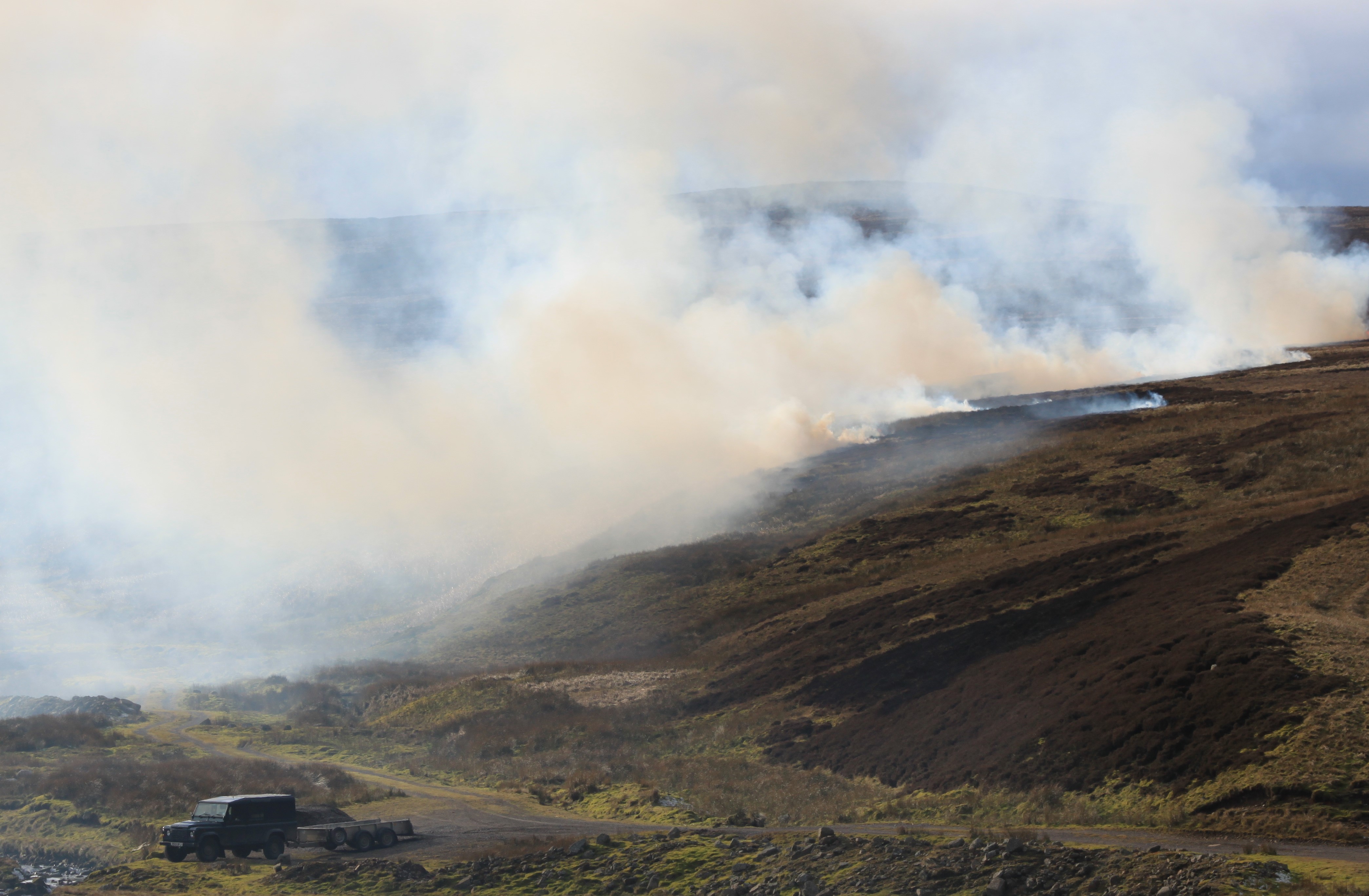
‘Rotational’ burning is used as a management tool on moorland and blanket bog. Land managers use controlled burning on patches of heather during winter months typically on a 8-12 year rotation.
[Setting fire to a grouse moor. Photo by Ruth Tingay]
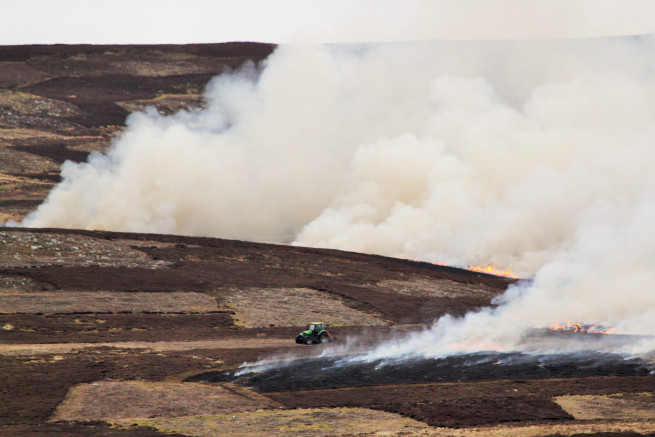
There is a consensus that burning of vegetation on blanket bog is damaging to peatland formation and habitat condition. It makes it more difficult or impossible to restore these habitats to their natural state and to restore their hydrology.
Restoring England’s peatlands is a priority for the government. It will help achieve net zero carbon emissions by 2050 as well as protecting our valuable habitats, and the biodiversity those habitats support.
Blanket bog, a type of peatland, is a delicate habitat of international importance, with the UK having 13% of the world’s blanket bog.
The government recognises that if moorland is unmanaged, there is a risk of wildfire which is most damaging of all and that these risks have grown due to climate change. Therefore, the government intends to work with land owners and managers to develop local wildfire control plans.
There will be specific circumstances where the ban does not apply, such as on steep land or where scree makes up half the land area. In addition, the Secretary of State may also issue licences for the burning of heather on blanket bog for the purposes of wildfire prevention, for a conservation purpose or where land is inaccessible to cutting or mowing machinery. These licences may cover several years so that they can be aligned with coherent management plans for sites.
Environment Secretary George Eustice said:
Our peatlands have great potential as a natural store of carbon, as well as protecting habitats, providing a haven for rare wildlife and being a natural provider of water regulation.
We want to work with land owners to restore the natural hydrology of many of these sites through our new agricultural policy to support our ambitions for the environment. The burning of heather on these sites makes it more difficult to restore their natural hydrology which is why we are taking this step today.
Natural England Chair Tony Juniper said:
This is a hugely welcome announcement which will see better protections for our globally important peatlands. Blanket bog is an amazing habitat that provides essential environmental benefits, including carbon storage, a home for wonderful wildlife, clean drinking water and flood mitigation. This is why it is vital we ensure these systems are healthy with peat-forming species, such as Sphagnum mosses, thriving in water-logged conditions.
We will continue to work with Defra and land managers to help with the successful implementation of these measures, including by providing advice on good upland management and leading a new peatland restoration grant scheme as part of the Nature for Climate programme.
This will provide funds to carry out restoration work on these precious ecosystems, ensuring their recovery and protection for the benefit of both present and future generations.
Today’s move marks a key step for meeting the Government’s nature and climate change mitigation and adaptation targets, and part of the Government’s 25 Year Environment Plan commitment to bring 75% of SSSIs into favourable condition.
The Government will be setting out further measures to protect England’s peatlands this year as part of a package of measures to protect England’s landscapes and nature-based solutions. The government’s £640m Nature for Climate Fund also includes funding to kick-start a programme of peatland restoration over the next 5 years.
The statutory instrument will be laid before Parliament for its approval before it comes into force.
ENDS
This is definitely progress, but although it might look good superficially, as with any Government statement the content should not be taken at face value and deserves a great deal of scrutiny.
Some of the caveats in these proposed regulations require special attention, e.g. issuing a licence to burn on blanket bog ‘for the purposes of wildfire prevention‘ sounds particularly dodgy, as does, ‘These licences may cover several years so that they can be aligned with coherent management plans for sites‘.
UPDATE 29th January 2021: Calls intensify to end muirburn on Scottish grouse moors (here)
UPDATE 29th January 2021: Reaction from RSPB’s Martin Harper (here)
UPDATE 1st February 2021: Reaction from Mark Avery (here)
UPDATE 5th February 2021: Which English grouse moors will escape DEFRA’s so-called moorland ‘burning ban’? (here)