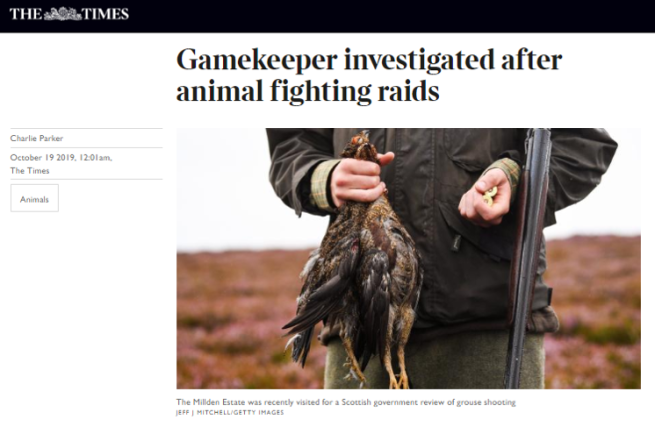
A gamekeeper from the Angus Glens is due back in court today to face charges relating to alleged animal fighting and animal suffering.
These charges stem from a joint Scottish SPCA / Police Scotland search warrant which was executed on Millden Estate in October 2019 where a number of dogs were seized.
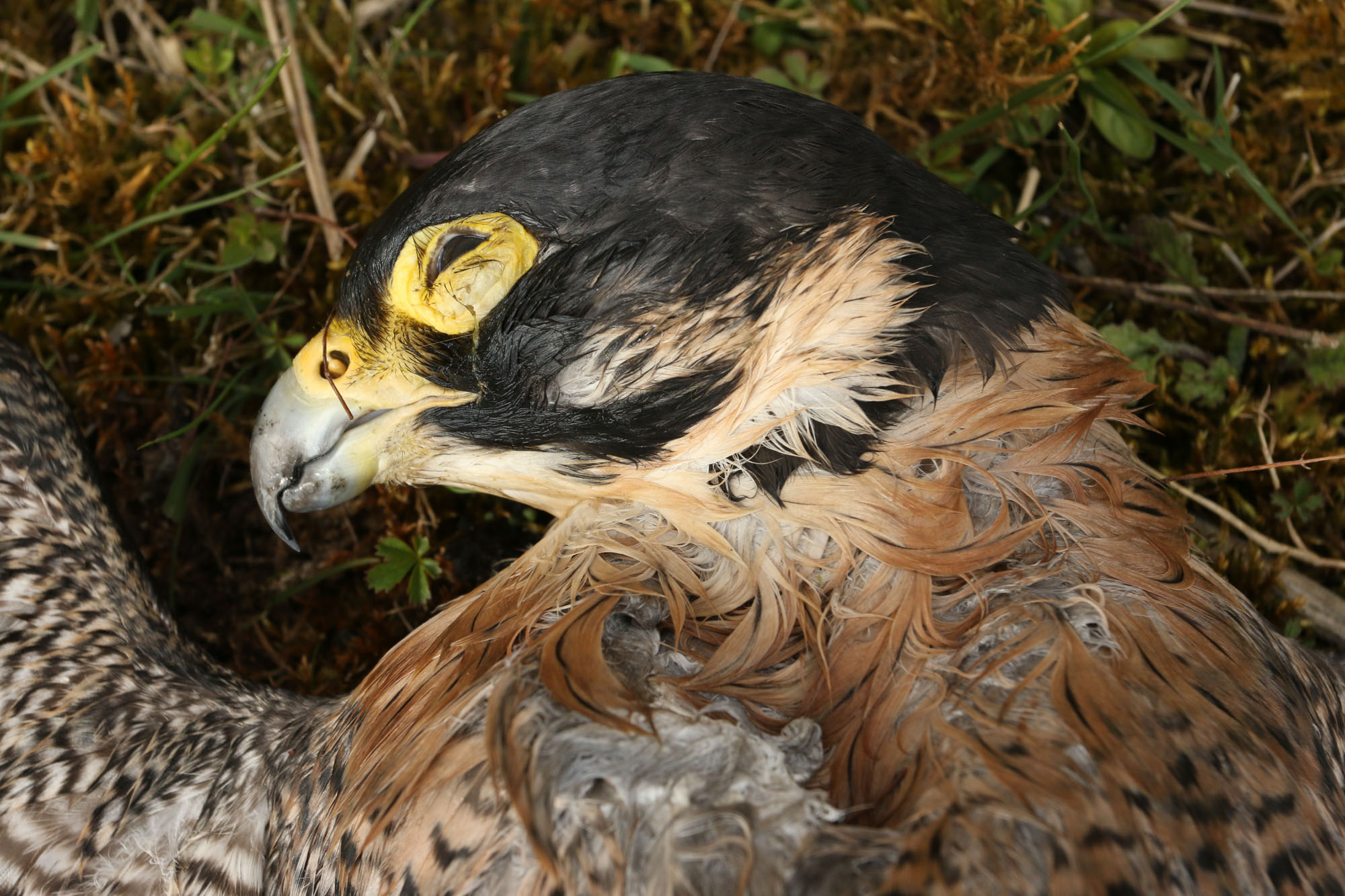
A gamekeeper in the Scottish Borders has been convicted today after two supposedly protected birds of prey (a barn owl and a goshawk) died inside a trap which he neglected to check.
There’s an article about this case in the Border Telegraph this evening, which I’ll copy below, and then I’ll add some further commentary below that.
Here’s the Border Telegraph piece:
Borders gamekeeper ‘recklessly’ killed two protected birds
A GAMEKEEPER who recklessly killed two protected birds on a Borders estate by leaving open the door of a multi crow cage trap [Ed: see commentary at foot of this blog] has been fined £300 at Selkirk Sheriff Court.
An owl and a goshawk perished from exposure and a lack of food and water at Cathpair Farm near Stow on September 13 last year.
Fifty-three-year-old Peter Givens, of Keepers Cottage, Cathpair, pleaded guilty to recklessly taking and killing the wild birds under the Wildlife and Countryside Act.
His lawyer explained that Givens had used the crow trap for the lambing season earlier in the year but thought had had [sic] secured it properly when no longer required.
Wildlife and environmental crime depute fiscal Joe Stewart said: “An ecologist carrying out a survey on the estate came across a crow cage trap near some woodland.
“He noticed a barn owl lying deceased in the trap which was in an advanced state of decomposition and had obviously been there for a long time.
“The door was closed and the trap was in use.
“The local wildlife police attended carrying out a search and he found another bird in the trap which was a goshawk.”
An identification tag on the trap was traced to Givens.
Mr Stewart said the trap should have been removed.
Givens’ lawyer said his client had been a gamekeeper for more than 30 years and had no previous convictions.
He said around the start of the COVID pandemic in March 2020 the trap was put in place and checked on a regular basis in case other birds were trapped.
He explained that there had been a lot of crows at the start of the lambing season but this had tailed off by May.
The lawyer continued: “He thought the trap had been deactivated. There was no intention to keep the trap operating.
“What happened on September 13 came as a shock to him and a source of embarrassment and sadness for the damage he has caused.
“He has accepted he failed to deactivate the trap properly.
“He accepts his conduct was reckless but it was not intentional and he is very remorseful.”
Sheriff Peter Paterson said: “This was an oversight rather than an intentional act.
“It was not a deliberate act to trap predators with the unintended consequences.”
Sheriff Paterson added: “I take into account your spotless record and while this was reckless, it was not intentional.”
He reduced the fine from £375 to £300 to reflect the guilty plea with a £20 victim surcharge added.
ENDS
Ok, so first a technical correction on the court reporter’s write up in the Border Telegraph. The article states the gamekeeper had killed the two birds of prey ‘by leaving open the door of a multi crow cage trap’. This can’t be accurate. Had he left the door open, the barn owl and the goshawk would have been able to escape! What is more likely to have happened is the gamekeeper kept the cage door shut, which is an offence if the trap is no longer in use because, as we’ve seen, birds can enter the trap through a roof opening (either a ‘ladder’ or funnel design) but then they cannot escape back up.
Anybody who operates a multi-cage crow trap under the General Licences in Scotland MUST render the trap ‘incapable of use’ if the trap is not being used, and this means either removing the door entirely or padlocking it open. Leaving the door closed when the trap is not in use is an offence.
I was interested to read the gamekeeper’s lawyer’s defence: “…..the gamekeeper thought he had secured it properly when no longer required“. I’m not sure how someone can believe they’ve secured a cage trap ‘properly’ if they haven’t obeyed the General Licence terms and conditions and either (a) removed the door or (b) padlocked it open. There’s no possibility of ‘accidentally’ doing half a job here – you either remove the door or you don’t, or you padlock the door open, or you don’t.
I was also interested to see that the guilty gamekeeper was 53 years old and had been a gamekeeper for ‘more than 30 years’. These were details given by his lawyer in his defence. I’d argue that those details should have gone against the gamekeeper – he’s been in the wildlife-killing business for long enough to know the risks and certainly to know the law. Indeed, I understand Peter Givens was the former Head Gamekeeper on nearby Raeshaw Estate. This is an estate that has been at the centre of multiple wildlife crime investigations for many, many years and was the subject of the very first General Licence restriction in 2015, based on clear police evidence that wildlife crimes had been committed there, although there was insufficient evidence to prosecute any individual (see here).
Even after the General Licence restriction was imposed on Raeshaw Estate, even more alleged wildlife crimes were uncovered which resulted in the estate’s Individual licences being revoked by SNH in 2017 (here).
There is no evidence nor indeed suggestion that Peter Givens was involved in any of those alleged offences but the point of highlighting this background is that he would certainly have been aware of the police investigations and thus the importance of adhering to the law, which he failed to do in this latest case (which incidentally did not take place on Raeshaw Estate – Givens has since moved to a smaller shoot].
The lawyer also made a point of telling the Sheriff that Givens had no previous convictions, and his ‘spotless record’ was taken in to account by Sheriff Paterson when Givens was sentenced.
And the punishment for ‘recklessly’ killing two Schedule 1 birds of prey? A £300 fine and a £20 victim surcharge.
You can decide for yourselves whether this will be sufficient deterrent for other gamekeepers to ensure they adhere to the terms and conditions of the General Licences to prevent protected species being trapped in a literal death trap and starving to death.
This came as a huge surprise so thank you to whoever made the nomination!
It’s a strong category comprising many hardworking local and national campaigners, some of whose names will be familiar to this blog’s readers, and it’s an honour to be considered amongst them.
Thanks also to TGO for providing links next to each candidate – it’s a brilliant way to reach new audiences.
Today is the 26th November 2021. It’s been exactly one year since the then Environment Minister Mairi Gougeon announced the Scottish Government’s long-awaited response to the Werritty Review on grouse moor management and a decision to implement a licensing scheme for grouse shooting.
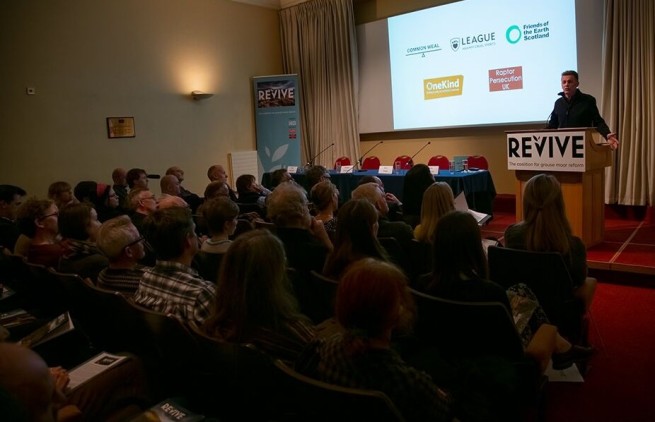
How we got to that position was the subject of a talk I presented at the REVIVE national conference a couple of weeks ago, hosted by Chris Packham at Perth Concert Hall.
[Chris Packham opening the REVIVE coalition for grouse moor reform conference. Photo by Ruth Tingay]
There had been an intention for a recording of the entire event to be made available but we learned subsequently that unfortunately the venue’s audio system had failed. REVIVE’s campaign manager, Max Wiszniewski has since published a conference overview (here) but I thought I’d take the opportunity to share the main points from my talk, to try and put Mairi Gougeon’s announcement in to some sort of context, and it seems fitting to do that today.
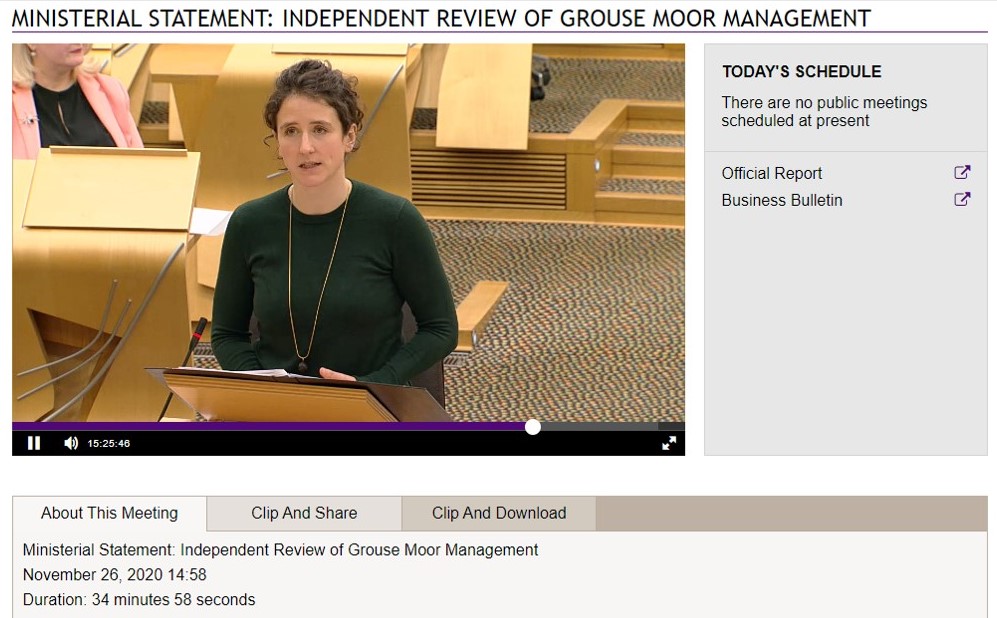
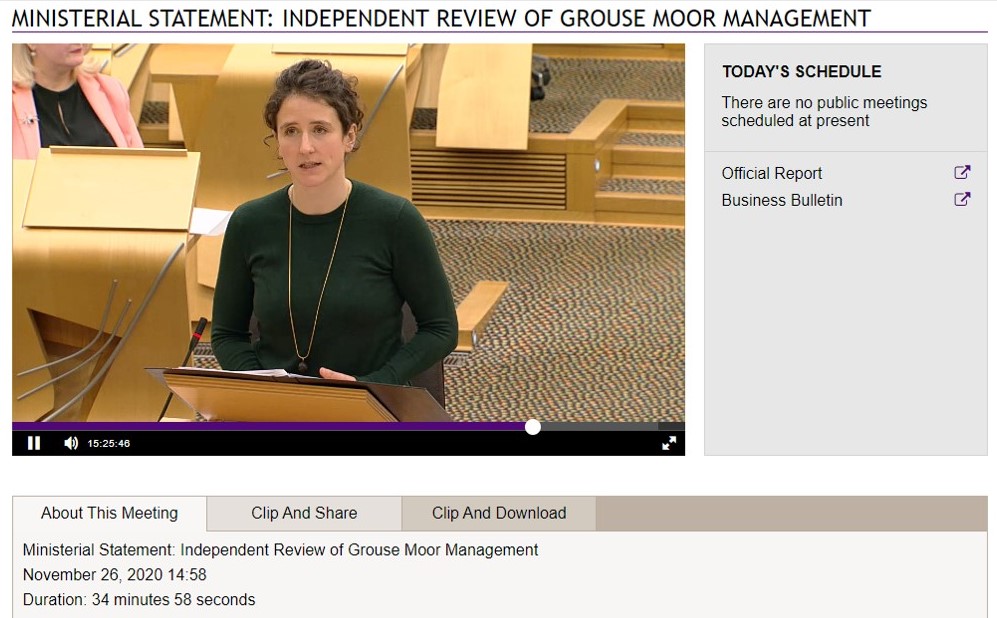
My opening slide was a screengrab of Minister Gougeon making that historic statement on 26th November 2020:
“The key recommendation put forward in the Werritty report – is that a ‘licensing scheme be introduced for the shooting of grouse’. This is a recommendation that I accept.
However, while I the understand why the review group also recommended that such a scheme should be introduced if, after five years, ‘there is no marked improvement in the ecological sustainability of grouse moor management’, I believe that the Government needs to act sooner than this and begin developing a licensing scheme now”.
There’s no question that this was a significant statement and although some campaigners were disappointingly dismissive (including several commentators on this blog), I think that when you understand the history of exactly what it took to get there, over many, many years of hard campaigning at substantial personal cost to many, you’ll hopefully appreciate why so many of us celebrated it as a huge victory. It’s not the end point, not by any means, but it is hugely symbolic of the direction of travel.
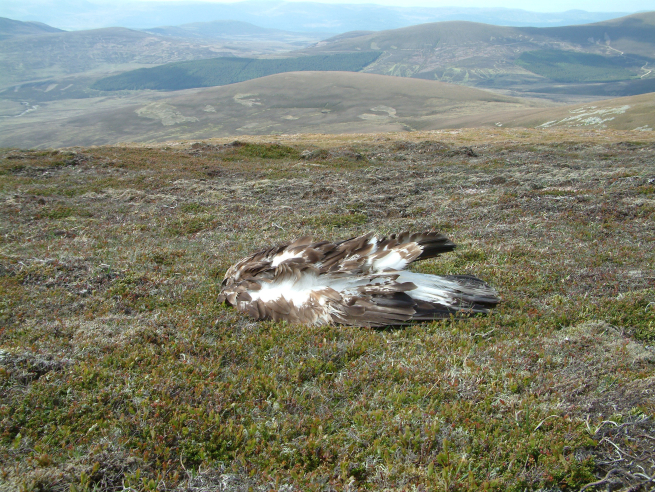
My next slide is a photo that I use in pretty much every talk I give on raptor persecution in the UK:
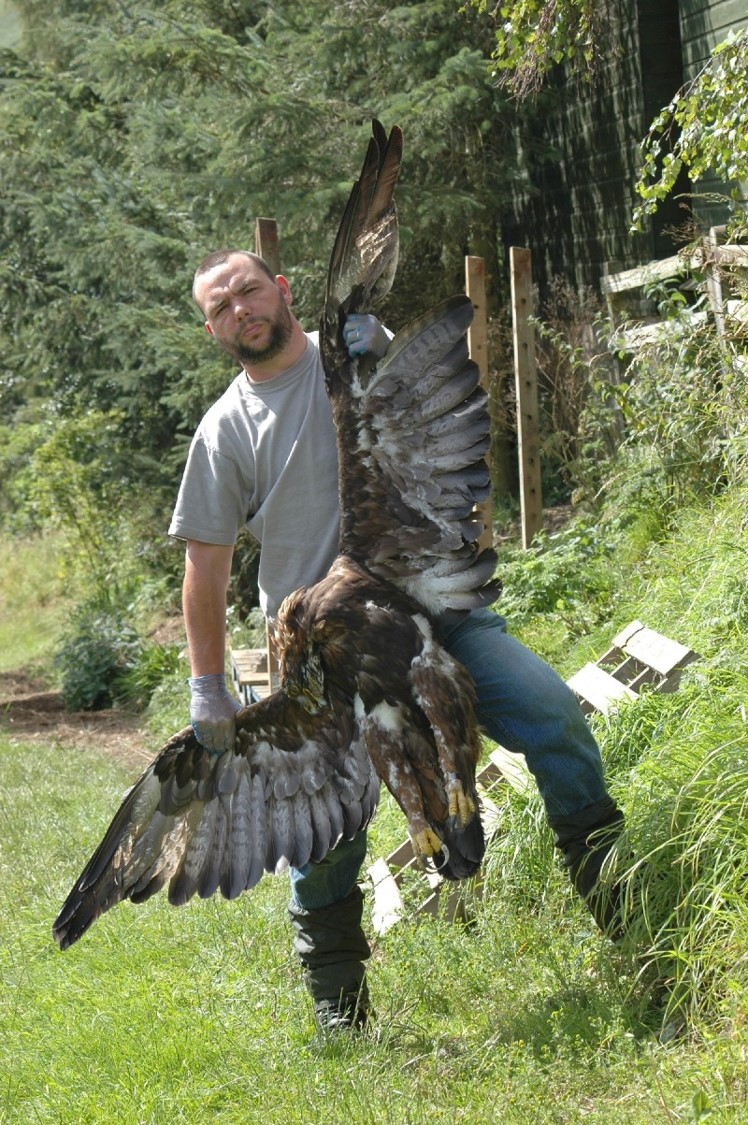
This is a photograph of a young golden eagle, found illegally poisoned on a grouse moor in the Cairngorms National Park in 2006. It was photographed by former RSPB Investigator Dave Dick (now retired) who had been sent out to retrieve it for post mortem. He had picked up many other illegally killed birds of prey on grouse moors over the years, but this image epitomises everything in its pitiful, poignant, senselessness.
I asked the audience to hold this image in their head as the talk progressed to cover some of the key moments in this long campaign against criminal activity and for effective law enforcement against those criminals.
I started with the basics – the 1954 Protection of Birds Act which brought legal protection for all raptor species in the UK, with the exception of the sparrowhawk which finally received full protection in 1961. So for most UK birds of prey, they’ve supposedly been protected for 67 years! This isn’t a new law that society needs time to adjust to and for which we should forgive any lack of adherence. This legislation was enacted a lifetime ago and was probably in place before every current working gamekeeper was even born. Ignorance of the law is no defence and that statement applies here, in spades.
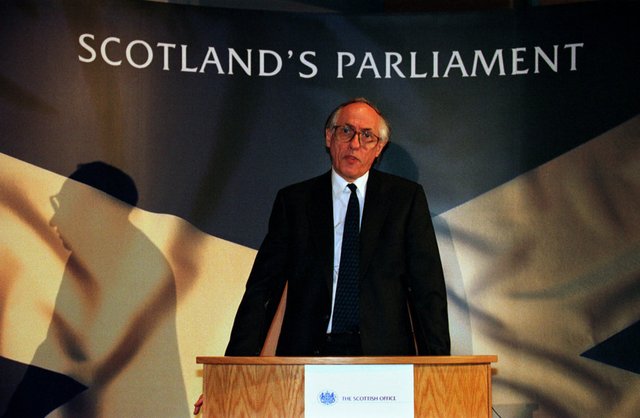
In 1998, 44 years after raptors were declared ‘protected species’ in law, the then Secretary of State, Donald Dewar described the level of raptor persecution in Scotland as “a national disgrace“. He promised that following devolution the following year, the Scottish Government would take “all possible steps to eradicate it”.
RSPB Scotland started publishing annual reports in 1994, meticulously documenting raptor persecution. Their 20th report, published in 2004, documented that 779 birds of prey had been confirmed illegally killed between 1994 and 2004. This figure was considered the tip of the iceberg as wildlife crime, including raptor persecution, is widely recognised as being under-recorded for a number of reasons.
During the late 1990s-mid-2000s, and actually continuing to this day, researchers published a suite of scientific papers documenting the impact of illegal raptor persecution. This wasn’t just the odd ‘rogue incident’ here and there; raptor persecution was so extensive and systematic it was having population-level impacts on a number of species, notably the golden eagle, hen harrier, peregrine and red kite. The peer-reviewed evidence was conclusive – much of the killing was linked to game-shooting, and particularly to driven grouse moor management.
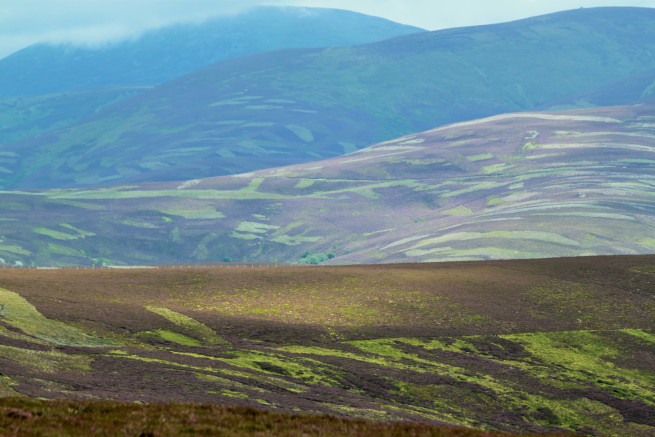
[An expanse of driven grouse moors inside the Cairngorms National Park. Photo by Ruth Tingay]
In 2000, the UK Raptor Working Group (established in 1995 and comprising a variety of statutory agencies, conservation NGOs and game-shooting bodies) published a report with a series of recommendations to address the recovery of bird of prey populations and their perceived impact on gamebirds, moorland management and pigeon racing.
In 2002, Scottish Natural Heritage (SNH) advised the Scottish Executive to accept most of the recommendations of the 2000 report and this led to many developments, with a particular focus on partnership working. Most of these so-called partnerships have since proven to be utterly ineffective (e.g. Partnership for Action Against Wildlife Crime Raptor Group, Heads Up for Hen Harriers) mostly due to them being heavily weighted towards game-shooting interests who seem intent on preventing progress by means of constant denial and obfuscation.
In 2004, raptor satellite-tagging began as a novel method of studying the biology and ecology of several species, notably the golden eagle. The significance of this will become apparent later.
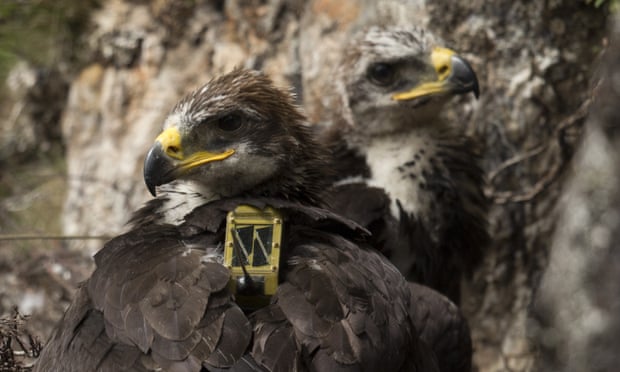
[Two young golden eagles fitted with satellite tags prior to fledging. Photo by Dan Kitwood]
In 2005 the Possession of Pesticides (Scotland) Order was enacted, making it an offence for anyone to possess any of the eight highly toxic poisons used most frequently for killing birds of prey. This piece of legislation has proven useful in that it has allowed law enforcement agencies to prosecute for the lesser offence of ‘possession’ in cases where it has been virtually impossible to provide sufficient evidence to prosecute for actually poisoning a bird of prey.
In 2007 an adult golden eagle was found poisoned at her nest site in the Borders. She was part of the only breeding pair in the region. Nobody was prosecuted and the ensuing public outrage resulted in the then Environment Minister Mike Russell ordering a Thematic Review into the prevention, investigation and prosecution of wildlife crime, which led to a series of recommendations to improve enforcement activities.
[Police officer Mark Rafferty holding the poisoned corpse of the Borders golden eagle. Photo by Dave Dick]
In 2010, this blog was launched primarily to raise public awareness about the scale of illegal raptor persecution in Scotland. It was later widened to cover the whole of the UK. It’s had over 7.5 million views to date.
In 2011, the Scottish Government launched a poisons disposal scheme, offering a sort of ‘amnesty’ and the safe destruction of any banned poisons that might have been left over from when it was legal for people to have these toxins in their possession (i.e. pre-2005).
Also in 2011, Peter Peacock MSP put forward an amendment for the Wildlife & Natural Environment (Scotland) Bill to introduce additional powers for the Scottish SPCA to enable them to investigate a wider suite of wildlife crime, including raptor persecution. Then Environment Minister Roseanna Cunningham rejected the amendment but committed to launch a public consultation on this subject.
Later in 2011 the Wildlife & Natural Environment (Scotland) Act was enacted and in 2012 this led to the Scottish Government having to publish its first annual wildlife crime report. The legislation also brought in vicarious liability, providing an opportunity for prosecutions against landowners and sporting agents whose employees had committed certain offences linked to raptor persecution. After almost ten years there have only been two successful prosecutions. That’s not because there haven’t been more opportunities for prosecution – there have been plenty – it’s because for the most part the Crown Office has refused to take the cases. When pushed for an explanation we’ve simply been told ‘it’s not in the public interest to proceed’. One case was not progressed because the landowner / hierarchy of supervision could not be established because the identity of the person was hidden in an offshore trust.
In 2013 the then Environment Minister Paul Wheelhouse ordered a review of the penalties available for wildlife crime and appointed Professor Poustie to lead the review.
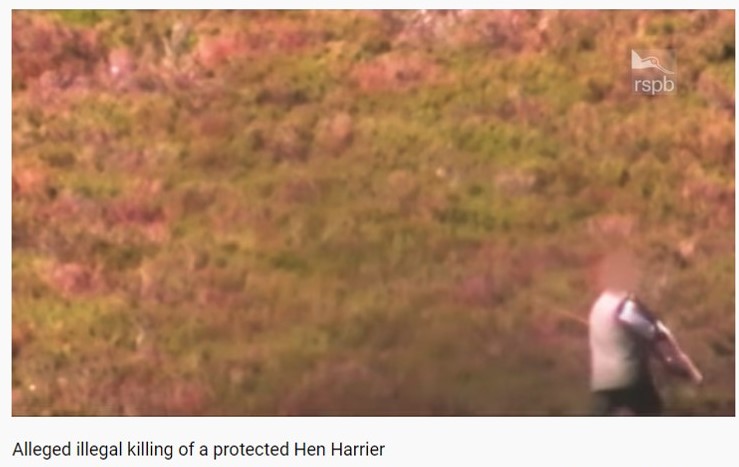
Also in 2013, after RSPB video evidence was published showing a gamekeeper allegedly shooting a hen harrier on its nest on a grouse moor in Morayshire, which led to a prosecution that was later dropped because the Crown Office ruled the evidence ‘inadmissible’, huge public uproar led to Environment Minister Paul Wheelhouse having discussions with the Lord Advocate about maximising opportunities for prosecution and the Lord Advocate subsequently instructed the Crown Office to utilise all investigative tools for enforcement against wildlife crime. This had zero impact – several other high profile cases involving RSPB video evidence have also since been dropped due to this apparent inadmissibility.
[A screen grab from an RSPB video showing the alleged shooting of a hen harrier on a grouse moor]
In 2014 Environment Minister Paul Wheelhouse introduced General Licence restrictions for shooting estates where police evidence confirmed that raptor persecution had taken place but where there was insufficient evidence to bring a prosecution against a named individual. This was supposed to be a ‘reputational driver’ to deter crimes but has proven to be utterly ineffective with just a handful of restrictions applied over the last seven years and most ‘sanctioned’ estates simply given an individual licence to allow them to continue the activities which were supposed to have been restricted under the General Licence. It’s just bonkers.
Also in 2014, Paul Wheelhouse ordered a review of gamebird management systems in other European countries to see whether these different management approaches could help address ongoing raptor persecution in Scotland.
Also in 2014, the Scottish Government finally launched a public consultation on increased powers for the SSPCA, three years after first agreeing to set this up.
In 2014, Mark Avery and Chris Packham launched the concept of Hen Harrier Day to draw attention to the plight of the hen harrier, timed to coincide with the start of the grouse shooting season on 12th August. Hen Harrier Day has now become an annual event and volunteers Andrea Hudspeth and Andrea Goddard have organised these high profile events in Scotland.
In 2015, with raptor poisoning crimes still occurring, not content that the poisoners had already been given an opportunity to hand in their illegal stashes back in 2011, the Scottish Government launched its second poisons amnesty scheme, ten years after it became an offence to possess these dangerous toxins. How many chances do these gamekeepers get?
Also in 2015, SNH launched its ridiculous Heads up for Hen Harriers project – joining forces with shooting estates to fix nest cameras at hen harrier nests to determine the cause of breeding failures on grouse moors (yes, really!). It was doomed to failure because obviously the gamekeepers on estates where the cameras had been installed would not destroy the harriers/nests (at least not while the birds were within camera range) and the study’s ‘findings’ would then be skewed towards natural predator events and poor weather conditions which the grouse shooting industry would then point to as being the main cause of hen harrier breeding failure on grouse moors. It was nothing more than a greenwashing project.
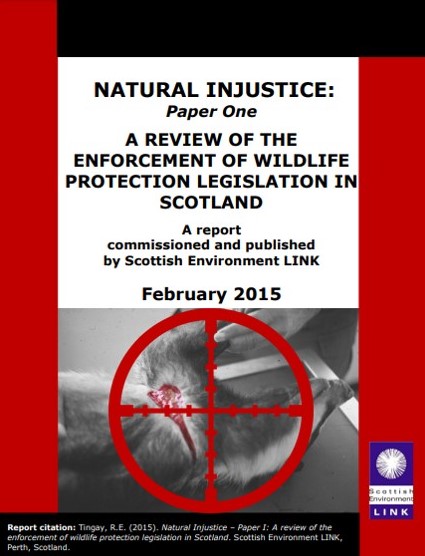
Also in 2015, Scottish Environment LINK published a damning report demonstrating that wildlife crime enforcement measures were still weak, inconsistent & ineffective, seven years after the HM Inspector of Constabulary published its Thematic Review into the prevention, investigation and prosecution of wildlife crime and its subsequent recommendations to improve enforcement measures. Even today, apart from the RSPB’s meticulous records, it’s virtually impossible to get accurate raptor persecution statistics due to incoherent recording across agencies and Police Scotland’s strange decisions to sometimes withhold information, long after investigations have closed.
Also in 2015, Professor Poustie’s review of wildlife crime penalties was published, making a series of recommendations to substantially increase penalties for certain types of wildlife crime, including raptor persecution.
A year later in 2016, then Environment Minister Dr Aileen McLeod accepted the Poustie Review recommendations to substantially increase penalties for wildlife crime. These were not finally enacted until four years later in the Animals and Wildlife (Penalties, Protections and Powers) (Scotland) Act 2020, increasing the maximum penalty for the most serious animal welfare and wildlife crimes to five years imprisonment and unlimited fines. We have yet to see these utilised by the courts.
Also in 2016 the Scottish Government made a manifesto pledge to establish a Wildlife Crime Investigation Unit as part of Police Scotland. This has not happened and appears to have been quietly dropped.
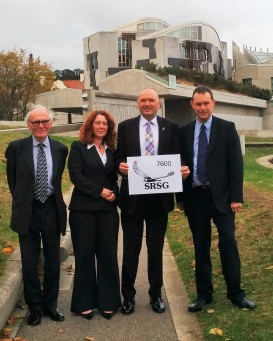
Also in 2016, the Scottish Raptor Study Group (SRSG) launched a petition to the Scottish Parliament calling for the introduction of a state-regulated licensing system for gamebird shooting. These volunteers who later spoke so passionately and convincingly in front of a televised Parliamentary committee in 2017 were subjected to a barrage of offensive online abuse from a number of gamekeepers and their hangers-on and this hate campaign continues to this day.
[SRSG members Patrick Stirling-Aird, Andrea Hudspeth, Logan Steele and Duncan Orr-Ewing outside the Scottish Parliament building. Photo by SRSG]
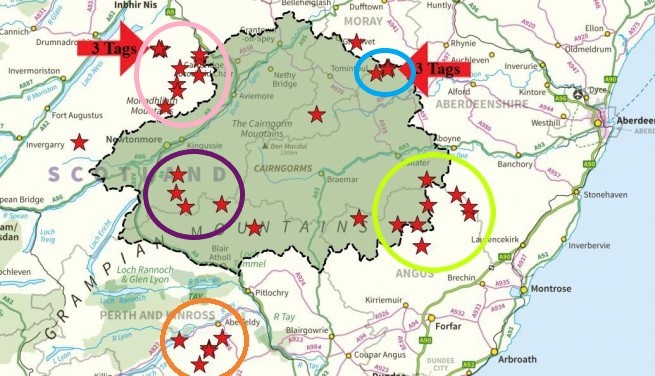
2016 also saw what in my opinion was the most significant and important event in the road leading to the introduction of grouse moor licensing. The RSPB published a press release about the suspicious disappearance of eight satellite-tagged golden eagles on grouse moors in the Monadhliaths between 2011-2016. Public outrage about this news, combined with the fact that nobody had ever being successfully prosecuted for killing a golden eagle, led to then Environment Cabinet Secretary Roseanna Cunningham calling for a review of golden eagle satellite tag data to establish whether there was a pattern to the disappearance of tagged eagles and whether there was a link with driven grouse shooting. Of course we all knew there was, but it was significant that the Cabinet Secretary had officially requested the analysis. Predictably, this Government-sponsored review coincided with a concerted smear campaign by the grouse shooting industry to undermine the functionality and reliability of satellite tags and the integrity of the highly qualified and licensed researchers who were fitting the tags to eagles. This continues to this day.
In 2017 the review of gamebird management in other European countries was published, showing that gamebird shooting in the UK was the most unregulated and unaccountable system of all those reviewed. This didn’t result in any direct action from the Scottish Government other than an instruction for the Werritty panel to consider the report’s findings as part of its Grouse Moor Management Review.
Also in 2017 Cabinet Secretary Roseanna Cunningham responded to the public consultation on increased SSPCA powers (3 yrs after the consultation closed!) & rejected it ‘based on legal advice’ which was never explained. As an alternative, she announced a Police Special Constables pilot scheme in the Cairngorms National Park to help detect raptor persecution crimes and bring the offenders before the courts.
The most significant event in 2017 was the publication of the Golden Eagle Satellite Tag Review. This comprehensive and forensic review was devastating, showing that almost one third of satellite-tagged golden eagles (131 of them) had been illegally killed or had ‘disappeared’ in suspicious circumstances between 2004-2016, and there were irrefutable geographic clusters centred on some driven grouse moors:
On the basis of this report, Cabinet Secretary Roseanna Cunningham ordered yet another independent review, this time to assess the environmental impact of grouse moor management and to provide recommendations and options for regulation, including the potential for a licensing scheme. Professor Werritty was appointed to lead the review.
In 2018 REVIVE was launched – a consortium of environmental, social justice and animal welfare groups seeking grouse moor reform in Scotland. The well-attended launch took place in Edinburgh and Chris Packham was the keynote speaker. Inevitably this led to yet another smear campaign by certain elements of the grouse shooting industry which continues to this day.
[Photo by REVIVE]
In 2019 the Police Special Constables pilot scheme in the Cairngorms National Park came to an end in complete failure. They didn’t report a single wildlife crime during this two-year scheme but illegal raptor persecution continued, as evidenced by the RSPB’S annual reports.
In December 2019 the Werritty Report was finally published two and a half years after it was commissioned. It highlighted many of the problems associated with driven grouse moor management but crucially it recommended a further five-year wait before the introduction of a licensing scheme to allow the grouse shooting industry yet more opportunity to oust the criminals within rather than have regulation foisted on it by legislation. This recommendation was clearly a result of having a number of representatives from the grouse shooting industry serving on the so-called independent panel. Meanwhile, the raptor killing continued.
In 2020 MSP Mark Ruskell (Scottish Greens) proposed increased powers for the SSPCA as an amendment in the Animals & Wildlife Bill. The then Environment Minister Mairi Gougeon rejected the amendment but promised to establish a task force later in summer to consider increased powers. Deja vu, anyone?
In November 2020 the Animals and Wildlife (Penalties, Protections and Powers) (Scotland) Act was enacted, increasing the maximum penalty for the most serious animal welfare and wildlife crimes to five years imprisonment and unlimited fines (after the recommendations of the Poustie review published in 2015). This raises the status of some offences to ‘serious’ and thus for the first time allows the Police to seek permission to utilise covert video surveillance in areas where raptor persecution is suspected. I know there is enthusiasm for this from a number of police officers and I look forward to seeing some results.
In December 2020, a year after receiving the Werrity Review, Environment Minister Mairi Gougeon announced the Scottish Government’s intention to introduce a licensing scheme for grouse moors without waiting for a further five years as the review had recommended.
[NB: I understand that Ian Thomson, Head of Investigations at RSPB Scotland will publish a blog later today (26th November 2021) detailing what has happened in the year following this announcement. I will publish the blog here when it’s available]. Update – Ian’s blog available here
In January 2021 the new Environment Minister Ben MacPherson responded to a Parliamentary Question from Mark Ruskell MSP and admits that the promised taskforce to consider increased powers for the SSPCA had not yet formed but was ‘expected later this year’. This is ten years on from when increased powers for the SSPCA was first mooted in the Scottish Parliament.
In September 2021 the Scottish Government published its five-year Programme for Government and it included commitments to deliver the recommendations of the Werritty review, and to establish a taskforce to review increased powers for the SSPCA, to report by the end of 2022. Yet another Environment Minister (the 9th one?) is in post – Mairi McAllan.
In October 2021 the ridiculous Heads Up for Hen Harriers ‘partnership’ project was closed, with SNH declaring it a ‘success’. It wasn’t, at all. I’ll be blogging about this separately in the next few days.
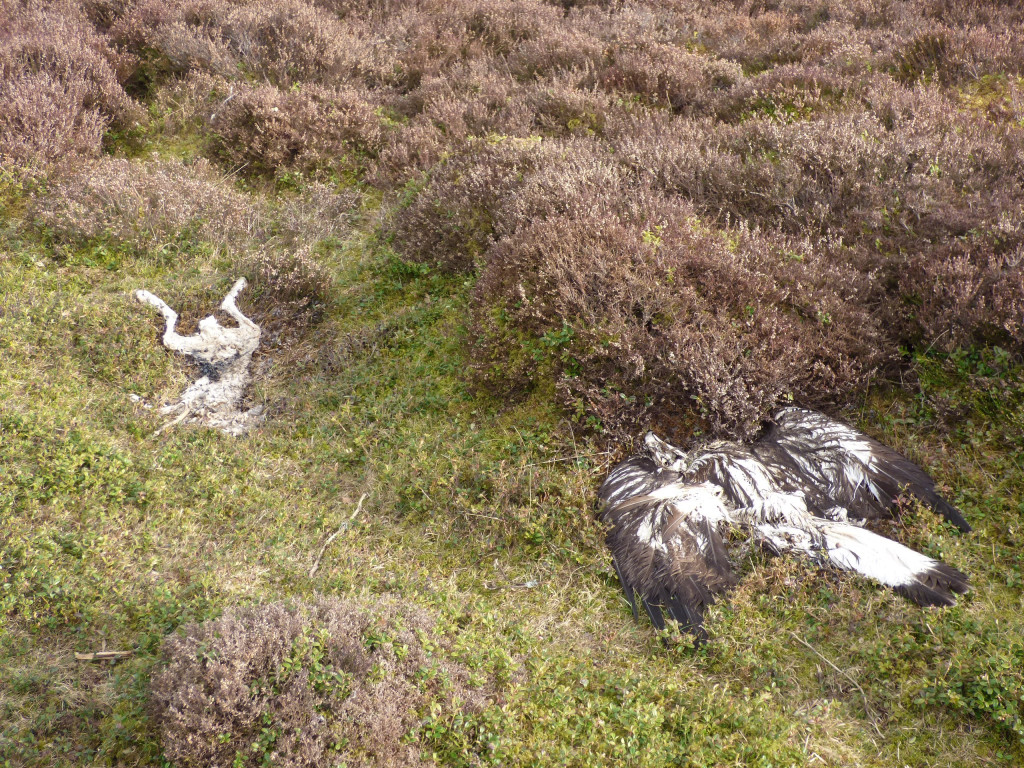
Meanwhile, in May 2021 a young golden eagle was found deliberately poisoned, lying dead next to a poisoned bait, on an Invercauld Estate grouse moor inside the Cairngorms National Park. Sixty-seven years after raptors gained legal protection and 23 years after Donald Dewar declared raptor persecution in Scotland ‘a national disgrace’, golden eagles and other raptors are still being illegally killed on some driven grouse moors.
[The poisoned golden eagle, next to the poisoned hare bait, on a grouse moor on Invercauld Estate in the Cairngorms National Park in May 2021. Photo by RSPB Scotland]
So despite all this campaigning and political movement, nothing has changed on the ground. Golden eagles (and other raptor species) are still being killed on grouse moors, even inside the Cairngorms National Park, and still not one person has been successfully prosecuted.
It’s shameful that we, ordinary members of the public, have to campaign just to have the law upheld, but its even more shameful that despite decades of compelling evidence, the Scottish Government has still not taken effective action against the criminals within the driven grouse shooting industry.
Even so, we should absolutely celebrate how far we have come, and it’s been hard work and at great personal cost to many, but don’t underestimate just how much more work there is to come.
Yesterday, the BBC’s News at Six included a five-minute feature on the rewilding of grouse moors in Scotland.
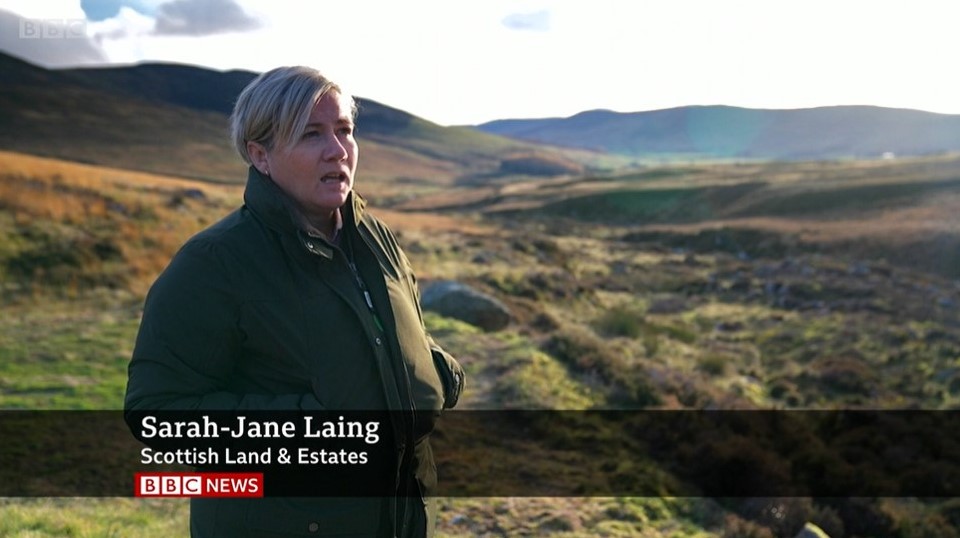
Contributors included Thomas MacDonnell of Wildland, Chief Executive of grouse moor lobby group Scottish Land & Estates Sarah-Jane Laing, and Magnus Davidson from the University of the Highlands & Islands.
It’s available on BBC iPlayer but only until 6.30pm this evening. You can watch it here (starts at 24.44 mins).
The enormous environmental costs of managing moors for driven grouse shooting were hardly covered at all – there was a bit in the introduction to the piece from Huw Edwards, and this sounded promising:
‘One of those crucial aspects [of national life in Scotland] is the future of the Scottish Highlands. Vast areas of the countryside are being bought by wealthy individuals keen to return the land to its natural state. They want to introduce the process of rewilding as it’s called, and to stop what they say is ecological degradation, deforestation and loss of biodiversity‘.
However, the piece itself was lacking. There was a little bit about the need to remove deer to allow vegetation regeneration but there was absolutely nothing on the impacts of muirburn, or on the serious organised crime that facilitates the illegal shooting, trapping and poisoning of birds of prey such as golden eagles and hen harriers. Nothing on the use of hundreds of thousands of traps and snares to kill other birds and mammals to enable an excessively artificial number of red grouse to be put in front of the gun-toting bloodsports enthusiasts, or on the mass use of toxic veterinary drugs spread across the moors, or on the mass dumping of toxic lead ammunition across the moors, or on the vast public subsidies enjoyed by many of these private estates etc etc.
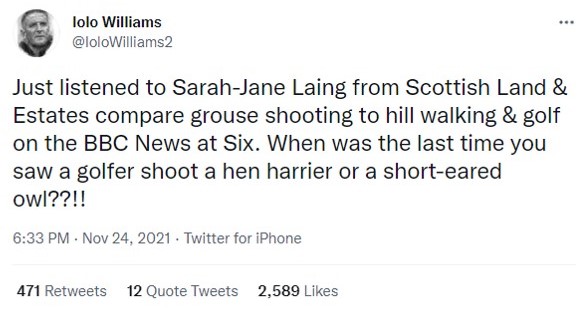
Instead, there was this from Sarah-Jane Laing (Scottish Land & Estates):
“The idea that nothing else happens apart from grouse shooting on grouse moors is just not true. You know, what you see is a balanced approach to managing the landscape so that you can give the best possible chance for a wild bird to thrive and it’s only the surplus which are shot.
And country sports, yes, it’s a pleasure, in the same way that golf and hill walking and other things which happen in Scotland and are celebrated are, you know people come from all over the world because Scotland has the best grouse shooting globally and that’s something we should celebrate“.
None of this was challenged.
Here’s Iolo Williams’ response on Twitter last night:
It’s good that the issue of rewilding grouse moors is featuring on the BBC News at Six but it has to be far better informed than last night’s programme.
For readers new to the issue and wanting to learn more, I recommend visiting the website of REVIVE, the coalition for grouse moor reform (here).
Press release Wildlife & Countryside Link (25th November 2021)
Rising reports of wildlife crimes during the pandemic spark fresh fears for beloved species
Reports of wildlife crimes against many species rose between 35-90% in 2020
At the same time convictions on key types of wildlife crime fell by 50%+
Nature experts are calling for improved recording and monitoring, better targeting of resources, and enhanced use of expert police and prosecutors to tackle wildlife crime
A new report published today (25 Nov) by nature experts has revealed a worrying increase in reporting of wildlife crimes against badgers, fish, birds of prey, and marine mammals during the pandemic. While a sharp decline in convictions for wildlife crimes including hunting, illegal wildlife trade, and fishing crime was also seen in 2020.
Reports of likely crimes against badgers rose by 36% in 2020, compared to 2019, with reports of potential fishing crimes up by more than a third (35%) and marine mammal incident reports (in Cornwall alone) rising 90%, according to data gathered by the NGOs. The number of confirmed raptor crimes in England & Wales in 2020 was almost double that in 2019, rising from 54 to 104 (the worst year for bird-crime ever as detailed by the RSPB in October).
At the same time fishing crime convictions fell by almost two-thirds from 2037 in 2019 to 679 in 2020, and illegal wildlife trade convictions halved to just 4 convictions. Hunting prosecutions also more than halved, from 49 in 2019 to 22 in 2020, with only 8 convictions. Hunting conviction rates have in fact steadily decreased for the last five years, falling from 54% of prosecutions being successful in 2016 to less than a third (32%) of prosecutions achieving conviction in 2020.
Martin Sims, Director of Investigations at the League Against Cruel Sports and Chair of Wildlife and Countryside Link’s Wildlife Crime group, said: ‘‘Wildlife crime is something that should concern everyone –it inflicts pain, harm and loss for much-loved wildlife and fuels wider criminality against people and property. Despite this the police still don’t gather centralised data on these serious crimes, leaving an incomplete picture from charities, which could be just a drop in the ocean of wildlife crimes. It is high time the Government steps in to treat wildlife crime with the seriousness it deserves. Making key crimes notifiable would enable police forces to better target resources, and track repeat offenders. While better police and prosecutor training and resources would help raise the pitiful 32% conviction rate for hunting prosecutions alone. The system must change to crack down on offences against nature once and for all.”
Dawn Varley, Acting CEO of the Badger Trust, said: “Badger crime has been a UK Wildlife Crime Priority for more than a decade, due to the scale of persecution – but sadly this persecution shows no sign of letting up. 2020 saw reports of badger crime rise, driven in large part by a shocking 220% increase in reports of developers interfering with badger setts. A small minority seem to see badger habitat protections as an inconvenience to be quietly bulldozed over, rather than a legal requirement to conserve an iconic British mammal. 2022 must see renewed work by police forces and the Crown Prosecution Service to bring offenders to justice. This must be supported by better monitoring, new training to enable officers and prosecutors to demonstrate criminal intent, and consistently tougher sentencing to deter these crimes.”
Mark Thomas, RSPB Head of Investigations UK, said: “In the wake of an emergency climate conference and with all life on earth facing an uncertain future, there has never been a more important time for urgent action to end the illegal killing of wildlife. Wildlife declines are already being felt, and species can ill afford to face the additional pressure of being brutally shot, trapped or poisoned; nor should the public have to put up with these crimes taking place in the wild places they go to for refuge.
“Bird of prey persecution reached unprecedented heights in 2020, particularly where land was managed for gamebird shooting. And it is certain that more crimes will have been committed and simply gone undetected and unreported. We urge the public to report dead or injured birds of prey in suspicious circumstances to the police and the RSPB, or pass on any information which may help lead to a conviction.”
[One of two dead peregrines found illegally poisoned near Tadcaster, North Yorkshire in 2020. Photo RSPB]
The lockdowns and restrictions of 2020 appear to have contributed to rises in reporting of wildlife crimes and falls in convictions in several ways. Opportunistic offenders may have felt that with the police busy enforcing social restrictions that wildlife could be harmed with relative impunity. With increased use of the countryside in the pandemic more members of the public were also present to witness and report incidents of concern. COVID-19 pressures around social restrictions and staff absences appear also to have unfortunately reduced the capacity of police forces and the Crown Prosecution Service, and their ability to both bring hunting and fishing cases to trial and achieve convictions.
While today’s report reveals worrying figures, with impacts for treasured species like badgers, buzzards, kestrels, seals, dolphins and bluebells, it gives an incomplete picture. These organisations all collect data in different ways, with many only holding figures on reporting and convictions for incidents where members of the public have directly contacted them. There is a huge lack of information on wildlife crimes due to police not being required to officially record wildlife offences. Most wildlife crimes are recorded as ‘miscellaneous’ offences and are therefore invisible in police records, with no duty to be reported upon. The scale of wildlife crime is therefore likely to be far greater than the data collected by NGOs suggests.
The 16 wildlife organisations behind today’s report are warning that the way wildlife crimes are handled by both the police and Crown Prosecution Service must be reviewed and improved, if offences against treasured British wildlife are to be tackled. In particular, the new report highlights that the continued absence of dedicated recording for wildlife crimes means that resources cannot be effectively assessed and targeted. A lack of expertise and resource for police and prosecutors, and deficiency of sentencing guidelines, is also leading to failures in convicting criminals and inadequate penalties for crimes.
Nature experts and conservationists are calling for several key actions to better tackle wildlife crimes:
Make wildlife crimes recordable – A shortlist of wildlife offences (compiled by the National Wildlife Crime Unit) is being considered by the Home Office for notifiable status. This must be approved in 2022 to bridge the crippling wildlife crime data gap and help target resources effectively.
Ensure effective police & prosecutor action – Staff with expert training on wildlife crimes are critical to effectively building and prosecuting a case against these criminals. Also key is early coordination between the CPS and police on cases, and ensuring prosecutors have adequate preparation time for cases. Ensuring police and CPS training and process reflects this is vital.
Produce sentencing guidelines – Unlike most other crimes, the Sentencing Council provides no sentencing guidelines for wildlife crimes. This must be rectified to ensure sentencing consistently reflects the seriousness of these crimes and acts as a deterrent to criminal activity.
The new report has been written and published by Wildlife and Countryside Link, the biggest coalition of wildlife and environment charities in England, and Wales Environment Link, a network of environmental, countryside and heritage non-governmental organisations with an all-Wales remit. Both operate as part of a UK-wide coalition – Environment Links UK.
Organisations supporting today’s report include: Amphibian and Reptile Conservation, Badger Trust, Bat Conservation Trust, Buglife, Four Paws, Humane Society International UK, IFAW, Institute of Fisheries Management, League Against Cruel Sports, National Trust, Naturewatch Foundation, Plantlife, RSPB, Whale and Dolphin Conservation, Wild Justice and WWF UK.
UPDATE 12.45hrs: Coverage of this new report in The Guardianhere
UPDATE 13.00hrs: Coverage on Farming Today (starts at 06.20min) interviewing Mark Thomas, Head of RSPB Investigations here
Crikey, it’s coming to something when The Times (Scottish edition) headlines with this:
Royal family ‘hypocritical’ to have grouse shooting at Balmoral.
This paper is not known for its criticism of the establishment and especially not of establishment hobbies such as driven grouse shooting (e.g. it was only on Sunday the paper was publishing what looked very much like an attempted stitch-up of Chris Packham at the behest of a load of gamekeepers (or more likely the gamekeepers’ masters)).
Anyway, today’s headlining article is very welcome. I’m afraid it sits behind a paywall but as it’s based on the writing of Nick Kempe, whose brilliant blog ParksWatchScotland should be a must-read for anyone interested in the mis-management of Scotland’s two national parks, the Cairngorms and Loch Lomond & the Trossachs, then I’d encourage you to cut out the middle man and go direct to Nick’s blog.
The blog post on which today’s article in The Times is based is this one:
COP26, the Royal Family and the failures of the Cairngorms National Park, published by Nick on 12th November 2021 and can be read here.
And if that whets your appetite, there’s now a follow-on blog called:
The £23m sale of the Abergeldie Estate – the Royal Family should pay for their environmental damage, published by Nick on 22nd November 2021 (here).
It’s a fascinating and useful discussion which will help inform your reaction the next time you hear a senior Royal claiming green / conservation credentials.
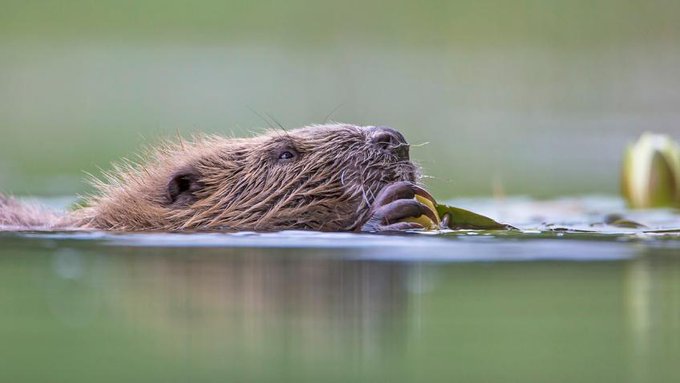
Further to the blog posted on 22nd October 2021 about Scottish charity Trees For Life‘s successful judicial review challenge against the shooting of beavers and the potential consequences of that ruling on the ‘control’ of other protected species such as birds of prey (here), today the Scottish Government has made a complete u-turn and has announced it now supports translocation (of beavers) over lethal control.
This is a massive and hard-won result for all those campaigners who have spent considerable time and effort over a number of years to force a change of policy. Brilliant work, well done to all of them!
[Photo by Scotland The Big Picture]
Here is a press release from Trees For Life (24th November 2021)
Breakthrough for Scotland’s beavers a win for nature, climate and farmers
The Scottish Government today announced a new approach to actively expand Scotland’s beaver population, through more use of translocation to new areas of Scotland outside of beavers’ current range rather than lethal control to deal with negative beaver impacts.
Responding to the announcement, Trees for Life’s Chief Executive Steve Micklewright said: “This is a rewilding win for Scotland’s wildlife, climate and farmers. After almost half a millennium, the country is set to welcome beavers back properly at last.
“Allowing these habitat-creating, biodiversity-boosting, flood-preventing animals to be relocated across Scotland – to where they are needed and wanted, away from prime agricultural land, and in a way that works for farmers – offers hope for tackling the nature and climate emergencies.
“It’s a wonderful result 16 months to the day that we launched our campaign for Scotland’s beavers, which has seen almost 17,000 people sign the most successful petition to the Scottish Parliament in over a decade, our successful court case in which a senior judge ruled that NatureScot’s beaver-killing licences have been unlawfully issued, and 66% of Scots say they back relocation not killing of beavers.”
Trees for Life says ministers now need to lay out clearly that the Government and NatureScot will ensure proper support for farms and communities wanting to reintroduce beavers to new sites of suitable habitat – including through a simplified process that doesn’t tangle applications up in needless red tape. The Government should ensure practical and financial support for farmers – including a beaver relocation service, and access to timely and efficient advice and resources.
The Government’s announcement comes days before the Scottish Parliament’s Net Zero, Energy and Transport Committee is due on 30 November to consider Trees for Life’s petition to the Scottish Parliament calling for the Government to relocate rather than shoot beavers.
The Government’s previous refusal to allow beavers to be relocated to new areas of Scotland, even though NatureScot has identified over 100,000 hectares of habitat, had left Tayside farmers whose crops are damaged by beavers with little option but to apply for a culling licence.
Since the Government legally protected beavers in 2019, its nature agency NatureScot has allowed over 200 beavers to be killed under license – despite laws under which beavers are a protected species which should not be killed unless there is no satisfactory alternative.
NatureScot’s failure to make licensed killing of beavers a last resort was challenged by Trees for Life’s judicial review, heard by the Court of Session in June. The charity’s crowdfunder for the case was supported by over 1,500 people and raised over £60,000. Lady Carmichael ruled that NatureScot had ‘erred in law’ when issuing licences authorising the deaths of over 200 beavers.
Beavers create wetlands that benefit other wildlife, soak up carbon dioxide, purify water and reduce flooding, but the animals sometimes need managing if they cause damage to farmland.
Trees for Life is dedicated to rewilding the Scottish Highlands. See treesforlife.org.uk.
The British Birdwatching Fair (known to many as simply Birdfair) has come to an end, at least in the location and format we all knew: an annual event celebrating the world of birds which took place over three days in late August at Rutland Water.
This morning an announcement was sent to all previous participants by the Birdfair team, as follows:
Statement from Dr Anthony Biddle, Chair LRWT:
It is with great regret that Leicestershire and Rutland Wildlife Trust (LRWT) has made the decision to no longer run the annual Birdfair staged at Rutland Water Nature Reserve.
For over 30 years, LRWT, supported by its staff, volunteers and members, has been proud to run this internationally-renowned event. Working with our co-promoter, the RSPB, we have brought thousands of visitors to Rutland Water Nature Reserve for three days each August, and overall have raised more than £5 million for overseas projects run via the Birdlife International group of charities. We are immensely proud of this achievement in global wildlife conservation.
The global pandemic has had a significant effect on our day-to-day operations as a charity. Like many other similar institutions, we have seen income streams lost or reduced, with resultant significant impact on our financial reserves and thus the delivery of our charitable work.
Birdfair operations have contributed to these financial concerns. When Covid struck, we were obliged to cancel the 2020 event. We could have chosen to close the gates of Birdfair for good at that point. Instead we decided to press forward with evolving the event and continuing the Birdfair legacy. Our innovative Virtual Birdfair, held in 2020, showed how new digital techniques could be harnessed effectively to communicate with the public and spread the Birdfair message.
However, to continue Birdfair operations, we had to obtain external funding from the National Lottery Heritage Fund, as well as a loan from the Royal Society of Wildlife Trusts to support our working capital. Despite these measures, Birdfair operations made a loss of over £19,000 in Financial Year 20/21, which is wholly borne by LRWT itself. These stresses were exacerbated by the prolonged Covid measures which meant that an event in 2021 was also not viable.
The impact of Covid has meant that we have had to take a long, hard look at our commitment in operating Birdfair.
Birdfair proceeds have always been donated in full to Birdlife International. LRWT has never received any part of this, but we have nevertheless borne all the risks and liabilities. Moreover a large part of our staff team have had to devote significant time to its preparation and running over the years, supported by our remarkable team of 341 Birdfair volunteers. This is a significant burden for any organisation, let alone a small, local, charity such as ourselves.
LRWT’s focus now has to be on our recovery from the financial impacts of Covid, and on our new forward strategy ‘30 by 30’, which aims for 30% of land managed for wildlife by 2030.
We also need to be aware that the world has changed markedly over the past two years. One realisation in particular is that a vastly disrupting event such as the global pandemic we are still experiencing may not be uncommon in future.
Other concerns have also been key to our decision.
Firstly, the current format of Birdfair is heavily influenced by travel and tourism. The carbon footprint generated both by the event itself and the activities it promotes does not now fit well with our own strategy towards tackling the climate crisis.
Secondly, we have become concerned about the impact the event might be having on Rutland Water Nature Reserve itself in terms of compaction of soil in the site area. Whilst our studies have not been conclusive so far, our stewardship of the Nature Reserve has to be taken seriously. On balance, we believe the risk to the site itself, and also to LRWT’s reputation should the site become damaged, outweigh the benefits of the event continuing at the Nature Reserve.
We conclude that in this overall scenario, continuing to run Birdfair in its current form presents LRWT with unsustainable financial, ecological and reputational risk. We feel that if it were to continue, then the event would need a radical rethink in terms of content and format. Given the other factors to our decision I have noted, LRWT does not have the resources to take up this challenge.
We have thought long and hard about all these concerns, and the decision has been an extremely difficult and sad one. But we knew that it was now time to make the future clear, in the interests of the event, and of everyone who is involved in it or supports it.
We hope the legacy of Birdfair may live on in similar events, run by organisations with greater resources than our own.
Although we are bringing our involvement with Birdfair to a close, we are pleased to be able to announce a donation of £15,005 to Birdlife International. This amount is made up of direct donations and auction proceeds in aid of their Helmeted Hornbill conservation project supported by our Virtual Birdfair in 2020.
We send our thanks to all our sponsors, exhibitors, site contractors, and the many wildlife experts and media presenters who have supported Birdfair over the years. Thanks are also due to LRWT’s members, and the tremendous family of Birdfair volunteers, not forgetting LRWT’s Birdfair organisation team, the Rutland Water Nature Reserve site team, our finance team, and Anglian Water. Birdfair could not have existed without these key people.
What’s this got to do with raptor persecution? Plenty – the Birdfair was a venue to reach wide audiences, to raise awareness, to educate, to inform, to learn, and to make connections and gather support for campaigns, several of which were hatched over the years during conversations inside and outside those humid tents.
It’ll be missed but I’m sure someone will see an opportunity to fill the void.
Yesterday the Sunday Times (Scotland) ran an opportunistic piece, presumably at the behest of a load of gamekeepers.
Written by Deputy Editor Mark Macaskill, it was claimed that a ‘moorland consortium’ had invited Chris Packham to visit a grouse moor to watch them set it alight, in response to Chris’s derision of muirburn whilst COP26 was taking place just down the road.
It transpires that the ‘moorland consortium’ in question is the one representing Scotland’s regional moorland groups, some of whose members are either currently, or recently have been, under police investigation for alleged raptor persecution crimes (e.g. members of the Angus Glens Moorland Group, Tomatin Moorland Group, Strathdearn & Speyside Moorland Group, Grampian Moorland Group, Tayside & Central Moorland Group), but this doesn’t appear to be a barrier to getting the deputy editor of the Times to publish favourable articles. Friends in high places, no doubt.
Anyway, a quote from the moorland groups’ co-ordinator, Lianne MacLennan, included this line:
“There is an opportunity to foster a better understanding and take the heat out of a polarised debate“.
I spoke to Chris about this and at the time of writing, Chris hadn’t received the invitation but he was still pushed for a quote by Macaskill. That quote was then minimised in the print edition of the article (apparently due to lack of space) and not fully presented even in the digital edition, where space is not an issue.
It’s strange that when journalists ask for a quote they don’t use it in full. This happens a lot.
Here is Chris’s quote, in full:
“Thank you for the invitation. Whilst I have a genuine desire to reach a point when real conservationists and some of the responsible factions of the game shooting industry can again sit around a table and make progress, I fear we are not yet at that point.
So I would gladly visit an estate to witness the burning . . . as long as I was also shown the whereabouts of all the graves of illegally killed raptors were buried. Until the wholesale slaughter of our precious birds of prey ends, I’m out. Its an intractable blockage to progress – stop the killing and we can start talking. And also, science, proper science, isn’t about whether Mars Bars get singed or not. Just saying . . .“
[Chris with the corpse of a male hen harrier that had been caught in a barbaric trap that had been set illegally next to the harrier’s nest on a driven grouse moor. Photo by Ruth Tingay]
Here is a copy of the digital edition of the article:
Packham urged to take heat out of moorland burns
Mark Macaskill, Sunday November 21 2021
Chris Packham has declined an invitation to witness the controlled burning of Scottish moorlands after his comments during the Cop26 climate talks that Scotland was “sticking two fingers up” to a world in ecological crisis.
The naturalist and host of BBC Winterwatch, who was the victim of an arson attack at his home in Hampshire last month, used social media to highlight muirburn, which he believes contributes to carbon emissions and should be banned. He was accused of claiming, falsely, that peat, a natural carbon store, was being burnt on grouse moors.
In an effort to “take the heat” out of the debate, a moorland consortium asked Packham to be their guest on a Scottish estate to see muirburn in action.
Packham said that he was willing to engage with the shooting industry but pointed to the illegal persecution of birds of prey as a stumbling block.
“Whilst I have a genuine desire to reach a point when real conservationists and some of the responsible factions of the game shooting industry can again sit around a table and make progress , I fear we are not yet at that point . So I would gladly visit an estate to witness the burning . . . as long as I was also shown the whereabouts of all the graves of illegally killed raptors. Until the wholesale slaughter of our precious birds of prey ends , I’m out . Its an intractable blockage to progress – stop the killing and we can start talking.”
Bodies such as the Scottish Gamekeepers Association (SGA) insist that muirburn removes surface vegetation while leaving underlying layers of moss and peat intact. The practice is approved under licence from NatureScot, the government agency.
Environmentalists argue that burning on peatlands releases carbon into the atmosphere, undermining efforts to reduce emissions to help control climate change.
During the muirburn season from October to April it is estimated that the equivalent of 87,000 football pitches is burned.
Lianne MacLennan, co-ordinator of Scotland’s regional moorland groups, said that muirburn was conducted carefully and pointed to a Scottish government report last year which suggested that many bird species fared better where muirburn had taken place, although further research was required.
“Muirburn plays a vital role in preventing the type of climate-busting wildfires that lost a million tonnes of carbon in Moray and the Flow Country in 2019 and can help retain carbon in peatlands,” she said. “ We have written to Chris Packham in the hope he will come out and see what actually happens when trained, professional gamekeepers carry out the activity.”
A letter sent to Packham on Friday stated: “There is an opportunity to foster a better understanding and take the heat out of a polarised debate.”