A trial begins today at Perth Sheriff Court for a Scottish gamekeeper accused of killing a Goshawk on a Perthshire shooting estate.
The alleged incident took place on 12 February 2024 on a shooting estate near Blairgowrie.
Goshawk with a Pheasant. Photo by Ronnie Gilbert.
Police Scotland, with the assistance of partners from the RSPB and Scottish SPCA, executed a search warrant on the estate on 29 February 2024, leading to the arrest of a 47-year-old gamekeeper and subsequent charge (see here).
He has pleaded not guilty.
NB: As this case is live, comments are turned off until legal proceedings have ended.
UPDATE 12 November 2025: Trial of Scottish gamekeeper accused of killing Goshawk now delayed until March 2026 (here)
Press release from Wildlife & Countryside Link (Wildlife Crime sub-group)
Lack of wildlife crime convictions opening the door to other serious crimes
Wildlife and Countryside Link has today released its annual Wildlife Crime Report, highlighting that only 2% of reported wildlife crimes in 2024 resulted in a conviction (excluding fisheries).
The report also reveals startling new statistics on the strong connection between wildlife crime and other serious and violent crimes against people – including criminal damage, domestic violence, burglary and drug crimes.
The report details thousands of protected wild animals are being illegally killed, trapped, or disturbed every year, with offences ranging from badger baiting, hare coursing and raptor persecution to the illegal wildlife trade. Yet the vast majority of offenders face no consequences for wildlife crime. Lack of action on wildlife crime can leave criminals offending more widely, with over 80% of wildlife offenders active in other crimes against people.
Key findings from the 2024 Wildlife Crime Report include:
Nearly 2,000 wildlife crime incidents were reported in 2024 – but only 43 convictions were secured (excluding fisheries). Though this is a rise from 2023, convictions remain too low to be an effective deterrent.
A record low level of hunting convictions since 2017 – just 14 convictions
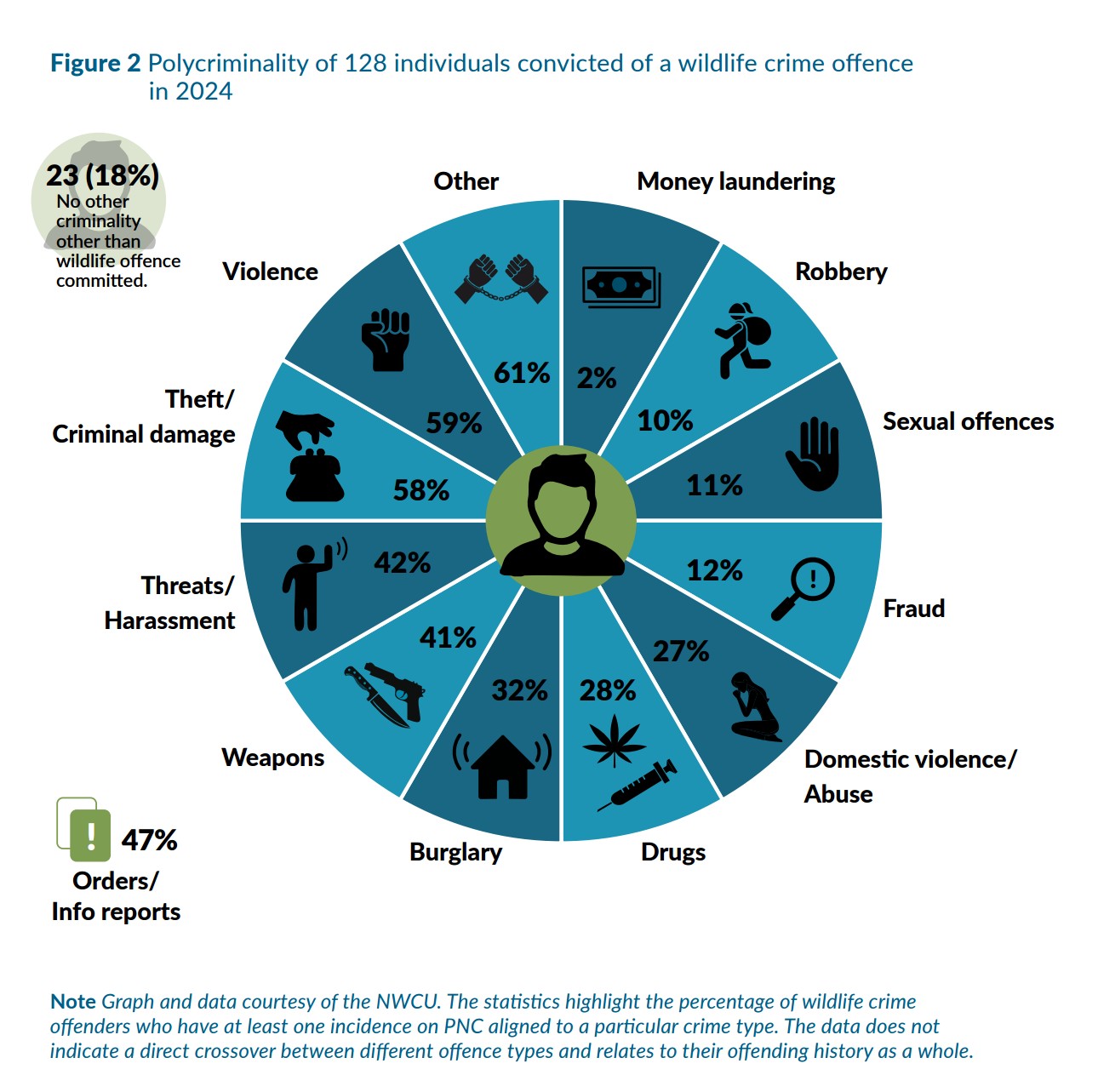
New National Wildlife Crime Unit (NWCU) analysis of data on 128 wildlife criminals also reveals strong connections between crime towards animals and violent crimes towards people. With particularly strong connections to poaching, hare coursing and badger crimes.
Wildlife criminals are most commonly associated with violent offences and theft/criminal damage (59% and 58% respectively). This rises steeply for poaching and hare coursing offenders (72% and 78%) and badger crime offenders (67% and 62%).
The association with organised acquisitive crime (including burglary and rogue trader related fraud) is also strongest in poaching and hare coursing offenders.
Drug criminality is most strongly associated with badger crime offenders (48%).
There is a link to domestic violence and abuse for 27% of all wildlife crime. offenders, but this is strongest in poaching and hare coursing offenders (34%).
Just 18% of all wildlife crime offenders did not have a connection to any other crime besides their conviction.
Richard Benwell, CEO of Wildlife and Countryside Link, said:
“The criminal justice system is failing British wildlife and communities on wildlife crime. Wildlife is being relentlessly targeted by criminals – from brutal badger baiting to birds of prey being shot or poisoned. Yet barely two percent of reported wildlife crimes result in a conviction. This sends a dangerous message that people can kill or harm wildlife and get away with it.
“It’s not just nature at stake. The National Wildlife Crime Unit has shown that those who commit crimes against animals are often involved in serious violence and organised crime. Failing to convict on wildlife crimes leaves the door wide open for these criminals to commit other offences. Better resourcing for police forces and strategically tackling wildlife crime as a recordable offence would help make our streets safer for people as well as protect treasured British wildlife.”
Kevin Lacks-Kelly, Head of UK National Wildlife Crime Unit & Chair INTERPOL Wildlife Crime Working Group, said: “Protecting wildlife is protecting communities. Wildlife crime fuels broader organised offending and damages public safety, the economy and nature. Only a sustained, well-resourced, partnership-led response will stop it.”
A wide array of wildlife crimes is detailed in the new report. Crimes against birds of prey continue to blight the countryside, with hen harriers the most persecuted bird of prey in England, yet no one has ever been convicted for targeting, injuring or killing a hen harrier. Hunting Act breaches remain widespread, with hundreds of suspected illegal hunts still taking place under the guise of trail hunting, and with violent cruel ‘sports’ like hare coursing and badger baiting still rife. Building-related wildlife crime is still highly prevalent, with crimes by developers and individual home-owners against species like bats, badgers, foxes and birds. Marine mammals, including seals and dolphins, are frequently disturbed or harmed, with many cases unrecorded or left unenforced.
Even fisheries crimes, which have been traditionally better resourced and enforced, are seeing resources fall (with a 90% reduction (£10.6m) in the enforcement grant in aid to the Environment Agency since 2010 and falling enforcement revenue from rod licences). Illegal wildlife trade border seizures (of items such as wild plants, traditional medicine products, ivory and other ornaments as well as live wild animals for pets and for food), increased this year by 30%, which is welcome, but we are only aware of 8 CITES prosecution cases since our 2023 report.
Effectively tackling wildlife crime is a key step towards meeting Government commitments to meet its legally binding target to halt and reverse biodiversity loss by 2030. Wildlife and Countryside Link is urging the Government to:
Make key wildlife crimes “notifiable” to the Home Office, so they are properly recorded and prioritised by police.
Introduce sentencing guidelines and tougher penalties for wildlife crimes, in line with other animal welfare offences.
Ban snares and trail hunting, as promised in the Labour manifesto.
Increase police training and resources, including long-term funding for the National Wildlife Crime Unit.
Enforce wildlife protections in planning and development, to prevent illegal harm to habitats and species.
The Scottish Raptor Study Group (SRSG) is saddened to report the passing last week of its long-term Secretary Patrick Stirling Aird at his home in Dunblane, Perthshire. We are extremely fortunate and proud to have had Patrick as our Secretary for more than 20 years. It is believed that Patrick started in this role on 19th February 2000. It cannot be overstated how much of a massive role Patrick has played both for the SRSG and more widely for raptor conservation in Scotland. He will be greatly missed by all of us in the tight-knit Scottish raptor conservation community.
Patrick Stirling-Aird (Photo by Sue Stirling-Aird)
Patrick was an authority on the Peregrine Falcon, his main passion, along with other upland raptor species including Golden Eagles and Ravens. He assiduously monitored these birds in the Central Scotland (CSRSG) and Tayside and Fife Raptor Study Group (TFRSG) areas for decades. Even whilst in his mid-eighties Patrick was out monitoring Peregrines this year, and was still the species coordinator for both Peregrine and Golden Eagle in the Central Scotland Raptor Study Group area.
In his book “The Peregrine Falcon” (New Holland 2012) Patrick claimed to have seen his first Peregrine more than 40 years ago, so going back to the early 1970s. He said it was these first sightings, and the recognition of the Peregrine as an “ecological barometer”, that got him involved with formal raptor monitoring. At this time, raptor monitoring was pioneering work promoted especially by Derek Ratcliffe, who warmly acknowledged Patrick’s work and influence in his own monographs on the Peregrine and Raven. In the 1970s and when Patrick took up raptor monitoring in west Perthshire, the Peregrine had of course become an extremely rare breeding bird following the pesticide crisis caused by DDT and Dieldrin in the 1960s, and as revealed by those dedicated individuals who monitored Peregrines across the UK at the time.
I first met Patrick in the early 1990s when I became a member of the CSRSG, having moved down from the Highlands. He was the Chair of CSRSG since its formation in 1983 and only stood down from that role ten years ago. Patrick was definitely in charge of monitoring Peregrines, Golden Eagles and Ravens! It amused me at the time that other species including Red Kites, my own passion, were given relatively short attention at meetings! Owls were barely mentioned unless prompted (something that did not change greatly)! The focus was clearly on the three key raptor species – Patrick’s birds! What was also clear was Patrick had huge attention to detail. Patrick was trained and worked as a solicitor and brought this attention to detail to his raptor monitoring. His raptor data record keeping was second to none. When discussing particular raptor sites, he could call on an extensive background history of each site, rigorously documented year by year. If anybody was asked to monitor any Peregrine sites for him or to search certain glens for occupancy, you could expect a full documented history of that site, sometimes going back for over 50 years; detailing alternative sites, productivity; and information on how to access to get the best view of nests.
Patrick’s own study area was along the boundary between the CSRSG and TFRSG areas. He monitored all of the peregrines from Glen Artney up to Glen Almond and across to Stirling for decades. He also monitored the breeding Golden Eagles and Ravens in these areas. However, when discussing other sites for these species in these RSG areas there did not seem to be many that he had missed during his time either! For SRSG nationally in Scotland, and for CSRSG and TFRSG more locally, he coordinated the national population surveys for Peregrine – in particular in 1981, 1991, 2001 and 2014.
By Patrick’s own admission he liked to monitor his birds alone. He also waited impatiently for the good weather to go and do his work on the hill. Characteristically he wore his tweed “plus twos” and deerstalker “fore and aft” hat. When he went out in the field, he tended to spend all day on the hill monitoring one or a small number of sites in a day, observing Peregrines and Eagles for many hours from a distance, noting their behaviour carefully. From my own conversations with folk on the ground whilst out doing my own raptor studies in the same general area I noted the respect that he also carried with the landowners, gamekeepers and stalkers. Patrick always made time to speak to estate owners and their employees both before and after his monitoring visits. In my time, I have rarely heard anybody saying a bad word about Patrick, even when he had to have the difficult conversations with estates about the suspicious disappearance of raptors he was monitoring or their apparently criminal breeding failure! Patrick was calm, forceful and never shied away from conflict.
Sadly in many parts of Patrick’s study area he monitored a decline in numbers of breeding Peregrines in recent decades in line with national trends for this species in the Scottish uplands, however the Ravens have fared well, and the Eagles that he monitored are now largely free from human interference. I am privileged to be amongst the few who have been out on the hill over many years with Patrick and every trip was a learning experience. Patrick had a huge commitment to raptor monitoring above all else.
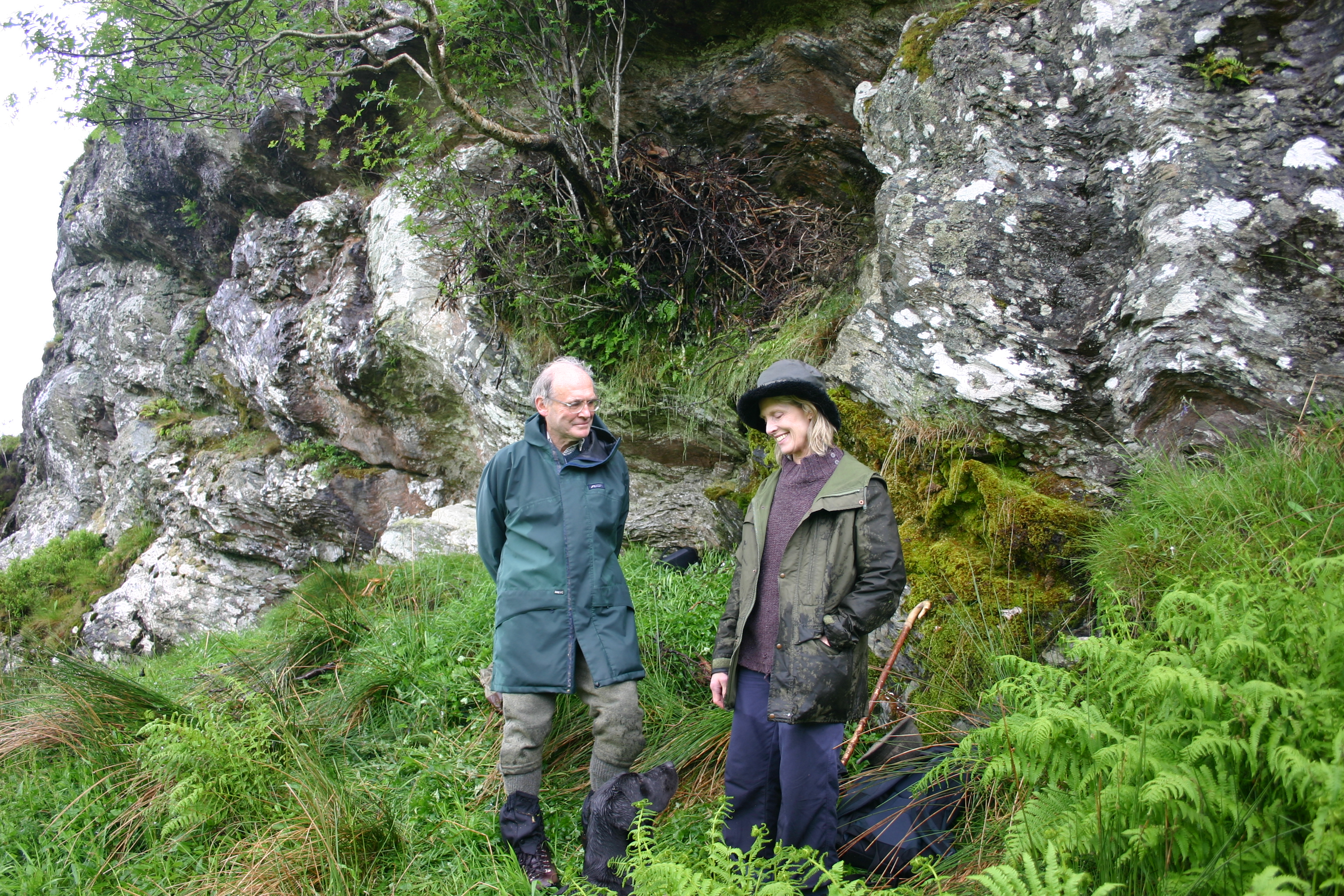
Patrick and Sue Stirling-Aird at a Golden Eagle eyrie (Photo by Duncan Orr-Ewing)
The list of important public roles Patrick undertook over many years as the SRSG Secretary are endless. He was a member of the UK Government’s DETR Raptor Working Group from 1995 to 2000. This initiative was set up originally to tackle what was perceived by the then administration as “the raptor problem”. It ended up meeting 25 times and making 25 recommendations for the enhancement of raptor conservation! Several officials singled out Patrick for special praise for his unstinting contributions to the group. The DETR RWG Report was a seismic moment for raptor conservation in the UK and included the production of the SRSG document “Counting the Cost” which used SRSG data to highlight the continuing illegal persecution of raptors in Scotland, including around Patrick’s own long term Peregrine study area in Central Scotland – “Human interference apparently affected about one fifth of the peregrine breeding population in central Scotland, 18% less young produced in the years 1981-1996”.
In my own role at RSPB Scotland, we used these Report recommendations in the early 2000s to tackle the Scottish Government to do more for raptor conservation. The formation of the Scottish Raptor Monitoring Scheme, in which Patrick was also instrumental, is one very good example of the report’s outcome. Licensing of grouse shooting was secured in Scotland in March 2024 to address systemic illegal persecution of raptors associated with this land use, and this is testament to many decades of hard work by a number of key individuals, who could hold the ring and talk authoritatively about raptors. Patrick played a totemic role in this.
In his role as SRSG Secretary, Patrick represented the SRSG on the Moorland Forum and the Police Raptor Persecution Priority Delivery Group. His controlled persistence in defence of raptors, and against criminal persecution was unique, using his background training and professionalism as a solicitor to maximum effect. No matter how discordant the voices of the those in denial of raptor persecution, Patrick calmly and robustly spoke up for raptors and SRSG fieldworkers. Not a lover of the phrase ‘balance’, he warmed to the closing lines of Derek Ratcliffe in his 2003 foreword to ‘Birds of Prey in a Changing Environment’: “Raptor enthusiasts will have to speak up, and assert their simple conviction that birds of prey are as important as gamebirds or homing pigeons.”
Patrick has served time on the UK RSPB Council and was previously a member of the RSPB Scottish Advisory Committee. He was also on the Scottish Wildlife Trust Council and a member of the BTO Research & Surveys Committee. We in the SRSG community and his family were all absolutely delighted when Patrick was awarded an MBE in 2005 in the New Year’s Honours list for his services to wildlife conservation and this award was subsequently presented at a ceremony at Holyrood Palace. This demonstrated the high regard with which he was held throughout the conservation and political world.
Duncan Orr-Ewing, Head of Species and Land Management, RSPB Scotland and Chair, Central Scotland Raptor Study Group
The Scottish Government’s nature advisory agency, NatureScot, has been now been procrastinating for over 18 months on whether to impose a sanction on an estate in relation to the ‘shooting and killing’ of a sleeping Golden Eagle called Merrick. But apparently a decision is now expected “in the next few weeks”.
Merrick was a young satellite-tagged Golden Eagle, released in south Scotland in 2022 as part of the South Scotland Golden Eagle Project, a lottery-funded conservation initiative which translocated young Golden Eagles from various sites across north Scotland to boost the tiny remnants of the Golden Eagle breeding population in south Scotland that had previously been decimated by illegal persecution and had become isolated by geographic barriers.
Camera trap photo of golden eagle Merrick in 2022, from South Scotland Golden Eagle Project
A year after her release, which had seen her fly around south Scotland and down into northern England and back, on 12 October 2023 Merrick’s satellite tag suddenly and inexplicably stopped transmitting from a roost site in the Moorfoot Hills in the Scottish Borders where she’d been sleeping overnight.
A project officer from the South Scotland Golden Eagle Project went to her last known location where he found Merrick’s feathers and blood directly below her roost tree. Police Scotland later determined from the evidence that she’d been ‘shot and killed’ and that someone had then ‘removed her body and destroyed her satellite tag’ (see here).
There was limited scope for anyone to be charged and prosecuted for killing this eagle unless someone in the know came forward with sufficient evidence to identify the individual(s) responsible. In addition, the prospect of an estate having its grouse-shooting licence withdrawn as a consequence of this crime was zero, given that this offence took place prior to the enactment of the Wildlife & Muirburn (Scotland) Act 2024, the legislation that introduced grouse moor licensing.
That just left a General Licence restriction as a possible sanction. Not that I’d describe a GL restriction as an effective sanction, for reasons that have been explored previously on this blog (e.g. here and here). Nevertheless, it’s still something and, given the high-profile of Merrick’s death, you might think that making a decision on whether to impose a GL restriction would be a high priority for NatureScot.
Not so.
I wrote about NatureScot’s procrastination on this case in August (see here), after receiving a response to a Freedom of Information request I’d lodged in June 2025. That response confirmed that NatureScot had received an information package from Police Scotland, on which it would base its General Licence restriction decision, in April 2024.
I blogged again in September, highlighting that NatureScot had now procrastinated for 17 months. Unbeknownst to me at the time, that blog prompted two blog readers to write to NatureScot, and one of them lodged a formal complaint against the agency.
Blog reader Stuart Wilson has kindly given permission for me to share the response he received recently from NatureScot in relation to his complaint, which is almost identical to the response blog reader SusanH shared on this blog a few days ago on an unrelated post.
This is a guest blog written by Fred Rutter, a 57-year-old business consultant who lives in West London and visits the Scottish Highlands every year.Publication on the RPUK blog does not indicate endorsementof any of the claims made.
WINDFARMS vs WILDNERNESS – THE DESTRUCTION OF COIGNAFEARN
We need renewable energy, so we need windfarms. But wind turbine generators and electrical infrastructure have a significant impact on their local environment. So, what is the balance?
Windmills have sprouted up all over the highlands and now plans are in to install two massive new developments in the Monadhliaths, a magnificent area of pristine, high moorland wilderness and one of the last remaining. Windfarms are proven to have a seriously detrimental effect on local bird populations, (Drewitt & Langston, 2006; De Lucas, Janss, & Ferrer, 2007; Arnett & May, 2016) and the significant study by Duriez, Pilard, Saulnier, Boudarel and Besnard, published: 13 September 2022 on long term populations, showing that even strong, healthy populations go into decline due to collisions, lost of habitat and loss of prey species.
The Monadhliaths stand on the other side of the A9 to the Cairngorms, a place now ruined by too many visitors, mountain bike tracks and Leylandii hedges. As Wikipedia says – “The landscape of the Monadhliath is one of the most ancient in Britain.” It is intact, pristine and perfect. But perhaps not for long.
This is the place where, more than 15 years ago, I saw my first Golden Eagle in the wild, where I saw my first Peregrine in the wild, where I saw my first Hen Harrier. This is the place where Merlins streak across the heather after Pipits, where red deer and wild goats appear over the hillcrest. This is a truly inspirational place where, as a human, you feel small, a place where the silence and sheer magnificence of nature feed your soul!
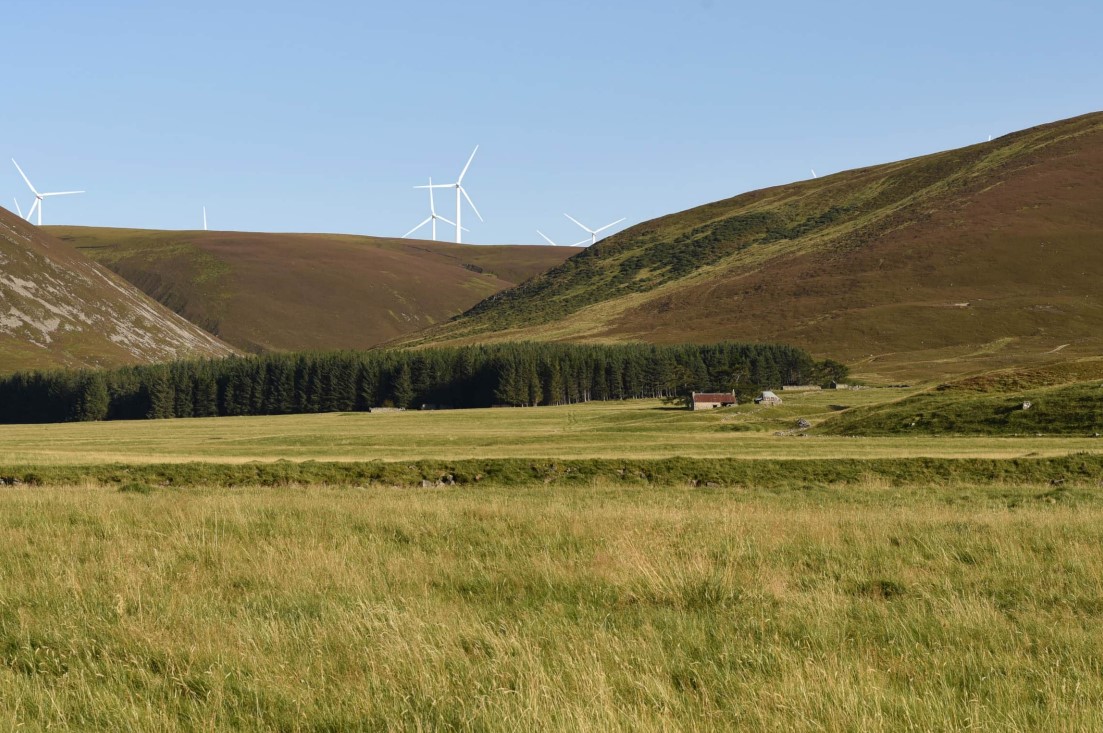
The Findhorn Valley at Coignafearn looking east and west (Fred Rutter)
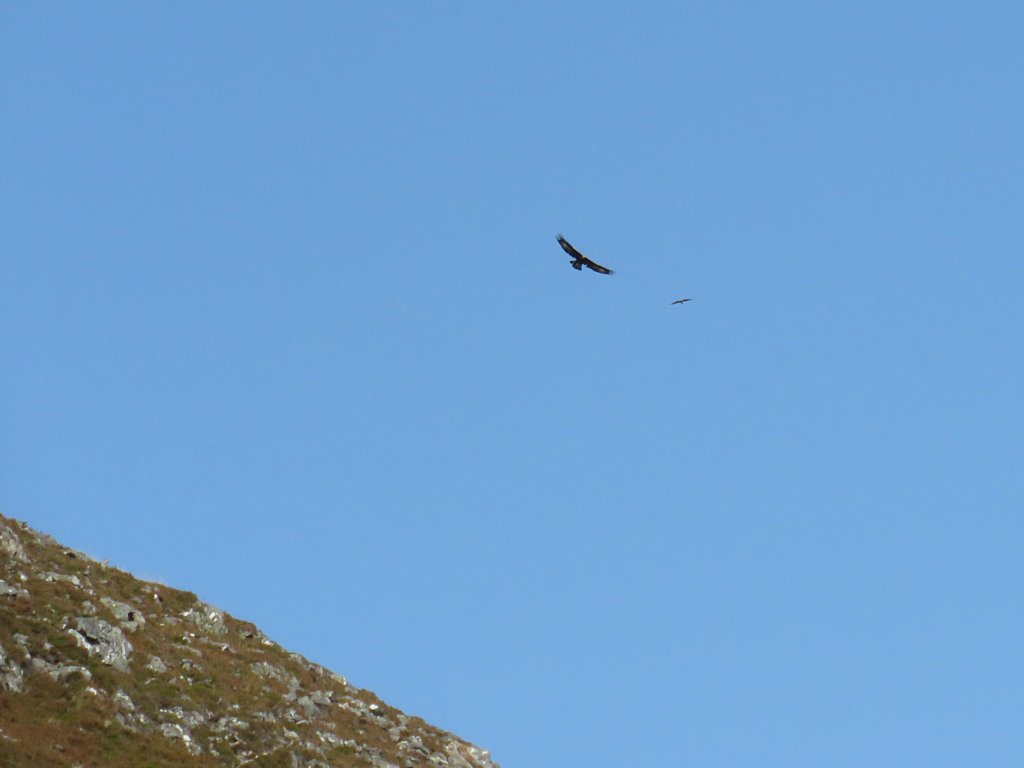
This September, as I stood on the valley floor taking the pics above, a Golden Eagle floated into view over the top, immediately to be mobbed by a kestrel and then yo-yoed by a pair of Peregrines. It was spectacular. If the wind turbines had been installed, that eagle coming over the top, would have been chopped to pieces.
Golden Eagle and Peregrine at Coignafearn (Fred Rutter)
The Monadhliaths have lain undisturbed since the ice retreated. They are home to our wildest of wild, and now they propose to build service roads into the interior, plough through the peat and heather, install great chopping blades where I have watched eagles holding into the wind, install new pylons to carry the electricity and at night all this will be illuminated.
Strathdearn now (Fred Rutter)
Visualisation of Strathdearn with proposed wind turbines
This proposal will complete destroy one of the most inspiring wild places in the UK. And there is no one really there to complain. This is more than a crying shame, this is an outrageous travesty. If this windfarm proposal goes ahead we will have lost one of our last true wildernesses forever. We must come together to protect this magical, magical place. We need wind farms, but this is completely out of balance.
Last month a local campaign group called Friends of the Dales launched a new campaign to raise awareness of illegal raptor persecution in the Yorkshire Dales National Park (see here).
This new campaign from the local community follows the recent collapse of the Yorkshire Dales National Park Bird of Prey Partnership (due to its failure to tackle crimes against birds of prey), and the news that since 2015, 29 Hen Harriers have gone ‘missing’ in suspicious circumstances and almost 40 other raptors have been found poisoned, trapped or shot in the Yorkshire Dales National Park since 2015, including Peregrines, Hen Harriers, Red Kites and Buzzards.
The Friends of the Dales group is planning a series of events as part of its campaign, and it kicked off with a webinar delivered by Kate Jennings, Head of Conservation and Species Policy at the RSPB, who gave a detailed overview about raptor persecution in the UK.
The webinar was recorded and is now available to watch on the Friends of the Dales YouTube channel here.
For more information about the Eyes on the Skies campaign, visit the Friends of the Dales website here.
Three Peregrine chicks that hatched on Worcester Cathedral all died within a few weeks, earlier this spring. Two of the dead chicks were retrieved and sent for post mortem and the results have now shown they died from ingesting poison.
The name of the poison hasn’t been published but a statement by the group who monitor the adult Peregrines at Worcester Cathedral (‘Peregrine Falcons in Worcester’) says, ‘Both birds had internal bleeding consistent with death from poison‘, which suggests the poison was probably a Second Generation Anti-coagulant Rodenticide (SGAR).
The adult breeding pair (known as ‘Peter’ and ‘Peggy’) are fine.
The BBC News website has an article on the news (here) and states that West Mercia Police had received a report but the investigation has closed due to ‘evidential difficulties’.
One of the adult Peregrines at Worcester Cathedral. (Photo from Worcester Cathedral)
A recent report written by Dr Ed Blane and published on the Wildlife Poisoning Research UK website shows that there has been a substantial increase in Peregrine exposure to SGARs, and especially to the poison Brodifacoum. The same issue is affecting Foxes and Otters.
This follows a report published last year ‘Collateral Damage‘ by Wild Justice which reported an alarming increase in SGARs exposure in Buzzards and Red Kites and was heavily critical of the Rodenticide Stewardship Scheme and how the government was ignoring the evidence.
As a result, the Health & Safety Executive, which controls the approval regime in the UK for rodenticides and decides what can and cannot be used, ran a public consultation in September 2025 to look at alternatives to SGARs.
A young Buzzard was found in a field in Leominster, Herefordshire last week, unable to fly.
An x-ray revealed at least two shotgun pellets lodged in its body. It’s not known when the bird was shot, or where.
Photo by Sasha Norris
Photo via Sasha Norris
The Buzzard is currently receiving expert veterinary care from Dr Sasha Norris of Hereford Wildlife Rescue with assistance from Holmer Veterinary Surgery in Hereford and Battle Flatts Veterinary Clinic in Yorkshire.
Sasha reports that the Buzzard was ‘alert, bright and eating well’ this morning.
Following the excellent news yesterday that the Scottish Agriculture Minister Jim Fairlie MSP has committed to closing the loophole on grouse moor licences (here), RSPB Scotland Director Anne McCall has issued the following statement:
“I am feeling cautiously hopeful following an announcement by Jim Fairlie MSP, Minister for Agriculture and Connectivity, promising the Scottish Government will fix an unintended loophole in last year’s landmark legislation to make land management more sustainable through an amendment to the Natural Environment Bill.
“When the Wildlife Management and Muirburn Act was passed in 2024, it was monumental. Scotland finally had legislation to provide a meaningful deterrent to stop the illegal killing of birds of prey linked to grouse moor management, with NatureScot empowered to remove a grouse shooting licence when illegal killing is confirmed to them by Police Scotland.
The illegal killing of birds of prey is directly linked to the management of moorland for Red Grouse shooting. Photo: Ronnie Gilbert
“However, it has become clear that the wording of the legislation means its implementation does not match the original intention of the Scottish Parliament and risks failing Scotland’s wildlife. Currently, landowners can register for a licence for just the land specifically used for shooting. This means that even if a crime was confirmed in another part of the landowner’s holding, for example neighbouring woodland where some birds of prey breed, the licence may not be removed, unless that crime could be specifically linked to management of the grouse moor.
“Our team that works alongside public enforcement agencies to investigate wildlife crime knows all too well how often birds are killed in woodland or nearby farmland rather than on the moors themselves, and that obtaining the level of proof the current licence conditions demand would be exceedingly difficult, especially on a land-holding that may have other gamebird shooting interests.
“An amendment to the Wildlife and Countryside Act, via the Natural Environment Bill, to ensure that a whole sporting estate is included in any grouse shooting licence will remove the unintended loophole in the legislation and ensure that Scotland truly takes a major step forward for wildlife protection and accountability.
“This approach has secured cross-party support thanks in no small part to efforts by Mark Ruskell MSP in highlighting the issue and the risk to Scotland’s reputation.
“We will be keeping a close eye on this, along with other crucial changes to the Natural Environment Bill, as it passes through Parliament“.
ENDS
The Natural Environment (Scotland) Bill is currently at Stage 2 of its passage through the Scottish Parliament. Amendments can be lodged by MSPs up until 13 November and these are expected to be debated on 19 November 2025.









 Raptor Persecution UK