
Scottish gamekeeper and former convicted sex offender Russell Douglas Mason, 49, attended a sentencing hearing at Perth Sheriff Court this morning, after pleading guilty last month to the brutal killing of a Goshawk that he battered to death inside a Crow cage trap on a shooting estate in Perthshire (see here for previous blog with case details).
Here is a press release from the RSPB, following sentencing:
GAMEKEEPER FROM PERTHSHIRE SHOOTING ESTATE FINED FOR BEATING PROTECTED BIRD OF PREY TO DEATH
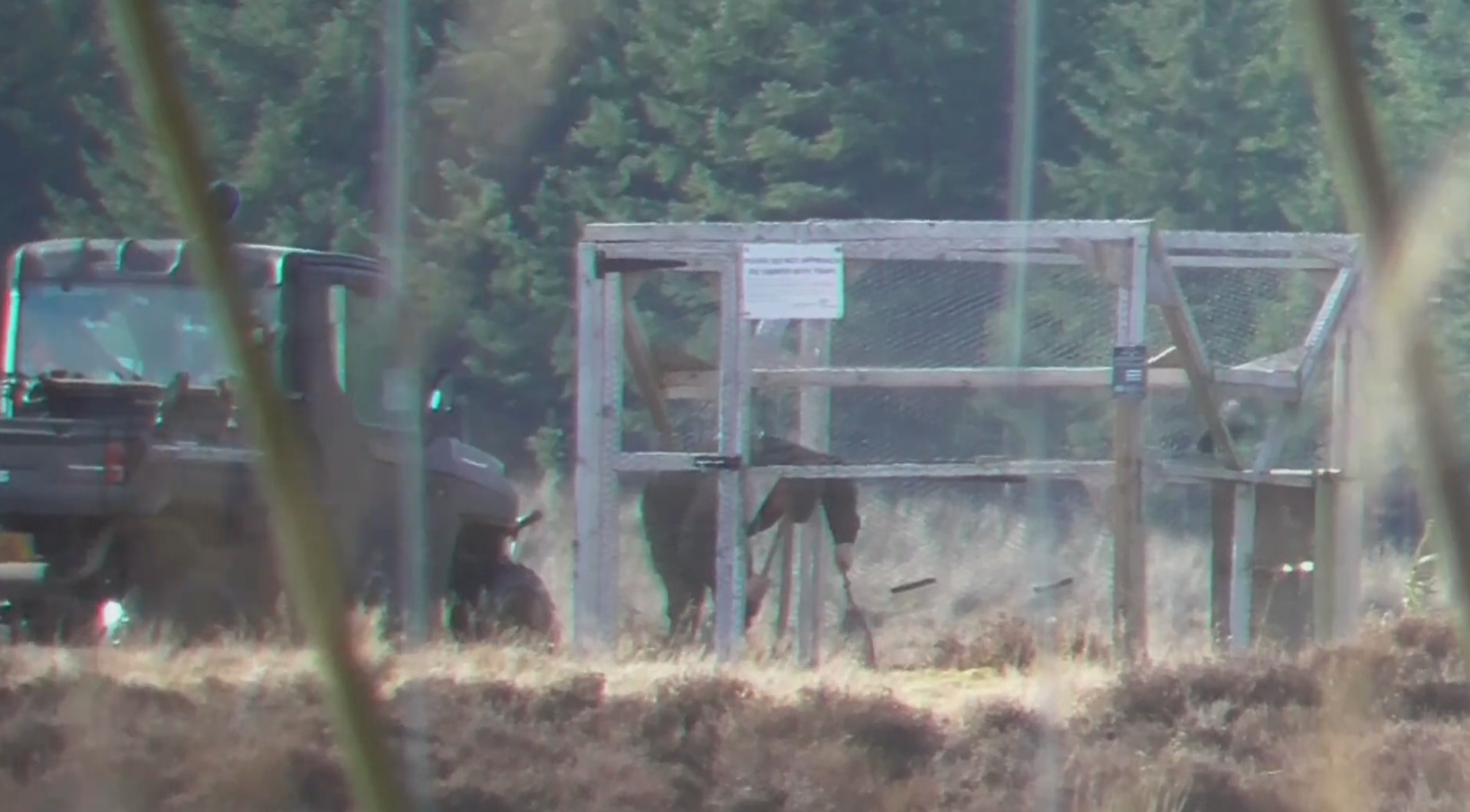
- In February 2024, video footage gathered by the RSPB showed gamekeeper Russell Mason brutally killing a protected Goshawk whilst it was caught in a cage trap near Bridge of Cally, in Perth and Kinross, Scotland.
- Mason pleaded guilty to the illegal killing of the Goshawk and a firearms offence on 17 March 2026 and was sentenced today, at Perth Sheriff Court. He was given a 200-hour Community Payback Order for killing the Goshawk and fined £890 for firearm offences.
- Although cage traps can be legally operated under annual government licences, numerous investigations and convictions have demonstrated that these types of traps are frequently used unlawfully to catch and kill birds of prey on gamebird shooting estates in an effort to remove any potential threat to their gamebird stocks and to maximise gamebird numbers.
In early 2024, RSPB Investigations staff deployed a covert camera to monitor the use of a crow cage trap on the Milton of Drimmie Estate near Bridge of Cally, Perthshire. The footage recorded on 12 February 2024, showed a Goshawk, a specially protected bird of prey, enter the trap and fly around, unable to escape.
Later that day, Russell Mason, a gamekeeper employed by the estate, arrived at the trap in a vehicle. He then unlocked and entered the trap whilst carrying a large, long-handled net in one hand and a short stick in the other. He then captured the Goshawk in the net, pinning it against the ground, and began beating it with the stick. After striking the bird six times he can be seen prodding the bird’s body, then removing the now dead Goshawk from the net and placing it in a plastic bag. After picking up the net and stick, with the bird’s bagged remains held under his arm, he left the trap locking it behind him. He returned to the vehicle and left the scene.
The RSPB’s recording can be viewed below: WARNING, CONTAINS DISTRESSING FOOTAGE
Goshawks are a rare and elusive species. In the late 19th Century Goshawks became extinct in the UK as a result of persecution associated with gamebird shooting and widespread deforestation. Though their population has been recovering in recent decades, Goshawks are still relatively scarce, with an estimated 700-1,200 breeding pairs in the UK. Despite their scarcity, they are regularly illegally killed, with 49 confirmed incidents recorded between 2015 and 2024 in the UK. Two thirds of these incidents occurred on land managed for gamebird shooting where birds of prey continue to be targeted to remove any perceived threat of predation to gamebird stocks despite full legal protection across the UK.
Crow cage traps can be operated legally to control stipulated corvid species (such as Carrion Crows) under the conditions of general licences, issued annually by the UK countries statutory nature conservation agencies. Permitted target species can be legally controlled for specific purposes including the conservation of other wild birds, flora or fauna, the protection of crops/livestock, or public health. As multiple previous cases have revealed, including some resulting in successful prosecutions, on some gamebird shooting estates crow cage traps are often illegally used to intentionally trap birds of prey that are subsequently killed.
Functioning like a large lobster pot, birds enter these large live-capture traps by way of an opening in the roof, often like a funnel. Once inside, it is impossible for a bird to escape. Non-target species, including birds of prey, are regularly and routinely trapped in these types of cage traps.
While under the general licence conditions, it is not an offence to catch a non-target species, it must be released unharmed within 24 hours, and at the time of discovery. However, many trap operators do not adhere to these conditions and will either kill trapped birds of prey or bag and remove them from site, potentially to be killed in another location. Both killing and taking a bird of prey is an offence under the Wildlife and Countryside Act 1981.
On 17 March 2026 at Perth Sheriff Court, Mason pleaded guilty to the illegal killing of a Goshawk. Sentencing took place today (24 April 2026). He was given a 200-hour Community Payback Order for killing the Goshawk and fined £890 for firearm offences.
This case marks the sixth successful conviction for Goshawk persecution in the UK since 2015. In all of these cases the individuals convicted were associated with the gamebird shooting industry when the crime was committed.
Ian Thomson, RSPB’s Investigations Manager said:
“Crimes such as this give unequivocal proof that these types of traps are incredibly effective at catching non-target species such as birds of prey, which are then routinely killed.
“We welcome the conviction of Mr Mason and are pleased that our video evidence was again key in detecting a crime against one of our rarest raptors and in securing this result. We are, however, disappointed that the penalty imposed will have little in the way of a deterrent effect on others considering committing similar offences.
“There are hundreds of these traps in use across our countryside, and this case shows, yet again, that the indiscriminate nature of such traps encourages their misuse and deliberate abuse; this in turn poses a significant threat to protected species.
“For those wanting to undertake licensed control of species such as crows, other more selective options are available, posing considerably less risk to non-target species such as protected birds of prey. We have been raising these concerns with the licensing authorities for over 30 years, and cases such as this again pose significant questions about the legitimacy of using indiscriminate cage traps in our countryside“.
The RSPB would like to thank Police Scotland, the Scottish SPCA, National Wildlife Crime Unit, the Wildlife Forensics team at Science and Advice for Scottish Agriculture (SASA) and the Wildlife and Environmental Crime Unit from the Crown Office and Procurator Fiscal Service for their roles in investigating and prosecuting this case.
Members of the public are urged to report any suspected incidents of bird of prey persecution to the police by calling 101 and by submitting a report to the RSPB by visiting www.rspb.org.uk/report-crimes or by calling the RSPB’s confidential Raptor Crime Hotline on 0300 999 0101. Reports via the RSPB’s reporting form and RSPB Raptor Crime Hotline can be made anonymously.
ENDS
My commentary:
First of all, congratulations and thanks are due to the RSPB’s Investigations Team. This is the third successful prosecution for raptor persecution offences so far this year where covert video evidence provided by the RSPB has been pivotal to securing a conviction.
The other two cases were:
12 January 2026, Scarborough Magistrates’ Court: gamekeeper Thomas Munday pleaded guilty to battering to death a Buzzard that had been caught inside a Crow cage trap on a Pheasant shoot at Hovingham, North Yorkshire (here)
and
29 January 2026, York Magistrates’ Court: gamekeeper Racster Dingwall pleaded guilty to conspiring to kill a Hen Harrier as it came in to roost on a grouse moor on the Conistone & Grassington Estate in the Yorkshire Dales National Park (here).
Secondly, congratulations and thanks are due to Police Scotland, RSPB, Scottish SPCA and the Crown Office & Fiscal Service for an exemplary investigation and prosecution. This is what effective partnership-working looks like.
However, congratulations and thanks are not due to the sentencing Sheriff. Mason’s sentence can only be described as derisory, given the circumstances of his offences. Trapping and then battering to death a supposedly protected species meets the threshold for a custodial sentence (e.g. see here for a similar case in Scotland where a gamekeeper was filmed trapping and then beating a Goshawk to death with a stick). Mason’s additional firearms offences should have seen him imprisoned.
Mitigation provided to the court by Mason’s defence agent included the fact that he’d lost his job, his home and his guns.
Some of us would argue that he should never have had a firearms and shotgun certificate anyway, given his previous conviction and placement on the sex offenders register. That’s hardly indicative of being of ‘good character’ and being entrusted to own guns.
As Ian Thomson pointed out in the RSPB press release, Mason’s sentence will be of no deterrent whatsoever. There will be other gamekeepers watching all this and who will decide that the risk is very much worth taking because the consequences are minimal. Mason may well have lost his job but I daresay he’ll find another one, in the same industry – there are plenty of examples of this.
If those committing raptor persecution offences continue to receive pitiful sentences, it shouldn’t be any surprise that these crimes will continue.
And what of the shooting industry itself? How will it respond? So far, all the shooting and gamekeeping organisations have remained silent about Mason’s conviction (see here), which is surprising given the industry’s repeated claims of having ‘zero tolerance’ for raptor persecution.
Where are their statements of condemnation?
Was Mason a member of the Scottish Gamekeepers Association? If so, has he now been expelled?
Was Mason a member of BASC? If so, has he now been expelled?
Was the Milton of Drimmie Estate a member of Scottish Land & Estates? If so, has it now been expelled?
It’ll be interesting to see whether there is now a prosecution for alleged vicarious liability against the estate. We’re also waiting to see whether NatureScot imposes a three-year General Licence restriction on the estate. It’s my understanding that consideration of this process was paused whilst the criminal prosecution against Mason was underway.
UPDATE 16.00hrs: Statement from Crown Office & Procurator Fiscal Service (COPFS) on conviction of Scottish gamekeeper Russell Mason (here)
 Raptor Persecution UK
A derisory sentence most certainly. He should have gone to prison. Utterly pathetic.
Please keep up the good work.
What kind of sentence and message does this send? Truly I despair of so called justice. Bring on 7 May and a decent government with the attitude and policies and then [Ed: rest of comment deleted]
Once again, Scottish law is exposed for extending no right to the general public to appeal any unduly lenient sentence.
It is a gaping hole in Scottish Law, but no political party cares.
Let’s see the vicarious liability carried through and punitive penalties applied.
Do we know who the Sheriff is? Has he a track record of pathetic sentences? Does he need a refresher training course?
It’s worth remembering that a prosecution for alleged vicarious liability doesn’t mean there’s an automatic conviction.
There is, of course, a defence. The accused has to demonstrate to the court that:
(a) he/she did not know the offence was being committed; AND
(b) he/she took all reasonable steps AND exercised all due diligence to prevent the offence being committed.
Indeed. But even charges being laid, irrespective of outcome, might help other employers to consider their responsibilities.
I’d be surprised if charges were brought against the employer now – certainly on any prosecution I ever took with a vicarious liability element, the charges were made against both the employer and their agent at the same time.