
NatureScot has today announced a three-year General Licence restriction on Raeshaw Estate (and on neighbouring Watherston Wood, which is understood to be under separate management to Raeshaw), in relation to the shooting/killing of Golden Eagle ‘Merrick’ in October 2023.
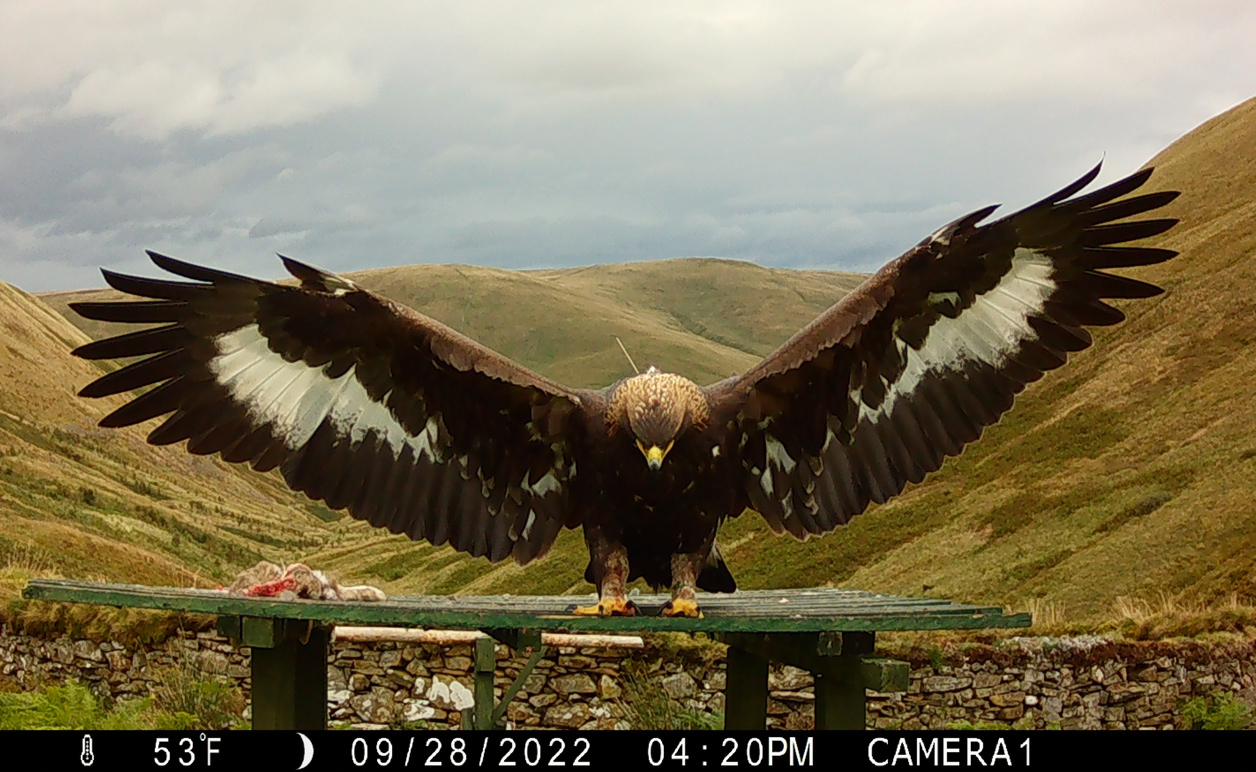
Here is Naturescot’s statement:
10 February 2026
NatureScot has restricted the use of general licences at Raeshaw Estate and Watherston Wood in the Scottish Borders.
The decision was made based on evidence provided by Police Scotland of wildlife crime against birds.
This evidence included the sudden disappearance of a satellite-tagged golden eagle named Merrick in October 2023 as well as golden eagle blood, feathers and shotgun cartridge wadding recovered from the same location.
Chris Dailly, NatureScot’s Head of Licensing, said: “We have decided, in discussion with Police Scotland, to suspend the use of general licences on this land for three years until January 2029. The police have recorded Merrick’s disappearance as a crime and have provided robust evidence to NatureScot to support this.
“We are committed to using all the tools we have available to tackle wildlife crime. This measure will help to protect wild birds in the area, while still allowing necessary land management activities to take place.
“We believe this is a proportionate response to protect wild birds and prevent further wildlife crime. We will continue to work closely with Police Scotland and consider information they provide on cases which may warrant restricting general licences.”
Individual licences may still be applied for, but these will be subject to strict record-keeping and reporting requirements and will be closely monitored to ensure licence conditions are met.
General licences allow landowners or land managers to carry out control of common species of wild birds, such as crows and magpies, to protect crops or livestock, without the need to apply for an individual licence.
In addition to this restriction, there are currently two other restrictions in place in Scotland: on Millden Estate in Angus and Lochindorb Estate in Highland.
ENDS
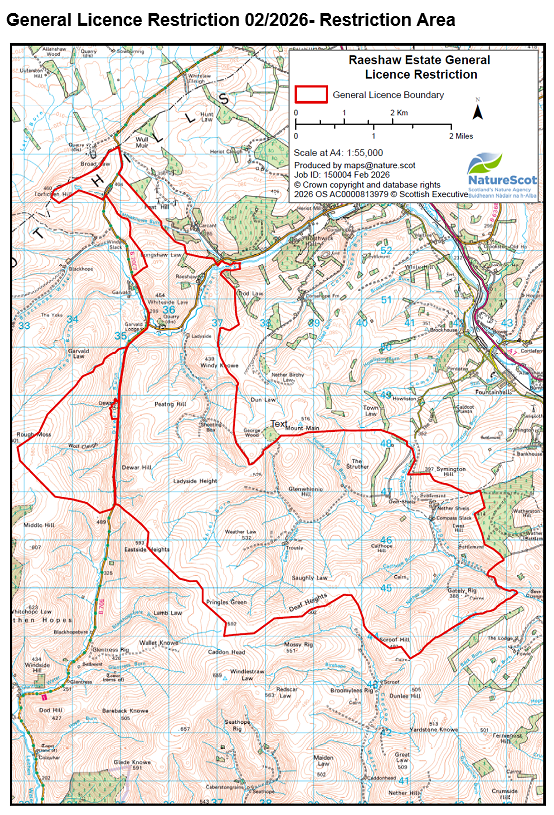
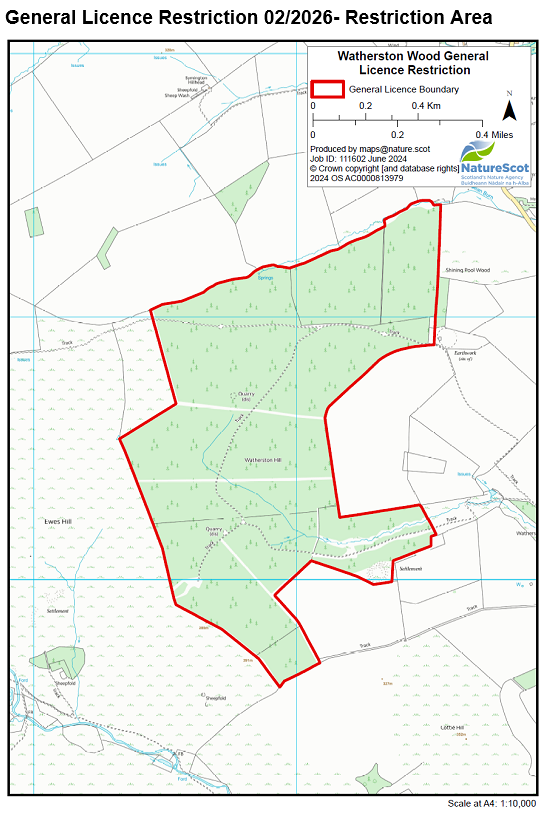
Here are the maps provided by NatureScot showing the restriction areas on Raeshaw Estate and Watherston Wood, and an accompanying statement of clarification:
In line with NatureScot’s published General Licence restrictions: Framework for Implementing Restrictions we hereby give notice that a restriction has been applied to the land outlined in red overleaf. This restriction prohibits the use of General Licences 01, 02 and 03 on that land from 10th February 2026 up to and including 9th February 2029.
Please note that this restriction does not imply responsibility for the commission of crimes on any individuals.
My commentary:
There’s a lot to say about this latest General Licence restriction. Some of it will have to wait for another blog because I’m short on time at the moment, but some of it I’ll say now.
General Licence restrictions, which have been available to NatureScot since 2014, are based on the civil burden of proof and are issued when NatureScot receives information from Police Scotland about wildlife crimes but where there is insufficient evidence to identify an individual offender for prosecution. (GL restrictions can also be imposed on estates where gamekeepers have been convicted of wildlife crimes).
General Licence restrictions do not prevent an estate from game-shooting, nor do they prevent an estate from carrying out [lawful] predator control – this can still be undertaken if the estate applies for an ‘individual licence’ which may restrict the amount of predator control, the estate may be subject to compliance spot checks, and the licence holder must provide NatureScot with licence returns (i.e. indicate how many birds were killed, where, and when etc).
General Licence restrictions are not perfect as an effective sanction – they are nowhere near, as I’ve written about many times before (e.g. see here and links within). They do, however, work as a ‘reputational driver’, although in some cases reputation is apparently not an issue of concern.
Whilst today’s decision is very welcome news, it’s taken NatureScot far too long to reach it. Regular blog readers will know that NatureScot has been considering this decision since April 2024 (see here) when it first received information from Police Scotland about the shooting/killing of Merrick. That’s almost two years of procrastination (e.g. see here, here). It’s nowhere near good enough.
This is the second General Licence restriction imposed on Raeshaw Estate.
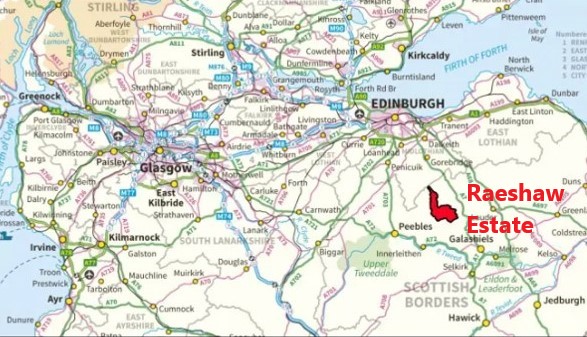
Raeshaw Estate was one of the first estates to receive a General Licence restriction in 2015, based on clear police evidence that wildlife crimes had been committed although there was insufficient evidence to prosecute any individual (see here). Representatives of Raeshaw Estate applied for a judicial review of NatureScot’s decision but the Court of Session upheld NatureScot’s procedures and ruled them lawful (here).
Whilst under that first General Licence restriction, Raeshaw Estate applied for, and was granted, a number of ‘individual licences’ so the gamekeepers could continue to kill certain species as part of the estate’s grouse moor management plan (quite a lot of birds were lawfully killed – see here).
However, in 2017 the individual licence was revoked by NatureScot due to non-compliance issues and more suspected wildlife crime offences (see here). Not that the revocation made any difference whatsoever, as the estate could simply apply for another individual licence!
Inexplicably to many of us, NatureScot did not extend the length of the original General Licence restriction, which it has the authority to do, in light of the non-compliance issues on the estate’s individual licence (see here).
And now here we are again, with a second General Licence restriction imposed, this time in relation to the illegal shooting and killing of Golden Eagle ‘Merrick’ in October 2023.
As a colleague pointed out to me today, General Licence restrictions have been useful in as much as they have provided a framework for imposing a licence restriction based on the civil burden of proof, and this has clearly influenced the new system of grouse moor licensing in Scotland, introduced as a new sanction under the Wildlife Management & Muirburn Act 2024, whereby licences to shoot Red Grouse can be revoked, based on the civil burden of proof, if evidence of wildlife crime is provided to NatureScot by Police Scotland.
In this latest case relating to Raeshaw Estate, I doubt very much whether a grouse shooting licence will be revoked because Merrick was shot in October 2023, before the introduction of grouse shoot licences, and a licence revocation can’t be applied retrospectively. I’m not even sure whether Raeshaw Estate has a grouse shooting licence; there isn’t a public register to consult. If it doesn’t currently have a grouse shooting licence, but applies for one during this three-year General Licence restriction, it’d be interesting to see what happens.
More commentary to come soon…
UPDATE 11 February 2026: Raeshaw Estate claims General Licence restriction “wholly unjustified” and intends to appeal (here)
UPDATE 7 April 2026: Raeshaw Estate loses appeal against 3-yr General Licence restriction in relation to Golden Eagle Merrick being ‘shot & killed’ (here)
 Raptor Persecution UK
I’m maybe being cynical, but it seems that NatureScot delayed as long as they could before having to be seen to do something.
Not worth the paper its written on. What is is needed is a TOTAL ban on all live bird shooting and put them all out of business. They are one area of growth this country does not need and I for one would be delighted to see every single one of them closed and finished for good.
I’m disappointed NatureScotland haven’t already adopted the estate boundaries per legislation intention and as we know the government is going to enact. They could have done this already and revoked this estate’s license.
“I’m disappointed NatureScotland haven’t already adopted the estate boundaries per legislation intention and as we know the government is going to enact.”
What do you mean? Which legislation are you referencing?
“They could have done this already and revoked this estate’s license.”
‘This estate’s license’ for what?
The Wildlife Management & Muirburn Act 2024.
As you know this legislation mandates that land used to kill red grouse must licensed. You will further be aware that landowners challenged this legislation and forced NatureScotland to accept an extremely narrow interpretation of “land used to kill”. You will further be aware that recently the government committed to ensure the legislation’s original intent for the entire shooting estate to require a license to be written into law.
The imposed sanction of a general shooting license restriction is I’m sure you know essentially no sanction at all beyond possibly reputational which some estates don’t appear to be overly concerned about.
Me: “Which legislation are you referencing?”
“The Wildlife Management & Muirburn Act 2024.
As you know this legislation mandates that land used to kill red grouse must licensed”
NatureScot wrote: “This evidence included the sudden disappearance of a satellite-tagged golden eagle named Merrick in October 2023”
I do not believe you can be held liable for any breach of legislation which occurred before the legislation was enacted, unless the legislation explicitly states that it is to be applied retrospectively. Article 7 European Convention on Human Rights. As far as I know, the Wildlife Management and Muirburn (Scotland) Act 2024 includes no such provision.
“You will further be aware that landowners challenged this legislation and forced NatureScotland to accept an extremely narrow interpretation of “land used to kill”.”
I do not know that. What I do know is that the Act explicitly stated that the land to be covered by the grouse shooting licence was to be defined by the landowner or occupier, and that was the wording which was voted on by the Scottish Parliament:-( Worse – with no limit set on the number of such licences which could be held by any individual:-(
Ditto for Muirburn licences:-(
I agree with your other points.
The Herald reports that Louis Moore Bacon a Wall Street hedge fund manager is the beneficial owner of this estate. It also reports that the estate was subject to restrictions linked to alleged BOP persecution in 2016. Bacon is a major conservative party donor.