Organised by Wildlife Countryside LINK, the inaugural Wild Summit takes place at the Bristol Beacon on Thursday 11 September 2025.
From the Wild Summit website:
‘Nature brings immense value to our lives, to the economy and to communities. Whether it’s protecting communities from flooding and extreme weather, supporting rural areas and food production, helping tackle climate change, or improving our mental health, nature underpins it all.
At our first Wild Summit, we’ll bring together nature lovers, community campaigners, businesses, politicians, officials and policy experts for a day of presentations, panel discussions, workshops, and conversations focused on the critical importance of investing in nature. We’ll celebrate the incredible work being done by charities, community groups, innovators, and land managers, as well as explore the vital roles of tourism, research, upskilling, and corporate and government projects in restoring our natural world.
The goal? To help the UK meet its target of protecting 30% of land and sea by 2030‘.
Why are 50 million non-native chickens released into our countryside every year?
Pheasants are a familiar feathered face of the countryside; plastered all over tea-towels, cushion covers, and our roads. But how did they get here? What impact are they having on our environment? And why are there so many?!
Join Wild Justice for an interactive and visual dive into the past, present and future of what George Monbiot describes as the ‘bronze plague’.
The British Farmland Bird of Prey Initiative is a new project set up by Nigel Middleton and Twiggy Bigwood, offering expert support for landowners and conservation groups across England who want to host raptors on their land.
Services include site visits and consultation, habitat surveys, the provision, installation and monitoring of nest boxes, and planning mitigation for Barn Owls.
The British Farmland Bird of Prey Initiative website is HERE.
For those of you interested in the uplands, UKEconet and the South Yorkshire Biodiversity Research Group are co-hosting a three-day conference in Sheffield in October.
The conference includes two days of presentations and discussion and a field trip to the Peak District on day three.
Key themes include the management and protection of important temperate rainforests such as Borrowdale in Cumbria, natural regeneration, Curlews, peat cutting, grouse moors and rewilding.
Desolate uplands in the North Pennines. Photo by Ruth Tingay
A Wilder Future for the Uplands: Unleashing the Power of Nature to Recover and Restore the Countryside
1-3 October 2025
Speakers include Kate Hanley (RSPB Dove Stone), Sara King (Rewilding Britain), Ian Rotherham (Sheffield Hallam University), Andrew Weatherall (RSPB), Danny Udall (Eastern Moors Partnership), Jade Allen (National Trust), Mary Colwell (Curlew Action), Daniel Cameron (National Trust), Luke Steer (Treescapes Consultancy), Mark Avery, James Fenton and others.
Defra has announced increased biosecurity measures for gamebird releases amidst the heightened risk of Highly Pathogenic Avian Influenza (HPAI), also known as ‘Bird Flu’.
All of England is already in an Avian Influenza Prevention Zone (AIPZ) with mandatory biosecurity measures. Additional biosecurity measures were announced yesterday for gamebird rearers and gamebird shoot operators and will come in to force next Tuesday (26 August 2025).
These additional measures are apparently intended to minimise the risk of Avian Influenza spreading from gamebirds to wild birds and vice versa.
Large Pheasant release pen with unobstructed easy access for wild birds. Photo: Ruth Tingay
Defra made the announcement in a press release, as follows:
HEIGHTENED AVIAN INFLUENZA RISK WARNING ISSUED TO BIRD KEEPERS AND GAMEBIRD REARERS
Bird keepers are today being warned of a heightened avian influenza risk and are urged to tighten their biosecurity measures, particularly those involved in running a shoot or game bird rearing.
This includes commercial poultry keepers and game bird rearers and shoot operators. The risk from avian influenza continues to rise, particularly in coastal counties which are on bird migration routes and parts of the country with a significant gamebird industry
An Avian Influenza Prevention Zone (AIPZ) with mandatory biosecurity measures remains in force across Great Britain. It has been in England updated today to include additional biosecurity measures for game bird operations.
These measures reflect the specific disease risks associated with the game bird and shooting sector at this time of year and are intended to protect both wild and captive bird populations.
During outbreaks, there are also controls on the release of game birds in areas of known high risk which must be abided by. The release of game birds is not permitted in any avian influenza disease control zone.
UK Chief Veterinary Officer, Christine Middlemiss, said:
“We are seeing increasing outbreaks of avian influenza, particularly in coastal counties. Gamebird operations, alongside all other poultry keepers, must take action now to protect their birds and limit the risk of further outbreaks.
“Strong biosecurity remains our best defence, and we urge all keepers to take immediate steps to strengthen their measures. We will continue to monitor the situation closely“.
Changes for gamebird keepers include:
Disinfecting any vehicles upon first entry to the site and each day they are in use;
Providing one feeding station per 60 released game birds;
Cleaning feeding and watering stations daily to remove faecal matter, feathers and spilled feed;
Covering feeding and, where possible, watering stations to avoid contamination from wild bird droppings;
Placed pheasants in release pens should not be fed within 50 metres of a water body frequented by ducks and other wildfowl;
Placed game birds in release pens should not be fed within 500 metres of any poultry or other kept birds;
During the open season, checking placed game birds in release pens daily for signs of avian influenza;
Conducting a daily search of the area within and up to a 50 metre radius surrounding the perimeter of release pens for carcases of dead game birds and dead wild birds;
Reporting dead wild birds to Defra using the dead wild bird reporting tool and disposing of carcases appropriately;
Keeping detailed records of all visitors to the site (including deliveries and collections).
All bird keepers – whether of gamebirds, poultry, or other captive species – must remain vigilant for signs of disease, maintain high standards of hygiene and separation, and report any suspected cases immediately to the APHA. Avian influenza is a notifiable disease, and early action is vital to prevent wider spread.
Keepers are reminded that gatherings of poultry are banned. This includes birds from multiple locations brought onto a vehicle and then dropped off at other multiple locations.
Avian influenza is a notifiable disease. The risk to public health remains very low, and properly cooked poultry, game meat and eggs remain safe to eat.
ENDS
The UK Chief Veterinary Officer claims, “Strong biosecurity is our best defence“.
Really?
I’d argue our best defence is to ban the release of 60 million non-native gamebirds for shooting, along with the release of at least two and half million ducks, also for shooting, and for which the biosecurity measures don’t apply, as pointed out recently by Katie-Jo Luxton, Global Conservation Director at the RSPB.
Does Dr Middlemiss seriously believe that every game shoot is going to take the time and effort to clean every single feed and water station, every day? It’s hardly likely, given that some shoots are not even bothering to declare their gamebirds with APHA (there appear to be at least 20 million ‘ghost Pheasants’ unregistered according to research by Guy Shrubsole – here) so how on earth does Dr Middlemiss intend to monitor compliance with these latest regulations?
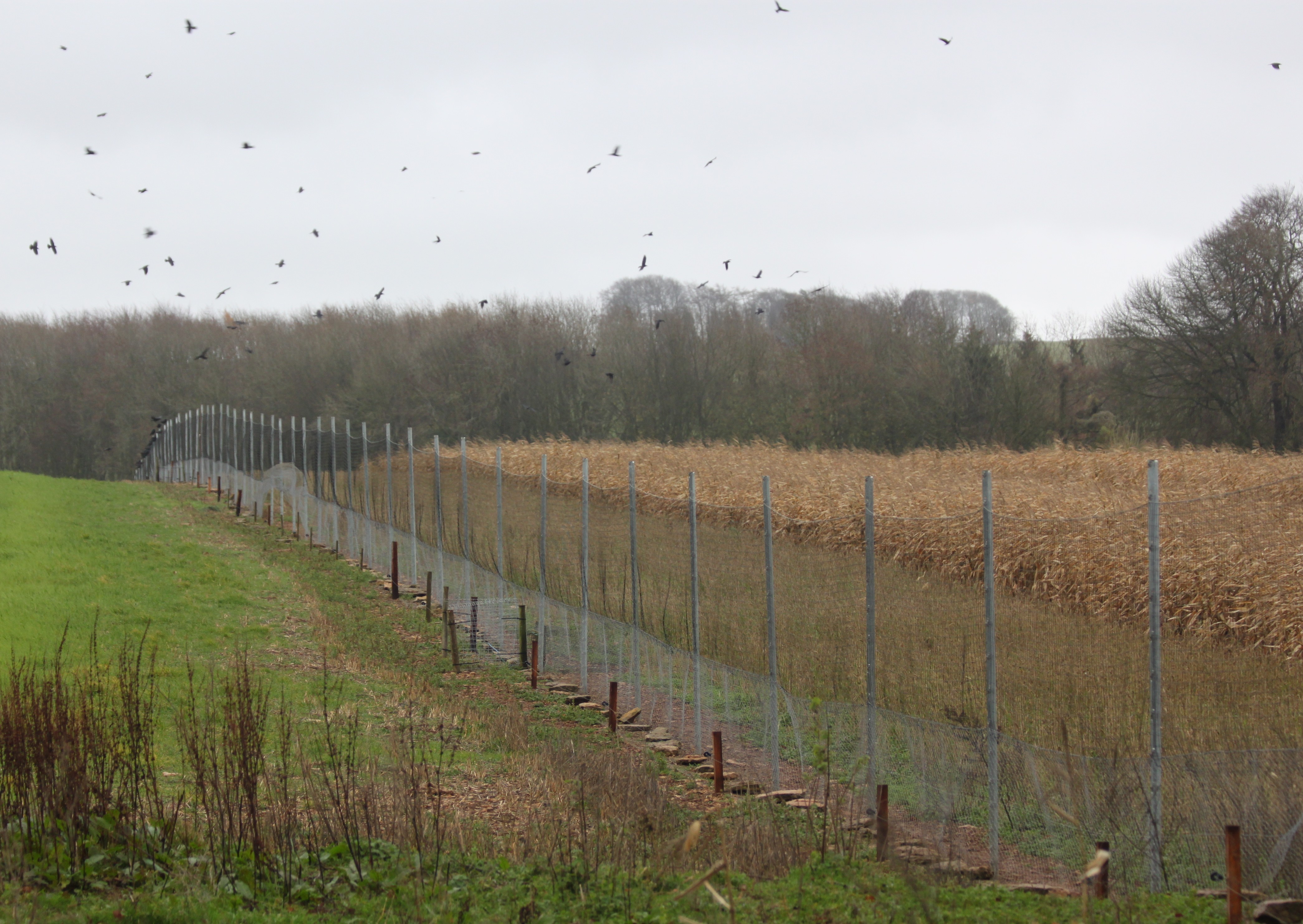
Crows gathering on release pen fence to take advantage of plentiful food supply. Photo by Ruth Tingay
And even if they did comply with the biosecurity regulations, the massively high densities of gamebirds within these pens and in the surrounding area after release provides the perfect environment for the rapid transmission of disease through faeces and other secretions away from feed and water stations.
What if the gamebirds are already infected with subclinical Avian Influenza (acting as a reservoir for the disease but not yet showing outward signs of ill-health) and are subsequently released from a pen? What happens then?
It’s a disaster waiting to happen, not least for raptors that will feed on infected carcasses and succumb to the disease. There are already plenty of examples of this in the UK in recent years. But it needn’t happen if Defra suspended all gamebird shooting during this Bid Flu outbreak. It has the legal authority to do this, but doesn’t appear to have the backbone.
Following yesterday’s news of a successful Hen Harrier breeding attempt this year on National Trust-owned moorland in the Peak District National Park (here), Craig Best, the NT’s General Manager in the High Peak, was interviewed on BBC Radio Derby about the significance of the successful nest and the importance of satellite-tagging the young birds (this year’s two Peak District tags have been paid for by the National Trust and the Peak District National Park).
Craig Best, National Trust General Manager, High Peak (photo supplied)
Craig is well known as an experienced, committed and passionate advocate for restoring the uplands and is the driving force behind significant & welcome changes in how the NT’s moorlands are managed in the High Peak (e.g. see here, here, here and here for earlier blogs).
He’s also not someone who pretends that illegal raptor persecution isn’t an ongoing issue and for that alone, he deserves much kudos.
The interview on BBC Radio Derby with host Becky Measures is just four minutes long and appears to be a cut from a wider conversation, but Craig gets his point across about Hen Harrier persecution. It can be heard here and is available on BBC Sounds for a year.
Here’s the transcript:
Craig Best: It’s brilliant that we’re seeing Hen Harriers nest on our land, on National Trust land in the High Peak, so yeah, you’re right, these birds suffer persecution, in fact they’re the most persecuted bird of prey in the UK.
Becky Measures: Why?
Craig Best: Well, all these birds nest on open moorland in really remote places, and what we’re finding is the vast majority of persecution happens on or near to land managed for grouse shooting. Hen Harriers obviously have to eat, so they’ll eat small mammals such as voles and shrews, but they’ll also take chicks of birds, and I’m sure they will take grouse chicks as well, so unfortunately these birds suffer high levels of persecution across the UK and they’re quite often shot.
Becky Measures: So how does tagging, then, protect them?
Craig Best: Yeah, so interestingly, we tag these birds, which is brilliant because it gives us data on where they fly, and some of these birds fly across the UK, we’ve even had some of the Hen Harriers that we’ve tagged in the past fly to places like France, so they cover huge distances, that gives us lots of information, it gives us information where they roost, where they might be feeding, but importantly, these tags are very expensive, they’re about a thousand quid each, but importantly they track the birds and when the bird ‘mysteriously disappears’ we’ve got some idea where that happens.
Beck Measures: Right, ok, so you’re able to kind of keep an eye on them and know what their movements are. It must be difficult to get the tags on them, though?
Craig Best: Yeah, so the tags are, I mean the people who do it are licenced by Natural England and we’re working really closely with our colleagues at the RSPB, but also there’s a volunteer group in the Peak District called the Peak District Raptor Group and all these individuals are experts, and when the birds are young on the nest, not able to fly, we approach them and carefully apply the tag.
But the tag provides much needed protection, so they’re less likely to be shot because if that tag stops working, or we find it, you know we don’t get the tag movements, clearly that could link to a persecution incident. Not always, sometimes these birds, like many other animals do, die naturally, but quite often what we’re finding across the UK and in the Peak District and places like North Yorkshire, these birds are persecuted and are shot in these remote areas and it’s very much linked to grouse shooting.
We invest millions in the upland landscape in the High Peak to restore our peatlands, restore the peat, you know, this landscape is fantastic for our drinking water, a lot of rain falls on our drinking water so whether you live in Sheffield or Manchester, that’s where it comes from, and we restore the landscape by establishing trees, because these places are just fantastic for nature and provide lots of services, such as flood risk reductions for people’s homes and businesses, but of course we invest this money and these pinnacle species such as Hen Harriers should be in much greater numbers. I think there’s something in order of 30-40 breeding pairs across the UK* so they’re really at risk of extinction if this persecution continues, but because we invest so much money, it’d be such a shame to not have these spectacular birds flying around and you know, like you referenced earlier on, your listeners and many people will have watched Springwatch and we saw a pair of Hen Harriers feeding and flying around and they’re just beautiful to look at and of course they have the right to exist like many other animals in the Peak District.
ENDS
*Craig was referring to England, not the UK. In 2024 there was a total of 34 Hen Harrier breeding attempts in England, of which 25 were successful, which is lower than the last two years, according to Natural England.
Press release from National Trust (18 August 2025)
LATEST HEN HARRIER FLEDGLINGS RECEIVE PROTECTIVE SATELLITE TAGS IN THE PEAK DISTRICT
Two hen harrier chicks from a nest found on National Trust land, raised by the adult birds featured on Springwatch, have been tagged to protect them from persecution.
The RSPB tagged the chicks thanks to support from the National Trust and the Peak District National Park, and with the help of the Peak District Raptor Study Group.
Satellite tagging provides a valuable insight into the preferences and behaviour of these birds, as well as building vital evidence to enable their protection.
Hen harriers are one of the UK’s most persecuted birds.
Two hen harrier chicks, hatched from a nest on moorland in the care of the National Trust in the Peak District, have been fitted with satellite tags by the RSPB to protect them from persecution1.
At the same time as providing location data, the satellite tags will provide vital information about the behaviour of this threatened species and an insight into roosting, breeding and foraging sites. The tried and tested method also helps to gather evidence in the fight against criminal activity. Each year in England, around 30 chicks are fitted with these tags.
Specially trained officers from the RSPB fitted the tags, thanks to funding from the National Trust and the Peak District National Park. The organisations are working together along with the Peak District Raptor Study Group to give birds of prey like Hen Harriers the best chance of survival in the area.
The chicks tagged were part of a brood of three chicks from the same nest who have now successfully fledged. They are the offspring of the adult birds which featured on the BBC’s Springwatch earlier this year, spectacularly passing food mid-air.
Successful Hen Harrier breeding attempt on National Trust moorland in Peak District National Park. Photo: Peak District Raptor Study Group
The news of the successful nest has been met with cautious celebration by the conservation partners involved, as the presence of nests and fledging chicks shows efforts to create the right habitats for the birds are taking effect2. However, there is still much to do to protect this important bird of prey from the threats it faces from habitat loss and persecution.
This is the eighth nest attempt to have been recorded over the past five years in the Peak District. Last year there were only 34 nests in the UK compared to 49 in 2022. There are only around 30-40 breeding pairs of hen harriers in England.
Craig Best, General Manager in the Peak District at the National Trust said:
“We have been working hard with our partners to create ideal habitats to attract red-listed birds and provide good homes for them when they move to moorland landscapes over the spring and summer. A significant amount of time and investment is made to do this. These birds need moorland where you find a variety of plants and animals. We’re restoring peatland and ensuring wetlands and grasslands can host a good mix of species which means these habitats become a good place for small birds and voles too, which are a vital food for hen harriers and their young.
“It is wonderful to see successful nests on the land in our care because it is a good indicator that our work is providing them with the conditions they need. However, we need to be cautious and vigilant because despite being legally protected, persecution is still one of the biggest threats to these special birds of prey in the Peak District and across the UK.
“This is harder to address, but we’re taking action to combat these illegal practices. We’re working closely with our partners in the Police, Statutory Agencies, the Raptor Monitoring Group and the RSPB. One way we do this is by supporting tagging the birds and tracking their movements.
“I am delighted that we have been able to give these two chicks this extra protection, and that the data they provide will provide evidence to tackle illegal activity as well as support our conservation efforts.”
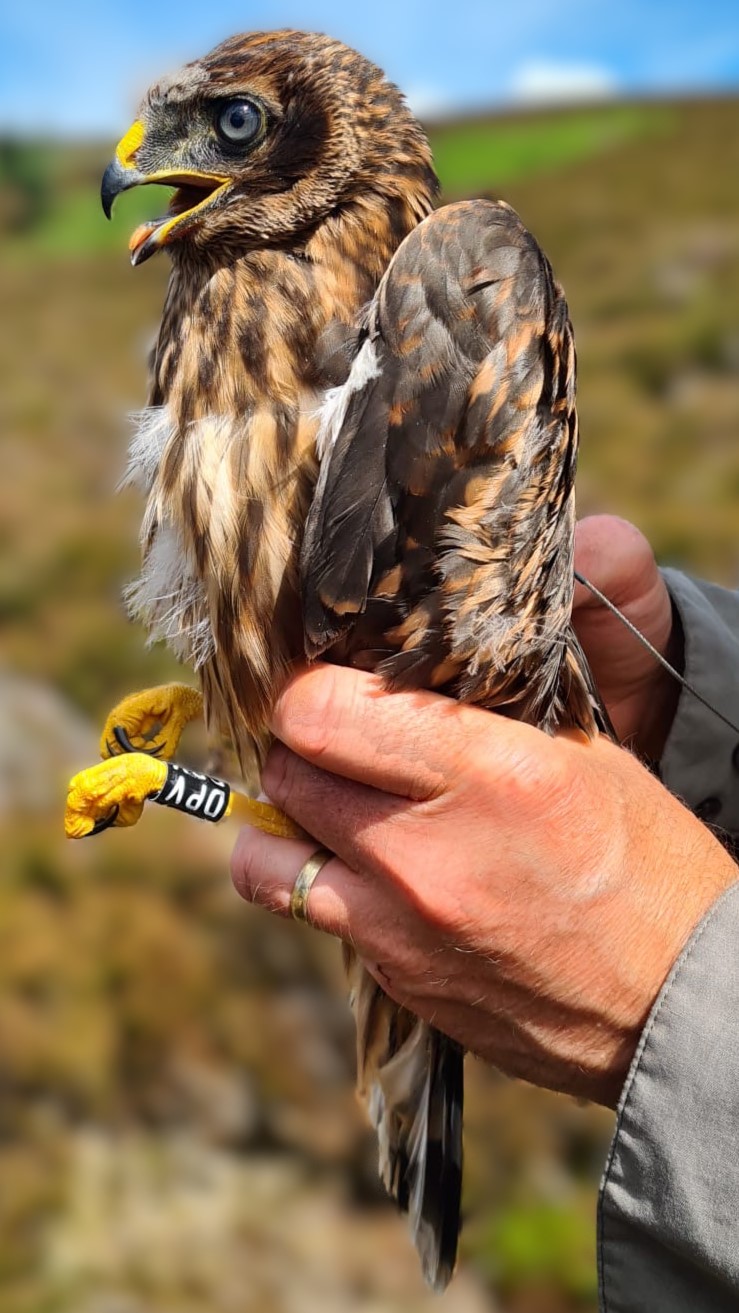
One of the two Hen Harrier chicks being satellite-tagged on National Trust moorland in Peak District National Park. Photo by Ant Messenger
Mark Thomas, Head of Investigations at the RSPB said:
“Satellite-tagging of Hen Harriers has been a game changer; it tells us what habitats the birds are using and informs us of the place and reason for any mortality. For a persecuted species this is vital, to inform police investigations, to document associated land uses and to lobby for policy outcomes that aim to provide a better future. The RSPB believes that is through the licensing of grouse shooting, a pragmatic solution to tackle the record high levels of illegal killing in the last five years.”
For example, a recent successful tracking of another hen harrier, fitted with a satellite tag by Natural England on National Trust land in 2022, also returned to the Peak District earlier this year. The tracking data shows the extensive flight-path of the bird, which travels down to Cornwall during the winter months, before returning to the Peak District each summer, flying approximately over 550 miles between wintering sites and breeding grounds and choosing to spend time in the moorland habitat, not far from where it fledged, after stopping off in Wales along the way.
Phil Mulligan, Chief Executive Officer at the Peak District National Park said:
“It is vital for our ecosystems and the health of the landscape in the Peak District National Park that we do all that we can to welcome and protect these stunning birds of prey. I look forward to the day when there is a healthy population of hen harriers here. It is great to hear that hen harriers which started their life in the Peak District will help us gather important data to improve the chances of the species in the future.”
Editor’s notes:
Despite having the highest level of protection under UK law and a designated species of high conservation concern, Hen Harriers are being illegally killed in the UK.
In the last five years, the number of confirmed and suspected Hen Harrier persecution incidents has increased with 102 recorded between 2020 and 2024. 89% of these incidents took place in northern England. 2023 was notably the worst year on record with 34 Hen Harriers confirmed to have been killed or disappearing under suspicious circumstances. The impact of these crimes is most evident in England with numbers recorded in 2024 representing only one tenth of the upper estimate of potential breeding pairs for England (323-340 pairs) as outlined by the Joint Nature Conservation Committee Report in 2011. Information taken from Hen Harriers in the Firing Line – RSPB report 2025.
2. Work undertaken by the National Trust includes cutting heather to allow a more diverse range of moorland plants such as sphagnum moss, bilberry and cottongrass to grow, which helps attract the different insects and small mammals which the birds rely upon for food. The charity is also working closely with tenants to ensure their land management practices support the vision for more birds of prey in the area.
ENDS
UPDATE 20 August 2025: Hen Harrier persecution “is very much linked to grouse shooting” – Craig Best, National Trust General Manager, Peak District (here)
One of the translocated Golden Eagles in southern Scotland has bred with one of ‘our’ wild satellite-tagged eagles, resulting in the successful fledging of a male eaglet.
This is the first fledging event from a nest of one of the translocated eagles and marks a major milestone for the South Scotland Golden Eagle Project.
The chick has been named ‘Princeling’ by Sir David Attenborough.
Golden Eagle chick ‘Princeling’ having a satellite tag fitted (Photo copyright Ian Georgeson)
The breeding pair got together in 2024 and built up a nest but didn’t breed. That’s not unusual behaviour for young Golden Eagles who can take up to six years to mature, although in areas where there’s little competition for territories (e.g. through depletion of the population by persecution, as in south Scotland), breeding can happen much earlier.
Emma, the female, had been translocated to south Scotland in 2021 and was named by the Scottish Government’s then Biodiversity Minister, Lorna Slater MSP, in memory of the women’s rights and equality advocate, Emma Ritch.
Keith, the male, fledged from a wild nest in Dumfries & Galloway in 2018 and was named Keith after a member of the local Raptor Study Group. He was satellite-tagged as part of a project run by RPUK and Chris Packham in association with experts from the Scottish Raptor Study Group and we’ve been tracking his movements ever since.
Here he is prior to fledging in 2018 (Keith is on the right, one of his parents on the left). This is footage from a nest camera which are routinely installed (under licence) at nest sites to help researchers monitor young eagles after they’ve been fitted with a satellite tag to ensure the tag/harness is not causing any health or welfare issues.
Photo copyright Scottish Raptor Study Group
After dispersing from his natal territory in November 2018, Keith hung around in Dumfries & Galloway for a few months before then suddenly making a beeline for the border and in to England. He stayed in Northumberland for a while (and was joined by at least one other tagged Golden Eagle that had been translocated to south Scotland) before heading back in to Scotland and heading over to his old haunts in SW Scotland before eventually finding his own territory and settling there in October 2023.
After their unsuccessful breeding attempt in spring 2024, Keith and Emma were photographed together in October 2024 on a camera trap at a food platform provided by the South Scotland Golden Eagle Project. They looked to be in excellent condition:
Keith on the right, with the much larger female Emma. Photo copyright South Scotland Golden Eagle Project
The location of their successful breeding attempt this year has had to remain a secret because, as we’ve seen, (here and here) Golden Eagles, along with many other raptor species, still face the threat of illegal persecution in this region and beyond.
I’ve lost count of the number of times I’ve heard that gamebird shooting, whether it be Red Grouse, Pheasant or Red-legged Partridge shooting, and all its associated ‘management’ is vital for rural community cohesion and it’s only so-called ‘Townies’ that don’t understand and want to protest about it.
As with most things claimed by the gamebird shooting industry, it’s not true.
Over recent years a number of local rural communities in England (particularly across Yorkshire) and Scotland have rejected this fictional romanticism of their lives and have found the courage, often in the face of intimidation from dark powerful forces, to voice their dissent.
Now it’s happening in Wales, too.
The following article was published by The Telegraph last week:
A village is locked in dispute with wealthy tourists who pay more than £3,000 for a day’s pheasant shooting.
Residents in Pennal, a community of 404 in Snowdonia, North Wales, claim the shoots have set “neighbour against neighbour”, and led to claims of intimidation and harassment.
Some villagers have even complained of dead foxes dumped in their gardens.
But others, who support shooting, said “incomers” to the village were behind the complaints, and told them to “move back to where they came from” if they don’t like it.
The shoots, run by Cambrian Birds on the Pennal Estate, are marketed as “the most talked-about in the UK” for their “high-quality driven pheasants and partridges along with top class hospitality”.
Guests are promised at least four drives a day, and a two-course meal or afternoon tea.
But an anonymous survey in the village uncovered anger at what some locals see as a “takeover” by “large commercial shoots”.
One resident said: “Disharmony and division within our once peaceful village. Most people I speak to in the village hate what’s happening but are afraid to publicly voice their concerns for fear of retribution or escalating the division further.
“These fears are evident in that a local lady in her seventies living alone has now had two healthy looking but dead foxes put in her garden with loud bangs on her windows in the night. Police were informed, but little action.”
Another villager said there had been “no consultation with village residents” before it was “taken over”.
The same resident complained of “acts of intimidation towards people who speak up”, alleging there had been “shooting across gardens late at night” and even “dead foxes dumped on one person’s land”.
It is not known who is behind these alleged “acts of intimidation”.
Other residents said they felt pressured to take sides.
“Several residents asked me to declare whether I was with or against the shooting,” complained one, adding: “One person even told me who I should talk to and who not.”
They claimed that some villagers were now considering “moving away” as a result of the disputes.
But supporters argued the shoots bring vital income to the rural economy, and accused critics of being “incomers”, and part of the “anti-shooting brigade”.
A lifelong resident, who described themselves as “Pennal born and bred”, said: “Cambrian Birds pays a decent rent to the hill farmers of Pennal, helping in many cases, young families to stay and work the land. Young families move into the area, helping the local school.”
The resident said that if the “anti-shooting brigade” didn’t like it they should “move back to where they came from”.
They likened it to “buying a house next door to a pub and then complaining about the noise of throwing-out time”.
Cambrian Birds has been approached for comment.
ENDS
The Telegraph article was likely inspired by an article in Cambrian News on 23 July 2025 about a village protest held against the Cambrian Birds shoot at Pennal.
Local villagers protest about the Pheasant shoot. Photo supplied to Cambrian News
This isn’t the villagers’ first protest against Cambrian Bird’s game-rearing and shooting business. In January this year they featured in an article in the Powys County Times about how they’d erected banners and sprayed ‘crime-scene’-type silhouettes of Pheasants on village roads as part of their protest:
Image supplied to Powys County Times
Some of you may recognise the name ‘Cambrian Birds’. Its associated business, ‘Cambrian Shooting’, hit the headlines in January 2022 when the League Against Cruel Sports published covert video footage showing someone from the shoot at Dyfi Falls (one of six shoots managed by Cambrian Sporting) chucking at least 45 shot Pheasant and Red-legged Partridge carcasses down a mineshaft (here).
A statement from the company later confirmed that the person filmed was one of their gamekeepers. They said he had been ‘severely reprimanded‘ and that ‘he no longer works for the company‘ (here).
Natural Resources Wales launched an investigation into the possible pollution and contamination of the river close to the site where the mass gamebird dumping took place but as far as I can tell, nothing ever came of it.
To read more about the Dyfi Falls shoot, this blog by Jeremy Moore, a leading Welsh environmental photographer, is fascinating.
The Hawk & Owl Trust, and its Chief Operations Director, Adrian Blumfield, have been slammed by an employment tribunal about the unfair dismissal of long-term employee, Nigel Middleton.
Nigel, a well-respected naturalist, raptor specialist and the now former Conservation Officer at the Hawk & Owl Trust (HOT), was amongst other things responsible for wardening the HOT’s Sculthorpe Moor Nature Reserve in Norfolk, a reserve he founded with the late David Cobham and which opened to the public in 2003.
On 5th May 2023, Nigel received a letter from the HOT informing him that he’d been dismissed with immediate effect as he’d been made redundant.
Nigel Middleton (Photo supplied)
Blog readers may recall a ‘revolt’ against the Hawk & Owl Trust in July 2023 by disgruntled life members and volunteers of the HOT, who held a peaceful protest at the HOT HQ (see here and here) and made a formal complaint to the Charity Commission about what they believed was “poor management” of the organisation, following Nigel’s dismissal and the unusual departure of other staff.
The Charity Commission later stated:
“We carefully considered concerns raised with us about the governance of The Hawk and Owl Trust. Based on the information provided, we determined that there is no regulatory role for us at this time“.
The Hawk & Owl Trust’s Chief Operations Director Adrian Blumfield was quoted in the press at the time:
“We understand that a small number of people previously connected with the charity are resistant to the positive progress and changes that have been made.
“Any criticism of the charity is completely unwarranted, misplaced and risks undermining the work being undertaken“.
Some HOT volunteers later said they’d been banned from the HOT’s Sculthorpe Moor Reserve after staging the protest.
Nigel lodged legal proceedings for unfair dismissal against the Hawk & Owl Trust and Adrian Blumfield on 3 August 2023 and a six-day tribunal hearing took place in June/July 2025 before an employment judge, M. Warren. Nigel was supported during each day of the hearing by many of the ex-volunteers and ex-members of staff that Adrian Blumfield had banned from Sculthorpe Moor Nature Reserve.
A reserved judgement was handed down on 12 August 2025 by Judge Warren who stated:
“There was no potentially fair reason for dismissal and therefore Mr Middleton’s complaint of unfair dismissal succeeds. Had there been a potentially fair reason, the procedural failings set out above would inevitably have led to a conclusion that the dismissal was unfair in any event“.
The issue of compensation for Nigel will be determined at a future date.
Here is some background detail about the whole sorry mess:
The tribunal heard that Nigel had grown concerned about the way Adrian Blumfield was managing Sculthorpe Moor Nature Reserve and in November 2022 had approached Dr Andrew McCulloch, the Chair of the Hawk and Owl Trust, to voice his concerns.
Dr McCulloch is also the Chair of ‘Social Work England’ and, as he wrote in his witness statement to the tribunal, has “Years of experience in the Civil Service achieving the grade of Deputy Director, followed by eleven years’ experience as Chief Executive of a larger nationally well known charity… (and) that he had over 40 years of experience on Boards and Committees.”
Nigel had hoped that Dr McCulloch would hear his concerns and those of other HOT employees, members and local people, which Nigel had sent on to him.
Despite asking for these disclosures to remain private, Judge Warren states in his tribunal ruling:
“ We (the Tribunal) glean that it seems Dr McCulloch must have in some way, informed Mr Blumfield that Mr Middleton had raised with him matters that would need to be discussed. Dr McCulloch denied this in cross examination. We did not find his denial convincing. The timing of Mr Blumfield’s [subsequent] actions are a remarkable coincidence. We conclude that Dr McCulloch must have made Mr Blumfield aware that Mr Middleton had raised matters about him.”
Nigel argues that shortly afterwards he was subjected to a ‘catalogue of persecution’.
‘People can be a pain in the arse’
In February 2023, and a few days after undergoing major surgery, Nigel received a letter from Adrian Blumfield, inviting him to discuss the future of his employment, the timing of which Judge Warren wrote, “was crass“.
A formal grievance was raised by Nigel which was to be heard by Peter Lawrence of Human Capital Department, the HOT’s human resource advisor whose own advertising states that, ‘People can be a pain in the arse‘.
Human Capital Department advert for business services
Before he had even held Nigel’s grievance hearing, Mr Lawrence wrote to Adrian Blumfield and Dr McCulloch as follows:
“It might be better if I were to deliver the decision on Friday am to show that it has been considered carefully.”
Judge Warren’s tribunal finding states that,
“The foregoing has led us to conclude that a campaign against Mr Middleton was launched by Mr Blumfield because he came to learn that Mr Middleton had raised concerns about him.
“It was clear that Mr Blumfield was aiming to ultimately remove Mr Middleton from the business.
“Dr McCulloch had also formed the view, influenced by Mr Blumfield, that Mr Middleton must go. He wrote of needing to get the Board, “behind the direction of travel”.
‘Smelling a rat’
In an email about the grievance procedure from Mr Lawrence to Adrian Blumfield, and then sent to Dr McCulloch, it speaks of Nigel potentially “smelling a rat”. Judge Warren stated that:
“Mr Blumfield and Dr McCulloch told (the tribunal) in evidence that they were unable to explain what the, “rat” was that Mr Middleton might smell.”
Nigel’s grievance against the HOT about the timing of Adrian Blumfield’s letter inviting him to discuss his employment future was not upheld by Ian Lawrence, and although Mr Lawrence admitted that in hindsight, the timing was “ill-timed“, he did not consider that it warranted an apology as Nigel had requested.
However, in the tribunal finding, Judge Warren states:
“The letter inviting Mr Middleton to discuss his employment future whilst he was recovering from an operation, as not warranting an apology, is surprising, wrong and indicative of the Respondent’s mindset.”
Shortly after the grievance hearing, Adrian Blumfield invited Nigel to attend a disciplinary hearing about alleged gross misconduct; Blumfield had written a report alleging four counts but had not met with Nigel or any other member of staff during the preparation of the report. The following day, Nigel received a letter advising him that he’d been suspended.
During the tribunal, Blumfield admitted that not one of the purported disciplinary charges were deemed ‘gross misconduct’ as he had apparently told the HOT Trustees.
Nigel had asked that the disciplinary hearing be postponed for seven days as he was unwell, but this request was refused; a refusal which the tribunal decided was unfair.
Nigel had been told that the disciplinary hearing would go ahead without him. He heard nothing for weeks until he was later told that the process had not gone ahead – again deemed unfair by the tribunal.
‘Spurious’
The following month, Adrian Blumfield sent a letter to Nigel informing him he was at risk of redundancy, a claim which the tribunal decided was ‘spurious’, and that a 7-day redundancy consultation process was underway.
At this point, Nigel was still suspended from work and the disciplinary process was pending.
On 4 May 2023, solicitors acting on behalf of Nigel emailed Mr Lawrence of Human Capital Department to explain that Nigel could not engage in meaningful consultation about redundancy until he was able to understand the arrangements for the ongoing disciplinary process. Further, she pointed out that Nigel was on annual leave until 12 May 2023 and would not engage in consultation during that period.
There followed correspondence in which it was suggested that Nigel was not on annual leave. His solicitor produced a screen shot of the HOT’s management system leave calendar showing that he was indeed on pre-arranged leave.
On 5 May 2023, Nigel received a letter informing him that notice he attend a disciplinary hearing was withdrawn. Twenty minutes later, he received a letter informing him that he was dismissed with immediate effect, saying that he had refused to attend a meeting, would not discuss matters with them and they therefore had no alternative but to make his position redundant.
The tribunal finding notes that, “Informing Mr Middleton that he was no longer subject to disciplinary action and then 20 minutes later, informing him that he was dismissed with immediate effect, because he was redundant, was unfair.“
‘A woeful tale of unfairness in process’ and ‘a sham’
The written judgement from Judge Warren concludes:
“In the Tribunal’s judgement, redundancy as a purported reason for dismissal was nothing more than a sham”
and
“The reason for Mr Middleton’s dismissal was that he had complained about Mr Blumfield’s management style“
and
“The procedure followed by the Respondent [Hawk & Owl Trust] in dismissing Mr Middleton was a woeful tale of unfairness in process“.
And just in case anyone still doubts the petty and vindictive behaviour of the HOT ‘leadership’…
On 23 May 2023, solicitors acting on instructions from Adrian Blumfield wrote to Nigel’s daughter. She had grazed cattle on the Trust’s land since 2005 – two steers which were regarded as family pets. The solicitor’s letter suggested that these animals were on the Trust’s property without knowledge or permission and demanded that they remove them within ten days. They warned that if they did not comply, County Court proceedings would be issued for trespass, resulting in a judgement that would be recorded on the register for Orders, Judgements and Fines.
What a bloody shame. When I was taking my first tentative steps in to the world of raptor research and conservation, many years ago, the Hawk & Owl Trust was widely admired as one of the few UK-based charities dedicated to birds of prey and owls.
Its former director, Colin Shawyer, was one of those guys whose expertise was unrivalled and in demand and yet he still found the time to answer my letters about identifying prey remains I’d found inside pellets and he encouraged me to get involved with a Barn Owl monitoring project being run by Sue and Richard Dewar on behalf of the HOT. Those early field experiences and opportunities were instrumental to my career choice.
It’s hard to imagine that level of support and encouragement being offered to someone under the current management regime.
Things started to fall apart for the HOT ten years ago in 2014/2015 when it decided, under the direction of then Chair Philip Merricks, to get into bed with the grouse shooting industry and support the Hen Harrier Brood Meddling sham.
That decision, and the HOT’s subsequent behaviour, cost the HOT dearly. It lost its president (Chris Packham) and it lost the support and respect of many in the conservation world.
The banning of many loyal volunteers and members from the HOT’s Sculthorpe Moor Nature Reserve in 2023, now followed by an employment tribunal’s damning conclusion about the HOT’s treatment of an outstanding and long-serving member of staff, leave the reputation of the HOT in the gutter.
Nigel has been vindicated and he’s better off being as far away as possible from this toxic, dysfunctional outfit. I wish him all the best in his future ventures.
BBC Radio 4’s Farming Today programme (aired yesterday, 14 August 2025) included an extended feature on the current row about the release of gamebirds (Pheasants & Red-legged Partridges) on or near protected areas during national concern over Avian Flu outbreaks.
As many of you will know, Defra sensibly withdrew General Licence 45 in March this year – this is the licence under which restricted numbers of gamebirds (Pheasants and Red-legged Partridges) can be released on or within 500m of Special Protection Areas – which was withdrawn due to Defra’s legitimate concerns about the spread of Highly Pathogenic Avian Influenza (HPAI).
Instead of being able to use GL45 this year, Natural England said that gamebird shoots could apply for individual licences to release gamebirds on or close to SPAs, but that only some licences would be permitted and only with a delayed release date for the poults, whereas licences for many other SPAs would be unlikely to be issued at all.
Released Pheasants can spread highly contagious Avian Flu across the countryside. Photo: Ruth Tingay
On yesterday’s Farming Today programme, Hugh Carter, Chairman and Director of the Bulford & Tidworth Garrison shoot, whose licence application to release gamebirds on Salisbury Plain this year has been refused by Natural England, argued that the decision means the shoot is at risk of closure.
Interestingly, the same argument was used by the same shoot two years ago when its licence application to release who-knows-how-many thousands of non-native gamebirds was also refused (see here).
Also on the programme was Katie-Jo Luxton, Global Conservation Director at the RSPB, who made the case for all gamebird releases to be licensed, not just those on or close to protected areas, and she made the point that the current restrictions don’t include the release of Mallards for shooting, of which there’s a rough estimation of 2.5 million released each year. Katie-Jo argued that Mallards probably pose an even higher risk of transmitting Bird Flu than Pheasants and Red-legged Partridges so should also be restricted from being released on or close to protected areas during the current outbreaks of HPAI.
Marnie Lovejoy, Deputy Director of Conservation at BASC was also interviewed, and she argued that the restrictions on the releasing of gamebirds should be lifted because “biosecurity is taken very seriously on game farms and game shoots“.
I’m not sure on what evidence she is basing this assertion, given that shooting estates are failing to declare millions of Pheasants that are bred, reared and released in to the countryside (see here).
Even if Marnie’s claim is true, biosecurity measures didn’t prevent an outbreak of HPAI at a game bird breeding facility in North Yorkshire in March this year (here) and nor did it prevent an outbreak on a Pheasant shoot in Exmoor National Park in July this year (here).
Not much evidence of biosecurity measures in place at this Pheasant release pen. Photo: Ruth Tingay
And when asked by presenter Charlotte Smith about the risk of making the Bird Flu outbreak situation worse by releasing thousands/millions of gamebirds, Marnie’s response was to argue that there are always risks posed by ‘almost any countryside activity‘ including ‘walking your dogs in the countryside‘ and ‘having visitors on bird reserves‘.
I’m not sure that these are comparable levels of risk!
Farming Today episode can be heard here (starts at 04.36) and is available for the next 28 days.
UPDATE 21 August 2025: Defra announces additional biosecurity measures for gamebird releases amidst heightened risk of Avian Influenza (here)








 Raptor Persecution UK