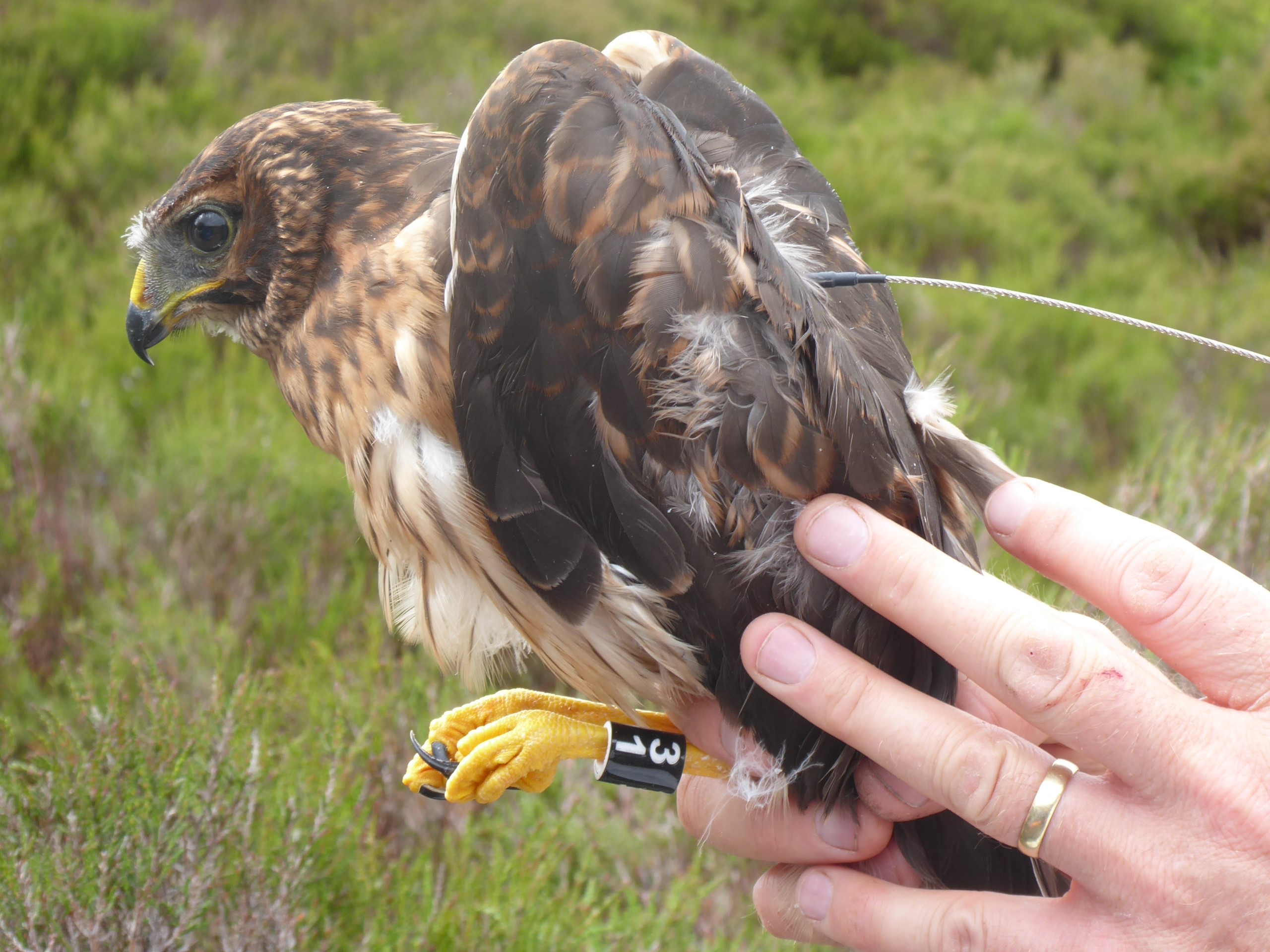
The RSPB’s Investigations Team has reported on social media that a satellite-tagged hen harrier named ‘Helius’ has ‘disappeared’ in suspicious circumstances in the Bowland area.
Her tag had been functioning well before suddenly cutting out in July at a location on the boundary of a United Utilities Estate between Brennand Fell and Tarnbrook Fell. A police search found no trace of her or her tag.
Hen harrier ‘Helius’. Photo by RSPB
Helius’s suspicious disappearance is the 10th reported hen harrier case this year, following the suspicious disappearance of hen harrier ‘Shalimar’ who vanished on a grouse moor in the Angus Glens in February (here), and eight other hen harriers either found dead or have ‘vanished’ in Northumberland, Devon, Nidderdale, Bowland and Yorkshire Dales National Park throughout the year (see here).
We’re still waiting for Natural England to provide an update on the status of those eight investigations. There’s no excuse for the long delay in providing post mortem results – some of those cases date back to February and March 2024.
The cynical amongst us might think that Natural England is deliberately withholding the results to swerve any bad press as it evaluates the success/failure of the hen harrier brood meddling trial, with a report due by the end of this year.
Unsurprisingly, Natural England’s main partner in the brood meddling sham, the Moorland Association (the grouse moor owners’ lobby group), is already shamelessly claiming the trial “a remarkable success story” (here), totally ignoring the ongoing and relentless persecution of hen harriers throughout the trial period, presumably in an attempt to persuade Natural England to roll out hen harrier brood meddling licences as a regular annual option.
By my calculations, 129 hen harriers are now confirmed to have been illegally killed/disappeared in suspicious circumstances, mostly on or close to grouse moors, since the brood meddling trial began in 2018. I’ll be updating the hen harrier death list shortly.
UPDATE 15 October 2024: 129 hen harriers confirmed ‘missing’ or illegally killed in UK since 2018, most of them on or close to grouse moors (here).
Press release from the BTO (British Trust for Ornithology), 14th October 2024:
BTO is seeking volunteers across Wales to help locate and observe birds of prey, particularly within the country’s Protected Areas. This unique project, named Cudyll Cymru (part of a new Welsh Raptor monitoring initiative), will build a network of dedicated volunteers to monitor the health and habitats of four widespread raptor species: Buzzard, Kestrel, Red Kite and Sparrowhawk, along with one crow species, the Raven.
Raptors are critical to the health of ecosystems, acting as top predators. Their sensitivity to changes in prey availability, habitat conditions, and climate makes them pivotal for researchers when detecting and monitoring environmental shifts.
Sparrowhawk photo by Sarah Kelman (via BTO press release)
The five chosen species covered by the study are widespread across Wales, and relatively familiar to most residents:
Common Buzzard A large bird of prey, these can be seen in a wide range of habitats. Their preferred food includes Rabbits and other small animals and birds, carrion, insects and earthworms.
Kestrel These pigeon-sized falcons are frequently seen hovering over fields and roadside verges, searching for voles, mice and other small mammals.
Red Kite Once threatened with extinction, these majestic birds can now be seen in many parts of Wales following successful, targeted conservation efforts. Primarily a scavenger, Red Kites mainly eat carrion, along with small animals and birds.
Sparrowhawk Another pigeon-sized raptor, these dashing hawks feed almost entirely on other birds. Mainly confined to woodlands, Sparrowhawks will also regularly visit gardens and parks.
Raven The largest member of the crow family, Ravens are not strictly raptors but share many characteristics of birds of prey. These distinctive birds will eat a wide range of food from berries to carrion, as well as small animals and birds. The study will collect data to assess raptor and Raven population trends and breeding success, with a particular focus on Wales’ Protected Area network, which includes Sites of Special Scientific Interest (SSSIs) and Special Protection Areas (SPAs).
This information will be vital in supporting conservation strategies and for informing government commitments to wildlife protection, especially as Wales faces ecological pressures from land use and climate change.
How to Get Involved
BTO is seeking volunteers of all levels of experience to join Cudyll Cymru. You only need to identify at least one of the key species and count the birds, nests, or territories in your chosen ‘patch’. Training will be provided through bird identification videos, written guides, and 1-on-1 mentoring. Flexible participation means you can contribute as little as two hours a month, making it easy to fit into your schedule.
Core surveys run from March through August, with data submitted through an easy-to-use online portal. Volunteers will receive full support, ensuring a smooth and rewarding experience.
Cudyll Cymru officially launches in January 2025, but you can register your interest now to be among the first to start monitoring. For more information and to sign up, visit the project webpage at:
Charlotte Griffiths, Welsh Raptor Monitoring Coordinator – Project Lead, said: “The five species we’re focusing on are significantly under-reported, and the data collected through these surveys will provide crucial insights into their breeding populations across Wales. In developing and supporting a future network of monitors, we’re taking great strides in securing the future of Welsh raptors.”
Dr Callum Macgregor, Senior Research Ecologist at BTO Cymru, added, “Participating in bird surveys is a wonderfully rewarding way to spend time outdoors. Anyone can take part and make an important contribution to conservation. We hope that Cudyll Cymru will provide the opportunity for lots of people to experience this for the first time, gaining valuable skills and knowledge in the process.”
This project is funded by the Nature Networks Programme. It is being delivered by the Heritage Fund, on behalf of the Welsh Government.
This is a guest blog written by conservation campaigner Bob Berzins who has featured previously on this blog here, here, here, here, hereand here.
Huge swathes of England’s Pennine uplands are managed for grouse shooting, an activity that benefits a handful of people but has a negative effect on millions more – those living downwind and downstream and the global community affected by carbon emissions.
In a biodiversity and nature emergency these uplands are robbed of life and the most glaring example is continued wholesale persecution of raptors and the land itself has been degraded over the last 200 years where ownership has often remained in the same family. Right now we pay those landowning families millions in subsidies and millions more in restoration grants in an attempt to put right the damage they’ve done – but the damage continues. There has to be a better way. In this blog I’ll make the case for compulsory purchase of land that’s being managed to the detriment of local communities.
The English Devolution Bill is due to be debated in Westminster parliament this autumn. The proposals will empower local communities with a strong new ‘right to buy’ for valued community assets. The examples given are mainly urban but Labour activists and many others have been calling for sweeping changes to land ownership.
This piece by Labour Councillor Minesh Parekh was written when he was part of Olivia Blake’s team in a shadow Defra role. George Monbiot, Guy Shrubsole and others wrote Land For the Many in 2019 where they propose a structure to enable community ownership using the example of the moors above Hebden Bridge where, “The community could reasonably argue that such land serves a more important public purpose as a natural flood defence than as a grouse shoot”.
Mark Avery argues for public ownership in Reflections and Guy Shrubsole expands on this in Lie of the Land.
These books are important because they firmly put the case for the benefits changes in ownership will bring. An example of how this might work in practice is the community fundraising and management of Tarras Valley which has shown how to bring life to a depleted grouse moor.
I live in Sheffield where grouse moors lie within the city boundary, just a few miles from the homes of half a million people and everything that happens on that moorland affects our lives.
Land use map of Sheffield – grouse estates are located in the northern half of moorland (brown)
These moors could provide huge benefits, locally and globally, but instead they are failing by the Government’s own measure. We deserve better and to add to that sense of injustice ownership of these uplands was wrenched away from the community to become the sole property of one person, usually The Lord of the Manor.
The Enclosure or Inclosure Acts 1790 – 1830
During this period MPs were largely rich, aristocratic landowners and they voted through a series of individual Acts of Parliament where moors, waste and commons were shared out between themselves.
In what is now Sheffield, the Duke of Norfolk received most land – from lowland sites where steelworks were eventually constructed, to uplands which soon became grouse shoots such as Hallam moors which is now part of the Moscar Estate. Other beneficiaries included Earl Fitzwilliam who ended up with Bradfield moors and this family are still the owners today.
Map of Land Preserved by the Bradfield Game Association 1898 Wentworth Woodhouse Muniments – Sheffield Archive
The land marked here includes the Fitzwilliam Wentworth Estate to the east and Howden Moors owned by the Duke of Devonshire which is now part of National Trust High Peak Estate. The preservation by the Game Association has left a legacy of dry, denuded moorland in unfavourable condition.
It took at least six individual enclosure acts for the Duke of Rutland to get hold of the Sheffield Eastern moors and a hundred years later we have death duties to thank for the sale of this estate which eventually led to ownership by the National Trust, Sheffield Council and the National Park Authority – land which is now managed for the benefit of us all (see Eastern Moors Partnership).
But it seems the Rutlands couldn’t bear to be without a grouse moor and they bought Moscar Estate from the snuff making Wilson family in 2016 who had acquired the land from the Duke of Norfolk in 1897. The other large estate overlooking Sheffield is Broomhead where a different Wilson family have been in residence since the 1300s, again benefitting from enclosure to get their hands on the moors.
The Dukes of Norfolk, Rutland and Earl Fitzwilliam were and remain some of the richest and most powerful landowners in the country. Over the centuries aristocratic family names have changed slightly but the property portfolios haven’t and it was the Enclosure Acts which defined their ownership of the uplands (Source: David Hey – A History of the Peak District Moors).
It’s worth noting that whilst the Fitzwilliams were enjoying their grouse shooting 36 miners died in their Elsecar collieries between 1868 and 1895. The Fitzwilliams owned not just the collieries but the surrounding land and miners cottages as well – so they pretty much owned the workers themselves.
The Grouse Moors are in an atrocious state – Who takes ownership for that?
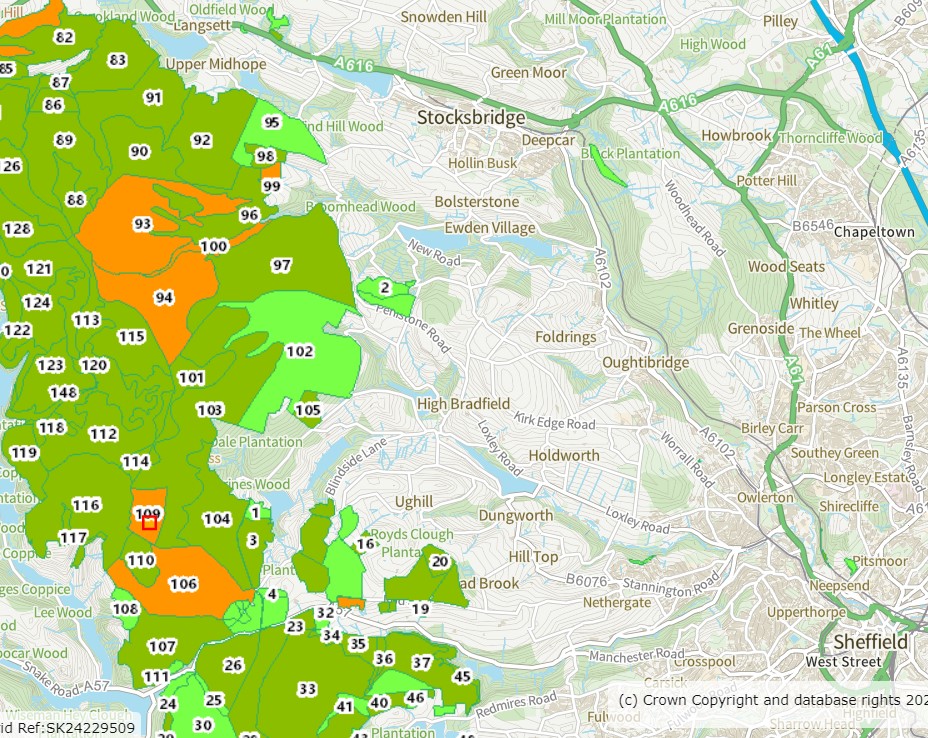
SSSI units on Sheffield Grouse Moors (Defra Magic map)
This is land with the highest conservation designations – Sites of Special Scientific Interest, Special Protection Areas for wildlife and Special Areas of Conservation for habitat. Light green means the SSSI has favourable condition. Dark green means unfavourable recovering and pale red means unfavourable no change. Many of the unfavourable recovering sites haven’t been surveyed since 2011 when austerity slashed Natural England’s budget and the few remaining staff rarely visited these sites. The units were given recovering status because of new stewardship agreements which were supposedly going to transform the land but this hasn’t happened. Very clearly these moors are failing.
If we look at the units in pale red which have been surveyed recently, Middle Moss (94) is on the Broomhead Estate and the site visit refers to restoration work – in 2016/17 Broomhead received £530,922 (source FOI) in capital grants for restoration of this unit and others as well as around £2 million over a ten year period in Stewardship funding, mainly to improve conservation.
Restoration work creating Peat dams Middle Moss 2017. Note the low species diversity – lots of heather.
Example of restoration in Upper Derwent 2024 on National Trust land. Stone dam, heather brash to re-seed gully sides and lime fertiliser because the peat here is too acidic.
Surely such expensive restoration work on Middle Moss would result in a huge improvement and we’d now be seeing the benefits? No, the assessment is ‘unfavourable no change’. This land has been in the same family for 200 years – two centuries of burning and drainage to dry the whole landscape and promote a monoculture of heather can’t be undone with a half million pound tranche of restoration money. It’s left to the taxpayer to provide a bottomless pit of money to repair this damage.
Is the atrocious state of Grouse Moors limited to the Peak District?
The Duke of Devonshire’s family have owned Bolton Abbey Estate since 1748. Located in the Yorkshire Dales National Park, it’s been largely assessed as ‘unfavourable declining’ condition (bright red) in the screen grab below:
SSSI Units at Bolton Abbey (Defra Magic map)
The Barden Moor unit assessment in 2024 states, “activities relating to grouse management are impacting throughout”. And on Thorpe Fell, “Blanket bog in this unit appears relatively dry and there is a notable lack of sphagnum cover / species… Rewetting, re-vegetating exposed peat and reduction in the intensity of / location of grouse management activities would all likely see an improvement in the condition of both dry heath and blanket bog in this unit.”
In this area of the Yorkshire Dales, grouse management has resulted in dry moors which are unfavourable condition and declining. Managed to death, this huge area of moorland is failing under its current owners.
Grouse moor management is still a constant brake on improvement
Back in the Peak District, Moscar Estate also received huge sums for restoration – £348,800 in 2016/17 but Black Hole Moor unit 109 was assessed as ‘unfavourable no change’ in 2022 and previous “Hot Burns” are one of the contributing factors.
When burning was allowed on this blanket bog the management plan specified “Cool Burns” leaving much of the vegetation intact. Natural England issued the estate with a warning letter in 2016 after I complained about Hot Burns (removing all the vegetation) but that’s the limit of their monitoring.
This year I attended a public inquiry where a Natural England Manager said he’d been tasked with replying to my complaint about the Hot Burns on 9th October 2023 when Sheffield filled with smoke. He described me as a pain in the neck, but apparently at least I kept them honest.
Well I still haven’t had a reply and it seems that Natural England’s historical failure to monitor and act over illegal Hot Burns has led to the ‘unfavourable condition’ of this conservation unit. We all suffer as a result of that because an ‘unfavourable’ assessment means rainfall is flooding downstream and carbon is flooding into the atmosphere. Grouse moor managers know that dry, heather-dominated moors have provided ideal conditions for a huge number of grouse over the last 200 years and they’re not going to give that up.
Natural Flood Management
Leaky Dam in Limb Valley (suburb of Sheffield)
Sheffield suffered catastrophic flooding in June 2007. The moors are the highest part of the catchment – the area with highest rainfall. Seventeen years on there’s been some progress but nowhere near enough.
The Environment Agency and partners are starting to look at flood prevention measures. But crucially nobody has come up with a coherent plan of how to manage all moorland to provide the best mitigation against flooding. If blanket bog is still in ‘unfavourable’ condition that means the gully blocking has not transformed the landscape. The dams need to create mounds of sphagnum and a wider habitat where the water table is at the surface year round. And there’s still 50% of moorland on thinner peat soils – Dry Heath.
Natural England’s idea of ‘Favourable condition’ Dry Heath at Emlin Unit 102
I’d say this is the worst possible management to prevent flooding yet this type of burning is usually described as essential by moorland owners. Under current arrangements there’s zero chance of seeing trees, scrub, more varied vegetation and measures to retain and increase peat coverage such as we’re seeing on blanket bog.
Illegal Blanket bog burning 2024
As well as the very obvious failure to prevent, police and prosecute raptor persecution, the same can be said of illegal burning on deep peat supposedly prohibited by The Heather and Grass Burning Regulations from October 2021.
We’ve had two token prosecutions (here) and (here) which did nothing to prevent alleged illegal burning on Fitzwilliam Estate over the last three seasons – all logged with Natural England and Defra. Another example of grouse moor managers desperately trying to maintain dry, heather dominated moors and apparently another example of our authorities looking the other way.
Conclusion
Two hundred years of grouse moor management is a major factor in the dire state of these uplands yet the taxpayer continues to fund practices which harm local and wider communities. We are paying for this land over and over, through subsidies and grants yet it remains the property of a handful of individuals. This is land which was wrenched away from the community and it needs to be taken back to provide benefits for us all.
Extending community ‘right to buy’ to moorlands is a start but we need more – a programme of moorlands coming under state ownership through compulsory purchase if necessary.
Who would manage this state owned land for the benefit of us all? Natural England is an obvious candidate but it would take a ban on grouse shooting for them to do the job effectively and honestly – the reach and influence of the grouse industry is simply too great at the moment.
If this seems like an impossibly high goal, land reform will be discussed and debated in Westminster and the impacts of climate change cannot be ignored forever. There has been probably five consecutive years of poor to non-existent grouse shooting in the Peak District the southernmost and warmest grouse area and extreme weather events and weather patterns are becoming normal. We need urgent, drastic action to put things right.
Please start by lobbying your MP over the English Devolution Bill. And if you want to hear more about all this Guy Shrubsole is doing a speaking tour with his new book.
REVIVE, the coalition for grouse moor reform, is hosting it’s annual national conference at Perth Concert Hall on Sunday 10th November 2024 and the full programme has now been announced.
Press release from REVIVE:
Big Land Question Conference to Tackle Land Reform
Actor David Hayman to co-host conference with Lesley Riddoch on 10 November in Perth.
The conference will launch a year-long programme of independent research to gather robust data on what the Scottish people want land reform to deliver.
The big question at the core of the conference is why do just 433 individuals own half of Scotland’s private land?
The REVIVE Coalition is set to launch ‘The Big Land Question’ campaign at a landmark conference in Perth next month that will address the pressing issue of land reform in Scotland.
Co-chaired by actor David Hayman alongside journalist and broadcaster Dr Lesley Riddoch, the event will take place at a time of increasing public demand for more ambitious land reform policies.
The question at the core of the conference is the fact that just 433 individuals control half of Scotland’s private land, an imbalance that has far-reaching consequences for local communities, wildlife and the environment.
The need to change patterns of land ownership was highlighted by a 2019 review by SRUC commissioned by the Scottish Land Commission. The review stated that concentrated land ownership was causing “significant and long-term damage to the communities affected”, and that the economic benefits from scale of ownership tend to benefit the landowner rather than communities.
David Hayman underscored the significance of the conference, commenting:
“For too long, Scotland’s land has been in the hands of the few. The Big Land Question is about bringing people together – from activists and policymakers to those directly impacted – to ask the tough questions about what land reform means in practice. This is an important conference with a provocative and inspiring programme. Ultimately, it’s about fairness and how we ensure that Scotland’s land benefits the many.
“Access to land and decisions about how it’s used affect so many aspects of Scottish life, from housing and the economy to recreation and wellbeing. The highly concentrated nature of Scotland’s land ownership is a roadblock to unlocking the potential prosperity of our nation’s natural resources. We need bold, innovative solutions and more ambition in our policy approach, and this conference is where those conversations will happen. We’ve got a real chance to drive change and this could be the turning point for Scotland’s people, wildlife and environment we’ve been looking for. I’m proud to be part of it.”
The one-day conference in Perth is being organised by REVIVE – a coalition of environmental, social justice and animal welfare organisations – and it features a diverse panel of prominent speakers including Andy Wightman, author, land reform campaigner and former MSP who recently revealed that research shows the Duke of Buccleuch has been responsible for redistributing more land in the last five years than Scottish Government has managed in 25 years of devolution, although this has been costly for communities.
The largest of the Buccleuch land holdings to move into community ownership is Tarras Valley Nature Reserve, a former grouse moor near Langholm, and Estate Manager Jenny Barlow will also speak at the conference. She will be joined by Kevin Cumming, Director of Rewilding Britain, Donna Smith, Chief Executive of the Scottish Crofting Federation, and Michael Russell, Chair of the Scottish Land Commission. Participating political figures include Rhoda Grant MSP (Scottish Labour) and Arianne Burgess MSP (Scottish Green Party), both representing the Highlands and Islands, and a Scottish Government Minister is also expected to attend.
Max Wiszniewski, Campaign Manager for the REVIVE Coalition, said:
“This conference comes at a pivotal moment where there is growing recognition that the current patterns of land ownership are holding back Scotland. Our polling data demonstrates strong public support for policies that would limit the amount of land any one person or business can own, increase community ownership, and ensure that land use aligns with climate and biodiversity goals.
“The Big Land Question conference will provide a platform for serious discussion on how to address these demands, and it will launch a campaign of independent research with the aim of enhancing and informing policy development to create a more democratic, fair, and sustainable vision for Scotland’s land.”
Polling carried out for the REVIVE Coalition and Community Land Scotland by the Diffley Partnership in May this year showed that a clear majority of Scots want land reform policies to go much further than the land reform bill currently proposed by the Scottish Government. The new year-long programme of research will build on those initial findings, using a combination of surveys and moderated stakeholder roundtables to provide rich data and insights that will be shared with political parties and policy makers.
The suffocating impact of Scotland’s concentrated land ownership was also evident in research by Biggar Economics, published last year and commissioned by Scottish Land and Estates. The report identified that 1125 rural estates take up approximately 4.1 million hectares, and found that while this equates to around 57% of Scotland’s rural land, they:
Account for less than 2% of the value of the Scottish economy, a level assessed as “trivial” by the report authors
Account for just 1 in 10 rural jobs
Provide only around 3% of rural homes and build around 1% of new homes built in rural areas each year
The research also noted that only a quarter of estates self-report that they actively contribute to community empowerment.
Max Wiszniewski added:
“While members of the REVIVE Coalition welcome the work done on land reform so far, the current Land Reform (Scotland) Bill lacks ambition and does not align with the expectations of the Scottish people. We look forward to The Big Land Question conference and campaign shining a spotlight on opportunities to transform Scotland’s pattern of increasingly concentrated land ownership for good.”
The Big Land Question Conference takes place on Sunday 10th November at Perth Concert Hall. Tickets cost £8 (£5 concession) and are available from the venue HERE.
Regular blog readers will know that the Scottish Parliament voted through a complete ban on the use of all snares (and so-called ‘humane cable restraints’) as part of the Wildlife Management & Muirburn Scotland Act 2024 earlier this year (here).
It was recently announced that the ban will commence with immediate effect on 25 November 2024.
Those who have followed the long campaign to bring regulation to the grouse shooting industry’s activities will also be well aware of that industry’s outright hostility to even the concept of a potential grouse moor licensing regime, dating back many years (e.g. here, here, here and here).
The amateur dramatics continued in 2020 (here) when the Scottish Government finally announced its response to the Werritty Review and told the world that grouse moor licensing would definitely be introduced, largely down to the continued illegal persecution of raptors on many driven grouse moors.
The subsequent hysterical scaremongering from the industry included declarations that grouse moor licensing would ‘threaten’ and ‘damage’ the rural economy; an oft-used but wholly unsubstantiated claim by this lot, e.g. on land reform, see here; on the removal of an exemption on business rates, here; and on the introduction of vicarious liability to tackle raptor persecution crimes, here.
Has the rural economy fallen flat on its arse as a result of these measures? Not according to the grouse shooting industry, which is still declaring itself indispensable to the Scottish economy (a claim strongly contested by others, e.g. see here).
It’s no surprise then to see the industry wheel out the so-called ‘negative financial effect’ claim once again, this time on the eve of the snare ban commencement.
A consortium of the usual suspects (Scottish Land & Estates, Scottish Gamekeepers Association, Scottish Countryside Alliance, BASC Scotland, Scotland’s Regional Moorland Groups and the Scottish Association for Country Sports), joined this time by the National Farmers Union of Scotland, has written an overly-dramatic letter to the Convenor of the Scottish Parliament’s Rural Affairs & Islands Committee to complain about the commencement of the ban.
I’m not sure what they’re on about in paragraph 2, suggesting that the principles behind the snare ban “were not afforded the customary levels of parliamentary scrutiny, which is extremely regrettable“. Eh?
Actually, the subject of snares has been debated repeatedly in the Scottish Parliament over many, many years (at least 15 yrs). It has also been the subject of public consultations, and there was a full parliamentary evidence session at Stage 1 of the Bill to which several of these organisations contributed (here). Christ, the grouse shooting industry was even given extra time to submit more evidence, as a gracious gesture by the then Environment Minister, Gillian Martin, so all this portrayal of themselves being victims of procedural unfairness is hilarious.
Their letter reveals their latest ploy to disrupt the will of Parliament – to complain that Ministers haven’t conducted a Business & Regulatory Impact Assessment prior to the commencement of the snare ban, and they strongly suggest that this should afford a delay to the commencement of the snare ban.
I’m sure that in a strictly technical sense, they may have a point, although my understanding of BRIAs is that they are not compulsory and should be proportionate to the new regulation being proposed, but the absurdity of this latest complaint is hard to ignore.
The snare ban doesn’t prevent gamekeepers from continuing to kill foxes. And the foxes they are killing (e.g. 200 per year on one estate whose gamekeeper gave evidence to the Bill committee) are probably at such high densities thanks in large part to the availability of unnaturally-high levels of gamebirds that create an over-abundance of prey that will attract foxes to the estate. Its a problem of the industry’s own making.
To suggest that an estate might face financial ruin if gamekeepers can only shoot foxes in the face rather than asphyxiate them with a wire noose reveals an awful lot about the mindset of these so-called ‘guardians of the countryside’.
Imagine arguing against a ban on a device that causes so much unnecessary suffering to any poor animal unfortunate enough to be caught in it, let alone suggesting that your business can’t function without being able to inflict such cruelty. If that’s the case, they shouldn’t be in business at all.
The Convenor of the Rural Affairs Committee, Finlay Carson MSP (who, along with his fellow Conservatives voted against the Wildlife Management Act) has responded to the letter of complaint by writing his own letter, on behalf of the Committee, to Minister Jim Fairlie (gosh, it’s almost as if this was all pre-planned). Here’s the Convenor’s letter to the Minister:
In February this year, part-time gamekeeper Timothy Hall, 48, and his son Lewis Hall, 23, were sentenced after they’d pleaded guilty to the illegal laundering of wild peregrines that had been stolen from nest sites across southern Scotland and were sold on to falconers in the Middle East (see here).
Young peregrines at a nest site in Scotland. Photo (taken under licence) by Ruth Tingay
Despite their offences passing the threshold for a custodial sentence, Timothy Hall was only ordered to complete 220 hours of unpaid work and Lewis Hall was only ordered to complete 150 hours. These sentences were considered to be staggeringly inadequate given the extent of the Halls’ offending (see here).
Lewis Hall leaving court in February, before being prosecuted under the Proceeds of Crime Act. Photo screen-grabbed from BBC Reporting Scotland footage.
However, the Crown Office reported at the time that Lewis Hall would also be subject to action under the Proceeds of Crime Act, where profits from criminal activity can be confiscated.
At a court hearing in June, it was revealed that prosecutors were seeking to recover £164,028.80 from Hall (here) and the Sheriff allowed Hall additional time to provide evidence from a forensic accountant to challenge this amount.
Following a hearing at Selkirk Sheriff Court today (10 Oct 2024), Lewis Hall accepted that he benefitted from “general criminal conduct” by £110,000.
The court ordered he repay £27,182 (based on an amount the court deemed was available) and he is likely to have to pay this within six months.
That leaves £82,981 unrecovered. However, the Crown has the power to apply to the court to extend the order to seize money and any assets Hall acquires in the future to pay back the full amount he made from his crimes. I hope the Crown pursues this.
Police Officer Suzanne Hall, who was cleared of involvement in the peregrine laundering crimes, is reportedly facing a separate charge of alleged fraud relating to almost £10,000, to which she has pleaded not guilty. Her trial is due to begin on 19th November 2024 (see here).
Please note – as Suzanne Hall’s case is still active, no blog comments about it will be posted on this blog until proceedings finish. However, as Lewis Hall’s case has now concluded, comments about his case are now accepted. [UPDATE 12 October 2024:I’ve received an unconfirmed report that the case against WPC Suzanne Hall has been dropped. I’m seeking confirmation of this and will report in due course. Comments about her case remain switched off until confirmation is received from the prosecuting authorities].
This is a significant and relatively rare result for a wildlife crime case in the UK. It doesn’t excuse the pathetically inadequate sentences handed down in February to Timothy and Lewis Hall for the serial offending they committed over a long period of time, but it does provide gratification that they haven’t escaped justice entirely. It should also act as a meaningful deterrent to others. I also hope it provides some satisfaction to the investigatory team behind Operation Tantallon who put in several years of painstaking work to get these criminals in to court.
The Crown Office has released the following statement about Lewis Hall’s case:
Man convicted of illegally selling peregrine falcon chicks agrees to repay £27,000
A man convicted of possessing and selling wild peregrine falcon chicks for large sums of money has agreed to pay back more than £27,000 in a Proceeds of Crime confiscation action.
Lewis Hall, 24, was ordered to carry out 150 hours of unpaid work over 15 months and banned from possessing or having under his control any bird of prey for five years after being sentenced in February at Jedburgh Sheriff Court.
He had earlier pled guilty at Selkirk Sheriff Court to acquiring for commercial purposes, keeping for sale, and selling the chicks between 2020 and 2021.
Hall, of Berwick-Upon-Tweed, has now agreed to repay £27,182 under Proceeds of Crime legislation following a hearing at Selkirk Sheriff Court. The figure is based on an amount which the court deems as being available.
Court records show that Hall accepted he benefited from “general criminal conduct” by £110,000.
The Crown has the power to apply to the court to extend the order to seize money and any assets Hall acquires in the future to pay back the full amount he made from his crimes.
Sineidin Corrins, Deputy Procurator Fiscal for specialist casework at the Crown Office and Procurator Fiscal Service (COPFS), said: “The sale of peregrine falcons has become an extremely lucrative business.
“Lewis Hall took advantage of that for his own financial gain and to the detriment of the wild peregrine falcon population in the South of Scotland.
“However, even after a conviction was secured in this matter, the Crown commenced Proceeds of Crime action to ensure the funds Hall obtained illegally were pursued.
“Prosecution of those involved in financial crime does not stop at criminal conviction and sentencing.
“The funds recovered from Lewis Hall will be added to those already gathered from Proceeds of Crime, to be re-invested in the community by Scottish Ministers through the CashBack for Communities programme.”
The court heard how in April 2021 a member of the Lothian and Borders Raptor Study Group alerted police to suspicious failures of peregrine falcon nests in the Berwickshire area which had previously been productive.
Officers later investigated two nesting sites and discovered they had been disturbed and a number of eggs were missing from both locations.
A police search of Lewis Hall’s father’s home in Berwick-Upon-Tweed subsequently found a total of seven peregrine falcon chicks as well as a number of other birds of prey.
Further enquiries concluded that none of the chicks were captive-born and had been taken from the wild.
Under legislation, selling captive-bred peregrine falcons is legal but possessing or selling wild birds is unlawful.
Appeal for information from Police Scotland (10th October 2024)
APPEAL FOLLOWING DEATH OF PEREGRINE FALCON IN ANGUS
Wildlife officers are appealing for information following the death of a peregrine falcon in the Angus area.
On Tuesday, 3 September, 2024, the injured bird was found in distress by a member of the public in the Glen Esk area near to Tarfside. The SSPCA was called, and the bird taken to the wildlife resource centre in Fishcross for treatment. Due to the severity of the injuries, the bird had to be euthanised on Wednesday, 11 September, 2024.
Following further investigations, it was established that it had been shot and police were contacted.
Constable Craig Savage, Wildlife Crime Officer, said: “Peregrine falcons are protected under the Wildlife and Countryside Act and it is illegal to kill any protected species.
“Since this matter was reported to police, we have been carrying out enquiries and working with our partner agencies to establish the full circumstances.
“We would appeal to anyone with any information that may assist our investigation to please contact us. Your information could be vital in in establishing what has happened. If you were in the Glen Esk area around Tuesday, 3 September and saw anything suspicious or have any information about shooting activity in the area, please come forward.
“Anyone with information is urged to contact Police Scotland on 101 quoting reference CR/0368615/24.”
Ian Thomson, RSPB Scotland’s Head of Investigations said “The news of this crime comes only a few weeks after an Osprey was shot in an adjacent glen [Ed: see here] but hearing about ongoing raptor persecution incidents in the Angus Glens will come as no surprise to anyone with an interest in the fortunes of Scotland’s birds of prey.
There has been a catalogue of cases of poisoning, shooting and illegal trap use in this area dating back decades. As with many previous cases, there will be very few people in the local area who have the motivation, access, requisite firearms and opportunity to shoot and fatally injure one of our most iconic bird of prey species.
We trust that if this latest crime is found to be linked to local grouse moor management, that NatureScot utilise the powers give to them by the Wildlife Management and Muirburn Bill to impose the most robust sanctions possible.”
ENDS
I’ll comment on this case shortly, in relation to Scotland’s new grouse moor licensing scheme.
The Moorland Association, a lobby group for grouse moor owners in England, has jumped the gun and prematurely declared the 7-year hen harrier brood meddling trial “a remarkable success story” and says its Board has decided to apply to Natural England for what it describes as a ‘conservation licence’ to permit continued hen harrier brood meddling on an annual basis now that the trial has ended (see Moorland Association blog here).
For new blog readers, the hen harrier brood meddling trial was a conservation sham sanctioned by DEFRA as part of its ludicrous ‘Hen Harrier Action Plan‘ and carried out by Natural England between 2018 – 2024, in cahoots with the very industry responsible for the species’ catastrophic decline in England. In general terms, the plan involved the removal of hen harrier chicks from grouse moors, they were reared in captivity, then released back into the uplands just in time for the start of the grouse-shooting season where many were illegally killed. It was plainly bonkers. For more background see here and here.
Hen harrier photo by Laurie Campbell
I’ve written a bit about hen harrier brood meddling this year, including the news that no hen harriers were brood meddled in the trial’s final year (2024) and possible reasons why that might have been (here) and the news that one of the project partners, the Hawk & Owl Trust, has recently withdrawn from the project now the trial has ended (here).
We also know that Natural England is “currently reviewing and analysing the data” [from the brood meddling trial] and that this is “a process which will be concluded later this year. These findings will play a critical role in informing Natural England’s judgement as to the effectiveness of brood management as a conservation technique“.
As a reminder, the brood meddling trial, initially set up as a five-year trial and later extended for a further two years, was supposedly designed to test two specific objectives:
The practicalities of brood management: can [hen harrier] eggs or chicks be taken from the wild and raised in captivity, can those chicks be released back in to the wild and the implications for their subsequent behaviour and survival;
Changes in societal attitudes by those involved in upland land management to the presence of hen harriers on grouse moors with a brood management scheme in place.
It’s quite clear that objective 1 has been answered by the trial – although chicks rather than eggs have been brood meddled due to concerns about transporting the eggs from the nests over rough terrain, but that’s no big deal in terms of assessing the viability of the objective.
But what about objective 2? It seems pretty clear to me that apart from the handful of estates involved in the brood meddling trial (whether they be ‘donor’ or ‘receptor’ sites), that a high level of illegal hen harrier persecution continues amongst the wider grouse moor industry (128 hen harriers reported as ‘missing’/illegally killed so far since the trial began in 2018, including at least 30 brood meddled hen harriers) and the killing is on such a scale that the police have had to set up a new Hen Harrier Taskforce, designed to use techniques usually seen when dealing with serious and organised crime, to address the ongoing criminality.
It’s obvious then that attitudes towards hen harriers from within the wider grouse shooting industry have not changed as a result of the trial, so the Moorland Association’s claim of the trial being “a remarkable success story” is unsubstantiated nonsense.
Incidentally, Natural England has already produced an interim report (in April 2022) on the social science aspect of the brood meddling trial, which is hilariously bad, but I’ll write about that separately as it deserves its own blog post.
Back to the Moorland Association’s premature announcement that it intends to apply to Natural England for a (currently non-existent) ‘conservation licence’ to continue hen harrier brood meddling, the MA states that, “This approach fitswith global guidelines onwildlife conflict resolution, produced by the International Union for the Conservation of Nature (IUCN)“.
On the contrary, those IUCN guidelines are quite clear that animal translocations (in the context of human/wildlife conflict, as opposed to translocations for conservation purposes) should not take place if the perceived ‘problems’ caused by that species at the original location (in this case, on driven grouse moors) would simply be transferred to the new location(s). We’ve already seen that removing hen harrier chicks from a few grouse moors and releasing them somewhere else does not fix the problem – hen harriers are still not tolerated on other grouse moors and continue to be killed.
It’s also interesting that the Moorland Association’s blog details what it claims to be “the format of the conservation licence“, when that licence doesn’t even exist, let alone any details of its format/content! The Moorland Association claims the format includes, “A single release site” [for brood meddled hen harriers], presumably to get around the problem of there not being sufficient receptor sites willing to take the brood meddled harriers, and, “No further requirement for satellite tags“, presumably because the data from current satellite-tagged hen harriers have been so very effective at revealing the devastating extent of ongoing hen harrier persecution (e.g. see here and here). Awkward!
My guess is that the Moorland Association has made this announcement now, knowing full well that Natural England is still in the process of evaluating the success/failure of the brood meddling trial and the MA is using this announcement as a way of piling on the pressure on Natural England.
I’m really looking forward to Natural England’s full evaluation of the brood meddling trial, apparently due by the end of this year. And maybe by then it’ll also provide updates about the current ongoing police investigations into hen harriers that have died/gone ‘missing’ this year.
UPDATE 14 April 2025: Natural England / DEFRA turns down licence application for hen harrier brood meddling in 2025 (here)
A proposal to translocate white-tailed eagles to Cumbria that has been in development for a number of years (see here) has reached the public consultation stage.
The Cumbrian White-tailed Eagle Project is being overseen by a steering group comprising the University of Cumbria, Cumbria Wildlife Trust, The Lifescape Project, RSPB, the Wildland Institute, the Lake District National Park Authority alongside local estate owners and managers.
According to the steering group, research has indicated that Cumbria has sufficient suitable habitat to support a population of white-tailed eagles and the county is considered an important strategic location to encourage links between other populations in Scotland, Ireland and Northern Ireland and the south of England.
The group is now engaging with the public to listen to views on bringing back this species to Cumbria and has begun a series of drop-in sessions, meetings and workshops (details here).
Unsurprisingly, this news has triggered the usual idiotic fear-mongering hysteria about white-tailed eagles based on ignorance and a persistent Victorian attitude to raptors, led, of course, by The Telegraph:
This is just lazy journalism. Had The Telegraph bothered to undertake any research at all, it would know that a series of scientific studies have shown that white-tailed eagles are generalist predators with a broad diet, and the most recent study from Scotland (here) shows that lambs are not an important food source for this species but marine prey is. This finding is also supported by a recent dietary study from the WTE Isle of Wight Reintroduction Project (here), which also concluded “there have been no cases of livestock predation since the project began“.
The hysteria was continued by this tweet from Mark Robinson, a farmer in North Yorkshire whose Twitter bio says he’s also the Reform Party spokesperson for the Thirsk and Malton Constituency (having failed to get elected in June). According to Farmer Robinson, the eagles will be ‘snatching up babies’ -:
It sounds like Farmer Robinson has been reading the discredited guff of the Scottish Gamekeepers Association, who has previously written to the Scottish Government about concerns that white-tailed eagles might eat children (here).
UPDATE 23 October 2025: Should White-tailed Eagles be reintroduced to Cumbria? Another questionnaire seeks your views (here)







 Raptor Persecution UK