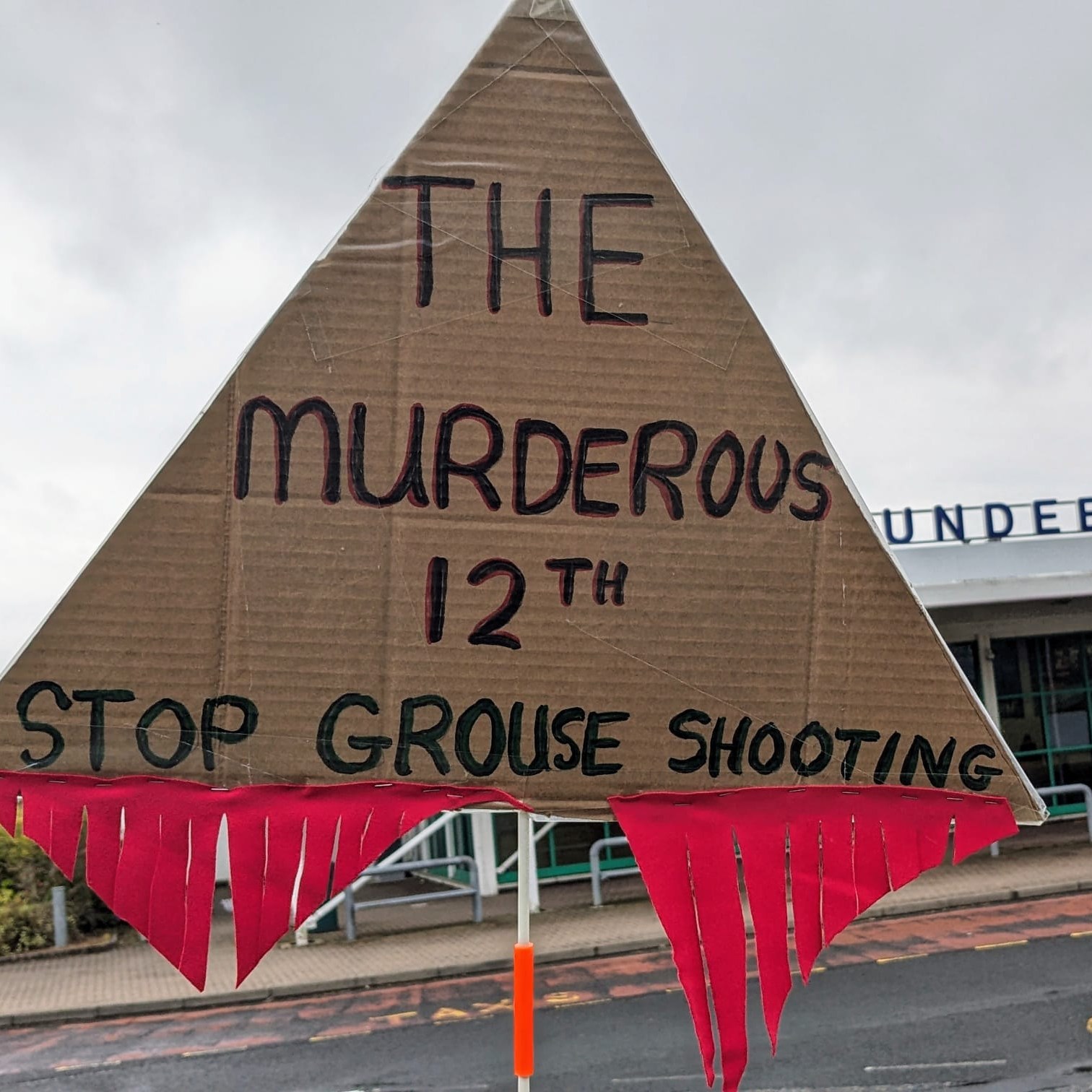
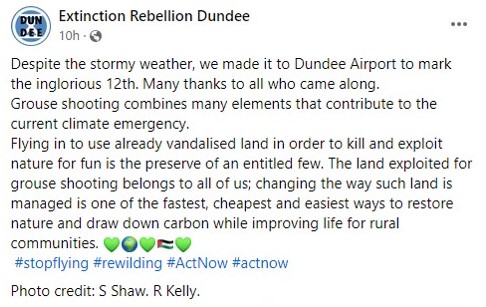
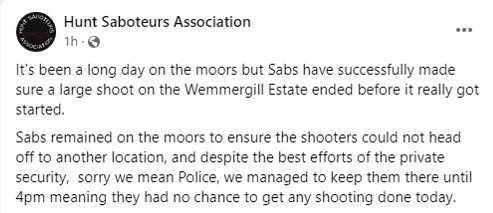
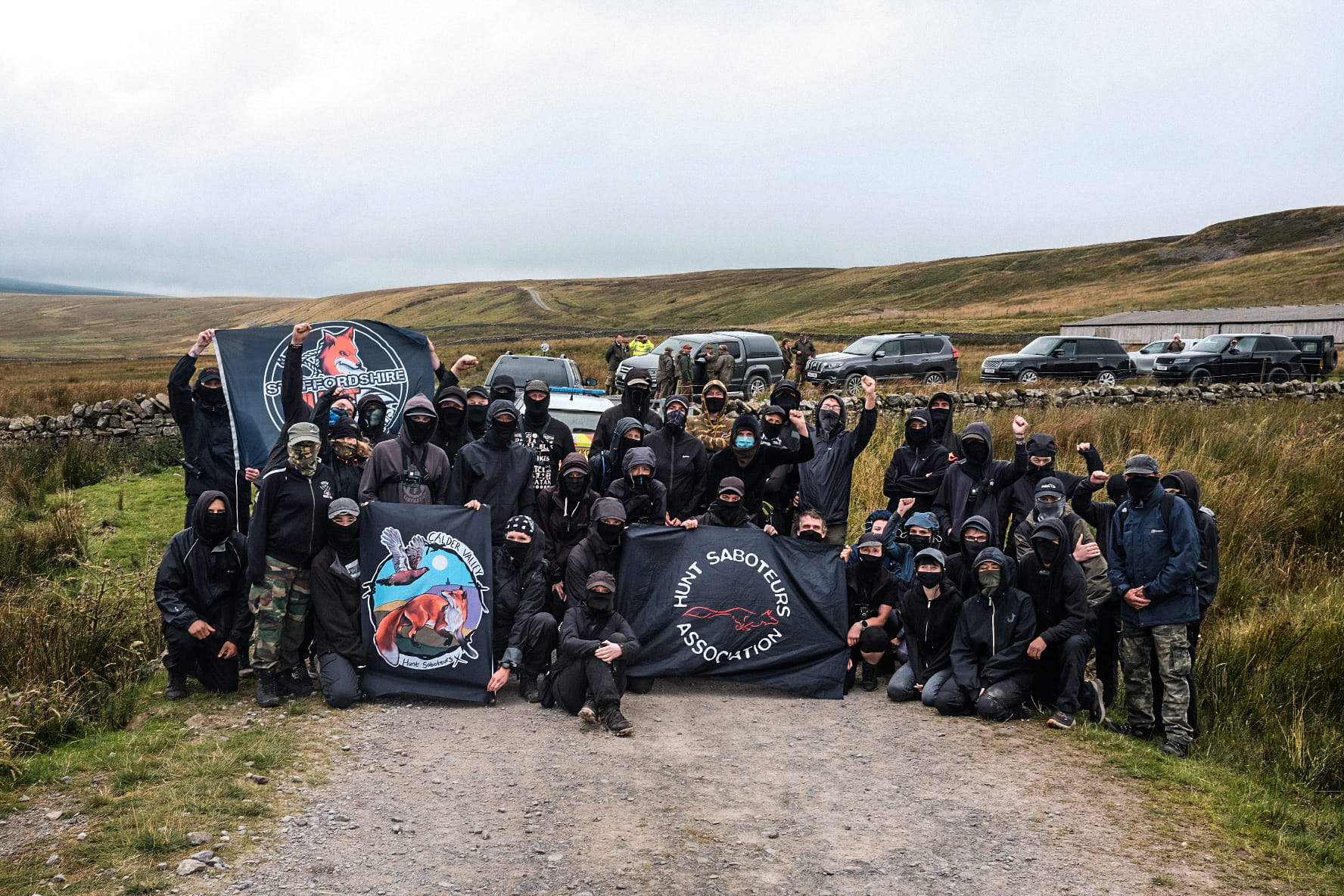
Whilst the Hunt Sabs were out disrupting grouse shoots in northern England yesterday (here), Extinction Rebellion were at Dundee Airport in Scotland to protest against grouse shooting.
This is the third year they’ve demonstrated with banners at Dundee Airport on the Inglorious 12th, aiming to coincide with the arrival on private jets of grouse shooters, heading from the airport to go shooting in the Angus Glens.
There are more photographs of the event on the Extinction Rebellion Dundee facebook page, including someone who looks remarkably similar to Maggie Chapman MSP from the Scottish Greens.
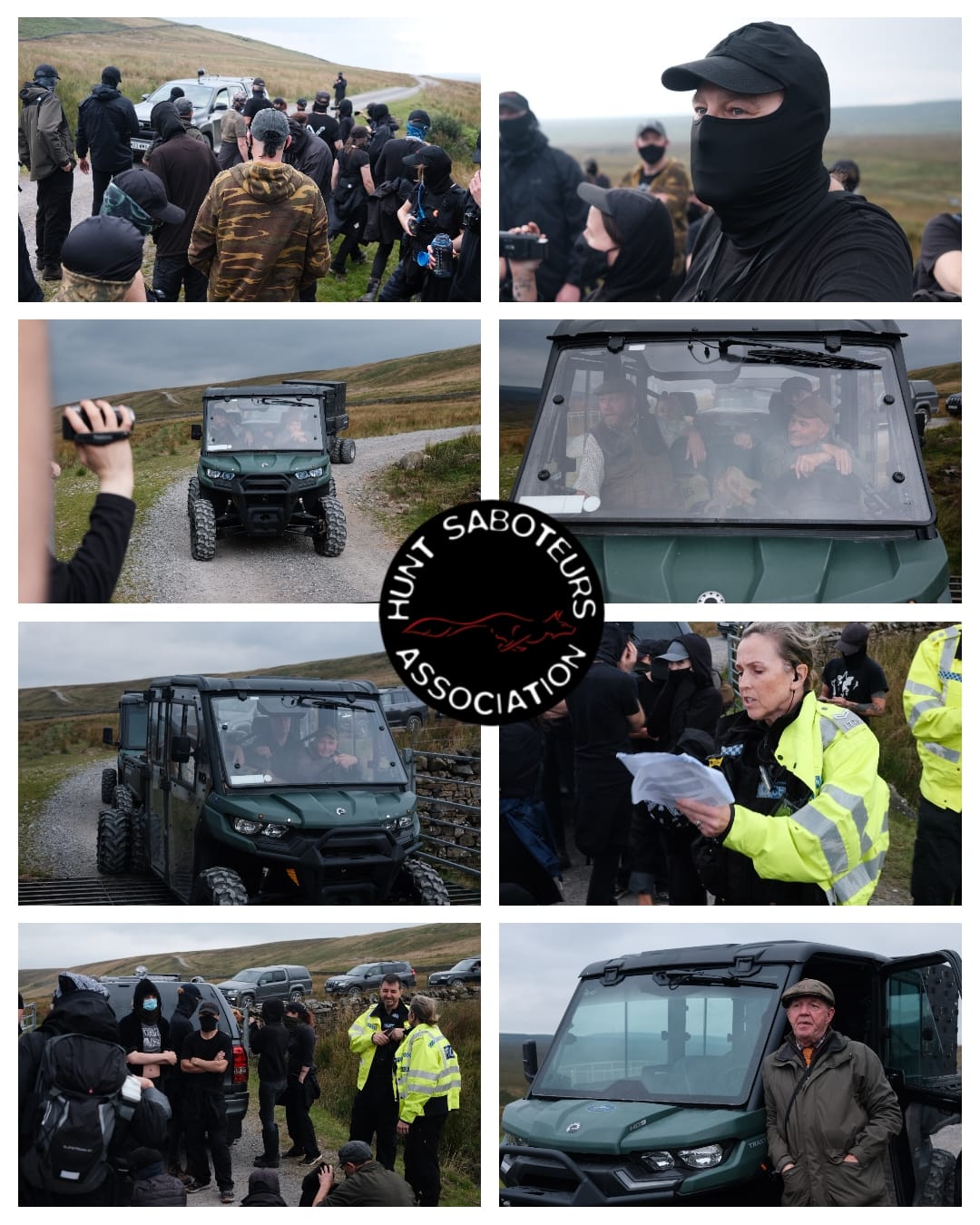
As they’ve done in previous years (e.g. see here), members of the Hunt Saboteurs Association were out in force today in northern England to disrupt grouse shooting on the Inglorious 12th.
Today they were on the Wemmergill Estate in County Durham. If Wemmergill sounds familiar it’s because it’s previously featured on this blog (here, here and here) and on Mark Avery’s blog (here).
Today marks the opening of the red grouse shooting season (the Inglorious 12th) and the media is full of ‘woe is us’ stories from the grouse shooting industry claiming that the lack of grouse available to shoot this year (largely down to climate breakdown) will result in the annihilation of the rural economy. (It won’t).
Strangely, the grouse shooting industry is keeping very quiet about the jolly good wheeze it’s got up its sleeve to ensure that the bloodsports enthusiasts will still have something to get their kicks from killing – they’re using the red-legged partridge (RLP) as an alternative quarry to red grouse – although they won’t be able to kill them until the RLP shooting season opens on 1st September.
Millions of this non-native species, hatched and reared by gamebird breeders and sold to shooting estates across the UK, are typically released onto lowland shoots but in recent years there has been an upsurge in the release of this species on to upland grouse moors.
This may be a response to continuing low red grouse stocks, but in Scotland I suspect it’s also a response to the new legislation requiring licences for grouse shooting, which can be suspended / revoked if wildlife crime such as raptor persecution, badger persecution, fox hunting etc continues on those estates.
I’ve written about this previously (here), as the new licences only cover the shooting of red grouse, not the shooting of pheasants or RLPs. I’ve argued that shooting estates can simply by-pass the new grouse shooting licencing rules (and thus sanctions) by shooting RLPs instead of grouse.
Additionally, if a grouse moor owner’s licence is suspended/revoked because wildlife crimes have been uncovered on the estate, that owner/tenant could simply switch to shooting RLPs instead of red grouse because the licence revocation doesn’t apply to shooting RLPs.
Although, to be fair, the Scottish Parliament has recognised that estates may use this ploy to escape sanction for the continued killing of birds of prey on the moors and has thus included a provision in the new Wildlife Management & Muirburn (Scotland) Act 2024 to add other species, including RLPs, to the new licensing regime if it’s found that this is indeed what Scottish grouse moor owners are up to.
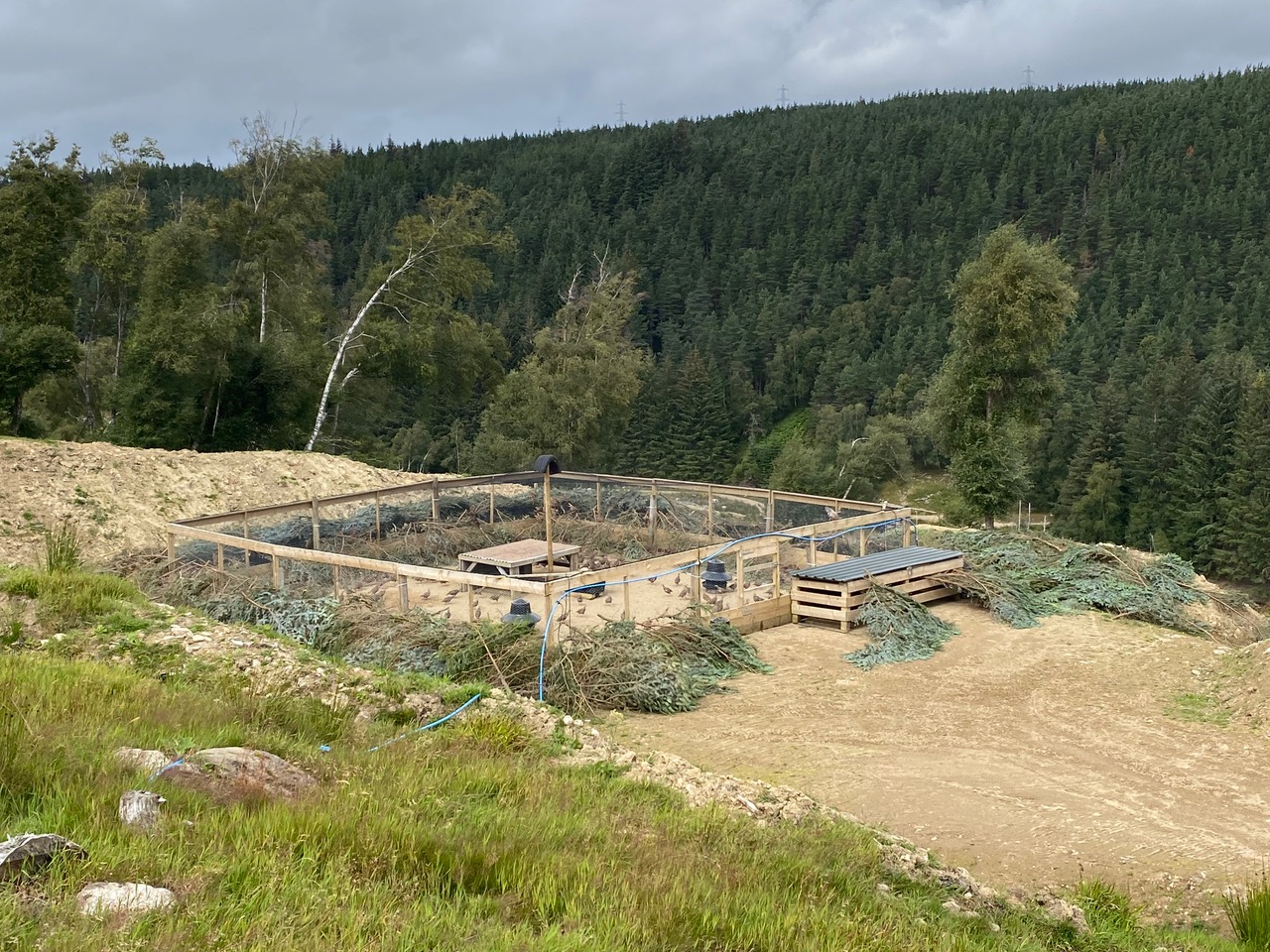
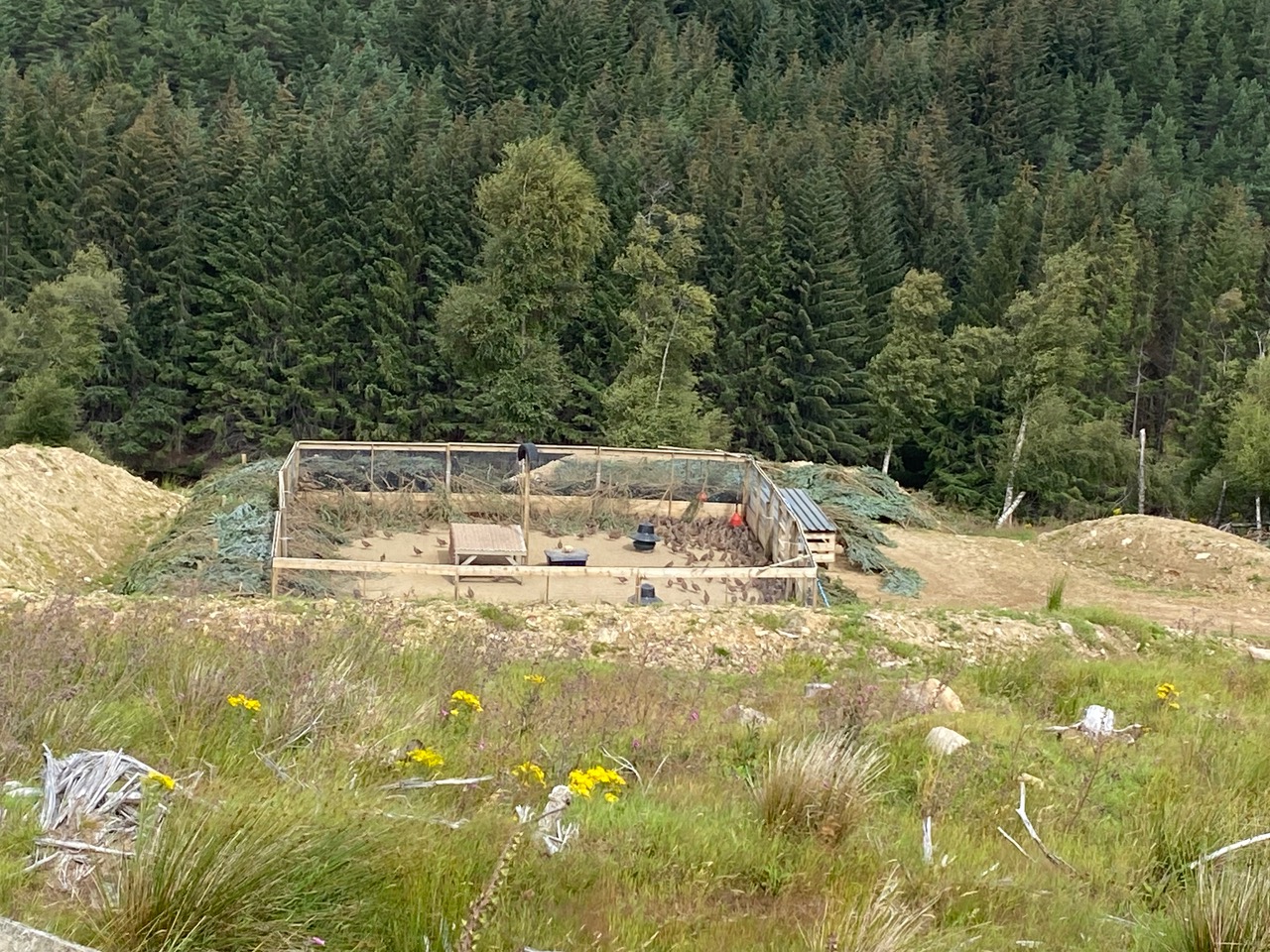
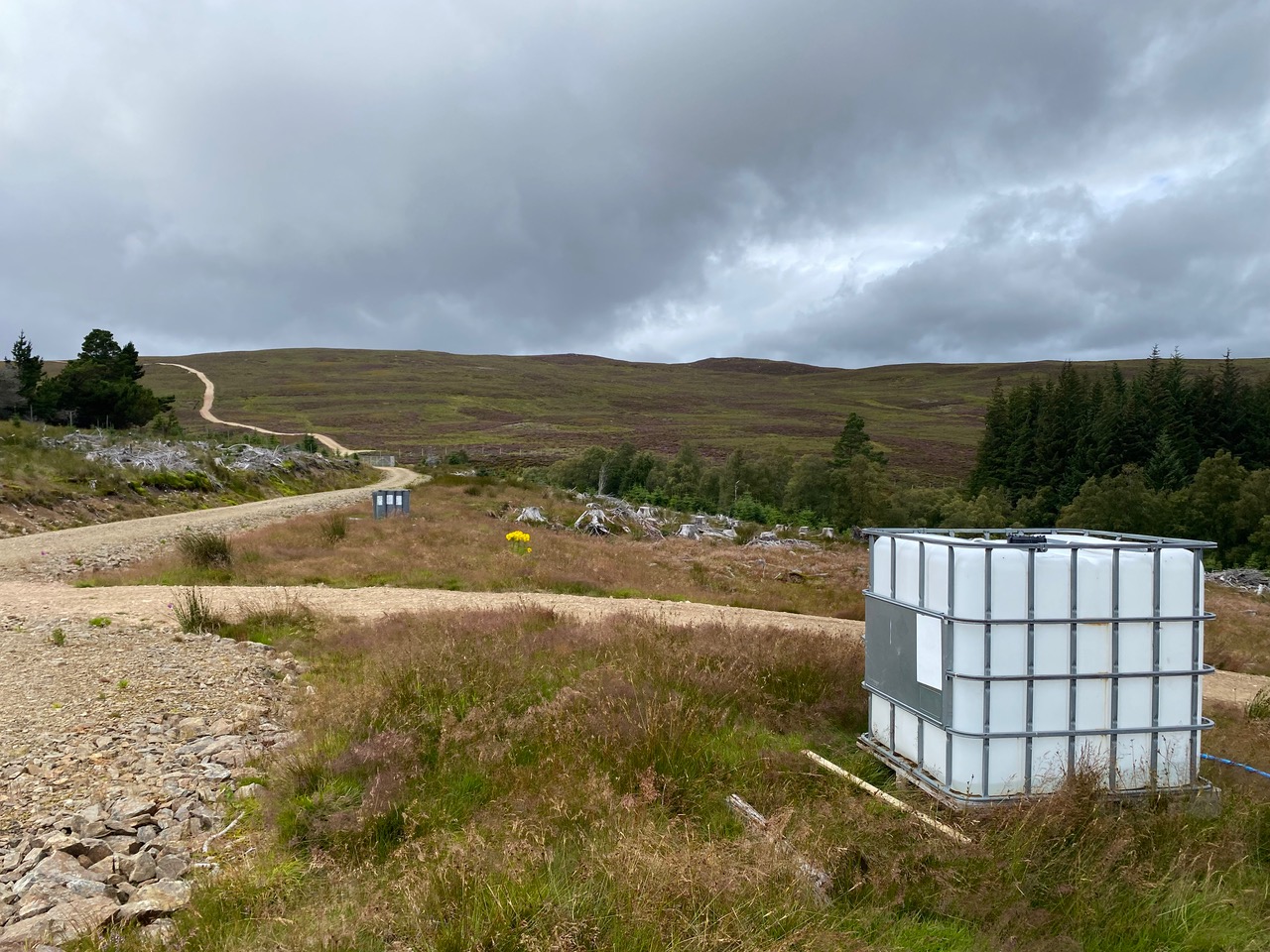
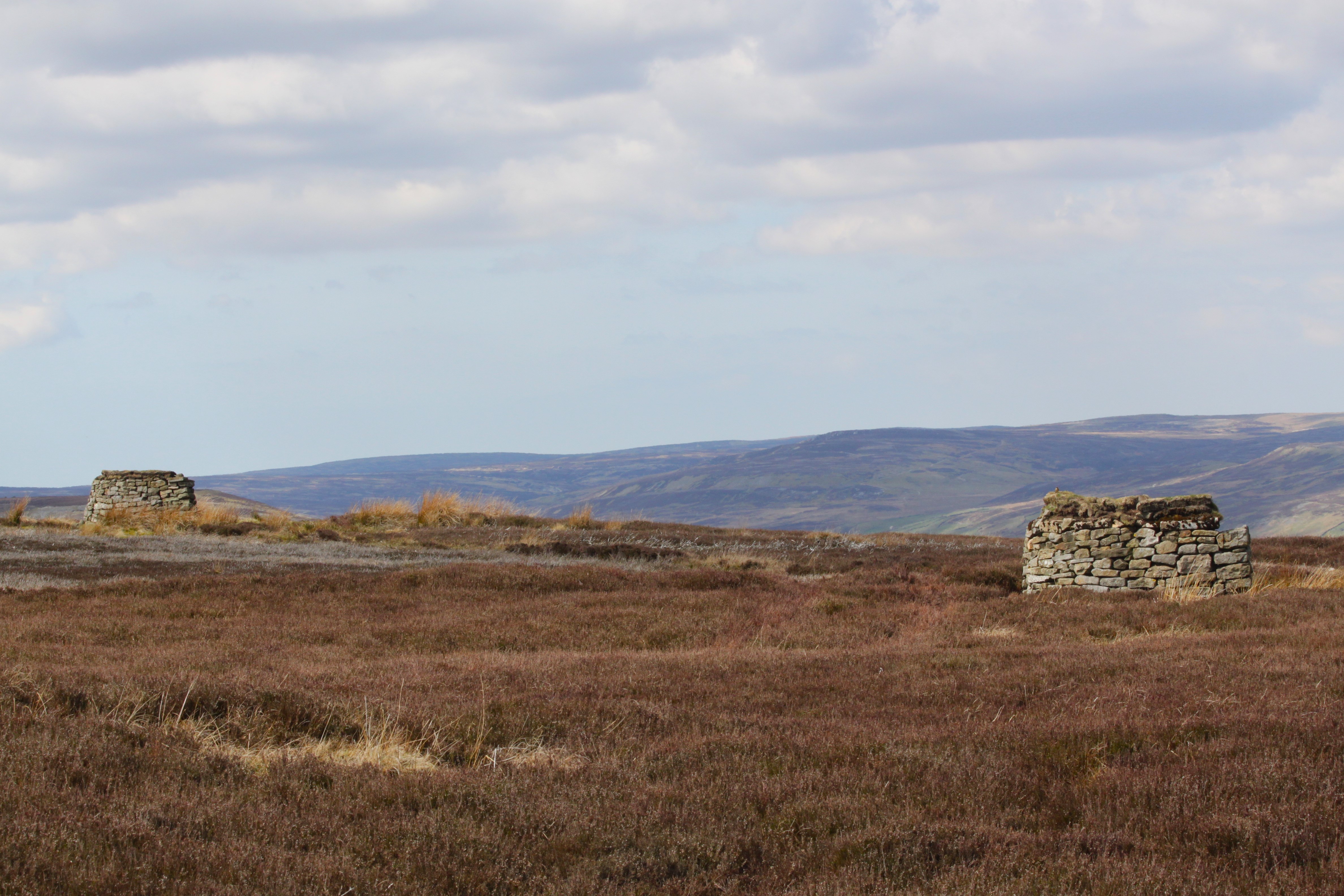
I’ve previously published photographs on here of new RLP release pens being built on grouse moors (here) and now another blog reader (thank you!) has sent me photographs of more new RLP release pens that he found on Friday on a well-known Scottish grouse moor in the Highlands:
The blog reader told me there were three identical RLP release pens at this site, approximately 50m apart, although only one is shown in the above photographs.
You can clearly see the size of the operation, including what looks like brand new hill tracks built across the moor to access the pens. I suspect the hill track campaign run by Scottish Ramblers might be interested in these.
I showed these photographs to Mark Avery at the weekend, who wryly pointed out, “There’ll have trouble arguing that this is traditional“.
Apparently there won’t be much grouse shooting taking place this year when the season opens on Monday (12th August). According to various reports from the grouse shooting industry, this is due to a combination of factors including a cold wet spring and an extraordinarily high worm burden on many moors.
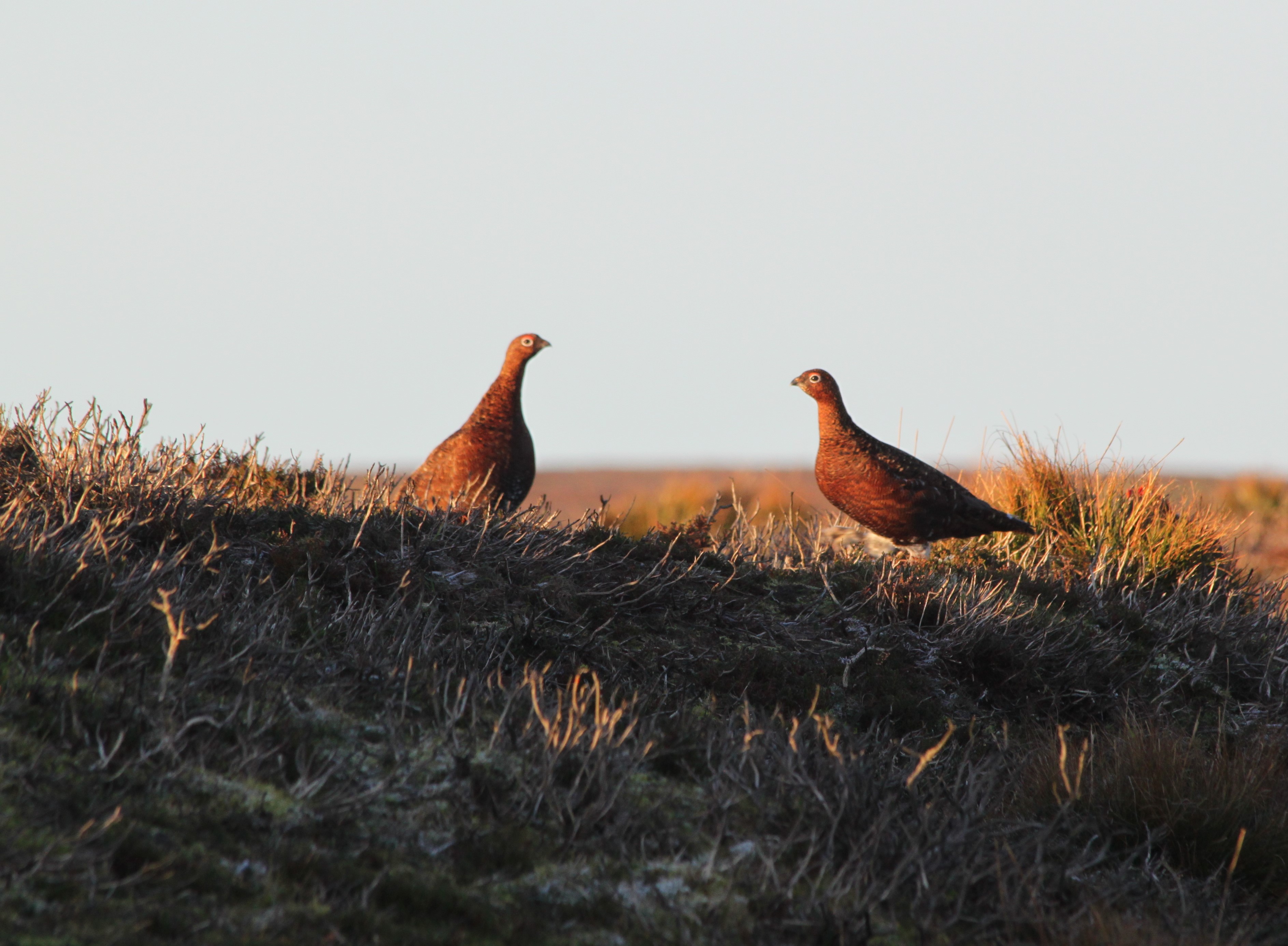
Red grouse photo by Ruth Tingay
They may not be shooting many red grouse but they’re more than making up for it by shooting themselves in the foot instead, particularly in Scotland.
I’ve read quite a few newspaper articles in the last few days about the so-called Glorious 12th but a couple of them stood out – whoever is advising the shooting organisations on their PR strategy is hanging them out to dry! Not that I’m complaining, if they want to make complete fools of themselves it saves me a job.
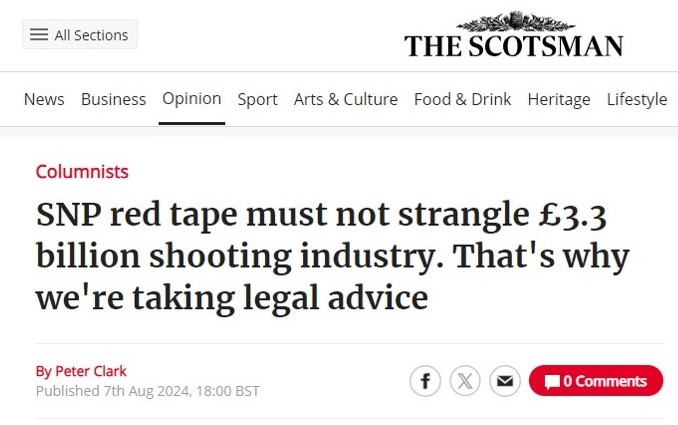
The first article that made me laugh out loud was an opinion piece in TheScotsman by Peter Clark, BASC’s Scotland Director:
I’m not going to reproduce the whole article because it’s too dull – you can read it here if you want to – but I do want to highlight a couple of points.
His opening paragraph goes like this:
“Grouse shooting is crucial to rural upland communities, with the start of the season representing the culmination of a year’s hard work, grit, and determination. Unfortunately, this season doesn’t look as promising as previous ones, with counts looking less positive“.
I wondered if the grit he refers to is the tonnes and tonnes of toxic, medicated grit that grouse moor managers chuck out on the moors, with minimal regulation, to medicate the so-called ‘wild’ red grouse to stop the natural, cyclical population crashes caused by parasites? I somehow doubt it – the industry’s leaders prefer to keep this dodgy practice under the radar.
Peter’s article goes on (and on) about how much shooting is worth to the economy, but predictably he lumps ALL types of shooting together rather than just focusing on grouse shooting, presumably to make grouse shooting look more economically viable than it actually is. It’s a common tactic. He also fails to include in his calculations the economic costs of grouse shooting to society. Again, a common ploy by the defenders of this so-called ‘sport’.
But the real PR disaster comes further down the article where he’s discussing the new grouse moor licences that have been introduced for the first time this year as the Scottish Government’s latest attempt to stop the illegal persecution of birds of prey on grouse moors. Peter writes:
“We clearly communicated to Jim Fairlie, the Scottish Government’s minister for agriculture and connectivity, before the Wildlife Management Bill became an Act that he should pursue amendments to make it more practical.
These proposed adjustments included removing provisions for adding additional game bird species to the shooting licenses, eliminating expanded investigative powers for the Scottish Society for Prevention of Cruelty to Animals, and refining the scope of what are considered to be “relevant offences” under the licencing scheme. These offences include those under wildlife legislation, ranging from the Wildlife and Countryside Act 1981, right through to the new Hunting with Dogs (Scotland) Act 2023. The British Association for Shooting and Conservation (BASC) was clear that the scope of the relevant offences was too broad, given that the sole focus of this licensing regime from its inception was to tackle raptor persecution.
Despite presenting strong evidence of the risks these aspects pose to the sector, our specific proposed changes were not included. While the BASC and other shooting organisations successfully won amendments to the Bill and challenged many aspects of what was originally proposed, ultimately, the shooting community now faces new layers of regulation.
Consequently, BASC is defending its members and seeking legal advice regarding the final version of the licensing scheme, which has now been implemented ahead of the start of the season“.
So let me get this right. Peter seems to be arguing that it’s just not fair that grouse shooting licences could be suspended and/or revoked if offences, other than those relating to raptor persecution, such as badger persecution or the hunting of foxes with more than two dogs, are uncovered on grouse moors!
“BASC is defending its members…” he says. What, by saying that BASC members shouldn’t be sanctioned if these other types of wildlife crime are uncovered??
Is he for real?!!
BASC is not alone in making the industry look ridiculous. In another article, published yesterday in the Guardian (here), BASC, along with industry lobby groups Scottish Land and Estates (SLE) and the Game and Wildlife Conservation Trust (GWCT) are also arguing that the licensable area to which these new regulations apply should be restricted to just the grouse moor area and that’s it’s ‘unnecessary and unfair‘ if the licence applies to other parts of an estate.
Eh? Where’s the logic in that? It’s blindingly obvious that estates would simply restrict their illegal activities to estate land next to the grouse moor, e.g. shooting a sleeping eagle as it roosts in trees on the edge of the moor, thus carefully avoiding culpability and a licence sanction, let alone a criminal prosecution.
The raptor killers have been exploiting this loophole for a long time – the most favoured practice being placing poisoned bait on the tops of fenceposts on an estate’s boundary line, especially at the top of a hill, making it more likely that a poisoned raptor will die further downhill on an adjoining estate and thus putting that neighbouring estate in the frame for the illegal poisoning.
As for the extent of the licence coverage being “unnecessary“, if that were so, why would the shooting organisations be so keen to limit the licence’s geographical extent if they’ve got nothing to hide?
There’s a quote at the end of the Guardian piece from Professor Colin Galbraith, Chair of NatureScot’s Board, discussing the entire coverage of an estate with a licence:
“If they’re not doing anything wrong, why worry about it?“.
Last month I raised concerns about NatureScot’s proposed framework that it will use when making decisions about whether to modify, suspend or revoke the new grouse shoot licences that form part of the Wildlife Management and Muirburn (Scotland) Act 2024 (that blog can be read here).
For new readers, this Act was introduced as the Scottish Government’s response to the continued widespread illegal killing of birds of prey on grouse moors. It will work on the basis that all red grouse shooting must now be licensed in Scotland under a section 16AA licence and if, on the civil burden of proof (i.e. the balance of probability) sufficient evidence is found that the licence has been breached (including evidence of illegal raptor persecution), the licence can be withdrawn as a sanction, preventing the shooting of red grouse on a particular estate for a period of up to five years.
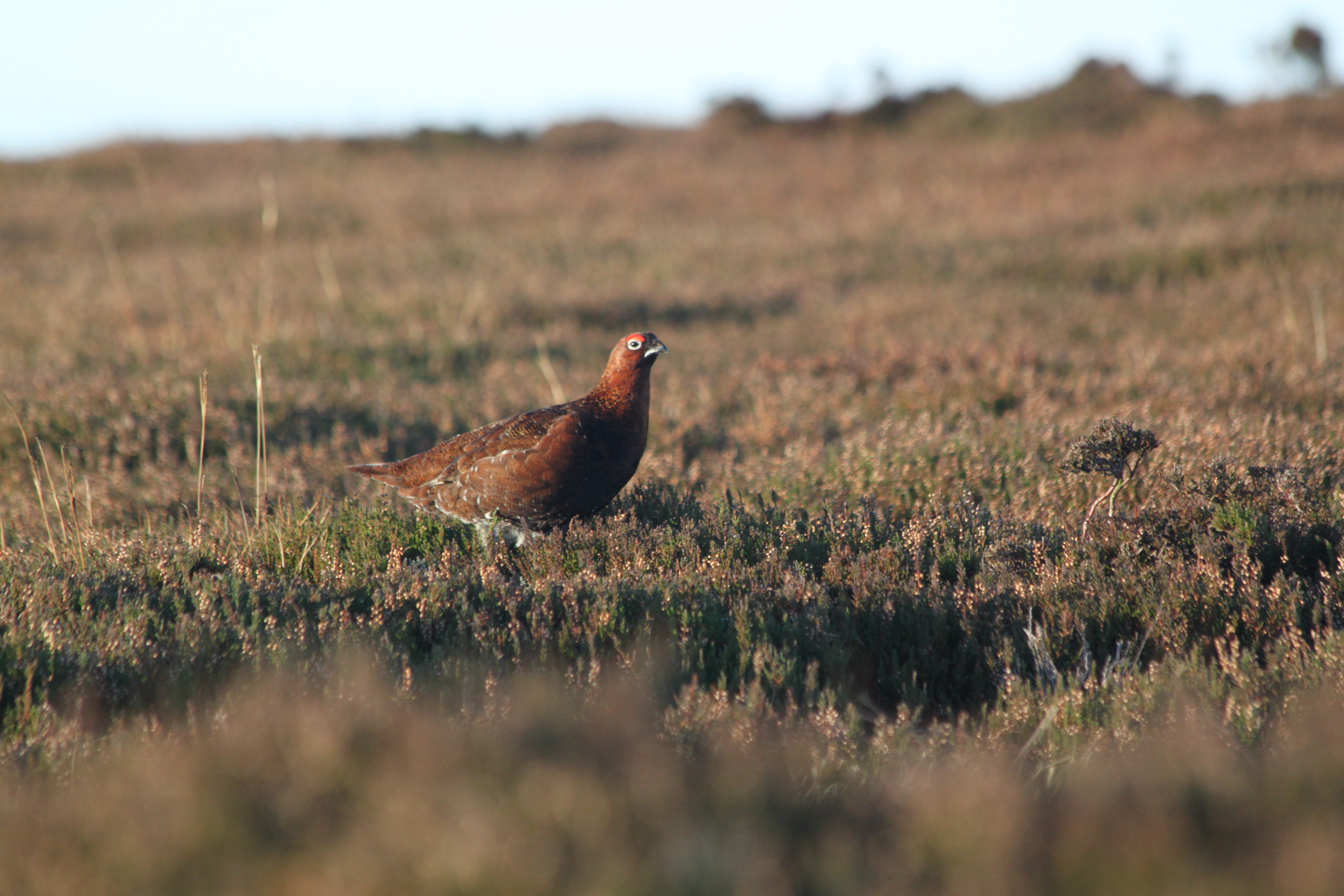
Red grouse photo by Ruth Tingay
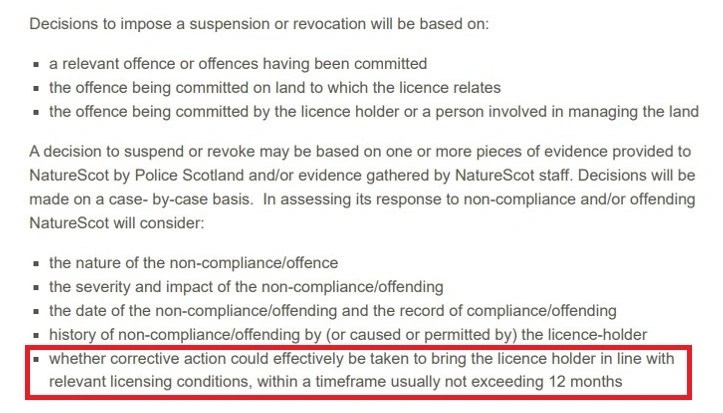
NatureScot published its proposed decision-making framework in July 2024, as follows:
My biggest concern about the framework was that NatureScot was proposing that a licence might not be suspended / revoked if “corrective action could effectively be taken to bring the licence holder in line with relevant licensing conditions, within a timeframe usually not exceeding 12 months“:
NatureScot didn’t define “corrective action” and I argued that the removal and replacement of a gamekeeper could be considered to be “corrective action”, in which case NatureScot would effectively be providing estates with a massive loophole to be be exploited because the estate could simply perpetually replace ‘dodgy’ gamekeepers that fell under suspicion and thus never suffer the consequences of a licence suspension/revocation for wildlife offences.
I’ve since written to NatureScot to ask for clarification on that issue and a few other concerns about the proposed framework. I’m grateful to Robbie Kernahan from NatureScot’s senior leadership team for his responses, as follows:
Please can you explain whether evidence provided by the Scottish SPCA will be accepted in NatureScot’s decision making? And if it won’t be accepted, what the rationale is for that?
NatureScot can consider evidence gathered through SSPCA in line with the arrangements they are developing with Police Scotland.
2. How will NatureSot define ‘minor’ and ‘of a serious nature’ when considering the level of non-compliance?
We recognise there will be a spectrum of potential issues which may arise associated from non-compliance of conditions of licence, through to offences under the relevant legislation. For instance, returns not being made within the defined period – would be a compliance issue, but one which could be rectified without necessarily recourse to suspension or revocation, and may therefore be considered to be ‘minor’. NatureScot being satisfied that a relevant offence has been committed on the land by the licence holder or a person involved in managing the land to which the licence relates, is likely to be considered to be ‘of a serious nature’.
3. How will NatureScot determine whether a relevant offence has been committed by ‘the licence holder or a person managing the land’? It seems to me that this difficulty is precisely why the licensing scheme has been introduced, because it’s often not possible to identify the individual responsible for an offence.
NatureScot will consider such evidence as is made available to us. We anticipate that the primary source of evidence will be provided by Police Scotland, supplemented by any additional intelligence available to us. This will be on a similar basis to the evidence provided to us in considering the restriction on use of General licences. There may be cases in which NS will be satisfied, based on the evidence available, that a relevant offence has been committed on the land by the licence holder or a person involved in managing the land to which the licence relates, and as you note, where that evidence would not necessarily satisfy the standard of proof required for a criminal conviction of the relevant offence.
4. How will NatureScot define ‘corrective action’ when considering a decision to suspend/revoke a licence? Will that include the removal (by the estate) of an individual gamekeeper? If so, what are the implications for a prosecution (of that gamekeeper) or for vicarious liability (of the licence holder)? And why would the removal of one gamekeeper, presumably to be replaced by another one, solve the problem? How many times can an estate remove and replace a gamekeeper, without the estate being sanctioned?
The corrective action we envisage in this is likely to be around administrative issues (supply of returns) or other minor breaches which could be rectified quickly – not for wildlife crime.
These responses provide some reassurance but not all are as convincing as they might have been.
For example, on question 1, the arrangements between the SSPCA and Police Scotland for investigating and reporting suspected offences has not yet been made public (and may not become public) so the question of whether NatureScot will accept evidence provided by the SSPCA is still not clear. Remember, this arrangement between Police Scotland and the SSPCA relates only to the SSPCA’s increased investigatory powers for incidents where a live animal is not involved. The SSPCA is already a statutory reporting agency in its own right for offences under section 19 of the Animal Health and Welfare (Scotland) Act 2006, which is included in the ‘relevant list of offences’ [for which a licence may be suspended/revoked] under Naturescot’s proposed framework so it’s not clear to me why there’s so much opaqueness about whether evidence provided by the SSPCA will be accepted by NatureScot, especially in relation to offences under the Animal Health & Welfare Act.
On question 2, I think NatureScot’s explanation is clear and its rationale for distinguishing between ‘minor‘ non-compliance breaches and those ‘of a serious nature‘ seems sensible and fair.
On question 3, I think this is a reasonable response in as much as NatureScot can’t predict the type of evidence that will be available as each case (and thus available evidence) will be different. NatureScot has done a fairly good job so far of assessing evidence in relation to the General Licence restrictions it has imposed so we’ll have to wait and see whether that standard will be applicable for the suspension/revocation of section 16AA licences, which ultimately can be (and undoubtedly will be) challenged by the licence holder in a Sheriff Court.
On question 4, the definition of “corrective action“, I’m pleased to see the clarification from NatureScot that corrective action “is likely” to be associated with administrative breaches and not for wildlife crime, although I would have preferred to have seen this written as “will be” rather than “is likely” to be.
However, I’m still concerned that this “corrective action” loophole is included in the framework under the section headed ‘suspending or revoking a licence’. If NatureScot’s intention is to apply this measure for minor admin breaches only, why wasn’t it included in the section headed ‘modifying a licence’, which specifically deals with minor breaches, instead of the section headed ‘suspending and revoking a licence’, which deals with more serious breaches (i.e. criminal offences)?
Press release from Hen Harrier Action, 7th August 2024:
FOUR YOUNG HEN HARRIERS SATELLITE TAGGED THANKS TO GENEROSITY OF WILDLIFE CHARITY SUPPORTERS
Uplands conservation charity Hen Harrier Action has just released full details of the four young Hen Harriers satellite tagged with funds raised by the charity’s supporters in a Christmas Appeal. The appeal aimed to raise enough money to fund four tags, and the donations poured in. In just 10 days the Christmas Appeal reached, and then exceeded, its ambitious target.
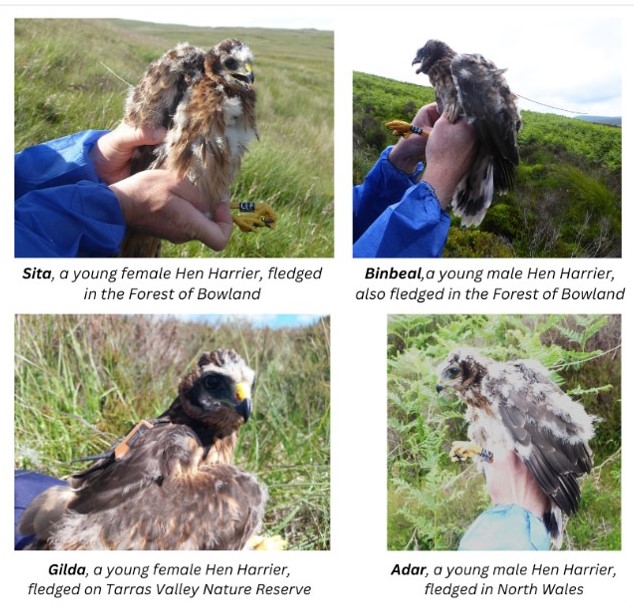
The satellite tags have been fitted to four young Hen Harriers, two that fledged in England, one in Wales and one in Scotland.
The tags, fitted by experts from the RSPB and Northern England Raptor Forum, will allow dedicated staff at the RSPB to monitor the birds’ movements throughout their lifespan.
Two English Hen Harriers fledged in the Forest of Bowland
The two English Hen Harriers, Sita and Binbeal, fledged in the Forest of Bowland. Sita, a female, is named for the Hindu Goddess of self-sacrifice and dedication – a fitting name for a female Hen Harrier who will hopefully go on to breed and fiercely defend her chicks.
And Binbeal, a male, is named for the Australian Aboriginal spirit of rainbows. In the mythology, he is the son of Bunjil, the creator deity often depicted as a Wedge-tailed Eagle.
Scottish and Welsh Hen Harriers
The Scottish Hen Harrier, a female, named Gilda by the Scottish Raptor Study Group, fledged at the Tarras Valley Nature Reserve, the ambitious community-led rewilding project. One of four chicks, Gilda has two sisters and a brother. In Old English, the name means golden.
And the Welsh bird, a male called Adar, fledged in North Wales, named after the medieval Welsh word for birds.
Battling the British Weather
After the unusually wet and dreary Spring and early Summer, it was challenging for the teams out in the field fitting satellite tags to the young Hen Harriers in the nest.
Steve Downing, Chair of the Northern England Raptor Forum and a veteran of satellite tagging projects, commented on the challenges: “It is always challenging and this year was no different with the occasional hot day; but predominantly the weather was dominated by cold, persistently wet days throughout the breeding season. Now we wish them and the other members of the 2024 cohort fair weather and a following wind to take them away from the threat of persecution and on to a long and successful life.”
For those who want to find out more about hen harriers and their illegal persecution in the UK, this year’s Hen Harrier Day, organised by Hen Harrier Action, takes place this Saturday (10th August) at Carsington Water in Derbyshire. For more details about this free event, please click here.
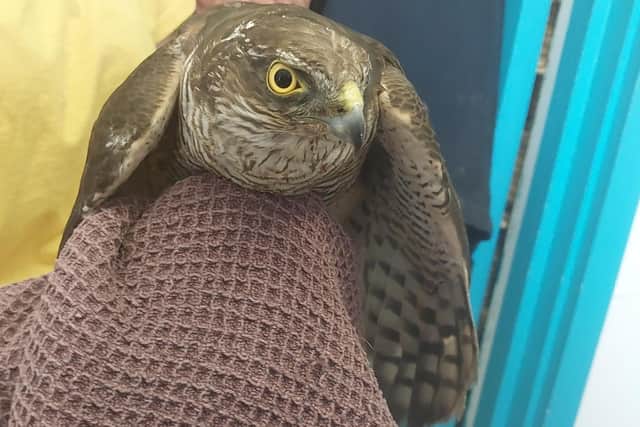
Derbyshire Police are appealing for information after a sparrowhawk died from gunshot injuries.
The injured sparrowhawk was found by a member of the public on 24 July 2024 in the Walton area of Chesterfield and was taken to the Pet Samaritans Animal Sanctuary in Old Whittington.
A Derbyshire Police spokesperson said:
“The injured Sparrow Hawk was found by a member of public in the Walton area on July 24. On closer inspection, it has become apparent that the bird has been shot by what we believe to be an air rifle.
Sadly, despite the best efforts from the staff at Pet Samaritans, the Sparrow Hawk has since died from its injuries.
Sparrow Hawks are protected under the Wildlife and Countryside Act 1981 which means that it is illegal to intentionally kill, harm or physically move them. Anyone found guilty of killing a Sparrow Hawk could face an unlimited fine and up to six months imprisonment“.
If you have any information about this incident please contact Derbyshire Police’s Rural Crime Team via 101 or email: drct@derbyshire.police.uk and quote reference number 24*454772.
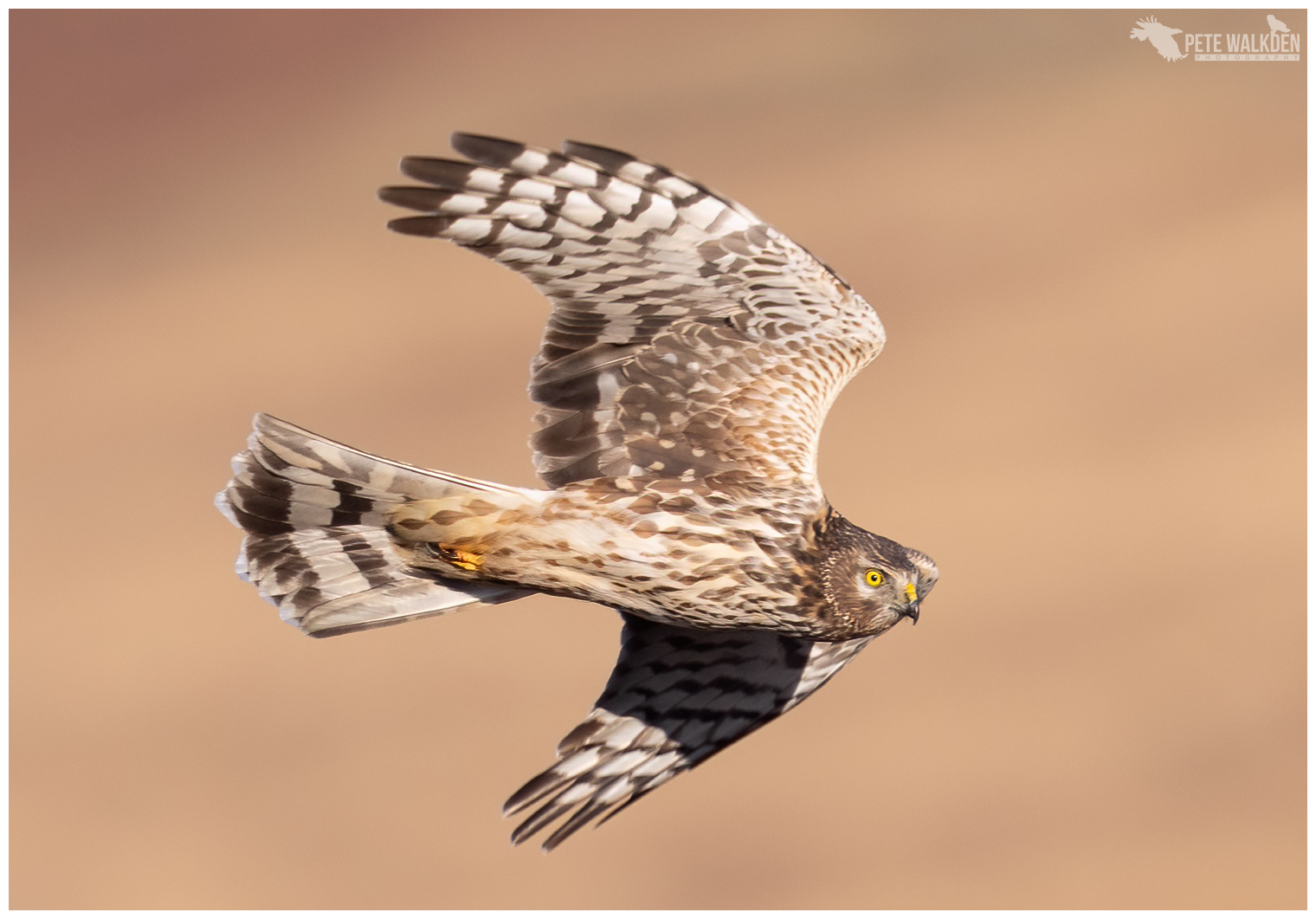
Two criminal investigations are underway following the discovery of two dead hen harriers earlier this spring.
According to Natural England’s most recent update on the fates of its satellite-tagged hen harriers (updates are periodical – the most recent was April 2024), the following two harriers have been found dead, one at an undisclosed location in Northumberland and another at an undisclosed location in Devon:
Hen harrier ‘Susie’, female, Tag ID: 201122, satellite-tagged in Cumbria on 21 July 2020. Date of last transmission: 12 February 2024 in Northumberland. Notes: “Recovered awaiting PM” [post mortem].
Hen harrier R2-M1-23, male, Tag ID: 213927, satellite-tagged as part of the brood meddling trial /sham on 19 July 2023 at site BM-R2-Cumbria. Date of last transmission: 7 March 2024 in Devon. Notes: “Recovered awaiting PM”.
You might remember ‘Susie’ – she’s the hen harrier whose chicks were brutally stamped on and crushed to death in their nest on a grouse moor in Whernside in the Yorkshire Dales National Park, in June 2022 (here).
I hadn’t seen any media about the latest two dead hen harriers so in May I submitted an FoI to Natural England to ask for the details of the post mortem reports to determine whether they’d been killed illegally.
Natural England responded in June and told me the information was being withheld under Regulation 12(5)(b) which states:
“A public authority may refuse to disclose information to the extent that its disclosure would adversely affect: (b) the course of justice, the ability of a person to receive a fair trial or the ability of a public authority to conduct an enquiry of a criminal or disciplinary nature”.
Natural England also told me:
“Natural England can confirm the investigations for the two Hen Harriers cases are live. As such it is our view that this exception covers the information we hold in scope of your request and therefore we are withholding because if it were to be disclosed at this stage it could comprise the result and have a serious impact on the ongoing process and proceedings“.
Natural England’s response suggests that criminality is indeed suspected but I’ll await confirmation before adding these two to the ever-growing list of hen harriers that have been illegally killed / disappeared in suspicious circumstances since the brood meddling sham began in 2018 (the running tally currently stands as 123 hen harriers).
These are the second and third known investigations this year, following the suspicious disappearance of a hen harrier called ‘Shalimar’ on a grouse moor in the Angus Glens on 15 February 2024 (see here).
Although I was at a wildlife crime forum in London last month where a police officer from the NWCU’s Hen Harrier Taskforce told the audience that there were currently five investigations ongoing, although no details were provided.
Last week I blogged about how the Moorland Association (grouse moor owners’ lobby group in England) had been booted off the ‘partnership’ designed to tackle illegal raptor persecution in England and Wales (the Raptor Persecution Priority Delivery Group – RPPDG), after the Moorland Association had published an inflammatory blog that looked to be an attempt to sabotage the National Wildlife Crime Unit’s (NWCU) new Hen Harrier Taskforce (see here).
Grouse shooting butts in Yorkshire Dales National Park. Photo by Ruth Tingay
It seems that the Moorland Association’s inflammatory blog wasn’t an isolated incident, but more like the last straw for the NWCU.
A series of FoI responses has revealed some fascinating correspondence between the Moorland Association and the NWCU, about the Hen Harrier Taskforce, in the run up to the Moorland Association being booted out of the RPPDG last week.
I’ll post some of the correspondence below (there’s more to come) and although the names of the individuals have been redacted, it’s clear to me (from some other information released) that the Moorland Association’s correspondent is CEO Andrew Gilruth.
You can see that the Moorland Association is following a familiar line that we’ve seen from shooting industry organisations in recent years – that of putting pressure on the police to change the narrative on raptor persecution crimes (e.g. BASC did it here; National Gamekeepers Organisation did it here and again here) but this time the NWCU has called it out and has suggested that the Moorland Association is “wasting time and distracting from the real work” [i.e. that of tackling illegal raptor persecution, in this case hen harriers].
The Moorland Association’s response is to accuse the NWCU of “entirely unprofessional conduct” (cue official complaint). From what I’ve read, the NWCU has acted with patience and professionalism in the face of an arrogant and disruptive influence.
The following two files show correspondence between the NWCU and the Moorland Association from 21 December 2023 – 10 June 2024 and from 20 June 2024 – 8 July 2024:
Dave Sexton, the RSPB’s Mull Officer, is retiring after spending over two decades leading the local community’s efforts to protect the island’s famous White-tailed and Golden eagles and, through his extensive media work, helping to establish Mull as one of the best wildlife tourism destinations in Scotland.
Dave’s contribution has been immense and has been recognised with multiple awards for his work. He’s written a few words to mark the occasion:
All good things…
It’s hard to know where the years have gone but, much like the white-tailed eagles which have shaped my career, they’ve certainly flown by! I came to Mull as the RSPB Mull Officer in 2003 on a short-term, one year contract. It was a bit of a gamble walking away from a permanent Head of Department managerial job in Edinburgh but the call of the wild was getting increasingly louder. And, remarkably, 21 years later, I’m still here! Just. But all good things must come to an end…or at least they must change. That’s life. Change isn’t always easy but it’s inevitable. So, whilst this isn’t exactly ‘goodbye’ it is a kind of ‘farewell’…for now at least. I’m not leaving Mull, but I think the current way of describing things is that, after 16 August 2024 and two decades of field seasons here, I’ll be ‘stepping back’ from this role. The post of RSPB Mull Officer will conclude, and I’m honoured to have followed in the giant footsteps of those who went before me – the much-missed Mike Madders and Richard Evans.
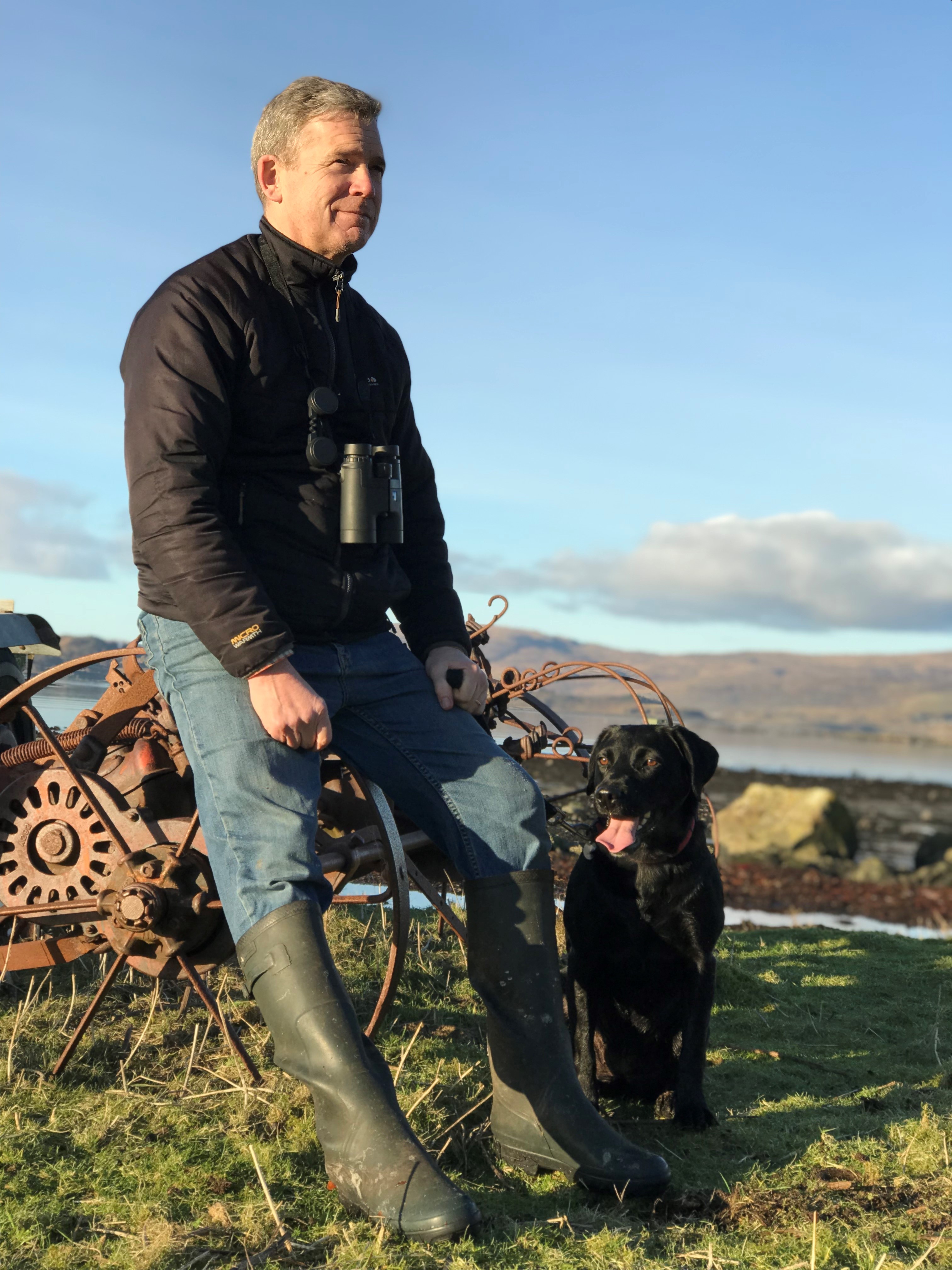
Dave Sexton with his dog Cally. Photo by Olivia Sexton
If my 21 years on Mull have flown by, my overall 36 years with the RSPB have positively flashed by in the blink of an eye. My first day at Scottish Headquarters in Edinburgh in 1988 was as an Assistant Reserves Manager looking after reserves and staff from the Mull of Galloway in the south, to Fetlar in Shetland and Balranald in the Western Isles! That’s some geographic spread and it gave me the chance to see and travel the length and breadth of Scotland. But there was always one place which kept drawing me back. The Isle of Mull. I’d first set eyes on Mull in 1978 on a school geography and biology field trip. For a kid from south London to see mountains, glens and lochs…and then a golden eagle was simply awe inspiring. A spell had been cast. Then two years later I was back on holiday and saw my first white-tailed eagle flapping low across Loch Spelve and the second spell was cast. It was a sighting which was to transform my life in ways I could never imagine. From protecting the first nest in 1984, to guarding the first chick in 1985, to the present day where I’ve been fortunate to monitor Mull’s 23 pairs of sea eagles, this bird has given me a long career in a place I love. You can’t ask for much more than that. It’s also meant my wonderful supportive family – Caroline, Bethan and Olivia – have had a home and childhoods filled with memories of a safe, carefree island life running on sandy beaches, trekking through forests, climbing mountains and being part of this special place. That’s why I’ll go on being a voice for white-tailed eagles long beyond this change because, well, I kind of owe them and Mull, pretty much everything.
This job would not have been possible without the people, organisations and agencies who work on or own parts of this amazing island. For some, I know, living and working alongside the eagles is challenging and a distinctly mixed blessing and I’ve always appreciated and understood that. We’ve often had to agree to differ over the years, but I also hope I’ve helped in some small way, whether with farming, forestry, or other interests (even including the new helipad!), by finding practical and pragmatic ways through any problems encountered. For others, the eagles are a significant and important part of their lives too and I couldn’t have done this job without the many additional eyes and ears of residents and visitors alike.
There’ll be more to say about future work in the months ahead but one other change earlier this year made me stop and reflect. Our gorgeous, best and beautiful girl Cally had been my constant companion in the field on countless eagle forays for 11 years. Suddenly she was gone from our lives, and something had changed forever. It was time to take stock and realise that, indeed, all good things… We miss her so much and shared so many adventures that now my days with the eagles feel somehow emptier.
For now, as I said, it’s not exactly goodbye but a farewell and a deep, heartfelt thank you to everyone, both inside and outside the RSPB, who has been a part of this incredible journey and made it all possible. And to the eagles, to whom I owe so much, fly free and may you soar to even greater heights!


 Raptor Persecution UK