
Over the last few months I’ve heard from various well-placed sources that hen harrier brood meddling has not taken place this year.
For new blog readers, hen harrier brood meddling is a conservation sham sanctioned by DEFRA as part of its ludicrous ‘Hen Harrier Action Plan‘ and carried out by Natural England, in cahoots with the very industry responsible for the species’ catastrophic decline in England. In general terms, the plan involves the removal of hen harrier chicks and eggs from grouse moors, rear them in captivity, then release them back into the uplands just in time for the start of the grouse-shooting season where they’ll be illegally killed. It’s plainly bonkers. For more background see here and here.
I’ve asked Natural England (the licensing authority for hen harrier brood meddling) about the status of brood meddling this year but they haven’t responded yet.
If the rumours are true, and brood meddling hasn’t taken place this year despite there being broods available to meddle with, it raises a lot of questions, not just about what happened this year but also about any future prospects for brood meddling, whether that be as part of the continuing so-called scientific trial or the full roll-out of brood meddling as a recurrent annual practice, which is what the grouse shooting industry wants (laughingly calling it a ‘conservation licence’)!
Long-term blog readers will know that the initial brood meddling trial ran for five years from 2018-2022 inclusive. At the end of that trial, the brood meddling project board (which unbelievably includes vested-interest representatives from the grouse shooting industry such as the Moorland Association and GWCT, as well as the licence applicant, Jemima Parry Jones, who’s paid by the MA to do the brood meddling) decided it wanted to extend the trial and Natural England agreed to a further five year trial period (here).
An initial two-year extension licence was granted for 2023 and 2024 (NE isn’t permitted to grant a licence for longer than a two-year period in one go) with a few changes to the licence conditions as requested by the ‘project board’, including:
- An increase in the number of times a pair of breeding hen harriers can have their nest brood meddled (previously, intervention was restricted to prevent the same pair being brood meddled in successive years – this time intervention was permitted in successive years);
- No further requirement to satellite tag ALL the brood meddled chicks, only a sub-sample;
- In the case of the North Pennines Special Protection Area (SPA) Southern Zone, no further requirement for brood meddled birds from this Zone to be released back into this Zone specifically, but still must be released into the wider North Pennines SPA (the project board had sought to remove entirely the requirement for brood meddled birds to be returned to the same SPA from where they were originally removed – this is important, I’ll come back to this point below).
For more detail about the changes to the licence conditions for 2023/2024 extension, see this Case Submission to Natural England’s High Risk Casework Panel in April 2023 and released to me under FoI:
So if the brood meddling ‘project board’ was so keen for an extension to the brood meddling trial/sham, why would they only take advantage of the extension for one year (2023) instead of the two years for which it was licensed? Just adding a one year extension to the trial doesn’t seem sufficient time (to me) to provide the data required to address the questions the so-called scientific trial was seeking to address, which is why NE approved a two-year licence extension within an extended five-year trial extension.
Well, there are a few hypotheses circulating about that. Of course these are all speculative at the moment because we don’t know for sure that brood meddling didn’t take place this year, but let’s assume for now that it didn’t.
The first hypothesis is that the grouse shooting industry simply hasn’t been able to find sufficient ‘receptor sites’ where the brood meddled chicks would be released post-captivity. We know, from an official internal NE report released via FoI, dated April 2022 (heading into the last year of the initial five year trial), that only four estates had been involved as ‘intervention sites’ (i.e. their hen harriers were brood meddled: one nest in 2019, two nests in 2020 and two nests in 2021) and only three estates had functioned as ‘receptor sites’. That’s not very many estates willing to engage in hen harrier brood meddling, is it?
Incidentally, data from the 2022 breeding season show there were four broods meddled with that year and six broods meddled with in 2024. I haven’t seen any information about how many estates were involved (as intervention or receptor sites) but the figure must still be staggeringly low.
Out of a purported 190 grouse moor member estates, the Moorland Association seems only to have found a handful willing to participate in the brood meddling trial, whether as an ‘intervention’ site or a ‘receptor’ site. I wonder why that is?
It could be that a lot of grouse shooting estates don’t see the point of getting involved in brood meddling because they’ve already got a tried and tested way of removing hen harriers from their moors (i.e. illegally killing them) and the chance of getting caught and prosecuted for it is virtually nil (see here).
It could be that a lot of grouse shooting estates won’t get involved in brood meddling unless it’s guaranteed that after the ‘trial’ period, brood meddling will be rolled out as a standard, legal technique that grouse moor owners can use every year to get rid of hen harriers. There’s some evidence that this hypothesis is more than speculative, as follows:
Cast you minds back to Valentine’s Day 2023 when the Natural England Board and some of its senior staff had a day out at Swinton Estate in Nidderdale (an estate at the epicentre of hen harrier brood meddling and also an estate with a long track record of confirmed and suspected raptor persecution offences, including some relating to hen harriers). I wrote about that day out (here and here).
After their soiree on the Swinton grouse moors, Natural England’s Board and senior staff went out to dinner and invited some fascinating guests. The NE Board had been issued with an internal briefing document to help them navigate what were described as “elephant traps and tricky issues”, which included hen harrier brood meddling. Here’s the briefing document, released to me under FoI – pay attention on page 3 under the heading Future of Brood Management, where it says this:
“NE Board has taken the in-principle decision to continue participation I [sic] brood management on a scientific trial basis. The MA is the principal partner in the trail [sic], promoting participation by estates, organising and funding release facilities and enabling access for our fieldworkers to tag and monitor chicks. Along with all our brood management partners, they are rightly proud of the success so far and are clear that an estate’s appetite for tolerating or welcoming breeding hen harriers is directly related to the availability of brood management as a ‘pressure valve’ to avoid a build-up of breeding hen harriers. The MA has supported the proposal of extending the trial but is clear that this should lead to the eventual wide availability of the technique as a practical and affordable tool“. (Emphasis added by me).
Also of interest in this internal briefing document is the news that the Moorland Association had asked for a ‘fixed release site’ (for brood meddled hen harriers) instead of having to release the birds back the same SPA from where they were removed. The MA had suggested Moorhouse NNR in Upper Teesdale or Ingleborough NNR in the Yorkshire Dales National Park as potential fixed sites. NE didn’t support this and the briefing document states:
“[REDACTED] judgement is that this represents too great a risk to the ‘NNR-brand’ as a whole and individual sites as long as illegal persecution remains a real threat to any hen harrier nest: additionally the MA should have sufficient contacts with access to vast tracts of suitable land if a long term commitment to hen harrier recovery is their goal“. [Emphasis is mine].
So there’s that issue I flagged earlier about the difficulty the MA appears to be having in providing ‘receptor’ sites. Funnily enough, this issue has also been raised again this year in a Moorland Association blog posted on 12 April 2024 (here), where there is quite a lot of moaning about having to release brood meddled hen harriers back in to the same SPA from where they were removed, and of course the now obligatory veiled threat about this potentially being in breach of IUCN guidelines, an argument the MA has also used recently in relation to the Police-led Hen Harrier Taskforce and one that the National Wildlife Crime Unit has summarily dismissed (see here).
A further hypothesis that’s been put forward about why the hen harrier brood meddling sham appears to have collapsed this year is that the Moorland Association probably doesn’t want to have to keep spending a fortune on paying for satellite tags when those tags are the primary source of evidence that demonstrate that brood meddling has not put an end to hen harrier persecution – indeed, last year (2023) was the worst on record since the brood meddling sham began in 2018, with 33 individual hen harriers reported as being illegally killed or to have disappeared in suspicious circumstances, including 13 brood meddled birds, and most of them on or close to driven grouse moors:
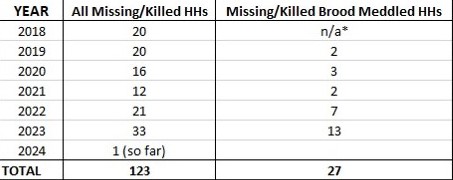
Over the next few weeks there should be more information available about this year’s hen harrier breeding season, including the number of breeding attempts, breeding failures and successes, the number of hen harriers satellite-tagged by Natural England and by the RSPB in various regions, the number of dead/missing hen harriers reported so far this year, and whether brood meddling did take place this year or whether the whole sham has just come tumbling down.
Whatever has happened this year, Natural England’s two-year extended brood meddling licence (2023-2024) has now expired and we can expect a substantial review of the seven-year ‘scientific trial’ which will be used to determine whether the trial is now closed or extended again, whether the grouse shooting industry will get a permanent ‘conservation licence’ (ha!) to continually remove hen harriers from the grouse moors, or whether the new Government will be pressed into dropping the whole sorry pantomime and instead focus its attention (and our money) into taking more effective action against the hen harrier killers.
Watch this space.
 Raptor Persecution UK
What an appalling litany of betrayal – by Natural England – of our precious and glorious Hen Harriers: Tony Juniper’s worst hour:-(
This has to mark a radical change of direction for Natural England and Defra, otherwise the Labour Party will stand forever condemned.
Well said.
We live in interesting times indeed. What I can say is that nests on one of the estates at the epicentre of this whole project were not meddled this year but were fed. it is however not clear what happened at any harrier nests on neighbouring estates or their success rate. We surely cannot go back to pre 2018 nest persecution levels. What the figures of the number of estates involved surely shows the general attitude to the scheme by most grouse moors, many of whom have clearly demonstrated their unchanging attitudes by the continued disappearance or finding of corpses of shot harriers in the same old places on the same old estates. Licencing is surely the next option.
It isn’t surprising that biodiversity in the UK has suffered significantly when this type of interference is government sanctioned. The UK is one of the most nature-depleted countries in the world.
I agree with you. I’d like to add something, however…
People almost always quote biodiversity, but – personally – I think bioabundance is by far the more important metric. To completely lose a species is painful, but rare. To gain a species is difficult, but achievable with resources in place (see Beavers, Red Kites, White Tailed Eagles, Large Blue Butterflies..)
A planning ‘trick’ these days is for developers to remove habitat and yet claim a ‘net biodiversity gain’ by the simple expedient of creating a pond in an otherwise pond-free habitat.
However the overall loss is in bioabundance… houses, business parks etc replacing fields, rough pasture, scrub land… with the addition of a pond.
“The UK is one of the most nature-depleted countries in the world.”
Indeed. It is also one of the most over-populated. I think the two are connected.
Most overpopulated, indeed. Don’t people find it odd that the left – which purports to being on the side of nature and the environment – is mad keen on mass immigration from, well, everywhere? It seems to me that it has no more interest in the conservation of biodiversity than the killers of HHs.
“Don’t people find it odd that the left – which purports to being on the side of nature and the environment – is mad keen on mass immigration from, well, everywhere?”
This is, I think, a residual effect from the days when public opposition to mass immigration – in the UK – appeared to be expressed purely on racial grounds. They were days when awareness of anthropogenic global warming was almost non-existent, and when the fragility of our environment was seriously under-appreciated.
Our environment appeared ‘robust’ and the only adverse consequences of mass net immigration seemed to be racial intolerance.
But mass immigration is also part of a much more dangerous general trend: population increases over-and-above the sustainable carrying capacity of the land. We have a new awareness of that issue.
But some people simply don’t think/care either about that, or about the consequent loss of wildlife. They are stuck in the old battles against racism.
I think it is critical that we (as a society) do not muddle the two ‘issues’.
“the left …is mad keen on mass immigration from, well, everywhere?”
No it isn’t – that is a rightwing travesty of an imaginary leftwing position. “The left” – if that means anything – is not “mad keen” on immigration. But, unlike “the right”, it takes a pragmatic view, and doesn’t cynically and implausibly blame immigration – or more importantly, immigrants – as the source of all the nation’s problems.
There are many reasons for loss of habitat. Immigrants, typically, live in high-density accommodation in existing, urban housing. The rise of divorce, developers’ profiteering, weak enforcement of planning law, the demands of a car-centred lifestyle, status-driven housing choices…all are factors in the amount of land used for housing. Agriculture has more impact than housing.
(This is off-topic anyway, BTW. Hen Harriers face many threats, but house-building is not high among them.)
Dave you talk bull!, the greatest threat to wildlife/nature, is huge populations of people. If half the world population were to vanish overnight, half the problems facing wildlife/nature, would be solved. Half the infrastructure, incl vehicles, houses, rubbish, and all the other crap, man carries with him. We need serious global breeding limits introducing, and soon, or we will follow the rest of nature into oblivion!
You are missing the point.
The OP was not talking about “the world population”, they were talking about immigration to the UK. People moving from one country to another have precisely zero net affect on world population or environmental impact. Those people’s impact on the environment move with them – their impact disappears from the place they leave.
That’s not “bull”, it’s straightforward logic.
But this is irrelevant. My response was, as someone who is broadly “left”, to rebut the silly suggestion that “the left” is “mad keen” on immigration, or that immigration was even relevant in this context. Immigration to the UK has no impact on Hen Harriers, at all.
“People moving from one country to another have precisely zero net affect on world population or environmental impact.”
That would only be true if the average consumption of each immigrant remained the same from the time before emigrating, to the time after immigrating.
“There are many reasons for loss of habitat. Immigrants, typically, live in high-density accommodation in existing, urban housing.”
According to the ONS, net immigration for 2022 was 764,000. Also according to the ONS, net immigration for 2023 was 685,000.
In just those two most recent years, net immigration into the UK amounted to 1.27 x the population of Birmingham (2021 census).
They didn’t all just disappear into “existing, urban housing”, did they? Do you really think that there were one-and-a-quarter times the size of Birmingham’s total housing just standing empty elsewhere?
Take whatever set of metrics you like… for example, those people required significant additional water extraction and sewage disposal. Both of those activities adversely effect our environment.
They also required significant additional food, driving up intensification of agriculture in the UK. That also adversely affects our environment.
They certainly require significant additional housing, driving a building boom on the outskirts of every settlement, whether it be City, Town or Village…
The Tories wanted to enable this by abandoning net nutrient neutrality, but scrapped the plan under pressure. Labour proposes to scrap the current Green Belt legislation, so they can build over it…
Both of those proposals would have/will significantly adversely effect our environment.
Totally agree, and 70 million plus people, isnt helping!. Same population of france, and its more than twice the size. Same size as Finland!, it has less than 6 million!. We cant afford to lose wildlife thro persecution!, unless we hunt people of course, but who will sanction that!
Amazing analysis as ever. The most sickening thing about all this (after persecution) is what it reveals about the Government in this country. Not only does it align itself with the raptor killers, but actively supports them. Then it obstructs those who wish to protect these magnificent birds.
I’m afraid I found the repeated references to “brood meddling” a bit childish and distracting. Let the facts speak for themselves.
Errrrr…. isn’t brood meddling a ‘fact’? One considered so important that it has consumed resources from Natural England for years and dominates Defra’s current approach to Hen Harrier decline?
Yes, brood management is a fact and I’m not in favour of it. But “brood meddling” is a silly, petty name for it that undermines the credibility of the argument. If you must express your contempt at every mention, use scare quotes (“brood management”) or whatever.
It’s also easily rebuffed by the meddlers – the hunting lobby can simply point to similar (but less cynically motivated) rear-and-release schemes in other species and call them “brood meddling” too.
Thanks, Dave. I fundamentally disagree. The term ‘brood meddling’ (coined by Mark Avery) is an appropriate term because this is not a serious scientific study. It’s a sham, dressed up as a scientific study, but entirely focused on appeasing the criminals. ‘Brood management’ gives the trial an air of authenticity that it does not deserve.
A comparison with other rear and release schemes is false. HH brood meddling is often compared (by the grouse shooting industry) with the temporary removal of harrier spp. from agricultural fields in Europe to prevent the chicks being killed by agricultural vehicles. However, once the crop has been cut, the danger to the harrier chicks has passed so it is then safe to release them back to the wild. The same is not true for the removal of HHs from grouse moors – the danger has NOT passed and those brood meddled birds are returned to the same landscape where the main threat (persecution) remains.
I’ll be blogging shortly about one of the so-called ‘scientific’ elements of the brood meddling sham – the bit where NE tries to assess whether brood meddling has changed attitudes towards HHs within the grouse shooting industry. When you read the initial ‘results’ you’ll see exactly how much of a scientific sham this trial has been.
“But “brood meddling” is a silly, petty name for it that undermines the credibility of the argument.”
How is it possible that ‘brood meddling’ is “a silly, petty name”? Do you think that ‘brood meddling’ – the activity – is a serious, scientific attempt to preserve our stocks of Hen Harriers, then?
Or… is it a ‘silly, petty’ non-scientific attempt to appease the shooting industry by pretending to ‘rescue’ Hen Harrier chicks, only to release them knowing they will venture back to the uplands where the shooting industry will continue to illegally trap, poison and shoot them?
How does ‘brood meddling’ – the noun – “undermine” any argument pointing that out?
“the hunting lobby can simply point to similar (but less cynically motivated) rear-and-release schemes”
How are these other schemes ‘similar’? My understanding is that conservationists use two techniques to bolster numbers of endangered species.
The first to take ‘surplus’ eggs from nests, and hand rear them. That way, they manage to increase the survival rate to fledging, and over time they hope to increase numbers. In extreme cases they may even take the entire clutch, and hand rear them, in the hope that the parents may nest again, and – over time – hope to increase the population.
I see no similarity whatsoever between that and the ‘brood meddling’ of Hen Harriers.
In the second instance eggs/chicks may be temporarily removed from an imminent threat, and returned when that threat abates (maybe because, as chicks unable to fly away, they cannot escape a ground threat?)
Again, I see no similarity whatsoever between that and the ‘brood meddling’ of Hen Harriers.
I am at a loss to understand your concern over the term ‘brood meddling’, and – indeed – incredulous at the claim it “undermines the credibility of the argument”.
I’m not questioning the value of or other rear-and-release schemes, or comparing HH “brood management” to those schemes, or suggesting that “brood management” of Hen Harriers is anything other than a cynical piece of window-dressing.
I just think the optics of the “brood meddling” name are flawed. Using silly, childish names diminishes the credibility and seriousness of the party making the argument. And all it does is generate heat rather than light.
But it appears I’m on my own on wanting to conduct the debate like grown adults rather than exchanging petty slogans and soundbites. A shame.
Dave
“I’m not questioning the value of or other rear-and-release schemes, or comparing HH “brood management” to those schemes”
Yes, you are. You wrote:
“the hunting lobby can simply point to similar (but less cynically motivated) rear-and-release schemes in other species”
“Using silly, childish names…”
It is not a ‘silly, childish’ name.
“And all it does is generate heat rather than light.”
No, it does not: it serves to distinguish a licensed sham operation from genuine conservation efforts, where license-holders must be able to demonstrate that released birds will be relatively safe.
“But it appears I’m on my own on wanting to conduct the debate like grown adults”
Ha! Don’t you think you are overrating yourself?
I would imagine NE is heaving a sigh of relief at the change of Government and the idea that further spend will be sanctioned is hopefully beyond belief. As ever the wind changes – we all know that – and the Grouse industry has completely failed to prepare for a different future. Time for driven Grouse shooting to go, surely.
“I would imagine NE is heaving a sigh of relief at the change of Government…”
Natural England’s legal, independent, status is laid out in this:
https://assets.publishing.service.gov.uk/media/62bf03e1d3bf7f163f23dff9/natural-england-framework-document-2022.pdf
“3. Classification
It (Natural England)
has a separate legal identity and is expected to operate at arm’s length
from government, carrying out its statutory functions with technical
expertise, impartiality, and transparency. As such, Natural England is
staffed by public servants not civil servants.”
But what it appears to lack is a leadership prepared to display some backbone.
This was interpreted among some on shooting side as the beginning of a journey that would hopefully lead to a quota system, whereby each estate might have to put up with one one pair of Harriers for but anymore would be removed. A minority of estates believed it and kept their fingers off the trigger, while most have just carried on killing. After all, in keepers wisdom you cannot tolerate leaving a litter of fox cubs to prosper on your ground – so how could you cope with even one brood of Hen Harriers left to their own devices? (The “damage” to grouse stocks is – within “keepering lore” at least – habitually equated as being the same between a litter of cubs and a brood of Harriers.