
Yesterday the RSPB published a press release (see below) about the status of the Hen Harrier across the UK and Isle of Man following the national Hen Harrier survey conducted in 2023 (UK-wide) and 2022 (Isle of Man).
This press release provides a UK-wide overview (as well as the Isle of Man). I’ll publish a Scotland-specific press release later today.
Unfortunately, the peer-reviewed scientific paper that provides a much more in depth analysis of the figures than a summarising press release, is not yet available.
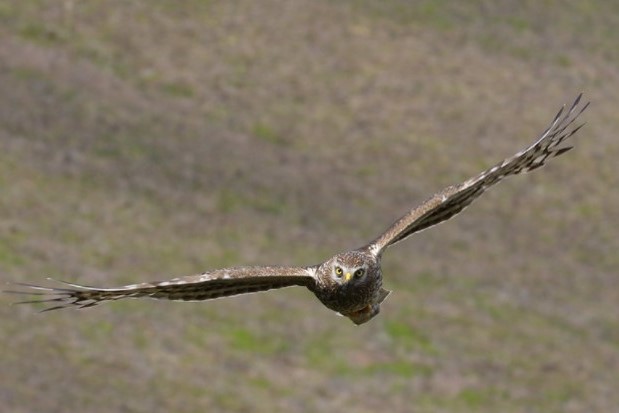
Here’s the RSPB press release summarising the survey results across the UK and Isle of Man:
HEN HARRIER SURVEY RESULTS2023: NUMBERS IMPROVE, BUT MUCH MORE TO BE DONE
Numbers of one of the UK’s rarest birds of prey, the Hen Harrier, are increasing across the UK, but their future still hangs in the balance according to a new survey.
Results of the 2023 Hen Harrier survey have been released, which show how populations of Hen Harriers are faring throughout the UK and Isle of Man, but it’s a mixed picture, with some populations doing better than in previous years, while others are in decline.
The results give some cause for optimism – the UK and Isle of Man population is estimated to be 691 territorial pairs, of which 653 are found in UK. This is a 20% increase from the 545 pairs recorded in the last survey in 2016 and also arrests the trend of decline shown since the 2004 survey, when 749 pairs were recorded.
However, Hen Harriers remain far less abundant or widespread than they should be, and the new population estimate represents only a quarter of the potential population their ideal habitat can support.
Across all four countries of the UK, there is huge variation between populations. England has seen the biggest increase since 2016. Natural England data shows there were 54 Hen Harrier breeding attempts by 50 territorial pairs in 2023 – a substantial 1,150% increase from just the four pairs recorded in 2016.
But while the 2023 figures may look encouraging, Hen Harriers remain absent from large parts of England, including the Peak District and North York Moors – where there are substantial areas of their ideal habitat per 100km sq.
Katie-Jo Luxton, the RSPB’s executive director of global conservation said:
“While there have been encouraging signs since 2016 a closer look shows there’s much more to be done to address the differences across the UK. For example, England has seen the biggest increase, which is welcome news, but the starting point was shockingly low, and well below where we would expect healthy populations of these birds to be given the habitat available to them.
“The work we and others have been doing to restore these populations is incredibly important, and we need to make sure it continues and that we step up our efforts to tackle the illegal killing of birds of prey.”
Disappearances and persecution of satellite-tagged birds shows illegal persecution continues to hamper population recovery. Combined Natural England and RSPB data shows a shocking 32 satellite-tagged Hen Harriers vanished or were confirmed as being illegally killed in England in 2023 – the highest recorded number of Hen Harriers killed or suspiciously disappeared in one year. [Ed: Actually it’s 33 satellite-tagged hen harriers, not 32 – the figure was updated in January 2024 after Natural England released more data: see here].
There was a mixed picture for Hen Harriers in Scotland. The overall population was estimated at 529 territorial pairs, up by 15% since 2016, giving Scotland 77% of the UK and Isle of Man population.
The west Highlands, Hebrides and Orkney continued to provide a home for the majority of Scotland’s breeding harriers. The population remains low on parts of the mainland, where persecution continues to be a likely constraint on their numbers, as evidenced by satellite-tagged Hen Harriers continuing to disappear, mainly in areas managed for grouse shooting.
Elsewhere, the 2023 survey recorded 40 territorial pairs in Wales, up from 35 in 2016. More than half of the Hen Harrier pairs were in the two Special Protected Areas (SPAs) designated for breeding harriers, Berwyn in Northeast Wales and Migneint-Arenig-Dduallt in the northwest.
Northern Ireland recorded only 34 territorial pairs in 2023, a decrease of about 26% which is linked to loss of habitat, increasingly poor habitat quality, and a range of disturbances, a decline which mirrors the 33% population decrease within the Republic of Ireland seen in 2022.
In the Isle of Man, a total of 38 territorial pairs were recorded last year, the highest count since 2004 when the Manx breeding population peaked at 57 pairs.
Simon Wotton, RSPB senior conservation scientist added:
“As the results of the 2023 survey show, the UK has seen an increase in Hen Harriers, which is very welcome, but the overall population is still well below where it should be.
“The reasons for Hen Harriers continuing to be far below their potential population are complex, but one of the primary causes is that continuing illegal killing, typically associated with intensive grouse moor management, is stifling their full recovery.
“With the UK population at around a quarter of its estimated potential, there so much more to do to secure a meaningful recovery. The recent Wildlife Management and Muirburn Bill includes specific monitoring and reporting of Hen Harrier populations on grouse moors in Scotland to the Scottish Parliament and will be an important step in assessing progress with their recovery in these areas.”
The Scottish Government recently passed the Wildlife Management and Muirburn (Scotland) Bill which will introduce licencing for grouse shooting in Scotland, alongside measures to protect the habitats Hen Harriers need to thrive.
The RSPB hopes the success in Scotland will lead to similar legislation in England, and that and landscape restoration in Wales and Northern Ireland lead to a brighter future for Hen Harriers in the UK.
ENDS
A couple of blogs written in response to these findings are worth a read: Mark Avery (here) and Mike Shurmer, RSPB Head of Species (here).
More on the Scotland-specific results shortly…
UPDATE 10th April 2024: Breeding Hen Harriers continue to decline on Scottish grouse moors (here)
 Raptor Persecution UK
it is ashame that the RSPB published this information in the manner chosen Natural England could publish this. One might almost think the improvement in England is excellent news. It is not.
I’m not sure why you think NE should have published the findings, Alex. Although NE was a participant (along with several other organisations), as with previous national surveys it was the RSPB that coordinated the fieldwork and RSPB staff that have led on the analysis.
“Natural England could publish this.”No, it could not. Natural England does not cover Northern Ireland, Wales, Scotland or the Isle of Man.
Until shooting of Gamebirds is outlawed and serious sentences are given for this against gamekeepers etc al zilch will change except numbers will decrease even further. Don’t therefore hold your breath for better news next time.
Why does the RSPB choose to use a nonsensical percentage increase when starting from a base of 4? It gives a totally false impression of things improving dramatically, when in reality they are not.
I totally agree with your comment. I am sure there will be some who will misuse the percentage increase figures to claim Hen Harriers are recovering well and illegal persecution is on the decline. The fact that 33 satellite tagged Hen Harriers were reported missing or illegally killed in 2023; which is apparently the highest number on record should be the headline. The fact that so many critically endangered Hen Harriers were potentially killed by criminals, criminals who have never been brought to justice, but are able to hide in plain sight in some of our rural communities is absolutely damming. I suspect most regular readers of this blog have long since realised that Hen Harrier persecution will only stop when politicians pass the necessary legislation to make it extremely difficult for rogue shooting estates, where Hen Harrier persecution is suspected, to operate. It will be very interesting to see what effect the new legislation being introduced in Scotland has on illegal raptor persecution, and whether this legislation could serve as a blueprint for the rest of the UK?
the sort of people that do driven grouse shooting are the same sort of people who sit in the courts deciding the outcomes??,
“Why does the RSPB choose to use a nonsensical percentage increase when starting from a base of 4?”
Someone should ask the RSPB what is the percentage increase from 0 pairs to, say, two pairs? And then ask the RSPB if that is a meaningful statistic to publish?
i agree with you country born and bred nothing will change ban grouse shooting and leave the poor birds alone . Just been to Scotland for 5 days didn’t see any birds of prey until we went through Durham seen red kites and buzzards.1 red squirrel.
Percentages are such a dangerous measure to use when starting from a low base. It is an unfortunate fact that the criminals in the shooting industry have grasped this percentage increase as propaganda supporting the crimes and killing they carry out to enable the tax-dodging profiteers that run these estates to make more profit and dodge more tax, whilst pretending to benefit the rural community with a few part-time jobs, whilst ignoring all of the downsides: particularly flooding, peat burning, loss of tree cover, loss of natural wildlife and huge lead deposits.