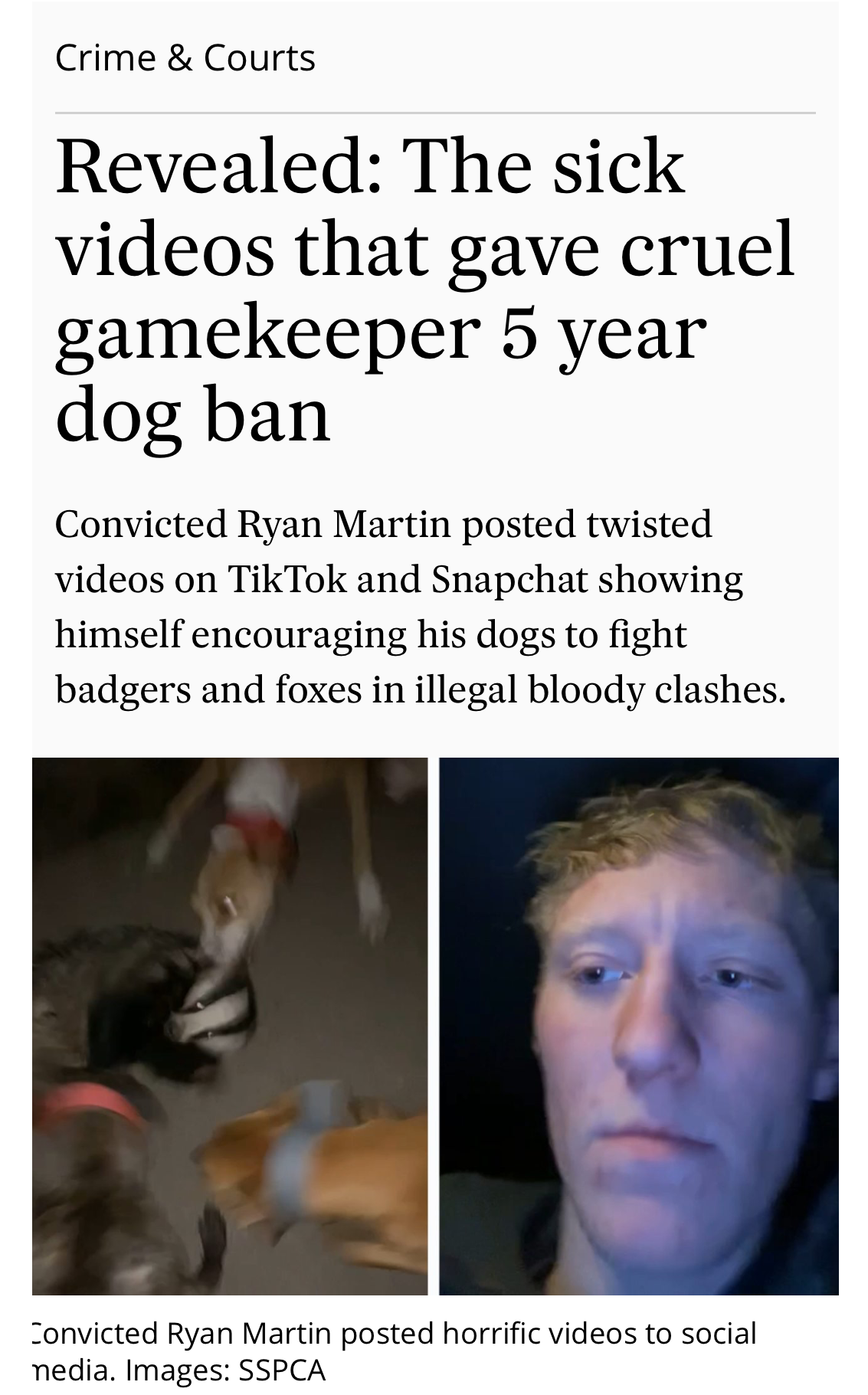
A young gamekeeper from Aberdeenshire has been convicted of sadistic animal cruelty offences after he posted footage on social media of himself encouraging his dogs to fight with badgers and foxes, according to the Press and Journal.
The P&J article is behind a paywall but it describes proceedings from Aberdeen Sheriff Court on 6th December 2023 where 23-year old gamekeeper Ryan Martin of Balmanno Cottages, Marykirk pleaded guilty to causing dogs to fight with badgers and foxes on various occasions.
He was caught after a tip off to the Scottish SPCA, who raided his house in February 2022 with Police Scotland. Three of his dogs were found with fresh wounds and historical injuries and were immediately confiscated and taken for treatment. They have since been signed over to the SSPCA and rehomed.
Martin’s phone was seized during the raid and a digital forensic examination uncovered the disturbing videos that he’d posted to TikTok and Snapchat. He’d prefaced one of the videos with,
“Hold on to your fucking hats. What you’re about to see isn’t 100% legal“,
so there can be no doubt that he knew what he was doing was illegal, even though he had initially denied causing the dogs to fight with other animals when he spoke with a social worker for a background report.
Martin’s defence lawyer Gregor Kelly, told the court what Martin had said to the social worker:
“He’s been out at night shooting foxes as he thinks he’s entitled to do with his dogs. At the time, when foxes have been shot, he encourages the dogs to go and retrieve, as they’re trained to do, and dispatch the foxes. On one occasion, they encountered a badger“.
According to the P&J’s court reporter, ‘Mr Kelly also told the court that Martin, who is employed as a gamekeeper, saw foxes and badgers as “vermin“, but said, “He accepts these are views not acceptable in modern Scotland“‘.
He told the court that ‘Martin intends to work as a joiner to support his partner and children in the future’.
Sheriff Ian Wallace told Martin: “I don’t accept the explanation you gave to the social worker. It’s clear from the narrative you were causing, intentionally, these animals to fight and that caused injuries and/or death to not just the foxes and badgers but to your own dogs“.
And yet despite the clear evidence and the eventual guilty pleas, Martin was only ordered to carry out 175 hours of unpaid work and was banned from keeping or working with dogs for five years.
Eh? What happened to the ‘tougher penalties‘ for animal and wildlife crime that was enacted in Scotland in December 2020 (the Animals and Wildlife (Penalties, Protections and Powers) (Scotland) Act 2020), which increased the maximum penalty for the most serious animal welfare and wildlife crimes (which includes animal fighting offences) to five years imprisonment and unlimited fines?
Even under the old legislation, Martin’s sentence would be seen as being light touch. For example, compare his sentence to that of Millden Estate gamekeeper Rhys Owen Davies who was convicted for badger and fox baiting offences he committed in Scotland 2018 and 2019 – Davies was given an eight month custodial sentence and banned from owning or keeping animals for 15 years (see here).
Once again we see an inconsistent sentencing approach and, in Martin’s case, an ineffectual punishment that simply won’t provide a deterrent for other depraved individuals who think animal abuse is acceptable.
Kudos to the Scottish SPCA whose investigation brought Martin to court – yet another clear demonstration that SSPCA officers are equipped and capable of dealing with serious wildlife crime. The sooner they get an extension of those powers (through the Wildlife Management & Muirburn Bill) to deal with a wider suite of wildlife crimes, the better.
The Health & Safety Executive (HSE) is running a public consultation on the use of lead ammunition in England, Wales and Scotland.
This is the final phase of a long-running (and delayed) process to consider the risks posed by lead ammunition to human health and the environment. The HSE has come up with proposed restrictions on the use of lead ammunition – this public consultation is asking for our views on those proposals, prior to the DEFRA Secretary of State making a decision.
The proposals fall far short of what is needed, no doubt heavily influenced by the game-shooting lobby which has stood in the way of progress on this issue for years. It’s current and much-heralded claim of a voluntary transition away from lead shot is not well supported as lead-contaminated gamebird meat still dominates the market, three years into the five-year phase out period (see here). The shooting industry’s response to these results was a disgraceful attempt to slur the research as ‘pseudoscience’ (see here).
Of most concern for those of us wanting to protect raptors is the HSE’s opinion that there’s no need to ban lead rifle bullets. Instead, the HSE has argued that because the tonnage of lead emitted as shotgun pellets is larger than that emitted as rifle bullets, they can safely ignore benefits of a ban of lead rifle bullets in their benefit/cost calculations. This is clearly bonkers given the hunting habits of certain raptor species, especially golden and white-tailed eagles, which are massively vulnerable to lead poisoning, either directly or indirectly by sublethal effects, when they scavenge on rifle-shot deer gralloch that has been left on the hill.
The HSE’s consultation closes just before midnight tomorrow (Sunday 10 December 2023). It would be brilliant if you could take 15 minutes this weekend to complete it, to show the HSE (and DEFRA) that the banning of ALL lead ammunition (shot and bullets) is long overdue and is a matter of widespread concern, not just for the benefits to human health but also for our environment.
Conservation campaign group Wild Justice has provided a step-by-step guide to responding to the consultation – please click here for details.
Press release from Wildlife & Countryside LINK’s Wildlife Crime Group (5th December 2023):
Low convictions allowing wildlife crime to go unpunished, say nature groups
Some of the country’s leading nature voices are today releasing analysis showing that our cherished wildlife is being failed in the courts, with people who commit crimes (including persecution of birds of prey, badgers and bats) rarely being convicted. Such a lack of convictions removes a key deterrent for would-be criminals and makes it more likely for people to become repeat offenders. Wildlife crime can also be linked to other serious crimes like firearms offences and organised crime.
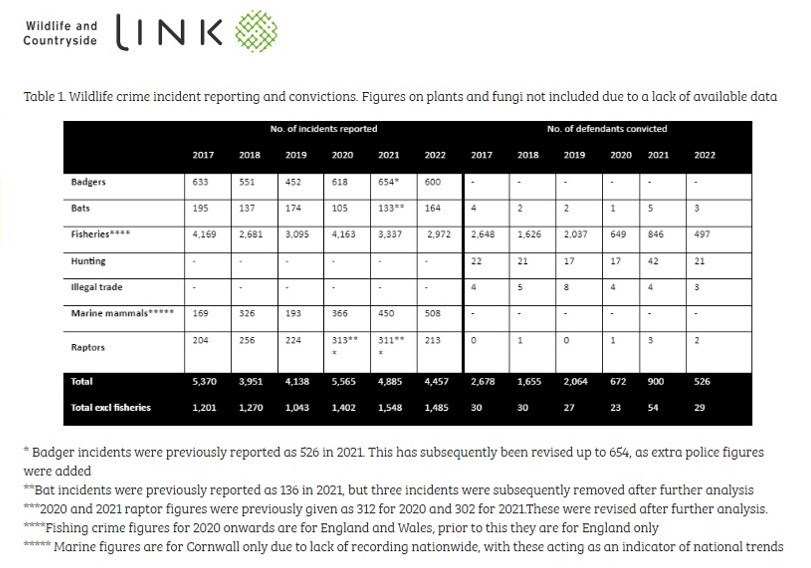
The Wildlife Crime Report for 2022, compiled by Wildlife and Countryside Link, with information from groups including RSPB, WWF UK, and the League Against Cruel Sports, has shown that convictions for crime against wildlife in 2022 decreased substantially. This is despite a record number of reports of wildlife crime over 2021. Other wildlife crimes include the disturbance of seals and dolphins, and the illegal trade of wildlife across international boundaries.
In 2022, Link estimates that there were around 4,457 reported wildlife crime incidents in England and Wales, compared to 4,885 in 2021 (a record level sustained from a surge in incidents in 2020 during the pandemic). Despite record levels of wildlife crime in 2021, there was a notable 42% fall in subsequent convictions for wildlife crime, from 900 in 2021 to 526 in 2022.
Dominic Dyer, Wildlife and Countryside Link’s Wildlife Crime Chair, said: “To put it simply, people who hurt wildlife are getting away with it, with a lack of convictions leaving them free to cause further suffering. Despite shockingly high levels of wildlife crime in recent years we’re not seeing higher levels of convictions to give nature the justice it deserves.
“With the Government’s deadline to halt the decline of nature by 2030 getting ever closer, it’s time for ministers to take the issue of wildlife crime seriously. This means the Home Office making it a notifiable offence to help police forces identify crime hotspots and plan accordingly.”
Despite a slight fall in the overall number of reports of wildlife crime, the report shows that reports of disturbances on marine mammals (including seals and dolphins) rose from 450 in 2021 to 508 in 2022. This is likely due to the rise in the number of people participating in outdoor activities on or near the coast including walking, paddle boarding, kayaking and jet skiing, as well as wildlife tours and wild swimming. Marine experts and water sports governing bodies are working to educate the public on how to enjoy our beaches and ocean without putting the welfare of marine wildlife at risk.
Sue Sayer MBE of Seal Research Trust, said: “More people enjoying our ocean is great news for health and wellbeing, but we must be more mindful of how this can impact marine wildlife including seals. If a seal gets scared by people getting too close it will use huge amounts of energy to scamper away and could also risk serious injury when getting back into the water. Fortunately, it’s very easy to enjoy our beaches and ocean without putting seals at risk of harm. Just follow the Defra Marine and Coastal Wildlife Code, Give Seals Space (100m+), and slowly move further away from seals if they start to look at you.”
Bat crime figures for 2022 increased by 23% compared to 2021. A survey issued by the National Wildlife Crime Unit to the 43 police forces across England and Wales (19 responded meaning these numbers are likely far less than the true extent of crime), coupled with reports to Bat Conservation Trust revealed 164 cases of bat crime. The most common form of bat crime is disturbance or destruction of roosts, often due to property development. The report points to a case in Monmouthshire of a developer being fined more than £7,000 after renovating an old school building where bats were known to be present.
Kit Stoner, chief executive of Bat Conservation Trust, said: “Bats are long lived, roost faithful, and slow to recover from population losses. Unfortunately, many species of bat in the UK are under threat from loss of roosting sites. With the most common form of bat crime being disturbance or destruction of roosts, it is vital that we maintain and enforce protections. Without this action, we will not meet targets to halt the decline of species.”
Due to a lack of official data, these figures on crime (most of the data relies on direct reports from members of the public to nature groups) are likely to be a significant under-estimate of wildlife offences. Wildlife and Countryside Link is therefore calling on the Home Office to make wildlife crime notifiable, to help target resources and action to deal with hotspots of criminality.
To properly tackle the issue of wildlife crime, nature experts are calling for the following actions (most of which were also recommended by a UN report in 2021):
Making wildlife crimes notifiable to the Home Office, so such crimes are officially recorded in national statistics. This would better enable police forces to gauge the true extent of wildlife crime and to plan strategically to address it.
Increasing resources & training for wildlife crime teams in police forces. Significant investment in expanding wildlife and rural crime teams across police forces in England & Wales, would enable further investigations, and lead to further successful prosecutions. Funding for the National Wildlife Crime Unit should be increased in line with inflation, to allow the Unit to continue its excellent work.
Reforming wildlife crime legislation. Wildlife crime legislation in the UK is antiquated and disparate. A 2015 Law Commission report concluded these laws are ‘‘overly complicated, frequently contradictory and unduly prescriptive’’. Much of this stems from the need to prove ‘intention and recklessness’, which has stunted the potential for prosecution in even clear cases of harm being done to protected and endangered species.
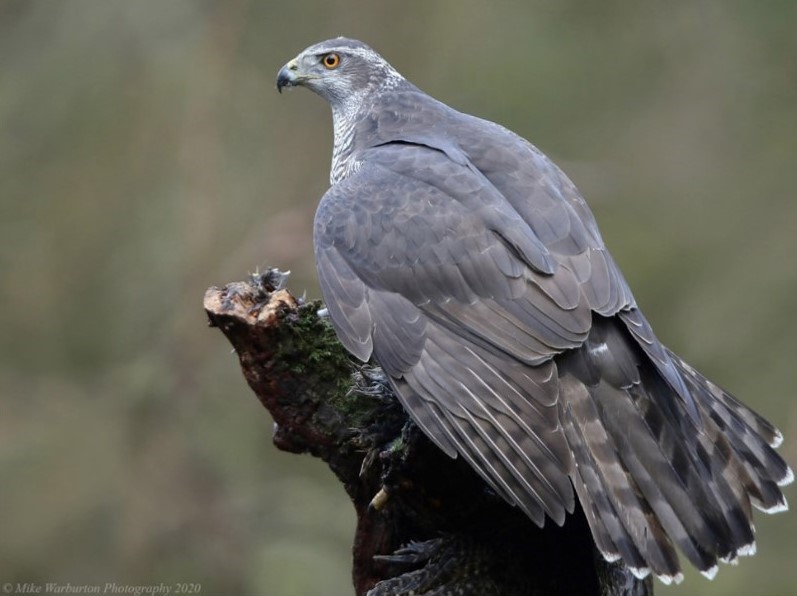
A trial against a man accused of killing a goshawk at a pheasant-rearing farm in Wales has been discontinued.
Thomas Edward Jones, 38, was due to stand trial at Welshpool Magistrates Court yesterday after he previously pleaded not guilty at an earlier hearing to the shooting and killing of a goshawk at Pentre Farm in northern Powys in July 2022, where tens of thousands of pheasants are reportedly reared for the game shooting industry (see here, here, here for previous blogs on this case).
Goshawk photo by Mike Warburton
The RSPB Investigations Team published a tweet yesterday with the following update:
‘Disappointingly, the trial today has been discontinued by the CPS [Crown Prosecution Service], following the court’s refusal for an adjournment made by the CPS, who then deemed they were not in a position to continue with proceedings‘.
I don’t have any further detail about why the CPS wanted an adjournment or why the court refused to grant it.
Further to the news that Scottish grouse moor owner Robbie Douglas-Miller has been appointed to DEFRA’s ministerial team (see here), it has now been confirmed that his role is Parliamentary Under Secretary of State, Minister for Biosecurity, Animal Health and Welfare, and his responsibilities include biosecurity and borders, Northern Ireland and animal welfare:
It’s an interesting appointment, as journalists Helena Horton & Rowena Mason from the Guardian have unearthed some more of his background which includes backing the culling of seals and predatory birds which he believes threaten salmon stocks.
This is a guest blog written by conservation campaigner Bob Berzins who has who has featured previously on this blog here, here, here, here and here.
The city of Sheffield lies immediately to the east of the Peak District National Park at the south end of the Pennines. The city boundary extends into the uplands with four intensively managed grouse shooting moors to the west and north-west of highly populated areas. Every year these shooting moors are burnt to increase grouse numbers and despite recent legislation banning the burning of vegetation over deep peat (more than 40cm) there’s been no noticeable reduction in fires. Around half of each estate comprises shallower peat generally described as Dry Heath and this is where we see continued rotational burning pretty much on every fine day between October and the end of March. The management of these areas affects everyone in Sheffield because of the impact on air quality, water quality, flood risk and carbon losses.
What happened in October?
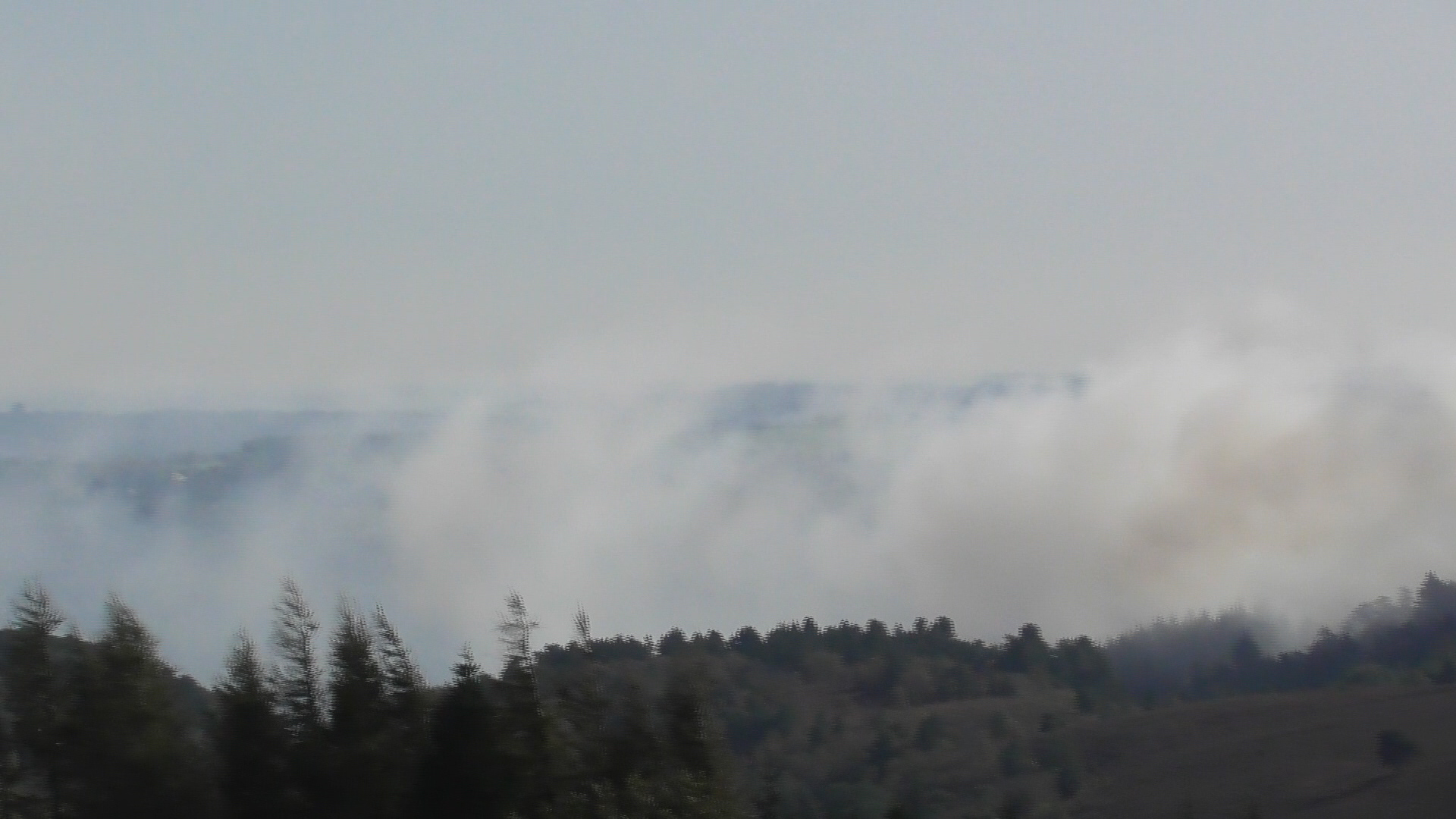
It was only a matter of time until two factors combined: the moors closest to Sheffield suburbs were burnt and the prevailing westerly winds blew all the smoke into those densely populated areas. On 9th October 2023 all four grouse moors within Sheffield were burning heather and in particular Moscar Estate was burning near Wyming Brook just a mile from the suburbs at Lodge Moor:
Burning at Wyming Brook
Smoke was blown into Sheffield and that pollution built up in urban areas:
Smoke lingering near Lodge Moor
Very soon social media was alive with complaints from Sheffield residents who not only found the smoke unpleasant but were having difficulty breathing and were forced to stay indoors with windows closed [here]. The smoke particularly affected those with existing respiratory conditions such as asthma. And there was a real sense of anger because everyone knew this burning was intentional for the benefit of a few grouse moor owners.
Why is this smoke harmful to health?
Sheffield has a network of “citizen science” air quality sensors which measure particulates including PM2.5 which are tiny particles less than 2.5 micro metres (µm) in size and are especially harmful because they pass from our lungs into the bloodstream and affect all our organs. Defra say “Exposure to high concentrations of PM (e.g, during short term pollution episodes) can also exacerbate heart and lung conditions, significantly affecting quality of life, and increase deaths and hospital admissions” [here]. To put this into context the World Health Organisation has set a safe PM2.5 limit of an average of 15 µg/m3 per day and this air quality sensor was showing spikes of around 120 µg/ m3 as shown here:
Air quality sensor at Hunters Bar, around 4 miles from the main burn site
There is a more detailed and easy to read analysis including data from Defra and Sheffield Council air quality sensors, undertaken by Sheffield University [here].
So it’s clear Sheffield suffered a major air pollution incident on 9th October and the only rational explanation for this was moorland burning.
But they’re allowed to burn aren’t they?
The burning near Wyming Brook occurred on moorland which is designated as a Site of Special Scientific Interest (SSSI), Special Area of Conservation (SAC) and Specially Protected Area (SPA). It’s obviously shallow peat soil (<40cm deep) so the blanket bog burning ban does not apply. But as Natural England explained to me:
“The moorland estates located within Sites of Special Scientific Interest (SSSi’s) close to Sheffield do tend to have Agri-Environment Higher Level Stewardship agreements that contain burning plans. These are compliant with the Heather and Grass Burning Regulations, which are the effective detailed consent under the Wildlife and Countryside Act for the agreement period.”
This is a long winded way of describing how Moscar Estate has a management plan which MUST be followed.
An Environmental Information Request revealed what’s entailed in the detailed consent – see below to read the Moscar Management Plan File:
According to this management plan, burning is allowed in this area on a 7-10 year rotation subject to a number of conditions including (4.1.5):
‘Burning will only be carried out when conditions allow for quick cool burns. A cool burn is one which removes the dwarf-shrub canopy yet leaves behind a proportion of ‘stick’ and does not cause damage to the moss layer or expose the peat surface.
Hotter, slower burns can kill the moss and lichen layer and plants like cowberry and bilberry and if severe it can burn into the peat surface causing erosion and affecting the integrity of the sensitive habitat. The moss or lichen or litter layer should not be damaged by burning, such that the moss layer will not recover within a year. When conditions do not to allow for this, fires will not be started‘.
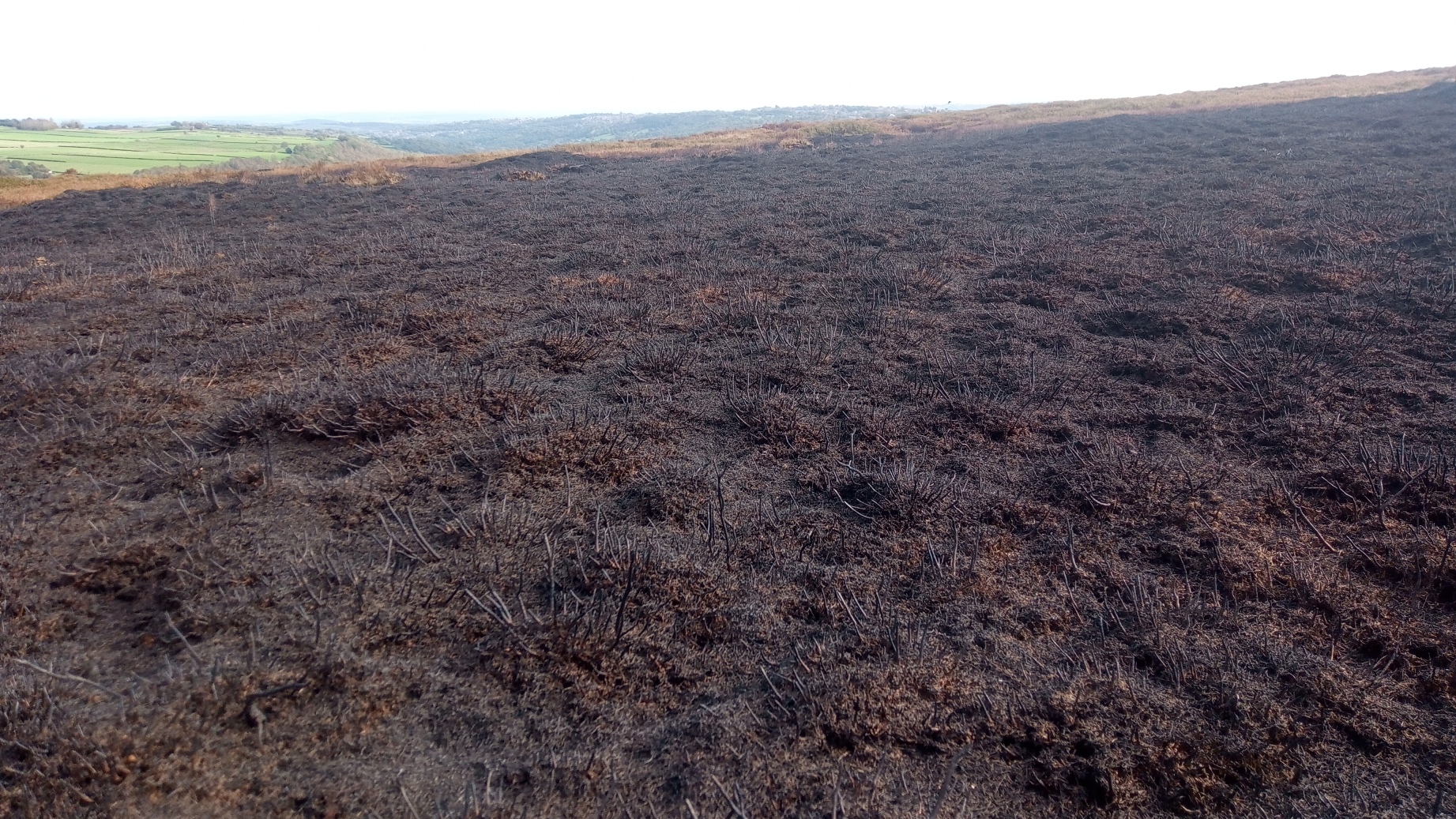
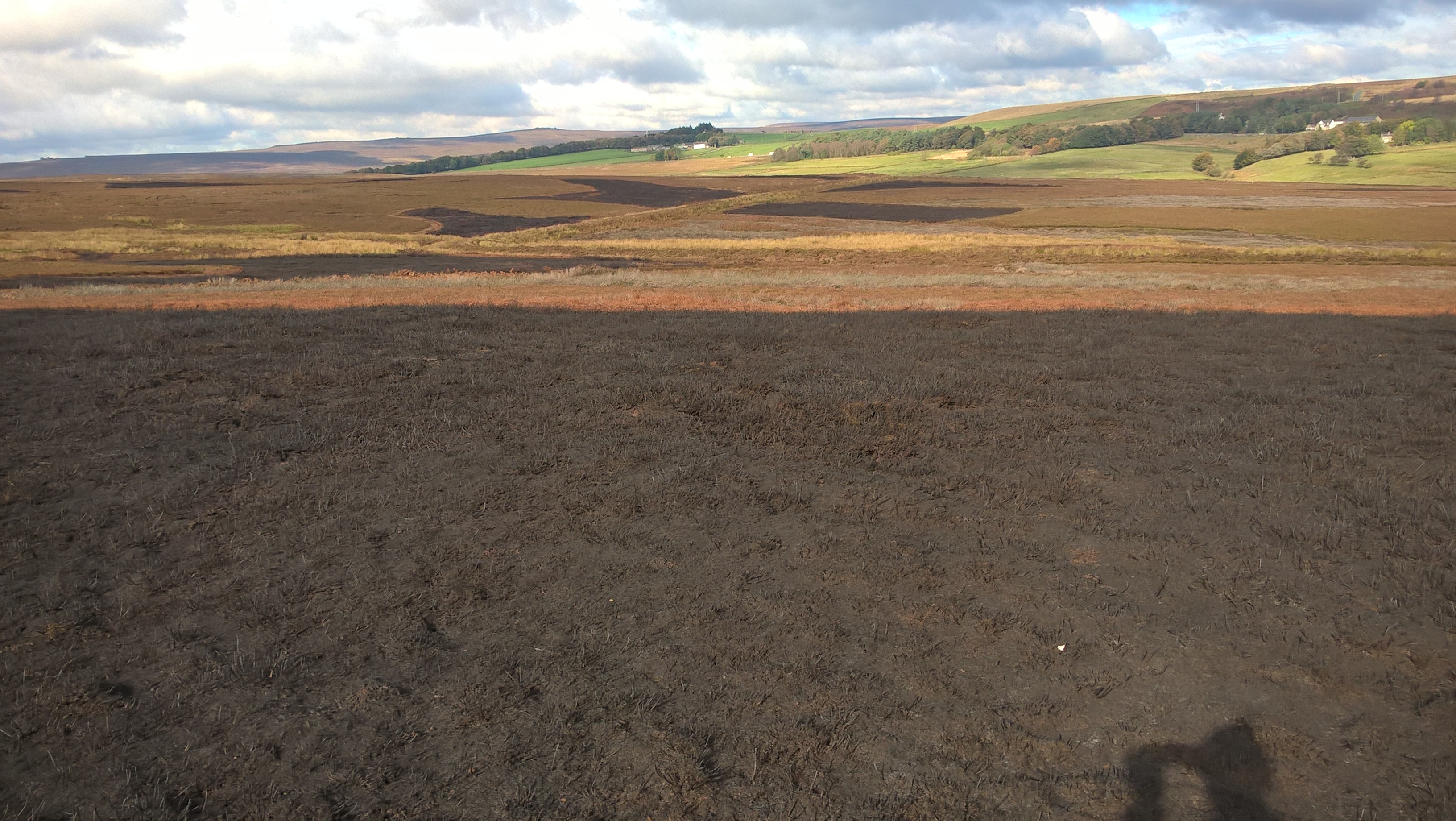
But when I visited the burn site I counted around 40 individual burns many of which had apparently been “hot” and “intensive” leaving no heather stick or moss. Like this:
And like this (Sheffield suburbs just behind):
The burning occurred in SSSI unit 37 which has been assessed as ‘Unfavourable Recovering’; (3.2.1) lists the detailed management actions and objectives needed to achieve favourable condition.
The areas burnt in October are best described as species poor because they’re dominated by heather. There’s often a lack of ground layer which means organic soil can be exposed following burning and the management objective is to minimize the area of peat exposed through careful cool burning or cutting. But what actually happened appears to be the opposite – hot intensive burns left a large amount of peat exposed which could compound the unfavourable condition of the SSSI unit.
The burning appears to be a clear breach of the management plan conditions and therefore an apparent breach of Section 28 of the Wildlife & Countryside Act which deals with SSSIs.
In this case it’s crucial to emphasise that hot intensive burns inevitably create more smoke because all combustible material is burnt. Cool burns leave a lot of vegetation intact and therefore create less smoke.
I did report similar intensive, hot burning at Moscar Estate in 2016 which resulted in the estate receiving a warning, so the requirements for consented burning should have been very clear.
Evidence of burning on Moscar in 2016
Natural England are primarily concerned with conservation not air pollution but as I’ve described above the two issues are inextricably linked in this case. The Local Authority – Sheffield Council – has powers under The Environment Act 1990 to tackle a Statutory Nuisance [here] which has a broad definition but includes smoke from “premises” that
unreasonably and substantially interfere with the use or enjoyment of a home or other premises;
injure health or be likely to injure health.
And given the public outcry, a number of people including Councillors are pressing Sheffield Council to serve a Smoke Abatement Notice via Section 80 of the Environment Act 1990. The latest Sheffield Council response is [here]:
“The Environmental Protection Service has written to the three landowners to establish what went wrong on this occasion and to seek assurances that measures are put in place to minimise the impact in future. We have advised them of the provisions of the Environmental Protection Act 1990 and the potential consequences if an authorised officer from this Service finds that a statutory nuisance exists during future burns. We are awaiting their responses. It seems that on this occasion the high pressure weather event played a part in forcing the smoke down into Sheffield.”
Blog readers will be familiar with this type of response from a statutory body to the actions of grouse moors – hopelessly inadequate. The citizens of Sheffield are crying out for their Local Authority to take immediate robust action for this major pollution event which has already occurred and already affected the lives and health of thousands of people.
Sheffield Council also contacted Natural England who said “Once we have established the circumstances leading to the incident this year we will consider if the service of a S80 notice is appropriate.” So it all comes down to Natural England’s assessment of the burning. I’ve done my best to give them full information by sending them videos of the burning and photos with GPS refs of the post-burn sites.
Landowner Public Accountability
My site visit revealed many of the burns had mown margins (that acted as a fire break) so it’s clear that all these patches of moorland could have been mown and the burning wasn’t necessary at all:
Mown margins
Moscar Estate owner, the Duke of Rutland, has now responded to a request for a ‘Smoke Summit’ meeting with South Yorkshire Regional Mayor Oliver Coppard [see here].
It is a matter of public record, via Defra’s Magic map [see screen grab below] that Moscar Estate receives around £200,000pa in High Level Stewardship funding which is taxpayers’ money. The public deserves an explanation:
Screenshot from Magic Agri-Environment layer site search Moscar. Note named person is the agricultural tenant rather than Duke of Rutland. This is referenced in the management plan.
The Sheffield Tribune [here] did manage to speak to a representative of the Peak District Moorland Group who “accepted the situation that occurred was totally unsatisfactory for those that were affected by the lingering smoke”. He added that the PDMG hoped to organise a meeting with residents to discuss the smoke and explain why ‘consented low intensity vegetation burning’ was selected over other management options available to land managers.
But of course we haven’t heard anything about a public meeting.
Conclusion
I’ve witnessed an awful lot of burning over the last 10 years and the intensity of burning and amount of smoke produced in this incident was bad but not exceptional. Everybody noticed these burns because the smoke ended up in Sheffield and was measured. Countless smaller communities and individual dwellings suffer similar levels of smoke pollution throughout the grouse moor burning season.
If you live in Sheffield please write to your councillor and MP to ensure the smoke abatement notice does happen. If you live elsewhere write to your MP and ask what they will do after the next election to ensure moorland burning comes to an end.
Press release from the Oxford Centre for Animal Ethics (4th December 2023):
‘Predator control’ on Scottish grouse moors causes tremendous, unjustifiable suffering to animals, say academics.
Over 120 academics worldwide have backed a report that calls for an end to snaring, trapping, and poisoning animals on Scottish moors. Animals are killed in order to artificially inflate grouse populations for shooting.
“The best available estimates indicate that as many as 260,000 animals are killed as a result of legal ‘predator control’ practices each year in Scotland” maintains the Report.
The Report is signed by numerous ethicists and philosophers, including Scottish academics from the universities of St Andrews, Edinburgh, Stirling, and Aberdeen, and the Nobel Laureate, J. M. Coetzee.
Titled “Killing to Kill,” the 71-page report by the Oxford Centre for Animal Ethics graphically details how each method of control “causes suffering, or prolongs suffering, or makes animals liable to suffering.”
Snares are condemned because they “inevitably mean that animals can struggle for hours in considerable pain and distress.” Even the supposedly most humane trap, the DOC (Department of Conservation) trap, only kills 80% of its victims quickly, while the remaining 20% are left to suffer appalling injuries, with no requirement for inspection. And poisons mean that animals suffer for days.
“This is a major moral issue” claims Centre director the Revd Professor Andrew Linzey, “it simply cannot be right to cause tremendous suffering for non-essential purposes. When we began the report, we knew hardly anything about these control measures, but we have been staggered by the degree of suffering. Few people are cognizant of the situation. It is a much neglected and overlooked area of animal cruelty.”
The report concludes by calling for a new charter for free-living animals. “Scotland could lead the way in pioneering legislation that encompasses not only domestic animals, but also free-living ones. This legislation should begin with the recognition of sentiency and enshrine in law the value and dignity of free-living animals such that their right to live unmolested is respected.”
The report is written by a fellow and the directors of the Centre, Dr Katie Javanaud, Dr Clair Linzey, and the Revd Professor Andrew Linzey. It was commissioned by the Scottish charity, the League Against Cruel Sports, but is an entirely independent report and at no point did the League seek to influence the Report’s findings or conclusions.
Director of the League Against Cruel Sports Scotland Robbie Marsland, commented: “The League Against Cruel Sports is not surprised that many people believe Scotland’s “grouse moors” are an animal ethics free zone. Polling shows that 76% of Scots do not support the practice of ‘predator control’ to kill hundreds and thousands of animals so that more grouse can be shot for entertainment.
“This report clearly outlines the ethical case against this uncontrolled killing. The biggest surprise is that any suggestion that this killing should stop is met with incredulity by the shooting fraternity. We hope the report will open the eyes of politicians considering the Wildlife Management and Muirburn (Scotland) Bill to the enormous ethical issues before them.”
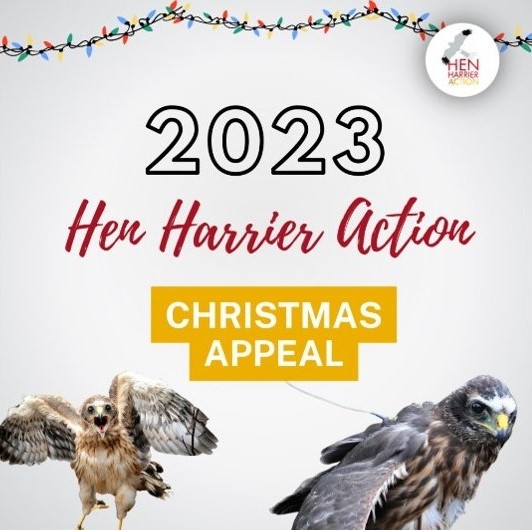
The charity Hen Harrier Action has launched a Christmas fundraising appeal to raise money for at least four more satellite tags to be fitted to young hen harriers in spring 2024.
Here are a few words from Hen Harrier Action about this fundraising appeal:
The latest RSPB Birdcrime Report documents the continuing relentless persecution of Hen Harriers and other birds of prey in the UK. As the Report notes, ‘despite being fully protected by law and a UK Red Listed species, they are being persecuted on a relentless scale’.
Between January 2022 and October 2023, 39 Hen Harriers are suspected or proven to have been persecuted across the UK. And the report tells us that this number is likely to rise, as some known incidents cannot be disclosed yet as they form part of on-going investigations.
As a rare protected species with an estimated fewer than 600 breeding pairs in the whole of the UK, this chronic level of persecution, if it continues, will severely hamper the chance of any recovery for this charismatic raptor.
In response, Hen Harrier Action has launched a Christmas Appeal on GoFundMe to raise money to fund the satellite tagging and monitoring of young Hen Harrier chicks next Spring.
We’ve set an ambitious target of raising enough money to fund four satellite tags, likely to cost around £12,000. The tagging and monitoring will be undertaken by the RSPB.
There’s more information here, and the fundraising page for donations is here.
Press release from Yorkshire Dales National Park Authority (1st December 2023)
Reaction to the RSPB Birdcrime Report
The RSPB recently published its latest ‘Birdcrime’ report.
David Butterworth, Chief Executive Officer of the Yorkshire Dales National Park Authority, said: “It is yet again hugely embarrassing that this part of the country has been shamed as being the worst for proven and suspected bird of prey persecution in the UK.
“An end to the illegal killing of birds cannot come soon enough. Some of the instances of criminality this year beggar belief. The stamping to death of 4 young Harrier chicks and one Harrier having its head pulled from its body while still alive. Truly shocking levels of depravity.
Hen harrier ‘Free’, found on moorland in the Yorkshire Dales National Park and whose post mortem revealed that the cause of death was the head being twisted and pulled off while the body was held tightly. His leg had also been ripped off whilst he was alive. Photo by Natural England via RSPB’s 2022 Birdcrime report.
“It’s all the more galling because there are signs of positive change. Some local land managers are doing great work to conserve birds of prey in the National Park.
“We are currently preparing a new evidence report on bird of prey populations in the National Park on behalf of the Yorkshire Dales Bird of Prey Partnership. We hope this report will be published in the coming weeks. Sadly all of this will count for little whilst the persecution of Birds of Prey continues“.
ENDS
Bravo, David Butterworth, for this very public and unequivocal condemnation of the ongoing raptor persecution in this so-called National Park.
But isn’t it time the pretend Yorkshire Dales Bird of Prey ‘Partnership’ was closed down? The RSPB has already left because it recognised the futility of trying to ‘partner’ with the likes of the Moorland Association – how much more time, money and effort is going to be pumped into this pseudo-union, whilst the crimes against birds of prey just carry on and on and on?
Partnerships and coalitions only work when objectives are shared. In the case of the Yorkshire Dales Bird of Prey ‘Partnership’, the Chair of the Moorland Association doesn’t even accept that hen harrier persecution is happening (see here), let alone that it’s an issue that needs to be addressed. What’s the point of continuing this ‘partnership’ charade?
As an aside, the RSPB’s 2022 Birdcrime report was published ten days ago and it contains a lot of material that I want to blog about. I’ve been distracted by events in Scotland (more golden eagle persecution, more peregrine persecution, and a landmark vote by the Scottish Parliament to agree to the general principles of a grouse moor licensing scheme) but I haven’t forgotten about the Birdcrime report and will come back to it shortly….
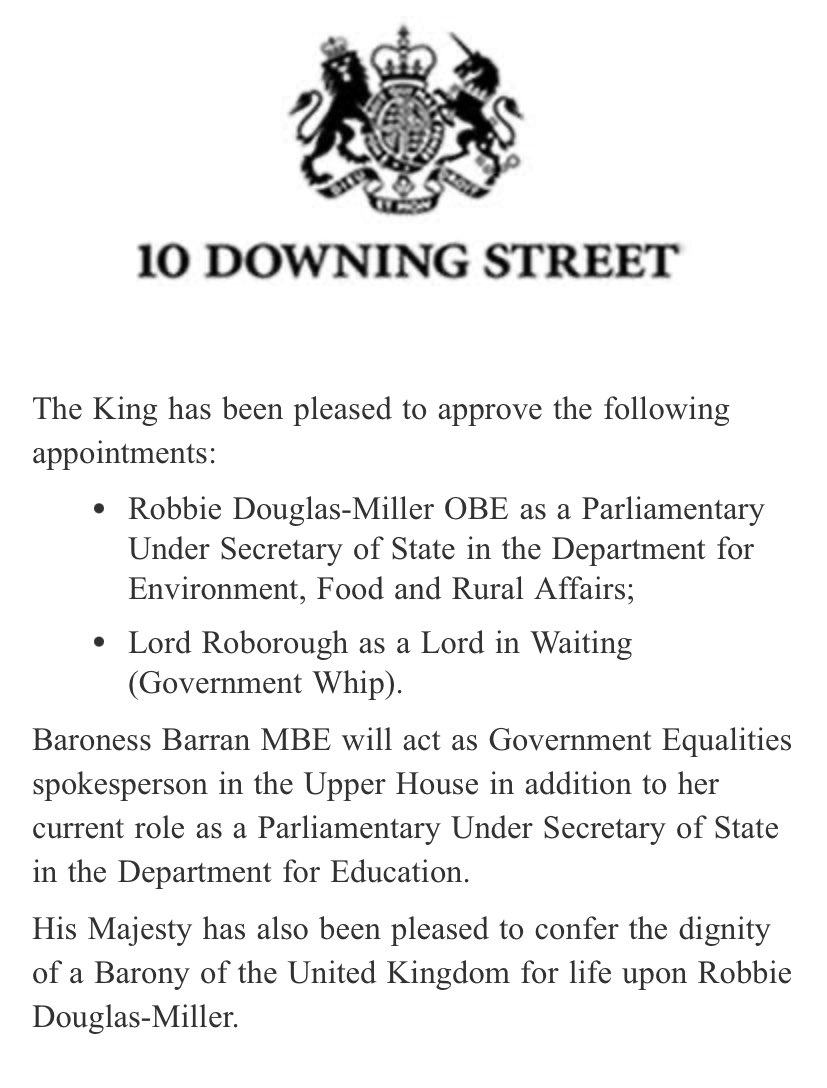
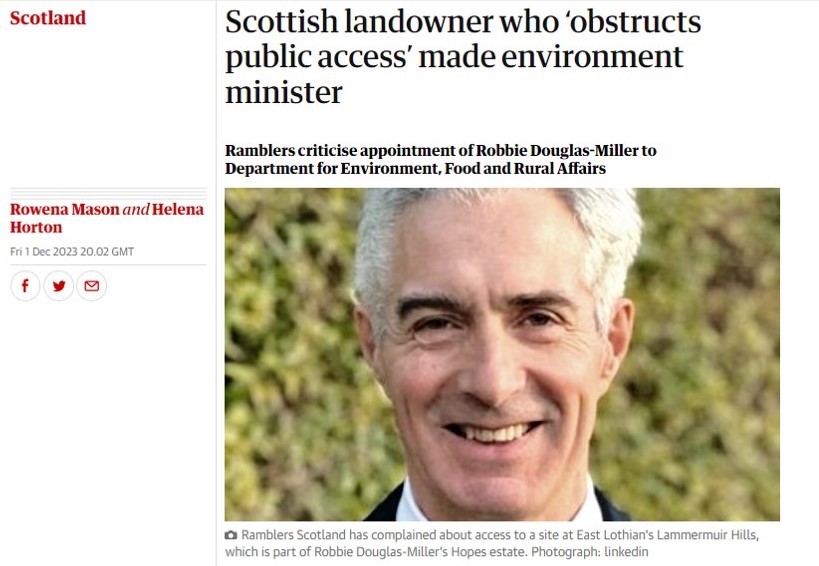
Yesterday it was announced that Robbie Douglas-Miller OBE has been appointed as a Parliamentary Under Secretary of State in the Department for Environment, Food and Rural Affairs (DEFRA).
Eh? So an unelected billionaire who likes to wear a crown has conferred a Barony on some other bloke which then allows that other unelected bloke to be given a Ministerial role in DEFRA, which has been approved by the unelected billionaire who likes to wear a crown, and we’re all supposed to accept this is a functional democracy? Good grief.
That new unelected DEFRA Environment Minister, Baron Douglas-Miller, is believed to be the same Robbie Douglas-Miller who just happens to be the sole director of Moorfoot Capital Management Ltd which owns a grouse moor (Hopes Estate) in the Lammermuirs in south Scotland. Along with Lord Benyon, that’ll now be two grouse moor-owning Environment Ministers in DEFRA.
Douglas-Miller has, according to this article in the Guardian, been accused of ‘obstructing public access‘ by ‘apparently making it difficult for walkers to access a site East Lothian’s Lammermuir Hills, which is part of his Hopes Estate‘.
It’s not the first time access issues have been raised at Hopes Estate. In 2017, fieldworkers from the Scottish Raptor Study Group published two scientific papers about their long-term monitoring of merlins on grouse moors in the Lammermuirs and how that came to an abrupt end in 2015 after they were suddenly refused vehicular access, having previously enjoyed a good cooperative relationship with landowners and gamekeepers for many years. They believed that the relationship breakdown was a result of them highlighting some of the intensification of management practices on those grouse moors. Their study area covered several estates including the Hopes Estate (see here and here).
It’s worth noting that none of these grouse moor management practices were unlawful (at the time), and indeed the fieldworkers did not find any evidence of illegal raptor persecution, but their criticism of the increased use of bridge (rail) traps that were catching / killing non-target species such as dippers, merlin and ring ouzels, and the killing of mountain hares that were then dumped in stink pits was an issue of concern to them.
The Hopes Estate had achieved accreditation in 2013/14 under the Wildlife Estates Scotland (WES) scheme, which is administered by landowners’ lobby group Scottish Land & Estates and was chaired for several years by Robbie Douglas-Miller.
Estates that are awarded accreditation under the WES scheme have to meet certain criteria, including:
Commitment to best practice
Adoption of game and wildlife management plans that underpin best practice
Maintaining species and habitats records
Conservation and collaborative work
Integration with other land management activities (such as farming, forestry and tourism)
Social, economic and cultural aspects (such as employment, community engagement and communications)
The WES scheme was first piloted in 2011 and was believed to be in response to MSP Peter Peacock’s call in 2010 for an estate licensing scheme to combat ongoing raptor persecution (see here). The scheme was then rolled out fully in 2013 but not without some healthy scepticism of it being a greenwashing exercise (see here).
Since then, in general, I think it’s probably been a good thing for estates to aspire to, although a number of estates in the WES scheme have had wildlife crime incidents recorded on their land, e.g. Invercauld Estate (see here and pay attention to the letter written by the estate to the then Environment Minister where the estate quoted its membership of the WES scheme as an example of its apparently good stewardship. Of course, this estate is now currently serving a three-year General Licence restriction after further evidence of wildlife crime was uncovered there, including what Police Scotland described as the ‘deliberate’ poisoning of a golden eagle – here).
In addition, the WES-accredited Newlands Estate in Dumfriesshire saw one of its gamekeepers convicted for killing a buzzard after he threw rocks at it before repeatedly stamping on it (see here and here). To be fair, when challenged about the estate’s WES accreditation in light of the gamekeeper’s conviction, WES stated that the estate’s accreditation had been ‘suspended’ (note, not revoked, see here) although for how long, who knows?
And just this week, another WES-accredited estate is at the centre of a police investigation after a dead peregrine was found in a baited illegal pole trap in the Pentlands (see here). The Police Scotland appeal for information stated that the dead peregrine ‘was found around 100 yards from a public path on the edge of a small woodland south of Wester Bavelaw on Thursday, 23 November, 2023′.
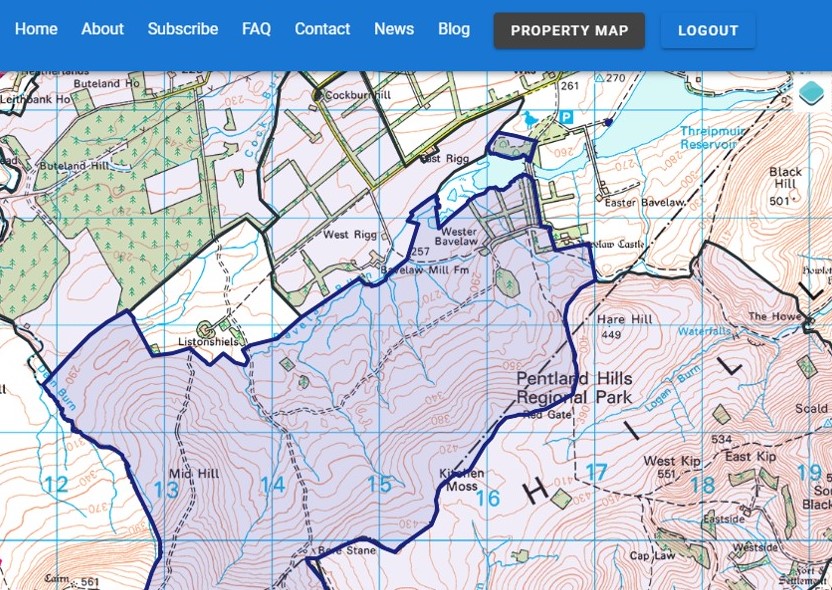
According to Andy Wightman’s Who Owns Scotland website this ‘small woodland south of Wester Bavelaw’ appears to be on the Bavelaw Estate:
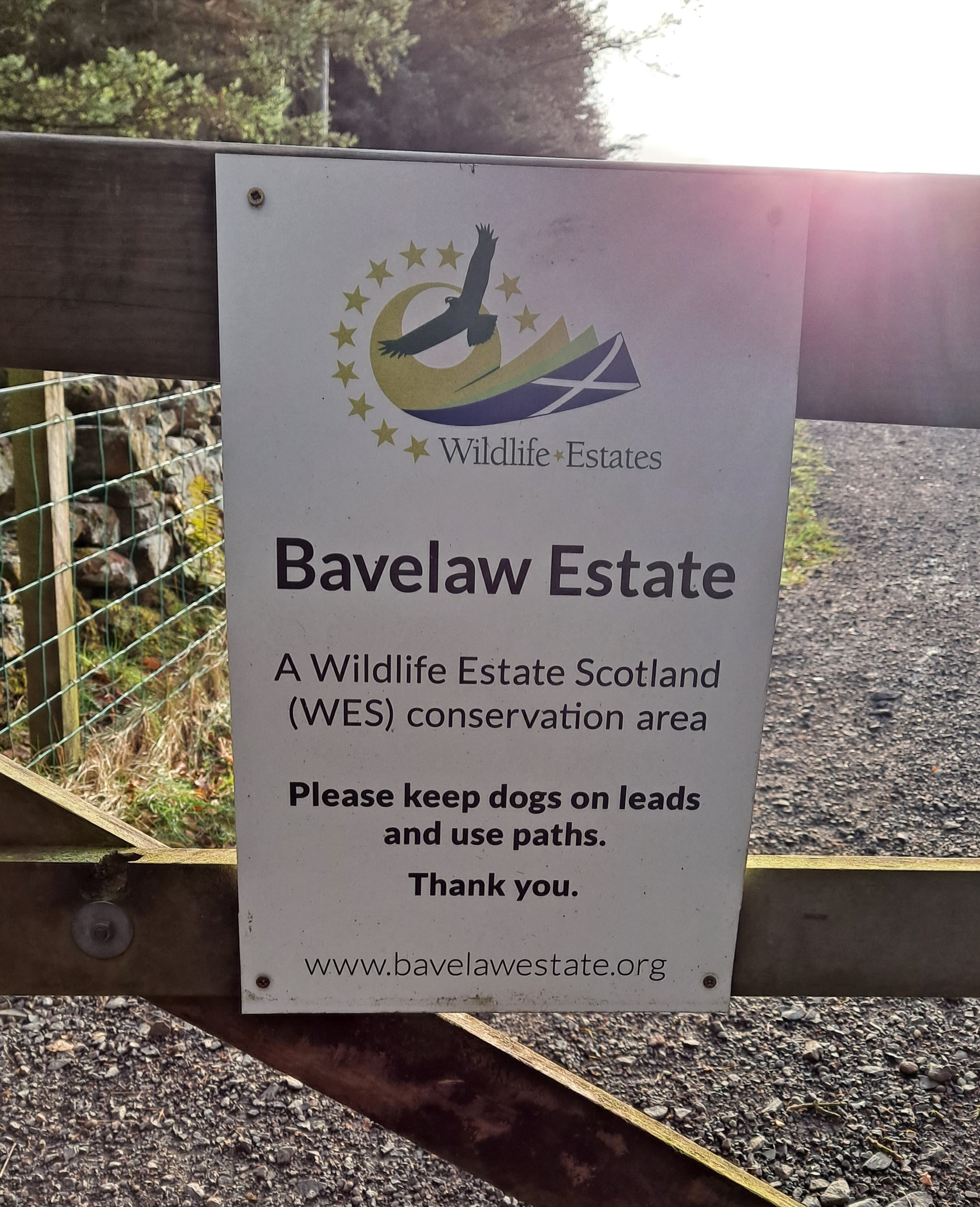
The Bavelaw Estate, according to its own website, is a WES-accredited estate and says this about it:
‘Over the last five years, The estate have enhanced habitat across the board, including planting over 50 ha of mixed native woodland, peatland restoration, the creation of wetland areas, including wader scrapes and ponds, restoration of riparian habitats and heather and bracken swiping as well as connecting wildlife corridors. Additionally, restoring 7,861 sq Km of public access paths.
The assessor was extremely impressed with the integrated management direction the Estate is taking and specifically referenced the undeniable passion and enthusiasm for nature that both the landowner and his employees have‘.
Photo by RPUK blog reader
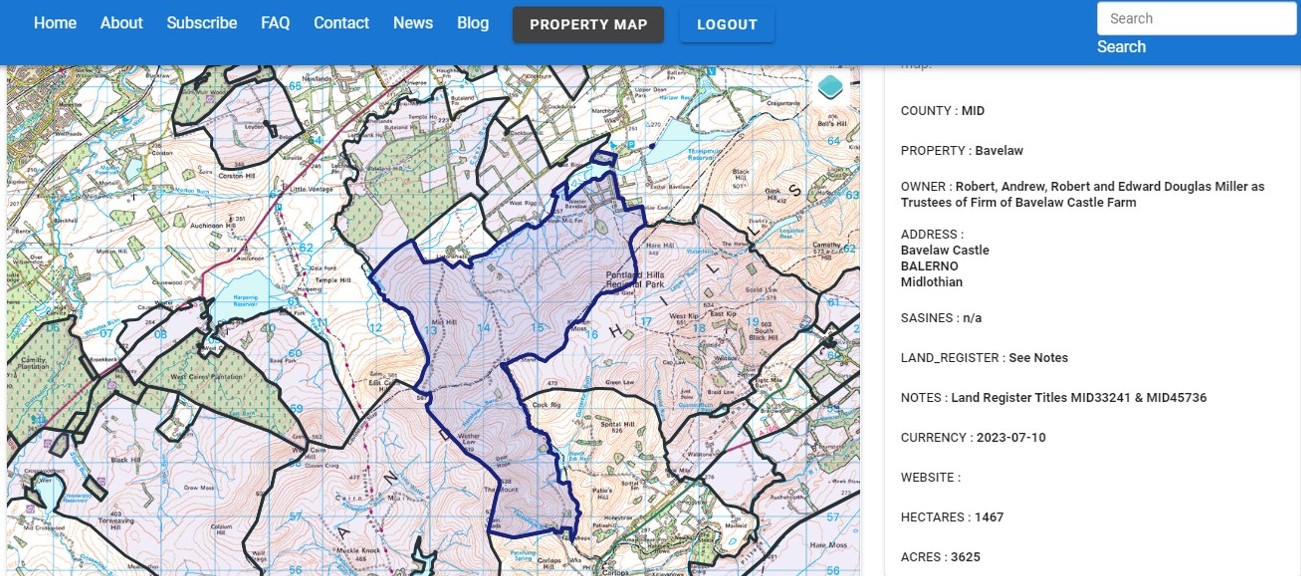
Interestingly, and again according to Andy Wightman’s Who Owns Scotland website (data collected 10 July 2023), Bavelaw Estate is owned by Robert, Andrew, Robert and Edward Douglas-Miller as Trustees of Firm of Bavelaw Castle Farm:
Now, to be absolutely clear and for the avoidance of doubt, there is no suggestion whatsoever that Robbie Douglas-Miller, or his relatives, or indeed anyone associated with Bavelaw Estate is responsible for, or had any knowledge of, the setting and baiting of that illegal pole trap that killed the peregrine. The police investigation is ongoing and we’ll just have to wait and see whether the police appeal for information brings forward any witnesses and whether the forensic analysis identifies a suspect.
I genuinely expect Robbie Douglas-Miller will have been as horrified as the rest of us and will be eager to know who set that illegal trap, and who might also be responsible for other incidents of raptor persecution / wildlife crime in the area, e.g. the illegally poisoned peregrine found about half a mile away in 2018 (here), the suspicious disappearance of golden eagle Fred a few kilometres away in 2018 (here) the merlin nest that was shot out in 2017 (here) and the raven shot on its nest in 2016 (here).
Nevertheless, it appears that a heinous wildlife crime has been detected on another WES-accredited estate, and that the apparent new DEFRA Environment Minister is a co-Trustee of the company that owns the estate.
As an aside, I was interested to see the game-shooting lobby was very quick to deny that the pole-trapped peregrine had anything to do with grouse shooting – indeed, MSP Rachael Hamilton even stated as much in the Chamber during Thursday’s parliamentary debate on the Wildlife Management Bill (“…there is clearly no link to a grouse moor management…“, here). How does she know?!
There is driven grouse shooting on neighbouring land to Bavelaw and Bavelaw was once a prominent grouse shooting estate itself (the lines of grouse butts are marked on the OS map) but it is believed that Bavelaw is currently managed as a sheep farm, although there is evidence that muirburn takes place but it doesn’t look like the intensive muirburn typically associated with a driven grouse moor:
Bavelaw Estate. Photo by RPUK blog reader
What’s really interesting then, is why the Bavelaw Estate was a signatory on a recent letter sent to Environment Minister Gillian Martin where nearly 400 rural businesses expressed their concern that a grouse moor licensing scheme would be detrimental to their interests (see here). You can’t have it both ways – either there’s a link to grouse shooting or there isn’t.
I really don’t know what to make of Robbie Douglas-Miller’s appointment as an Environment Minister in DEFRA. What can a prominent grouse moor owner, member of Scottish Land & Estates and a former GWCT Director bring to the policy table? Perhaps he’ll use his experience of chairing the WES scheme in Scotland to try and impart some sense to the appalling and unregulated mismanagement of England’s grouse moors? Although given SLE’s open-mouthed hysteria about the proposed grouse moor licensing scheme in Scotland, that doesn’t seem likely.
UPDATE 7th December 2023: More information emerges on new, unelected DEFRA minister (here)










 Raptor Persecution UK