Earlier this month I blogged about the appointment of Gillian Martin MSP as the new Environment Minister in the Scottish Government, alongside her current role as Energy Minister (see here).
Environment & Energy Minister Gillian Martin in action at Holyrood last week (Scottish Parliament TV)
At the time of Gillian’s appointment her specific responsibilities under the ‘Environment’ remit had not yet been published, other than to say she would be supporting the Cabinet Secretary for Rural Affairs, Land Reform and Islands (Mairi Gougeon).
The full list of Gillian’s responsibilities has now been made public, and as expected, her new portfolio covers many issues relevant to us, including wildlife management and wildlife crime:
Further to the publication yesterday of the Scottish Government’s commissioned review on increased investigatory powers for the Scottish SPCA (here), this issue was raised in the Scottish Parliament yesterday during Portfolio Questions.
This is a fairly positive response from the Minister but yet again, we’re left waiting for a formal Government response to the review, even though in February we were told that the Government’s response would be published at the same time as the review (i.e. yesterday).
I don’t understand why we’ve had to wait eight months for this very short review to be published (it was submitted to Government in Oct 2022) if the Government hasn’t even managed to cobble together a formal response yet. What was the delay for? And given that the issue has been tabled during the recent evidence sessions during the Stage 1 scrutiny of the Wildlife & Muirburn (Scotland) Bill, wouldn’t it have been useful to have had this review available in time for discussions?
So now we wait again….more bloody can-kicking, 12 years on. It’s tedious and unimpressive governance. Nevertheless, kudos to Mark Ruskell MSP (Scottish Greens) who has been pushing on this issue for many years now.
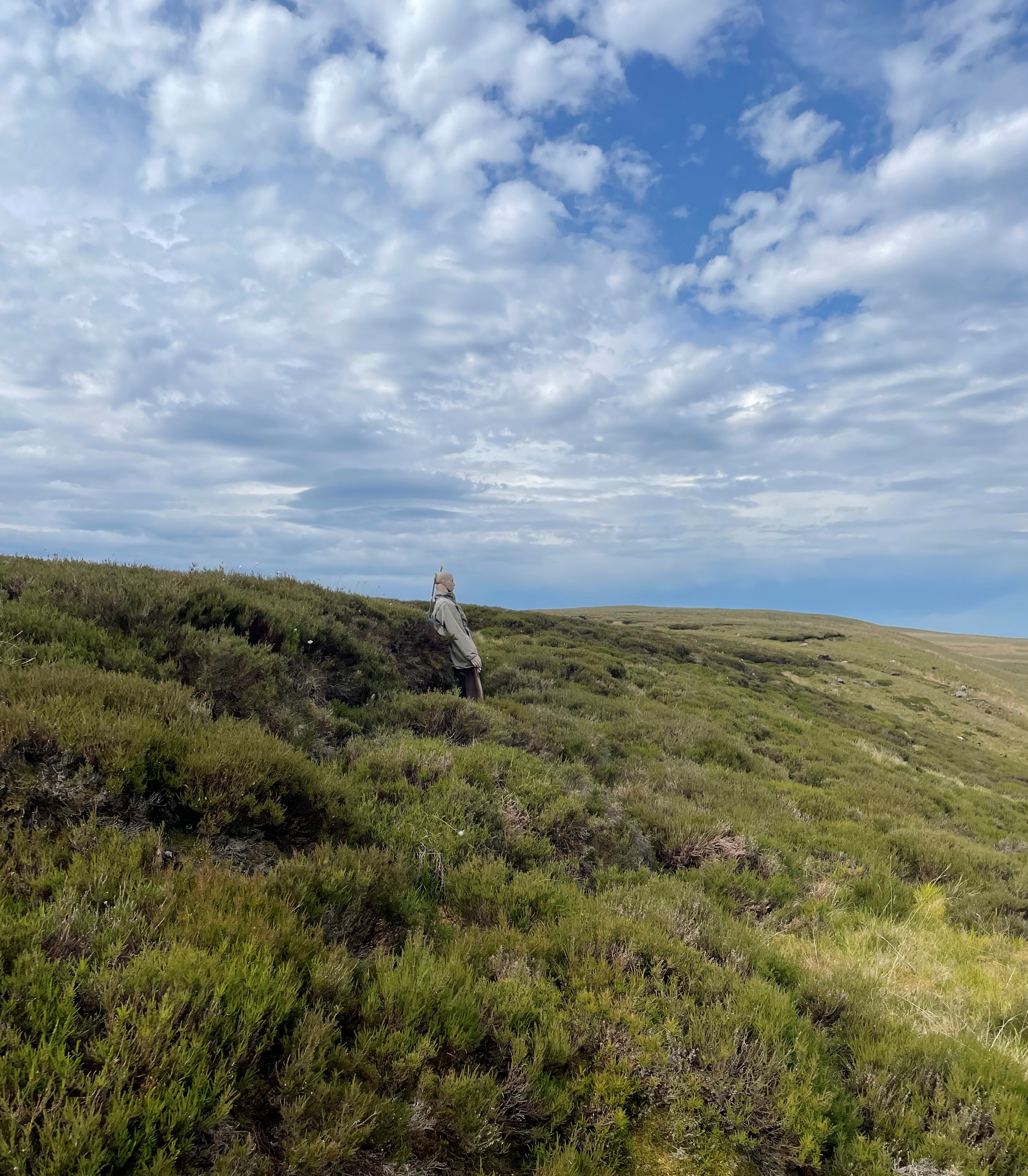
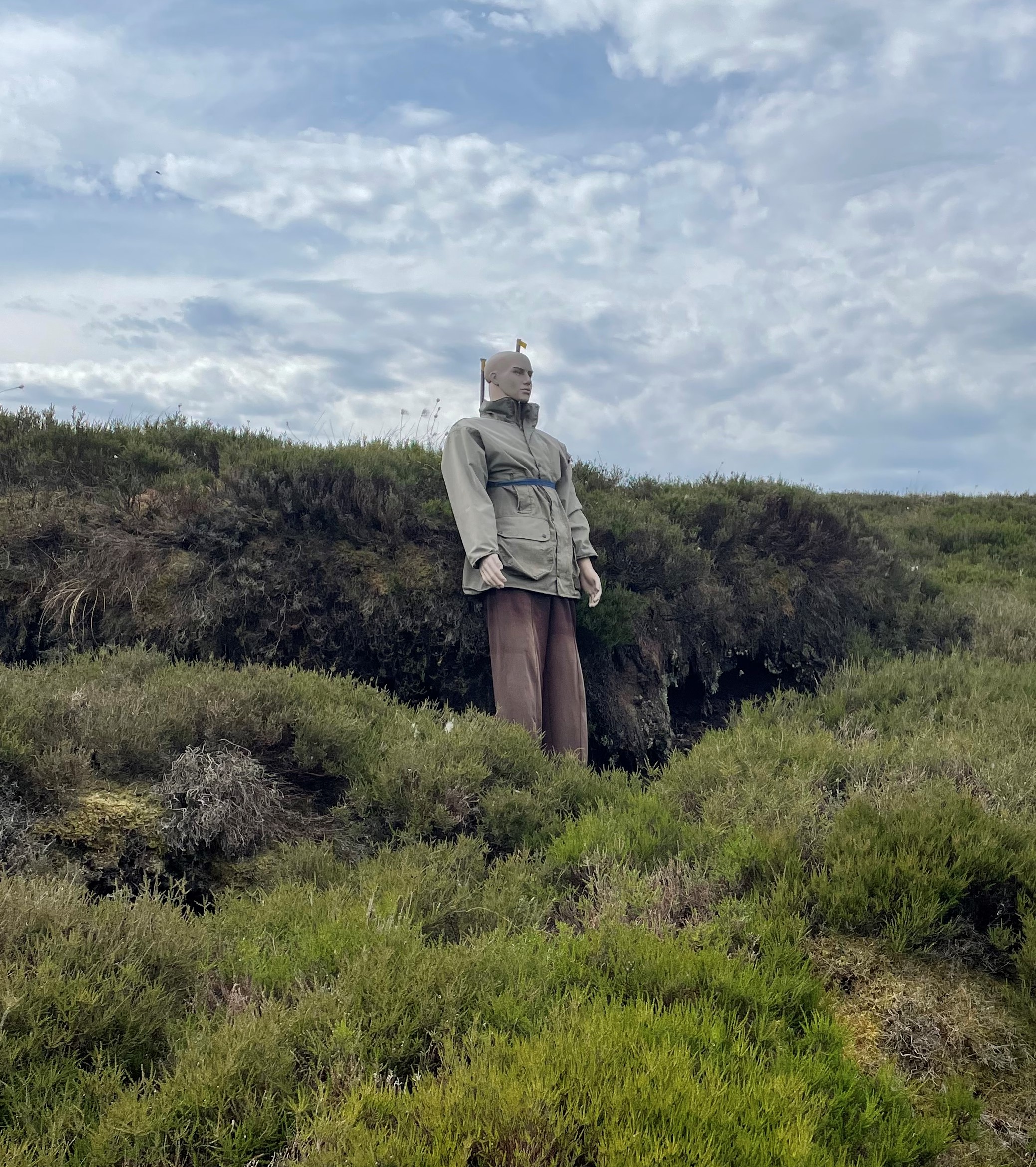
Thanks to the blog reader who sent in photos of another mannequin (hen harrier scarer), this time on a grouse moor in the North Pennines Area of Outstanding Natural Beauty (AONB).
Photos taken last Saturday (17th June 2023).
Other mannequins (hen harrier scarers) photographed on grouse moors this year include those seen in the Yorkshire Dales National Park (here and here) and the Peak District National Park (here).
The RSPB has this evening released video footage of an eyewitness’s account of a short-eared owl being shot on the well-known Broomhead Estate in the Peak District National Park last summer.
Screen grab from the RSPB video showing the shot corpse of the short-eared owl.
The eyewitness, who understandably doesn’t want to be identified (probably due to the harassment and intimidation suffered by other eyewitnesses in this region – e.g. see here), watched the owl being shot by an armed man who had arrived on the grouse moor on an all-terrain vehicle, carrying a shotgun and a bag. He shot the owl and shoved its lifeless corpse inside a rabbit hole in an effort to conceal the crime.
Fortunately, this eyewitness was savvy enough to have filmed the event and was able to return to the grouse moor the next day and pinpoint the spot for investigators from the RSPB and South Yorkshire Police.
They retrieved the owl’s corpse and a post-mortem confirmed it had been shot.
A local gamekeeper became the immediate suspect but, as happens so often, there was insufficient evidence to link him conclusively to the crime and so no prosecution could take place. You can read the RSPB’s blog about this case here, including a link to the video.
RPUK map showing location of Broomhead Estate in Peak District National Park
Grouse moors in this part of the Peak District National Park have been at the centre of other police investigations into alleged raptor persecution in recent years, including the suspicious disappearance of a satellite-tagged hen harrier (‘Octavia’) in 2018 (here).
Last year, another satellite-tagged hen harrier (‘Anu’) roosted overnight on a local grouse moor before ‘disappearing’. His tag was found several km away, no longer attached to the harrier and a forensic examination revealed the tag’s harness had been deliberately cut from the bird (here).
Two other hen harriers ‘disappeared’ from their breeding attempts on National Trust-owned grouse moors in the Peak District National Park last year (see here).
I’ve blogged previously about the Broomhead Estate in relation to the apparent mis-use of medicated grit (see here) and the use of gas gun bird scarers (here, here, here and here).
Grouse-shooting butt on Broomhead Estate. Photo: Ruth Tingay
The Scottish Government has finally published its commissioned review on increasing the Scottish SPCA’s investigatory powers to enable the organisation to help tackle wildlife crime, and particularly raptor persecution.
Buzzard killed after eating poisoned rabbit bait. Photo: NIRSG
As a quick recap for new blog readers, the SSPCA’s current powers (under animal welfare legislation) limits their investigations to cases that involve a live animal in distress (including some wildlife crimes). The proposed new powers would allow them to also investigate wildlife crimes under the Wildlife & Countryside Act legislation, e.g. where the victim is already dead, and also incidents where a victim may not be present (e.g. if an illegally-set pole trap or a poisoned bait was discovered). See here for further detail.
The review taskforce, launched in July 2022 and chaired by Susan Davies FRSB, was established after 11 long years of political can-kicking on this issue by the SNP, only because the Scottish Greens insisted on its inclusion in the historic Bute House Agreement, the power-sharing policy document published by the two parties in 2021.
The 13-page published review, which was submitted to the Scottish Government in October last year, can be read/downloaded here:
I haven’t read the review in detail yet but the main recommendation is that the Scottish SPCA NOT be given increased powers due to the lack of support for this provision from Police Scotland, the Crown Office and the National Wildlife Crime Unit (NWCU).
I’ll comment on that when the Scottish Government has published its own response to the review, which it previously said (here) would be published at the same time as the review was published, but I haven’t seen the Government’s response yet.
I think it’s prudent to wait to see the Government’s response before making any comment, although I’ve previously been critical of the apparent bias in favour of game-shooting industry organisations being invited to contribute to the review (all of whom are opposed to increased powers for the SSPCA), whereas opportunities for conservation organisations were apparently limited (see here and here).
Increased powers for the SSPCA is due to be debated at Stage 2 of the Wildlife & Muirburn (Scotland) Bill in the autumn, so this is far from over.
This issue has now been running for the last 12 years – here is the timeline of this sorry saga:
February 2011: Increased powers for the SSPCA was first suggested by MSP Peter Peacock as an amendment during the Wildlife & Natural Environment (Scotland) Bill debates. The then Environment Minister Roseanna Cunningham rejected it as an amendment but suggested a public consultation was in order.
September 2011: Seven months later Elaine Murray MSP (Scottish Labour) lodged a parliamentary motion that further powers for the SSPCA should be considered.
November 2011: Elaine Murray MSP (Scottish Labour) formalised the question in a P&Q session and the next Environment Minister, Stewart Stevenson MSP, then promised that the consultation would happen ‘in the first half of 2012’.
September 2012: Nine months later and nothing had happened so I asked Paul Wheelhouse MSP, as the new Environment Minister, when the consultation would take place. The response, in October 2012, was:
“The consultation has been delayed by resource pressures but will be brought forward in the near future”.
July 2013: Ten months later and still no sign so I asked the Environment Minister (still Paul Wheelhouse) again. In August 2013, this was the response:
“We regret that resource pressures did further delay the public consultation on the extension of SSPCA powers. However, I can confirm that the consultation document will be published later this year”.
September 2013: At a meeting of the PAW Executive Group, Minister Wheelhouse said this:
“The consultation on new powers for the SSPCA will be published in October 2013“.
January 2014: In response to one of this blog’s readers who wrote to the Minister (still Paul Wheelhouse) to ask why the consultation had not yet been published:
“We very much regret that resource pressures have caused further delays to the consultation to gain views on the extension of SSPCA powers. It will be published in the near future“.
31 March 2014: Public consultation launched.
1 September 2014: Consultation closed.
26 October 2014: I published my analysis of the consultation responses here.
22 January 2015: Analysis of consultation responses published by Scottish Government. 233 responses (although 7,256 responses if online petition included – see here).
I was told a decision would come from the new Environment Minister, Dr Aileen McLeod MSP, “in due course”.
1 September 2015: One year after the consultation closed and still nothing.
25 February 2016: In response to a question posed by the Rural Affairs, Climate Change & Environment Committee, Environment Minister Dr Aileen McLeod said: “I have some further matters to clarify with the SSPCA, however I do hope to be able to report on the Scottish Government’s position on this issue shortly“.
May 2016: Dr Aileen McLeod fails to get re-elected and loses her position as Environment Minister. Roseanna Cunningham is promoted to a newly-created position of Cabinet Secretary for the Environment.
12 May 2016: Mark Ruskell MSP (Scottish Greens) submits the following Parliamentary question:
Question S5W-00030 – To ask the Scottish Government when it will announce its decision regarding extending the powers of the Scottish SPCA to tackle wildlife crime.
26 May 2016: Cabinet Secretary Roseanna Cunningham responds with this:
A decision on whether to extend the investigatory powers of the Scottish SPCA will be announced in due course.
1 September 2016: Two years after the consultation closed and still nothing.
9 January 2017: Mark Ruskell MSP (Scottish Greens) submits the following Parliamentary question:
Question S5W-05982 – To ask the Scottish Government by what date it will publish its response to the consultation on the extension of wildlife crime investigative powers for inspectors in the Scottish SPCA.
17 January 2017: Cabinet Secretary Roseanna Cunningham responds:
A decision on whether to extend the investigatory powers of the Scottish Society for the Prevention of Cruelty to Animals will be announced in the first half of 2017.
31 May 2017: Cabinet Secretary Roseanna Cunningham rejects an extension of powers for the SSPCA ‘based on legal advice’ and instead announces, as an alternative, a pilot scheme of Special Constables for the Cairngorms National Park (here). It later emerged in 2018 that this pilot scheme was also an alternative to the Government’s 2016 manifesto pledge to establish a Wildlife Crime Investigation Unit as part of Police Scotland – a pledge on which it had now reneged (see here).
November 2019: The pilot scheme of Special Constables in the Cairngorms National Park was an absolute failure as a grand total of zero wildlife crimes were recorded by the Special Constables but plenty were reported by others (see here).
June 2020: Mark Ruskell (Scottish Greens) proposed further powers for the SSPCA at Stage 2 of the Animals and Wildlife Bill. The latest Environment Minister, Mairi Gougeon persuaded him to withdraw the proposed amendment on the basis that she’d consider establishing a taskforce to convene ‘this summer’ to consider increased powers (see here).
December 2020: Mark Ruskell (Scottish Greens) submits two Parliamentary questions asking about the status of the taskforce and who is serving on it (see here).
January 2021: New Environment Minister Ben Macpherson says the taskforce has not yet been appointed but that it is “expected to be established later this year“ (see here).
September 2021: In the 2021 to 2022 Programme for Government it was announced that the ‘independent taskforce [Ed: still to be appointed] will report before the end of 2022’ (see here).
May 3 2022: In an interview with Max Wiszniewski of the REVIVE coalition for grouse moor reform, new Environment Minister Mairi McAllan said: “It’s imminent and I wish I could tell you today but we are just finalising the last few points for the membership but I’m hoping to be able to make an announcement about that in the next few weeks“ (see here).
1 July 2022: Scottish Government announces Susan Davies has been appointed to lead the taskforce review and will ‘publish a report later this year’ (see here).
27December 2022: A Scottish Government spokesperson tells Scotsman journalist the taskforce has completed its review and its findings will be published ‘within weeks’ (see here).
31 January 2023: An FoI response from the Scottish Government to this blog’s author reveals the Taskforce’s review was submitted to the Scottish Government on 22nd October 2022 and will be published ‘prior to summer 2023’.
1 February 2023: Wildlife crime: key conservation organisations ‘excluded’ from Scottish Government’s review on increasing SSPCA powers (here).
7 February 2023: Scottish Government tells journalist from The Scotsman that it will provide a response at the same time the Taskforce review on SSPCA powers is published (here).
7 March 2023: More detail provided on why key conservation organisations were excluded from Scottish Government’s review on increasing SSPCA powers (here).
21 June 2023: Scottish Government publishes its commissioned review on SSPCA powers.
UPDATE 27th June 2023: New investigatory powers for SSPCA proposed by Scottish Government (here)
As many of you know, the Scottish Parliament’s Rural Affairs & Islands Committee is currently taking evidence from stakeholders as part of the Committee’s Stage 1 scrutiny of the Wildlife & Muirburn (Scotland) Bill.
For new blog readers, this is the Bill that has been introduced by the Scottish Government in response to the recommendations made in the 2019 Werritty Review and is designed to bring in licensing for grouse moor management and introduce measures to put an end to the illegal killing of birds of prey on grouse moors.
The first evidence session took place on 31st May 2023 and the Committee heard from members of the Scottish Government Bill Team, led by senior civil servant Hugh Dignon.
The second evidence session took place on 14th June 2023 and the Committee heard from members of the Werritty Review Group as well as a range of stakeholders. It was a fascinating session and I’ve quite a lot to say about it but I don’t intend to comment until later.
You can watch the second evidence session on Scottish Parliament TV (archived video here) and you can read the transcript here:
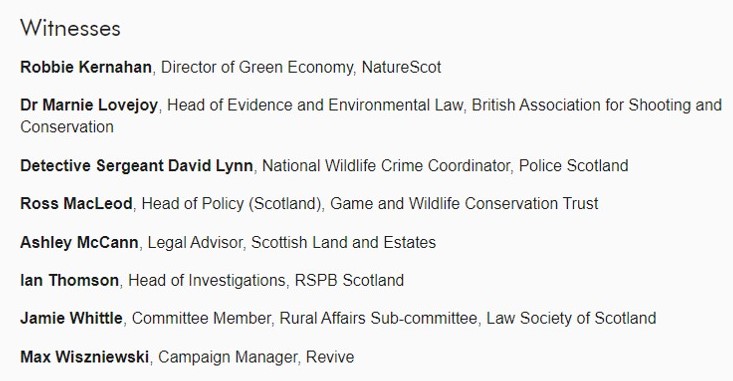
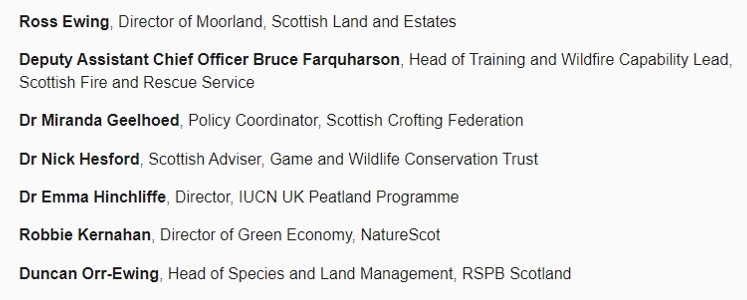
The third evidence session (in a series of four) takes place today, starting at 9am in the Fleming Room at Holyrood. There will be two sub-sessions: the first one on grouse moor licensing and the second one on muirburn. The witnesses giving evidence in these two sub-sessions are as follows:
Grouse moor licensing:
Muirburn:
You can watch live on Scottish Parliament TV (here) or watch the video archive shortly afterwards via the same website. The official transcript will be available several days after the meeting and I’ll post it on this blog when it comes out.
The fourth and final session, scheduled for 28th June, will hear evidence from Mairi Gougeon, the Cabinet Secretary for Rural Affairs, Land Reform and Islands.
I’ve recently been blogging about a number of mannequins (hen harrier scarers) that have been installed on a number of grouse moors in the Yorkshire Dales National Park and the Peak District National Park (here, here and here).
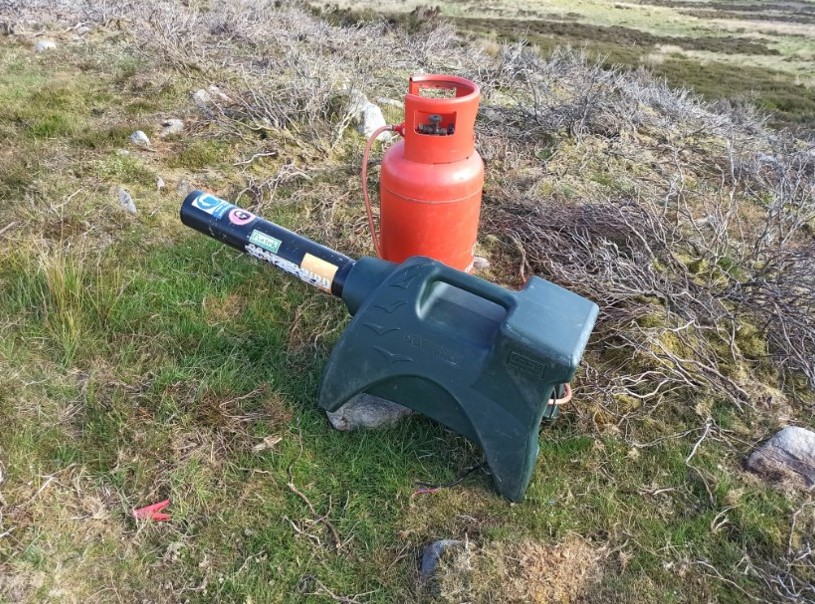
I also wrote about an active gas gun (a bird-scaring device designed to ‘boom’ loudly and intermittently), that had also been placed out on one of those grouse moors (here).
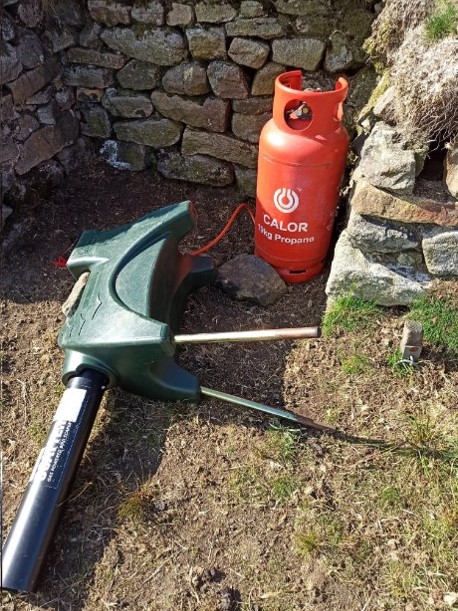
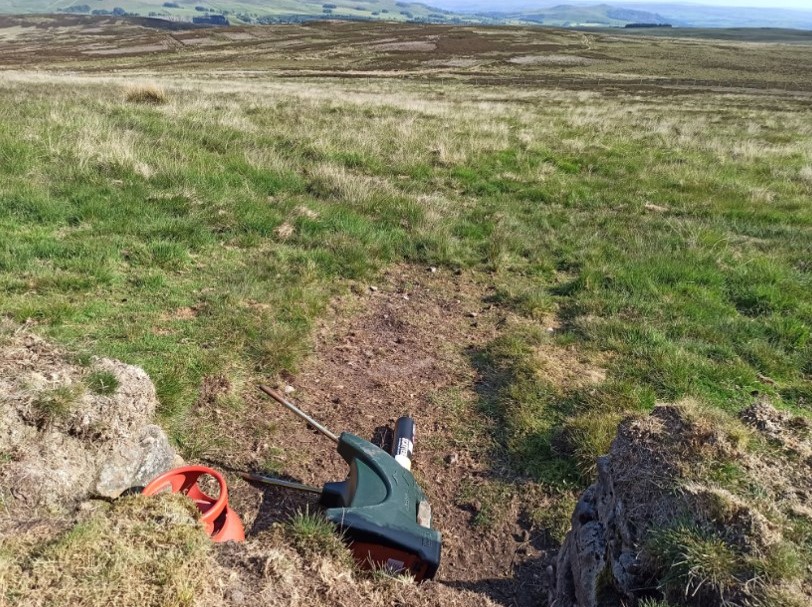
Another blog reader has now been in touch with photographs of two more gas guns that have been positioned on another grouse moor in the Yorkshire Dales National Park, one out in the open and the other one set inside a grouse- shooting butt:
I’ve blogged about the use of gas guns to deter breeding hen harriers many times before, as has Mark Avery, which led to us seeking advice from SNH (now NatureScot) and Natural England for guidance for their use on grouse moors during the breeding season (see here).
The eventual advice from SNH (here) and Natural England (here) was unimpressive to say the least, although it was clear that if Schedule 1 birds (i.e. hen harriers) were present in the area, the user was advised to ‘ensure that gas guns are located so that they do not disturb breeding Schedule 1 birds. This includes all breeding stages from nest building through to young that are still dependant on the adult birds‘.
The difficulties associated with determining sufficient evidence to demonstrate a disturbance offence in this scenario was coherently examined by former Police Wildlife Crime Officer Alan Stewart on his blog (here), at least in terms of wildlife protection legislation in Scotland.
So here we are, seven years later, and this issue is still not resolved.
I’d also like to know how the firing of gas guns, and the installation of mannequins, on grouse moors during the hen harrier breeding season fits in with DEFRA’s ludicrous Hen Harrier Action Plan (and the associated hen harrier brood meddling trial), where we’re supposed to believe that grouse moor owners and their gamekeepers are all welcoming breeding hen harriers with open arms.
Incidentally, the gas guns photographed earlier this month on a grouse moor in the Yorkshire Dales National Park (see above) just happen to be on the same grouse moor that was at at the centre of a police investigation in 2017 into the suspicious disappearance of a satellite-tagged hen harrier and another police investigation in 2020 into the alleged shooting of another hen harrier. Imagine that.
Last month I blogged about a number of mannequins (hen harrier scarers) that had been photographed on two separate grouse moors in the Yorkshire Dales National Park this year (see here and here).
Another blog reader (who wishes to remain anonymous) has sent in a photograph of another mannequin that’s been installed on another grouse moor, this time in the Peak District National Park:
A few people have commented on the purpose of these mannequins, rejecting the hypothesis that they’ve been installed to deter breeding hen harriers, even though one mannequin just happened to have been installed on the very hill slope where hen harriers had been prospecting just a few weeks prior to the installation of that particular mannequin. Coincidence? Perhaps, but I’m unconvinced given the grouse shooting industry’s continued intolerance of this species.
It’s been argued that the mannequins in the Yorkshire Dales National Park have been installed to deter ‘seagulls’ [sic] and someone suggested to me that this latest one in the Peak District National Park has been put there to deter ravens.
Maybe. But the point is, the deterrent effect is indiscriminate. Even if they have been installed to deter another species, a prospecting hen harrier is still going to take one look and move on. Job done.
Incidentally, that mannequin in the Yorkshire Dales National Park that suddenly appeared on the very slope where hen harriers had been nest prospecting – guess what? Two hen harrier nests close by have both failed, with the reported ‘disappearance’ of one of the males. Imagine that.
UPDATE 19th June 2013: More gas guns positioned on another grouse moor in Yorkshire Dales National Park (here)
ENDING USE OF SECOND-GENERATION ANTICOAGULANT RODENTICIDES BROMADIOLONE AND DIFENACOUM AWAY FROM BUILDINGS
Legal authorisation is being withdrawn for open area and waste dump use for the only two second generation anticoagulant rodenticides (SGARs) currently allowed to be used that way, bromadiolone and difenacoum. This will take effect in July next year.
The change was instigated voluntarily by the Campaign for Responsible Rodenticide Use UK, with support to make the necessary amendments from UK biocides regulator, the Health and Safety Executive (HSE). CRRU Chairman Dr Alan Buckle states that the change was a unanimous decision by all CRRU Directors to help meet rodenticide stewardship’s environmental targets.
“A primary factor leading to this is the stubbornly static incidence of rodenticide residues in around 80 per cent of barn owls, the HSE-nominated sentinel species for annual surveillance,” he explains. “This change will enable a single clear message about SGAR use: None of these products can be applied away from buildings.”
Sales of products containing bromadiolone and difenacoum for use in open areas and at waste dumps will cease on 4 July 2024. These products purchased on or before that date will be authorised for use in open areas and waste dumps until 31 December 2024. After that, it will be illegal to use any SGAR product to treat a rodent infestation not associated with a building.
Manufacturers will change product label instructions accordingly and will continue to promote the application of integrated pest management practices among all rodenticide users. The CRRU Code of Best Practice offers a range of effective methods for rodent management away from buildings, including elimination of harbourage, food and water; lethal non-anticoagulant baits; and trapping, shooting and dogs.
At the beginning of the UK Rodenticide Stewardship Regime the CRRU UK Board of Directors decided that manufacturers would not apply for authorisations for products containing the active substances brodifacoum, difethialone and flocoumafen to be used in ‘open areas’ and at ‘waste dumps’. This was because it considered that these high-potency anticoagulants were most likely to result in risk to wildlife when used in these scenarios. The CRRU board has now unanimously decided to extend this policy to products containing bromadiolone and difenacoum, thereby applying a consistent approach to all second-generation anticoagulant rodenticides (SGARs).
There are two reasons for this. The first is that the previously excluded SGARs bromadiolone and difenacoum contribute significantly to the total burden of SGAR residues found in UK wildlife, and at the initiation of the regime it was a critical requirement set upon CRRU UK by the regulatory agency, the Health and Safety Executive (HSE), to reduce all SGAR residues in wildlife. The second reason is that there has been a recent and sudden increase in exposure of wildlife to products containing brodifacoum. It is considered that such an apparently recent and widespread increase can only be explained by use of this substance, contrary to label instructions, in the open countryside.
The new CRRU policy will permit a clear message to be put out to all UK SGAR users: none of them can be used anywhere away from buildings and such use is illegal and may be subject to prosecution.
The CRRU Board took this decision after carefully considering the availability of alternatives and finding that options exist for those needing to control rodents in open areas and at waste dumps. These include chemical and non-chemical methods, as well as lethal and non-lethal techniques, so that unavailability of SGARs for use away from buildings need not be detrimental either to human and animal health or the rural economy.
Natural Resources Wales (NRW), the Welsh Government’s statutory conservation agency, is running a public consultation on proposed new regulations for the release of non-native gamebirds (red-legged partridge and pheasants) in to the countryside.
The public consultation closes on Tuesday (20th June 2023) and anyone can contribute their view, you don’t have to live in Wales to participate.
The game shooting industry has reacted with typical hysteria, claiming that licensing regulations would threaten the rural economy and bring an end to gamebird shooting. Let’s just be clear – it won’t. What licensing will do (if it’s properly monitored and sanctions enforced), is begin to regulate the behaviour of the shooting industry that has, for so many years, been allowed to do what it likes, releasing significant numbers of non-native species into the countryside without giving any consideration to the environmental impact of such releases.
The unregulated release of non-native gamebirds in the UK countryside has gone on for far too long. Photo: Ruth Tingay
The conservation campaign group Wild Justice, who for the last few years has been at the forefront of challenging the unregulated release of millions of gamebirds in to the UK countryside, has provided a useful set of proposed responses to this consultation and is urging everyone to submit a response before the consultation closes on Tuesday.
You can either copy and paste Wild Justice’s proposed responses, or, preferably, use them to craft your own personalised response.
You can find all the information on Wild Justice’s blog here.










 Raptor Persecution UK